
Kent County Jail
How do you find someone who has been arrested in Kent County?
The Kent County Jail is CLOSED. Offenders arrested for misdemeanors and felonies in this county are brought to either the Dickens County Jail or the Garza County Jail for booking and processing, and if their crime requires it, are incarcerated until they either get bail or are released from custody on their own recognizance.
Those who are found guilty and sentenced to a term of less than one year, will do their time in either Dickens or Garza County. Those sentenced to longer terms will be sent to either the Texas State Prison System or the Federal Bureau of Prisons.
- Review the Jail Roster, or
- Call the Kent County Jail at 806-237-3801
- Look up the offender's criminal charges
- Find out their bond, and
- View their public mugshot in the roster.
If you cannot find the mugshot of the offender that has been arrested, it is because Kent County or the state of Texas has recently changed their policy regarding publicly posting them in the jail roster. However, you can write the jail at the following address and request a copy of an inmate's mugshot be mailed or sent by email to you. Make sure to include your email address in all correspondence.
Mail to:
Kent County Jail
227 S. Main Street
Jayton, TX 79528
Attention: Media Relations - Inmate Mugshot Request
Mail, click on the link below, or call the facility at 806-237-3801 for the information you are looking for.
Kent County Jail Inmate Search
How do I find out if someone was arrested in Kent County?
There are five ways to find out if someone was arrested in Kent County:
1. Look them up on the official jail inmate roster.
2. Look them up on vinelink.com, a national inmate tracking resource.
3. Call the jail at 806-237-3801. This is available 24 hours a day.
4. Write or visit the jail and request information.
You can reach them at:
Kent County Jail
227 S. Main Street
Jayton, TX 79528
5. Do a search online using this person’s name, the town or city you think they were arrested in, and the crime you think they were arrested for. Sometimes the local newspaper, police department or sheriff’s office will have a daily police blotter published on their website.
What information is included in jail booking records and the jail roster?
Jail booking records, also known as the jail roster, typically include the following information:
• Full name of the inmate
• Inmate's physical characteristics (age, sex, height, weight, etc.)
• Inmate’s mugshot(s)
• Booking number, Inmate ID#, Jacket #, etc.
• Booking date and time
• Charges or offense details – the applicable statute
• Bond or bail amount, if applicable
• Court date, if set, plus the court name and location
• Previous arrests in this jurisdiction, conviction details, and sentence
- Note that not all this information will be included. Most booking records and jail inmate rosters contain only the basic information such as name, date of arrest and the criminal charge.
- The amount and quality of the information depends on the state’s laws and the jail’s policies.
How often are jail booking records and rosters updated?
Most jails update their records at least once per day. Some booking information is updated as often as every 15 minutes in the roster. From the time a person is first arrested until when they are booked in the jail, it can be as short as a couple of hours, up to 24 hours, or even longer if they were arrested during a major event such as a protest or riot in which hundreds of people were arrested at the same time.
How do I find an inmate in the Kent County Jail?
There are seven ways to find an inmate in Kent County or the Kent County Jail:
1. Look them up on the official jail inmate roster.
2. Look them up on vinelink.com, a national inmate tracking resource.
3. Call the jail at 806-237-3801. This is available 24 hours a day.
4. Call local police departments in Kent County. Sometimes the local jails will hold recent arrestees for up to 72 hours before transporting them the Kent County Jail.
5. Check with the jails in neighboring counties and look up their rosters. It is always possible they were arrested there instead of Kent County.
6. Write or visit the jail and request information.
Kent County Jail
227 S. Main Street
Jayton, TX 79528
7. Do a search online using this person’s name, the town or city you think they were arrested in, and the crime you think they were arrested for. Sometimes the local newspaper, police department or sheriff’s office will have a daily police blotter published on their website as well.
How do I find an inmate in a Texas state prison?
You can find an inmate in the Texas Department of Corrections by searching for them on the State Prison Locator, Vinelink.com (a nationwide inmate locator resource), or by calling the Department of Corrections.
How do I find an inmate in federal prison?
- The United States Bureau of Prisons maintains an up-to-date inmate locator where you can look up any inmate that has been in federal prison from 1982 to the present day.
- If they are currently in custody, you can see what institution they are in.
- If they are in transport, meaning they are being shuttled from one prison to another, that information will not be available. If they are no longer in custody, it will list their discharge date.
- Other information provided is their BOP Registry Number (inmate ID#), their race, age and release date.
- If they are in custody, there are links to how to visit them, send them money, communicating with them and sending the prison a concern you may have about them.
How do I find a detainee in an ICE facility?
- The US Immigration and Custom’s Enforcement maintains an up-to-date online detainee locator of all foreign detainees aged 18 and older that are in the custody of ICE.
- When searching by name, a detainee's first and last names are required and must be an exact match. When inputting a hyphenated last name into the Online Detainee Locator System, include the hyphen for the locator to find the individual (e.g., Doe-Smith).
- You can also search by using an A-number (Alien Registration Number) if you have it at the same link. The A-Number must be exactly nine digits long. If the A-Number has fewer than nine digits, add zeros at the beginning.
- You are also required to select the detainee's correct Country of Birth from the drop-down menu provided on the page.
NOTE: If an alien is arrested for a state crime, you will still be able to locate them in the police jail or the county jail where they were arrested. If it was a misdemeanor crime, they would do their time in the Kent County Jail or the county jail where they were arrested and convicted.
If they were convicted of a Texas state felony and sent to state prison, and not deported, then you can locate them in the Texas state prison system.
How do I find an inmate in juvenile detention?
In the United States, a juvenile is a person under the age of 18. If a juvenile is arrested for a crime, it is unlikely that their name will be publicly listed on an inmate search page or detention center roster, or will be released to the public. Only the juvenile’s parents or legal guardians will be given that information.
If the crime is a serious felony such as Capital Murder, some states will release their name to the public, either when they are first arrested or after they are convicted. However, in general, it is unlikely that an inmate who is a juvenile will have their name released in any public way.
How can I see if someone is in jail or prison in Kent County or the state of Texas?
For online searches, if you want to see if someone is in jail in Kent County.
If you want a list of all the other county jail inmate searches in Texas.
If you want a list of all the county jails in the United States.
If you want to look up an inmate in any of the Texas state prisons. To look up the prisons in Texas.
How do I get information on someone in jail in Kent County?
If you want detailed information on a particular inmate in in jail in Kent County, and you can’t find it online in the jail inmate roster, your only other option is to either call the jail at 806-237-3801, go to the jail in person and ask, or write them at:
Kent County Jail
227 S. Main Street
Jayton, TX 79528
That said, most jails will limit the amount of information that they give to the public about an inmate in their roster because the offender is considered innocent until proven guilty, and thus is afforded a certain amount of privacy.
Once an offender is convicted, you are far more likely to find out information about them.
If you are good at using Google, you can dig into a person’s past and learn as much information about anyone as someone in the media can.
You can also search a website that has all the public records about people. One of the best online websites we found will cost you only $1.00.
Who can I call to find an inmate in Kent County?
To find an inmate in custody or ask about their roster in Kent County call 806-237-3801 24 hours a day.
Does the jail or prison have to keep the inmate in the county or state where they are charged or convicted?
No. Even though 99.9% of all pre-trial and convicted inmates are kept in the state where they were arrested and/or convicted, they can be kept in any US jail or prison that will have them. This is seen in circumstances where a jurisdiction is overcrowded, or an inmate is moved for their safety. That said, a person must stand trial where they were arrested unless the presiding judge or prosecuting attorney agrees to move the offender’s trial to a different jurisdiction if it is likely they will not get a fair trial.
What if I can’t find an inmate and I know they are in custody in Kent County?
If you know an inmate is in custody in Kent County, and you can’t find them, it can mean one of several things:
1. Either you or the jail has the spelling of the inmate’s name inputted incorrectly.
2. The jail has not yet updated their booking information or roster.
3. The inmate has already been released.
4. The inmate has either been arrested or is being housed in another jail.
5. The inmate is underage; therefore, it is illegal to post their information, or the inmate you are trying to find had their age incorrectly listed as someone under age 18.
I know the person was arrested and in jail, but my search in the roster comes back as “no record found.” What happened?
Same answer as that above. If you know an inmate is in custody in Kent County, but your search comes back in the roster as “no record found.”, it can mean one of several things:
1. Either you or the jail has the spelling of the inmate’s name wrong.
2. The jail has not yet updated their booking information or roster.
3. The inmate has already been released.
4. The inmate has either been arrested or is being housed in another jail.
5. The inmate is underage; therefore it is illegal to post their information, or the inmate you are trying to find had their age incorrectly listed as someone under age 18.
I was released from jail in Kent County, but my record still shows. When will it go away?
If your record of arrest and booking is still showing online, even though you were released, it is because some jails allow that information to remain public indefinitely. Unfortunately, even though the charges against you may have been dropped, many jails will not erase that information from their public records voluntarily.
In a situation like this your only option will be to get an attorney and request they petition the court to force the jail to remove this information. That said, if you were in fact found guilty of the crime you were arrested for, it is unlikely they will remove the information surrounding your arrest and conviction.
An inmate’s family member just died; how can I let them know right away?
The death of a family member is one of the few times, if not the only time, that a jail will take a message for an inmate. Because of the sensitivity of the tragic news, when a family member has died, the news will be transmitted by a member of the clergy, a counselor or someone who is very high ranking within the jail.
Jail management understands that a sudden death of a loved one could cause a violent emotional response that jeopardizes the safety of staff or other inmates.
An inmate’s family member just died; will they be allowed to attend the funeral?
The death of a family member is one of the few times, if not the only time, that a jail will allow an inmate, whether it pre-trial or post-conviction, to be allowed outside of the jail. Even if they are allowed outside the jail, they will have to have at least two armed escorts. An inmate attending a funeral is an extraordinary cost, use of staff and potential danger to the public. That is why it is rarely allowed.
This is not always the case though, and whether an inmate can attend a funeral depends on the inmate’s security classification, whether the jail has the staff to handle it, official jail policy, whether or not the inmate has an attorney that can push the right people, including the judge overseeing the inmate’s case, etc.
What determines whether an inmate is placed in low or high security facilities?
An inmate’s security classification depends on the following:
1. The inmate’s current crime.
2. The inmate previous crimes.
3. The inmate’s history for violence within the walls of the facility.
4. The inmate’s gang affiliation.
5. The jail's current distribution of inmates.
What information is available about an inmate?
The information that a jail or court releases publicly about an inmate depends on the laws in the state, the policy of the jail, and the sheriff’s or warden’s individual decision.
Jail booking records and rosters can include more or less, the following information:
• Full name of the inmate
• Inmate's physical characteristics (age, sex, height, weight, etc.)
• Inmate’s mugshot(s)
• Booking number, Inmate ID#, Jacket #, etc.
• Booking date and time
• Charges or offense details – the applicable statute
• Bond or bail amount, if applicable
• Court date, if set, plus the court name and location
• Previous arrests in this jurisdiction, conviction details, and sentence
What is vinelink.com?
Vinelink, which you will see referenced when discussing public information about offenders and inmates, is a national public roster that both allows the public to look up and see the person’s status, plus be able to track their movements, whether it involves being transferred from one facility to another or being released from custody.
The tracking feature is especially helpful for those who are victims of, or witnesses to, a crime and fear that the release of an offender may be dangerous to them or someone close to them.
Anyone can register with Vine to receive automated notifications via email, text or phone. It is available in 48 states and 2,900 jails and prisons.
Here is a short video explaining why it started and how it works.
How do I find old Kent County jail and inmate records from years ago?
To find jail records that go back many years really depends on how far you want to go back, however you would need to send a written request to the county sheriff as follows:
Kent County Sheriff
Att: Jail Records
227 S. Main Street
Jayton, TX 79528
Let them know the inmate’s name, any aliases, date of birth, the date range that the inmate may have been incarcerated, the crime they were charged with/convicted of, and any other helpful information you can think of.
How can I have my jail record sealed?
To have your jail records sealed, you will have to have the crime you were convicted of expunged. You should know up front that not all crimes are eligible for expungement.
1. Hire a lawyer that specializes in expungement.
2. If your crime is eligible, they will contact the District Attorney's office in the judicial district where you were charged or convicted.
3. They will file a petition with the court where you were charged or convicted.
4. The entire process may take 1-2 years.
Where can I get Prison records from the state of Texas?
To get prison records from the state of Texas, you will need to send a written request to the state prison system in Texas.
Let them know the inmate’s name, any aliases, date of birth, the date range that the inmate may have been incarcerated, the crime they were charged with/convicted of, the name of the facility you believe they were incarcerated in, plus any other helpful information you can think of.
For inmate services and facility information such as:
- Directions
- Booking Process
- Visiting an Inmate
- Sending Money
- Mailing
- Emailing or Texting
- Receiving phone calls
- Bail Bond Information
- Court Information
Click the links above, or the button below.
Kent County Bail: How Release Works
No jail operates in Kent County, so every adult a deputy arrests rides out of the county to be booked. The usual stops are the Garza County Jail, 412 East 15th Street, Post, TX 79356, and the Dickens County Jail, which you reach through the Dickens Sheriff's Office at 201 US-82, Dickens, TX 79229. Below, bail is traced from the magistrate's ruling to the refund.
The state's Texas IVSS-Counties lookup is free and finds people held in Texas county jails by name. JE pairs it with the official jail search chosen for this county. For new bookings, open warrants, charges, mugshots, property pickup and public defenders, open our Recent Arrests page.
Phone the Sheriff's Office in Jayton at 806-237-3801 before anything else. Find out which jail has your person, whether bail is set yet and the figure on each charge. When the bond is handled, see our court page for each step of the case.
1. Who decides bail once Kent County deputies arrest someone?
A magistrate makes that call. The written lawyer plan this county shares with three neighbors repeats the state rule: the person goes before a magistrate with no needless delay, inside 48 hours of the arrest (CCP 15.17). Magistrate duty can fall to the County Judge, a district judge or the local justice of the peace (CCP 2A.151).
During the hearing, which is short, the magistrate:
- states the charge and spells out two rights: silence and a lawyer;
- offers a county-paid lawyer and helps fill in the request;
- sets a bail figure and release terms, using the lightest rules that still bring the person back and keep people safe (CCP 17.028).
On Class B cases and above, a report on the person's record must reach the magistrate first. That report holds no score and no suggested amount (CCP 17.021, 17.022). Ask the Sheriff's Office, 227 S. Main Street, Jayton, TX 79528, at 806-237-3801 for the hearing time and place.
↑ Back to the question list2. What sorts of bond can a magistrate grant?
Under CCP 17.01, bail comes in two forms, a bail bond or a personal bond. For a family, that becomes three paths:
- Cash. The whole figure, paid in U.S. currency, is held by the court and refunded later, less any fee (CCP 17.02).
- Surety. A bondsman, or another qualified backer, guarantees the full figure. The backer charges you for this.
- Personal bond. Release on a signed pledge, with no money paid at the start (CCP 17.03).
Certain charges shut out the personal bond: offenses the statute lists as violent, terroristic threat at Class A or higher, some protective-order breaches and gun possession by a felon. Charges of burglary, organized crime or certain drug felonies work another way: only the trial court may say yes to one. On a repeat DWI, an ignition interlock in the car becomes a bond rule (CCP 17.441).
Families who want the full statewide picture can open our Texas bail laws page for more.
↑ Back to the question list3. How is the bail figure chosen?
No two cases get the same figure, because the magistrate weighs facts about this person and this charge. State law (CCP 17.15) points to:
- a figure big enough that skipping court would cost real money;
- a sum that is never used as a weapon against them;
- the nature of the charge, and any injury or threat to someone;
- how much the person can honestly pay;
- danger to the victim, to police or to the community;
- the person's record, any other open cases and citizenship status.
Two dollar caps appear in the statute. They matter after an arrest with no warrant, if a probable-cause ruling comes too late. Then a misdemeanor arrestee must walk out by hour 24, with bail of $5,000 at most. A felony arrestee must walk out by hour 48, with bail of $10,000 at most (CCP 17.033). The state court system's bail information pages explain the forms magistrates fill out. Get the actual figure from the Sheriff's Office at 806-237-3801.
↑ Back to the question list4. How is bond posted when the jail is in another county?
Plan on dealing with the jail where the person was booked. In order:
- Ring the Sheriff's Office, 227 S. Main Street, Jayton, TX 79528, at 806-237-3801. Ask which jail took the person and the bail on each count.
- For the Garza County Jail, housed in the Garza County Law Enforcement Center, 412 East 15th Street, Post, TX 79356, dial the jail desk at 806-990-9974.
- For the Dickens County Jail, dial the Dickens Sheriff's Office, 201 US-82, Dickens, TX 79229, at 806-623-5533.
- Ask that desk when bonds are accepted, which payments work and the exact wording for the money order's payee.
- Arrive with photo ID, the money, the person's full name exactly as written on their ID, plus their birth date. Hold on to the receipt.
5. Will the clerk in Jayton accept a cash bond?
Under state law, cash bail may be deposited with the court's custodian of funds rather than at a jail (CCP 17.02). In this county one office handles both felony and misdemeanor files: the District and County Clerk, Kent County Courthouse, 101 N Main St., Jayton, TX 79528, 806-237-3881. Its mailing address is P.O. Box 9, Jayton, TX 79528.
- Phone ahead to learn if a cash bond on this case can be left with the clerk.
- Ask about office hours and which payments are welcome.
- Ask how word of the deposit reaches the jail, so the release moves fast.
6. Which kinds of money can post a bond?
For a cash bond, Texas law asks for current U.S. currency (CCP 17.02). Each jail and office decides the rest. Before the drive, ask whoever is taking the bond:
- whether money orders, cashier's checks or cards pass;
- what extra charge a card carries;
- how to fill in the payee line.
A bondsman collects the fee directly. Texas law makes the bondsman hand over a receipt whenever cash or property changes hands (Tex. Occ. Code 1704.305). Cash never belongs in an envelope. In Post, the jail desk at 806-990-9974 can answer. In Dickens, try 806-623-5533.
↑ Back to the question list7. How do bondsmen operate in Kent County?
About 674 people lived here in mid-2025, by a Census Bureau estimate. The board requirement starts at a population of 110,000; below that, setting one up is optional (Tex. Occ. Code 1704.002, 1704.051). With no board, sureties may be approved by the sheriff once their backing passes a check (CCP 17.141).
- To learn which sureties are accepted, phone the Sheriff's Office at 806-237-3801 or the jail holding the person.
- No Texas law limits the bondsman's fee. Compare a few, and ask for the terms in writing.
- Bondsmen may not drum up business while inside a jail or police station (Tex. Occ. Code 1704.304).
- Once the final case closes, send the bondsman a letter asking for your collateral. Thirty days is the legal limit for handing it over (Tex. Occ. Code 1704.301).
- Your own defense lawyer is allowed to sign the bond, no license needed (Tex. Occ. Code 1704.163).
8. Why might they stay behind bars after bond?
A bond covers just the charge it was set on, nothing more. Before you pay, have jail staff read out each hold. Common ones:
- Another county's warrant. Local magistrates can take bail on such a warrant and send the bond along to the issuing county (CCP 15.18).
- A parole warrant. Someone on parole who is held for a violation waits in custody for the hearing (Tex. Gov't Code 508.254).
- Family violence. If the magistrate finds the violence is likely to go on, the person stays locked up four extra hours after bond. A written order may stretch the stay by up to 48 hours (CCP 17.291).
- ICE. Texas jails follow an immigration detainer unless the person shows lawful status (CCP 2A.060).
- Probation. Supervision for this county runs out of the Haskell CSCD, 1301 N. First St., Haskell, TX 79521, 940-864-3627. Ask whether a fresh arrest changes the terms.
9. Which cases allow no bail at all?
Texas guarantees bail in most cases. Even so, the Texas Constitution carves out cases where a judge may deny it:
- capital cases with evident proof (art. I, §11);
- repeat felony offenders, and people charged with a felony while on felony bail (art. I, §11a);
- broken safety terms of a bond, or a broken family-violence protective order (art. I, §§11b, 11c).
Proposition 3, passed by voters on November 4, 2025, added art. I, §11d. It covers every type of murder and trafficking. Add to that indecency with a child, plus four aggravated crimes: sexual assault, kidnapping, robbery and some assaults. The prosecutor alone can request it. After a hearing, bail must be denied if prosecutors prove the person would more likely than not flee, or that the person is dangerous, under the higher clear-and-convincing standard. A judge who lets the person out on bail anyway must give written reasons.
For felonies, that request would come from the 39th District Attorney, whose local office is in the Jayton courthouse, 101 N Main St., Jayton, TX 79528, 940-864-2072.
↑ Back to the question list10. What helps win a smaller bail figure?
A defense lawyer asks for it in writing, filed in the court with the case. The family's part:
- Gather pay stubs, a lease or deed, proof that family lives nearby, and a simple budget. The law bans oppressive bail and tells the magistrate to weigh what the person can pay (CCP 17.15).
- Watch the days. If prosecutors are still unready when the deadline passes, the judge must release on personal bond or reduce bail. The windows are 90 days for a felony, 30 for a misdemeanor carrying over 180 days of jail, 15 for a lesser jailable misdemeanor and 5 for a fine-only charge (CCP 17.151). Exceptions exist.
- Expect a reply from the state. A 2025 law gives the prosecutor a route to a district judge's review of any felony bail (CCP 17.029).
The clerk at 806-237-3881 knows which court has the file.
↑ Back to the question list11. Who pays the lawyer for a Kent County defendant?
The county does, when they can't afford one. Ask at the first hearing; the magistrate must help with the form. Haskell, Kent, Stonewall and Throckmorton counties follow one written plan. Under it, the request is passed along within 24 hours. The appointment follows within three working days of its arrival (area lawyer plan).
- Felony requests: the 39th District Judge's office, Haskell County Courthouse, 1 Ave D, Haskell, TX 79521, 940-864-2661.
- Misdemeanor requests: the County Judge, at the courthouse, 101 N Main St., Jayton, TX 79528, 806-237-3373.
- Public defender: for cases it can accept, judges must turn first to the Caprock Regional Public Defender. It is housed at Texas Tech's law school, 3311 18th St., Lubbock, TX 79409, 806-742-4312.
12. Where are the courthouses for Kent County cases?
- Kent County Courthouse, 101 N Main St., Jayton, TX 79528, 806-237-3373. The County Judge presides over the County Court here, which takes Class A and B misdemeanors. Every criminal file, felony or misdemeanor, is kept by the District and County Clerk in the same building, 806-237-3881. That office can also point you to the justice of the peace, who handles Class C tickets.
- 39th District Court, for felonies. One judge covers this county plus Haskell, Stonewall and Throckmorton. The judge's office is in the Haskell County Courthouse, 1 Ave D, Haskell, TX 79521, 940-864-2661.
- Federal court, Lubbock Division, Mahon Federal Building, 1205 Texas Avenue, Room 209, Lubbock, TX 79401, 806-472-1900.
13. When does Kent County bail money come back?
When cash bail is refunded, it goes to the receipt holder. That happens after the case closes, if the person never missed court (CCP 17.02). Guard that slip of paper.
- The clerk may keep up to 5%, never more than $50. That fee applies only after a guilty result or deferred adjudication. The cash may also cover fines and costs (state court guide to money bonds).
- Missing court triggers a forfeiture. The judge has the name called at the courthouse door, then enters judgment against the bond (CCP 22.02).
- The surety's debt ends if police jail the person again in time. For a misdemeanor bond, that window is 180 days. For a felony bond it stretches to 270 (CCP 22.13).
- Failing to appear is a crime too, graded by the original charge. A no-show on a fine-only ticket is a Class C offense. On any other misdemeanor it becomes Class A. On a felony, it is a third-degree felony (Tex. Penal Code 38.10).
Refunds start with a call to the clerk's office at 806-237-3881.
↑ Back to the question list14. Who returns their money and belongings at release?
The booking jail keeps the person's things and any account balance. Call that jail to arrange pickup:
- Garza County Jail, 412 East 15th Street, Post, TX 79356, 806-990-9974
- Dickens County Sheriff's Office, 201 US-82, Dickens, TX 79229, 806-623-5533
A car, phone or other item that deputies held after the arrest is a matter for the Sheriff's Office, 227 S. Main Street, Jayton, TX 79528, 806-237-3801. Have a photo ID with you. Our jail account money page covers how leftover balances are usually paid out.
↑ Back to the question list15. Federal charges: who decides release?
Cases charged by federal prosecutors here go to the Northern District's Lubbock Division, at the Mahon Federal Building, 1205 Texas Avenue, Room 209, Lubbock, TX 79401, 806-472-1900.
- Release or detention is settled by a U.S. magistrate judge after a hearing. No bondsman is involved (18 U.S.C. 3142).
- Until the case ends, U.S. marshals hold the person, often paying a county jail for the bed. Its Lubbock office is at 1205 Texas Avenue, Room C-126, Lubbock, TX 79401, 806-472-7655.
- The Federal Public Defender keeps a Lubbock office at 1205 Texas Avenue, Room 507, Lubbock, TX 79401, 806-472-7236.
- After a federal prison sentence, search the Federal Bureau of Prisons inmate locator.
16. ICE detainer and state bond: does one cancel the other?
No. Bail settles the state charge only, while the ICE hold is a separate federal matter. The steps:
- Step one: ICE, which enforces federal immigration law, asks the Texas jail in writing to hold the person. The form is I-247A.
- The detainer allows a hold of up to 48 hours after they would otherwise be released (8 CFR 287.7(d)).
- A Texas jail is bound to honor the detainer under CCP 2A.060 unless the person proves citizenship or lawful presence. Since 2017, local policies that limit immigration enforcement are banned (Tex. Gov't Code 752.053). Every county that operates a jail now faces a 2025 state law, S.B. 8, demanding that it sign a 287(g) agreement with ICE. The deadline is December 1, 2026.
- Magistrates appointed under Gov't Code chapter 54 cannot grant bail to a person with a detainer (CCP 17.027).
- ICE officers collect the person. This region falls under the Dallas Field Office, 8101 N. Stemmons Freeway, Dallas, TX 75247, 972-367-2200.
- Look the person up on the ICE Online Detainee Locator with their name and country of birth.
17. Where does TDCJ send a long sentence?
A state jail term, the lowest felony level, has a floor of 180 days and a ceiling of two years. Felonies of the third degree or worse mean TDCJ prison (Tex. Penal Code ch. 12). The person waits at the contract jail for a TDCJ transfer, then goes through intake, where staff choose a unit that fits.
- Read unit profiles on our Texas state prisons page.
- Find someone through the TDCJ inmate search with a last name and first initial, or a TDCJ number. It is updated each working day.
18. What if the arrested child is not yet 17?
Texas juvenile court hears cases of kids who were at least 10 and still under 17 when the offense took place. Charges against a 17-year-old start out in the adult system (Tex. Fam. Code 51.02). A youth goes to a juvenile office rather than the adult jail, and a parent must be told (Tex. Fam. Code 52.02).
- Under the area's juvenile board plan, a child may stay in a processing office six hours at most.
- A detention hearing follows fast, no later than the second working day. When the pickup happens on a Friday or Saturday, the hearing lands on the first working day. A lawyer gets appointed ahead of it (Tex. Fam. Code 54.01).
- The juvenile judge decides on release. No bail schedule applies.
The Sheriff's Office at 806-237-3801 can say where a child was taken.
↑ Back to the question listKent County Criminal Courts and Cases
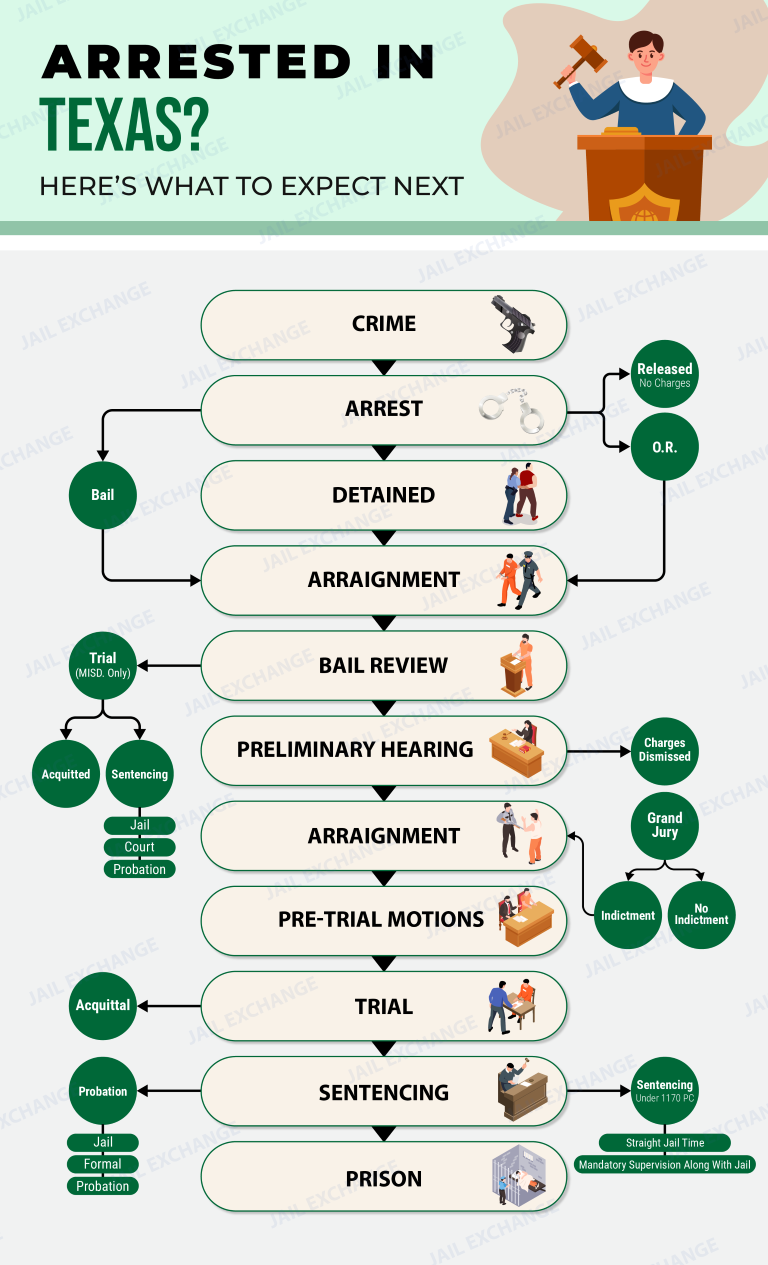
Every Kent County charge is filed at the courthouse in Jayton, 101 N Main St., Jayton, TX 79528, yet the county houses no prisoners itself. People who can't make bail are boarded next door, most often at the Garza County Jail, 412 East 15th Street, Post, TX 79356, or the Dickens County Jail, whose sheriff works from 201 US-82, Dickens, TX 79229. This guide sorts out the courts, the steps from arrest to verdict and the offices worth calling.
Is your person still locked up? Texas IVSS-Counties answers by name for jails across Texas, and JE also links the official jail search picked for this county. The arrest itself, from booking and warrants to charges, mugshots, defenders and property, gets its own walk-through on our Inmates in Custody page.
Right now, ring the District and County Clerk at 806-237-3881 and jot down the case number, the court handling it, and the date set next. Our bail page walks through release before trial.
1. Which court gets a Class C, a misdemeanor or a felony?
Texas sorts charges by weight, and each weight has its own court (state court guide):
- Class C (a fine up to $500, no jail) goes to the justice of the peace (Tex. Penal Code 12.23).
- Class B (up to 180 days and a $2,000 fine) and Class A (up to a year and a $4,000 fine) are tried in County Court before the County Judge (Tex. Penal Code 12.21, 12.22).
- Felonies belong to the 39th District Court, a court this county splits with three neighbors.
After a conviction, an appeal is possible. Criminal appeals may rise from there, and the Court of Criminal Appeals in Austin rules last. Not sure of the level? The clerk at 806-237-3881 can read it off the file.
↑ Back to the question list2. Where do Kent County charges land?
- Kent County Courthouse, 101 N Main St., Jayton, TX 79528. The County Judge holds County Court here. Main number 806-237-3373.
- District and County Clerk, same building, 806-237-3881. This single office files felonies and misdemeanors alike. Mailing: P.O. Box 9, Jayton, TX 79528. Ask by phone about its business hours.
- 39th District Court, hearing felonies from Haskell, Kent, Stonewall and Throckmorton counties. Its judge works from 1 Ave D, Haskell, TX 79521, inside the Haskell courthouse, 940-864-2661. The clerk in Jayton knows where each felony setting will be held.
- Federal court: Mahon Federal Building, 1205 Texas Avenue, Room 209, Lubbock, TX 79401, 806-472-1900.
3. Who handles tickets around Jayton?
Fine-only tickets written by deputies or troopers out here are answered before the justice of the peace. State law lets justice courts and city courts split Class C work. For the justice court's office, or to learn whether a ticket names a city court, phone the District and County Clerk, 101 N Main St., Jayton, TX 79528, at 806-237-3881.
- Except for public intoxication, a Class C offense can end with a written citation rather than a trip to jail (CCP 14.06).
- Short on money for the fine? Ask the judge about a payment plan, community service (each 8 hours knocks $150 off), or a waiver. Before anyone sits in jail for an unpaid fine, the judge must hold a hearing (CCP 45A.252 to 45A.261).
- The ticket itself lists the court and the date to show up.
4. What does the first meeting with a magistrate cover?
Booking at the out-of-county jail comes first. Then, inside 48 hours, a magistrate meets the person (CCP 15.17) and covers:
- the accusation, plus the right to stay silent and to stop an interview whenever they like;
- the choice between hiring a lawyer and requesting a county-paid one;
- for a felony, the chance at an examining trial, where a magistrate weighs whether the proof holds up (CCP 16.01).
Bail gets set at the same sitting. When jail staff spot possible mental illness, they have 12 hours to alert the magistrate (CCP 16.22). With no warrant and no probable cause finding, the area's lawyer plan frees a misdemeanor arrestee inside 24 hours and a felony arrestee inside 48. To learn when the hearing happened, call the Sheriff's Office at 806-237-3801.
↑ Back to the question list5. DWI, theft, assault: how does a misdemeanor play out?
The prosecutor opens a misdemeanor in County Court with an information, the paper that spells out the accusation. Then:
- Arraignment fixes who the person is and takes the plea (CCP 26.01).
- Pretrial settings are where the defense and prosecutor trade evidence and haggle over terms.
- Plea or trial. When a deal exists, the judge tells everyone in court whether it stands. Should the judge refuse it, the plea can be pulled back (CCP 26.13).
Penalties track the class: up to 180 days and $2,000 for Class B, up to one year and $4,000 for Class A (Tex. Penal Code ch. 12). Instead of jail, a judge may order probation for as long as two years, or deferred adjudication, which ends in a dismissal once the terms are met (CCP 42A.053, 42A.103).
Probation officers for this county work from the Haskell CSCD, 1301 N. First St., Haskell, TX 79521, 940-864-3627.
↑ Back to the question list6. How does a Kent County felony travel to trial?
- Magistrate and bail, inside 48 hours.
- Examining trial, if the defense requests one before indictment. A magistrate tests whether the evidence is enough (CCP 16.01).
- Grand jury. Prosecutors from the 39th District Attorney's office lay out the case behind closed doors, and nine or more grand jurors must back an indictment (CCP 20A.301).
- Arraignment before the 39th District Court, followed by motion and evidence hearings.
- Plea or trial. A plea bargain settles most felonies.
Each degree carries its own range (Tex. Penal Code 12.32 to 12.35). The mildest tier is the state jail felony, worth between 180 days and 2 years of state jail time. Higher up, third degree means a prison term of 2 to 10 years, second degree means 2 to 20, and first degree means life or anywhere from 5 to 99 years. Every level allows a fine as high as $10,000, and earlier felonies can bump the range higher (Tex. Penal Code 12.42).
For felony cases, deferred adjudication may stretch to 10 years and ends in dismissal when completed (CCP 42A.103, 42A.111). The clerk at 806-237-3881 has the case number and next date.
↑ Back to the question list7. How do violent charges differ?
Violent felonies walk the same path, with steeper odds at every turn:
- A personal bond is usually off limits, so getting out usually means cash or a bondsman (CCP 17.03).
- Proposition 3 passed in 2025. It lets a prosecutor seek a no-bail order on listed charges, murder and aggravated robbery among them (Tex. Const. art. I, §11d).
- For an adult, a capital murder conviction means life without parole or a death sentence (Tex. Penal Code 12.31).
- Victims may ask to be told of each hearing and may speak to the court about the harm done (CCP 56A.051).
The 39th District Attorney, 940-864-2072, handles these cases in the 39th District Court. A capital defendant too poor to hire counsel has the Regional Public Defender for Capital Cases appointed. Call 806-696-3740 or write PO Box 2097, Lubbock, TX 79408.
↑ Back to the question list8. Which offices prosecute and defend here?
Who prosecutes
- Felonies: the 39th District Attorney, covering Haskell, Kent, Stonewall and Throckmorton counties. The Jayton office is at 101 N Main St., Jayton, TX 79528, 940-864-2072. Letters go to P.O. Box 193, Haskell, TX 79521, not Jayton.
- County-level matters: the County Attorney, also at the courthouse, through its main number, 806-237-3373. Ask which office has a given misdemeanor.
Free defense when money is short
- Tell the magistrate you want one. Under the area lawyer plan, the request is forwarded inside 24 hours, and the appointment comes by the third working day.
- Judges offer eligible cases to the Caprock Regional Public Defender before anyone else. Its office is at the Texas Tech law school, 3311 18th St., Lubbock, TX 79409, 806-742-4312.
- After the appointment, the lawyer owes the client a first contact attempt before another working day ends (CCP 26.04).
9. Where are case details and hearing dates found?
A phone call is the fastest route. The District and County Clerk, 101 N Main St., Jayton, TX 79528, 806-237-3881, holds every criminal file here and can share the case number, the charge and the coming setting. Know their legal name and birthday first.
- re:SearchTX is the statewide court filing site, and it asks you to register at no cost. The public can view a case's index along with the indictment or information and the judgment. For hearing dates, go back to the clerk.
- The DPS conviction search shows past convictions and deferred adjudications for a fee.
10. Might a Kent County warrant be pending?
Deputies with the Sheriff's Office serve warrants here, from 227 S. Main Street, Jayton, TX 79528, 806-237-3801. Give the deputy a full name and birthday, then ask if a warrant is out. DPS lists the top fugitives statewide on its Texas 10 Most Wanted list. The District and County Clerk, 101 N Main St., Jayton, TX 79528, 806-237-3881, can tell which court signed a warrant. A lawyer, hired or appointed, makes clearing one safer. Go in together to the judge who signed it, or have the lawyer ask that judge's court for a fresh date.
↑ Back to the question list11. Where would a federal charge go?
Federal prosecutions from this county are handled by the Northern District of Texas at its Lubbock courthouse, the Mahon Federal Building, 1205 Texas Avenue, Room 209, Lubbock, TX 79401, 806-472-1900.
- A U.S. magistrate judge sees the person first and, after a hearing, orders release or detention (18 U.S.C. 3142).
- Someone kept in custody is under the U.S. Marshals Service, whose Lubbock office is at 1205 Texas Avenue, Room C-126, Lubbock, TX 79401, 806-472-7655. That office can name the jail.
- A defendant who can't pay a lawyer gets the Federal Public Defender: 1205 Texas Avenue, Room 507, Lubbock, TX 79401, 806-472-7236.
- After sentencing, look for them on the Federal Bureau of Prisons inmate locator.
12. Will an ICE hold change how the case ends?
The state case moves ahead, yet an ICE detainer reshapes the release. Steps in order:
- ICE delivers Form I-247A, asking jailers to keep custody past the normal release.
- When bail is posted or the case ends, the jail may hold the person up to 48 hours after they would otherwise be released (8 CFR 287.7(d)).
- Texas requires jails to honor detainers unless the person proves lawful status (CCP 2A.060). Counties may not restrict cooperation with immigration enforcement (Tex. Gov't Code 752.053). Also, a 2025 law tells counties with jails to have 287(g) agreements in place by December 1, 2026.
- ICE picks the person up. This area belongs to the Dallas Field Office, 8101 N. Stemmons Freeway, Dallas, TX 75247, 972-367-2200.
- Search the ICE Online Detainee Locator.
For a defendant without U.S. citizenship, the judge gives a deportation warning, spoken and written, before any guilty or no-contest plea counts (CCP 26.13). Have a lawyer check the immigration risk before any deal.
↑ Back to the question list13. Where is prison or state jail time spent?
Felony time splits in two. TDCJ runs the state jails where state jail sentences are served (Tex. Penal Code 12.35). Anyone sentenced for a third-degree felony or worse heads to a TDCJ prison unit. Following sentencing, the person waits at whichever jail is holding them until TDCJ has room. Intake staff then match them with a unit.
- TDCJ's own inmate search finds people by name or ID number once they reach a unit. People still waiting in a county jail won't come up yet.
- For each unit's details, open our Texas state prisons page.
14. What happens in juvenile court?
Juvenile court handles offenses by children who were 10 through 16 when they acted. At 17, a person's case is heard in adult court instead (Tex. Fam. Code 51.02). For Haskell, Kent, Stonewall and Throckmorton counties, one juvenile board chooses the court for these cases (Tex. Fam. Code 51.04).
- Officers notify a parent quickly. The child may be held at a juvenile processing office, and the juvenile board plan caps that stay at six hours.
- Within two working days comes a detention hearing, and the child's lawyer is in place by then under Tex. Fam. Code 54.01.
- A full hearing can end with a transfer to adult court. Such a transfer is allowed from age 14 for capital murder, first-degree felonies and aggravated drug felonies. For other felonies, the youngest age is 15 (Tex. Fam. Code 54.02).
The Sheriff's Office at 806-237-3801 can say where a child was taken. Statewide, the Texas Juvenile Justice Department is at 1711 San Jacinto Blvd, Austin, TX 78701, 512-490-7130.
↑ Back to the question list15. What support do Kent County crime victims get?
Texas law hands crime victims real rights. Their safety counts at bail, they can ask for hearing notices, and they may give an impact statement before sentencing (CCP 56A.051).
- Custody alerts. Sign up on Texas IVSS-Counties or dial 866-268-8959, day or night. It is free, and the inmate is never told.
- Bills. A state program, Crime Victims' Compensation, overseen by the Attorney General, can reimburse up to $50,000 in bills such as medical care and counseling. Phone 800-983-9933.
- The prosecutor. For a felony, contact the 39th District Attorney, 101 N Main St., Jayton, TX 79528, 940-864-2072.
Information for this service is currently unavailable.
Information for this service is currently unavailable.
Information for this service is currently unavailable.
Information for this service is currently unavailable.
Information for this service is currently unavailable.
Information for this service is currently unavailable.
- Jail (Main): 806-237-3801
- Sheriff: 806-237-3801
The Kent County Jail serves the following cities and towns of Kent County: Jayton.