
King County Jail
King County Jail
Jail Phone Number
806-596-4413How do you find someone who has been arrested in King County?
The King County Jail is CLOSED. Offenders arrested for misdemeanors and felonies in this county are brought to the Dickens County Jail for booking and processing, and if their crime requires it, are incarcerated until they either get bail or are released from custody on their own recognizance.
Those who are found guilty and sentenced to a term of less than one year, will do their time in Dickens County. Those sentenced to longer terms will be sent to either the Texas State Prison System or the Federal Bureau of Prisons.
- Review the Jail Roster, or
- Call the King County Jail at 806-596-4413
- Look up the offender's criminal charges
- Find out their bond, and
- View their public mugshot in the roster.
If you cannot find the mugshot of the offender that has been arrested, it is because King County or the state of Texas has recently changed their policy regarding publicly posting them in the jail roster. However, you can write the jail at the following address and request a copy of an inmate's mugshot be mailed or sent by email to you. Make sure to include your email address in all correspondence.
Mail to:
King County Jail
1667 US-83
Guthrie, TX 79236
Attention: Media Relations - Inmate Mugshot Request
Mail, click on the link below, or call the facility at 806-596-4413 for the information you are looking for.
King County Jail Inmate Search
How do I find out if someone was arrested in King County?
There are five ways to find out if someone was arrested in King County:
1. Look them up on the official jail inmate roster.
2. Look them up on vinelink.com, a national inmate tracking resource.
3. Call the jail at 806-596-4413. This is available 24 hours a day.
4. Write or visit the jail and request information.
You can reach them at:
King County Jail
1667 US-83
Guthrie, TX 79236
5. Do a search online using this person’s name, the town or city you think they were arrested in, and the crime you think they were arrested for. Sometimes the local newspaper, police department or sheriff’s office will have a daily police blotter published on their website.
What information is included in jail booking records and the jail roster?
Jail booking records, also known as the jail roster, typically include the following information:
• Full name of the inmate
• Inmate's physical characteristics (age, sex, height, weight, etc.)
• Inmate’s mugshot(s)
• Booking number, Inmate ID#, Jacket #, etc.
• Booking date and time
• Charges or offense details – the applicable statute
• Bond or bail amount, if applicable
• Court date, if set, plus the court name and location
• Previous arrests in this jurisdiction, conviction details, and sentence
- Note that not all this information will be included. Most booking records and jail inmate rosters contain only the basic information such as name, date of arrest and the criminal charge.
- The amount and quality of the information depends on the state’s laws and the jail’s policies.
How often are jail booking records and rosters updated?
Most jails update their records at least once per day. Some booking information is updated as often as every 15 minutes in the roster. From the time a person is first arrested until when they are booked in the jail, it can be as short as a couple of hours, up to 24 hours, or even longer if they were arrested during a major event such as a protest or riot in which hundreds of people were arrested at the same time.
How do I find an inmate in the King County Jail?
There are seven ways to find an inmate in King County or the King County Jail:
1. Look them up on the official jail inmate roster.
2. Look them up on vinelink.com, a national inmate tracking resource.
3. Call the jail at 806-596-4413. This is available 24 hours a day.
4. Call local police departments in King County. Sometimes the local jails will hold recent arrestees for up to 72 hours before transporting them the King County Jail.
5. Check with the jails in neighboring counties and look up their rosters. It is always possible they were arrested there instead of King County.
6. Write or visit the jail and request information.
King County Jail
1667 US-83
Guthrie, TX 79236
7. Do a search online using this person’s name, the town or city you think they were arrested in, and the crime you think they were arrested for. Sometimes the local newspaper, police department or sheriff’s office will have a daily police blotter published on their website as well.
How do I find an inmate in a Texas state prison?
You can find an inmate in the Texas Department of Corrections by searching for them on the State Prison Locator, Vinelink.com (a nationwide inmate locator resource), or by calling the Department of Corrections.
How do I find an inmate in federal prison?
- The United States Bureau of Prisons maintains an up-to-date inmate locator where you can look up any inmate that has been in federal prison from 1982 to the present day.
- If they are currently in custody, you can see what institution they are in.
- If they are in transport, meaning they are being shuttled from one prison to another, that information will not be available. If they are no longer in custody, it will list their discharge date.
- Other information provided is their BOP Registry Number (inmate ID#), their race, age and release date.
- If they are in custody, there are links to how to visit them, send them money, communicating with them and sending the prison a concern you may have about them.
How do I find a detainee in an ICE facility?
- The US Immigration and Custom’s Enforcement maintains an up-to-date online detainee locator of all foreign detainees aged 18 and older that are in the custody of ICE.
- When searching by name, a detainee's first and last names are required and must be an exact match. When inputting a hyphenated last name into the Online Detainee Locator System, include the hyphen for the locator to find the individual (e.g., Doe-Smith).
- You can also search by using an A-number (Alien Registration Number) if you have it at the same link. The A-Number must be exactly nine digits long. If the A-Number has fewer than nine digits, add zeros at the beginning.
- You are also required to select the detainee's correct Country of Birth from the drop-down menu provided on the page.
NOTE: If an alien is arrested for a state crime, you will still be able to locate them in the police jail or the county jail where they were arrested. If it was a misdemeanor crime, they would do their time in the King County Jail or the county jail where they were arrested and convicted.
If they were convicted of a Texas state felony and sent to state prison, and not deported, then you can locate them in the Texas state prison system.
How do I find an inmate in juvenile detention?
In the United States, a juvenile is a person under the age of 18. If a juvenile is arrested for a crime, it is unlikely that their name will be publicly listed on an inmate search page or detention center roster, or will be released to the public. Only the juvenile’s parents or legal guardians will be given that information.
If the crime is a serious felony such as Capital Murder, some states will release their name to the public, either when they are first arrested or after they are convicted. However, in general, it is unlikely that an inmate who is a juvenile will have their name released in any public way.
How can I see if someone is in jail or prison in King County or the state of Texas?
For online searches, if you want to see if someone is in jail in King County.
If you want a list of all the other county jail inmate searches in Texas.
If you want a list of all the county jails in the United States.
If you want to look up an inmate in any of the Texas state prisons. To look up the prisons in Texas.
How do I get information on someone in jail in King County?
If you want detailed information on a particular inmate in in jail in King County, and you can’t find it online in the jail inmate roster, your only other option is to either call the jail at 806-596-4413, go to the jail in person and ask, or write them at:
King County Jail
1667 US-83
Guthrie, TX 79236
That said, most jails will limit the amount of information that they give to the public about an inmate in their roster because the offender is considered innocent until proven guilty, and thus is afforded a certain amount of privacy.
Once an offender is convicted, you are far more likely to find out information about them.
If you are good at using Google, you can dig into a person’s past and learn as much information about anyone as someone in the media can.
You can also search a website that has all the public records about people. One of the best online websites we found will cost you only $1.00.
Who can I call to find an inmate in King County?
To find an inmate in custody or ask about their roster in King County call 806-596-4413 24 hours a day.
Does the jail or prison have to keep the inmate in the county or state where they are charged or convicted?
No. Even though 99.9% of all pre-trial and convicted inmates are kept in the state where they were arrested and/or convicted, they can be kept in any US jail or prison that will have them. This is seen in circumstances where a jurisdiction is overcrowded, or an inmate is moved for their safety. That said, a person must stand trial where they were arrested unless the presiding judge or prosecuting attorney agrees to move the offender’s trial to a different jurisdiction if it is likely they will not get a fair trial.
What if I can’t find an inmate and I know they are in custody in King County?
If you know an inmate is in custody in King County, and you can’t find them, it can mean one of several things:
1. Either you or the jail has the spelling of the inmate’s name inputted incorrectly.
2. The jail has not yet updated their booking information or roster.
3. The inmate has already been released.
4. The inmate has either been arrested or is being housed in another jail.
5. The inmate is underage; therefore, it is illegal to post their information, or the inmate you are trying to find had their age incorrectly listed as someone under age 18.
I know the person was arrested and in jail, but my search in the roster comes back as “no record found.” What happened?
Same answer as that above. If you know an inmate is in custody in King County, but your search comes back in the roster as “no record found.”, it can mean one of several things:
1. Either you or the jail has the spelling of the inmate’s name wrong.
2. The jail has not yet updated their booking information or roster.
3. The inmate has already been released.
4. The inmate has either been arrested or is being housed in another jail.
5. The inmate is underage; therefore it is illegal to post their information, or the inmate you are trying to find had their age incorrectly listed as someone under age 18.
I was released from jail in King County, but my record still shows. When will it go away?
If your record of arrest and booking is still showing online, even though you were released, it is because some jails allow that information to remain public indefinitely. Unfortunately, even though the charges against you may have been dropped, many jails will not erase that information from their public records voluntarily.
In a situation like this your only option will be to get an attorney and request they petition the court to force the jail to remove this information. That said, if you were in fact found guilty of the crime you were arrested for, it is unlikely they will remove the information surrounding your arrest and conviction.
An inmate’s family member just died; how can I let them know right away?
The death of a family member is one of the few times, if not the only time, that a jail will take a message for an inmate. Because of the sensitivity of the tragic news, when a family member has died, the news will be transmitted by a member of the clergy, a counselor or someone who is very high ranking within the jail.
Jail management understands that a sudden death of a loved one could cause a violent emotional response that jeopardizes the safety of staff or other inmates.
An inmate’s family member just died; will they be allowed to attend the funeral?
The death of a family member is one of the few times, if not the only time, that a jail will allow an inmate, whether it pre-trial or post-conviction, to be allowed outside of the jail. Even if they are allowed outside the jail, they will have to have at least two armed escorts. An inmate attending a funeral is an extraordinary cost, use of staff and potential danger to the public. That is why it is rarely allowed.
This is not always the case though, and whether an inmate can attend a funeral depends on the inmate’s security classification, whether the jail has the staff to handle it, official jail policy, whether or not the inmate has an attorney that can push the right people, including the judge overseeing the inmate’s case, etc.
What determines whether an inmate is placed in low or high security facilities?
An inmate’s security classification depends on the following:
1. The inmate’s current crime.
2. The inmate previous crimes.
3. The inmate’s history for violence within the walls of the facility.
4. The inmate’s gang affiliation.
5. The jail's current distribution of inmates.
What information is available about an inmate?
The information that a jail or court releases publicly about an inmate depends on the laws in the state, the policy of the jail, and the sheriff’s or warden’s individual decision.
Jail booking records and rosters can include more or less, the following information:
• Full name of the inmate
• Inmate's physical characteristics (age, sex, height, weight, etc.)
• Inmate’s mugshot(s)
• Booking number, Inmate ID#, Jacket #, etc.
• Booking date and time
• Charges or offense details – the applicable statute
• Bond or bail amount, if applicable
• Court date, if set, plus the court name and location
• Previous arrests in this jurisdiction, conviction details, and sentence
What is vinelink.com?
Vinelink, which you will see referenced when discussing public information about offenders and inmates, is a national public roster that both allows the public to look up and see the person’s status, plus be able to track their movements, whether it involves being transferred from one facility to another or being released from custody.
The tracking feature is especially helpful for those who are victims of, or witnesses to, a crime and fear that the release of an offender may be dangerous to them or someone close to them.
Anyone can register with Vine to receive automated notifications via email, text or phone. It is available in 48 states and 2,900 jails and prisons.
Here is a short video explaining why it started and how it works.
How do I find old King County jail and inmate records from years ago?
To find jail records that go back many years really depends on how far you want to go back, however you would need to send a written request to the county sheriff as follows:
King County Sheriff
Att: Jail Records
1667 US-83
Guthrie, TX 79236
Let them know the inmate’s name, any aliases, date of birth, the date range that the inmate may have been incarcerated, the crime they were charged with/convicted of, and any other helpful information you can think of.
How can I have my jail record sealed?
To have your jail records sealed, you will have to have the crime you were convicted of expunged. You should know up front that not all crimes are eligible for expungement.
1. Hire a lawyer that specializes in expungement.
2. If your crime is eligible, they will contact the District Attorney's office in the judicial district where you were charged or convicted.
3. They will file a petition with the court where you were charged or convicted.
4. The entire process may take 1-2 years.
Where can I get Prison records from the state of Texas?
To get prison records from the state of Texas, you will need to send a written request to the state prison system in Texas.
Let them know the inmate’s name, any aliases, date of birth, the date range that the inmate may have been incarcerated, the crime they were charged with/convicted of, the name of the facility you believe they were incarcerated in, plus any other helpful information you can think of.
For inmate services and facility information such as:
- Directions
- Booking Process
- Visiting an Inmate
- Sending Money
- Mailing
- Emailing or Texting
- Receiving phone calls
- Bail Bond Information
- Court Information
Click the links above, or the button below.
King County Bail and Release
Nobody is jailed inside King County, because the county has no jail. Deputies carry arrested people to a jail in a neighboring county, and bond gets settled there. One possibility is the Dickens County Jail, 819 5th Street, Dickens, TX 79229, but the King County Sheriff can confirm. Below we walk through the magistrate's job, each bond type, paying, and holds that can outlast a bond.
Where did they end up? Texas IVSS-Counties looks up names in county jails statewide. The county's official jail search link is another check. Our Inmate Search page handles custody topics: who is held right now, today's arrests, warrants, charges, mugshots, appointed lawyers and getting property back.
Ring 806-596-4413, the Sheriff's Office line, on a weekday between 8 a.m. and 5 p.m. Get three answers: where the person is jailed, the charge, and any bond amount already set. Once a judge has the case, our court page explains each step. For rules that apply everywhere in Texas, our Texas bail laws page has the long version.
1. Which magistrate sets bond for King County arrests?
Texas gives the power to set bail to magistrates. That group includes the local Justice of the Peace, any county or district judge, city judges and certain appointed officers (Code Crim. Proc. 2A.151). The jailer must get the person to one inside 48 hours, and faster is expected. Video hearings count (Code Crim. Proc. 14.06, 15.17).
King, Baylor, Cottle and Knox counties share one plan for appointed lawyers, and it repeats that 48-hour deadline. At the hearing, expect the magistrate to:
- spell out the charge and the person's rights, such as keeping quiet and having counsel;
- offer a court-appointed lawyer and walk them through the request;
- fix the bond and any release terms.
That bond ruling has its own 48-hour limit. It must fit the one person, using the least restrictive terms that do the job (Code Crim. Proc. 17.028). Charges at Class B or higher add a step: reviewing the public safety report, basically a criminal-history printout with no risk number and no bond figure on it (Code Crim. Proc. 17.021, 17.022).
The county's Justice of the Peace keeps an office in the courthouse at 1667 US-83, Guthrie, TX 79236, 806-596-4481. A magistrate in the county where the person is jailed can also hold the hearing.
↑ Back to the question list2. Which of the three Texas bonds applies?
Texas allows three kinds of bail (Code Crim. Proc. 17.01 to 17.03):
- Cash bond. Money for the full bond is paid to the court and stays there until the case closes.
- Surety bond. A bondsman, or another surety, guarantees the full sum to the court, and charges the family a fee.
- Personal bond. The person's own signed promise to return replaces any payment.
Violence charges usually knock personal bonds off the menu. The same is true for terroristic threat (Class A or above), a felon's firearm possession and some protective order violations. Add to that a fresh charge filed while the person is on supervision for violence. On certain drug felonies, organized crime or burglary, only the trial court, not a magistrate, may grant one (Code Crim. Proc. 17.03).
Many bonds come with rules. Intoxication manslaughter, intoxication assault, a DWI with a child in the vehicle, and a repeat DWI all bring a court-ordered ignition interlock (Code Crim. Proc. 17.441). On a fine-only Class C offense, a written promise to appear on a set date can replace the bond, unless certain earlier convictions rule it out (Code Crim. Proc. 15.17(b)). Read about each choice on our statewide bail rules page.
↑ Back to the question list3. What decides the bond amount in King County?
Texas uses no statewide price list. Each magistrate picks a figure for the person in front of them. For the number in your case, ring the Sheriff's Office at 806-596-4413 or the jail now housing the person. By law, the magistrate weighs questions like these (Code Crim. Proc. 17.15):
- Is the sum big enough that the person shows up for court, yet not so big it oppresses?
- What crime is charged, and how did it happen?
- Can this particular person pay it?
- Who could be hurt: the victim, officers, neighbors?
- What does the criminal-history report say?
- Is the person a citizen?
There is one hard limit. When police arrest without a warrant, a magistrate has to find probable cause promptly. If that step is missed, the law sets two clocks. On a misdemeanor, the person goes free within 24 hours on a bond no larger than $5,000. On a felony, it is 48 hours and no more than $10,000. Someone who can't raise that sum gets a personal bond. The state can ask to push the deadline out to 72 hours (Code Crim. Proc. 17.033).
↑ Back to the question list4. How is bond posted with no county jail?
Bail goes to whichever jail is holding the person. For local arrests, that may be the Dickens County Jail, 819 5th Street, Dickens, TX 79229, which the Dickens County Sheriff's Office runs, 806-623-5533. Work through these steps:
- Ring the King County Sheriff's Office, 806-596-4413, any weekday from 8 a.m. to 5 p.m. Ask where deputies took the person.
- Phone that jail. Have the legal name and birthday ready.
- Request the bond figure, every charge and the bond type.
- Ask when the jail accepts bond, what forms of money it takes, and how to address a money order.
- Ask if any hold is on file.
- Pay, keep the receipt, and ask roughly when they will walk out.
Before a jailer or sheriff accepts bail, Texas law has them pull up the person's criminal history. For violent charges, only a magistrate picks the amount; jail staff never do (Code Crim. Proc. 17.20, 17.22).
↑ Back to the question list5. Will the Guthrie courthouse take a bond?
Call first. The courthouse sits at 1667 US-83, Guthrie, TX 79236, 806-596-4411. Two local offices handle bond papers:
- County Clerk, which keeps misdemeanor files: 800 South Baker, Guthrie, TX 79236, 806-596-4412. Its mailing address is P.O. Box 135, Guthrie, TX 79236.
- Justice of the Peace, who hears Class C cases and works as a magistrate: in the courthouse, 806-596-4481. Its mailing address is P.O. Box 67, Guthrie, TX 79236.
Ask the clerk if a cash bond on a local case is accepted in person, what the office takes, and its hours. Class C defendants in justice court are normally released on a personal bond (Code Crim. Proc. 45A.107).
A person arrested on a local warrant in some distant county does not have to come here first. The magistrate where they were caught can take bail and mail the bond back (Code Crim. Proc. 15.18).
↑ Back to the question list6. Cash, card or money order for bond?
Rules differ from one office to the next. Before handing over money, put these questions to the jail holding the person or to the Sheriff's Office at 806-596-4413:
- Does cash work, and must it be exact?
- Money orders, cashier's checks: which are taken, and who is the payee?
- Is plastic accepted, debit or credit, and what does the card fee run?
- Is a personal check ever allowed?
Hold on to the receipt. The refund on a cash bond goes to the name printed on it (Code Crim. Proc. 17.02). Bondsmen owe you a receipt for each payment as well (Occupations Code, ch. 1704).
↑ Back to the question list7. Do King County cases use bail bondsmen?
They can. State law makes counties of 110,000 people or more set up a bail bond board (Occupations Code, sec. 1704.002). This county is tiny by comparison: a 2025 Census estimate counted about 192 residents. Here, with no board, the Sheriff's Office may keep its own posted list of sureties approved to write bonds (Code Crim. Proc. 17.141). Ask for that list at 806-596-4413, and ask the jail holding the person which bondsmen it will deal with.
Points to weigh before signing with a bondsman:
- The fee, or premium, has no state cap. Compare several.
- Collateral, like a truck title, may be asked for. Once the case is done, it must come back within 30 days after you request it in writing.
- No bondsman may hunt for clients among the people in a jail.
- An attorney already representing the person may act as surety.
You'll find those protections in the Occupations Code (secs. 1704.163, .301, .304, .305). To get off a bond, a bondsman must alert the defense lawyer first, plus the prosecutor in a felony, and then file an affidavit (Code Crim. Proc. 17.19).
↑ Back to the question list8. Which holds outlast a paid bond?
Several can. Have the jail check for them before you pay.
- Family violence. Release can be pushed back four hours after bond when the magistrate finds more violence likely. A written order stretches the wait as far as 48 hours (Code Crim. Proc. 17.291). The victim is notified before the person leaves (Code Crim. Proc. 17.29).
- Another county's warrant. That county may require its own bond (Code Crim. Proc. 15.18).
- Parole blue warrant. A parolee picked up on one waits for the violation hearing behind bars (Gov't Code, sec. 508.254).
- Immigration detainer. Unless the person proves lawful status, the jail is required to honor it (Code Crim. Proc. 2A.060).
- Probation. A fresh arrest can lead to a probation warrant.
Adult probation for King, Baylor, Cottle and Knox counties runs from 101 S Washington, Seymour, TX 76380, 940-888-3778.
↑ Back to the question list9. Can a magistrate refuse bond in Texas?
Rarely. Bail is a right in Texas, with a handful of exceptions written into the state constitution (Texas Constitution, Article I, secs. 11 to 11c):
- capital cases when the proof is evident;
- some repeat felony cases, or picking up a new felony charge while free on felony bond;
- violating a release condition meant to protect safety;
- violating a family violence protective order.
Proposition 3, approved by voters November 4, 2025, adds section 11d for the gravest violent charges. The list runs from murder and capital murder through aggravated robbery. Trafficking, aggravated sexual assault and some aggravated assaults are on it too. Only a prosecutor can ask for denial. Bail is refused if the prosecutor proves flight risk as more likely than not, or danger by clear and convincing evidence. Should a judge allow bail anyway, written reasons are required (Texas Constitution, Article I, sec. 11d).
Felony bail can now get a second look from a district judge when the prosecutor requests it. For certain violent charges, the state may also challenge a too-low bail before the court of appeals, which must rule within 20 days, while the defendant waits in jail (Code Crim. Proc. 17.029, 44.01). The felony prosecutor here is the 50th District Attorney, 101 S. Washington St., Seymour, TX 76380, 940-889-2852.
↑ Back to the question list10. How can a bond be lowered later?
Usually a lawyer asks the court. A family can help with these steps:
- If money is tight, ask the magistrate for an appointed lawyer.
- Have that lawyer file a motion to reduce the bond or loosen its terms.
- Collect papers on money: pay stubs, bills, rent, and the people who rely on the person.
- Show local ties, like steady work, a house and relatives close by.
For Class B and up, the accused may swear out an affidavit saying they cannot pay. The court then owes them a prompt review (Code Crim. Proc. 17.028).
Count the days if prosecutors stall. Once 90 days pass on a felony without the state being ready for trial, the law requires a personal bond or reduced bail for the person still in jail. The cutoffs shrink for smaller charges: 30 days if the misdemeanor carries a possible jail term above 180 days, 15 if 180 days or under, and 5 days for a ticket that can bring nothing but a fine. Exceptions exist (Code Crim. Proc. 17.151).
↑ Back to the question list11. How does King County appoint free lawyers?
Anyone facing possible jail who cannot pay a lawyer may ask for one. Appointments follow a written plan for King, Baylor, Cottle and Knox counties, posted by the state's indigent defense commission (see the plan):
- At the first hearing, tell the magistrate you want a lawyer. You will get the form and help with it.
- Within a day, the magistrate sends it on: misdemeanor requests to the County Judge, felony requests to the District Judge.
- The appointment deadline: three working days from the request (Code Crim. Proc. 1.051).
- Before any hearing, a request can be sent to the District Judge at 101 S. Washington Street, Seymour, TX 76380, or emailed to admin50th@srcaccess.net.
You'll find the County Judge's office in the courthouse, 1667 US-83, Guthrie, TX 79236, 806-596-4411. In capital matters, the court appoints the Regional Public Defender for Capital Cases. Other cases go to private lawyers the court appoints. Look for the lawyer's first contact attempt within one working day of the appointment (Code Crim. Proc. 26.04). The Texas Indigent Defense Commission takes plan questions at 512-936-6994.
↑ Back to the question list12. Where do King County cases go to court?
Local cases are heard at the courthouse, 1667 US-83, Guthrie, TX 79236, 806-596-4411.
- Class A and B misdemeanors are the County Judge's to try, in County Court.
- Tickets and other Class C cases, which carry fines only, are the Justice of the Peace's job, 806-596-4481.
- Misdemeanor records sit with the County Clerk, 800 South Baker, Guthrie, TX 79236, 806-596-4412.
- The 50th District Court, shared with Baylor, Cottle and Knox counties, takes felony cases. Its judge's office is at 101 S. Washington Street, Seymour, TX 76380. Call the courthouse number for local felony settings.
Federal charges from here are heard in Wichita Falls, in the Northern District of Texas. That courthouse, at 1000 Lamar Street, 2nd Floor, Wichita Falls, TX 76301, is open only when court is sitting. The division's clerk answers from 501 West 10th Street, Room 310, Fort Worth, TX 76102, 817-850-6600.
↑ Back to the question list13. When is cash bond refunded, and when is it lost?
Refunds wait until the case ends. The person must have kept every bond condition. It goes to the name on the bond receipt, less any fee (Code Crim. Proc. 17.02). The clerk can keep a small fee, 5 percent capped at $50, though only if the case ends with a conviction, or with deferred adjudication. Any unpaid fines and costs in the case may be paid from the cash too (Local Gov't Code, sec. 117.055; Code Crim. Proc. 17.53). When the case is final, the clerk has to provide the refund motion form at no charge. Texas courts explain the process in a cash bond guide.
A missed court date leads to a judgment nisi, which starts the forfeiture. The surety is excused if the person is locked up again soon enough: 270 days on a felony, 180 on a misdemeanor (Code Crim. Proc. 22.01, 22.02, 22.13). A no-show can also bring a new charge, bail jumping. Its level follows the first case. It may be as low as Class C or as high as a third-degree felony (Penal Code, sec. 38.10). Questions about a misdemeanor refund go to the County Clerk at 806-596-4412.
↑ Back to the question list14. Who keeps their belongings and jail money?
Clothes, wallet, phone and any jail account money remain at the booking jail. For a typical local arrest, that is the Dickens jail, 806-623-5533. When you call, ask:
- which days and hours items can be collected;
- what ID to show, and if you need written permission from the person;
- how leftover account money is returned.
If you can't tell which jail booked them, the Sheriff's Office knows: 806-596-4413. Our jail account money page covers deposits.
↑ Back to the question list15. Is federal bail set the same way?
No. A federal charge filed here is assigned to the court's Wichita Falls Division. A federal judge holds a detention hearing (18 U.S.C. 3142). The question there: can conditions make release safe, or must the person stay jailed until trial? State bondsmen play no part.
Until trial, the Marshals hold federal prisoners, often in county jails under contract. Their office in Wichita Falls is at 1000 Lamar Street, Room 218, Wichita Falls, TX 76307, 940-723-8662. The division's clerk can be reached in Fort Worth at 817-850-6600.
Federal defendants who cannot afford counsel get one through the Federal Public Defender. Its Dallas headquarters is at 525 South Griffin Street, Suite 629, Dallas, TX 75202, 214-767-2746. After sentencing, check the BOP inmate locator for their prison.
↑ Back to the question list16. What does a paid bond mean for an ICE detainer?
A detainer is a federal request, separate from the state bond.
- ICE starts with Form I-247A, its detainer, which asks the jail to keep custody.
- Once it arrives, the jail may keep them up to 48 hours after they would otherwise be released (8 CFR 287.7(d)). ICE uses that window to pick them up.
- ICE then takes the person to one of its detention centers.
- Search the ICE Online Detainee Locator by A-number. No A-number? Type the name and pick the country of birth.
- No result? ICE's Dallas office covers North Texas: 8101 N. Stemmons Freeway, Dallas, TX 75247, 972-367-2200.
Texas makes its jails follow these detainers, unless the person can show lawful status (Code Crim. Proc. 2A.060). Since 2017, state law has barred cities and counties from rules that restrict immigration enforcement (Gov't Code, sec. 752.053). The deadline is December 1, 2026: a 2025 statute gives every county that keeps a jail until then to request 287(g) status with ICE. People arrested here are held in another county, so that county's jail deals with any detainer.
↑ Back to the question list17. Which state system takes a felony sentence?
Someone given a state jail felony sentence does that time in a state jail. Those units are separate from prisons. For third-degree and higher felonies, the term is served in TDCJ units (Penal Code, secs. 12.31 to 12.35). New arrivals pass through intake, where staff pick a unit that fits, and then transfer.
To find someone, open the TDCJ inmate lookup. You can enter a TDCJ number or an SID number. Without either, type the surname and first-name initial. The data is a day old at minimum and refreshes on working days. For unit visiting and mail rules, see JailExchange's Texas state prisons page.
↑ Back to the question list18. What if deputies arrest a King County teen?
If the young person was age 10 through 16 at the offense, juvenile court takes the case. From age 17, Texas uses adult court (Family Code, sec. 51.02). The officer must promptly notify a parent (Family Code, sec. 52.02). A youth kept in detention must get a hearing within two working days (or by the first working day if a Friday or Saturday arrest started the detention). Before it, the court names a lawyer for them (Family Code, sec. 54.01).
King, Baylor, Cottle and Knox counties share a juvenile board. To find out which probation office and detention center handle local youth, call the Sheriff's Office at 806-596-4413 or the County Judge at 806-596-4411. The Texas Juvenile Justice Department, which registers youth detention centers, is at 1711 San Jacinto Blvd, Austin, TX 78701, 512-490-7130.
↑ Back to the question listKing County Criminal Court Guide
King County keeps its courts in Guthrie but runs no jail, so people arrested here wait in a jail elsewhere, and the Sheriff can say which. One candidate is the Dickens County Jail, 819 5th Street, Dickens, TX 79229. Felonies belong to the 50th District Court. Misdemeanors stay with the County Court or the Justice of the Peace. Here you'll find each court, how cases move, penalties, lawyers and lookups.
Begin by pinning down where the person is. Texas IVSS-Counties searches custody by name, and the county's jail search link is worth a click. Our Inmate Search page keeps to custody matters: public defenders, mugshots, warrants, charge details, who sits in jail tonight and reclaiming property.
For a case number or a court date, dial the County Clerk at 806-596-4412 and spell the defendant's full name. Ask the clerk which court has the file and when it's set next. Bond and release get their own explanation on our bail page.
1. Which court gets a King County misdemeanor or felony?
The charge's level picks the court. Texas splits it three ways:
- Class C misdemeanors: tickets punished by a fine alone; the Justice of the Peace in Guthrie hears them.
- Class A and B misdemeanors: these can mean jail time. The County Judge rules on them in County Court; the file itself sits with the County Clerk.
- Felonies, every grade, land in the 50th District Court. Its single judge serves King, Baylor, Cottle and Knox counties.
Appeals climb from there. For crimes, the last stop is the Court of Criminal Appeals (see the state's judicial system pamphlet).
↑ Back to the question list2. Where is the Guthrie courthouse, and who works there?
Most local court business runs through one building, the courthouse on the highway (1667 US-83, Guthrie, TX 79236). Its main line is 806-596-4411. Offices to know:
- County Judge and County Court: inside the courthouse, reached on the main line.
- Justice of the Peace: inside the courthouse, 806-596-4481. Mail goes to P.O. Box 67, Guthrie, TX 79236.
- County Clerk: 800 South Baker, Guthrie, TX 79236, 806-596-4412. Mail goes to P.O. Box 135, Guthrie, TX 79236.
- County Attorney: inside the courthouse, 806-928-2872.
Felony matters are run from Seymour. The 50th District Judge's office and the 50th District Attorney share the address 101 S. Washington Street, Seymour, TX 76380. The District Attorney answers at 940-889-2852. Plan on regular business hours, and phone ahead before a long drive.
↑ Back to the question list3. Do Guthrie or Dumont have a city court?
Texas city courts, called municipal courts, belong to incorporated towns. Guthrie, the county seat, and Dumont are small communities, and fine-only cases filed by county officers go to the county's Justice of the Peace. If a ticket names some other court, call the number printed on that ticket.
The justice court shares that building (1667 US-83, Guthrie, TX 79236), 806-596-4481. There, a Class C ticket can be paid, set for trial, or worked off. Money tight? A judge can approve time payments or a waiver, or let community service count at $150 for every 8 hours. Jail over an unpaid fine can come only after a hearing finds the person could have paid and simply chose not to (Code Crim. Proc. 45A.252 to 45A.261).
A justice court judgment can be appealed to the County Court. Ask the justice court clerk for the deadline the day of the ruling.
↑ Back to the question list4. What does the magistrate do in the first 48 hours?
A magistrate sees every arrested person, no later than hour 48. With no jail in the county, that meeting may run over video from the holding jail, though it can be face to face (Code Crim. Proc. 14.06, 15.17). The hearing covers:
- The charge. It is read to the person.
- Their rights. They may stay quiet. They may hire counsel and have that lawyer present for questioning. They may end any interview. They may ask for an examining trial. Anything they say may become evidence.
- A lawyer at county expense. The magistrate explains the process and assists with the paperwork.
- Bail. The magistrate sets the amount and the release rules.
The request form travels to the appointing judge within a day. Because the county is so small, the appointment deadline is the third working day after receipt (Code Crim. Proc. 1.051). The jail has 12 hours to flag a suspected mental illness to the magistrate (Code Crim. Proc. 16.22). Our bail and release page covers bond in detail.
↑ Back to the question list5. Which steps does a DWI or theft misdemeanor take?
A misdemeanor filed in County Court starts with a charging paper called an information. The level printed on it, Class A or Class B, sets the stakes. For theft, the dollar value of the property drives the class. The steps after that:
- Arraignment. A plea is entered after the charge is read aloud (Code Crim. Proc. 26.01).
- Pretrial settings. Evidence changes hands and offers get discussed.
- Resolution. A plea bargain or a trial. The judge announces in advance if the plea deal will be honored. Should the judge reject that deal, the defendant may pull the plea back (Code Crim. Proc. 26.13).
Penalty ceilings: Class C, $500 and no jail time; Class B, 180 days and $2,000; Class A, one year and $4,000. Jail and fine can be stacked (Penal Code, secs. 12.21 to 12.23).
Deferred adjudication leaves the guilty finding unmade. For a misdemeanor, the deferral lasts up to two years, and completing it ends in dismissal (Code Crim. Proc. 42A.101, 42A.103, 42A.111). Regular misdemeanor probation, called community supervision in Texas law, is capped at two years as well. The adult probation office serving this county is at 101 S Washington, Seymour, TX 76380, 940-888-3778.
↑ Back to the question list6. What path does a King County felony follow?
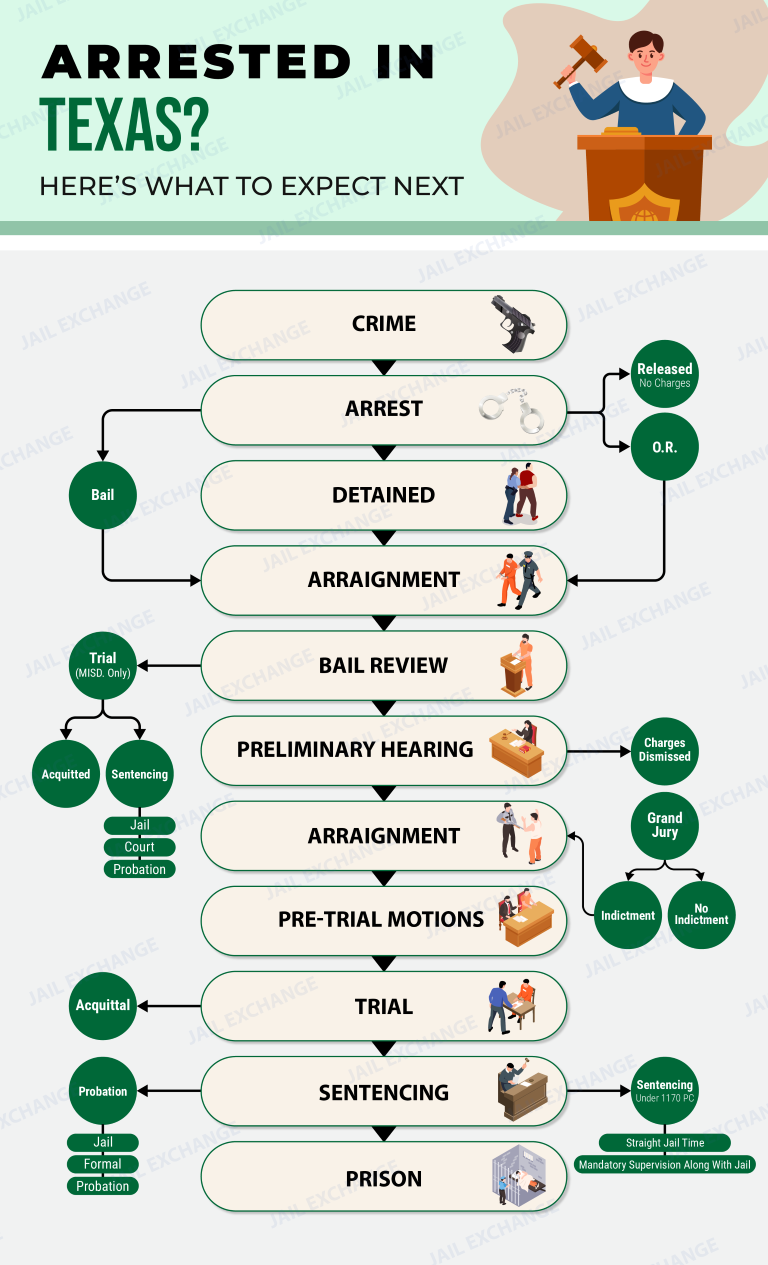
Felonies move on the 50th District Court's calendar, which it splits among four counties. The usual path:
- Magistrate hearing within 48 hours, with bail and a lawyer request.
- Examining trial (optional, before indictment). A judge tests probable cause (Code Crim. Proc. 16.01).
- Grand jury. Prosecutors lay out the evidence, and at least nine jurors must vote to indict (Code Crim. Proc. 20A.301).
- Arraignment in the 50th District Court: reading of the indictment, entry of a plea.
- Motions and settings. Evidence is exchanged and deals are discussed.
- Resolution. Most end with a plea. The rest are tried, often before a jury.
How long in prison? It depends on the grade. A state jail felony brings at least 180 days and no more than 2 years. Higher up the ladder: third degree, 2 to 10 years behind prison walls; second degree, double that ceiling at 2 to 20; first degree, no less than 5 years, while the top end stretches to 99 years or a life term. A fine of up to $10,000 can ride along with any grade (Penal Code, secs. 12.32-12.35).
Older felony convictions on a record can bump the range up a level (Penal Code, sec. 12.42). On a felony, both deferred adjudication and probation may last as long as 10 years (Code Crim. Proc. 42A.053). The state's specialty court registry shows any drug, veterans or mental health court open to this district.
↑ Back to the question list7. Which rules get tougher for violent felonies?
Several, starting with bail.
- Capital murder: death or life without parole. For a defendant younger than 18 on the offense date, life with a chance of parole is the sentence (Penal Code, sec. 12.31).
- No bail at all. Proposition 3 is a constitutional change that Texans approved in November 2025. Under it, a prosecutor may ask for a no-bail hold in cases like murder, trafficking or aggravated robbery. If the hearing shows flight risk or danger, the judge must refuse bail (Texas Constitution, Article I, sec. 11d).
- No personal bond. Most violent charges bar release on a signed promise alone (Code Crim. Proc. 17.03).
- Second looks. The District Attorney may seek district-judge review of a felony bond. On certain violent charges, it may also appeal a bond it considers too low (Code Crim. Proc. 17.029, 44.01).
In a family violence case, the magistrate's emergency protection order at the first appearance runs 61 to 91 days. If a weapon or serious bodily injury was involved, the order lasts 91 to 121 days instead (Code Crim. Proc. 17.292). The 50th District Attorney handles felonies here from 101 S. Washington St., Seymour, TX 76380, 940-889-2852.
↑ Back to the question list8. Which offices prosecute, and who gets appointed counsel?
Two prosecutor's offices work local cases:
- 50th District Attorney: felonies, at 101 S. Washington St., Seymour, TX 76380, 940-889-2852.
- County Attorney: courthouse office, 1667 US-83, Guthrie, TX 79236, 806-928-2872.
Not sure which prosecutor has a misdemeanor? The County Clerk at 806-596-4412 can say.
Instead of a public defender office, judges here appoint private lawyers under a four-county indigent defense plan. Requests go to the County Judge for misdemeanors and the District Judge for felonies. Before a first hearing, a felony request may be sent to the District Judge at 101 S. Washington Street, Seymour, TX 76380, or by email to admin50th@srcaccess.net. The Regional Public Defender for Capital Cases, a state-funded office, steps in when a charge could bring death.
Plans like this one are checked by the Texas Indigent Defense Commission, 209 West 14th Street, Room 202, Austin, TX 78701. Call 512-936-6994.
↑ Back to the question list9. How do I learn a case number or hearing date?
Calling is the fastest route in a small county. Use these numbers:
- Misdemeanor cases: County Clerk, 806-596-4412.
- Class C tickets: Justice of the Peace, 806-596-4481.
- Felony settings: the courthouse main line, 806-596-4411.
On the web, try re:SearchTX, the state's records portal, which needs a free account. Criminal entries reveal case numbers, the court and the charges, and some filings like an indictment or final judgment. For dates, phone the clerk.
Texas DPS also sells a conviction name search. It lists convictions and deferred adjudications, not pending cases.
↑ Back to the question list10. Who can say whether a warrant is open?
The Sheriff's Office carries out warrants countywide. To ask about one, call 806-596-4413 on a weekday, 8 a.m. to 5 p.m., or ask the clerk at whichever court signed it. For statewide fugitives, see the Texas DPS Most Wanted list.
Clearing one works best with a lawyer beside you. The usual choices are to surrender to the issuing court or to phone it about a fresh court date. Misdemeanor warrants run through the County Clerk, 800 South Baker, Guthrie, TX 79236, 806-596-4412. Ticket warrants run through the Justice of the Peace, 806-596-4481.
↑ Back to the question list11. Who handles a federal charge from this county?
Federal charges here go to Wichita Falls, one of the Northern District of Texas divisions. That building, at 1000 Lamar Street, 2nd Floor, Wichita Falls, TX 76301, opens for court sessions only. The clerk's office in Fort Worth takes filings and calls: 501 West 10th Street, Room 310, Fort Worth, TX 76102, 817-850-6600.
Release is decided at a detention hearing, where a federal judge asks if conditions could make it safe (18 U.S.C. 3142). The U.S. Marshals keep the person meanwhile. Their Wichita Falls office is at 1000 Lamar Street, Room 218, Wichita Falls, TX 76307, 940-723-8662.
The U.S. Attorney's main office in Dallas prosecutes, 214-659-8600. Appointed federal defense: Federal Public Defender, 525 South Griffin Street, Suite 629, Dallas, TX 75202, 214-767-2746. Once a federal sentence begins, the BOP's online locator finds people by register number or name.
↑ Back to the question list12. Where does an ICE detainer fit in a state case?
A detainer doesn't end the charges. What it changes is release day:
- The jail holding them receives Form I-247A from ICE.
- When state charges stop holding them, that jail may keep them up to 48 hours after they would otherwise be released (8 CFR 287.7(d)).
- ICE officers collect the person for immigration custody.
- Family can trace them in the ICE Online Detainee Locator. Entering the A-number is fastest; otherwise use name and birth country.
- For help, call the ICE Dallas Field Office, 8101 N. Stemmons Freeway, Dallas, TX 75247, 972-367-2200.
Texas requires jails to honor detainers, except when lawful status is proven (Code Crim. Proc. 2A.060). An appointed magistrate may not grant bail to someone with an ICE detainer (Code Crim. Proc. 17.027). Local governments may not limit immigration enforcement (Gov't Code, sec. 752.053). A 2025 statute adds a December 1, 2026 deadline for jail-operating counties to ask ICE for 287(g) agreements. Immigration status should be raised with the defense lawyer at the start, since a guilty plea can affect it.
↑ Back to the question list13. Where is a King County prison sentence served?
TDCJ runs both kinds of lockup. People with state jail felonies go to its state jails, and higher grades go to its prison units (Penal Code, secs. 12.34, 12.35). Once sentenced, they sit in the holding jail until TDCJ has a bed and sends transport. Intake staff then assess them and assign a unit.
To check on them, open the TDCJ inmate search. It takes a TDCJ number or SID number, or you can try a last name and the first initial. It shows only people now inside TDCJ, and it updates on working days. Our Texas prisons page has more on each unit.
↑ Back to the question list14. Who handles cases against 10- to 16-year-olds?
Texas treats a 10- to 16-year-old as a child in the legal sense. At 17, cases go to adult court (Family Code, sec. 51.02). Police must tell a parent promptly (Family Code, sec. 52.02). For a youth in detention, the hearing deadline is two working days, and a court-picked lawyer must be in place first (Family Code, sec. 54.01). Certification is the process for moving certain felony cases into adult court. It needs a hearing and a full investigation. The child must be 14 or older for capital, first-degree or aggravated drug charges, or 15 or older for other felonies (Family Code, sec. 54.02).
King, Baylor, Cottle and Knox counties work under one juvenile board. Which probation office and detention center take local youth is something the Sheriff's Office can confirm at 806-596-4413, as can the County Judge at 806-596-4411. The Texas Juvenile Justice Department is at 1711 San Jacinto Blvd, Austin, TX 78701, 512-490-7130.
↑ Back to the question list15. Where can crime victims in King County turn?
Texas victims have rights under Code Crim. Proc. 56A.051. They include safety being weighed at bail, word of court dates if they ask, and a chance to tell the judge, before sentence, how the crime hurt them. For a felony, start with the 50th District Attorney, 940-889-2852.
- Custody alerts. Texas IVSS-Counties will call or message you when the person is booked or released. Registration costs nothing and stays confidential. Its help line, 866-268-8959, answers 24 hours a day, in Spanish too.
- Paying for costs. Up to $50,000 for things such as medical bills and counseling may come from the Attorney General's victim compensation program. Call 800-983-9933.
Information for this service is currently unavailable.
Deputies in King County drive the people they arrest to a neighboring county's jail, because there is no working jail in Guthrie. Usually that means the Dickens County Jail:
819 5th Street
Dickens, TX 79229
806-623-5533
Deposits then follow the Dickens County Jail's rules, not King County's.
"Usually" isn't "always," and the King County Sheriff's Office keeps each person's location off its public pages. Call 806-596-4413 to confirm where they are, with their complete name and birth date ready. The office's mailing address is P.O. Box 66, Guthrie, TX 79236.
For a small jail like Dickens, the deposit families use most is a money order bought at the post office, either mailed or brought to the jail. Get the payee and mailing details from the holding jail before sending anything.
When the person leaves, whichever jail held them pays back what's left on the account.
There is no jail in King County, Texas. The Texas Commission on Jail Standards counts King among the counties with closed jails that send their prisoners to a neighboring county. People arrested in King County are taken to the Dickens County Jail in Dickens, Dickens County, Texas, so letters go there and not to the courthouse in Guthrie.
Letters for someone arrested in King County:
Inmate's Full Name & Inmate ID#
Dickens County Jail
819 5th Street
Dickens, TX 79229
- Confirm the jail: Look the person up on the state custody search, or ask the King County Sheriff's Office at 806-596-4413 where they are held.
- Envelope: The person's full name and inmate ID number on the first line, your name and address in the top left.
- Writing rules: Blue or black ink, no drawings, and nothing extra in the envelope such as glitter or confetti.
- Reading material: Only new items that a publisher mails, never hardcover books.
- Money: Don't mail cash. Make deposits online.
The Dickens County Jail can be reached at 806-623-5533.
Information for this service is currently unavailable.
Information for this service is currently unavailable.
Information for this service is currently unavailable.
King County County Jails
King County Juvenile Facilities
- Jail (Main): 806-596-4413
- Sheriff: 806-596-4413
The King County Jail serves the following cities and towns of King County: Guthrie.