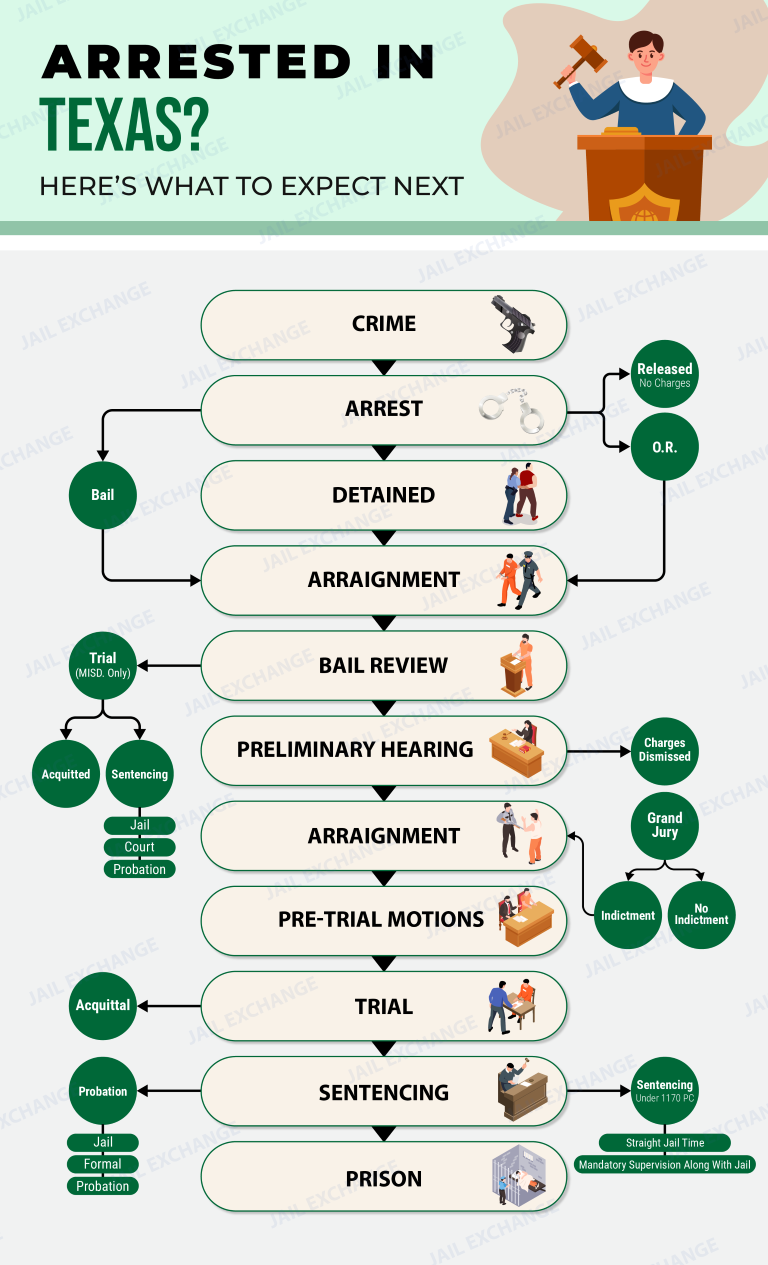
Sterling County Jail Criminal Court Process
Criminal Court Process for Sterling County Texas
Sterling County Criminal Courts
No county jail operates here, so a person picked up on a local charge may be held in San Angelo, at the Tom Green County Detention Center, 4382 N US Highway 277, San Angelo, TX 76905. The case itself stays home, in the courthouse on 4th Street. Read on for each court, the steps a charge takes, lawyers, warrants and court dates.
Searching by name on Texas IVSS-Counties tells you whether a county jail anywhere in the state lists the person. A second check is the official inmate lookup. For arrest details, the Sterling Inmates in Custody page explains who got booked lately, whether a warrant is out, the exact counts filed, jail photos, a lawyer paid by the court, and reclaiming a wallet or phone after release.
Ring 325-378-4771, the Sheriff's Office, before anything else. Three questions matter: which jail has the person now, what the charge says, and which court will hear it. For bond amounts, bondsmen and getting cash bail back, turn to our Sterling bail page.
1. Sterling County charge levels: who hears felonies, who hears misdemeanors?
In Texas, the grade printed on the charge picks the courtroom. Here all three trial courts share one building, the courthouse at 609 4th Street, Sterling City, TX 76951, main line 325-378-3481.
- Felony: the 51st District Court, whose judge rides a five-county circuit (Coke, Irion, Schleicher, Tom Green and this county). The District Clerk, 325-378-5191, takes the filings.
- Class A or B misdemeanor: the constitutional County Court, run by the elected County Judge. Lawyer requests on such charges are filed with it too.
- Class C: fine-only cases, so nobody serves jail time for them. These sit with the Justice of the Peace, 325-378-3761.
Not sure where a charge landed? The booking sheet lists the offense level. Read that line, then call the matching office above.
↑ Back to the question list2. Where do the hearings happen, and what are the clerk's hours?
Felony, misdemeanor and ticket dockets share one address: 609 4th Street, Sterling City, TX 76951. The building is open Monday through Thursday from 8:00 a.m. to 4:15 p.m., and on Friday from 8:00 a.m. to 2:00 p.m.
- Front desk and County Judge: 325-378-3481. Letters for the judge: Box 819, Sterling City, TX 76951.
- District Clerk: 325-378-5191; letters to Box 55, Sterling City, TX 76951. A regional council of governments directory shows this as one combined County and District Clerk office.
- Justice of the Peace: 325-378-3761; letters to Box 983, Sterling City, TX 76951. This office keeps slightly longer hours: 8:00 a.m. to 4:30 p.m. Monday to Thursday, and 8:00 a.m. to 2:00 p.m. Friday.
- County Attorney: 325-378-5621; letters to Box 88, Sterling City, TX 76951. Staff are in Monday and Wednesday, 8:30 a.m. to noon and 1:30 to 4:30 p.m., or by appointment.
Call before you drive in. A small office may be out at a hearing or closed for a holiday.
↑ Back to the question list3. Sterling City tickets: is there a town court?
No. The city's own website says it has no municipal court at present. A city citation lands on the JP's docket instead, inside the county building at 609 4th Street, Sterling City, TX 76951, 325-378-3761. For a question about a city rule, City Hall is at 508 3rd Street, Sterling City, TX 76951, 325-378-2811.
The JP's page on the county website lists fines for common citations. It also explains other ways to settle a fine besides paying. A traffic ticket may be settled through the payment portal linked from the county site. If money is short, Texas law gives JP courts these choices:
- a payment plan with set installments
- community service, credited at $150 or more for each 8 hours worked
- a full or partial waiver for someone who truly can't pay
Jail over a fine comes last of all (see CCP arts. 45A.252 to 45A.261), after a hearing. At it, the judge must decide that the person could pay yet made no good-faith effort.
↑ Back to the question list4. First appearance after an arrest: what goes on?
The first stop is a magistrate, inside 48 hours. Under the shared Concho Valley plan, this county's Justice of the Peace begins those duties by 1:00 p.m. each day. The person may stand before the JP or appear by video from the holding jail. In those few minutes the magistrate will:
- name the offense on the paperwork,
- explain two rights: silence, and help from counsel,
- take a request for a court-paid lawyer from anyone who can't afford one, and
- set bail and any release conditions.
What comes next depends on the level. Felony defendants have one extra option. CCP art. 16.01 calls it an "examining trial": a magistrate decides if enough evidence exists to go on. That right ends once a grand jury indicts. Misdemeanors begin differently: the County Attorney signs and files a charging document. Its legal name is an "information."
Arraignment follows. The court checks identity and hears the plea, guilty or not (CCP art. 26.01). Defense counsel can sign a waiver so the client never has to attend it (CCP art. 26.011).
↑ Back to the question list5. Misdemeanor arrest (theft, DWI, assault): what happens and what's the punishment?
Many common charges can be misdemeanors or felonies. The value taken, past convictions and injuries all change the level, so check the exact class on the paperwork. Penal Code chapter 12 sets the ranges:
- Class A: PC § 12.21 permits up to 12 months in jail, a fine reaching $4,000, or the pair together.
- Class B: PC § 12.22 permits 180 days of county time, a fine reaching $2,000, or the pair together.
- Class C: $500 tops, and never jail (PC § 12.23). For any Class C except public intoxication, an officer may hand out a citation rather than arrest (CCP art. 14.06).
Class A and B cases move through the County Court. The County Attorney prosecutes them (mail: Box 88, Sterling City, TX 76951), 325-378-5621. Once the information is on file, the court holds pretrial dates; the case ends in a negotiated plea or at trial.
Two results can keep a conviction off the record. Deferred adjudication puts a guilty finding on hold (CCP art. 42A.101; also arts. 42A.103, 42A.111). A misdemeanor version lasts two years or less, and the case is thrown out when the terms are met. Plain probation (community supervision, by statute) tops out at two years on these charges, per CCP art. 42A.053.
↑ Back to the question list6. Felony path in the 51st District Court: steps and prison ranges
A felony moves in stages. First, the person may request an examining trial. Next, grand jurors meet behind closed doors; CCP art. 20A.301 says nine or more of them must vote yes to indict. After that: arraignment, pretrial motions and, often, a plea offer. Suppose the judge turns down an agreed plea bargain. CCP art. 26.13 then lets the defendant take that guilty plea back. Cases that don't settle are tried.
Here is the punishment ladder set out in chapter 12 of the Penal Code:
- State jail felony: 6 to 24 months spent at a state jail unit, and as much as $10,000 in fines. Using or showing a deadly weapon bumps it to third degree.
- Prison terms by degree: a third-degree conviction carries 2 to 10 years. Second-degree ones bring 2 to 20. A first-degree conviction means 5 to 99 years or life. Any of the three can add a fine as large as $10,000.
- Capital felony: PC § 12.31 leaves adults facing execution or life, and that life term rules out parole. Offenders who were under 18 get life.
Earlier convictions can raise the grade (PC § 12.42). Going the other way, PC § 12.44 lets a judge drop the punishment for some state jail felonies to the Class A range. For felonies, deferred adjudication or probation may last up to 10 years. The 51st District Attorney prosecutes from 124 W. Beauregard, San Angelo, TX 76903, 325-659-6584. Probation is supervised by the Concho Valley CSCD, 3036 N Bryant Blvd, San Angelo, TX 76903, 325-659-6544.
↑ Back to the question list7. Violent or serious felony charges: how do they differ?
Charges that involve weapons, serious injury, sex crimes or a death carry stricter rules from arrest to sentence.
- Personal bond limits. A signature-only release is off the table on a long list of violent charges, under CCP art. 17.03.
- Bail can be refused. Proposition 3, which passed in November 2025, wrote § 11d into article I of the state constitution. For murder, aggravated kidnapping, aggravated robbery, trafficking and a few other listed crimes, prosecutors may ask a judge to deny bail outright.
- Prosecutor review and appeal. Since 2025, prosecutors may have a district judge recheck the bail in a felony (CCP art. 17.029). On certain violent counts, they may also appeal an amount they think is too small (CCP art. 44.01).
- Protective orders. CCP art. 17.292 lets a magistrate sign an emergency protective order during that first hearing. Its length: 61 to 91 days normally. If a deadly weapon was used or displayed during an assault, the range is 91 to 121 days instead.
- Weapons. A deadly weapon raises a state jail felony to third degree (PC § 12.35(c)).
Expect these cases to take longer. Ask the defense lawyer early how each rule could apply.
↑ Back to the question list8. Who prosecutes Sterling County cases, and who defends people short on money?
Two offices bring charges. Felonies are handled by the 51st District Attorney at 124 W. Beauregard, San Angelo, TX 76903, 325-659-6584. The County Attorney, 325-378-5621, takes Class A and B misdemeanors; its mailing address is Box 88, Sterling City, TX 76951.
On defense, seven Concho Valley counties share one court-appointed counsel plan. Under it, a regional public defender is offered many cases first:
- Concho Valley Public Defender's Office, 113 W. Beauregard Street, San Angelo, TX 76903, 325-229-4671, open Monday to Friday, 8:00 a.m. to 5:00 p.m.
- When that office can't take a case, the judge picks a private lawyer from an approved list.
Speak up at the magistrate hearing if you can. Too late for that? Fill out the Affidavit of Indigence (TIDC Form 2). Send it to the court where the charge sits: District Court for felonies, County Court for misdemeanors. Here, with fewer than 250,000 residents, CCP art. 1.051(c) sets the deadline for naming a lawyer at three working days after the request is received. After that, CCP art. 26.04 requires the lawyer to try reaching the client within one more working day.
↑ Back to the question list9. Looking up the case file or the next hearing
Texas court records sit on re:SearchTX. Signing up costs nothing. A logged-in member of the public sees each case's index, and five kinds of papers open too: indictments, informations, judgments, sentences and dismissal orders. E-filed cases go back to November 1, 2018. Copies cost $1.00 for up to 10 pages, then 10 cents a page.
That site is built for charges and outcomes. For the next hearing setting, phone the clerk:
- felony settings: District Clerk, 325-378-5191
- Class A and B settings: the courthouse line, 325-378-3481
- tickets and Class C: Justice of the Peace, 325-378-3761
Every one of those offices answers from 609 4th Street, Sterling City, TX 76951. Clerks find a file fastest by its case number. Otherwise they search by full legal name plus birthday. A background check of past convictions is a separate, paid service: the DPS conviction name search.
↑ Back to the question list10. Sterling County warrant check: who knows, and how do you settle it?
Here the Sheriff's deputies carry out arrest warrants. Phone 325-378-4771 to learn whether one is active, the charge behind it and the judge who signed it. State police post their worst-wanted list at DPS Texas 10 Most Wanted, also worth a glance.
A felony case file can be checked with the District Clerk, 325-378-5191, at the courthouse, 609 4th Street, Sterling City, TX 76951. For a missed ticket, ask the JP's office, 325-378-3761.
To resolve a warrant, hire or request a lawyer. With that lawyer, surrender at the court named on it, or phone its clerk about a new court date. Carry a photo ID and, if known, the case number.
↑ Back to the question list11. Federal charge from this area: which court and who holds the person?
San Angelo is where U.S. charges from this county get heard. That courthouse belongs to the Northern District's San Angelo Division, with the clerk at the O.C. Fisher Federal Building, 33 E. Twohig Avenue, Room 202, San Angelo, TX 76903, 325-655-4506.
- First appearance. A federal magistrate judge hears whether the person can go home on conditions or must stay locked up until trial (18 U.S.C. 3142).
- Custody. Pretrial federal detainees are the Marshals' responsibility, and many sleep in contract county jails. Their San Angelo office is at 33 E. Twohig Avenue, Suite 106-D, San Angelo, TX 76903, 325-658-4056. It is staffed during court terms only.
- Prosecution. The U.S. Attorney's Office (Northern District) is in Dallas at 1100 Commerce Street, 3rd Floor, Dallas, TX 75242, 214-659-8600.
- Defense. Without money for counsel, ask the court for the Federal Public Defender; its main branch is at 525 South Griffin Street, Suite 629, Dallas, TX 75202, 214-767-2746.
- After sentencing. To learn which federal prison took the person, use the BOP's online locator.
12. Immigration detainer on a Sterling County case: does the case stop?
No. The state case keeps going, and the court still expects the person at every setting. A detainer changes where the person goes after release:
- The paperwork is Form I-247A, which ICE sends to whichever jail has the person.
- Under 8 CFR 287.7(d), the jail may keep them up to 48 hours after they would otherwise be released, so ICE can arrange a pickup.
- Jails in Texas are bound by statute to honor the request (CCP art. 2A.060), though proof of lawful status releases the person from it.
- Gov't Code § 752.053 (2017) stops local governments from adopting policies limiting immigration enforcement.
- The 2025 law S.B. 8 adds a 287(g) duty: a county that operates a jail must request and enter that ICE agreement by December 1, 2026.
If ICE takes custody, the defense lawyer needs to know that day, so the judge learns the reason for any absence. Look the person up on the ICE Online Detainee Locator. Type in an A-number. Lacking that, use the name along with birth country and birthday.
↑ Back to the question list13. Long sentence: state jail or a TDCJ prison unit?
That depends on the sentence. Time on a state jail felony goes in a state jail facility. Second and third degree terms, and the top levels, are served in a TDCJ prison, run by the state's Texas Department of Criminal Justice agency.
Until transport, the person stays in county custody. Then comes a TDCJ intake unit, which runs tests and sorts newcomers by risk and need. Later the agency assigns a unit suited to that person.
- Use the TDCJ offender search by entering a SID or TDCJ number. Last name with first initial also works. Updates come once per working day.
- Unit addresses, mail and visiting rules: our Texas state prisons page.
14. Kids and teens charged: who handles a case under 17?
Age at the time of the offense decides. Juvenile court takes anyone aged 10 to 16. Seventeen counts as adult age in Texas criminal law (Fam. Code § 51.02(2)). Police must tell a parent quickly about the arrest and its reason (Fam. Code § 52.02).
- Fam. Code § 54.01 sets the detention hearing on or before working day two. After a Friday or Saturday detention, it moves up to working day one, and a lawyer is in place first.
- Fam. Code § 54.02 allows certain grave cases against youths as young as 14 to move up to adult court.
- Seven Concho Valley counties share a juvenile board. The board's detention site: the Tom Green County Juvenile Justice Center, 1253 West 19th Street, San Angelo, TX 76903, 325-655-2323. A child who must be held may go there.
To learn where a child is and when court is set, call the Sheriff's Office, 325-378-4771. The state agency for youth justice is TJJD, 1711 San Jacinto Blvd, Austin, TX 78701, 512-490-7130.
↑ Back to the question list15. Hurt by a crime in Sterling County? Victim rights and money help
Victims are not bystanders in a Texas case. CCP art. 56A.051 gives them the right to:
- safety counted as a factor when the magistrate sets bail,
- notice of hearings whenever they request it, and
- give a victim impact statement before sentencing.
CCP art. 56A.451 gives prosecutors 10 days after filing to mail victims notice of the case. For a felony, the contact is the 51st District Attorney, 325-659-6584, 124 W. Beauregard, San Angelo, TX 76903. In misdemeanor cases, call the County Attorney, 325-378-5621 (mail: Box 88, Sterling City, TX 76951).
Losses caused by the crime can be repaid up to $50,000. Apply to the Crime Victims' Compensation program; the state Attorney General pays these claims. Its phone is 800-983-9933. For an alert once the offender walks out of a county lockup, register with Texas IVSS-Counties. Its toll-free number, 866-268-8959, takes calls day and night, in Spanish or English.
↑ Back to the question list