
Arlington Police Department Jail
Arlington Police Department Jail
Jail Phone Number
817-459-5648Tarrant County Inmate Search: Tracking Someone Through the Fort Worth Jails
People arrested anywhere in the county are booked at the Sheriff's Corrections Center, 100 N. Lamar Street, Fort Worth, TX 76196. From there they may be housed in the Lon Evans Correction Center, 600 W. Weatherford Street, Fort Worth, TX 76196, the Green Bay Jail, 2500 Urban Drive, Fort Worth, TX 76106, or the Cold Springs labor detail. Arlington, Keller, Mansfield and White Settlement run short-stay city jails. Below: finding someone, then visits, deposits, mail, mugshots, warrants and court dates.
The Sheriff's inmate search takes a last and first name, or the CID number the jail assigns. Filters for race and sex help with common names. The Sheriff says this lookup, or a call to the jail, gives the charges and bond amounts for anyone held.
Ring the Inmate Information Line at 817-884-3000, open around the clock. Ask which building houses the person, the charge list and the bond figure. For release steps, read our bail page; for hearings and case stages, see the court page.
Read inmate search answers
 Read inmate search answers
1. What is the quickest way to use the Tarrant County inmate lookup?
The county jail system books about 35,000 people a year, so the lookup holds a lot of names. Use these steps:
- Load the Sheriff's inmate search page.
- Enter the surname, plus a first name when you have it. Use the spelling from their driver's license or ID card.
- Too many hits? Narrow them with the race and sex boxes, or show more records per page.
- Open the right record and copy down the CID number. Staff and the mailroom move faster with it.
- For a very fresh arrest, also check the Sheriff's daily booked-in reports.
Still unsure? Staff on the Inmate Information Line, 817-884-3000, can look the person up by name and birth date.
↑ Back to the question list2. Why might the search come back empty?
An empty result can mislead. Think through these reasons:
- Still in booking. Intake for the whole county runs through one building, and it can take hours.
- Held by a city. Some cities keep their own arrests for a short stay before transfer or release. See the next answer.
- Already released. Bond may have been posted, or a magistrate may have granted a personal bond.
- Moved. They may have left for a state prison, for federal custody or for another county holding a warrant.
- Too young. Anyone 16 or under is sent to the juvenile center instead.
- Spelled another way. Try it with both surnames, a former married name or a nickname.
The quickest check is a call to the Inmate Information Line at 817-884-3000.
↑ Back to the question list3. Which Tarrant County jail or city lockup could be holding them?
The Sheriff's Detention Bureau runs five jail facilities with room for about 5,000 people. All share one phone line, 817-884-3000, and the same visiting schedule.
- Corrections Center, 100 N. Lamar Street, Fort Worth, TX 76196. Every new arrest is booked, photographed and iris-scanned here. It is a maximum-security jail where officers work right inside the housing pods. Women trustees also sew mattresses and uniforms in its Jail Industries shop.
- Lon Evans Correction Center, 600 W. Weatherford Street, Fort Worth, TX 76196. A five-story maximum-security jail, certified by the state in 2012. Its central kitchen cooks for all the jails.
- Green Bay Jail, 2500 Urban Drive, Fort Worth, TX 76106. A former warehouse turned into a maximum-security jail, with 1,596 beds since 2007.
- Cold Springs Jail and Labor Detail, 1813 Cold Springs Road, Fort Worth, TX 76196, 817-884-1638. Built for low-risk prisoners, it has 384 beds used when needed. Inmates on the Sheriff's work crews bunk there.
- Belknap Facility. Older records name a jail unit at 350 W. Belknap Street, Fort Worth, TX 76196. County offices now list that building for courts, probation and a constable, so call the main jail line if papers mention Belknap.
City jails hold some arrests first, usually for a short time:
- Arlington City Jail, 620 W. Division Street, Arlington, TX 76011, 817-459-5648. Enter on the west side, facing Cooper Street. The city posts an online jail inmate list.
- Keller Regional Detention Center, 330 Rufe Snow Drive, Keller, TX 76248, 817-743-4770. It holds Keller and Southlake arrests and answers inmate and bond questions by phone.
- Mansfield Jail, 1601 Heritage Parkway, Mansfield, TX 76063, 817-804-5724, staffed 24 hours. It holds city prisoners and federal prisoners.
- White Settlement Holding Facility, 8900 Clifford Street, White Settlement, TX 76108, 817-246-7070. It books people arrested on charges or warrants. A judge sets bond at a morning arraignment most days.
- North Richland Hills Police City Jail. For whether a North Richland Hills arrest is still held there, ask the main jail line above.
- Grand Prairie Detention Center, 1525 Arkansas Lane, Grand Prairie, TX 75052, 972-237-8951. It takes Grand Prairie arrests from every county the city reaches into.
Children go to the Lynn W. Ross Juvenile Detention Center, 2701 Kimbo Road, Fort Worth, TX 76111, 817-838-4610.
↑ Back to the question list4. What do the daily booking and bond reports show?
Besides the name search, the Sheriff posts two daily lists. The booked-in reports cover recent bookings. The bond reports cover bonds posted. A third list on the lookup site, the magistration docket, shows who is due before a magistrate.
These lists help when a name is new or spelled oddly. For anything you can't find, call 817-884-3000.
↑ Back to the question list5. Can I see Tarrant County mugshots online?
Every person booked here is photographed at the Corrections Center. The Sheriff's website files its search under an "Inmate Records / Mugshots" heading, but the search page itself says only that it shows inmate information. To request the photo itself, send a written Public Information Act request to the Sheriff's Office, 200 Taylor Street, Fort Worth, TX 76196, 817-884-3099. Texas law makes basic facts about an arrest public (Gov't Code 552.108).
- Some websites post mugshots and charge $150 or more to pull them down. Texas makes those sites correct or delete an entry that is wrong or incomplete at no cost. A record a court has expunged or covered by a nondisclosure order can't go up at all (Business and Commerce Code chapter 109).
- ICE booking photos are requested through its FOIA records page.
- The federal government does not hand out its booking photos, though the U.S. Marshals Service may release one of a fugitive it is hunting.
6. Is there a free text or call alert for a release or transfer?
Yes, through Texas IVSS-Counties, which took over from the old VINE system. Look the person up with all or part of the name. Then choose to be notified about a booking, a release, a transfer or a changed court event. An account is optional. Signing up costs nothing, stays confidential, and the inmate never learns of it. Call 866-268-8959 at any hour for help in English or Spanish.
For a same-day answer, nothing beats the Inmate Information Line at 817-884-3000. Victims in family violence cases are also told before the person is released (CCP art. 17.29).
↑ Back to the question list7. What should families expect from the bond process in Fort Worth?
A magistrate must see the person within 48 hours. Here that is Central Magistration, at the Magistrate Courts, Tim Curry Criminal Justice Center, 401 W. Belknap Street, Fort Worth, TX 76196, 817-884-2812. The person hears their rights, may ask for appointed counsel and learns the bond amount there.
- Bonds are posted at the Corrections Center Bond Desk, open 24 hours. A person paying on their own must pay the full amount.
- Bonding companies licensed by the county charge a fee to post a surety bond.
- Some people get a personal bond with no money down. The court date is on the release papers. Lost them? Call 817-884-2674.
- Family violence cases can carry a four-hour hold after bond (CCP art. 17.291).
Our bail page explains bond types, payment and holds in full.
↑ Back to the question list8. Where are the person's charges written down?
Search the person on the jail lookup, or ask the Inmate Information Line. Write down each charge and its bond. After the prosecutor files the case, court records spell out each count:
- Felony and Class A or B settings: criminal dockets
- Class A and B files: county court records portal
- Felony filings: the District Clerk, 817-884-1574
Final charging choices belong to the Criminal District Attorney's Office, 401 W. Belknap Street, Fort Worth, TX 76196, 817-884-1400. Texas charges run from fine-only Class C up through capital felonies (Penal Code chapter 12).
↑ Back to the question list9. How does a person in custody get appointed counsel?
At magistration the person is asked if they want a free lawyer, and the magistrate helps with the form. The county then assigns an approved private lawyer through the Office of Attorney Appointments, 401 W. Belknap Street, Room 5043, Fort Worth, TX 76196, 817-884-2370. State law gives a county this big one working day to make the appointment (CCP art. 1.051).
The money form is the Affidavit of Indigence. A family can also retain its own attorney instead. Attorneys may visit whenever needed, and Wednesdays and Thursdays are set aside for lawyers and police.
↑ Back to the question list10. What are the Tarrant County jail visiting rules?
Every Sheriff's jail uses the same schedule, based on the inmate's last name:
- Last names A to L: Saturday and Monday, 9 a.m. to 9 p.m.; Friday, 9 a.m. to 3 p.m.
- Last names M to Z: Sunday and Tuesday, 9 a.m. to 9 p.m.; Friday, 3 p.m. to 9 p.m.
- Wednesday and Thursday: lawyers and law enforcement only.
Sign-in opens 30 minutes before visiting starts. No one is let in after 8:30 p.m., or after 2:30 p.m. on the early Friday block. More rules:
- One 30-minute visit a day, and up to three a week. Visitors who live more than 150 miles from Fort Worth get 40 minutes.
- At most two grown-ups and two kids 17 or under per visit. Kids must come with an adult.
- Anyone who was in a county jail here in the past six months may not visit.
- Bring a photo ID, such as a license, passport, military ID or Mexican Consulate card. Children may use a school ID.
- No phones, cameras, bags, purses, tobacco or food. A parent with a baby may bring one diaper bag.
- Dress modestly. Revealing shorts, tight or see-through clothes, hats, sleeveless tops and khaki or military-style clothes are turned away.
- Hospital visits run daily from 5 p.m. to 9 p.m.
See our visiting guide for general tips.
↑ Back to the question list11. Which deposit options does the Sheriff accept for inmate accounts?
The Sheriff offers five ways to add money:
- Lobby kiosk. Kiosks in the jail lobbies take cash. This is the only way to hand over cash at the jail.
- App or website. Pay with Visa or MasterCard. The Sheriff says this has the lowest handling fee.
- Phone. Call 866-345-1884 any hour, in English or Spanish, with a Visa or MasterCard.
- Mail. Only U.S. Postal or Western Union money orders, sent to Sheriff's Office Detention Bureau, 100 N. Lamar Street, Fort Worth, TX 76196. Mailed cash is sent back.
- Cash at a store. The Sheriff points to Cash Pay Today. Sign up online or call 844-340-2274. Dollar General and Family Dollar need a barcode, and Family Dollar takes only a printed one.
Have the CID number ready. Read about deposits in our money guide; what the funds can buy is in our commissary guide.
↑ Back to the question list12. Phone calls, collect charges and tablets: what applies here?
Every holding cell in booking has a phone, and calls during booking are free. After that:
- Calls to local numbers cost nothing.
- Calls outside the local area are collect, so the person who accepts pays.
- For rates, the Sheriff sends families to the jail's phone provider at 727-349-1561.
- Inmates use tablets to read their scanned mail.
Case talk is best kept for the defense attorney. Our jail phone guide explains calling plans. Texting and e-messages get their own inmate messaging guide.
↑ Back to the question list13. How should letters and books be addressed?
Personal letters, cards and postcards skip the jail. They go to an outside mail center, which scans them so the person can read them on a tablet. The exact address is shown on the Sheriff's inmate mail page. Personal mail sent straight to the jail comes back stamped Return to Sender.
Legal mail, books, magazines and money orders go to 100 North Lamar Street, Fort Worth, TX 76196. Rules to follow:
- Envelopes may be no bigger than 12 by 16 inches.
- Up to 10 photos, unframed, each 4 by 6 inches or smaller.
- Books must be new softcovers, shipped by the publisher through UPS or the Postal Service. Packages from other carriers, Amazon and store distributors are refused.
- Magazines and puzzle books come only through a publisher subscription.
- Anything not allowed is returned.
Our mail guide has more general advice.
↑ Back to the question list14. How is property released?
Clothing and items taken at booking normally go home with the person on release day. For a leftover account balance, phone the jail at 817-884-3000.
A tighter rule covers people headed to state prison. Only someone being sent to a Texas Department of Criminal Justice unit, or a place that works for it, can hand off clothes and property. At transfer, they write down who will pick it up. That person gets 30 days from the transfer date. Real hardship cases can ask Jail Administration for more time, through a captain or the booking watch commander.
↑ Back to the question list15. Who handles medicine, injuries or a mental health crisis in jail?
Each jail offers medical care, counseling and mental health services. If the person needs regular medication, lives with a chronic condition or has an injury, call 817-884-3000 and ask how to get health details to the medical staff. Tell staff which medicine, how much and how often, and who prescribed it.
Signs of mental illness must be reported to a magistrate, and staff have 12 hours to do it (CCP art. 16.22). In a true emergency, call 911. The jails also offer GED and English classes, a law library and re-entry services for people getting ready to leave.
↑ Back to the question list16. Who checks on conditions inside the jails?
The Texas Commission on Jail Standards inspects county jails. The Sheriff says the county has passed that certification every year since 1995. Each jail must also give inmates a written way to file a grievance.
A family member with a concern can use the commission's complaint form, email info@tcjs.state.tx.us or call 512-463-5505. Name the jail and the inmate, and give your contact details.
↑ Back to the question list17. Could there be a Tarrant County warrant too?
Deputies in the Sheriff's Criminal Warrants Division serve most warrants, at 200 Taylor Street, Fort Worth, TX 76196, 817-884-1289. Constables and city officers serve others; Fort Worth's non-emergency line is 817-392-4222. The Warrants Division handles public questions through a lawyer or licensed bondsman. Wanted fugitives are pictured on the Sheriff's Most Wanted page and on Texas 10 Most Wanted. A Class C case can be checked in the JP case lookup. To settle a warrant, go with a lawyer to the Corrections Center, 100 N. Lamar Street, Fort Worth, TX 76196, or contact the court that issued it. Felony files: District Clerk, 401 W. Belknap Street, Fort Worth, TX 76196, 817-884-1574.
↑ Back to the question list18. Which tools show the next hearing date?
Several places show it:
- The criminal court dockets, for felony and Class A or B settings.
- The release papers, for anyone let out on a personal bond. Lost copies: 817-884-2674.
- Criminal Court Support, Tim Curry Criminal Justice Center, 401 W. Belknap Street, Fort Worth, TX 76196, 817-212-6957, weekdays 8 a.m. to 5 p.m.
- The County Clerk's case status line, 817-884-1066, for Class A and B cases.
Our court page lists every courtroom and explains each stage of a case.
↑ Back to the question list19. Where is someone on a federal charge kept?
U.S. charges here are heard at the federal courthouse, 501 West 10th Street, Room 310, Fort Worth, TX 76102, 817-850-6600.
- At a detention hearing, a federal magistrate judge rules on release before trial (18 U.S.C. 3142).
- Anyone kept in custody is a U.S. Marshals Service prisoner, often housed in a nearby jail that accepts Marshals prisoners. The Mansfield Jail is one. Ask the Marshals at 501 West 10th Street, Room 211, Fort Worth, TX 76102, 682-703-4574.
- People awaiting trial may not show on the Bureau of Prisons search, since they are not yet in its custody.
- After sentencing, look them up on the Federal Bureau of Prisons inmate locator.
20. Where would ICE take someone after the jail?
Here is the order things usually happen in:
- While the person is in the county's custody, immigration agents file Form I-247A asking that they be held.
- When the local case would let them go, the Sheriff may hold them up to 48 hours after they would otherwise be released (8 CFR 287.7(d)).
- Texas jails are required to honor these requests (CCP art. 2A.060), and local rules may not get in the way of immigration enforcement (Gov't Code 752.053). Papers showing citizenship or lawful presence end the hold.
- ICE then moves the person under its Dallas Field Office, 8101 N. Stemmons Freeway, Dallas, TX 75247, 972-367-2200.
- Use the ICE Online Detainee Locator. It needs a full name, an A-number or a birth date, along with the country of birth. No match? Phone the field office.
Under S.B. 8 from 2025, each Texas sheriff who operates a jail must apply to ICE's 287(g) program no later than December 1, 2026. The Sheriff's Office, 817-884-3099, can tell you whether this county has signed one.
↑ Back to the question list21. How do I trace someone sent to a Texas prison unit?
Sentenced people stay in county custody until the state prison system has a spot. They go through intake first, then move to a unit that suits them.
- Use the TDCJ inmate search. Enter a last name spelled exactly, plus a first initial at minimum, or a TDCJ or SID number. It lists only people now in a state facility, and its records lag by 24 hours or more.
- Each unit's visiting and mail rules are on our Texas state prisons page.
- Remember the 30-day window to claim property after the move.
22. What if the person held in Tarrant County is 16 or younger?
Anyone 10 through 16 is handled as a child under Texas law (Family Code 51.02). A detained youth goes to the Lynn W. Ross Juvenile Detention Center, 2701 Kimbo Road, Fort Worth, TX 76111, 817-838-4610, while they wait for court.
- Close family may visit for 30 minutes a day.
- Each child gets a five-minute phone call with a parent or guardian every day.
- Every child is checked for mental health needs and seen by the on-site clinic.
- Within two working days a juvenile judge holds a detention hearing. Counsel for the child is in place before it begins (Family Code 54.01).
- Juvenile Services, the county's juvenile probation office, is at the same address, 817-838-4600, weekdays 7:30 a.m. to 4:30 p.m.
23. Which police force or constable made the arrest?
Deputies cover areas outside city limits. The Sheriff's Office is at 200 Taylor Street, Fort Worth, TX 76196, 817-884-3099. Larger city departments with confirmed lines:
- Fort Worth Police Department, Bob Bolen Public Safety Complex, 505 W. Felix Street, Fort Worth, TX 76115, non-emergency 817-392-4222
- Arlington Police Department, Ott Cribbs Public Safety Center, 620 W. Division Street, Arlington, TX 76011, 817-459-5700, open 24 hours
- Mansfield Police Department, 1601 Heritage Parkway, Mansfield, TX 76063, non-emergency 817-473-0211
- Bedford Police Department, 2121 L. Don Dodson Drive, Bedford, TX 76021, non-emergency 817-952-2127
- Southlake Police Department, 600 State Street, Southlake, TX 76092, non-emergency 817-743-4522. This dispatch line also serves Keller, whose police office is at 817-743-4577.
- White Settlement Police Department, 8900 Clifford Street, White Settlement, TX 76108, 817-246-7070
- Grand Prairie police book at their Detention Center, 1525 Arkansas Lane, Grand Prairie, TX 75052, 972-237-8951
The county's other incorporated places are below, grouped by area. For the right non-emergency line in any of them, ask the Sheriff's Office at the number above.
- Northeast: Colleyville, Euless, Flower Mound, Grapevine, Haltom City, Hurst, North Richland Hills, Richland Hills, Trophy Club, Watauga and Westlake.
- Northwest: Azle, Blue Mound, Haslet, Lake Worth, Lakeside, Newark, Pelican Bay, Reno, River Oaks, Saginaw and Sansom Park.
- West and southwest: Benbrook, Burleson, Crowley, Edgecliff Village, Westover Hills and Westworth Village.
- South and east: Dalworthington Gardens, Everman, Forest Hill, Kennedale and Pantego.
Constables serve warrants and papers in eight precincts:
- Precinct 1: 100 W. Weatherford Street, Suite 460A, Fort Worth, TX 76196, 817-884-1385
- Precinct 2: 700 East Abram Street, Suite 202, Arlington, TX 76010, 817-548-3910
- Precinct 3: 645 Grapevine Highway, Suite 110, Hurst, TX 76054, 817-581-3610, plus a Southlake office at 1400 Main Street, Suite 240, Southlake, TX 76092
- Precinct 4: 6713 Telephone Road, Suite 102, Lake Worth, TX 76135, 817-238-4411
- Precinct 5: 350 W. Belknap Street, Fort Worth, TX 76196, 817-884-1892
- Precinct 6: 6551 Granbury Road, Fort Worth, TX 76133, 817-370-4510
- Precinct 7: 1100 East Broad Street, Suite 201, Mansfield, TX 76063, 817-473-5110
- Precinct 8: 3500 Miller Avenue, Fort Worth, TX 76119, 817-531-5610
State troopers with the Texas Department of Public Safety also make arrests on highways here, and those arrests are booked into the county jail, 817-884-3000.
↑ Back to the question listTarrant County Bail and Release
Anyone arrested by deputies or most city officers here is booked at the Sheriff's Corrections Center, 100 N. Lamar Street, Fort Worth, TX 76196. Later they may be moved to the high-security Lon Evans Correction Center, the Green Bay Jail or the Cold Springs labor detail site. Arlington, Keller, Mansfield and White Settlement keep short-stay city lockups. This page walks through the magistrate's role, the 24-hour bond window, bondsmen and the holds that a paid bond leaves in place.
Type a last name or CID number into the Sheriff's jail lookup and the result tells you if your person remains behind bars. For everything else about the arrest and custody, open our Inmates in Custody page. With it you can trace a booking and learn about warrants and charges. It also shows how to find mugshots, reach a free lawyer and pick up belongings.
Start with the Inmate Information Line, 817-884-3000, which answers day and night. Ask if a magistrate has fixed the amount yet, what each charge carries and whether another agency has a hold. Our court page covers the case after release, and the Texas bail laws page sums up the statewide rules.
1. Who fixes bail after a Tarrant County arrest, and when?
A Texas magistrate sets it, and the law gives police two days at most to bring the person before one (CCP arts. 14.06, 15.17). In this county the work is done by Central Magistration. Its judges sit in the Magistrate Courts at the Tim Curry Criminal Justice Center, 401 W. Belknap Street, Fort Worth, TX 76196, 817-884-2812. Call that same number after hours.
Some hearings use a camera link between the courtroom and the jail. The county streams these on its remote magistration video page, and the Sheriff's lookup site carries a magistration docket of who is up next. During the hearing, expect the magistrate to:
- name each accusation and cover the person's rights: silence, a lawyer of their own and an examining trial;
- ask if the person wants a free lawyer and help with the request form;
- set the bond amount and any rules for release;
- decide on an emergency protective order in a family violence case.
Judges here size up each bond one person at a time. They weigh the facts alleged, the chance of a new offense before trial, what the person can afford and how well they have shown up to court before. Under CCP art. 17.028, conditions should be no tighter than needed. Before bail is set on anything from Class B up, the magistrate gets a public safety report listing past convictions and pending cases. Under CCP arts. 17.021 and 17.022, that report carries no risk score and no suggested amount.
↑ Back to the question list2. Which kinds of release can the magistrate choose?
Texas law splits bail into two families (CCP art. 17.01): money-backed bonds and personal bonds. Here are the four paths people here usually meet:
- Cash bond. A friend or relative deposits every dollar of the bond. The money comes back after the case closes, if the person made each hearing.
- Surety bond. A licensed bonding company promises the court the whole sum. You pay that company a fee, and the fee is never refunded.
- Personal bond. No money changes hands at the start; the person just signs a written pledge to appear whenever the court orders. The magistrate can add rules, such as check-ins or a monitor.
- Citation for small cases. Most Class C cases end with a ticket, not a trip to jail (CCP art. 14.06).
Judges can't grant a personal bond on many violent offenses. The same goes for a Class A or felony terroristic threat, breaking certain protective orders, a felon who has a gun, or a new arrest while already on probation or parole for a violent offense. S.B. 9 added more to that list in 2025. Only the trial judge can approve one for burglary, organized crime or certain drug felonies (CCP art. 17.03).
Some drunk driving cases bring a breath device on the car as a bond rule. It applies after more than one DWI, when a child rode along, and for intoxication assault or manslaughter (CCP art. 17.441).
↑ Back to the question list3. How much is bail on common Tarrant County charges?
No fixed chart of bail amounts exists anywhere in Texas. A magistrate here picks each figure using the factors in CCP art. 17.15. It should be large enough that the person comes back to court, and never so large that it oppresses them. The judge also weighs the charge, the safety of the victim and others, the person's record, their ability to pay and their citizenship status.
Only a few dollar limits are fixed by law. After an arrest made with no warrant, a magistrate must find probable cause quickly. When that ruling runs late, release is due by hour 24 on a misdemeanor or hour 48 on a felony. The bond can't go above $5,000 or $10,000 in those cases, and a person without the money must be offered a personal bond (CCP art. 17.033).
To see real amounts set here, check the Sheriff's daily bond reports and daily booked-in reports. For the figure on your person's charge, call the Inmate Information Line at 817-884-3000.
↑ Back to the question list4. How does the 24-hour Bond Desk handle a payment?
Bonds are posted at the Bond Desk inside the Corrections Center, 100 N. Lamar Street, Fort Worth, TX 76196. The desk works around the clock. Follow these steps:
- Call 817-884-3000. Ask if a magistrate has set the amount yet, since nothing can be posted before that.
- Write down the person's full legal name and CID number from the inmate lookup.
- Decide who pays. If you pay it yourself, the desk wants the full bond amount. A bondsman can post a surety bond for you instead.
- Ask on that call which forms of payment the desk accepts that day.
- Carry a photo ID. Hold on to each receipt.
- Expect a wait. Release paperwork and property take time, and some cases have a set hold first.
A person let out on a personal bond gets a court date on the release papers. If those papers are lost, call 817-884-2674 for the court, date and time.
↑ Back to the question list5. Do the clerks or city jails play a part in bond?
For county cases, the Sheriff points families to the Corrections Center Bond Desk. Other offices still play a part:
- Magistrate Courts, Tim Curry Criminal Justice Center, 401 W. Belknap Street, Fort Worth, TX 76196, 817-884-2812. They set and change bond.
- District Clerk (felony files and felony fees), third floor of the same building, 401 W. Belknap Street, Fort Worth, TX 76196, 817-884-1574, weekdays 8 a.m. to 5 p.m. Felony costs are listed in the clerk's felony payments sheet.
- County Clerk (Class A and B files and fines), second floor, with a cashier on the lower plaza level, 401 W. Belknap Street, Fort Worth, TX 76196, 817-884-1066, weekdays 7:30 a.m. to 5 p.m. Its fines page is for fines, not for bail.
Some cities hold their own arrests first. Ask each one how bond works there:
- Arlington City Jail, 620 W. Division Street, Arlington, TX 76011, 817-459-5648.
- Keller Regional Detention Center, 330 Rufe Snow Drive, Keller, TX 76248, 817-743-4770. It also holds Southlake arrests.
- Mansfield Jail, 1601 Heritage Parkway, Mansfield, TX 76063. Bond and inmate answers come 24 hours a day at 817-804-5724.
- White Settlement Holding Facility, 8900 Clifford Street, White Settlement, TX 76108, 817-246-7070. A judge sets bond at arraignment, usually each morning.
- Grand Prairie Detention Center, 1525 Arkansas Lane, Grand Prairie, TX 75052, 972-237-8951. Bonds above Class C are posted in the county where the case is filed.
6. Which payments work for a Tarrant County bond?
The Sheriff's bond page tells self-payers to bring the full amount. Before you leave home, call 817-884-3000 and ask which of these the desk will take today: cash, money orders, cashier's checks or cards.
- Have the person's name and CID number ready when you pay.
- Make sure the receipt shows who put up the money. Refunds go to whoever is named on it (CCP art. 17.02).
- A bondsman sets its own fee and payment terms. Get them in writing.
- Never send bond money in the mail.
Paying a fine on a closed misdemeanor is a different step. The County Clerk takes cards for a 2.35% fee, at least $1.50, plus $2 per payment. Online fine payments take three to four business days to post.
↑ Back to the question list7. Who licenses bondsmen in Tarrant County?
Because the county has more than 110,000 people, it must have a bail bond board, and no one may write bonds here without its license (OC 1704.002, 1704.151). The Tarrant County Bail Bond Board is chaired by the District Clerk, 817-884-1574. It meets the first Wednesday of each month at 1 p.m. in the Commissioners Courtroom, Administration Building, 100 East Weatherford Street, Fifth Floor, Fort Worth, TX 76102.
The board's bail bond board page links its board rules. By law, its list of licensed sureties must hang in each criminal court and in the booking area (OC 1704.107). Ask the bond desk staff to point it out.
- Texas puts no cap on the fee a bondsman charges.
- The bondsman must give a receipt for any money or property.
- Bondsmen may not hunt for clients inside the jail.
- Want your collateral back once the case wraps up? Ask in writing, and the company owes it to you within 30 days (OC 1704.301).
- An attorney already hired for the case can post the bond with no bail license (OC 1704.163).
- Before a bondsman can surrender a client, it has to notify the client's lawyer, plus the prosecutor on a felony. A sworn affidavit then goes to the judge (CCP art. 17.19).
8. Once bond is paid, which holds can still block release?
Each bond pays for one case only. So before paying, have the Inmate Information Line at 817-884-3000 go through every charge and hold with you. Common ones:
- Another case. Each charge, including a city ticket, may need its own bond.
- Another county's warrant. A local magistrate can set bail here and forward the paperwork to the county that wants them (CCP art. 15.18). Some counties still want the person picked up.
- Parole. A "blue warrant" from the parole board holds the person with no bond until the board rules on the violation (Gov't Code 508.254).
- Probation. A motion to revoke probation may carry its own warrant. The Community Supervision and Corrections Department central office is at 350 W. Belknap Street, Fort Worth, TX 76196, 817-884-1600.
- An ICE detainer. See the immigration answer below.
- A federal hold. That case needs its own federal release order.
- Mental health. When the jail sees signs of mental illness, it must tell the magistrate within 12 hours, which can lead to an exam (CCP art. 16.22).
9. What changes when the arrest is for family violence?
Family violence cases have extra steps in Texas:
- When the magistrate expects more violence, the person stays locked up four hours after bond is posted. With a signed order, a magistrate may keep the person up to two more days (CCP art. 17.291).
- Before release, the jail notifies the victim (CCP art. 17.29).
- At magistration, judges here may grant an emergency protective order. Most run 61 to 91 days. A case with a weapon or a serious injury gets a longer order, from 91 up to 121 days (CCP art. 17.292).
- Breaking a bond condition in these cases can lead a judge to deny bail (CCP art. 17.152).
An emergency protective order stays in force until the end date printed on it. Questions about one go to the prosecutor on the case at the Criminal District Attorney's Office, 817-884-1400. Its protective order unit answers at 817-884-1623.
↑ Back to the question list10. When may bail be denied outright in Texas?
Texas lets almost everyone out on bail. The state constitution makes these exceptions:
- Capital cases with very strong proof (art. I, §11).
- A new felony after two felony convictions, or while out on bail for a felony. A district judge decides after a hearing (§11a).
- Breaking release rules tied to safety in a felony or family violence case (§11b), and breaking certain protective orders (§11c).
- Proposition 3 passed on November 4, 2025, and added §11d. It covers murder of any kind, robbery, kidnapping or sexual assault when aggravated, indecency with a child, human trafficking, and aggravated assault where someone was badly hurt or a gun, knife, club or bomb was used. Bail must be denied when the state shows at a hearing that the person will likely flee or is a danger. Only the prosecutor may ask. A judge who grants bail must explain why in writing.
S.B. 9 took effect on September 1, 2025. Under it, prosecutors may have a felony bail reviewed by a district judge (CCP art. 17.029). When a listed violent charge gets a bail the state thinks is too low, the state can appeal. The person stays locked up while the appeals court decides, within 20 days (CCP art. 44.01).
The prosecutor is the Criminal District Attorney's Office, Tim Curry Criminal Justice Center, 401 W. Belknap Street, Fort Worth, TX 76196, 817-884-1400, open weekdays 7:45 a.m. to 4:45 p.m.
↑ Back to the question list11. How can a family ask for a lower bond?
The defense lawyer writes up a request, often called a bond reduction motion, and sends it to the judge presiding over the case. Families help most by gathering proof:
- Proof of steady work and a home, plus letters from a boss, teacher or faith leader.
- Proof of what the family can truly pay. A judge should not set an amount meant to keep someone poor locked up (CCP art. 17.15).
- A plan the judge can trust, such as a sober living spot, a job or a ride to court.
Delay by the state can help too. The clock starts when custody begins. The state gets 90 days to be ready on a felony, but only 5 days on a fine-only charge. For a jailable misdemeanor it gets 30 days when the top jail term is over 180 days, or 15 days when it is 180 days or less. Miss one, and the judge must grant a personal bond or cut the amount, with some exceptions (CCP art. 17.151).
For which court has the case, call Criminal Court Support at 817-212-6957, weekdays 8 a.m. to 5 p.m.
↑ Back to the question list12. Where does a free lawyer come from in Tarrant County?
The magistrate asks about a lawyer at the first hearing and helps fill in the request. That request must reach the people who appoint lawyers within 24 hours. Because over 250,000 people live here, counsel has to be appointed no later than one working day after the request arrives (CCP arts. 1.051, 15.17). Once named, the lawyer should reach out to the client within about one more working day.
Appointments here run through the Office of Attorney Appointments, 401 W. Belknap Street, Room 5043, Fort Worth, TX 76196, 817-884-2370. It helps the judges use approved private lawyers under the county plan.
- Money form: Affidavit of Indigence
- County plans on file with the state: felony plan and misdemeanor plan
- Texas Indigent Defense Commission, 209 West 14th Street, Room 202, Austin, TX 78701, 512-936-6994
13. Which courthouses hear Tarrant County criminal cases?
Nearly every criminal case starts in one place, the Tim Curry Criminal Justice Center, 401 W. Belknap Street, Fort Worth, TX 76196. Its courts are open weekdays 8 a.m. to 5 p.m. Criminal Court Support answers at 817-212-6957. Eleven felony courts, ten County Criminal Courts for Class A and B cases, and the Magistrate Courts all sit here.
Fine-only Class C tickets are heard by eight Justice of the Peace precincts and by city courts:
- JP Precinct 1: 100 W. Weatherford Street, Room 450, Fort Worth, TX 76196, 817-884-1395
- JP Precinct 2: 700 East Abram Street, Suite 200, Arlington, TX 76010, 817-548-3925
- JP Precinct 3: 645 Grapevine Highway, Suite 220, Hurst, TX 76054, 817-581-3625, with a second office at 1400 Main Street, Suite 220, Southlake, TX 76092, 682-732-6589
- JP Precinct 4: 6713 Telephone Road, Suite 201, Lake Worth, TX 76135, 817-238-4425
- JP Precinct 5: 350 W. Belknap Street, Fort Worth, TX 76102, 817-884-1438
- JP Precinct 6: 6551 Granbury Road, Fort Worth, TX 76133, 817-370-4525
- JP Precinct 7: 1100 E. Broad Street, Suite 202, Mansfield, TX 76063, 817-473-5101
- JP Precinct 8: 3500 Miller Avenue, Fort Worth, TX 76119, 817-531-5625
- Fort Worth Municipal Court: 1000 Throckmorton Street, Fort Worth, TX 76102, 817-392-6700
- Arlington Municipal Court: 101 S. Mesquite Street, Arlington, TX 76010, 817-459-6777. Call to confirm the room, since the court has moved for a time.
Federal charges go to the U.S. Courthouse, 501 West 10th Street, Room 310, Fort Worth, TX 76102, 817-850-6600.
↑ Back to the question list14. How do refunds and forfeitures of cash bonds work here?
Under CCP art. 17.02, cash bail comes back once the bond terms are met, minus any fee. The clerk can hold back 5%, never more than $50, but only after a guilty finding or deferred adjudication. The court may also put the cash toward money the person owes the court, like fines (CCP art. 17.53).
For a Class A or B case, the County Clerk returns cash bonds at 401 W. Belknap Street, Fort Worth, TX 76196. Show a driver's license or another ID with your photo. Refunds are handed out from 8 a.m. to noon and 1 p.m. to 3 p.m. You can also mail a notarized request with the case number and your current address to the County Clerk at that address. Questions go to 817-884-2848. For a felony cash bond, call the District Clerk at 817-884-1574.
Missing court is costly. The judge can declare the bond forfeited, and whoever posted it may owe the full amount (CCP art. 22.01). A surety is off the hook if police have the person back in custody before 180 days pass on a misdemeanor, or before 270 days on a felony charge (CCP art. 22.13). Prosecutors may file bail jumping as its own crime too, from Class C up to a third-degree felony, based on the first charge (Penal Code 38.10).
↑ Back to the question list15. How do they get back jail account cash and property?
Most people walk out with their own clothes and property. Call the Corrections Center at 817-884-3000 and ask how a leftover jail account balance is paid out.
When someone is sent on to state prison, the rules are strict. Only someone headed to a TDCJ unit, or to a facility under contract with TDCJ, may sign property and clothing over to another person. They name that person on a form at transfer. The named person then has 30 days from the transfer date to claim the items. Hardship requests go to Jail Administration through the same number.
Deposits and account basics are on our jail money page.
↑ Back to the question list16. Which judge handles release after a federal arrest near Fort Worth?
Arrests on U.S. charges in this county go to the Fort Worth Division, which belongs to the federal Northern District of Texas. Its clerk is at 501 West 10th Street, Room 310, Fort Worth, TX 76102, 817-850-6600.
- Release or detention is usually settled by a federal magistrate judge on day one. The hearing can slip a few days if a lawyer or prosecutor asks (18 U.S.C. 3142).
- While the case is open, custody stays with the U.S. Marshals Service. Its local office is at 501 West 10th Street, Room 211, Fort Worth, TX 76102, 682-703-4574. The Mansfield Jail is one local jail that houses federal prisoners.
- The Federal Public Defender's local office is at 819 Taylor Street, Room 9A10, Fort Worth, TX 76102, 817-978-2753.
- After sentencing, use the Federal Bureau of Prisons inmate locator.
17. Does an immigration detainer stay in place after state bond is paid?
Yes. Paying bail on the Texas charge leaves an immigration detainer untouched. What tends to follow:
- The Sheriff receives Form I-247A from federal immigration officers, naming the person they want held.
- With that form on file, the Sheriff can keep the person up to 48 hours after they would otherwise be released (8 CFR 287.7(d)).
- Texas requires jails to comply (CCP art. 2A.060). Anyone with papers proving citizenship or lawful presence must be released from the hold. Magistrates appointed under Government Code chapter 54 can't release someone on bail while a detainer is on file (CCP art. 17.027). Local leaders can't adopt rules that hold back immigration enforcement (Gov't Code 752.053).
- Agents then collect the person for ICE's Dallas Field Office, 8101 N. Stemmons Freeway, Dallas, TX 75247, 972-367-2200.
- Search the ICE Online Detainee Locator with the full name plus birth country, or with the A-number.
Under S.B. 8 (2025), sheriffs with jails must try to join ICE's 287(g) program before December 1, 2026. For where that stands in this county, call the Sheriff's Office at 817-884-3099.
↑ Back to the question list18. Where would a long prison or state jail term be served?
After a prison or state jail sentence, people usually stay in a county lockup until the state has room for them. The Texas Department of Criminal Justice sends them to an intake unit first, then to a unit that fits them.
- Search by name, or by a TDCJ or SID number, on the state's TDCJ inmate search. Its records update on business days only.
- Read our Texas state prisons page for each unit.
- A sentence of probation is supervised by the county's probation department at 817-884-1600.
19. What happens if a child under 17 is arrested here?
Texas juvenile law covers ages 10 through 16 (Family Code 51.02). From age 17 on, cases go to adult court. Children are held at the Lynn W. Ross Juvenile Detention Center, 2701 Kimbo Road, Fort Worth, TX 76111, 817-838-4610, not in an adult jail.
- Officers must contact a parent or guardian promptly (Family Code 52.02).
- Within two working days, a juvenile judge rules on continued detention. After a Friday or Saturday arrest, that hearing moves up to the first working day, and an attorney is appointed for the child ahead of it (Family Code 54.01).
- Juvenile Services runs probation from the same address, weekdays 7:30 a.m. to 4:30 p.m., 817-838-4600.
First, look up an inmate's bond (and criminal charges) online.
- Bonds may be posted at any time, 24 hours a day, at the Bond Desk, Tarrant County Corrections Center, 100 N. Lamar, Fort Worth, TX 76196.
- Call the Tarrant County Jail Inmate Information Line 817-884-3000 to determine if bond has been set and the amount of the bond.
- Individuals desiring to pay the bond themselves are required to pay the full amount of the bond.
Arlington Police Department Jail on-site Inmate Visitation Schedule & Guidelines
620 W. Division Street
Arlington, TX 76011
817-459-5648
- The signing up of visitors shall begin 30 minutes prior to the start of visiting hours.
- Each inmate will be limited to one 30-minute visit per day.
- Each inmate can have up to three visits per week, not including attorney, law enforcement or professional visits, unless approved by a Supervisor.
- A maximum of two adults will be allowed to visit at any one time.
- CHILDREN - No more than two children, 17 years of age or younger, may visit (maximum of two children). Children 17 years of age or younger must be accompanied by an adult.
Visitors bringing infants to Visitation shall be permitted to bring the following: One diaper bag, a blanket which must fit into the diaper bag, bottles which must fit into the diaper bag, and an infant carrier, although a visual inspection of infant carrier will be conducted. - Evening visitors will NOT be processed after 8:30 p.m., and Afternoon vistors will NOT be processed after 2:30 p.m.
- Out-of-town residents who reside further than 150 miles from Fort Worth city limits will be allowed a 40-minute visit. Residence will be verified at the time of the visit during normal visitation hours.
- Anyone who has been incarcerated in a Tarrant County Jail within the past six months will not be allowed to visit.
| INMATES | DAY | TIMES |
| Last Names M-Z |
SUN | 9:00AM to 9:00PM |
| Last Names A-L |
MON | 9:00AM to 9:00PM |
| Last Names M-Z |
TUE | 9:00AM to 9:00PM |
| Attorney & Law Enforcement Visits ONLY |
WED | 9:00AM to 9:00PM |
| Attorney & Law Enforcement Visits ONLY |
THU | 9:00AM to 9:00PM |
| Last Names A-L |
FRI | 9:00AM to 3:00PM |
| Last Names M-Z |
FRI | 3:00PM to 9:00PM |
| Last Names A-L |
SAT | 9:00AM to 9:00PM |
Hospital Visits
Seven Days a Week
5:00PM through 9:00PM
- Inmates housed in an Intensive Care or other special care units, will be permitted visitation with immediate family members in accordance with the individual hospital policy.
Tarrant County Criminal Court Guide
The bulk of criminal cases in this county are heard at the Tim Curry Criminal Justice Center, 401 W. Belknap Street, Fort Worth, TX 76196, home to 11 felony courts and 10 County Criminal Courts. People awaiting trial are booked at the Sheriff's Corrections Center, 100 N. Lamar Street, Fort Worth, TX 76196, and may be housed at Lon Evans, Green Bay or the Cold Springs labor detail. A few cities keep brief-stay jails. This guide pairs each charge with its court and walks the case forward.
First make sure where your person is. The Sheriff's custody lookup searches by name or CID number. After that, see what our Inmates in Custody page says about the arrest and time behind bars, from today's bookings and open warrants to charges and mugshots, plus how to get a free lawyer and reclaim belongings.
Phone Criminal Court Support at 817-212-6957 on a weekday. Read off the person's name as it appears on the arrest record, plus their birthday, and ask for the court number and the next setting. If bond is still the worry, our bail page explains release step by step.
1. Which Tarrant County courtroom gets a felony, a misdemeanor or a ticket?
The level of the charge decides the court:
- Felonies go to the district courts. Here that means Criminal District Courts 1 through 4 and the 213th, 297th, 371st, 372nd, 396th, 432nd and 485th District Courts. The District Clerk keeps their files.
- Jailable misdemeanors, meaning Class A and Class B, are heard by the ten County Criminal Courts. The County Clerk keeps those files.
- Class C offenses, which carry only a fine, belong in a JP court or a municipal court.
An appeal goes first to a state court of appeals. The final say on Texas criminal cases belongs to the Texas Court of Criminal Appeals. Federal crimes are a separate system, covered further down.
↑ Back to the question list2. Where are the criminal courtrooms in downtown Fort Worth?
The Tim Curry Criminal Justice Center, 401 W. Belknap Street, Fort Worth, TX 76196, is the main stop. Courts there are open weekdays from 8 a.m. to 5 p.m. Criminal Court Support takes general questions at 817-212-6957.
Felony courtrooms, each with its own office line:
- Criminal District Court No. 1, 5th floor, 817-884-1351
- Criminal District Court No. 2, 6th floor, 817-884-1347
- Criminal District Court No. 3, 7th floor, 817-884-1356
- Criminal District Court No. 4, 8th floor, 817-884-1362
- 213th District Court, 8th floor, 817-884-1529
- 297th District Court, 5th floor, 817-884-1908
- 371st District Court, 6th floor, 817-884-2985
- 372nd District Court, 6th floor, 817-884-2990
- 396th District Court, 7th floor, 817-884-2768
- 432nd District Court, 6th floor, 817-884-2935
- 485th District Court, 8th floor, 817-212-7143
Misdemeanor courtrooms, all in the same building:
- County Criminal Court No. 1, 5th floor, 817-884-1337
- No. 2, 6th floor, 817-884-1338
- No. 3, 7th floor, 817-884-1374
- No. 4, 5th floor, 817-884-1426
- No. 5, 8th floor, 817-884-2726
- No. 6, 8th floor, 817-884-2745
- No. 7, 7th floor, 817-884-2773
- No. 8, 7th floor, 817-884-3400
- No. 9, 8th floor, 817-884-3410
- No. 10, 6th floor, 817-884-3420
The building also houses the Magistrate Courts, 817-884-2812; the District Clerk's criminal office on the third floor, 817-884-1574, weekdays 8 a.m. to 5 p.m.; and the County Clerk's criminal office on the second floor, 817-884-1066, weekdays 7:30 a.m. to 5 p.m.
↑ Back to the question list3. Do Fort Worth, Arlington and other cities have their own courts?
Yes. A city ticket for a Class C offense or a city ordinance goes to that city's municipal court, not to the county. Two of the largest:
- Fort Worth Municipal Court, A.D. Marshall Municipal Court Building, 1000 Throckmorton Street, Fort Worth, TX 76102, 817-392-6700. Open weekdays 8 a.m. to 5 p.m., with walk-in dockets from 8:30 a.m. to 4:30 p.m.
- Arlington Municipal Court, 101 S. Mesquite Street, Arlington, TX 76010, 817-459-6777. Doors open weekdays 7:30 a.m. to 5 p.m., and phones are answered 8 a.m. to 5 p.m. The court has used a temporary site, so call to confirm where to go.
Many smaller cities in the county hold their own municipal court as well. Look on the ticket or the bond paperwork for the court's name and street address. Lost the ticket? Call the police department that wrote it, and ask which court has the case. Police phones for every city are on our Inmates in Custody page.
↑ Back to the question list4. Where are the eight Justice of the Peace courts?
Justice of the Peace courts take fine-only Class C cases that don't belong to a city court. A ticket from a Sheriff's deputy goes to the JP named on it. Each court's address and phone:
- Precinct 1: 1895 Courthouse, 100 W. Weatherford Street, Room 450, Fort Worth, TX 76196, 817-884-1395
- Precinct 2: Southeast Subcourthouse, 700 East Abram Street, Suite 200, Arlington, TX 76010, 817-548-3925
- Precinct 3: Northeast Courthouse, 645 Grapevine Highway, Suite 220, Hurst, TX 76054, 817-581-3625; also Southlake Town Hall, 1400 Main Street, Suite 220, Southlake, TX 76092, 682-732-6589
- Precinct 4: Northwest Subcourthouse, 6713 Telephone Road, Suite 201, Lake Worth, TX 76135, 817-238-4425
- Precinct 5: Criminal Justice Annex, 350 W. Belknap Street, Fort Worth, TX 76102, 817-884-1438
- Precinct 6: Southwest Subcourthouse, 6551 Granbury Road, Fort Worth, TX 76133, 817-370-4525
- Precinct 7: Mansfield Subcourthouse, 1100 E. Broad Street, Suite 202, Mansfield, TX 76063, 817-473-5101
- Precinct 8: Poly Subcourthouse, 3500 Miller Avenue, Fort Worth, TX 76119, 817-531-5625
Can't pay a fine? A JP or city judge can set up payments, swap it for community service at $150 for every eight hours, or waive it. Jail is allowed only after a hearing finds the person chose not to pay (CCP arts. 45A.252 to 45A.261).
↑ Back to the question list5. What happens at magistration and the first court date?
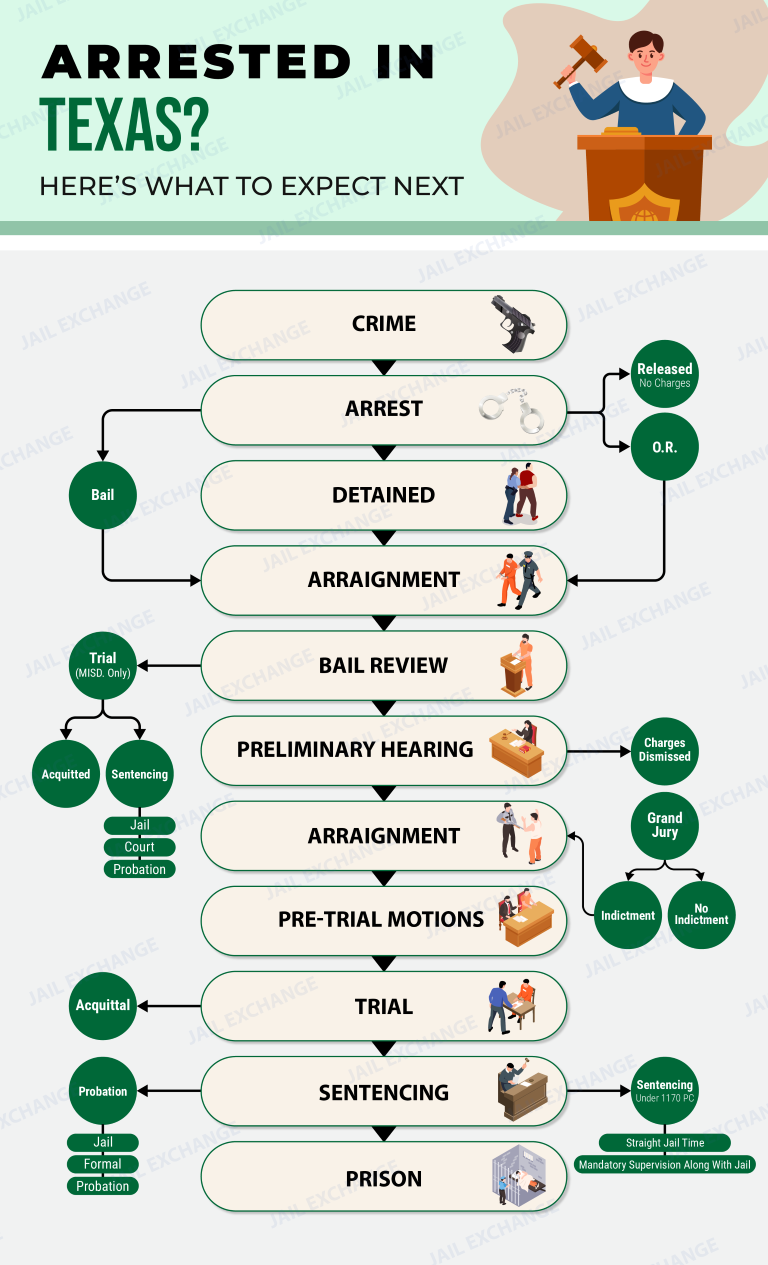
A Central Magistration judge must see the person no more than two days after arrest, whether in the courtroom or over a camera feed from the jail. That judge names the charge, explains the rights to keep quiet and to have counsel, and fixes the bond amount (CCP art. 15.17). Anyone who wants a court-appointed lawyer gets help with the form. Questions about magistration go to 817-884-2812.
Later the case gets its first setting in the trial court, often called arraignment. There the person hears the formal charge and answers it: guilty, not guilty or no contest (CCP art. 26.01). Someone released on a personal bond finds the court date on the release papers. If the papers are lost, call 817-884-2674.
Before any indictment, a person charged with a felony may ask for an examining trial. It is a short hearing where a judge looks at whether the evidence is enough to keep the case going (CCP art. 16.01).
↑ Back to the question list6. How does a Class A or B misdemeanor case move here?
Misdemeanors are filed by a written complaint called an information, not by a grand jury. They land in one of the ten County Criminal Courts. The Criminal District Attorney's misdemeanor section answers at 817-884-2488.
- The case is filed and assigned to a court.
- The person appears, with a lawyer if they have one, and enters a plea.
- Pretrial settings follow, and many cases settle with a plea deal. The judge says up front whether the deal will be followed. If the judge rejects it, the person may pull back the plea (CCP art. 26.13).
- If there is no deal, the case goes to trial before a judge or jury.
The top penalties are set by the Penal Code:
- Class B: as much as six months behind bars plus a fine reaching $2,000, or either one (Penal Code 12.22).
- Class A: a jail stay of 12 months or less and a fine that can reach $4,000, alone or together (Penal Code 12.21).
- Class C: a fine of up to $500 and no jail (Penal Code 12.23).
A misdemeanor can also end in deferred adjudication, which runs up to two years. When the person follows every rule, the judge dismisses the case and no conviction is entered (CCP art. 42A.111).
↑ Back to the question list7. Which stages does a Tarrant County felony pass through?
- Magistration and bond. The person sees a magistrate within 48 hours.
- Examining trial, if asked. Ahead of any grand jury action, a judge can test the evidence (CCP art. 16.01).
- Grand jury. Indictment needs the votes of nine or more grand jurors (CCP art. 20A.301).
- First felony court setting. One of the 11 felony courts reads the indictment and takes a plea.
- Motions and talks. Both sides share evidence, file motions and may work out an agreement.
- Resolution. The case ends with a plea, a bench trial or a jury verdict.
- Sentencing. Prison, state jail, probation or deferred adjudication.
Penalty ranges under Penal Code chapter 12:
- State jail felony: 180 days to two years in a state jail and a fine up to $10,000 (Penal Code 12.35). A judge may punish some as a Class A misdemeanor (Penal Code 12.44).
- Third degree: 2 to 10 years in prison (Penal Code 12.34).
- Second degree: 2 to 20 years (Penal Code 12.33).
- First degree: life, or a term from 5 up to 99 years (Penal Code 12.32).
- Capital: life without parole or death. Someone under 18 at the time faces life (Penal Code 12.31).
Each of the degree felonies also allows a fine of up to $10,000. Earlier convictions can raise the level (Penal Code 12.42). Felony probation can run up to 10 years (CCP art. 42A.053).
↑ Back to the question list8. Do violent charges get different treatment?
Yes, mostly at the bail stage and in what release looks like.
- Many violent charges can't get a personal bond (CCP art. 17.03).
- Proposition 3 took effect in late 2025. It lets prosecutors seek a no-bail order on certain grave charges. The list includes murder, aggravated sexual assault, aggravated robbery, trafficking and indecency with a child. At a hearing, prosecutors carry the burden of showing the person would flee or put others at risk (Tex. Const. art. I, §11d).
- Under S.B. 9 of 2025, the state may challenge a low bail on appeal in these cases, and the person stays in jail while that is decided (CCP art. 44.01).
Victims in these cases may ask for notice of every hearing. The prosecutor's Victim Advocates answer at 817-884-2740.
↑ Back to the question list9. Which office prosecutes here, and how are defense lawyers appointed?
One office handles the state's side. The Criminal District Attorney's Office is in the Tim Curry Criminal Justice Center, 401 W. Belknap Street, Fort Worth, TX 76196, 817-884-1400, weekdays 7:45 a.m. to 4:45 p.m. Its misdemeanor line is 817-884-2488.
For the defense, judges appoint approved private lawyers through the Office of Attorney Appointments, Room 5043 of the same building, 401 W. Belknap Street, Fort Worth, TX 76196, 817-884-2370. To qualify, a person fills out an Affidavit of Indigence about income and bills.
- Ask for a lawyer at magistration. Under CCP art. 15.17, staff must pass that request along within a day.
- A county of this size has one working day to name the lawyer once the paperwork lands (CCP art. 1.051).
- Read how it works in the county's felony plan and misdemeanor plan, filed with the Texas Indigent Defense Commission, 209 West 14th Street, Room 202, Austin, TX 78701, 512-936-6994.
10. Which diversion programs and specialty courts run in Tarrant County?
Some people can earn a dismissal or a lighter result by finishing a program. The criminal courts list these:
- Deferred Prosecution Program, run by the District Attorney.
- Felony Alcohol Intervention Program, known as FAIP.
- Veterans Diversion Program for people who served.
- RISE, for people charged with prostitution.
- DIRECT Drug Court, run with the county's probation department.
Timing matters. Applications for the Deferred Prosecution Program and FAIP are due within 60 days after the case is filed, with no exceptions. Ask the defense lawyer right away. The courts' 2026 local rules explain how cases are handled. Texas also keeps a registry of specialty courts, which mostly last 12 to 24 months.
↑ Back to the question list11. Which online searches show Tarrant County dockets and files?
Each court type has its own search:
- Felony and misdemeanor settings: criminal court dockets
- County Criminal Court files: county court records portal
- Justice of the Peace cases: JP case lookup
- Traffic tickets: traffic court lookup
- Felony papers: District Clerk document lookup
- Who sees a magistrate next: the magistration docket
The state's free re:SearchTX site needs an account. It lists charges and final judgments but not hearing times. By phone, ask the District Clerk at 817-884-1574 about felonies or the County Clerk at 817-884-1066 about Class A and B cases.
↑ Back to the question list12. Does the person have a Tarrant County warrant, and what clears it?
Most county warrants are served by the Sheriff's Criminal Warrants Division, 200 Taylor Street, Fort Worth, TX 76196, 817-884-1289. Constables and city police serve them too, such as Fort Worth officers at 817-392-4222. The division asks people to check through a defense lawyer or licensed bondsman. Court files show in the JP lookup and criminal dockets. Fugitives appear on the Sheriff's Most Wanted and Texas 10 Most Wanted lists. To clear a warrant, hire a lawyer and surrender at the Corrections Center, 100 N. Lamar Street, Fort Worth, TX 76196, or let a lawyer set up a new hearing in the court that issued it. For felonies, call the District Clerk at 817-884-1574.
↑ Back to the question list13. Where is a U.S. charge from this area heard?
Cases on U.S. charges here go to the Fort Worth Division. Its courthouse is at 501 West 10th Street, Room 310, Fort Worth, TX 76102, 817-850-6600.
- Prosecutor: federal prosecutors for North Texas, main office at 1100 Commerce Street, 3rd Floor, Dallas, TX 75242, local line 817-252-5200.
- Defense: Federal Public Defender, 819 Taylor Street, Room 9A10, Fort Worth, TX 76102, 817-978-2753.
- Custody: the U.S. Marshals Service, 501 West 10th Street, Room 211, Fort Worth, TX 76102, 682-703-4574. Before trial, people may be kept in a local jail that takes federal prisoners, such as the Mansfield Jail.
- First hearing: pretrial release is decided in a detention hearing under 18 U.S.C. 3142.
- After sentencing: the Federal Bureau of Prisons inmate locator shows where the person is sent. One nearby prison is FMC Fort Worth, a federal medical center at 3150 Horton Road, Fort Worth, TX 76119, 817-534-8400.
14. Can an ICE detainer change how the Texas case goes?
The Texas charge keeps its normal pace in court. ICE's request waits in the file until the day of release.
- Immigration officers file Form I-247A, the detainer request, with the jail staff.
- At the point of release, the jail can hold the person up to 48 hours after they would otherwise be released, so ICE can collect them (8 CFR 287.7(d)).
- Texas jails must follow detainers (CCP art. 2A.060). Showing proof of citizenship or legal presence ends the hold. Since 2017, cities and counties can't limit immigration enforcement (Gov't Code 752.053).
- People taken by ICE here are handled by the Dallas Field Office, 8101 N. Stemmons Freeway, Dallas, TX 75247, 972-367-2200.
- Find them with the ICE Online Detainee Locator.
A guilty plea can change immigration status. A noncitizen should ask a lawyer about that before any plea. S.B. 8, passed in 2025, gives sheriffs who run jails a December 1, 2026 deadline to apply for ICE's 287(g) program. The Sheriff's Office at 817-884-3099 can say where this county stands.
↑ Back to the question list15. After sentencing, where do people serve time or report for probation?
The Texas Department of Criminal Justice takes custody for state jail and prison terms. People are sorted at an intake unit and then sent to a unit that fits. Look them up in the TDCJ inmate search, and see our Texas state prisons page.
Probation is run by the Community Supervision and Corrections Department. People report to one of these offices:
- Central Office: 350 W. Belknap Street, Fort Worth, TX 76196, 817-884-1600, weekdays 7:30 a.m. to 5 p.m.
- Miller Complex: 3210 Miller Avenue, Fort Worth, TX 76119, 817-531-5601
- Southeast: 724 E. Border Street, Arlington, TX 76010, 817-548-3905
- Southwest: 3829 Altamesa Boulevard, Fort Worth, TX 76133, 817-370-4505
- Northeast: 201 East Plaza Boulevard, Hurst, TX 76053, 817-285-4100
- Northwest: 3800 Adam Grubb Drive, Suite 100, Lake Worth, TX 76135, 817-238-4405
- Day Treatment Program: 1400 Circle Drive, Suite 200, Fort Worth, TX 76119, 817-321-4833
16. How are charges against children handled in Tarrant County?
Here the 323rd District Court sits as the juvenile court. Its cases involve young people aged 10 to 16 when the offense happened (Family Code 51.02). Someone who was 17 faces adult court.
- A child who is held stays in the Lynn W. Ross Juvenile Detention Center, 2701 Kimbo Road, Fort Worth, TX 76111, 817-838-4610.
- Juvenile Services, the probation department, works from the same address, 817-838-4600, weekdays 7:30 a.m. to 4:30 p.m.
- The District Attorney's juvenile section answers at 817-838-4613.
- A hearing on whether to keep holding the child comes within two working days, and a lawyer is appointed before it (Family Code 54.01).
- Teens aged 14 or 15 who face a serious felony can be certified to stand trial as adults. That takes a full study of the case and a hearing first (Family Code 54.02).
17. Which offices support crime victims in Tarrant County?
The Criminal District Attorney's Victim Advocates help victims follow the case, at 817-884-2740. For a protective order, call the office's protective order unit at 817-884-1623.
- Texas gives victims several rights. A magistrate must think about their safety when setting bail. On request, the state keeps them posted on hearings, and they may describe the harm done in a written statement (CCP art. 56A.051).
- For medical bills and missed pay, the state's Crime Victims' Compensation fund, run by the Attorney General, pays up to $50,000. Call 800-983-9933.
- Sign up with Texas IVSS-Counties for no-cost, confidential notice of a booking, release or transfer. Help is at 866-268-8959 around the clock, in English or Spanish.
Information for this service is currently unavailable.
Information for this service is currently unavailable.
The Arlington Police Department Jail is the City of Arlington's lockup at 620 West Division Street in Arlington, Tarrant County. The public door is on the west side of the building, facing Cooper Street. It is a police jail where people are taken after an arrest in Arlington, not the county jail, and the city posts no rules for mailing letters to someone held here.
The city jail's address:
Inmate's Full Name
Arlington Police Department Jail
620 W. Division Street
Arlington, TX 76011
- Look before you write: Check the city's jail inmate list first. If the person is no longer listed, they may have been released or taken to a Tarrant County Sheriff's jail, and that jail has its own mail rules.
- If they go to the county: The Tarrant County Sheriff sends personal letters to a mail-scanning service, not to the jail, so read the county jail's mail page before you write.
- Bail: Bail for some people held here can be paid online through the city's link. Class B and higher charges, and holds for other agencies, can't be paid that way.
- Questions: Call the jail at 817-459-5648.
ViaPath AdvancePay Phone Calling Accounts
Provider: ViaPath Technologies • Formerly ConnectNetwork / Global Tel*Link (GTL)

AdvancePay is the primary prepaid telecommunications service operated by Global Tel*Link (GTL) and ConnectNetwork, which have unified under the corporate identity of ViaPath Technologies (and the myViaPath platform). By funding an AdvancePay account, telephone charges are deducted per minute whenever an incarcerated loved one calls your specific telephone number, preventing calls from being rejected by cellular carriers.
Important: Cell Carriers Automatically Block Jail Collect Calls
Inmate telephone networks do not permit incoming calls, and wireless cell providers automatically block traditional collect billing by default. While select traditional landlines may support operator billing, cell phones and internet-based lines require an active AdvancePay balance, which you can verify with your carrier. If you do not register your number online and add funds immediately, your loved one will hear an automated operator announcement stating your line is blocked from receiving correctional calls.
Step-by-Step Instructions to Open and Fund AdvancePay
- Visit web.connectnetwork.com or the updated my.viapath.com portal, or launch the ConnectNetwork / ViaPath mobile application.
- Click Sign Up and register using your primary 10-digit cellphone number and email address.
- Select Add Facility, pick your state, and choose the detention center or state prison where the inmate is held.
- Search for the inmate using their full legal name or facility booking ID number and link them to your contact directory.
- Select AdvancePay Phone and choose your deposit amount ($25, $50, or custom).
- Enter your debit or credit card billing details, accept the administrative transaction fee, and complete the payment.
- Check your phone settings to confirm that automated or unknown correctional numbers are not routed straight to spam.
What the Inmate Needs to Do
The inmate approaches any housing pod telephone, enters their assigned PIN and voice biometric recognition phrase, and dials your 10-digit number. ViaPath's automated operator confirms your active prepaid balance and connects the call. All personal telephone calls are subject to recording and monitoring by facility investigators.
Official Providers: ConnectNetwork Portal | myViaPath Portal
Customer Service Telephone: 1-877-650-4249 (Automated & Live Support)
Support Hours: Automated Service 24/7; Live Operators Monday – Friday, 8:00 AM – 10:00 PM EST
Supported Languages: English and Spanish
Other Services Provided by ViaPath Technologies (ConnectNetwork)
In addition to AdvancePay Phone Calling, ViaPath / ConnectNetwork provides several other communication, financial, and visitation services:
- ConnectNetwork Trust Fund Deposits: Transfer money directly into an inmate's jail trust account for commissary store purchases.
• Learn more on our website: Inmate Trust Deposits Guide | • Visit official vendor page: ConnectNetwork Trust Deposits - ViaPath PIN Debit Phone Calling: Give the inmate their own calling funds to contact any approved phone number independently.
• Learn more on our website: PIN Debit Phone Calling Guide | • Visit official vendor page: ViaPath PIN Debit Calling - ViaPath Messaging & Photo Sharing: Send digital messages, photos, and video attachments directly to their terminal.
• Learn more on our website: Digital Messaging Guide | • Visit official vendor page: ViaPath Messaging Services - GettingOut Video Visitation & Tablets: Schedule face-to-face remote video visits and manage handheld tablet communications.
• Learn more on our website: Remote Video Visitation Guide | • Visit official vendor page: GettingOut Video Visits
ViaPath PIN Debit Phone Calling Accounts
Provider: ViaPath Technologies • Formerly ConnectNetwork / Global Tel*Link (GTL)ViaPath PIN Debit (hosted on ConnectNetwork and myViaPath) provides incarcerated individuals with their own calling funds. Unlike AdvancePay (which only funds calls placed to your specific phone number), PIN Debit funds belong directly to the inmate, allowing them to call attorneys, bondsmen, employers, or extended family members across multiple approved telephone numbers.
Important: AdvancePay Only Funds a Single Phone Number
When someone is arrested, they often need to contact multiple people—including legal defense counsel, bail agents, employers, and relatives. If you only fund an AdvancePay account, your loved one will have no calling balance to dial anyone else, as rules and call authorizations vary by facility. Adding funds directly to ViaPath PIN Debit grants them the calling flexibility needed to handle critical legal and family arrangements without delay.
Step-by-Step Instructions to Fund a PIN Debit Account
- Sign into your account at web.connectnetwork.com or my.viapath.com.
- Click on PIN Debit under the communications menu.
- Select the state and facility, and link the inmate's booking identification number.
- Enter the deposit dollar amount and review the payment transaction fee.
- Enter your debit or credit card details and submit the payment.
- Notify your loved one that their personal PIN calling balance has been credited.
What the Inmate Needs to Do
The calling balance appears under the inmate's personal identification PIN. When they pick up any dayroom telephone or tablet, they select the 'PIN Debit' prompt from the automated menu to place calls to any approved number on their personal contact list.
Official Providers: ConnectNetwork Portal | myViaPath Portal
Customer Service Telephone: 1-877-650-4249
Support Hours: Automated Deposits 24/7/365; Live Agents Monday – Friday, 8:00 AM – 10:00 PM EST
Supported Languages: English and Spanish
Other Services Provided by ViaPath Technologies (ConnectNetwork)
In addition to PIN Debit Calling, ViaPath / ConnectNetwork provides several other communication, financial, and visitation services:
- AdvancePay Dedicated Phone Calling: Fund calls placed specifically to your personal phone number.
• Learn more on our website: AdvancePay Calling Guide | • Visit official vendor page: ConnectNetwork AdvancePay - ConnectNetwork Trust Fund Deposits: Deposit money for commissary food, hygiene supplies, and stationery.
• Learn more on our website: Inmate Trust Deposits Guide | • Visit official vendor page: ConnectNetwork Trust Deposits - ViaPath Messaging & Photo Sharing: Send digital messages and photos directly to their kiosk or tablet.
• Learn more on our website: Digital Messaging Guide | • Visit official vendor page: ViaPath Messaging Services - GettingOut Video Visitation & Tablets: Schedule face-to-face remote video visits from home.
• Learn more on our website: Remote Video Visitation Guide | • Visit official vendor page: GettingOut Video Visits
Information for this service is currently unavailable.
Information for this service is currently unavailable.
Tarrant County County Jails
Tarrant County City Jails
Tarrant County Juvenile Facilities
Nearby counties
- Jail (Main): 817-884-3116
- (PreTrial): 817-884-1465
- Adult Probation: 817-884-1600
- Arrest Warrants: 817-884-1320
- Bail: 817-884-3116
- Booking: 817-884-3116
- Court: 817-884-2811
- Crime Victims: 817-884-2740
- District Attorney: 817-884-1400
- Inmate Accounts: 817-884-3116
- Inmate Info: 817-884-3116
- Juvenile: 817-838-4610
- Juvenile Court: 817-838-4600
- Juvenile Probation: 817-838-4600
- Police: 817-335-4222
- Police Tips: 817-469-8477
- Records: 817-884-3116
- Sheriff: 817-884-3099
- Visitation: 817-884-3116
The Arlington Police Department Jail serves the following cities and towns of Tarrant County: Arlington, Azle, Bedford, Blue Mound, Burleson, Colleyville, Crowley, Dalworthington Gardens, Edgecliff Village, Euless, Everman, Forest Hill, Fort Worth, Grand Prairie, Grapevine, Haltom City, Haslet, Hurst, Keller, Kennedale, Lake Worth, Lakeside, Mansfield, North Richland Hills, Pantego, Pelican Bay, Richland Hills, River Oaks, Saginaw, Sansom Park, Southlake, Trophy Club, Watauga, Westlake, Westover Hills, Westworth Village and White Settlement.