Judge Arthur R. Tipps Juvenile Justice Center Criminal Court Process
Criminal Court Process for Wichita County Texas
Wichita County Criminal Court Guide
State courts in Wichita Falls hear every criminal case filed in Wichita County. Until release, the accused waits at the Wichita County Detention Center, 2815 Central E Fwy, Wichita Falls, TX 76302, the Sheriff's only adult jail. This guide sorts out which court gets which charge, the two clerk phone lines, each stage from booking to sentence, and where federal, immigration and youth matters land.
Is your person still behind bars? The Sheriff's Inmate Roster answers that. Our Recent Arrests page goes wider on custody itself: who was just booked, who sits in a cell tonight, live warrants, charge details, booking photos, court-appointed defenders and collecting belongings.
Start with one call to Booking at 940-766-8170. Ask whether the case is a felony, a jailable misdemeanor or a ticket, and whether a magistrate has set bail. When money is the only thing standing between your person and the front door, our bail page lays out the options.
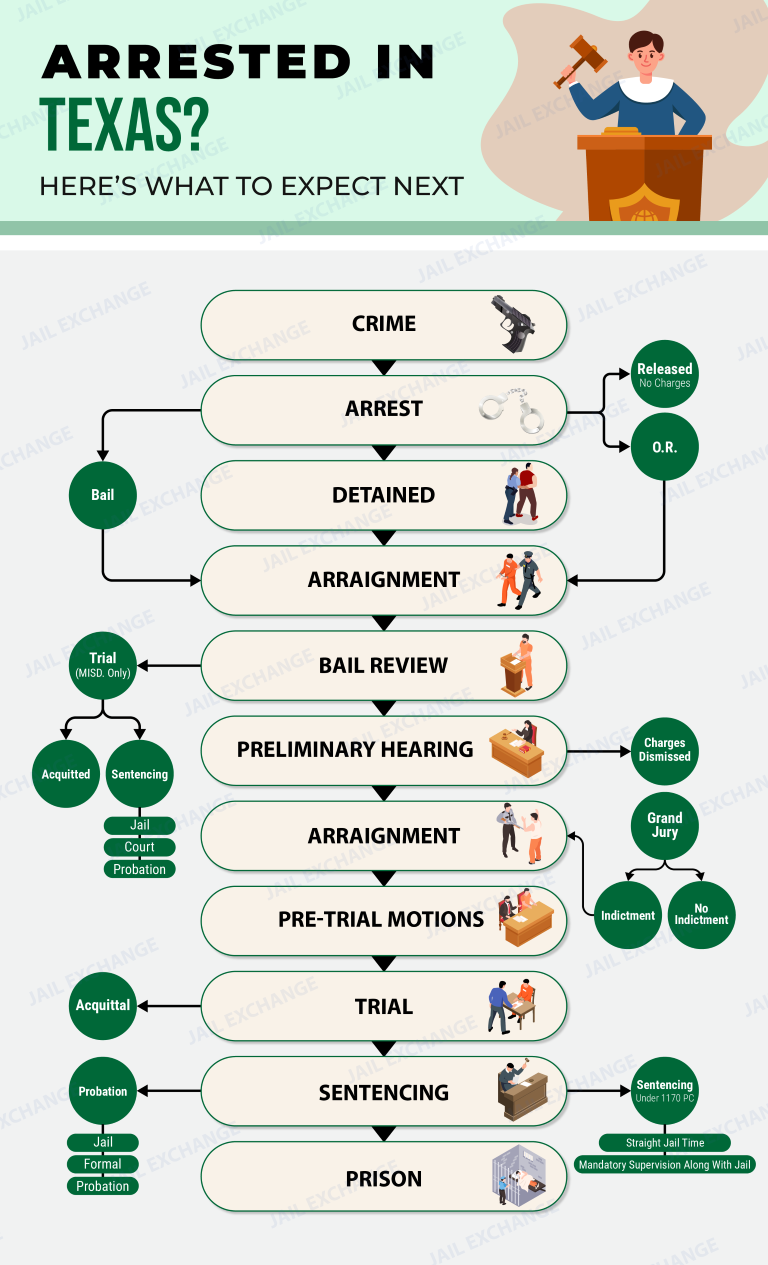
1. Felony, jailable misdemeanor or Class C ticket: whose courtroom is it?
Texas ranks crimes by grade, and the grade decides the courtroom. A quick map for this county:
- Felonies. Any felony, whether state jail grade or capital, runs through district court. Locally, that means the 30th, 78th or 89th District Court. The District Clerk keeps those files, 940-766-8100.
- Jailable misdemeanors. Class A and B charges sit at the county court level. Here, the two County Courts at Law hear them, and the County Clerk holds the records, 940-766-8195.
- Fine-only tickets. Class C carries a fine of up to $500 and no jail (Penal Code 12.23). These go to a JP or to a city's own municipal court.
Losing sides can appeal, first to a regional appeals court. For a criminal case, the top appeals court is the Court of Criminal Appeals in Austin, not the Supreme Court of Texas. Look at the bond form or citation, since it usually prints the court's name.
↑ Back to the question list2. Where are Wichita County's criminal courts, and who answers the phone?
Most families need just two numbers, one for each clerk:
- District Clerk, for the 30th, 78th and 89th District Courts: 940-766-8100. Ask here for felony settings and the courtroom number.
- County Clerk, for both County Courts at Law (Nos. 1 and 2): 940-766-8195. Ask here about misdemeanor dates and files.
- Justice of the Peace courts: five in all. Precinct 1 has Places 1 and 2, and Precincts 2, 3 and 4 each have one court. Besides Class C cases, the justices serve as magistrates for jail bookings.
- Federal court: the Wichita Falls Division courtroom, 1000 Lamar Street, 2nd Floor, Wichita Falls, TX 76301. It is staffed only during sessions. The clerk works from 501 West 10th Street, Room 310, Fort Worth, TX 76102-3673, 817-850-6600.
Not sure which justice court wrote a ticket? The Sheriff's Office can point you to it, 940-766-8170.
↑ Back to the question list3. Burkburnett, Iowa Park, Electra or the county seat: which towns run a municipal court?
All four do. Texas law sets up a municipal court in every incorporated city, and these courts share fine-only work with the JPs.
The biggest is the Municipal Court of Record run by the county seat. Its court page on the city website lists these rules:
- Counter payments stop at 4:30 p.m. Other case questions are handled until 5:00 p.m.
- Card payments need the cardholder in person with photo ID, plus a convenience fee.
- Paying online works any hour, but only for a full payment or a signed plan the court has approved.
- A "Check For Warrants" link sits on that same page.
For a ticket written by Burkburnett, Iowa Park or Electra officers, call the court phone printed on the citation. If none is printed, the Sheriff's Office at 940-766-8170 can steer you. Under CCP arts. 45A.252-45A.261, when a fine is more than a person can pay, the judge must look at a payment plan, community service at $150 of credit per 8 hours, or a waiver. Jail stays off the table unless a hearing shows no good-faith effort to pay.
↑ Back to the question list4. Magistration: what goes on at that first hearing?
Magistration is the first court step, and it must happen within 48 hours (CCP art. 15.17). Here, most of that work falls to the Justices of the Peace. The city's presiding municipal judge and weekend magistrates hired by contract also take turns. Video from the jail is allowed.
- The person hears the accusation and a list of rights. These include staying quiet, having counsel during questioning, stopping an interview and asking for an examining trial.
- Next comes the lawyer question. A request made here travels through the county's Bond Management Office to the Court Administrator within 24 hours.
- Bail and its conditions get set. On Class B charges and up, the public safety report is read first.
- Under CCP art. 15.17(h), a magistrate who finds no probable cause must explain why in writing within a day.
Felony defendants can also ask, ahead of any indictment, for an examining trial (CCP art. 16.01). There a magistrate weighs the evidence and decides if the charge should stand for now. Booking at 940-766-8170 knows if magistration is finished.
↑ Back to the question list5. What path does a Wichita County DWI, theft or assault misdemeanor follow?
Whether a DWI, a shoplifting or a fight counts as Class A, B or C depends on the facts, such as the value taken or the injury. The charging paper states the class. A jailable misdemeanor usually moves like this:
- The county's prosecutors draft a charging paper, an "information," and file it with the County Clerk.
- Either numbered County Court at Law sets an arraignment. That's where the plea goes on record (CCP art. 26.01).
- After that, the lawyers trade offers across several pretrial dates.
- At a plea hearing, the judge says up front whether they'll follow the deal. If not, CCP art. 26.13 lets the person withdraw the plea.
- Otherwise the case goes to trial.
Maximums under Penal Code 12.21-12.23 run like this. For Class A, a year in the county jail, $4,000, or both. For Class B, 180 days and $2,000, or both. For Class C, $500, with no jail at all.
Some misdemeanors end in deferred adjudication, which is supervision with no guilty finding. Its cap for a misdemeanor is two years, and a dismissal follows if the terms are met (CCP arts. 42A.101-42A.111). Regular misdemeanor probation has the same two-year ceiling.
↑ Back to the question list6. What are the felony steps from the Central Freeway jail to a sentence?
Felony cases pass through more checkpoints. Expect months, not days:
- Magistration at the jail within 48 hours, where bail is set.
- Examining trial, if requested before indictment.
- Grand jury. It meets in secret, and an indictment needs at least nine votes (CCP art. 20A.301).
- Arraignment before one of the three district judges, who hears the plea.
- Pretrial settings for motions, evidence sharing and plea offers.
- Plea or trial, and then punishment set by the judge or the jury.
Felony grades and their ranges sit in Penal Code chapter 12. For a state jail felony, it is 180 days at the low end and two years at the high end, all served in a state jail. Third degree runs 2-10 years in prison, second degree 2-20, and first degree 5-99 or life. Each one also allows a fine reaching $10,000. Capital cases are covered below.
A record of earlier felonies can push the range one notch higher (Penal Code 12.42). The reverse also exists: Penal Code 12.44 lets the judge punish a state jail felony as if it were a Class A misdemeanor. As for supervision, felony deferred adjudication can run 10 years, and most regular felony probation shares that cap (CCP arts. 42A.053, 42A.103).
↑ Back to the question list7. Are murder, robbery and other violent charges treated differently?
Yes. Violent charges bring tighter rules at almost every stage:
- Bond. The law blocks personal bonds on listed violent offenses (CCP art. 17.03). Proposition 3 (November 2025) added Tex. Const. art. I, §11d. For murder, aggravated robbery and other listed charges, the prosecutor gets a hearing; if flight or danger is shown there, the court issues an order where bail "shall be denied," in the amendment's words.
- Second looks at bail. Under CCP art. 17.029, a district judge can re-examine felony bail a magistrate set, at the prosecutor's request. For the listed violent offenses, the State may also challenge a low bail amount on appeal (CCP art. 44.01).
- Plea to sentencing. A guilty plea on some grave felonies sends the person straight back into custody until sentencing (CCP art. 27.20).
- Deferred adjudication. Not available for most murder cases, nor for certain sex and trafficking charges (CCP art. 42A.102).
- Capital murder. Death, or life with no parole. Someone who was 17 or younger when it happened gets a life sentence instead (Penal Code 12.31).
- Family violence. At the first hearing, a magistrate may issue an emergency protection order. Serious injury or a weapon makes the order mandatory (CCP art. 17.292), and then it lasts 91 to 121 days.
8. Who argues for the State here, and who stands up for a broke defendant?
The county's District Attorney's Office presents the state's side. For its number, ask the District Clerk at 940-766-8100 to transfer you.
On the defense side, the Public Defender's Office works at 600 Scott St., Suite 204, Wichita Falls, TX 76301, 940-766-8199. Under the county's indigent defense plan, it gets the first chance at each appointment. A conflict or a heavy caseload sends the case to a private lawyer on the court's list instead.
- Ask for a lawyer at magistration. A person who skipped that step can still ask through jail staff, and someone already free asks at the Court Administrator's office.
- The plan's clock runs three working days from when the court gets a request. A lawyer must be named before it runs out.
- Getting SNAP, Medicaid, TANF, SSI or public housing help, or living at or under the federal poverty line, counts as proof of need.
- Making bail does not, on its own, rule a person out (CCP art. 26.04).
Complaints about how the plan works locally may be raised with the Texas Indigent Defense Commission, 512-936-6994.
↑ Back to the question list9. How do I pin down a cause number or the next hearing?
Texas runs a statewide records site, re:SearchTX. Signing up is free. The public can see the case index and a few papers, such as the information, indictment and judgment. Copies cost $1 for up to 10 pages. Hearing times are a gap there, so get those from a clerk:
- Felony dates: District Clerk, 940-766-8100
- Misdemeanor dates: County Clerk, 940-766-8195
- City tickets from the county seat: the Municipal Court's city web page
Give the clerk the person's full legal name, birth date and, if known, the cause number. For past convictions, the state police sell searches through the DPS conviction database, which needs an account. Each new setting is also sent to defense counsel.
↑ Back to the question list10. Could a Wichita County warrant be waiting, and how does someone clear it?
Deputies serve warrants here. So do constables from Precincts 1 through 4 and officers of the cities. Phone the Sheriff's Office at 940-766-8170, or write to its Warrants Division at all_so_warrants@co.wichita.tx.us. City tickets in Wichita Falls have a Check For Warrants link on the Municipal Court page. DPS keeps a short list of the state's worst fugitives, its Texas 10 Most Wanted. The usual route to clearing a county warrant: talk to a defense lawyer, then report in person to the Detention Center, 2815 Central E Fwy, Wichita Falls, TX 76302. Felony warrants trace to the District Clerk, 940-766-8100. Misdemeanor ones go through the County Clerk, 940-766-8195.
↑ Back to the question list11. Federal charge instead of a state one: what is different?
This area's federal cases land in the Northern District of Texas. Its local courtroom, the Wichita Falls Division, is at 1000 Lamar Street, 2nd Floor, Wichita Falls, TX 76301. That courtroom opens only for sessions. Filings and questions go to the Fort Worth clerk, 817-850-6600.
- Bond in federal court is its own process. The pretrial custody call happens at a detention hearing, where release on conditions is set against keeping the person jailed (18 U.S.C. 3142).
- Custody of federal defendants, and the drive to court, belongs to the U.S. Marshals Service. Its office in this city is at 1000 Lamar Street, Room 218, Wichita Falls, TX 76307-3016, 940-723-8662.
- Prosecutors from the U.S. Attorney's Office handle the case. That office is headquartered at 1100 Commerce Street, 3rd Floor, Dallas, TX 75242-1699, 214-659-8600.
- For a defendant who can't pay, the closest Federal Public Defender office is at 819 Taylor Street, Room 9A10, Fort Worth, TX 76102, 817-978-2753.
- After sentencing, use the Federal Bureau of Prisons inmate locator to follow the person.
12. Does an immigration hold stall or change the Wichita County case?
The state charge keeps moving, but an immigration hold reshapes what happens around it. In order:
- ICE sends the Sheriff Form I-247A, asking for a hold.
- That request lets the jail keep someone up to 48 hours after they would otherwise be released (8 CFR 287.7(d)), even with bail paid.
- A detainer must be obeyed by any Texas jail (CCP art. 2A.060). The single escape from that rule is documented proof that the person holds U.S. citizenship or has lawful presence. Local policies limiting immigration enforcement have been illegal since 2017 (Gov't Code 752.053). Each county running a jail must also join ICE's 287(g) program by the start of December 2026, under a 2025 law. The Sheriff's Office can say whether that has happened here.
- ICE then takes custody. The Dallas Field Office covers North Texas, 8101 N. Stemmons Freeway, Dallas, TX 75247, 972-367-2200.
- Find the person on the ICE Online Detainee Locator using name and birth country, plus an A-number or birth date.
The judge has a duty, before accepting a guilty or no contest plea, to warn a non-citizen aloud and on paper that the plea may get them deported (CCP art. 26.13). Raise any immigration question with defense counsel early.
↑ Back to the question list13. Once a felony sentence comes down, where is the time served?
Sentences on state jail felonies get served inside Texas state jails. For third degree and higher, the person goes to a prison unit run by TDCJ (Penal Code 12.31-12.35). Until the transfer, the person typically waits at the Central Freeway jail. Intake at TDCJ comes next: testing, classification, then a unit assignment based on needs and risk.
- The TDCJ inmate search works by last name, TDCJ number or SID number. People appear only once they are inside a TDCJ facility, and the data lags at least a day.
- For each facility, see our Texas state prisons page.
14. How does Wichita County juvenile court handle a 10- to 16-year-old?
Texas law sends conduct by kids from 10 up to their 17th birthday to juvenile court (Family Code 51.02). Turning 17 means adult court. The county's juvenile board decides which local court hears juvenile matters, per Family Code 51.04.
- Police have to take an arrested youth straight to an approved intake site, and they owe the parents prompt word of the arrest (Family Code 52.02).
- A detained youth gets a hearing within two working days. Weekend arrests on a Friday or Saturday move that up to the first working day. Counsel comes first (Family Code 54.01).
- Family Code 54.02 lets the court, after a complete hearing, transfer certain serious felony cases against youths aged 14 and up to adult court.
Kids held in detention stay at the Arthur R. Tipps Juvenile Justice Center in Wichita Falls, 940-766-8225. The county's Juvenile Probation Department handles the case. The state agency, the Texas Juvenile Justice Department, is at 1711 San Jacinto Blvd, Austin, TX 78701, 512-490-7130.
↑ Back to the question list15. What can a crime victim in Wichita County ask for?
CCP art. 56A.051 lists rights for victims and close relatives. Among them:
- The magistrate must consider the victim's safety when setting bail.
- On request, victims get notice of hearings and of any changes to them.
- Victims may give an impact statement before sentencing or a plea.
- Victims may wait apart from the defendant before testifying.
The Attorney General's Crime Victims' Compensation fund, 800-983-9933, can pay up to $50,000 toward therapy, hospital bills, lost income and similar costs. To get a call or text when the accused is released, register with Texas IVSS-Counties, 866-268-8959, any hour, in English or Spanish. The county also has a Victim Services page, and the District Clerk can put you through to the District Attorney's Office.
↑ Back to the question list