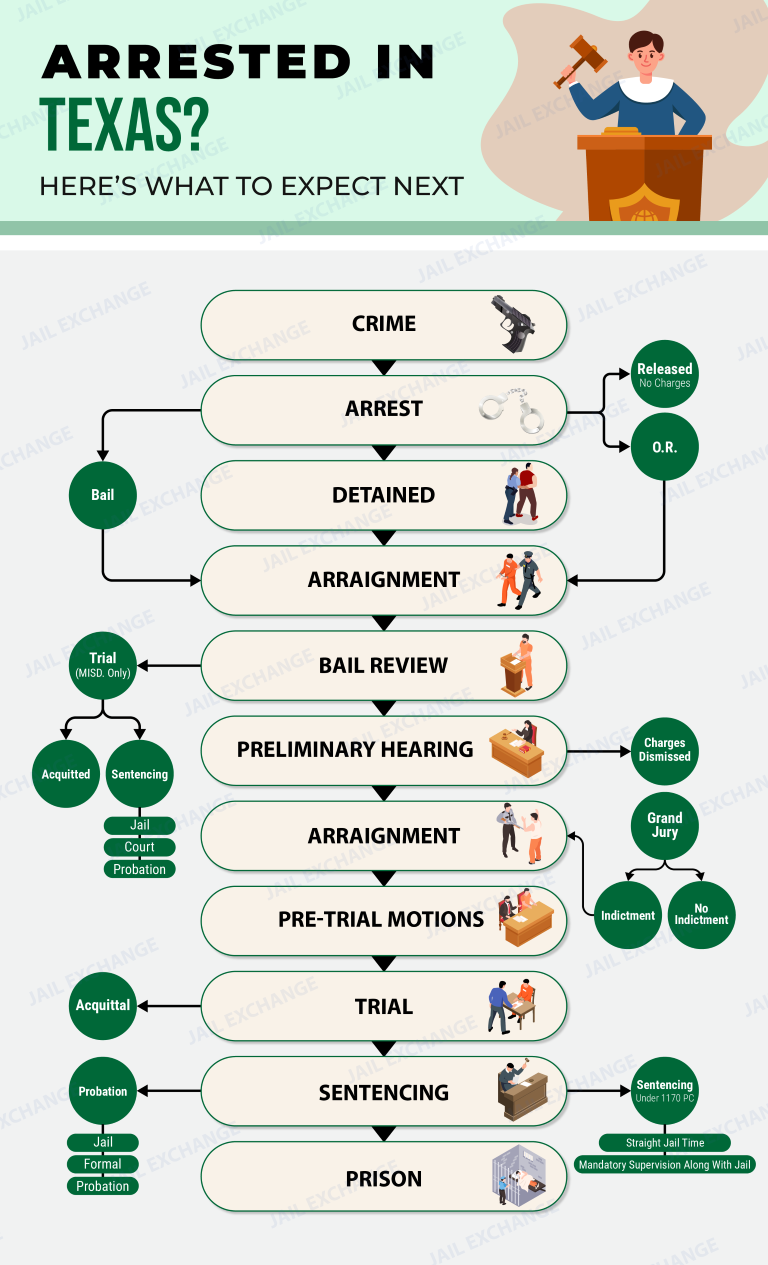
Williamson County Jail Criminal Court Process
Criminal Court Process for Williamson County Texas
Williamson County Criminal Court Guide
Anyone charged here who can't make bail waits in the Williamson County Jail, 306 West 4th Street, Georgetown, TX 78626. On hearing days, Sheriff's bailiffs walk them over to secure holding in the Justice Center Courthouse Annex, 405 Martin Luther King Street, Georgetown, TX 78626. This page maps out the district courts, county courts at law, justice courts and city courts, then tracks a case from the magistrate to a sentence.
Begin with the county's Records Inquiry to see if the person remains locked up. That same site carries criminal case records. For the custody picture, open our Inmates in Custody page: today's jail list, recent bookings, active warrants, plain-English charge meanings, mugshots, appointed counsel and property release.
Ring the jail at 512-943-1365. Ask which court has the case, whether the charge is a felony, and when it is next set. If getting the person out comes first, read our bail page before anything else.
1. Felony or misdemeanor: which Texas court gets the case?
Texas sends a case to a court based on its level. Each level has its own judges and clerk:
- District courts handle all felonies, the state jail level and everything above it. Their files sit with the District Clerk.
- County Courts at Law hear Class A and B misdemeanors. This county has five, and their files sit with the County Clerk.
- Justice of the Peace and municipal courts take fine-only Class C cases.
- The Court of Criminal Appeals has the last word on criminal appeals in Texas.
The Penal Code sets the ranges. Class C means a fine capped at $500, with no jail (12.23). Class B can bring up to 180 days in jail and a $2,000 fine (12.22). Class A can bring up to a year and a $4,000 fine (12.21). A state jail felony means a state jail stay of between 180 days and two years (12.35).
A third-degree felony carries prison from two up to ten years. At the second degree the top rises to 20 years. The first degree runs from five years up to 99 years or life. Any of these, like a state jail felony, can add a fine as high as $10,000 (12.32 to 12.35). Capital murder brings death or life without parole for an adult, and life for anyone under 18 (12.31). A past record can bump a charge into a higher range (12.42).
↑ Back to the question list2. Where do Williamson County criminal courts sit?
Felony and misdemeanor courts share the Justice Center, 405 Martin Luther King Street, Georgetown, TX 78626. The building is open weekdays, 8 a.m. to 5 p.m. Use the public entrance on the corner of 4th and Martin Luther King.
Felony courts. The District Clerk, 512-943-1212, holds the files for these. Call the clerk for business hours.
- 26th District Court: 512-943-1226
- 277th District Court: 512-943-1277
- 368th District Court: 512-943-1368
- 395th District Court: 512-943-1395
- 425th District Court: 512-943-3380
- 512th District Court: ask the District Clerk for its line
The 480th District Court, 512-943-3620, handles civil, family and child protection matters, not criminal trials.
Misdemeanor courts. The County Clerk's court cases office is on the 2nd Floor, open 8 a.m. to 5 p.m. on weekdays. Its criminal line is 512-943-1150.
- County Court at Law No. 1: 512-943-1200
- County Court at Law No. 2: 512-943-1410
- County Court at Law No. 3: 512-943-1160
- County Court at Law No. 4: 512-943-1681
- County Court at Law No. 5: 512-943-3671
3. Who handles Class C tickets: justice courts or city courts?
Four Justice of the Peace precincts hear fine-only cases from the whole county. County Attorney staff prosecute in all four.
- Precinct 1, 1801 E. Old Settlers Blvd., Suite 100, Round Rock, TX 78664, 512-244-8622. Weekdays 8 a.m. to 4:30 p.m. Payments stop at 4 p.m., and citations can be paid online through the court's county page.
- Precinct 2, 350 Discovery Blvd., Suite 204, Cedar Park, TX 78613, 512-260-4210. Monday to Thursday 8 a.m. to 4 p.m., Friday 8 a.m. to noon.
- Precinct 3, 100 Wilco Way, Suite 204, Georgetown, TX 78626, 512-943-1501. Call to confirm the room before you go.
- Precinct 4, 211 W. 6th Street, Taylor, TX 76574, 512-352-4155.
A ticket written by a city officer usually goes to that city's municipal court. Liberty Hill's court clerk works at 2801 RR 1869, Liberty Hill, TX 78642. Round Rock, Georgetown, Cedar Park, Leander, Hutto and Taylor also run city courts, and the citation lists the right address. If you lost the ticket, the County Clerk's criminal line, 512-943-1150, can point you to the court that has it.
Can't pay a fine? Ask the court about payments over time, community service or a waiver. A judge may jail someone for an unpaid fine only after a hearing that finds they could pay and chose not to (arts. 45A.252 to 45A.261).
↑ Back to the question list4. What does the magistrate do at the first jail hearing?
The first court step takes place inside the jail. Magistrate hearings run there every day of the year, led by four associate judges. Texas requires one within 48 hours of arrest (art. 15.17). The magistrate covers:
- each charge on file
- the choice to hire a lawyer, or to apply for a free one
- the right to stay silent, because anything said may become evidence
- the right to have counsel present during questioning, and to end an interview
- on a felony, the right to an examining trial, which tests probable cause before indictment (art. 16.01)
The magistrate then sets bail and conditions and may issue an emergency protective order. Request forms for a lawyer go to the appointing office within 24 hours. If no probable cause is found, the magistrate must put that in writing within 24 hours (art. 15.17(h)). The Magistrate's Office is at 405 Martin Luther King Street, Georgetown, TX 78626, 512-943-1377.
↑ Back to the question list5. How does a DWI, theft or assault misdemeanor play out in county court?
DWI, theft and assault can be charged at either level, based on what happened and the person's history. When they are misdemeanors, the County Attorney's Criminal Division files them. That division handles about 11,000 adult cases a year in the five County Courts at Law, each started by a charging paper called an information.
- Arraignment. The person is identified and enters a plea, unless the lawyer files a waiver (art. 26.01).
- Settings. Each side swaps evidence and files motions. Plea offers come up here too.
- Plea or trial. If there is a plea deal, the judge says in open court whether it will be followed. If not, the plea can be taken back (art. 26.13).
- Result. The case may be dropped. It may end in a fine, jail or probation. Or the judge may defer a finding of guilt for up to two years and dismiss the case once every term is met (arts. 42A.101, 42A.103, 42A.111).
The county also runs a Veterans Treatment Court and a DWI and Drug Court, reached at 512-943-1568. For young adults, the RISE Center diversion program answers at 512-688-4037. A defense lawyer can say if one is a good match. The state also keeps a specialty court registry.
↑ Back to the question list6. Grand jury to verdict: how does a Williamson County felony unfold?
The District Attorney's office prosecutes felonies, and the path has more stops:
- Magistrate hearing inside the jail, which fixes the bail.
- Examining trial, if the defense asks for it before indictment. A magistrate decides whether there is probable cause (art. 16.01).
- Grand jury. The DA's office lays out the evidence behind closed doors. To indict, at least nine grand jurors must vote yes (art. 20A.301).
- Arraignment before a district judge, who takes the plea (art. 26.01).
- Pretrial settings for evidence, motions and plea talks.
- Plea or jury trial, then sentencing by the judge or jury.
A judge may give deferred adjudication for up to 10 years, or probation that generally runs up to 10 years (arts. 42A.053, 42A.103). Some offenses can't get deferred adjudication, such as most murder charges and certain intoxication cases (art. 42A.102). For a felony DWI or drug case, ask the lawyer about the county's felony DWI and drug court diversion track.
↑ Back to the question list7. Which extra rules kick in on violent charges?
Several, starting in the first hour:
- No personal bond for offenses on the state's violent list, and jail staff can't set the bail amount (arts. 17.03, 17.20).
- Bail can be denied under Proposition 3, approved in November 2025. For murder, aggravated robbery, aggravated kidnapping, trafficking and similar crimes, the prosecutor can ask for a hearing. Bail is then refused if flight risk or danger is proven (Tex. Const. art. I, §11d).
- Prosecutor appeals: in listed violent cases, prosecutors may take an overly low bail to a higher court. The person stays jailed while the appeal is decided, within 20 days (art. 44.01).
- Family violence cases bring three extra steps. The magistrate can issue an emergency protective order. Release can wait 4 hours after bond if more violence seems likely. The victim also gets word before release (arts. 17.29, 17.291, 17.292).
- Some guilty pleas to serious felonies send the person straight to jail to wait for sentencing (art. 27.20).
8. Which offices prosecute, and where does appointed counsel come from?
Two elected offices bring cases:
- District Attorney, for felonies in the district courts: 405 M.L.K. Street, Suite 265, Georgetown, TX 78626, 512-943-1234.
- County Attorney, for adult misdemeanors, Class C cases in the justice courts and juvenile cases: 405 Martin Luther King Jr. Street, Suite 229, Georgetown, TX 78626, 512-943-1111.
On the defense side, someone short on money asks for counsel at the magistrate hearing. Pretrial Services manages those appointments from 405 Martin Luther King Street, Georgetown, TX 78626, 512-943-3224. In a county this large, counsel has to be named within one working day of receiving the request (art. 1.051). That lawyer then has one working day to reach out (art. 26.04).
On a sworn form, the person lists income, debts and dependents for the court. A finding of need lasts for the whole case unless finances change a lot (art. 26.04). This county's appointment plan can be read on the state's indigent defense plan lookup. Paying for a private lawyer is also allowed at any stage.
↑ Back to the question list9. How can we look up the case file or next hearing?
The county's records site is the quickest place to start. Besides jail records, it has a Criminal Case Records search and dockets for the district courts, several County Courts at Law, and Justice Precincts 1 and 3. The county warns that the online data may hold errors, so confirm a date with the clerk.
- Felony dates: District Clerk, 405 Martin Luther King Street, Georgetown, TX 78626, 512-943-1212
- Misdemeanor dates: County Clerk, Justice Center 2nd Floor, same address, 512-943-1150
- Class C dates: the justice court or city court on the ticket
Across Texas, re:SearchTX lets registered users read charging papers and judgments for free. Hearing dates are left out there. DPS runs a paid conviction name search. Searches go faster when you know the exact name spelling and the birth date.
↑ Back to the question list10. Could there be an open warrant, and what clears it?
Deputies, county constables and city officers serve warrants here. To ask about one, the Sheriff's Office answers at 512-943-1662, and Georgetown police at 512-930-3510. Statewide, DPS posts its Texas 10 Most Wanted fugitives. A filed case also turns up in the county's case records search. A lawyer should guide the next move. Usually that means a planned surrender at the jail, 306 West 4th Street, Georgetown, TX 78626, or a phone call asking the issuing court to reset the case. Felony warrant files sit with the District Clerk, 405 Martin Luther King Street, Georgetown, TX 78626, 512-943-1212.
↑ Back to the question list11. If agents filed federal charges in Williamson County, what then?
For this county, federal prosecutions run through the Austin Division of the Western District of Texas, 501 West Fifth Street, Suite 1100, Austin, TX 78701. The clerk's number is 512-916-5896.
- The first federal court date usually includes a detention hearing. A judge rules there on home or jail until trial (18 U.S.C. 3142).
- Federal prisoners are held and moved to court by the U.S. Marshals Service. The Austin office, 501 West 5th Street, Suite 3300, Austin, TX 78701, 512-916-5393, can tell you where someone is housed.
- The Federal Public Defender's Austin office defends people who can't pay, 504 Lavaca Street, Suite 960, Austin, TX 78701, 512-916-5025.
- PACER sells copies of case papers for a small fee. Following a prison sentence, use the Federal Bureau of Prisons inmate locator.
12. How might an ICE detainer change things on a Texas charge?
The state charge stays on track. What shifts is the release:
- With Form I-247A, immigration officers ask Texas jailers to hold someone up to 48 hours after they would otherwise be released (8 CFR 287.7(d)).
- Under Texas law, the jail must comply, except for someone who proves lawful status (art. 2A.060). Government Code 752.053 bars any local policy that limits immigration enforcement.
- A 2025 state law gives jail-running counties until December 1, 2026 to join 287(g). This county's jail FAQ reports that it is already part of the 287(g) program, for people booked in.
- Someone with a detainer can still post bail, but ICE may take custody at the door. Before any guilty plea, a non-citizen must be warned it could lead to deportation (art. 26.13).
- Track someone in ICE custody on the ICE Online Detainee Locator, or call ICE's San Antonio Field Office, 3523 Crosspoint Drive, San Antonio, TX 78217, 210-564-3300.
13. Where does someone serve a Texas prison or state jail term?
A state jail term is done in a state jail. Higher felony terms, from third degree up through capital, are served with the Texas Department of Criminal Justice. People usually wait in the Georgetown jail for the move. TDCJ intake staff then study each new arrival and assign a unit.
- Use the TDCJ inmate search with a TDCJ number or a last name. It lists only people already in a TDCJ unit.
- Read about each unit on our Texas state prisons page.
- Probation instead of prison is supervised by the county's adult probation department, 301 S.E. Inner Loop, Suite 101, Georgetown, TX 78626, 512-943-3500.
14. How are Williamson County youth cases handled?
Juvenile court covers children 10 through 16 (Family Code 51.02). New charges against a 17-year-old go to adult court instead. The County Attorney's Juvenile Division prosecutes youth cases.
- Police must tell a parent promptly, and a parent may join the child at the processing office (52.02, 52.025).
- A judge must review detention within two working days of custody. The child gets a lawyer first (54.01).
- A teen of 14 or older facing a grave felony can be moved up to adult court. The judge must first order a full study and hold a hearing (54.02).
Detained youths stay at the Juvenile Justice Center, 200 Wilco Way, Georgetown, TX 78626. Juvenile Services answers at 512-943-3200, and the detention desk at 512-943-3232.
↑ Back to the question list15. Which Williamson County offices help crime victims?
State law gives victims a voice. Their safety must be weighed when bail is set. Hearing notices go to victims who request them, and they may share how the crime hurt them before a sentence (art. 56A.051).
- The County Attorney's Victim Services office is at 405 M.L.K. Street, 2nd Floor, Courthouse Annex, Georgetown, TX 78626, 512-943-1918.
- The Sheriff's Office, 508 S. Rock Street, Georgetown, TX 78626, has Victim Services staff at 512-943-1373.
- Free, private custody alerts come from Texas IVSS-Counties, online at ivss-counties.tdcj.texas.gov or by phone at 866-268-8959, any hour.
- The Attorney General's Crime Victims' Compensation program can pay up to $50,000 toward costs from a crime. Call 800-983-9933.