
Arlington County Detention Facility
Arlington County Detention Facility
Physical Address
1435 North Courthouse RoadArlington, VA 22201
Jail Phone Number
703-228-4460Arlington County Inmate Search: Finding Someone Held at the Courthouse Road Jail
Adults arrested by county police, deputies or troopers go through booking at the Arlington County Detention Facility, 1435 North Courthouse Road, Arlington, VA 22201. The Sheriff runs this one adult jail, and it also takes adults from the City of Falls Church. Below you can look up a person, read how mugshots work, and get the steps for lawyers, visits, money, mail and court.
The quickest lookup is the Sheriff's inmate search. Type a name, or use a subject number or booking number if you hold one. A result shows if the person is still held, plus booking dates and the housing area. Someone arrested a moment ago may not be listed yet.
Need answers fast? Call the Sheriff's Office at 703-228-4460. Offer the full legal name plus the birthday, and ask where they are held, what they face and what happens next. Our bail guide explains how release works, while our court guide follows each hearing.
Read inmate search answers
 Read inmate search answers
1. How do I use the Arlington County inmate search?
The Sheriff's Office runs this lookup. Follow these steps:
- Go to the official inmate search page.
- Enter the family name and the given name. There are also boxes for a subject number and a booking number, which work well if a relative gave you one.
- Open the row that matches. It shows custody status, booking dates and the part of the jail where the person lives.
- Copy down any numbers you see. They help staff pull the right file when you call.
No luck? Phone the jail at 703-228-4460.
↑ Back to the question list2. Why can't I find the person I typed in?
Several plain reasons can explain an empty result:
- Booking is under way. Fingerprints and paperwork come first, so the list can trail behind.
- Already home. A magistrate may have let them leave on a summons, a signed promise or a bond.
- Held by someone else. They might be at a police station for a bit, in a neighboring jail, or with federal or state officers.
- A different spelling. Try short forms of the first name, a middle name, or a spelling with or without a hyphen.
- Younger than 18. Anyone under 18 goes elsewhere.
Staff can check for you. Dial 703-228-4460 and give the legal name with the birth date.
↑ Back to the question list3. Which jail near Arlington County holds arrestees?
One adult jail covers the county: the Arlington County Detention Facility, 1435 North Courthouse Road, Arlington, VA 22201, 703-228-4460. The Sheriff runs it. It is not a regional jail, and it stands next to the courts.
That single building serves several purposes:
- Men and women awaiting trial, from the county and from Falls Church.
- Inmates serving short local terms of up to a year.
- Inmates already sentenced to state prison, who stay until the state can take them.
- Some federal inmates, held for the U.S. Marshals Service under a contract.
Someone picked up just across the line may be in the neighboring locality's lockup instead. Use the number above to learn which one.
↑ Back to the question list4. Are Arlington mugshots available to the public?
Under Virginia's Freedom of Information Act, police and sheriffs must release an adult's booking photo, unless sharing it would hurt a felony case still under investigation (Va. Code § 2.2-3706). To request mugshots, ask the agency that made the arrest:
- Arlington County Police Department, 1425 North Courthouse Road, Arlington, VA 22201, 703-558-2222
- Sheriff's Office, 1425 North Courthouse Road, Suite 9100, Arlington, VA 22201, 703-228-4460
Booking photos of minors are private. Pictures taken by ICE are released through the ICE records page only. Federal photos are held back from the public. Only the U.S. Marshals Service may share one, to help catch someone who ran.
↑ Back to the question list5. What lets me know if they leave or transfer?
VINE is a free tool that sends alerts after a release or move from a local jail, regional jail or state prison.
- Create a free alert on VINELink or phone 800-467-4943, open every hour.
- Pick phone, text or email for the alerts.
Treat VINE as a backup, not a guarantee. The jail at 703-228-4460 can confirm a release for you.
↑ Back to the question list6. How is Arlington County bail decided?
A magistrate makes the first call, and the office never closes. It sits at 2020 North 15th Street, Arlington, VA 22201, 703-228-3961. Choices include a written pledge to return, an unsecured bond (you owe money only if they miss court) or a secured bond backed by cash, home equity or a bondsman. Under Va. Code § 19.2-120, the default is release. A judicial officer may refuse bail only after finding probable cause of flight risk or grave danger.
- A judge may add rules: a no-contact order, a curfew, drug testing or a GPS ankle monitor.
- Anyone still held appears in General District Court when the court next sits. The law (Va. Code § 19.2-158) gives the court three business days to hear a motion to change bail.
- A licensed bondsman asks 10 to 15 percent of the bond for its work, and that money is never refunded.
Ask the magistrate or the jail where bond money is accepted. Each stage is spelled out in the bail guide, and the Virginia bail laws page covers state rules.
↑ Back to the question list7. Where do I read the charges they face?
Charges appear in court files once a case begins. Two routes work:
- Try Virginia's Online Case Information System. Its files cover General District Court crime and traffic cases, grown-up criminal cases heard in JDR court, and every Circuit Court case. Cases of minors never appear.
- Or call a clerk with the person's name and birthday. The General District Court clerk, 1425 North Courthouse Road, Suite 2400, Arlington, VA 22201, 703-228-7900, works weekdays from 8 a.m. to 4 p.m. The Circuit Court clerk is at 1425 North Courthouse Road, Suite 6100, Arlington, VA 22201, 703-228-7010.
The Commonwealth's Attorney picks the final charges for both the county and Falls Church. Find that office at 1425 North Courthouse Road, Suite 5200, Arlington, VA 22201, 703-228-4410.
↑ Back to the question list8. Who provides a free lawyer after an arrest?
Speak up early. Tell the magistrate you want a lawyer, then repeat it before the judge at the first hearing. Va. Code § 19.2-159 lets the judge decide who qualifies, after the accused signs a sworn money statement.
- The public defender office for the county and Falls Church is at 2200 Wilson Boulevard, Suite 510, Arlington, VA 22201, 703-875-1111. It belongs to the Virginia Indigent Defense Commission.
- If the office cannot take the case, the judge assigns a private attorney from an approved list.
- After a conviction, the court may bill a fee for the appointed attorney.
You can hire your own attorney whenever you like. Charges that carry only a fine seldom qualify for a free one.
↑ Back to the question list9. What days can family visit the Arlington County jail?
The jail is at 1435 North Courthouse Road, Arlington, VA 22201. There are two ways to visit:
- Face to face: weekends from 9 a.m. to 6 p.m. Family visits also run Tuesday and Thursday from 3 to 6 p.m.
- Over video: use the Securus app, and sign up before your first try. Each inmate may have two 20-minute video visits per week.
Times shift and visits can be called off. Phone 703-228-4460 before you leave home, and ask which ID and dress rules apply. Our visiting guide adds more detail.
↑ Back to the question list10. What ways are there to fund an inmate account?
Funds cover snacks, soap and calls. The Sheriff's own page names three methods:
- An electronic transfer, using facility code DCA and pay location #5500.
- The kiosk in the jail lobby, 1435 North Courthouse Road, Arlington, VA 22201.
- A money order worth no more than $100.
Bring the inmate's full name and subject number. Phone 703-228-4460 to ask where to send a money order and how fast funds post. Never put cash in the mail. Learn more from the money page and the commissary page.
↑ Back to the question list11. Who sets the rules for jail phone service?
The jail decides how calls work. Phone 703-228-4460 to find out how your person can place calls, what they cost, and whether texting or tablets are offered. Video visits go through the Securus app, which the visits answer describes.
Expect that calls are taped. Keep case details for your attorney. See the page on jail phones and the page on inmate messaging for basics.
↑ Back to the question list12. Which address works for mail to an inmate?
The county's page routes letters through a mail processor. Use this address:
c/o Securus DMC, PO Box 21406, Tampa, FL 33622
Call 703-228-4460 and ask how to write the inmate's name and number above that line, plus which items are allowed. Write on plain paper, list your return address on the front, and never enclose cash. Our mail guide shares standard rules.
↑ Back to the question list13. How does an inmate's property get returned?
Pockets, wallets and bags emptied at booking go into jail storage. Phone 703-228-4460 and find out the hours for pickup, the ID you must show, and any form the inmate has to sign. Pickups happen at 1435 North Courthouse Road, Arlington, VA 22201.
Someone released on bond or by a judge gets their things back as they leave. Ask staff if clothes or shoes should be brought for them.
↑ Back to the question list14. What if an inmate is sick or injured?
Dial 703-228-4460 and ask for the nurses or medical unit. Give the legal name, the name and strength of every medicine, and the doctor's contact details. Urge them to file a written sick request in their unit.
For a life-threatening problem, use 911. Tell the operator at once if self-harm is a worry.
↑ Back to the question list15. What is the way to learn of a warrant?
Serving warrants falls to deputies at the Sheriff's Office, 703-228-4460, and to officers at county police, 703-558-2222, serve warrants. Phone either one and ask. You can also look up a case through the court clerks, 703-228-7900 for General District Court or 703-228-7010 for Circuit Court, or use the Online Case Information System. Speak with a lawyer before you surrender, then deal with the court that issued the paper. Each clerk's office is at 1425 North Courthouse Road, Arlington, VA 22201.
↑ Back to the question list16. Where can I confirm a hearing date?
Every court tracks its own cases. All three share the Justice Center building:
- General District Court, 1425 North Courthouse Road, Suite 2400, Arlington, VA 22201, 703-228-7900. Misdemeanors, traffic tickets and early felony hearings are here.
- Juvenile and Domestic Relations District Court, 1425 North Courthouse Road, Suite 4100, Arlington, VA 22201, 703-228-4495. Children's cases and family disputes go here.
- Circuit Court, 1425 North Courthouse Road, Suite 6100, Arlington, VA 22201, 703-228-7010. Indicted felonies and appeals are handled here.
The state case lookup accepts a name too. Our court guide walks through each stage. Do not carry a cell phone into the building.
↑ Back to the question list17. How are federal charges handled for people arrested here?
Federal prosecutions of people arrested here land in the Alexandria Division of the Eastern District of Virginia. Its home is the Albert V. Bryan U.S. Courthouse, 401 Courthouse Square, Alexandria, VA 22314, where the clerk answers at 703-299-2101.
- At an early detention hearing, a judge decides whether the person sits in a cell or goes home before the trial (18 U.S.C. § 3142).
- The U.S. Marshals Service controls where a federal inmate is kept. Its Alexandria office, 401 Courthouse Square, Alexandria, VA 22314, 703-837-5500, can say where.
- People who cannot afford counsel can ask for the Federal Public Defender at 1650 King Street, Suite 500, Alexandria, VA 22314, 703-600-0800.
- After sentencing, look them up on the BOP inmate locator.
18. How does an ICE hold work?
Steps often go like this:
- Paperwork on Form I-247A, citing 8 CFR 287.7(d), starts the hold.
- Staff may then hold the person up to 48 hours after they would otherwise be released.
- ICE takes custody and moves them. The agency's Washington Field Office, 14797 Murdock Street, Chantilly, VA 20151, 703-633-2100, covers Virginia.
- The ICE Online Detainee Locator works with an A-number. Lacking that, search a name together with a birth country.
Virginia law on these holds is shifting in 2026, so ask the Sheriff's Office how it works now. One February 2026 executive directive ended 287(g) agreements, and that step touched only state agencies.
↑ Back to the question list19. Can I trace a person headed to state prison?
People given prison terms by the state may stay in county custody until a bed opens at the Virginia Department of Corrections.
- The VADOC Inmate Locator lets you look up an offender with a name or a DOC number, and it updates daily.
- Questions can go to the department's main line, 804-674-3000.
- Our Virginia state prisons page explains visits and mail.
20. Where are children taken after an arrest?
Minors go through the Juvenile and Domestic Relations District Court, 1425 North Courthouse Road, Suite 4100, Arlington, VA 22201, 703-228-4495. An intake officer at the Court Service Unit, Suite 5100 in the same building, 703-228-4600, decides whether the child goes home or stays in detention.
A child ordered held goes to the Northern Virginia Juvenile Detention Center, 200 South Whiting Street, Alexandria, VA 22304, 703-751-3700. A judge looks at the hold within days. Files about children are mostly sealed.
↑ Back to the question list21. Which agency made the arrest in Arlington County?
The county has no towns, so two local agencies cover every street:
- Arlington County Police Department, 1425 North Courthouse Road, Arlington, VA 22201, non-emergency 703-558-2222. Its officers work areas such as Clarendon, Ballston, Rosslyn and Crystal City.
- Sheriff's Office, 1425 North Courthouse Road, Suite 9100, Arlington, VA 22201, 703-228-4460. Deputies run the jail and guard the courtrooms.
- Virginia State Police, Division Seven, 4977 Alliance Drive, Fairfax, VA 22030, 703-803-2660. This division serves Northern Virginia.
Park Police, Pentagon Force Protection officers and Metro Transit Police are federal and transit agencies that can also take people into custody here. Not sure who booked them? Call the Sheriff's Office to ask.
↑ Back to the question listArlington County bail and jail help
Anyone arrested in Arlington is booked into the Arlington County Detention Facility, 1435 North Courthouse Road, Arlington, VA 22201. Falls Church arrestees go there as well. Below is who sets bail here, plus the ways a family can pay it.
First, try the jail's own in-custody lookup and enter a last name. Our Arlington Jail Roster guide points to recent arrests, charges and free lawyer options.
Then phone the jail at 703-228-4460 with the full name in hand. Ask what the bond is. Hearing dates are on our Arlington court page.
1. Where is a person booked after an arrest in Arlington?
At the Arlington County Detention Facility next to the courthouse, 1435 N. Courthouse Road, Arlington, VA 22201. The jail phone is 703-228-4460.
↑ Back to the question list2. Where is the Arlington magistrate?
The magistrate office is at 2020 North 15th Street, Arlington, VA 22201; call 703-228-3961. It serves Arlington and Falls Church and sets bail soon after booking (Va. Code § 19.2-80).
↑ Back to the question list3. How does the magistrate decide?
Under state law the starting point is release: bail is denied only when there is probable cause of flight risk or of real danger to others (Va. Code § 19.2-120). The magistrate looks at the charge, the evidence, the record and the person’s job, family and ability to pay (Va. Code § 19.2-121).
↑ Back to the question list4. Is there pretrial supervision in Arlington?
Arlington has a pretrial services program. A judicial officer can release someone to that agency, which checks in with them, runs ordered drug tests and reports to the court (Va. Code § 19.2-123; Va. Code § 19.2-152.4:3).
↑ Back to the question list5. Can I look up who is held?
Yes, with the Arlington County inmate search. Booking can take a few hours to show.
↑ Back to the question list6. What happens in court?
The General District Court at 1425 North Courthouse Road, Suite 2400, Second Floor, Arlington, VA 22201 (703-228-7900) sees the person on the first day it sits if they are still held, and can review bail within three business days of a motion (Va. Code § 19.2-158). Indicted felonies go to the Circuit Court, 1425 North Courthouse Road, Arlington, VA 22201, 703-228-7010. Federal arrests go to the Eastern District of Virginia in Alexandria, not to these courts.
↑ Back to the question list7. How does bail get set after an Arlington arrest?
Arlington police book the person at the Detention Facility beside the courthouse, then a magistrate on North 15th Street decides on release without unreasonable delay (Va. Code § 19.2-80). The choices are a promise to appear, an unsecured bond or a secured bond (Va. Code § 19.2-123).
↑ Back to the question list8. What are my ways to pay Arlington bail?
The magistrate at 2020 North 15th Street, Arlington, VA 22201, 703-228-3961, is open around the clock (Va. Code § 19.2-48.1). Pay in cash, pledge Virginia property with equity, or use a DCJS-licensed bondsman (Va. Code § 9.1-185); their fee is 10% to 15% and is kept (Va. Code § 9.1-185.8).
↑ Back to the question list9. How do bail hearings and appeals work in Arlington?
Someone still locked up sees a district judge the following court day, usually by video (Va. Code § 19.2-158), and learns about a lawyer (Va. Code § 19.2-159). Later bail motions are heard within three business days. Circuit Court, 703-228-7010, takes appeals (Va. Code § 19.2-124).
↑ Back to the question list10. Where are Arlington cases heard?
General District Court in Suite 2400 of the courthouse, 703-228-7900, takes misdemeanors and felony preliminary hearings (Va. Code § 19.2-218). A misdemeanor verdict can be appealed in 10 days (Va. Code § 16.1-132). Juvenile and family cases (Va. Code § 16.1-241) go to JDR in Suite 4100 of the Justice Center, 703-228-4495.
↑ Back to the question list11. What should an Arlington defendant know about missing court?
It brings a capias, a forfeited bond and maybe a new charge, which is a Class 1 misdemeanor or Class 6 felony depending on the original case (Va. Code § 19.2-128). Call the clerk right away.
↑ Back to the question list12. Can Arlington bond terms keep someone away from a person?
Yes (Va. Code § 19.2-123). Domestic arrests normally carry an emergency protective order (Va. Code § 16.1-253.4). A warrant from another state is ruled on here (Va. Code § 19.2-102) and can hold someone past the local bond (Va. Code § 19.2-85).
↑ Back to the question list13. What about a federal arrest in Arlington?
Federal court for Arlington is the Eastern District of Virginia courthouse in nearby Alexandria. Release follows federal law (18 U.S.C. § 3142).
↑ Back to the question list14. How do I visit or find someone in the Arlington jail?
The Detention Facility is at 1435 North Courthouse Road, Arlington, VA 22201, 703-228-4460. Call for visit hours and deposit methods. The inmate search shows moves to state prison.
↑ Back to the question list15. What do Arlington sureties and refunds involve?
A surety may owe the bond after a no-show (Va. Code § 19.2-143) but can surrender the defendant (Va. Code § 19.2-149). Cash bail is returned at the end, less fines and costs, if the defendant attended every hearing. Release after posting usually takes an hour or two.
↑ Back to the question list16. Who can confirm bail for an Arlington arrest?
Jail: 703-228-4460. Magistrate: 703-228-3961. District court: 703-228-7900. Circuit Court clerk: 703-228-7010.
↑ Back to the question listContacts for Arlington County
- Jail
- Arlington County Detention Facility, 1435 N. Courthouse Road, Arlington, VA 22201; 703-228-4460
- Magistrate
- 2020 North 15th Street, Arlington, VA 22201; 703-228-3961
- District court
- 1425 North Courthouse Road, Suite 2400, Second Floor, Arlington, VA 22201; 703-228-7900
- Circuit court
- 1425 North Courthouse Road, Arlington, VA 22201; 703-228-7010
- Inmate search
- Arlington County inmate search
This page is not legal advice.
Arlington County Detention Facility ON-SITE (at the jail) VIDEO VISITATION SCHEDULE
1435 North Courthouse Road
Arlington, VA 22201
703-228-4460
Schedule Video Visits online with Securus

- On-site Visits are free.
- Visits are 30 minutes.
- Visitation schedule subject to change.
- Inmates are allowed two visits per week.
- A maximum of 2 guests are allowed per an on-site video session.
- All visits must be made at least 24 hours in advance.
ON SITE VISITATION SCHEDULE
| DAY | TIME |
| SUNDAY | 9:00 AM - 6:00 PM 7:30 PM - 9:00 PM |
| MONDAY | No video sessions |
| TUESDAY | 3:00 PM - 6:00 PM |
| WEDNESDAY | No video sessions |
| THURSDAY | 3:00 PM - 6:00 PM |
| FRIDAY | No Video Sessions |
| SATURDAY | 9:00 AM - 6:00 PM 7:30 PM - 9:00 PM |
Arlington County Detention Facility REMOTE (at home) VIDEO VISITATION SCHEDULE
Schedule Video Visits online with Securus
- All visits must be scheduled at least 24 hours in advance.
- Visitation Schedule subject to change.
REMOTE VISITATION SCHEDULE
| DAY | TIME |
| SUNDAY | 10:00 AM - 3:00 PM 3:30 PM - 6:00 PM 7:30 PM - 9:00 PM |
| MONDAY | 10:00 AM - 3:00 PM 3:30 PM - 6:00 PM 7:30 PM - 9:00 PM |
| TUESDAY | 10:00 AM - 3:00 PM 3:30 PM - 6:00 PM 7:30 PM - 9:00 PM |
| WEDNESDAY | 10:00 AM - 3:00 PM 3:30 PM - 6:00 PM 7:30 PM - 9:00 PM |
| THURSDAY | 10:00 AM - 3:00 PM 3:30 PM - 6:00 PM 7:30 PM - 9:00 PM |
| FRIDAY | 10:00 AM - 3:00 PM 3:30 PM - 6:00 PM 7:30 PM - 9:00 PM |
| SATURDAY | 10:00 AM - 3:00 PM 3:30 PM - 6:00 PM 7:30 PM - 9:00 PM |
Attorneys have access to their clients during the following times:
10:00 AM - 3:00 PM
3:30 PM - 6:00 PM
7:30 PM - 9:00 PM
- Inmates cannot be seen during mealtimes, lockdowns and emergency situations.
- Attorneys may call 703-228-4460 for appointments.

Securus Video Connect allows families to conduct scheduled face-to-face video visits with incarcerated loved ones from home. Using a computer with a webcam or the Securus mobile app, visitors can join live video sessions without traveling to the facility or waiting in jail visitor lobbies.
Important: Advance Registration and Visitor Clearance Required
Detention centers do not permit unscheduled or unverified video sessions. Correctional facilities require prospective visitors to submit government-issued photo identification and receive administrative clearance before booking an appointment, an approval process that can take up to 48 hours depending on facility staffing. You should verify your visitor approval status with the facility prior to scheduling. If you do not register well in advance, you will miss your loved one's scheduled visiting window for the week.
Step-by-Step Instructions to Register and Schedule a Video Visit
- Visit securustech.online or open the Securus mobile app.
- Register your account and upload a clear photograph of your government-issued ID (driver's license or passport) for facility background review.
- Wait for email confirmation indicating that facility administration has granted visitor approval.
- Select Schedule a Visit, choose your detention facility, and select the inmate.
- Browse the available schedule calendar, select an open 20- or 30-minute time slot, and pay the fee using a credit or debit card.
- Log into the website or app 10 minutes prior to the start time on a device with a functioning camera, microphone, and reliable high-speed internet connection.
What the Inmate Needs to Do
The inmate receives an alert on their housing unit video kiosk or personal tablet. At the scheduled time, they log in with their PIN and sit in front of the terminal. Inmates and visitors must strictly observe jail dress and conduct rules; sessions are monitored by staff and will terminate immediately upon any violation.
Official Provider: Securus Technologies Official Website
Customer Service Telephone: 1-800-844-6591
Support Hours: 24 hours a day, 7 days a week, 365 days a year
Supported Languages: English and Spanish
Other Services Provided by Securus Technologies
In addition to Securus Video Connect, Securus and its subsidiary JPay offer several other communication, financial, and visitation services:
- AdvanceConnect Prepaid Calling: Prepay for phone calling credits so your loved one can call your mobile phone directly.
• Learn more on our website: AdvanceConnect Calling Guide | • Visit official vendor page: Securus AdvanceConnect - Direct Bill Phone Calling: Establish an invoiced monthly billing account for qualified residential landlines.
• Learn more on our website: Direct Bill Phone Calling Guide | • Visit official vendor page: Securus Direct Bill - JPay Money Deposits (Trust & Canteen): Send money directly into an inmate's jail trust account for commissary store purchases.
• Learn more on our website: Money Deposits Guide | • Visit official vendor page: JPay Money Transfers - JPay Email Messaging & Photos: Send electronic letters, photos, and VideoGrams directly to their tablet or kiosk.
• Learn more on our website: Email Messaging Guide | • Visit official vendor page: JPay Email Services
Arlington County criminal courts and the jail next door
Arlington's criminal cases move through three state courts under one roof at 1425 North Courthouse Road, Arlington, VA 22201: Circuit Court, General District Court and a juvenile court (Juvenile and Domestic Relations). People who stay locked up wait at the Arlington County Detention Facility, 1435 North Courthouse Road, Arlington, VA 22201. Further down, you will see which court takes which charge.
To find someone, try the Sheriff's inmate query and search by name. Our Inmates in Custody section also lists recent arrests and public defender contacts.
Want a court date? Phone the criminal clerk's line at 703-228-7900 and give the full name. Bond questions are answered on our Arlington bail page.
1. Courts in Arlington County (circuit, general district, and juvenile and domestic relations courts)
Arlington County is a compact, urban county across the Potomac from Washington, D.C., with no incorporated towns inside it; county government and every criminal court operate from the Arlington County Justice Center on North Courthouse Road. Charges start in the Arlington General District Court or, for family-violence and youth cases, the Arlington Juvenile and Domestic Relations District Court, and felonies are tried in the Arlington Circuit Court, the single court of Virginia's 17th Judicial Circuit, which also serves the neighboring City of Falls Church. One elected official, the Commonwealth's Attorney for Arlington County and the City of Falls Church, prosecutes cases from both localities, and a state public defender office represents people who qualify. Adults held after arrest stay with the Sheriff at the Arlington County Detention Facility, next door to the courtrooms, until a magistrate or judge sets bail they can meet.
- Arlington Circuit Court and Clerk of the Circuit Court (17th Judicial Circuit), Arlington County Justice Center, 1425 North Courthouse Road, Suite 6100, Arlington, VA 22201, (703) 228-7010; criminal division (703) 228-4399
- Arlington General District Court, 1425 North Courthouse Road, Suite 2400, Arlington, VA 22201; clerk's office (criminal and traffic) (703) 228-7900
- Arlington Juvenile and Domestic Relations District Court, 1425 North Courthouse Road, Suite 4100, Arlington, VA 22201 (mail: P.O. Box 925, Arlington, VA 22216), (703) 228-4495
- Magistrate's office serving Arlington County (17th District, Magisterial Region 5), (703) 228-3961; regional office listing 2001 Mill Road, Alexandria, VA 22314
- 17th District Court Service Unit (juvenile intake for Arlington and Falls Church), 1425 North Courthouse Road, Suite 5100, Arlington, VA 22201, (703) 228-4600
- Office of the Commonwealth's Attorney for Arlington County and the City of Falls Church, 1425 North Courthouse Road, Suite 5200, Arlington, VA 22201, (703) 228-4410
- Office of the Public Defender for Arlington County and the City of Falls Church (Virginia Indigent Defense Commission), 2200 Wilson Boulevard, Arlington, VA 22201, (703) 875-1111
- Arlington County Sheriff's Office, 1425 North Courthouse Road, Suite 9100, Arlington, VA 22201, (703) 228-4460
- Arlington County Police Department, 1425 North Courthouse Road, Arlington, VA 22201; non-emergency line (703) 558-2222
- Arlington County Detention Facility, 1435 North Courthouse Road, Arlington, VA 22201; Sheriff's Office front desk (703) 228-4460
- Northern Virginia Juvenile Detention Center, 200 South Whiting Street, Alexandria, VA 22304, (703) 751-3700
Which court hears your case. In Arlington, a misdemeanor or traffic charge, such as shoplifting, a first DUI, reckless driving or trespassing, is decided by a judge of the Arlington General District Court; there are no juries in that court, and a person who is convicted has 10 days to note an appeal to the Arlington Circuit Court, where the case is heard fresh and a jury may be requested. When the alleged victim is a family or household member (assault and battery on a spouse, partner, parent or child, for example), or when the accused person or the victim is a juvenile, the case belongs to the Arlington Juvenile and Domestic Relations District Court. A felony begins in the General District Court (or the JDR court when the victim is a family member) with a preliminary hearing; after a grand jury indictment, the case moves upstairs to the Arlington Circuit Court for plea or trial.
Where pretrial inmates are held. The Arlington County Sheriff's Office runs the Arlington County Detention Facility at 1435 North Courthouse Road, directly connected to the Justice Center, so most people in custody are walked or brought by secure passage to court rather than driven. It is a Sheriff-operated county jail, not a regional jail, and it also houses adults arrested in the City of Falls Church under a services agreement between the two governments. People are booked there after an arrest by Arlington County police, the Sheriff, Virginia State Police or other agencies working in the county, and they remain there if the magistrate orders them held or sets a secured bond they cannot post. For information about a person in custody, call the Sheriff's Office at (703) 228-4460.
Virginia does not have municipal, town or mayor's courts, so every criminal charge filed in Arlington goes to one of three state courts. Arlington is also unusual among Virginia counties because it contains no incorporated towns at all; neighborhoods such as Clarendon, Ballston, Rosslyn, Crystal City, Shirlington and Columbia Pike are simply parts of the county, and charges from any of them are filed in the Arlington General District Court, the Arlington JDR court or the Arlington Circuit Court. All three courts, the Sheriff, the police headquarters and the prosecutor share the same address on North Courthouse Road.
- Arlington General District Court (second floor, Suite 2400): traffic infractions, misdemeanors, preliminary hearings in adult felonies and bond reviews. Clerk's office (703) 228-7900, open 8:00 a.m. to 4:00 p.m. on weekdays.
- Arlington Juvenile and Domestic Relations District Court (Suite 4100): delinquency petitions against anyone under 18, adult charges involving family or household members, protective orders and offenses against children. Clerk's office (703) 228-4495.
- Arlington Circuit Court (Suite 6100): felony indictments, jury trials, and appeals from both district courts. Clerk of the Circuit Court (703) 228-7010; criminal division (703) 228-4399.
- Magistrate: the magistrate's office for the 17th District, part of Magisterial Region 5, answers at (703) 228-3961 and handles arrest warrants, summonses, release decisions, search warrants and emergency protective orders at any hour.
- 17th District Court Service Unit: juvenile intake and probation for Arlington and Falls Church, Suite 5100, (703) 228-4600.
- Commonwealth's Attorney: Suite 5200, (703) 228-4410, weekdays 8 a.m. to 5 p.m.
- Public defender: Office of the Public Defender for Arlington County and the City of Falls Church, 2200 Wilson Boulevard, (703) 875-1111.
- Law enforcement: Arlington County Police Department (non-emergency (703) 558-2222) and the Arlington County Sheriff's Office ((703) 228-4460). Federal and regional agencies such as the Pentagon Force Protection Agency, the U.S. Park Police and the Metro Transit Police also make arrests inside the county, and state charges they file still land in these courts.
Cell phones are not allowed inside the Arlington courthouse, so plan to leave yours in the car or at home on a court date.
↑ Back to the question list2. The Arlington County Justice Center and the 17th Judicial Circuit
The 17th Judicial Circuit is one of the smallest circuits in Virginia by land area: it consists of Arlington County and the City of Falls Church, and its Circuit Court sits in the Justice Center at 1425 North Courthouse Road, a short walk from the Courthouse Metro station on the Orange and Silver lines. The building holds the courtrooms, the clerks' offices, the Commonwealth's Attorney and the Court Service Unit, and the jail is attached to it.
- Circuit Court judges and terms. Four Circuit Court judges hear cases. The court's terms open six times a year, on the first Monday of January, March, May, July, September and November, and the regular grand jury meets on the last Monday of each month.
- Criminal motions. Evidentiary motions in criminal cases, such as motions to suppress, are heard on the first and third Thursdays of the month.
- The district courts. The General District Court sits on the second floor and the JDR court on the fourth; Falls Church district-court cases are heard in that city's own combined court on Park Avenue, but Falls Church felonies come to this Circuit Court.
- Checking a case. Each court's clerk can confirm the next hearing date by phone, and hearing dates for traffic and criminal cases can also be looked up through the state courts' public case information system.
If you were summoned for a court date and cannot find your courtroom, the clerk's office of the court named on your summons is the right first stop; the summons or warrant lists which court (General District, JDR or Circuit) and the time.
↑ Back to the question list3. What happens after an arrest in Arlington County (magistrate, bail and pretrial services)
An adult arrested in Arlington is usually brought to the Sheriff's intake area at the Arlington County Detention Facility. Officers take fingerprints and photographs, property is inventoried, and the arresting officer presents the facts to a magistrate, often over a video link. The magistrate is a judicial officer, not a police officer, and decides two things: whether there is probable cause to issue a warrant or summons, and whether the person can be released before trial.
- Release options. The magistrate can release someone on a personal recognizance bond (a written promise to appear), an unsecured bond (a promise to pay a set amount only if the person fails to appear), or a secured bond that must be posted in cash or through a licensed bail bondsman. Virginia's Department of Criminal Justice Services licenses the bondsmen who post these.
- What the magistrate weighs. Since 2021, Virginia law no longer presumes that people charged with certain offenses should be held; instead, the magistrate looks at whether the person is likely to come back to court and whether release would endanger anyone. Prior record, ties to the area and the nature of the charge all matter.
- Pretrial supervision. Arlington's pretrial services program, operated through the county's community corrections staff, can supervise people released before trial, with check-ins, drug testing or other conditions a magistrate or judge sets. The same county program serves Falls Church cases.
- Asking a judge. Someone who is still held can ask a General District Court judge (or a JDR judge for family and juvenile cases) for a bond hearing, usually with help from the public defender or a private lawyer. A judge's decision can be appealed to the Circuit Court.
- Protective orders. In domestic cases, the magistrate often issues an emergency protective order that bars contact with the alleged victim for a few days, until the JDR court can hold a hearing on a longer order.
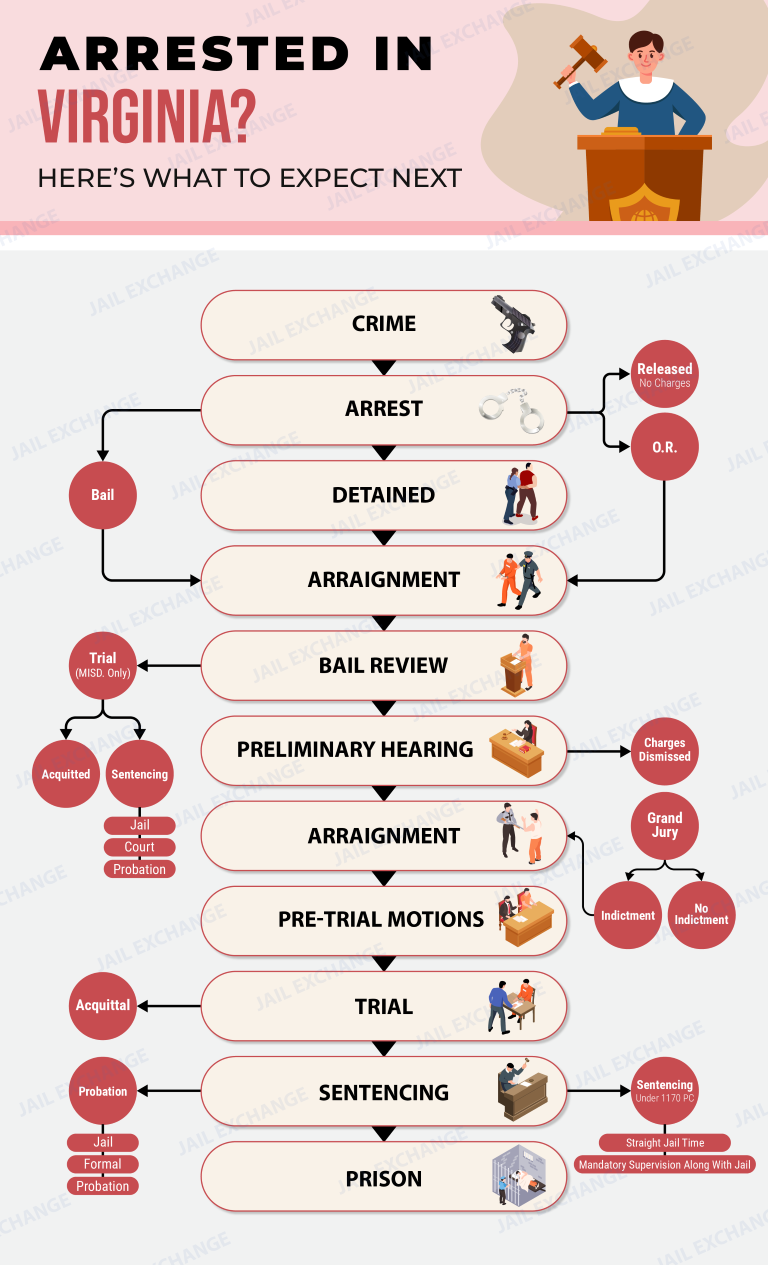
The first court appearance, called an advisement or arraignment, is normally held on the next day the court is in session. For someone in custody, that usually means video from the jail. The judge reads the charge, reviews release, and asks whether the person will hire a lawyer, wants a court-appointed one, or will waive counsel. People who cannot afford a lawyer fill out a financial statement, and the court usually appoints the public defender.
↑ Back to the question list4. The Arlington County Detention Facility
The Arlington County Detention Facility is the county's adult jail, run by the elected Arlington County Sheriff at 1435 North Courthouse Road. It holds men and women awaiting trial in the Arlington and Falls Church courts, people serving local sentences of 12 months or less, and people waiting to be moved to a state prison after a felony sentence. The Sheriff's Office also provides courtroom security and transports inmates between the jail and the courtrooms.
- Who is housed there. Arlington arrestees and adults charged in the City of Falls Church; the Falls Church agreement covers detention, booking, medical care, court security and pretrial services. The jail has also held federal pretrial detainees under an agreement with the U.S. Marshals Service.
- Posting bail. A secured bond set by the magistrate or a judge can be posted in cash or through a licensed bondsman; the Sheriff's Office front desk can explain current procedures.
- Calling about an inmate. The Sheriff's Office front desk is (703) 228-4460. Have the person's full name and date of birth ready.
- After sentencing. Sentences of more than 12 months for a felony are served in the Virginia Department of Corrections, and the person stays in the county jail until the state transfers them.
Juveniles are not held at this jail. Youths detained by the JDR court go to the Northern Virginia Juvenile Detention Center in Alexandria, described in the juvenile section below.
↑ Back to the question list5. The Arlington public defender and court-appointed lawyers
The Office of the Public Defender for Arlington County and the City of Falls Church is a state office under the Virginia Indigent Defense Commission. It is located at 2200 Wilson Boulevard and can be reached at (703) 875-1111. Its lawyers handle jailable charges in the General District, JDR and Circuit Courts for people the court finds unable to pay a private attorney, including adults and juveniles.
- How to ask. Tell the magistrate after arrest, and say so again to the judge at the first appearance. The court will have you complete a financial statement under oath; blank forms are also kept at the clerk's office of the court where your case is pending (General District Court clerk (703) 228-7900).
- Conflicts. When the public defender cannot take a case, for instance because it already represents a co-defendant or a witness, the judge appoints a private lawyer from the court's list of qualified attorneys.
- Cost. Representation is free at the start, but if the person is convicted, the court can add the state's fee for appointed counsel to the court costs.
- Fine-only charges. Offenses that cannot lead to jail, such as most traffic infractions, generally do not qualify for an appointed lawyer.
The public defender's lawyers also take part in Arlington's treatment dockets, described below, so asking them about eligibility early can help.
↑ Back to the question list6. The Commonwealth's Attorney and diversion in Arlington County
Criminal cases in Arlington are prosecuted by the Commonwealth's Attorney for Arlington County and the City of Falls Church, an elected official whose office is in Suite 5200 of the Justice Center, (703) 228-4410. Assistant Commonwealth's Attorneys appear in all three courts, decide which charges to pursue, and negotiate plea agreements. Police officers sometimes handle minor traffic matters themselves in General District Court, but the prosecutor's office may step into any case.
- Victim/Witness services. The office's victim/witness staff explain the court process to crime victims, give notice of hearings, help with restitution requests and support victims who testify, as the Crime Victim and Witness Rights Act provides.
- Deferred dispositions. For some first offenses, including first-offender drug possession and certain family assaults, Virginia law lets a judge defer the case and later dismiss it if the person completes conditions such as classes, community service and good behavior. The prosecutor's position often shapes whether this is offered.
- Treatment-based options. The office takes part in the Recovery Treatment Court and must approve referrals there; it can also agree to felony cases entering the Behavioral Health Docket.
- Charging changes. Prosecutors can reduce a charge (for example, a felony to a misdemeanor) as part of a negotiated plea, or drop it when the evidence will not support it.
Anyone with a pending case should talk with defense counsel before contacting the prosecutor's office directly about the facts.
↑ Back to the question list7. Specialty dockets: Recovery Treatment Court and the Behavioral Health Docket
Arlington runs two judge-supervised treatment programs aimed at people whose cases are driven by addiction or mental illness. Both are voluntary, both involve frequent court check-ins, and both depend on a team that includes the judge, the prosecutor, the public defender, probation or pretrial staff and treatment providers from the county's behavioral health services.
- Recovery Treatment Court (Circuit Court). Arlington's recovery court, which grew out of its earlier drug court, meets on Thursday mornings in a Circuit Court courtroom and is open to the public. It is designed for people on probation who have violated their terms because of a substance use problem. Admission requires the Commonwealth's Attorney's approval, and participants follow a structured treatment plan with regular testing and court reviews.
- Behavioral Health Docket (General District Court). This docket is for Arlington residents, including people who have been homeless in Arlington, who are 18 or older and have a serious mental illness, developmental disability or a dual diagnosis. It mainly takes misdemeanor cases; a felony can enter only if the Commonwealth's Attorney agrees. Screening looks at the person's risk of reoffending and treatment needs.
Referrals usually come through defense counsel. A person who thinks they might qualify should raise it with their lawyer as soon as possible, because entry may require a plea or agreement on specific conditions.
↑ Back to the question list8. Misdemeanor (for example, petit larceny, a first DUI, assault and battery, trespassing)
Most misdemeanor arrests in Arlington end with release the same day: the magistrate commonly issues a summons or a recognizance bond, and the person goes home with a court date in the Arlington General District Court. Someone held instead waits at the Arlington County Detention Facility and sees a judge by video on the next court day.
Penalty ranges. Virginia sorts misdemeanors into four classes:
- Class 1: the court may impose jail of up to 12 months, a fine as high as $2,500, or the two together. Petit larceny (property worth less than $1,000), simple assault and battery, and trespassing after being told to leave all fall here.
- Class 2: as much as 6 months in jail and a fine up to $1,000.
- Class 3 and Class 4: fines only, capped at $500 and $250.
A first DUI. Driving under the influence is a Class 1 misdemeanor. The license is suspended administratively for 7 days at arrest. A conviction brings a fine of at least $250, a one-year license revocation (a restricted license with an ignition interlock may be allowed), and enrollment in the Virginia Alcohol Safety Action Program (VASAP). A blood alcohol level of 0.15 to 0.20 means at least 5 days in jail, and anything above 0.20 means at least 10 days.
Family assaults. When the person hit or threatened is a spouse, partner, relative or someone living in the household, the case is heard in the Arlington JDR court instead. A first offender may be offered a deferred disposition that ends in dismissal; someone with two earlier family-assault convictions can face a felony charge for the third.
How the case moves. At arraignment the judge explains the charge and handles the lawyer question; the public defender is appointed for eligible people facing possible jail. The case is then set for trial before a judge, often within a few weeks. Results include dismissal, a deferred disposition, a fine, a suspended jail sentence with probation, or active jail time. Either side's case is heard all over again if the defendant appeals to the Arlington Circuit Court within 10 days; a jury may be requested there. A straightforward misdemeanor usually finishes in one to three months, longer with an appeal. Virginia's record-sealing law may later allow some misdemeanor charges and convictions to be sealed; a lawyer can check eligibility.
↑ Back to the question list9. Felony (for example, burglary, grand larceny, drug possession or distribution, malicious wounding)
A felony arrest in Arlington goes through the same magistrate step as any other charge, but release is less automatic: the magistrate may set a secured bond or hold the person at the Arlington County Detention Facility, and a General District Court judge reviews the decision at the first appearance. Felony penalties in Virginia run by class:
- Class 3: 5 to 20 years. Malicious wounding and nighttime burglary of a home are examples (a burglar armed with a deadly weapon faces a Class 2 charge).
- Class 4: 2 to 10 years.
- Class 5: 1 to 10 years, or up to 12 months in jail at the judge's discretion. Possessing a Schedule I or II drug such as cocaine, heroin or fentanyl is a Class 5 felony.
- Class 6: a prison range of 1 to 5 years, which a judge or jury may replace with a jail term of 12 months or less. Unlawful wounding is in this class.
- Grand larceny (property worth $1,000 or more) carries 1 to 20 years or up to 12 months in jail; possession with intent to distribute a Schedule I or II drug carries 5 to 40 years for a first offense, with mandatory minimums for large amounts. Possessing an ounce or less of marijuana is legal for adults 21 and over in Virginia, though sales outside the law are still prosecuted.
Preliminary hearing. The General District Court holds a preliminary hearing to decide whether there is probable cause. If the judge finds there is, the case is certified to the grand jury, which in Arlington meets monthly. Prosecutors can also go directly to the grand jury for an indictment without a preliminary hearing.
Circuit Court. After indictment, the defendant is arraigned in the Arlington Circuit Court. Most cases end with a plea agreement. A defendant who goes to trial may choose a judge or a jury of 12 that must agree unanimously; since July 2021 the judge decides the sentence unless the defendant asks the jury to do it. Virginia's sentencing guidelines are advisory, and the judge receives a presentence report before imposing sentence.
Timing and sentences. Under Virginia's speedy-trial statute, a defendant held in custody must generally be tried within five months after the probable-cause finding, and one who is free on bond within nine months, subject to exceptions such as continuances the defense requests. Most Arlington felony cases take somewhere between four months and a year to finish. Parole was abolished for felonies committed on or after January 1, 1995, although earned sentence credits can shorten time served, and sentences longer than 12 months go to the Department of Corrections. The public defender represents eligible defendants from the first appearance through trial and sentencing.
↑ Back to the question list10. Violent felony (for example, murder, rape, robbery)
Homicides, sexual assaults, armed robberies and similar charges in Arlington follow the felony path, but with higher stakes at every stage. A magistrate seldom releases a person accused of a violent crime, so the first bail argument usually happens in front of a General District Court judge, and a defendant who is denied release can ask the Arlington Circuit Court to reconsider. Most people charged with these crimes remain in the Arlington County Detention Facility for the life of the case.
- Aggravated murder (renamed from capital murder in 2021): Class 1 felony, punished by life imprisonment. Virginia abolished the death penalty in 2021.
- First-degree murder: a Class 2 felony that the Arlington Circuit Court can punish with anywhere from 20 years up to life. Second-degree murder: 5 to 40 years.
- Rape and robbery: each 5 years to life.
- Aggravated malicious wounding: an Arlington conviction for this Class 2 felony carries a sentence of at least 20 years and as much as life.
These cases are usually indicted by the grand jury and tried in the Arlington Circuit Court, where both sides may need expert witnesses, forensic testing and extensive discovery. As a result, one to two years from arrest to verdict is common. Victims and their families can rely on the victim/witness staff of the Commonwealth's Attorney's office for case updates, help preparing to testify, and notice of plea offers and sentencing, under the Crime Victim and Witness Rights Act. Defendants who qualify are represented by the public defender at (703) 875-1111 or by a court-appointed lawyer certified for serious felony cases.
↑ Back to the question list11. Juveniles (under 18) arrested in Arlington County
Anyone under 18 who is accused of a crime in Arlington comes under the Arlington Juvenile and Domestic Relations District Court, not the adult General District Court. The first decision belongs to an intake officer at the 17th District Court Service Unit (the Court Service Unit for Arlington and Falls Church), Suite 5100 of the Justice Center, (703) 228-4600.
- Intake. The officer reviews the complaint and decides whether to file a petition with the court, divert a minor first offense to an informal program (an apology, restitution, counseling or community service), or, for serious charges or a risk to safety, order the youth detained.
- Detention. Arlington youths who are detained are held at the Northern Virginia Juvenile Detention Center, 200 South Whiting Street in Alexandria, (703) 751-3700, which serves Arlington, Alexandria and Falls Church. A detention hearing before a JDR judge must take place within 72 hours, on the next day the court sits, and the judge decides whether the child stays detained or goes home with conditions.
- Lawyers and prosecutors. The Commonwealth's Attorney prosecutes juvenile cases, and the public defender's office represents children whose families cannot pay. A parent or guardian is expected to attend.
- Outcomes. A JDR judge can dismiss the case, defer it, place the child on probation supervised by the Court Service Unit, order community programs or treatment, or, for serious or repeated offenses, commit the child to the Department of Juvenile Justice, which may place the youth at Bon Air Juvenile Correctional Center or in a community placement.
- Adult court. A child 14 or older charged with certain serious felonies can be transferred to the Arlington Circuit Court after a transfer hearing in JDR court. For the most serious charges, such as murder or aggravated malicious wounding, the law allows the Commonwealth's Attorney to have a 16- or 17-year-old certified for trial as an adult once a judge finds probable cause at a preliminary hearing.
Juvenile court files and records are kept confidential in most cases, although there are exceptions for serious felonies and for some older juveniles.
↑ Back to the question list12. Federal cases (U.S. District Court) from Arlington County
Arlington is in the Eastern District of Virginia, and its federal criminal cases go to the Alexandria Division at the Albert V. Bryan U.S. Courthouse, 401 Courthouse Square, Alexandria, VA 22314 (clerk's office (703) 299-2107), a few miles south of the county line.
When a case becomes federal. Arlington hosts more federal property than almost any other county in Virginia. Offenses on the Pentagon reservation, at Joint Base Myer-Henderson Hall (Fort Myer), at Arlington National Cemetery or along the George Washington Memorial Parkway are often charged in federal court; petty offenses there typically go before a federal magistrate judge, while felonies go to a district judge. Away from federal land, federal prosecutors also bring drug trafficking, gun possession by prohibited people, bank robbery, child exploitation and fraud cases, sometimes after a state arrest.
- Prosecutor. The U.S. Attorney's Office for the Eastern District of Virginia has its Alexandria office at 2100 Jamieson Avenue, Alexandria, VA 22314, (703) 299-3700.
- Defense. The Office of the Federal Public Defender for the Eastern District of Virginia, 1650 King Street, Alexandria, represents people who cannot afford counsel; when it has a conflict, the court appoints a private lawyer from its Criminal Justice Act panel.
- First steps. After a federal arrest, the person sees a U.S. magistrate judge for an initial appearance. If the government asks for detention, a hearing is generally held within three court days. Applying the federal pretrial release statute, the judge either lets the person go the person on conditions supervised by U.S. Pretrial Services (Alexandria probation and pretrial office, (703) 299-2300) or orders detention.
- Indictment and speed. A person charged by complaint must be indicted within 30 days, and the Speedy Trial Act sets a 70-day clock to trial. The Eastern District is known as the "rocket docket," and Alexandria cases often move to trial or plea much faster than in other federal courts.
- Trial and sentencing. Most cases resolve by plea. Twelve jurors decide a federal trial, and their verdict has to be unanimous. A federal probation officer writes a presentence report ahead of the sentencing date, and the judge considers the advisory federal Sentencing Guidelines and any mandatory minimum. There is no parole in the federal system, so people serve about 85 percent of the sentence in the Bureau of Prisons, followed by supervised release. Appeals go to the U.S. Court of Appeals for the Fourth Circuit.
To find a federal prisoner, use the Federal Bureau of Prisons inmate locator, which accepts a name or a register number. Pretrial federal defendants are sometimes boarded by the Marshals Service in local or regional jails (Arlington's has had such a contract), and in that case the housing jail's roster may list them too. Federal charges against juveniles are rare; Arlington youth cases nearly always stay in the JDR court.
↑ Back to the question listThis page is a general overview of how criminal cases move through the courts serving Arlington County, Virginia; it is not legal advice, and court procedures, programs and phone numbers change. A person with a pending Arlington charge is best served by consulting a Virginia criminal defense attorney. To ask about appointed counsel, call the Arlington public defender office at (703) 875-1111 or the Arlington General District Court clerk at (703) 228-7900; for questions about someone in custody, call the Arlington County Sheriff's Office at (703) 228-4460.

Access Securepak is an authorized correctional commissary care-package program that allows families to purchase customized food, snack, hygiene, apparel, and electronics packages sent directly to an incarcerated loved one. Every package is custom-packed to meet the strict security regulations of the specific jail or state prison.
Important: Delivery Schedules and Package Quotas
Jail package guidelines are not uniform across detention centers. Some facilities permit orders year-round, while others restrict deliveries to quarterly cycles or strict weekly deadlines that you should confirm with the facility directly. If you delay setting up your account, you risk missing the upcoming delivery cutoff, leaving your loved one waiting an extra cycle for fresh food, warm thermals, or personal toiletries.
Step-by-Step Instructions to Register and Access Service
- Visit the official Access Securepak online store at www.accesscatalog.com.
- Select the state and the specific jail or correctional institution from the dropdown menu.
- Enter the inmate's legal last name and inmate ID to verify their active housing and package eligibility.
- Browse the catalog of approved meats, cheeses, ramen soups, cookies, toiletries, and clothing.
- Add items to your cart up to the facility's maximum weight or dollar limit (usually $50 to $125 per order).
- Check out using your debit or credit card and save the order confirmation tracking number.
What the Inmate Needs to Do
The inmate does not need to order anything themselves. Securepak ships the sealed package directly to the correctional facility's commissary warehouse. Jail staff inspect the box and deliver it to the inmate during regular pod commissary distribution, where the inmate signs for the package.
Official Provider: Access Corrections / Keefe Group Official Website
Customer Service Telephone: 1-800-546-6283
Support Hours: Monday – Friday, 8:30 AM – 11:30 PM EST; Saturday, 11:00 AM – 5:00 PM EST
Supported Languages: English and Spanish
Other Services Provided by Access Corrections / Keefe Group
In addition to Access Securepak (Commissary & Gift Packages), Access Corrections / Keefe Group provides several other communication, financial, and visitation services at participating correctional facilities:
- Inmate Trust Money Deposits: Send cash directly to their personal account so they can buy items independently.
• Learn more on our website: Inmate Trust Money Deposits Guide | • Visit official vendor page: Access Corrections / Keefe Group Inmate Trust Money Deposits - Digital Messaging & Photos: Send fast electronic letters and digital pictures to their tablet.
• Learn more on our website: Digital Messaging & Photos Guide | • Visit official vendor page: Access Corrections / Keefe Group Digital Messaging & Photos
Buy Commissary for an Inmate in the Arlington County Detention Facility
Arlington County Detention Facility Inmate Commissary - Sending Money or Purchasing Commissary for an Inmate
Arlington County Detention Facility allows inmates to purchase commissary. Ask the jail what its commissary sells; snacks and hygiene items are common.
You can buy commissary for an inmate using an online service called Access Securepak.

Call the facility at 703-228-4460 to ask whether there is a limit on how much an inmate can spend on commissary.
Access Securepak's site shows whether friends and family can order commissary for an inmate at this jail.
Scroll down for information on the Arlington County Detention Facility's service they use for you being able to purchase commissary items online and have them shipped directly to the inmate.
You can also go to our Inmate Money page for information on how to send money to an inmate.
Access Secure Deposits (Smart Deposit) allows families and friends to securely transfer money directly into an incarcerated person's jail trust account using a debit or credit card. Deposited funds become immediately available for your loved one to purchase essential hygiene goods, over-the-counter medication, food items, and writing materials from the facility commissary.
Important: Inmate Banking Policies Vary by Facility
Once a person is booked and moved to a cell, facilities do not always allow cash drop-offs or phone payments directly to the jail. Some might and you should confirm this by calling the facility and asking. But if you do not register online and fund your loved one's trust account immediately, they may be forced to wait days or weeks for standard paper processing, leaving them without essential soap, clean undergarments, basic medical sundries or snacks.
Step-by-Step Instructions to Register and Access Service
- Obtain the inmate's legal first and last name, date of birth, and official six- to ten-digit Booking or Inmate ID number.
- Visit the official Access Corrections portal at www.accesscorrections.com or download the Access Corrections mobile app.
- Select the state and the exact detention facility or county jail where the inmate is currently housed.
- Add the inmate as a contact and confirm their identity from the facility roster.
- Enter your debit or credit card billing information, choose your deposit amount, review the facility processing fee, and submit your payment.
- Save and print your transaction confirmation number for verification.
What the Inmate Needs to Do
The inmate does not need internet access to receive your deposit. Once approved, the funds post directly to their facility account balance. The inmate can verify their balance at the dayroom kiosk or on their trust statement and start ordering items on the next designated commissary day.
Official Provider: Access Corrections / Keefe Group Official Website
Customer Service Telephone: 1-866-345-1884
Support Hours: 24/7/365
Supported Languages: English and Spanish
Other Services Provided by Access Corrections / Keefe Group
In addition to Access Secure Deposits (Trust Money), Access Corrections / Keefe Group provides several other communication, financial, and visitation services at participating correctional facilities:
- Digital Messaging & Photos: Send digital letters and pictures straight to the inmate's kiosk or tablet.
• Learn more on our website: Digital Messaging & Photos Guide | • Visit official vendor page: Access Corrections / Keefe Group Digital Messaging & Photos - Commissary Care Packages: Order pre-approved food boxes, thermal clothes, and snack bundles directly to the jail.
• Learn more on our website: Commissary Care Packages Guide | • Visit official vendor page: Access Corrections / Keefe Group Commissary Care Packages
Deposit Money for an Inmate in the Arlington County Detention Facility
The Easiest and Securest Way of Depositing Money for an Inmate
There are several methods for depositing money on an inmate's account:
1. To send money online to an inmate in the Arlington County Detention Facility use Access Corrections.

2. If you prefer to use your credit or debit card and deposit money over the phone, you can call them at 866-345-1884.
3. Some jails have an Access Corrections kiosk for cash or card deposits. Call the Arlington County Detention Facility to ask whether it has one and where it is.
4. Access Corrections also has Kiosk machines that you can find in check cashing stores and retail outlets across the country.
5. The Arlington County Detention Facility may also allow you to *mail an inmate a money order or cashier’s check from a trusted source such as the Post Office, a local bank, or Western Union. Ask the jail who the money order should be made out to and what to write on it. To confirm this option call the facility at 703-228-4460.
*When mailing a money order or cashier’s check, send it an envelope by itself. Never send it with a letter or photos for your inmate, unless the facility allows it. Never send personal checks or cash.
6. To ask whether the Arlington County Detention Facility takes deposits in person, and when, call 703-228-4460.
Send an Inmate Mail in the Arlington County Detention Facility
The Arlington County Detention Facility on North Courthouse Road is run by the Arlington County Sheriff's Office. Personal letters are addressed to a mail-scanning service, not to the Courthouse Road building. Because letters are scanned, paper soaked in drugs never reaches the housing units. Each person is known by a P number, also called a Global Subject number, which belongs on everything you send.
Personal letters (mail-scanning service):
Inmate's Full Name & P#
Arlington County Detention Facility
c/o Securus DMC
P.O. Box 21406
Tampa, FL 33622
Legal mail, publications and money orders (detention facility):
Inmate's Full Name & P#
Arlington County Detention Facility
1435 North Courthouse Road
Arlington, VA 22201
- Find the P number: Look it up with the Arlington inmate search before you write.
- Money orders: A money order, cashier's check or certified check of up to $100 can be mailed to the detention facility or dropped off during visiting hours. Make it out to the inmate's full name and write their P number on it. If you are unsure, call 703-228-4460 to confirm. Never mail cash or a personal check.
- Your details: Your name and full address belong in the upper left of the envelope or postcard, or the mail is likely to go undelivered.
- Pens only: Blue or black ink. Crayons, felt markers, colored ink, lipstick and perfume are all against the rules.
- Drawings and add-ons: Leave out drawings, and put nothing extra in the envelope, such as glitter or confetti.
- Publications: Books, newspapers and magazines must be new and come directly from the publisher.
- Greeting cards: Choose a simple card for Arlington, never a musical one.
- Restricted contacts: No letters between an inmate and a co-defendant, another prisoner, or someone a no-contact order protects.
Mail is delivered on weekdays. Deposits can also be made online or at the lobby kiosk.
Securus AdvanceConnect is a prepaid calling account that links directly to your mobile phone or landline number, allowing you to receive outbound calls from an incarcerated individual. Because correctional phone systems never allow incoming calls, funding an AdvanceConnect balance ensures calls are accepted immediately without being blocked by cell carriers.
Important: Mobile Networks Block Inmate Calls Without Prepaid Funds
Correctional facilities do not allow collect billing to cell phones, and mobile carriers automatically block incoming collect calls from detention centers. While some residential landlines may allow direct billing, mobile phones and VoIP services require an active prepaid AdvanceConnect balance, which you can verify with your phone provider. If you do not register online and fund your account right away, your loved one will hear an automated error message stating that your number cannot accept calls.
Step-by-Step Instructions to Register and Fund AdvanceConnect
- Go to securustech.online or open the Securus mobile app.
- Select Sign Up and create your account using your 10-digit telephone number and email address.
- Search for your facility by state and agency name, then add the inmate using their full legal name or booking ID.
- Select AdvanceConnect under calling accounts.
- Choose your deposit amount, review convenience and transaction fees, and enter your credit or debit card billing details.
- Authorize payment and confirm that your mobile phone allows calls from automated or unknown correctional numbers.
What the Inmate Needs to Do
The inmate picks up any dayroom phone or logs onto their handheld tablet, dials your 10-digit number, and enters their assigned PIN. The automated system verifies that your AdvanceConnect account has an active balance and connects the call. All calls are subject to recording and monitoring by facility staff.
Official Provider: Securus Technologies Official Website
Customer Service Telephone: 1-800-844-6591
Support Hours: 24 hours a day, 7 days a week, 365 days a year
Supported Languages: English and Spanish
Other Services Provided by Securus Technologies
In addition to AdvanceConnect Prepaid Calling, Securus Technologies and its subsidiary JPay provide several other communication, financial, and visitation services:
- Direct Bill Phone Calling: Establish a monthly billed calling account for verified landline numbers.
• Learn more on our website: Direct Bill Phone Calling Guide | • Visit official vendor page: Securus Direct Bill - Securus Video Connect: Schedule and join live video visits from home using your computer or smartphone.
• Learn more on our website: Video Visitation Guide | • Visit official vendor page: Securus Video Connect - JPay Money Deposits (Trust & Canteen): Send money directly into an inmate's jail trust account for commissary store purchases.
• Learn more on our website: Money Deposits Guide | • Visit official vendor page: JPay Money Transfers - JPay Email Messaging & Photos: Send electronic messages, photo attachments, and VideoGrams directly to their tablet or kiosk.
• Learn more on our website: Email Messaging Guide | • Visit official vendor page: JPay Email Services
Securus Direct Bill is an invoiced telephone calling service designed for approved residential landlines, law offices, and commercial businesses. Instead of prepaying funds in advance, calls received from an incarcerated individual are billed directly to your account on a monthly itemized billing invoice.
Important: Direct Bill Requires Credit Approval and Qualifying Lines
Direct Bill is not available for mobile cell phones, internet VoIP numbers, or customers with poor or unestablished telephone credit history. Correctional facilities enforce strict telecommunications billing rules, which you can verify by calling Securus customer care. If your line does not meet credit approval standards, you must open an AdvanceConnect prepaid account instead to receive incoming calls from your loved one.
Step-by-Step Instructions to Set Up a Direct Bill Account
- Contact Securus customer service at 1-800-844-6591 or submit an application via securustech.net.
- Provide your billing name, service address, and qualifying residential or business landline telephone number.
- Submit to a standard credit evaluation performed by Securus to determine billing eligibility.
- Establish your authorized monthly credit limit upon approval.
- When your phone rings with a call from the detention center, follow the recorded operator instructions and press the requested key to accept charges.
- Pay your monthly billing invoice online, by phone, or through the mail.
What the Inmate Needs to Do
The inmate dials your phone number from any dayroom telephone and keys in their assigned PIN. The automated system verifies that your account is in good standing and has not exceeded its monthly spending ceiling before connecting the call. All non-privileged conversations are recorded and monitored.
Official Provider: Securus Technologies Official Website
Customer Service Telephone: 1-800-844-6591
Support Hours: 24 hours a day, 7 days a week, 365 days a year
Supported Languages: English and Spanish
Other Services Provided by Securus Technologies
In addition to Direct Bill Calling, Securus and its subsidiary JPay offer several other communication, financial, and visitation services:
- AdvanceConnect Prepaid Calling: Fund a prepaid calling account tied to your mobile phone number.
• Learn more on our website: AdvanceConnect Calling Guide | • Visit official vendor page: Securus AdvanceConnect - Securus Video Connect: Schedule and join live video visits from home using your computer or smartphone.
• Learn more on our website: Video Visitation Guide | • Visit official vendor page: Securus Video Connect - JPay Money Deposits (Trust & Canteen): Send money directly into an inmate's jail trust account for commissary store purchases.
• Learn more on our website: Money Deposits Guide | • Visit official vendor page: JPay Money Transfers - JPay Email Messaging & Photos: Send electronic letters, photos, and VideoGrams directly to their tablet or kiosk.
• Learn more on our website: Email Messaging Guide | • Visit official vendor page: JPay Email Services
Securus eMessaging provides a digital messaging service that allows family members to send electronic letters, digital photos, and eCards directly to an incarcerated loved one via handheld tablets and housing unit kiosks. Messages are screened electronically, delivering communication within hours instead of waiting days for postal mail delivery.
Important: Physical Mail Bans and Stamp Requirements Vary
Inmates cannot receive incoming phone calls, and traditional postal mail rules differ across correctional systems. While some jails continue to accept handwritten letters, many facilities have transitioned entirely to electronic messaging or digital mail scanning, which you can verify by checking facility rules. If you do not register online and purchase eMessaging stamps right away, your loved one may face lengthy periods without direct written contact from family.
Step-by-Step Instructions to Register and Send eMessages
- Go to securustech.online or open the Securus mobile app.
- Sign into your verified profile or create an account with your email and phone number.
- Select eMessaging from your service dashboard.
- Link the inmate to your account by selecting the facility and entering their legal name or booking ID.
- Purchase an eMessaging stamp book using a debit or credit card.
- Type your message in the editor, attach photos or eCards if permitted, and optionally include a prepaid reply stamp.
- Submit your message to the facility's screening queue.
What the Inmate Needs to Do
All electronic correspondence is screened by correctional staff before delivery. Once approved, the message arrives in the inmate's inbox on their assigned Securus tablet or housing unit kiosk. The inmate opens the message, views attached photos, and drafts an electronic reply using their available stamp balance.
Official Provider: Securus Technologies Official Website
Customer Service Telephone: 1-800-844-6591
Support Hours: 24 hours a day, 7 days a week, 365 days a year
Supported Languages: English and Spanish
Other Services Provided by Securus Technologies
In addition to eMessaging, Securus provides calling, video visitation, and trust money services:
- AdvanceConnect Prepaid Calling: Prepay for phone calling credits so your loved one can call your mobile phone directly.
• Learn more on our website: AdvanceConnect Calling Guide | • Visit official vendor page: Securus AdvanceConnect - Securus Video Connect: Schedule and join live video visits from home using your computer or smartphone.
• Learn more on our website: Video Visitation Guide | • Visit official vendor page: Securus Video Connect - JPay Money Deposits (Partner Trust Transfers): Send money directly into an inmate's jail trust account for commissary shopping.
• Learn more on our website: Money Deposits Guide | • Visit official vendor page: JPay Money Transfers
Securus Technologies (Aventiv) deploys secure, corrections-grade community tablets to incarcerated individuals across state prison systems and county jails. Operating over a private, encrypted facility network, these devices provide access to digital messaging (eMessaging), phone calls, educational courses, job search tools, eBooks, podcasts, and streaming music directly from housing units.
Important: Tablet Hardware Deployment and Rental Rules Vary
Detention centers do not manage tablet distribution identically. While some agencies issue individual personal tablets to every detainee at booking, others utilize shared pod docking stations or restrict tablet use to specific dayroom hours, which you should confirm with the facility directly. Although core educational and legal resources are generally provided free of charge, sending messages, listening to music, or making phone calls from the tablet requires an active balance funded by outside contacts.
Step-by-Step Instructions to Support and Fund Securus Tablets
- Verify that Securus handheld tablets are deployed at your loved one's specific facility.
- Log into your account at securustech.online or launch the Securus mobile app.
- Ensure the inmate is linked to your contact list using their legal name and booking ID number.
- Purchase eMessaging Stamps for digital messaging, fund an AdvanceConnect account for phone calls, or deposit funds into their Inmate Debit account for music and media.
- Review all transaction charges, complete payment with a credit or debit card, and save your confirmation receipt.
- Notify your loved one that funds have posted so they can access their media and communication apps.
What the Inmate Needs to Do
The inmate unlocks their assigned tablet using their facility PIN or biometric verification. They can access free rehabilitative and educational materials at no charge, or open communication and media applications to draft messages, place phone calls, or stream music using available balances. Devices are docked during quiet hours and shift changes for secure recharging and data synchronization.
Official Provider: Securus Technologies Official Website
Customer Service Telephone: 1-800-844-6591
Support Hours: 24 hours a day, 7 days a week, 365 days a year
Supported Languages: English and Spanish
Other Services Provided by Securus Technologies
In addition to Tablet Services, Securus provides calling, messaging, video visitation, and trust money transfers:
- eMessaging & Digital Mail: Send electronic messages, photo attachments, and eCards directly to an inmate's tablet.
• Learn more on our website: eMessaging Guide | • Visit official vendor page: Securus eMessaging - AdvanceConnect Prepaid Calling: Prepay for phone calling credits so your loved one can call your telephone directly.
• Learn more on our website: AdvanceConnect Calling Guide | • Visit official vendor page: Securus AdvanceConnect - Securus Video Connect: Schedule and join live video visits from home using your computer or smartphone.
• Learn more on our website: Video Visitation Guide | • Visit official vendor page: Securus Video Connect - JPay Money Deposits (Partner Trust Transfers): Send money directly into an inmate's jail trust account for commissary shopping.
• Learn more on our website: Money Deposits Guide | • Visit official vendor page: JPay Money Transfers
Arlington County Juvenile Facilities
- Jail (Main): 703-228-4460
- Adult Probation: 703-228-0125
- Police: 703-558-2222
- Public Defender: 703-875-1111
- Sheriff: 703-228-4460
The Arlington County Detention Facility serves the following cities and towns of Arlington County: Arlington, Bon Air and Fort Myer.