
Northwestern Regional Adult Detention Center
Northwestern Regional Adult Detention Center
Physical Address
141 Fort Collier RoadWinchester, VA 22603
Jail Phone Number
540-535-3800Winchester Inmate Search: Tracking a Loved One Booked on Fort Collier Road
City police bring an arrested adult to the Northwestern Regional Adult Detention Center, 141 Fort Collier Road, Winchester, VA 22603. The site has several buildings, and each houses a different kind of inmate. Below you will also find mugshot tips, bail basics, lawyer help, visit rules, mail advice and court contacts.
Your best first move is the jail's inmate search. Enter the surname, and switch to other spellings if nothing turns up. New bookings take a while to post, so a blank page is no sign that the person has gone.
Phone the jail at 540-535-3800 for a firm answer. Give the staff a full name and a birth date. Find out which building holds the person, how much money bail requires and when a judge will first hear the case. Our bail page covers the road to release, and the court page tracks hearings.
Read inmate search answers
 Read inmate search answers
1. Using the Winchester city jail list, step by step
The regional jail keeps a single online list of those it holds. Try this routine:
- Open the inmate search in a browser on any device.
- Type the last name alone at first. Add the first name when the results pile up.
- Still empty? Test nicknames, double-barreled surnames and spellings that differ by a letter.
- Study any dates beside the names. They separate two people who share a name.
- Jot down any booking number on the screen, because staff can open a file faster with it.
If the screen stays blank, call 540-535-3800 and ask the desk to confirm. A posted list may run behind the cell count, and the desk sees the real one. The state's free custody service, VINE, makes a useful second check.
↑ Back to the question list2. The jail list shows nothing: what now?
A blank screen usually has an ordinary cause:
- Booking is in progress. Prints, photos and paperwork may take hours to finish.
- A police lockup came first. Some people wait at the arresting agency before the drive to Fort Collier Road.
- A citation. An officer can write a summons, name a court day and let the person walk.
- Back home already. The magistrate may have accepted a bond, or the person's written pledge to return for court.
- Another address. The person might sit in a different locality's cell, in a federal or immigration hold, or in a state prison.
- The spelling. A wrong letter hides a record, so test variations.
- Age. People under 18 are sent elsewhere.
Ring the jail at 540-535-3800. If the desk says no one by that name is held, get the name of the arresting agency from staff and phone it. Police phone numbers close out this page.
↑ Back to the question list3. Which Fort Collier Road building holds a Winchester city arrest?
Residents of the city share a regional jail with neighbors. Frederick County, Clarke County and the city formed the jail board in 1987. Fauquier County joined in 1998 but still keeps a separate jail of its own in Warrenton.
Look at the Northwestern Regional Adult Detention Center first. It is at 141 Fort Collier Road, Winchester, VA 22603, inside city limits, and the phone is 540-535-3800. The grounds include:
- Main Jail. The central building, enlarged in 2007 to 337 beds. Fresh arrests normally begin here.
- Work Release Center. A 99-bed building for inmates cleared to leave for a job under strict conditions.
- Community Corrections Center. A 204-bed building next door to the Main Jail. Ask the desk which inmates live there.
- Security Annex. Jail mail records list an annex at 143 Fort Collier Road, Winchester, VA 22603. Ask the desk what it holds.
A person arrested in Fauquier County could be at that county's jail instead. JE shows the Fauquier County Adult Detention Center on its own page. Call the regional jail before you drive anywhere, since staff can steer you.
↑ Back to the question list4. Are mugshots online for a person held at Fort Collier Road?
Ask the jail desk at 540-535-3800 whether the inmate search displays mugshots. Check for yourself before you count on one.
Virginia's open-records statute makes law enforcement release adult booking photos shot during intake. A felony investigation still underway is the only reason an agency may hold one back (Va. Code § 2.2-3706). Contact the arresting agency to ask for a copy. City officers belong to the Winchester Police Department, Timbrook Public Safety Center, 231 E. Piccadilly Street, Winchester, VA 22601, 540-662-4131. Pictures of minors stay private.
- ICE photos can be requested only from ICE, through its online records request form.
- Nobody outside the government gets federal mugshots, with one narrow exception: the U.S. Marshals Service can release a photo of a fugitive it wants the public's help to find.
5. Can a text message tell me when they leave or change cells?
Yes. VINE costs nothing, shows custody status and location, and sends messages when that changes. It tracks county jails, regional jails and state prisons.
- Find the person on the VINE site, or call 800-467-4943 at any hour.
- Pick voice, text or email as your way to get the news.
- Alerts go out for a release, a transfer to another facility or an escape.
Think of VINE as a backup. When time matters, talk to the jail.
↑ Back to the question list6. Winchester city bail: how it is set and how to post it
The magistrate who first sees the person sets bail. Reach that office, open at all hours, at 141 Fort Collier Road, Winchester, VA 22603, 540-665-5679. You may see release on a signed pledge to return. Some people get an unsecured bond, with no money due yet. Others need a secured bond, paid with cash, land or a bondsman. Rules for release may be added, for instance staying home after dark or staying away from the accuser.
- After an amount is set, anyone can pay it at the jail, 141 Fort Collier Road, Winchester, VA 22603. The Magistrate's Office and the courts take bond as well.
- Jail staff cannot pick a bondsman for you. Licensed bondsmen set their fee by state law, from ten to fifteen percent of the bond. You cannot get that fee back.
- A General District Court judge sees every person still in custody once the court reopens. Families who ask for a lower amount get a hearing within three business days.
Our bail page covers each stage. For the law itself, read JE's Virginia bail laws page.
↑ Back to the question list7. Who has the exact charges on file?
Start with the jail desk at 540-535-3800. Provide the desk with the person's legal name and birthday. After that, find out what the accusation is and the date the person must next be in court.
Virginia also offers a free name lookup, the Online Case Information System. Expect traffic and criminal cases from General District Court. You will also find adult cases that reached the JDR court, which handles family matters, plus Circuit Court cases. Files about children are not included.
- General District Court clerk, Joint Judicial Center, 5 North Kent Street, Winchester, VA 22601, 540-722-7208. Misdemeanors and traffic tickets are heard here.
- Circuit Court clerk, same building, 540-667-5770. Felony trials are held here after the grand jury votes to indict.
- Commonwealth's Attorney, the office that prosecutes, in The Creamery Building, 21 South Kent Street, Suite 200, Winchester, VA 22601, 540-722-7940.
8. Paying for a lawyer is hard: what is the free option?
Hiring a private attorney is allowed at every stage of a case. Without money, a person can request one at no charge.
- At the first hearing the judge raises the subject of counsel. The person can speak up then, or tell the magistrate sooner.
- The person signs a sworn paper about income. The General District Court clerk, 540-722-7208, can describe the paper.
- The judge weighs eligibility and then appoints the public defender or another lawyer paid by the court.
The Winchester Public Defender Office is at 100 North Loudoun Street, Suite 230, Winchester, VA 22601, 540-722-3450. It also works for Clarke, Frederick, Page, Shenandoah and Warren counties. Relatives may phone it with questions.
↑ Back to the question list9. Planning a visit to Fort Collier Road
Every jail writes its own visit rules, and a wrong guess wastes gas. Call 540-535-3800 before leaving and ask:
- Which weekdays are open, and do I reserve a slot?
- Do visitors sit across a table or use a screen?
- What ID do you accept, and is there an age limit for guests?
- What counts as proper dress, and what stays in the car?
- Are kids welcome, and how many guests fit in one visit?
Attorneys often get their own meeting times. Our visiting guide lists extra pointers for newcomers.
↑ Back to the question list10. Sending money to a loved one inside
Account funds buy snacks and soap, and at some jails they buy phone minutes. Call 540-535-3800 to learn which payment options are open now, along with any fees or caps. Have the inmate's name ready, with a booking number if you know it.
No envelope should ever hold cash. Our money guide compares usual deposit routes, and our commissary guide shows the items those funds buy.
↑ Back to the question list11. Getting a phone call, text or video chat from inside
Inmates normally place the calls themselves, so you cannot ring a cell. Call 540-535-3800 to find out how to open an account that receives their calls. Check the cost of one call, and see if the jail offers texting, tablets or video.
Expect a recording on every line. Keep talk about the case between the inmate and counsel. Details on common services are in our calling guide and in the email and text guide too.
↑ Back to the question list12. Writing a letter to someone inside the jail
Hold off on stamps until you ring 540-535-3800. Request the precise mailing address, since the complex has more than one building. Find out whether a booking number should appear on the front, and which extras are permitted: cards, snapshots, paperbacks.
Write on plain sheets, print the inmate's legal name boldly and put your own name and address in the envelope's corner. Leave out money. Our mail guide describes the rules most jails follow.
↑ Back to the question list13. Getting back the clothes and things taken at booking
What the person wore in is bagged and shelved until release day. Call 540-535-3800 to learn how a relative can claim it. Find out the open hours, whether the inmate must sign off, and what ID you need to show.
The jail is at 141 Fort Collier Road, Winchester, VA 22603, but wait for staff to approve the trip. If the person has already walked out, the desk can explain how to claim leftover items.
↑ Back to the question list14. Getting medical help for a person in custody
Call 540-535-3800 right now and request the clinic staff. Name the medicine and dose, and give the prescribing doctor's contact details. Tell them about allergies, a pregnancy or a long illness.
Your loved one should also fill out the jail's sick-call request. Use 911 when someone's life is at risk. A fear of a mental health crisis belongs at the start of your call to the jail.
↑ Back to the question list15. Is there a Winchester city warrant out for someone?
Winchester Police officers and the Sheriff's Office serve warrants. Phone the police at 540-662-4131 or the Sheriff at 540-667-5770 and ask if one exists. You can also type the name into the state's online case records, or reach the General District Court clerk on 540-722-7208. A lawyer should advise you before you surrender or reach out to the issuing court. Clerks work at the Joint Judicial Center, 5 North Kent Street, Winchester, VA 22601.
↑ Back to the question list16. Winchester city: who posts the next court date?
The hearing date is picked by the court that has the case. All three meet in the Joint Judicial Center, 5 North Kent Street, Winchester, VA 22601, and the clerks keep weekday hours of 8:00 a.m. to 4:00 p.m.
- General District Court: traffic matters, misdemeanors, and preliminary hearings in felony cases. Clerk: 540-722-7208.
- Juvenile and Domestic Relations District Court: youths under 18 and disputes among relatives. Its clerk shares 540-667-5770 with the Circuit Court clerk.
- Circuit Court: trials for felonies, and appeals of verdicts from the district court.
The state case lookup takes a name too. To learn what happens at a hearing, use our court page.
↑ Back to the question list17. Federal arrest: the court, the Marshals and the locator
For federal charges, the court for the city sits in Harrisonburg: the Western District of Virginia, Harrisonburg Division, 116 North Main Street, Room 314, Harrisonburg, VA 22802, 540-434-3181.
- At the detention hearing a judge rules on jail or freedom before trial (18 U.S.C. § 3142).
- Waiting for trial, the person may be boarded at a nearby jail by the U.S. Marshals Service. Its Harrisonburg office is at 116 North Main Street, Harrisonburg, VA 22802, 540-574-3056.
- A defendant short on funds can request a federal public defender at 401 East Market Street, Suite 106, Charlottesville, VA 22902, 434-220-3380.
- After a sentence, run the name or register number through the Bureau of Prisons inmate locator.
18. An immigration hold from ICE
Here is how an ICE hold usually unfolds:
- ICE officers send the jail a detainer, known by its number, I-247A.
- The form lets the jail hold the person up to 48 hours after they would otherwise be released (8 CFR 287.7(d)).
- ICE then picks the person up and picks a place to send them. The Washington Field Office covers Virginia and D.C. and is at 14797 Murdock Street, Chantilly, VA 20151, 703-633-2100.
- Enter an A-number at the ICE Online Detainee Locator, or by entering the person's name and birth country.
Executive Directive 1, signed in February 2026, ends 287(g) agreements for state agencies only. Because detainer law here is changing, phone the jail and ask how it is handling ICE requests at the moment.
↑ Back to the question list19. Locating a person sent to a Virginia state prison
Some inmates sentenced to state time remain in the regional jail awaiting a state bed. At a reception center the department studies each case and assigns a prison.
- The VADOC locator looks people up by name or DOC number. It updates each day and includes inmates held in local jails under state authority.
- The department answers questions at 804-674-3000.
- JE's Virginia state prisons page lists the prisons, with visiting and mailing help for each.
20. A child arrested here: where do they go?
No child lives in the adult jail. Only a court official can order a child held. That includes judges, magistrates and intake officers. City youths are typically sent to the Northwestern Regional Juvenile Detention Center, 145 Fort Collier Road, Winchester, VA 22603, 540-722-6174.
The family court sits in the Joint Judicial Center, 5 North Kent Street, Winchester, VA 22601. Phone its clerk at 540-667-5770 and request intake. The files are closed to the public.
↑ Back to the question list21. Winchester city police and other agencies that make arrests
Not sure who arrested the person? Jail staff can say. Several agencies cover the city and the roads around it:
- Winchester Police Department, Timbrook Public Safety Center, 231 E. Piccadilly Street, Winchester, VA 22601, 540-662-4131. Its officers work inside the city.
- Winchester Sheriff's Office, Joint Judicial Center, 5 North Kent Street, Winchester, VA 22601, 540-667-5770. It provides courthouse security, delivers court papers and drives prisoners. It does not run the jail.
- Virginia State Police, Division Two, 15148 State Police Road, Culpeper, VA 22701, 540-829-7401. This division serves the city, and a trooper's arrest here also ends at Fort Collier Road.
For an arrest beyond city limits, the jail can name the agency.
↑ Back to the question listCity of Winchester: jail and bond
After an arrest in Winchester, adults go through booking at the Northwestern Regional Adult Detention Center, 141 Fort Collier Road, Winchester, VA 22603. That campus also has a work release center and a community corrections center. Below, you can see who sets bond, how it is paid and which court takes the case.
To check whether someone is booked, enter a name in the jail's inmate search. Our Winchester Jail Roster page also covers charges, public defenders and getting belongings back.
The fastest move is a call to the magistrate at 540-665-5679, since that office sets bond. Ask for the amount and where to pay. Then open the Winchester court guide for the next steps.
1. Which jail holds city arrestees?
The Northwestern Regional Adult Detention Center, 141 Fort Collier Road, Winchester, VA 22603. Phone 540-535-3800.
↑ Back to the question list2. Who sets bail?
The magistrate at 141 Fort Collier Road, Winchester, VA 22603, 540-665-5679.
↑ Back to the question list3. How do I search?
4. Where does a City of Winchester case begin?
With booking at the regional jail on Fort Collier Road and a hearing before the magistrate there (Va. Code § 19.2-80). The jail serves Winchester and Frederick, Clarke and Fauquier counties.
↑ Back to the question list5. Can the person go home without paying?
For lesser city charges, a magistrate frequently lets the person sign and go. Bigger cases require bail up front (Va. Code § 19.2-123). The charge, record and ties to Winchester all matter (Va. Code § 19.2-121).
↑ Back to the question list6. What forms of bail are accepted?
Cash, Virginia real estate, or a DCJS-licensed bail agent (Va. Code § 9.1-185) whose fee is kept (Va. Code § 9.1-185.8). Bonds can be posted day or night at the jail (Va. Code § 19.2-48.1).
↑ Back to the question list7. How can a city bail be lowered?
A lawyer can ask the district court (540-722-7208) for a hearing. Someone who stays in jail gets a bail review (Va. Code § 19.2-158) and a chance to ask for counsel (Va. Code § 19.2-159). Circuit Court hears appeals (Va. Code § 19.2-124).
↑ Back to the question list8. Where are city cases heard?
In the Judicial Center at 5 North Kent Street, downtown near the Old Town walking mall. City misdemeanor verdicts get a 10-day appeal window (Va. Code § 16.1-132), while felonies go to a preliminary hearing (Va. Code § 19.2-218). Family cases are in the same building (Va. Code § 16.1-241).
↑ Back to the question list9. Will the court give a free lawyer?
Yes. A judge appoints the public defender for city residents who could be jailed and sign a statement showing low income (Va. Code § 19.2-159).
↑ Back to the question list10. What rules might come with city release?
Old Town bar arrests often carry a no-drinking rule, and other terms include curfews and keep-away orders (Va. Code § 19.2-123). When the arrest involves family, a protective order lasting roughly 72 hours comes first (Va. Code § 16.1-253.4).
↑ Back to the question list11. What happens after a missed city date?
Winchester city defendants who skip court face a capias, lose the posted money, and may get a failure-to-appear count (Va. Code § 19.2-128).
↑ Back to the question list12. What about federal cases and city co-signers?
Federal Winchester cases are tried in Harrisonburg before the Western District of Virginia (18 U.S.C. § 3142). Winchester city co-signers pay the full amount after a no-show (Va. Code § 19.2-143), though delivering the defendant to Fort Collier Road first ends the debt (Va. Code § 19.2-149).
↑ Back to the question list13. Which offices confirm a City of Winchester bond?
Jail: 540-535-3800. Magistrate: 540-665-5679. Circuit Court clerk: 540-667-5770.
↑ Back to the question listContacts for Winchester city
- Jail
- Northwestern Regional Adult Detention Center, 141 Fort Collier Road, Winchester, VA 22603; 540-535-3800
- Magistrate
- 141 Fort Collier Road, Winchester, VA 22603; 540-665-5679
- District court
- Judicial Center, 5 North Kent Street, Winchester, VA 22601; 540-722-7208
- Circuit court
- The Judicial Center, 5 North Kent Street, Winchester, VA 22601; 540-667-5770
- Inmate search
- Winchester city inmate search
This page is not legal advice.
Facility_name_1} VISITATION SCHEDULE
ON-SITE (at the jail) Visiting
- Each visit is up to 30 minutes in duration.
- No more than (2) adults and (1) child or (1) adult and (2) children may visit at one time.
- All visitors must arrive thirty (30) minutes prior to the beginning of each visit for registration purposes.
- All visitors must present a valid state driver’s license or other current photo identification and must be included as an authorized visitor on the inmate’s visitation list before being permitted to visit.
- Persons less than 18 years old must be accompanied by an adult at least 21 years old.
- No visitor is permitted to enter after the cutoff times of 11:00AM and 3:00PM.
| DAY | TIME |
| MONDAY | 8:30AM-11:00AM 1:30PM-3:00PM |
| TUESDAY | 8:30AM-11:00AM 1:30PM-3:00PM |
| WEDNESDAY | 8:30AM-11:00AM 1:30PM-3:00PM |
| THURSDAY | 8:30AM-11:00AM 1:30PM-3:00PM |
| FRIDAY | 8:30AM-11:00AM 1:30PM-3:00PM |
| SATURDAY | no visits |
| SUNDAY | no visits |
Northwestern Regional Adult Detention Center OFF-SITE REMOTE VIDEO VISITATION
- Video on Demand Visitation:
Families and friends may visit inmates daily through video visitation by registering at gettingout.com

GettingOut / ViaPath Remote Video Visits
Provider: GettingOut (Telmate) • Rebranding as ViaPath Technologies (myViaPath Visits)

GettingOut Video Visitation allows friends and family members to conduct live, face-to-face video visits with incarcerated loved ones using a personal computer, laptop webcam, or the mobile application. Telmate and GTL operate under ViaPath Technologies, and the visiting service is transitioning from GettingOut Visits to myViaPath Visits; users may encounter either brand name depending on whether their county jail has completed the platform update.
Important: Advance Background Clearance Required
Detention centers do not permit unapproved drop-in video visitation. All visitors must submit valid government photo identification and pass administrative screening before an appointment can be booked, a review that can take up to 48 hours depending on facility staffing. You should verify your visitor approval status with the facility in advance. If you do not register ahead of time, you will miss your loved one's scheduled visiting slots for the week.
Step-by-Step Instructions to Schedule a Video Visit
- Open the GettingOut / myViaPath Visits app or go to www.gettingout.com / my.viapath.com.
- Register your profile and upload clear photographs of your government ID and a verification photo.
- Wait for the facility to issue visitor approval (you will receive an email confirmation).
- Select Schedule Visit, pick your detention facility, and select the inmate.
- Choose an available 25- or 30-minute time slot from the calendar and pay the visitation fee using a credit or debit card.
- Sign into the app or website 10 minutes prior to the start time on a device with a functioning camera, microphone, and stable internet connection.
What the Inmate Needs to Do
The inmate receives a schedule alert on their housing unit video kiosk or personal tablet. At the appointed time, they log in with their PIN and sit in front of the terminal. Inmates must follow institutional dress and conduct rules; corrections staff actively monitor sessions and will terminate any call immediately if rules are broken.
Official Providers: GettingOut Visits | myViaPath Visits
Customer Service Telephone: 1-866-516-0115 (GettingOut) • 1-877-650-4249 (ViaPath)
Support Hours: Monday – Friday, 7:00 AM – 11:00 PM CST; Saturday – Sunday, 8:00 AM – 7:00 PM CST
Supported Languages: English and Spanish
Other Services Provided by GettingOut / ViaPath
In addition to Remote Video Visits, GettingOut and ViaPath provide several other communication and financial options:
- Two-Way Text Messaging: Send electronic messages and photos straight to the inmate's screen.
• Learn more on our website: Two-Way Text Messaging Guide | • Visit official vendor page: GettingOut Messaging - Inmate Tablet Rentals & Content: Provide funds for educational modules, music streaming, and news.
• Learn more on our website: Tablet Rentals & Content Guide | • Visit official vendor page: GettingOut Tablets - AdvancePay Phone Calling: Keep a funded prepaid balance to receive calls directly on your phone.
• Learn more on our website: AdvancePay Phone Calling Guide | • Visit official vendor page: ViaPath ConnectNetwork Calling - Inmate Trust Deposits: Transfer money directly into their jail trust account for canteen goods.
• Learn more on our website: Inmate Trust Deposits Guide | • Visit official vendor page: ViaPath Trust Deposits
Winchester Criminal Courts on North Kent Street: Who Hears Your Case
Winchester has its own Circuit Court, plus district courts it shares with Frederick County, all inside the Joint Judicial Center, 5 North Kent Street, Winchester, VA 22601. Felony trials, family cases and everyday misdemeanors each land in a different courtroom. While a case is open, the person stays at the Northwestern Regional Adult Detention Center, 141 Fort Collier Road, Winchester, VA 22603, unless released.
First, try a name in the detention center's search tool. The Winchester Inmate Search page on our site covers fresh arrests, what the charges are and free lawyer help.
Call the General District Court clerk at 540-722-7208 and ask for the court date. For someone still held, our Winchester bail page explains bond.
1. Courts in the City of Winchester (circuit, general district, and juvenile and domestic relations courts)
The City of Winchester stands on its own as a Virginia independent city, with no county above it, and it is entirely surrounded by Frederick County. Felony indictments from the city are tried in the Winchester Circuit Court of the 26th Judicial Circuit; lesser charges and the first stages of felony cases are handled by two district courts the city has in common with the county, the Frederick/Winchester General District Court and the Frederick/Winchester Juvenile and Domestic Relations District Court. Prosecutions are brought by a Commonwealth's Attorney elected by city voters alone, not the county's. Anyone kept in custody is housed at the Northwestern Regional Adult Detention Center on Fort Collier Road, a jail the city shares with three neighboring counties.
- Northwestern Regional Adult Detention Center, 141 Fort Collier Road, Winchester, VA 22603, (540) 535-3800
- Winchester Circuit Court, Joint Judicial Center, 5 North Kent Street, Winchester, VA 22601; Clerk (540) 667-5770
- Frederick/Winchester General District Court, 5 North Kent Street, Winchester, VA 22601, (540) 722-7208
- Frederick/Winchester Juvenile and Domestic Relations District Court, 5 North Kent Street, Winchester, VA 22601, (540) 667-5770
- Commonwealth's Attorney for the City of Winchester, 21 South Kent Street, Suite 200, Winchester, VA 22601, (540) 722-7940
- Winchester Public Defender, 100 North Loudoun Street, Suite 230, Winchester, VA 22601, (540) 722-3450
- Winchester Police Department, 231 East Piccadilly Street, Winchester, VA 22601, (540) 662-4131
Which court hears your case. Traffic tickets and misdemeanors charged in the city are decided by a judge sitting without a jury in the Frederick/Winchester General District Court. After a conviction there, the defendant can appeal within 10 days and get a fresh trial in the Winchester Circuit Court, including a jury if desired. Domestic charges, meaning offenses against a family or household member, and all cases against people younger than 18 are filed in the Frederick/Winchester Juvenile and Domestic Relations District Court. A felony charge receives its preliminary hearing in one of those district courts and, after a grand jury indicts, moves up to the Winchester Circuit Court.
Where pretrial inmates are held. Rather than operating a city jail, Winchester belongs to the regional jail board that runs the adult detention center at 141 Fort Collier Road, together with Frederick, Clarke and Fauquier counties. Every adult arrested in the city who is not released by a magistrate is booked there. The jail's main number, (540) 535-3800, is the place to ask whether someone is being held, what bail was set and how visiting works.
There are no municipal, mayor's or town courts in Virginia. As a result, city police charges, State Police arrests within city limits and warrants sworn out by private citizens all proceed in state courts housed at the Joint Judicial Center on North Kent Street, next to the Old Town business district. The circuit court is the city's own, but the two district courts double as Frederick County's, so the clerks keep separate files for city and county cases.
Circuit Court
- Winchester Circuit Court, 5 North Kent Street, Winchester, VA 22601, (540) 667-5770. One elected Clerk of Circuit Court serves both the city and county circuit courts; office hours are 8:00 a.m. to 4:00 p.m., Monday through Friday.
District courts shared with Frederick County
- Frederick/Winchester General District Court, 5 North Kent Street, Winchester, VA 22601. Call (540) 722-7208 for criminal and traffic matters; the clerk's office keeps 8:00 a.m. to 4:00 p.m. hours.
- Frederick/Winchester Juvenile and Domestic Relations District Court, 5 North Kent Street, Winchester, VA 22601. The clerk can be reached at (540) 667-5770 from 8:00 a.m. to 4:00 p.m.
Magistrates and juvenile intake
- 26th District magistrates, who handle warrants and release decisions for the city around the clock, often through video links. Their district also includes Frederick, Clarke, Warren, Shenandoah and Page counties and Harrisonburg/Rockingham. The Winchester Police Department at (540) 662-4131 can explain how to reach the magistrate on duty.
- 26th District Court Service Unit, the Department of Juvenile Justice intake office for the city, Frederick County and Clarke County; ask for intake through the JDR clerk at (540) 667-5770.
Prosecution, defense and police
- Commonwealth's Attorney for the City of Winchester, The Creamery Building, 21 South Kent Street, Suite 200, Winchester, VA 22601, (540) 722-7940 (also the Victim/Witness line)
- Winchester Public Defender, a Virginia Indigent Defense Commission office for the city plus Frederick, Clarke, Page, Shenandoah and Warren counties: 100 North Loudoun Street, Suite 230, Winchester, VA 22601, (540) 722-3450
- Winchester Police Department, Timbrook Public Safety Center, 231 East Piccadilly Street, Winchester, VA 22601; around-the-clock line (540) 662-4131, office (540) 545-4730
- Winchester Sheriff's Office, which provides courthouse security, serves court papers and transports prisoners; its office in the Joint Judicial Center, 5 North Kent Street, answers at (540) 667-5770, extension 457
The magistrate decides initial release and any bond amount at any hour, so arrests made after the courthouse closes still get a prompt review.
↑ Back to the question list2. Misdemeanor (for example, petit larceny, a first DUI, assault and battery, trespassing)
Arrest or summons?
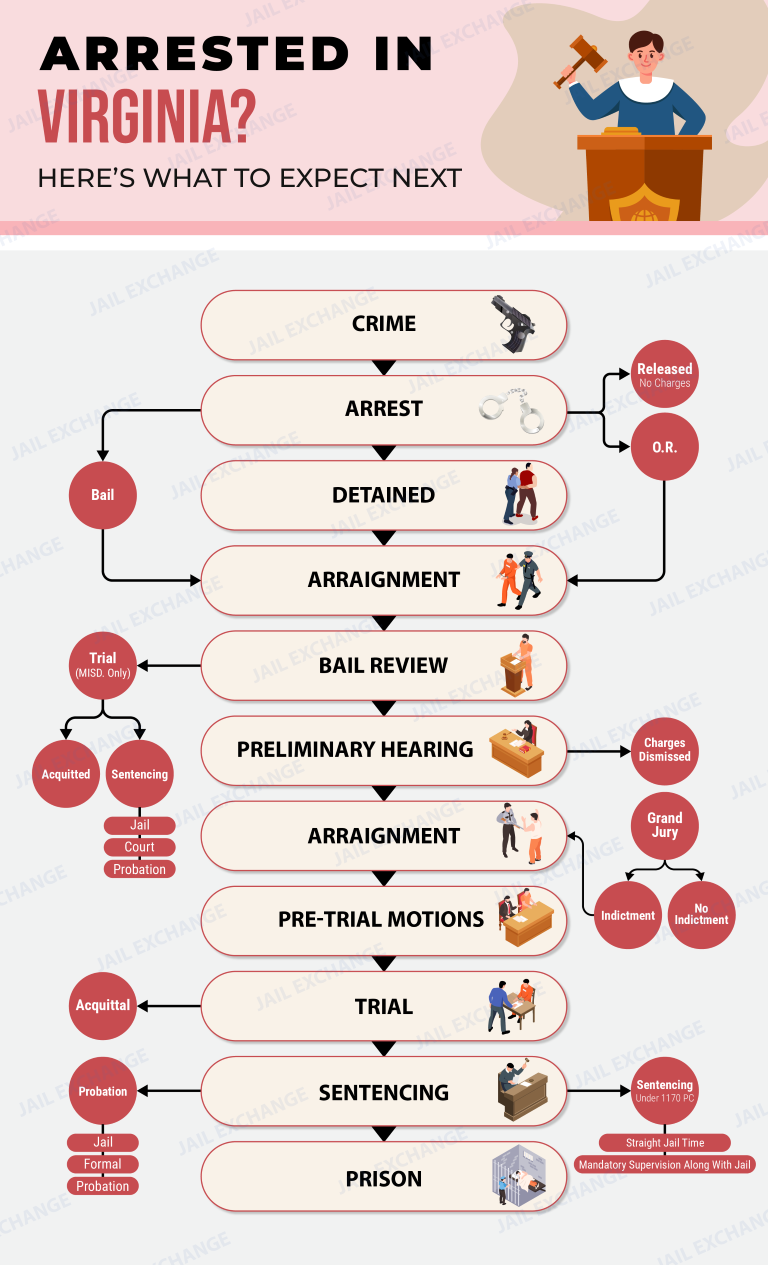
City officers write a summons for many minor offenses, letting the person go with a court date. For a DUI, a domestic call or an arrest on a warrant, the person is instead taken to a magistrate. That official may release the defendant on a simple promise to return (recognizance), on an unsecured bond that becomes payable only after a missed court date, or only after a secured bond is posted, either in cash or with the help of a state-licensed bail bondsman. Conditions such as pretrial supervision can be attached. The magistrate's focus is whether the defendant will come back to court and whether anyone would be endangered; Virginia removed its presumptions against release in 2021. Those who remain in custody are taken to the Northwestern Regional Adult Detention Center, and a district court judge can revisit the terms at a hearing, with a further appeal to the Circuit Court possible.
The first court date
A jailed defendant typically sees a judge, usually over video, the next day court sits. The judge reads the charge and asks how the defendant plans to handle legal representation. If the charge could lead to jail and the defendant's income is low, the judge can appoint the Winchester Public Defender once a financial affidavit is completed; the General District Court clerk at (540) 722-7208 provides it.
How much is at stake
Shoplifting goods worth under $1,000 (petit larceny), an ordinary assault and battery, and remaining on property after being told to leave are all Class 1 misdemeanors, which allow up to twelve months in jail and fines reaching $2,500. Class 2 offenses are capped at six months and $1,000, and the two lowest classes, 3 and 4, mean a fine of up to $500 or $250 with no jail.
Drunk driving deserves its own note. For a first DUI, which is a Class 1 misdemeanor, the minimum fine is $250; mandatory jail is five days for a blood alcohol concentration between 0.15 and 0.20 and ten days over 0.20. A seven-day administrative license suspension starts at arrest, a conviction brings a one-year revocation (restricted driving with an ignition interlock may be allowed), and the court will order VASAP classes.
Assault charges between relatives or members of the same household go to the JDR court. That court can offer an eligible first offender a deferred disposition, with the charge dismissed after treatment and a period of good behavior, while repeated convictions, three within the statutory period, can turn a later charge into a felony.
Verdict, sentence, appeal
Possible results include a dismissal, a deferred disposition, a fine, a suspended jail term with probation, or days to serve. Because the General District Court judge rules alone, the law gives every convicted defendant 10 days to appeal to the Winchester Circuit Court for a completely new trial, where a jury of seven can hear a misdemeanor. A typical case is finished in one to three months unless appealed.
↑ Back to the question list3. Felony (for example, burglary, grand larceny, drug possession or distribution, malicious wounding)
Sentencing ranges to know
- Grand larceny, the theft of property valued at $1,000 or more, permits a prison term of one to twenty years, though a judge or jury may impose twelve months or less in jail instead.
- For burglary, entering a dwelling at night to commit a crime is a Class 3 felony with a 5-to-20-year range, or Class 2 if a deadly weapon is involved; the remaining statutory burglary offenses top out at 20 years.
- Possessing heroin, cocaine, fentanyl or another Schedule I or II drug is a Class 5 felony punishable by one to ten years or a jail sentence of up to a year. Selling, or holding drugs with intent to sell, is punished by five to forty years for a first offense and by mandatory minimums when the quantity is large. Possessing an ounce or less of marijuana is lawful for adults 21 and older; distributing it is not.
- Malicious wounding (Class 3) brings 5 to 20 years; unlawful wounding (Class 6) brings one to five years or a jail term of a year or less.
From the magistrate to indictment
A felony arrest in the city leads to the magistrate first, who is more likely on a felony to demand a secured bond or to require pretrial services supervision, no contact with a complainant, or drug screens. Defendants held at the Northwestern Regional Adult Detention Center are advised of the charge in the shared General District Court, where a lawyer is appointed if they qualify. That court later holds the preliminary hearing (the JDR court does so when a family member is the alleged victim). If the judge decides there is probable cause, the charge is certified to a grand jury; the prosecutor may also go directly to the grand jury without a preliminary hearing.
In the Winchester Circuit Court
An indicted defendant is arraigned in Circuit Court and enters a plea. Negotiated pleas with the Commonwealth's Attorney end the majority of cases. A defendant who goes to trial may choose a judge or a jury of 12, whose verdict must be unanimous; the judge sets punishment, using Virginia's voluntary sentencing guidelines, unless the defendant requests jury sentencing. Virginia's speedy-trial law requires that trial start within five months after probable cause is found if the defendant is held, or within nine months if the defendant is free, with exceptions for continuances and defense-requested delays.
After a conviction
No parole is available for felonies committed since January 1, 1995, although sentence credits earned in custody can reduce the time. Anyone sentenced to more than a year serves the time in a Department of Corrections prison. Appeals go first to the Court of Appeals of Virginia. Including any plea talks, a city felony usually takes four months to a year. Appointed lawyers' fees can later be assessed as court costs.
↑ Back to the question list4. Violent felony (for example, murder, rape, robbery)
Crimes of serious violence inside the City of Winchester are relatively rare but are among the cases the Commonwealth's Attorney's office prepares most intensively.
Custody while charges are pending
A defendant accused of murder, rape or robbery is usually held at the Northwestern Regional Adult Detention Center. The defense can request release at a bond hearing in district court and appeal a refusal to the Winchester Circuit Court. Judges consider the nature of the accusation, prior convictions and the victim's safety; strict supervision or GPS tracking is often a condition if release is allowed.
What the law provides
- Life imprisonment for aggravated murder, the Class 1 felony formerly called capital murder (the death penalty ended in Virginia in 2021).
- For first-degree murder, a Class 2 felony, no less than twenty years and up to a life term; for second-degree murder, five to forty years.
- For rape, between five years and life.
- For robbery, likewise five years up to life.
- For aggravated malicious wounding, the same Class 2 range as first-degree murder.
The path through court
As with other felonies, the case passes through a preliminary hearing or direct indictment and a grand jury before trial in the Winchester Circuit Court, but laboratory work, expert evaluations and pretrial motions mean one to two years is common. Defendants who cannot pay are represented by the Winchester Public Defender or a qualified appointed attorney. Under the Crime Victim and Witness Rights Act, victims can be notified of proceedings and heard at sentencing, and the Commonwealth's Attorney's victim-witness staff, (540) 722-7940, assist them.
↑ Back to the question list5. Juveniles (under 18) arrested in the City of Winchester
Young people accused of crimes in the city appear in the Frederick/Winchester Juvenile and Domestic Relations District Court, which uses a separate, confidential process from the adult system.
Detention
If police believe a youth must be held, the decision is made by an intake officer or a judge, and a child from the city is normally placed at the Northwestern Regional Juvenile Detention Center, 145 Fort Collier Road, Winchester, VA 22603, (540) 722-6174. The law requires a detention hearing within 72 hours, usually the next day court meets, where the JDR judge decides whether the child goes home, perhaps with electronic monitoring, or remains in detention. Juvenile release does not involve posting bail.
Intake and the petition
The 26th District Court Service Unit, a Department of Juvenile Justice office covering the city, Frederick and Clarke, reviews each complaint. Its intake officers can resolve minor first offenses through diversion, or they can file a petition that puts the case on the JDR docket. Call the JDR clerk at (540) 667-5770 to be connected. The city's Commonwealth's Attorney prosecutes petitions that go forward.
How cases end
There are no juries in JDR court; a judge decides. Options include dismissal, informal supervision, restitution, community service, treatment and counseling, probation through the Court Service Unit, and, for the most serious or persistent offenders, commitment to the Department of Juvenile Justice, with placement at Bon Air Juvenile Correctional Center or a community program. Every child has the right to counsel, and the public defender or an appointed lawyer is available to families who qualify.
Trial in adult court
Youths 14 or older charged with certain serious felonies may be sent to the Winchester Circuit Court after a transfer hearing in JDR court. For the most serious crimes, such as murder or aggravated malicious wounding, a 16- or 17-year-old can be certified for adult trial by the Commonwealth's Attorney following a preliminary hearing. Juvenile records are generally kept confidential.
↑ Back to the question list6. Federal cases (U.S. District Court) from the City of Winchester
The federal court for the city
Federal prosecutions from Winchester go to the U.S. District Court for the Western District of Virginia, Harrisonburg Division: 116 North Main Street, Room 314, Harrisonburg, VA 22802, clerk's office (540) 434-3181.
Typical federal charges
With no federal installation in the city, federal cases from Winchester usually arise from task-force investigations: drug distribution networks using the I-81 and Route 7 corridors, firearms found with convicted felons or other prohibited people, holdups of banks, internet child exploitation, and fraud involving financial institutions, the mail, wire transfers or government benefits. Whether a case is brought in state or federal court is a decision made by prosecutors and can change during an investigation.
Prosecution and defense offices
- U.S. Attorney's Office, Western District of Virginia: Charlottesville branch, 255 West Main Street, Room 130, Charlottesville, VA 22902, (434) 293-4283; headquarters, 310 1st Street SW, Room 906, Roanoke, VA 24011, (540) 857-2250
- Federal Public Defender, Western District of Virginia: Roanoke, 210 First Street SW, Suite 400, Roanoke, VA 24011, (540) 777-0880; Charlottesville, 401 East Market Street, Suite 106, Charlottesville, VA 22902, (434) 220-3380. When the office has a conflict, a Criminal Justice Act panel attorney is appointed.
How a federal case proceeds
First comes an initial appearance in front of a U.S. Magistrate Judge, and if the government seeks to keep the defendant locked up, a detention hearing generally takes place within three court days. There is no cash bail schedule and no role for commercial sureties. The judge, applying the Bail Reform Act, sets release conditions supervised by U.S. Pretrial Services or orders detention if no conditions are adequate. A grand jury must indict within 30 days of an arrest on a complaint, and the Speedy Trial Act's 70-day trial deadline applies, although excluded periods often lengthen it. Most defendants plead guilty, and a trial jury of 12 must reach a unanimous verdict. The sentence rests on three things: a presentence report prepared by federal probation officers, the advisory Sentencing Guidelines, and any mandatory minimum the statute requires. Since federal law has no parole, a prisoner can expect to serve roughly 85 percent of the term in the Bureau of Prisons, then supervised release. The Fourth Circuit, sitting in Richmond, decides appeals.
Finding a federal inmate
Families in Winchester can look up a federal prisoner by name or register number in the Federal Bureau of Prisons inmate locator. Before trial, a defendant may be held at a local or regional jail under a U.S. Marshals housing agreement, in which case that jail's roster should also show the person. Juveniles are seldom prosecuted in federal court.
↑ Back to the question listThis City of Winchester guide summarizes how criminal cases generally work in Virginia and is not legal advice. Court rules, office addresses and telephone numbers can change without notice. Anyone facing a charge should consult a licensed Virginia defense lawyer; questions about a court-appointed attorney can go to the Frederick/Winchester General District Court at (540) 722-7208 or the Winchester Public Defender at (540) 722-3450.
Buy Commissary for an Inmate in the Northwestern Regional Adult Detention Center
Northwestern Regional Adult Detention Center Inmate Commissary - Sending Money or Purchasing Commissary for an Inmate
The Northwestern Regional Adult Detention Center allows inmates to purchase commissary. This can be snacks, hygiene products, stamps, stationary, clothing and even electronics.
Call the facility at 540-535-3800 to ask whether there is a limit on how much an inmate can spend on commissary.
Inmates have access to both an in-house commissary store, and commissary packages that can be purchased and shipped to the inmate by friends and family.
Scroll down for further information on the commissary program, how it works, what type of things inmates can buy, how often they receive commissary, and a lot more.
You can also go to our Inmate Money page for information on how to send money to an inmate.
ViaPath / ConnectNetwork Trust Fund Deposits
Provider: ViaPath Technologies • Formerly ConnectNetwork / GTL Financial
ViaPath Technologies (formerly GTL / ConnectNetwork) operates secure banking software enabling family members to deposit cash or card funds directly into an incarcerated person's jail trust account. Deposited funds allow the inmate to purchase commissary food items, clothing, personal hygiene goods, and medical copays, or transfer balances to phone time.
Important: Jail Trust Account Policies Differ by Agency
Once a person is booked and moved to a cell, facilities do not always allow cash drop-offs or phone payments directly to the jail window. Some might and you should confirm this by calling the facility and asking. But if you do not register online and fund your loved one's trust account immediately, they may be forced to wait days or weeks for standard paper processing, leaving them without essential soap, clean undergarments, basic medical sundries or snacks.
Step-by-Step Instructions to Deposit Trust Funds
- Confirm the inmate's legal name, date of birth, and assigned booking or institutional ID number.
- Log into your account at web.connectnetwork.com or my.viapath.com.
- Select Trust Fund from the available services dashboard.
- Select the facility and confirm your loved one's profile matches the active housing roster.
- Specify the deposit dollar amount and enter your debit or credit card billing details.
- Authorize the transaction and record the confirmation tracking number for your financial records.
What the Inmate Needs to Do
The inmate does not need an internet connection to receive trust funds. Once payment clears, the balance posts directly to their accounting profile in the jail's internal system. The inmate can review their updated balance at the pod kiosk or on their tablet and place their regular weekly store order.
Official Providers: ConnectNetwork Portal | myViaPath Portal
Customer Service Telephone: 1-877-650-4249
Support Hours: Automated Deposits 24/7/365; Live Agents Monday – Friday, 8:00 AM – 10:00 PM EST
Supported Languages: English and Spanish
Other Services Provided by ViaPath Technologies (ConnectNetwork)
In addition to Trust Fund Deposits, ViaPath / ConnectNetwork provides several other communication and calling options:
- AdvancePay Phone Calling Accounts: Keep a dedicated balance to receive telephone calls directly on your cell phone.
• Learn more on our website: AdvancePay Calling Guide | • Visit official vendor page: ConnectNetwork AdvancePay - ViaPath PIN Debit Phone Calling: Give the inmate calling funds to contact any approved phone number independently.
• Learn more on our website: PIN Debit Calling Guide | • Visit official vendor page: ViaPath PIN Debit - ViaPath Messaging & Photo Sharing: Send digital messages and photos directly to their kiosk or tablet.
• Learn more on our website: Digital Messaging Guide | • Visit official vendor page: ViaPath Messaging - GettingOut Video Visitation & Tablets: Schedule face-to-face remote video visits from home.
• Learn more on our website: Video Visitation Guide | • Visit official vendor page: GettingOut Video Visits
Deposit Money for an Inmate in the Northwestern Regional Adult Detention Center
The Easiest and Securest Way of Depositing Money for an Inmate
There are several methods for depositing money on an inmate's account:
1. To send money online to an inmate in the Northwestern Regional Adult Detention Center use GTL/Viapath.

2. If you prefer to use your credit or debit card and deposit money over the phone, you can call them at 877-650-4249.
3. Deposit cash or use a debit or credit card using a dedicated kiosk for this purpose. The machine is located in the lobby or visitation area of the Northwestern Regional Adult Detention Center.
4. The Northwestern Regional Adult Detention Center may also allow you to *mail an inmate a money order or cashier’s check from a trusted source such as the Post Office, a local bank, or Western Union. The money order should be be made out to either the inmate or the Winchester city Sheriff's Office, with the inmate’s name and ID# on the memo line of the check. To confirm this option call the facility at 540-535-3800.
*When mailing a money order or cashier’s check, send it an envelope by itself. Never send it with a letter or photos for your inmate, unless the facility allows it. Never send personal checks or cash.
5. The Northwestern Regional Adult Detention Center has a reception desk that may accept cash, money orders or cashier checks. Call 540-535-3800 to find out the specific hours for drop off times.
Send an Inmate Mail in the Northwestern Regional Adult Detention Center
The Northwestern Regional Adult Detention Center is the regional jail on Fort Collier Road in Winchester. Its main building, security annex and community corrections center stand side by side on the same road, and mail comes to the jail by regular post rather than through a scanning service.
Letters, legal mail, books and money orders:
Inmate's Full Name & Inmate ID#
Northwestern Regional Adult Detention Center (Main Facility)
141 Fort Collier Road
Winchester, VA 22603
Northwestern Regional Adult Detention Center (Security Annex)
143 Fort Collier Road
Winchester, VA 22603
Northwestern Regional Adult Detention Center (Community Correction Center)
147 Fort Collier Road
Winchester, VA 22603
- Inmate ID: Put the inmate's full name and their inmate ID number on the first line. Look them up on the detention center's inmate search.
- Return address: The top left corner needs your full name and mailing address. Mail that has none will most likely be thrown away.
- Books: New books may be sent only by a short list of booksellers the jail approves, never by family. Newspapers and magazines must be new and come from the publisher.
- Money orders: Mail a money order or cashier's check by itself, with no letter or photos, made out to the inmate's full name and showing their inmate ID number. If you are unsure, call 540-535-3800 to confirm. The jail turns down cash and personal checks sent by mail.
- Ink: Blue or black pen only. Markers, crayons and colored ink are not accepted.
- Plain pages: No drawings on the letter or envelope, and no lipstick, perfume, glitter or confetti.
- Cards: Plain greeting cards are allowed. Musical ones are not.
- Packages: Only from the outside company linked to the jail's commissary.
- Contact limits: Inmates can't write to co-defendants, other people in custody, or anyone under a no-contact order.
Mail is delivered on weekdays with no limit on how much a person receives.
ViaPath AdvancePay Phone Calling Accounts
Provider: ViaPath Technologies • Formerly ConnectNetwork / Global Tel*Link (GTL)AdvancePay is the primary prepaid telecommunications service operated by Global Tel*Link (GTL) and ConnectNetwork, which have unified under the corporate identity of ViaPath Technologies (and the myViaPath platform). By funding an AdvancePay account, telephone charges are deducted per minute whenever an incarcerated loved one calls your specific telephone number, preventing calls from being rejected by cellular carriers.
Important: Cell Carriers Automatically Block Jail Collect Calls
Inmate telephone networks do not permit incoming calls, and wireless cell providers automatically block traditional collect billing by default. While select traditional landlines may support operator billing, cell phones and internet-based lines require an active AdvancePay balance, which you can verify with your carrier. If you do not register your number online and add funds immediately, your loved one will hear an automated operator announcement stating your line is blocked from receiving correctional calls.
Step-by-Step Instructions to Open and Fund AdvancePay
- Visit web.connectnetwork.com or the updated my.viapath.com portal, or launch the ConnectNetwork / ViaPath mobile application.
- Click Sign Up and register using your primary 10-digit cellphone number and email address.
- Select Add Facility, pick your state, and choose the detention center or state prison where the inmate is held.
- Search for the inmate using their full legal name or facility booking ID number and link them to your contact directory.
- Select AdvancePay Phone and choose your deposit amount ($25, $50, or custom).
- Enter your debit or credit card billing details, accept the administrative transaction fee, and complete the payment.
- Check your phone settings to confirm that automated or unknown correctional numbers are not routed straight to spam.
What the Inmate Needs to Do
The inmate approaches any housing pod telephone, enters their assigned PIN and voice biometric recognition phrase, and dials your 10-digit number. ViaPath's automated operator confirms your active prepaid balance and connects the call. All personal telephone calls are subject to recording and monitoring by facility investigators.
Official Providers: ConnectNetwork Portal | myViaPath Portal
Customer Service Telephone: 1-877-650-4249 (Automated & Live Support)
Support Hours: Automated Service 24/7; Live Operators Monday – Friday, 8:00 AM – 10:00 PM EST
Supported Languages: English and Spanish
Other Services Provided by ViaPath Technologies (ConnectNetwork)
In addition to AdvancePay Phone Calling, ViaPath / ConnectNetwork provides several other communication, financial, and visitation services:
- ConnectNetwork Trust Fund Deposits: Transfer money directly into an inmate's jail trust account for commissary store purchases.
• Learn more on our website: Inmate Trust Deposits Guide | • Visit official vendor page: ConnectNetwork Trust Deposits - ViaPath PIN Debit Phone Calling: Give the inmate their own calling funds to contact any approved phone number independently.
• Learn more on our website: PIN Debit Phone Calling Guide | • Visit official vendor page: ViaPath PIN Debit Calling - ViaPath Messaging & Photo Sharing: Send digital messages, photos, and video attachments directly to their terminal.
• Learn more on our website: Digital Messaging Guide | • Visit official vendor page: ViaPath Messaging Services - GettingOut Video Visitation & Tablets: Schedule face-to-face remote video visits and manage handheld tablet communications.
• Learn more on our website: Remote Video Visitation Guide | • Visit official vendor page: GettingOut Video Visits
ViaPath PIN Debit Phone Calling Accounts
Provider: ViaPath Technologies • Formerly ConnectNetwork / Global Tel*Link (GTL)ViaPath PIN Debit (hosted on ConnectNetwork and myViaPath) provides incarcerated individuals with their own calling funds. Unlike AdvancePay (which only funds calls placed to your specific phone number), PIN Debit funds belong directly to the inmate, allowing them to call attorneys, bondsmen, employers, or extended family members across multiple approved telephone numbers.
Important: AdvancePay Only Funds a Single Phone Number
When someone is arrested, they often need to contact multiple people—including legal defense counsel, bail agents, employers, and relatives. If you only fund an AdvancePay account, your loved one will have no calling balance to dial anyone else, as rules and call authorizations vary by facility. Adding funds directly to ViaPath PIN Debit grants them the calling flexibility needed to handle critical legal and family arrangements without delay.
Step-by-Step Instructions to Fund a PIN Debit Account
- Sign into your account at web.connectnetwork.com or my.viapath.com.
- Click on PIN Debit under the communications menu.
- Select the state and facility, and link the inmate's booking identification number.
- Enter the deposit dollar amount and review the payment transaction fee.
- Enter your debit or credit card details and submit the payment.
- Notify your loved one that their personal PIN calling balance has been credited.
What the Inmate Needs to Do
The calling balance appears under the inmate's personal identification PIN. When they pick up any dayroom telephone or tablet, they select the 'PIN Debit' prompt from the automated menu to place calls to any approved number on their personal contact list.
Official Providers: ConnectNetwork Portal | myViaPath Portal
Customer Service Telephone: 1-877-650-4249
Support Hours: Automated Deposits 24/7/365; Live Agents Monday – Friday, 8:00 AM – 10:00 PM EST
Supported Languages: English and Spanish
Other Services Provided by ViaPath Technologies (ConnectNetwork)
In addition to PIN Debit Calling, ViaPath / ConnectNetwork provides several other communication, financial, and visitation services:
- AdvancePay Dedicated Phone Calling: Fund calls placed specifically to your personal phone number.
• Learn more on our website: AdvancePay Calling Guide | • Visit official vendor page: ConnectNetwork AdvancePay - ConnectNetwork Trust Fund Deposits: Deposit money for commissary food, hygiene supplies, and stationery.
• Learn more on our website: Inmate Trust Deposits Guide | • Visit official vendor page: ConnectNetwork Trust Deposits - ViaPath Messaging & Photo Sharing: Send digital messages and photos directly to their kiosk or tablet.
• Learn more on our website: Digital Messaging Guide | • Visit official vendor page: ViaPath Messaging Services - GettingOut Video Visitation & Tablets: Schedule face-to-face remote video visits from home.
• Learn more on our website: Remote Video Visitation Guide | • Visit official vendor page: GettingOut Video Visits
GettingOut / ViaPath Inmate Messaging
Provider: GettingOut (Telmate) • Rebranding as ViaPath Technologies (myViaPath)GettingOut (a service of Global Tel*Link / Telmate) provides an instant two-way digital messaging and photo-sharing platform connecting families with incarcerated individuals via housing-unit kiosks and handheld tablets. The provider is actively rebranding as ViaPath Technologies (under the myViaPath platform); depending on the facility contract, local booking sheets and tablets may still refer to the service as GettingOut, GTL, or ViaPath, but both brand portals grant access to the same centralized messaging balance.
Important: Contact Authorization and Digital Mail Rules Vary
Inmate digital messaging rules are not uniform across all county detention centers. While some jails allow immediate two-way messaging upon registration, others require initial contact invitations or administrative ID verification, which you should verify directly with the facility. If you delay setting up an online profile and funding your Friends & Family messaging account, your loved one may face lengthy periods without direct family communication.
Step-by-Step Instructions to Register and Message an Inmate
- Visit www.gettingout.com or the newly branded my.viapath.com portal, or install the GettingOut / myViaPath mobile app.
- Create a user profile using your primary email address and 10-digit mobile phone number.
- Complete identity verification by uploading a clear photo of your government-issued driver's license or state ID and taking a verification selfie if requested.
- Search for the inmate by selecting the state, correctional facility, and their legal name or booking ID.
- Send an outside contact connection request to link your account to their tablet profile.
- Deposit funds into your 'Friends & Family Account' using a debit or credit card to cover message and photo-sharing costs.
- Compose your text message in the chat box, attach approved photos, and submit it for jail screening.
What the Inmate Needs to Do
The inmate powers on their assigned pod tablet or approaches a housing-unit kiosk and logs into the messaging application with their PIN. They accept your incoming contact invitation on the screen. Once approved by institutional monitors, incoming messages appear in their inbox, and the inmate types a reply directly on the screen.
Official Providers: GettingOut Website | myViaPath Portal
Customer Service Telephone: 1-866-516-0115 (GettingOut Support) • 1-877-650-4249 (ViaPath Support)
Support Hours: Monday – Friday, 7:00 AM – 11:00 PM CST; Saturday – Sunday, 8:00 AM – 7:00 PM CST
Supported Languages: English and Spanish
Other Services Provided by GettingOut / ViaPath
In addition to Two-Way Text Messaging, GettingOut and ViaPath provide several other communications and visitation options:
- Remote Video Visits: Schedule and join live web-based video visits from your computer or smartphone.
• Learn more on our website: Video Visitation Guide | • Visit official vendor page: GettingOut Video Visits - Inmate Tablet Rentals & Media: Fund tablet entertainment, music streaming, games, and news modules.
• Learn more on our website: Tablet Rentals & Content Guide | • Visit official vendor page: GettingOut Tablets - AdvancePay Phone Calling: Prepay for telephone calls so your loved one can dial your mobile phone directly.
• Learn more on our website: AdvancePay Phone Calling Guide | • Visit official vendor page: ViaPath ConnectNetwork Calling - Inmate Trust Deposits: Transfer funds directly into their jail trust account for commissary store purchases.
• Learn more on our website: Inmate Trust Deposits Guide | • Visit official vendor page: ViaPath Trust Deposits
GettingOut / ViaPath Inmate Tablets & Media
Provider: GettingOut (Telmate) • Rebranding as ViaPath Technologies (myViaPath)GettingOut provides specialized, secure handheld tablets for county jail inmates, offering access to messaging apps, telephone calling, legal research tools, eBooks, vocational training, and premium entertainment rentals. As part of GTL and Telmate's transition to ViaPath Technologies, tablet firmware and management platforms are moving to the myViaPath system.
Important: Tablet Feature Availability Varies by Facility
Jails manage tablet distribution according to individual facility contracts. While basic educational and legal materials are often provided without cost, access to music streaming, games, podcasts, and premium movies requires an active funded account. You should confirm the tablet rules with the facility directly. Registering and funding their media balance right away ensures your loved one has productive resources and recreation during their stay.
Step-by-Step Instructions to Fund Inmate Tablet Services
- Confirm that GettingOut / ViaPath handheld tablets are active at your loved one's specific detention facility.
- Navigate to www.gettingout.com or my.viapath.com.
- Sign into your verified user profile and link the inmate's legal name and booking ID number.
- Select Make a Deposit and choose either your Friends & Family Account (for messaging) or the inmate's personal Inmate Account (for entertainment and song rentals).
- Choose your deposit amount, review convenience fees, and complete payment with a credit or debit card.
- Notify your loved one that their tablet account balance has been funded.
What the Inmate Needs to Do
The inmate unlocks their assigned tablet or signs one out from the pod charging station using their biometric verification or PIN. Once logged in, their available balance appears on the screen, allowing them to download songs, stream educational content, and communicate with approved family members.
Official Providers: GettingOut Website | myViaPath Portal
Customer Service Telephone: 1-866-516-0115 (GettingOut) • 1-877-650-4249 (ViaPath)
Support Hours: Monday – Friday, 7:00 AM – 11:00 PM CST; Saturday – Sunday, 8:00 AM – 7:00 PM CST
Supported Languages: English and Spanish
Other Services Provided by GettingOut / ViaPath
In addition to Tablet Media & Rentals, GettingOut and ViaPath provide several other communication and account services:
- Two-Way Text Messaging: Send electronic letters and photos straight to the inmate's screen.
• Learn more on our website: Two-Way Text Messaging Guide | • Visit official vendor page: GettingOut Messaging - Remote Video Visits: Meet face-to-face over secure live video from home.
• Learn more on our website: Video Visitation Guide | • Visit official vendor page: GettingOut Video Visits - AdvancePay Phone Calling: Prepay for phone calling credits so your loved one can call your telephone directly.
• Learn more on our website: AdvancePay Phone Calling Guide | • Visit official vendor page: ViaPath ConnectNetwork Calling - Inmate Trust Deposits: Transfer cash directly into an inmate's jail ledger for commissary purchases.
• Learn more on our website: Inmate Trust Deposits Guide | • Visit official vendor page: ViaPath Trust Deposits
Winchester city Juvenile Facilities
- Jail (Main): 540-535-3800
- Clarke County Sheriff: 540-955-1234
- Fauquier County Sheriff: 540-347-3300
- Frederick County Sheriff: 540-662-6162
- Winchester Police: 540-662-4131
- Winchester Sheriff: 540-667-5770
At times this facility may also house inmates arrested in the following counties: Clarke County, Fauquier County, Frederick County and Winchester.