
James H. "Tiger" Morton Juvenile Center
James H. "Tiger" Morton Juvenile Center
Physical Address
60 Manfred Holland WayDunbar, WV 25064
Jail Phone Number
304-766-2616Kanawha County Inmate Search: Tracing a Charleston-Area Arrest to the Right Jail
There is no county jail in Kanawha County. Deputies and city officers bring the adults they arrest to the South Central Regional Jail and Correctional Facility, 1001 Centre Way, Charleston, WV 25309, a state-run jail that also takes in Jackson County. The Charleston Correctional Center and Jail, 1356 Hansford Street, Charleston, WV 25301, is a work release site, not a place for new arrests. Read on to find the person and learn about bail, visits, mail, money, mugshots and warrants.
To look someone up, open the state's Daily Incarcerations list of recent regional jail bookings, or use the Offender Search (Jails) tool on the same WVDCR site to look up a name. Each result names the facility holding the person. Someone picked up only hours ago may still be in booking, so wait a few hours before you try the search again.
Next, phone South Central at 304-558-1336. Have the legal name and birth date written down before the call. Ask staff to read you each charge and the bond, and to say when court is scheduled. Our bail guide shows how bond gets set, and our court guide walks from the first hearing to trial.
Read inmate search answers
 Read inmate search answers
1. How do I use the WVDCR search for a Kanawha County arrest?
The West Virginia Division of Corrections and Rehabilitation (WVDCR) keeps a single lookup for the regional jails statewide. Step by step:
- Open the state's Offender Search page. It has four tools on it.
- Choose Offender Search (Jails) to search one name, or open the Daily Incarcerations list to scan new bookings.
- Enter the person's legal name. If no record appears, try other spellings, a nickname or the name used before a marriage.
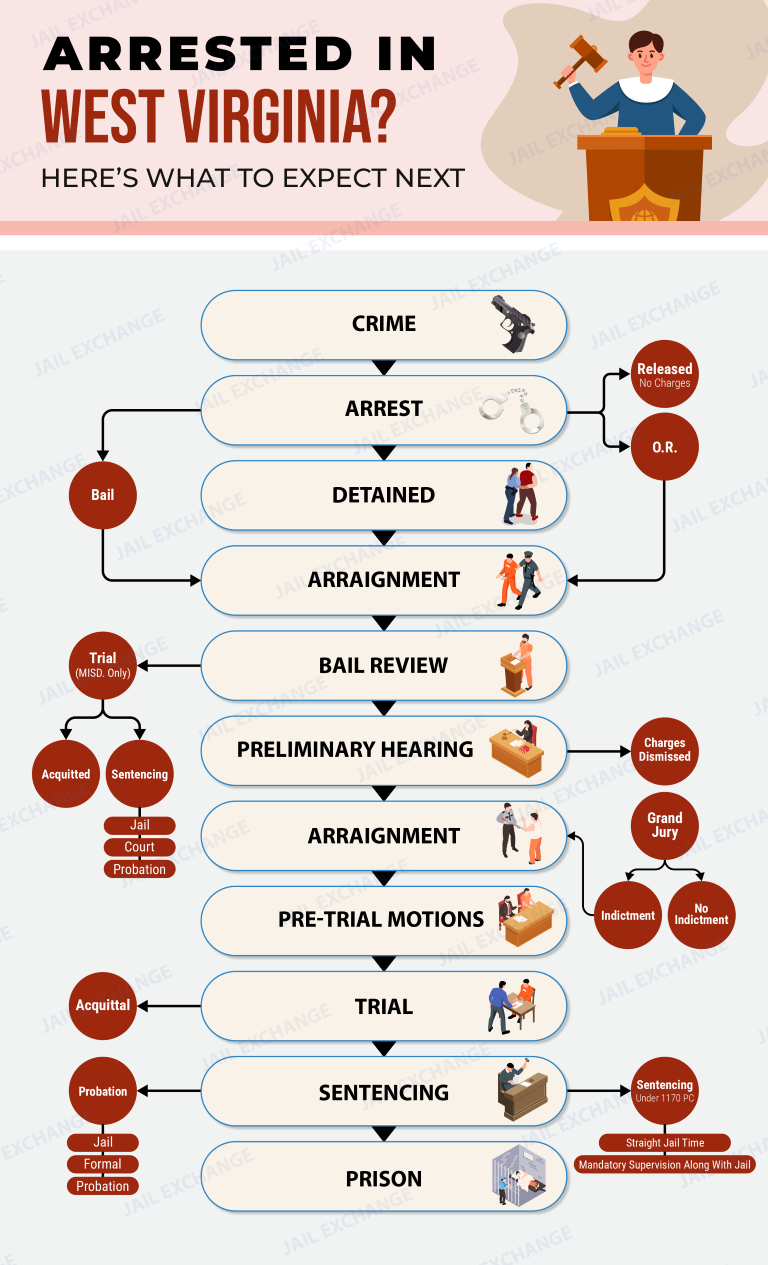
- Read the facility name. A person arrested in this county should show South Central Regional Jail and Correctional Facility.
- Call South Central at 304-558-1336 for the charges, the bond and whether a release is coming. Ask for the person's OID number too. Letters call for it.
2. No match on the WVDCR list yet?
A blank search right after an arrest is common. Here is why it happens:
- Intake isn't done. The jail has to take prints and a photo and enter the paperwork before the record appears.
- They haven't reached the jail. The arresting officers could still be holding them, or they could be in front of a magistrate. The Sheriff's 24-hour line, 304-357-0169, can help you learn which agency has them.
- A magistrate let them go. Lots of people leave on a personal recognizance bond, which is a written promise to show up for every hearing. The magistrate clerk at 304-357-0422 can tell you if a bond was set or posted.
- A judge ordered home confinement. The Sheriff's Home Confinement unit is at 409 Virginia Street East, Charleston, WV 25301, 304-357-0532.
Still no answer? Phone South Central at 304-558-1336 and give the name and birth date so staff can look.
↑ Back to the question list3. Where does Kanawha County send its adult arrests?
No county lockup exists here. Adults in custody are spread across these state sites, each with its own job:
- South Central Regional Jail and Correctional Facility, 1001 Centre Way, Charleston, WV 25309, 304-558-1336. New arrests from Kanawha and Jackson counties are booked and held here while their cases go on. It also houses the state's only Forensic Evaluation Unit.
- Charleston Correctional Center and Jail, 1356 Hansford Street, Charleston, WV 25301, 304-340-6921. This community corrections center has a 96-bed work release unit for men and women and a 32-bed drug and alcohol treatment unit for women. It is for people already sentenced.
- Tygart Valley Regional Jail and Correctional Facility, 400 Abbey Road, Belington, WV 26250, 304-637-0382. It sits in Randolph County. Most West Virginia women headed for prison wait here for a transfer.
Picked up across the county line? Then check the regional jail serving that county. Some you may need:
- Putnam or Lincoln: Western Regional Jail and Correctional Facility, One O'Hanlon Place, Barboursville, WV 25504, 304-733-6821
- Boone: Southwestern Regional Jail and Correctional Facility, 1300 Gaston Caperton Drive, Holden, WV 25625, 304-239-3032
- Fayette: Southern Regional Jail and Correctional Facility, 1200 Airport Road, Beaver, WV 25813, 304-256-6726
- Clay or Roane: Central Regional Jail and Correctional Facility, 1255 Dyer Hill Road, Sutton, WV 26601, 304-765-7904
Federal detainees, and sentenced people waiting on a prison bed, may be housed at a regional jail too.
↑ Back to the question list4. Are mugshots shown for Kanawha County bookings?
WVDCR's search is meant to show which facility holds someone. Questions about mugshots go to the police agency or deputies who booked the case. Two you may need are the Charleston Police Department, 501 Virginia Street East, Charleston, WV 25301, 304-348-6400, and the Sheriff's Office, 301 Virginia Street East, Charleston, WV 25301, 304-357-0200.
Police social media posts of booking photos are restricted by W. Va. Code §62-1-6a, enacted in 2023. Minor offenses here mean misdemeanors and nonviolent felonies a court could later erase through expungement. For those, police may not post the photo on social media. Posting is still allowed once the person is convicted, while they are a fugitive, if they pose an imminent threat, or on a judge's order. After a dismissal, a decision not to indict or an acquittal, the person can ask, and the agency must remove the photo within 14 days.
- News outlets can send photo requests to the arresting agency.
- As a rule, booking photos from federal arrests are held back, though the U.S. Marshals Service sometimes releases one, for instance while it hunts a fugitive.
- ICE handles its own photo requests on the ICE records request page.
5. Can VINE ping me when their custody changes?
VINE, a statewide service, tracks custody at the regional jails and state prisons. Look up the person to see their custody status and the facility, then register for notices.
- Search or register on VINELink.
- Or phone 866-984-8463, which spells 1-866-WV4-VINE.
- VINE stays silent when a person changes facilities. When you hear of a transfer, run the search again or phone South Central at 304-558-1336.
6. Who sets bond in Kanawha County, and what are the rules?
A magistrate picks the bond amount during the initial appearance, the first time the person goes before the court. No needless wait is allowed before that hearing, per W. Va. Code §62-1-5. Plenty of these first hearings run on a screen, with the person still inside South Central. Magistrate Court is in the Judicial Building, 111 Court Street, Charleston, WV 25301, and the clerk answers at 304-357-0422.
- Misdemeanors. Unless the magistrate finds good cause, the person should be freed on personal recognizance, a written promise with no money down (§62-1C-1a). Exceptions to that rule are charges involving violence, a deadly weapon, drugs, sexual abuse, DUI, theft above $250 or a child victim. If cash is required, it may not exceed three times the largest fine the charge carries. If only an unpaid secured bond keeps them locked up, a hearing must follow in five days or less.
- Felonies. Some felony charges never get a promise-only release from a magistrate. They include violent crimes against a person, crimes with a child victim, arson, burglary and drug crimes. Where a life sentence is possible, only the circuit court may decide on bail (§62-1C-1).
- Posting it. Magistrates set each amount for the case at hand; no statewide chart exists. Anyone, such as a parent or friend, may post it. On some cash bonds, a 10 percent cash payment is enough when a surety or a signed promise covers the rest. Real estate works as security if the value left after loans equals at least 50 percent of the bail (§62-1C-4).
- Bondsmen. They must be licensed through the Insurance Commissioner (§51-10-8) and charge 10 percent or more. The fee can be paid in one go, or a family can put down at least 3 percent up front and spread the balance across as long as 12 months (§51-10-5a). A license can be checked at 304-558-0610 or on the bondsman license page.
Not showing up for court brings its own charge. A felony defendant who misses court risks 1 to 5 years behind bars and as much as $5,000 in fines; a misdemeanor defendant faces up to a year and $1,000 (§62-1C-17b). Our bail page covers each step here, and the state bail laws page has the bigger picture.
↑ Back to the question list7. Which charges were filed, and where do I look?
Start with the free Magistrate Court Record Search. Type the person's name or the case number to see what was filed.
The magistrate clerk can also tell you the charges. Call 304-357-0422 or stop by the Judicial Building, 111 Court Street, Charleston, WV 25301.
Once a felony reaches Circuit Court, the Circuit Clerk in that same building takes questions at 304-357-0440. For circuit files, the state Supreme Court runs the Court Record Access page. The Prosecuting Attorney's Office, 301 Virginia Street East, Charleston, WV 25301, 304-357-0300, brings the case for the state.
↑ Back to the question list8. Will the court assign a lawyer at no charge?
Someone without money for a lawyer may request an appointed one. During the initial appearance, they ask for the eligibility affidavit (court form SCA-C&M-101), which covers income and bills, and fill it in. The circuit judge then reviews the form and makes the appointment call.
Appointed cases here are handled by the public defender corporation of the Eighth Judicial Circuit, 816 Quarrier Street, Suite 300, Charleston, WV 25301, 304-348-2323. The court may also appoint a private lawyer.
Relatives who can afford it may hire defense counsel of their choosing. If a felony defendant is still in jail, a preliminary examination is due within 10 days of the initial appearance under Rule 5(e) of the magistrate court criminal rules. A lawyer can also push for lower bail.
↑ Back to the question list9. How do South Central visits get booked?
Visitors and the person inside stay apart during every visit here, since the jail uses non-contact visiting. Plan around these points:
- The person inside requests the visit, and the jail schedules it from that request.
- Visiting hours are Thursday from 1 to 9 p.m. and Saturday and Sunday from 8 a.m. to 5 p.m.
- Each person gets one visit every 30 days.
- The dress code is strict. Orange clothing is not allowed.
- Video visits through GettingOut are another choice. Ask whether this jail lets you visit by video from home.
Questions about a visit go to South Central at 304-558-1336. Our visiting guide is worth a read before a first trip.
↑ Back to the question list10. How do deposits reach their trust account?
Deposits go into the person's trust account through ConnectNetwork, the service WVDCR uses. Pick whichever of these four suits you:
- the ConnectNetwork.com site
- the app from ConnectNetwork
- an automated phone line, 888-988-4768
- a kiosk in the jail lobby
Keep the person's full name handy, and check with the jail on which ID number a deposit needs. Trust account support at 888-428-1845 handles deposit trouble. Ask about fees before you pay. Never tuck cash into a letter. To learn what the balance can buy, read our commissary guide; deposit tips are in our money guide.
↑ Back to the question list11. Is GettingOut the way to call or video chat?
WVDCR has a contract with GettingOut for phone calls and video visits. To get started, open an account through gettingout.com or the GettingOut app. The state's guide also lists messages, voicemail and photo sharing.
WVDCR describes video visits from a home computer, plus visits on a phone at some sites. To learn what South Central allows, call 304-558-1336. For help with your account, GettingOut family support is at 866-516-0115.
Jail calls are no place to discuss the charges; save that for the lawyer. Read our phone call guide for costs, and our inmate text and email guide for messages.
↑ Back to the question list12. How should letters to South Central be addressed?
Personal letters travel first to a scanning address in Phoenix, Maryland, under WVDCR's mail rules, rather than to the jail itself. Address the envelope this way:
Person's first and last name, OID number
South Central Regional Jail and Correctional Facility
PO Box 336
Phoenix, MD 21131
- Give the facility's whole name and skip abbreviations.
- Letters are scanned and sent on to the person.
- No photos. An envelope with a photo goes back to you.
- No attachments or enclosures, and one person per envelope.
- Put your complete name on the return address. A first initial is not enough.
Break a rule and the whole envelope is returned. The rules come from the state's Division-wide page, so confirm them with South Central at 304-558-1336. For general tips, read our mail guide.
↑ Back to the question list13. Who collects the belongings they were booked with?
The jail keeps whatever the person carried when they were booked. Before you drive to 1001 Centre Way, Charleston, WV 25309, call 304-558-1336 and ask:
- Must the person sign a form before family can take the items?
- When is the property window open?
- What photo ID should I bring?
- What happens to the items if the person moves to a prison?
14. They need medicine or care. Who do I call?
Phone South Central at 304-558-1336 and ask for the medical department. Tell them the person's name, birth date, the illness or injury, and every medicine with its dose. Add the names of their doctor and pharmacy so staff can confirm prescriptions.
The person should also send a written health request to medical staff from inside. Start the call with any worry about suicide or self-injury, or signs of a breakdown. The defense lawyer may bring serious medical needs to the judge.
↑ Back to the question list15. Is there a Kanawha County warrant out for someone?
The Warrant Division of the Kanawha County Sheriff's Office, 301 Virginia Street East, Charleston, WV 25301, takes questions about warrants. Call 304-357-0157 during business hours or 304-357-0169 after hours. You can also open the Sheriff's warrant search page and the State Police Most Wanted list. The free Magistrate Court Record Search shows filed cases, though it is not a warrant list. A lawyer should be your first call if a warrant turns up. Next, contact the court that issued it. Magistrates issue arrest warrants, and Magistrate Court sits in the Judicial Building, 111 Court Street, Charleston, WV 25301, 304-357-0422.
↑ Back to the question list16. Which court has the case, and on what day?
Magistrate Court handles misdemeanor trials and the first stage of felony cases, in the Judicial Building, 111 Court Street, Charleston, WV 25301. Call the clerk at 304-357-0422 and give the name and birth date, or look the case up on the Magistrate Court Record Search.
- For a felony with the person in jail, the preliminary examination comes within 10 days.
- Next, a grand jury looks at the evidence and may return an indictment. Trials on indictments take place in Circuit Court for the Eighth Judicial Circuit, whose clerk works in the same building.
- For a circuit date, call the Circuit Clerk at 304-357-0440 or use the Court Record Access page.
Every hearing is explained in plain words in our court guide.
↑ Back to the question list17. Which courthouse takes a federal case from here?
Charges filed in federal court stay in Charleston, before the Southern District of West Virginia's U.S. District Court. The courthouse address is 300 Virginia Street East, Suite 2400, Charleston, WV 25301 (the Robert C. Byrd United States Courthouse). The clerk answers at 304-347-3000.
- A federal judge chooses release or detention at a hearing under 18 U.S.C. 3142. By law the judge picks the mildest terms that still assure a return to court and community safety.
- A person the judge orders held is in U.S. Marshals Service custody before trial. Because WVDCR has an agreement with the U.S. Marshals Service to house federal detainees, they may be held in a regional jail. The Marshals' Charleston office is at 300 Virginia Street East, Room 3602, Charleston, WV 25301, 304-347-5136.
- Post-sentence, the Federal Bureau of Prisons inmate locator shows which federal prison has them.
18. Could ICE take them when the jail lets them go?
An immigration hold usually moves in this order:
- A detainer request on Form I-247A from ICE opens the process.
- Staff can keep the person for up to 48 hours after they would otherwise be released. That window comes from 8 CFR 287.7(d) and gives ICE time to arrive.
- Cases in this state are handled by ICE's Philadelphia Field Office, 114 North 8th Street, Philadelphia, PA 19107, 215-656-7164.
- After the transfer, the ICE Online Detainee Locator can help you look for the person.
West Virginia adds two rules. Section 15-16-2 of the W. Va. Code forbids any policy that restricts cooperation with immigration enforcement. A second rule, in §15-16-3, says that when a detainer is lodged, the holding agency notifies the court setting bail, writes the detainer into its records and follows it "to the extent required by law". Per the Governor's Aug. 13, 2025, announcement, 287(g) agreements with ICE now cover three agencies. WVDCR has one, and the State Police and West Virginia National Guard each have their own.
↑ Back to the question list19. Which search finds someone moved to a state prison?
After a judge orders prison time, WVDCR handles intake and classification to choose a prison that fits the person. A prison bed may take a while, so some people stay at a regional jail for now. Women waiting for prison are mostly held at Tygart Valley Regional Jail and Correctional Facility, 400 Abbey Road, Belington, WV 26250, 304-637-0382.
- Use Offender Search (Prisons) on the state's Offender Search page to see where they are.
- Our West Virginia state prisons guide gives visit and mail details prison by prison.
20. Where is a Charleston-area teen taken after arrest?
Juvenile court, not adult court, hears the case of anyone whose alleged offense happened before their 18th birthday. A parent gets word of the arrest, and youth are never held in adult jails. A youth kept in detention gets a hearing by the next day.
The state's detention center in this county is the James H. "Tiger" Morton Juvenile Center, 60 Manfred Holland Way, Dunbar, WV 25064, 304-766-2616. Youth from all 55 counties can be held there.
For case questions, reach Juvenile Probation at the Judicial Annex, 111 Court Street, Third Floor, Charleston, WV 25301, 304-357-0520. W. Va. Code §49-4-710 sets the only path for moving a youth case to adult court.
↑ Back to the question list21. Which police department works each Kanawha County town?
Call the department for the town where the arrest took place. That office knows whether the person went to South Central or straight to a magistrate.
Charleston and the western valley
- Charleston Police Department, 501 Virginia Street East, Charleston, WV 25301, 304-348-6400
- South Charleston Police Department, 235 4th Avenue, South Charleston, WV, non-emergency 304-348-8111
- Dunbar Police Department, 1227 Leone Drive, Dunbar, WV 25064, 304-766-0204
- St. Albans Police Department, 304-727-2252
- Nitro Police Department, 497 1st Ave S, Nitro, WV 25143, 304-729-8071 (part of Nitro lies in Putnam County)
Upper valley, east along the river
- Belle Police Department, 304-949-3841
- Chesapeake Police Department, 12404 MacCorkle Avenue SW, Chesapeake, WV 25315, 304-949-1496
- East Bank Police Department, 201 Walnut Street, East Bank, WV 25067, 304-595-3305; alternative number 304-595-1605
- Glasgow Police Department, 50 3rd St., Glasgow, WV 25086, 304-595-1919
- Cedar Grove Police Department, 304-595-1841
- Pratt Police Department, PO Box 128, Pratt, WV 25162, 304-442-0103
- Handley town police, 304-442-5100
- Smithers Police Department, P.O. Box 489, Smithers, WV 25186, 304-442-5296 (most of Smithers is in Fayette County)
- Marmet and Montgomery: ask the Sheriff's 24-hour line which agency handled the call.
Elk River
- Clendenin Police Department, P.O. Box 694, Clendenin, WV 25045, 304-548-4192
Countywide, campus and state
- Kanawha County Sheriff's Office, 301 Virginia Street East, Charleston, WV 25301, 304-357-0200; 24-hour line 304-357-0169. Deputies patrol places outside the towns, such as Cross Lanes, Elkview and Sissonville. Detachments: 5461-A Big Tyler Road, Cross Lanes, WV 25313; 1078 Main Street, Elkview, WV 25071; 6809 Ohio Avenue, Saint Albans, WV 25177; 6817 1/2 Sissonville Drive, Sissonville, WV 25320; and Quincy, 2700 East Dupont Avenue, Belle, WV 25015.
- West Virginia State University Police, Institute, 304-766-3181
- Yeager Airport Police, 304-344-0200
- West Virginia State Police, Quincy detachment, 2700 E. DuPont Avenue, Belle, WV 25015, 304-949-3136
- West Virginia State Police, South Charleston detachment, 711 Jefferson Road, South Charleston, WV 25309, 304-558-7777
- West Virginia Turnpike patrol, State Police Troop 7 Charleston South, 304-926-1916
Kanawha County bail and bond: Charleston magistrates, the South Central Regional Jail, and release
After an arrest in Kanawha County, an adult who is not let go is booked into the South Central Regional Jail, 1001 Centre Way, Charleston, WV 25309. This state regional jail sits inside the county and also serves Jackson County. Don't confuse it with the Charleston Correctional Center and Jail, 1356 Hansford Street, Charleston, WV 25301, a state work release center that holds no new arrests. Below, learn how bail is set at arraignment, how to pay it, and what bondsmen cost.
So you are not calling the wrong place, look your loved one up first. The state regional jail search tool finds people by name, and someone booked only hours ago may need a later search. Our Kanawha County Inmate Search page is a handy next stop for active warrants, mugshots and help from a public defender.
Next, call the magistrate clerk at the Judicial Building in Charleston, 304-357-0422. Ask whether the bond has been set and what form of money the court will accept. Once your loved one is home, our criminal court steps page explains the road ahead.
1. Which jail holds people arrested in Kanawha County?
The South Central Regional Jail and Correctional Facility, at 1001 Centre Way in Charleston. It is run by the state Division of Corrections and Rehabilitation, not by the county, and it serves Kanawha and Jackson counties.
The county pays the state for its pretrial inmates' housing. The family owes the jail no housing fee.
↑ Back to the question list2. Is the Charleston Correctional Center and Jail the same thing?
No. The Charleston Correctional Center and Jail is a minimum-security work-release center. It does not hold people who were just arrested and are waiting for a bond hearing. The pretrial jail is South Central.
Do not send mail, money orders or visitors to the wrong building. Confirm the location through Kanawha County Inmate Search or by calling 304-558-1336.
↑ Back to the question list3. How do I find out whether my daughter has been booked?
Enter her name on Kanawha County Inmate Search. If the booking is only a few hours old, search again later.
If the record still does not appear, call the Kanawha County Sheriff's Office, 301 Virginia Street East, 304-357-0200, and ask which agency arrested her. The regional jail is at 304-558-1336.
↑ Back to the question list4. Where does arraignment happen, and who sets the bond?
At the Kanawha County Magistrate Court in the Judicial Building, 111 Court Street, where Court and Virginia Streets meet. Kanawha has thirteen magistrates, and the presiding magistrate sets the bond at arraignment. For a person who surrenders on a warrant, the amount is not decided before then.
The law requires the arrested person to be taken before a magistrate without unnecessary delay. A person already in the regional jail appears by video. The clerk is at 304-357-0422.
↑ Back to the question list5. Can bail be posted at night or on a Sunday?
Magistrate court runs every judicial day except Saturday. After hours, one Kanawha magistrate is on call. That magistrate checks the jail and juvenile facility at set times: 10 to 11 p.m. Monday through Friday; 10 to 11 a.m. and 10 to 11 p.m. on Saturdays and holidays; noon to 1 p.m. and 10 to 11 p.m. on Sundays.
The magistrate goes to the court offices when there is a person to see or a bond to take. Do not count on a window being open late.
↑ Back to the question list6. How do we pay in Charleston?
Bail is received by the clerk of court or the magistrate. Many families bring a friend or relative to the Magistrate Court in the Judicial Building with the money. Accepted: U.S. currency, cashier's checks, certified checks, money orders and traveler's checks. Personal checks can be refused, and no credit or debit card can be used for a bond.
The circuit clerk, for cases beyond magistrate court, is in the same building at P.O. Box 2351 and answers at 304-357-0440.
↑ Back to the question list7. What happens at the Sheriff's Office after someone turns himself in?
A person who surrenders on a warrant goes to the Magistrate Court first. If he is released on bond, he is normally fingerprinted and photographed at the Sheriff's Office, which is across Virginia Street from the Magistrate Court.
The Sheriff's Office main line is 304-357-0200. Ask the clerk, 304-357-0422, how to reach the right magistrate.
↑ Back to the question list8. Can a misdemeanor suspect leave without paying?
Usually. The law presumes release on a written promise to appear unless the magistrate finds good cause. The magistrate looks at residence, community ties and flight risk.
Violence, a minor victim, a deadly weapon, controlled substances, sexual abuse, the serious drunk-driving statutes, and theft or tampering above $250 are outside the presumption. If cash is demanded for a misdemeanor, it cannot go above three times the maximum fine.
↑ Back to the question list9. What decides bail for a felony in Kanawha County?
A person arrested for an offense not punishable by life has a right to bail. The magistrate balances the seriousness of the crime, prior convictions, ability to pay, residence, health, the evidence and current probation or parole.
Promise-only release is barred for a violent felony against a person, a felony with a minor victim, felony arson or burglary, and a felony drug offense. Those defendants need money or a bond.
↑ Back to the question list10. How is a drunk driving arrest treated?
The serious traffic statutes, including the drunk-driving law, are carved out of the misdemeanor promise-only rule. The magistrate sets conditions or money. A guaranteed arrest bond certificate cannot be used for reckless or drunk driving.
Ask the clerk at 304-357-0422 about the amount in a specific case.
↑ Back to the question list11. What does a bondsman cost in Kanawha County?
Every bondsman must hold a license from the Insurance Commissioner. The fee is at least 10 percent of the bond, and three percent may be paid at signing with up to twelve months for the rest. Total fees can never exceed the bond.
Insist on a written agreement and a numbered receipt for collateral. Verify a license at 304-558-0610 or on the bondsman license page. A bondsman may enter a jail only if someone called, and may not pay officials for business.
↑ Back to the question list12. Can we use property instead of cash?
Adults who own West Virginia real estate may sign a recognizance if the property's assessed value on the county land books, less liens and loans, is at least half the bail. The court can require proof of ownership.
The clerk at 304-357-0422 explains the papers. A surety company authorized in West Virginia is the other route, and that is what most bondsman releases use.
↑ Back to the question list13. Who can lower the bail?
The defendant or his lawyer, by filing a motion with notice to both sides. A hearing must follow within five days of filing. A person kept on a misdemeanor only because a secured bond cannot be met must get a hearing within five days of the bail order.
Courts can replace money with a custodian, a job, an alcohol ban, home incarceration or electronic monitoring where a program exists.
↑ Back to the question list14. What are the bond rules after a domestic violence arrest?
An officer may arrest without a warrant on credible corroborating evidence plus a statement from the victim or a witness, and the person must see a magistrate in the county where it happened.
When a threat is found, bail must keep the defendant away from the victim's home, school and workplace and from contact with the victim or a child in the household. The clerk gives the victim certified copies free. Breaking the terms means immediate arrest and a hearing on revoking bail.
↑ Back to the question list15. Who is the free lawyer in Kanawha County?
The public defender corporation is at 816 Quarrier Street, Suite 300, Charleston, WV 25301, phone 304-348-2323. At the first appearance the magistrate explains the right to counsel, and a person who qualifies can ask for an appointed lawyer.
A lawyer can seek a lower bail, a bail hearing, or a preliminary examination on a felony.
↑ Back to the question list16. Where are juveniles detained?
The James H. "Tiger" Morton Juvenile Center, 60 Manfred Holland Way, Dunbar, WV 25064, is a state detention center in the county, and the Division of Juvenile Services places youth from all counties in its centers. The phone is 304-766-2616.
Kanawha County Juvenile Probation is at 111 Court Street, third floor, 304-357-0520. A child's case is confidential and will not show on the adult search.
↑ Back to the question list17. What if the case is in federal court?
Federal charges go to the U.S. District Court for the Southern District of West Virginia. The Charleston courthouse is the Robert C. Byrd United States Courthouse, 300 Virginia Street East, Charleston, WV 25301, open Monday to Friday, 8:30 a.m. to 5 p.m. The clerk is at 304-347-3000.
The Kanawha magistrate does not set bail on a federal charge.
↑ Back to the question list18. What are the penalties for missing court?
The bail can be forfeited. A person who put up money, or signed a recognizance, receives ten days' notice by certified mail before judgment. A bondsman who surrenders the defendant inside two years of the forfeiture recovers the forfeited amount.
Failure to appear is also a crime. After a felony arrest it is a felony, one to five years and up to $5,000. After a misdemeanor arrest it is a misdemeanor, up to a year and $1,000.
↑ Back to the question listKanawha County bail contacts
- Regional jail: South Central Regional Jail and Correctional Facility, 1001 Centre Way, Charleston, WV 25309; 304-558-1336
- Bail and bond: Bond instructions for the Charleston jail
- Custody lookup: Kanawha County Inmate Search
- Magistrate court: Kanawha County Judicial Building, 111 Court Street, Charleston, WV 25301; clerk 304-357-0422
- Circuit clerk: Judicial Building, P.O. Box 2351; 304-357-0440
- Sheriff: Sheriff's Office, 301 Virginia Street East, Charleston, WV 25301; 304-357-0200
- Public defender: 816 Quarrier Street, Suite 300, Charleston, WV 25301; 304-348-2323
- Youth detention: James H. "Tiger" Morton Juvenile Center, 60 Manfred Holland Way, Dunbar, WV 25064; 304-766-2616
- Probation: Judicial Annex, third floor; adult 304-357-0500; juvenile 304-357-0520
- Federal court: 300 Virginia Street East, Charleston, WV 25301; 304-347-3000
- Bondsman licensing: Insurance Commissioner, 304-558-0610
This page is a general guide to bail in Kanawha County, West Virginia, and not legal advice. A lawyer can answer questions about a particular charge.
GettingOut / ViaPath Remote Video Visits
Provider: GettingOut (Telmate) • Rebranding as ViaPath Technologies (myViaPath Visits)

GettingOut Video Visitation allows friends and family members to conduct live, face-to-face video visits with incarcerated loved ones using a personal computer, laptop webcam, or the mobile application. Telmate and GTL operate under ViaPath Technologies, and the visiting service is transitioning from GettingOut Visits to myViaPath Visits; users may encounter either brand name depending on whether their county jail has completed the platform update.
Important: Advance Background Clearance Required
Detention centers do not permit unapproved drop-in video visitation. All visitors must submit valid government photo identification and pass administrative screening before an appointment can be booked, a review that can take up to 48 hours depending on facility staffing. You should verify your visitor approval status with the facility in advance. If you do not register ahead of time, you will miss your loved one's scheduled visiting slots for the week.
Step-by-Step Instructions to Schedule a Video Visit
- Open the GettingOut / myViaPath Visits app or go to www.gettingout.com / my.viapath.com.
- Register your profile and upload clear photographs of your government ID and a verification photo.
- Wait for the facility to issue visitor approval (you will receive an email confirmation).
- Select Schedule Visit, pick your detention facility, and select the inmate.
- Choose an available 25- or 30-minute time slot from the calendar and pay the visitation fee using a credit or debit card.
- Sign into the app or website 10 minutes prior to the start time on a device with a functioning camera, microphone, and stable internet connection.
What the Inmate Needs to Do
The inmate receives a schedule alert on their housing unit video kiosk or personal tablet. At the appointed time, they log in with their PIN and sit in front of the terminal. Inmates must follow institutional dress and conduct rules; corrections staff actively monitor sessions and will terminate any call immediately if rules are broken.
Official Providers: GettingOut Visits | myViaPath Visits
Customer Service Telephone: 1-866-516-0115 (GettingOut) • 1-877-650-4249 (ViaPath)
Support Hours: Monday – Friday, 7:00 AM – 11:00 PM CST; Saturday – Sunday, 8:00 AM – 7:00 PM CST
Supported Languages: English and Spanish
Other Services Provided by GettingOut / ViaPath
In addition to Remote Video Visits, GettingOut and ViaPath provide several other communication and financial options:
- Two-Way Text Messaging: Send electronic messages and photos straight to the inmate's screen.
• Learn more on our website: Two-Way Text Messaging Guide | • Visit official vendor page: GettingOut Messaging - Inmate Tablet Rentals & Content: Provide funds for educational modules, music streaming, and news.
• Learn more on our website: Tablet Rentals & Content Guide | • Visit official vendor page: GettingOut Tablets - AdvancePay Phone Calling: Keep a funded prepaid balance to receive calls directly on your phone.
• Learn more on our website: AdvancePay Phone Calling Guide | • Visit official vendor page: ViaPath ConnectNetwork Calling - Inmate Trust Deposits: Transfer money directly into their jail trust account for canteen goods.
• Learn more on our website: Inmate Trust Deposits Guide | • Visit official vendor page: ViaPath Trust Deposits
Kanawha County Court Guide: Criminal Hearings in Charleston Explained
In Kanawha County, both criminal courts work out of the Judicial Building, 111 Court Street, Charleston, WV 25301. The Magistrate Court handles first hearings and many misdemeanors, and the Circuit Court takes felonies; its clerk answers at 304-357-0440. People held before trial stay at the state's South Central Regional Jail, 1001 Centre Way, Charleston, WV 25309, while the Charleston Correctional Center and Jail is a separate work release site. Read on for trials, penalties, youth cases and free legal help.
Before you phone the court, confirm where your relative is being held. Search by first and last name on the official West Virginia jail lookup, and if a recent arrest is missing, look again later on. Our Recent Arrests page can also help you see charges, find booking photos and pick up personal items.
Then call the Magistrate Court clerk at 304-357-0422 with the person's full name in hand. Ask which magistrate has the case, what charge was filed, and when your relative is due back before a magistrate. If bond is still unpaid, our Kanawha County bail guide shows how to handle it.
1. Which courts hear criminal cases and where are they?
Kanawha County criminal cases begin in the county Magistrate Court for many misdemeanor matters and preliminary felony proceedings. Felony trials are within Circuit Court jurisdiction. These are separate from the facility holding the person.
- Kanawha County Circuit Court / Circuit Clerk: 111 Court Street, Charleston, WV 25301, 304-357-0440
- Kanawha County Magistrate Court / Magistrate Clerk: 111 Court Street, Charleston, WV 25301, 304-357-0422
Magistrate Court is the first point of contact for many arrests; the Circuit Clerk maintains Circuit Court felony records.
↑ Back to the question list2. What happens after arrest and which regional jail receives detainees?
The earliest court decision usually concerns whether the accused can leave custody before the next hearing. The county magistrate considers the charges and sets any lawful bond or release restrictions. Jail officers handle housing; they do not decide guilt.
Regional detention facility serving Kanawha County: South Central Regional Jail and Correctional Facility, 1001 Centre Way, Charleston, WV 25309. Telephone 304-558-1336. This regional jail serves multiple West Virginia counties. The county sheriff does not operate a separate ordinary county jail for these bookings.
Booking may involve identification, a photograph, fingerprints, inventory of property and a medical screening. A jail assignment is not a conviction.
↑ Back to the question list3. How can the family arrange bail or bond?
For a Kanawha County charge, a magistrate commonly considers whether the person may be released on a personal-recognizance promise, a secured bond, a surety bond or other lawful conditions. Bond amounts belong to the court case; staff at South Central Regional Jail and Correctional Facility can help identify the custody record and payment arrangements.
For information about this facility’s bonding desk and inmate release, use the verified South Central Regional Jail and Correctional Facility facility page.
Have the person’s full legal name and booking information ready. A licensed bonding company charges a fee, which is separate from any refundable deposit made with a court.
↑ Back to the question list4. How do misdemeanor cases proceed and what can they cost?
A misdemeanor typically remains in Magistrate Court, although some cases can reach Circuit Court on appeal or through specific procedures. Many charges are resolved after a court date, a plea discussion or trial. The accused can ask for legal representation when incarceration is possible.
Actual misdemeanor penalty examples
- Petit larceny: Theft of property worth less than $1,000 may bring up to one year in jail, a fine up to $2,500, or both (WV Code §61-3-13).
- First ordinary DUI under §17C-5-2(e): Up to six months in jail and a fine of $100–$500, plus driver license consequences.
- DUI with a blood-alcohol level of 0.15% or above under §17C-5-2(f): Two days to six months and a $200–$1,000 fine, with a minimum actual confinement requirement.
There is no single fine that applies to every West Virginia misdemeanor; the offense’s own statute determines the range.
↑ Back to the question list5. What happens after someone is charged with a felony?
For a felony allegation in Kanawha County, the first appearance and any preliminary hearing are generally handled in Magistrate Court. A grand jury indictment sends the case to Circuit Court, where arraignment, evidence exchange, motions, a possible plea agreement and any felony trial take place. The prosecution must prove guilt beyond a reasonable doubt.
A person charged with a felony can apply for appointed counsel if unable to pay an attorney. A conviction does not automatically mean the statutory maximum sentence; the charge, mandatory provisions, criminal history and sentencing decisions matter.
↑ Back to the question list6. How do serious violent crime cases proceed?
Murder and other serious violence allegations proceed in Circuit Court, with close attention to forensic evidence, victim testimony and release decisions. Detention may continue during the case if the legal requirements for holding the accused are satisfied.
West Virginia’s penalty for first-degree murder can be life imprisonment, while second-degree murder is also punishable by substantial imprisonment. Whether parole is possible depends on the offense and the judgment. Certain repeat serious felonies can trigger enhanced punishment under §61-11-18; those enhancements require the legal findings specified by the statute.
↑ Back to the question list7. What happens when the person arrested is younger than 18?
A person under 18 ordinarily goes through the juvenile provisions of West Virginia’s court system rather than the adult regional jail. The Circuit Court has juvenile jurisdiction, and the judge may order diversion, supervision, treatment or a lawful placement after considering the youth’s circumstances.
Juvenile detention facilities are separate from South Central Regional Jail and Correctional Facility. A parent or guardian should ask the court for the child’s hearing details and request appointed counsel when eligible. Some grave allegations involving older teenagers can be transferred under specific statutory procedures.
↑ Back to the question list8. What are the actual fines and possible jail or prison sentences?
West Virginia does not use one universal Class A/B/C felony sentencing chart. A person’s exposure depends on the offense statute and any applicable enhancement. The following are concrete examples:
- Petit larceny, below $1,000: up to 12 months in jail and/or $2,500 (§61-3-13(b)).
- Grand larceny, $1,000 or more: generally 1–10 years in a state correctional facility, or a discretionary jail alternative of up to one year and fine up to $2,500 (§61-3-13(a)).
- First ordinary DUI: up to six months in jail and $100–$500 (§17C-5-2(e)).
- Third DUI under §17C-5-2(m): 2–5 years in a state correctional facility, with a discretionary $3,000–$5,000 fine and license penalties.
- Impaired driving causing death under §17C-5-2(b)(2): 3–15 years and $1,000–$3,000, subject to the statute’s details.
Probation, suspension of sentences, restitution, mandatory minimums and repeat-offender laws can change the outcome. A listed range is not a prediction of the sentence in a particular case.
↑ Back to the question list9. How does someone qualify for a public defender?
Someone without enough money to hire a lawyer should ask the magistrate or Circuit Court about appointed counsel at the earliest appearance. Eligibility depends on financial circumstances and the nature of the case. Public defender office: 816 Quarrier Street, Suite 300, Charleston, WV 25301, 304-348-2323.
An attorney can examine charging papers, request discovery, challenge an unlawful detention, advise on a plea offer and present information at sentencing. Family members can gather court papers and accurate contact information for counsel.
↑ Back to the question list10. What about municipal court violations and other local charges?
Some city ordinance citations and local traffic matters are handled in municipal courts where the municipality maintains one. A county criminal charge is different: its hearings follow the county Magistrate or Circuit Court. Read the citation or court notice to identify which court actually issued it.
The Kanawha County Magistrate Clerk can be reached at 304-357-0422 at 111 Court Street, Charleston.
↑ Back to the question list11. How are federal crimes prosecuted and how can federal inmates be found?
Federal prosecutions involve violations of federal law, such as certain interstate fraud, federal firearms offenses, federal drug trafficking or crimes on federal property. They do not automatically go to Kanawha County Circuit Court.
U.S. District Court, Southern District of West Virginia: principal courthouse 300 Virginia Street East, Charleston, WV 25301, telephone 304-347-3000. Another division courthouse may be assigned to the particular federal case.
Federal defendants may be detained in local or contracted custody before trial. People serving federal prison sentences are placed within the federal prison system as designated by the Bureau of Prisons. To search for a federal inmate, use the Bureau of Prisons Inmate Locator.
↑ Back to the question listThis is general information about criminal procedure in Kanawha County, not legal advice. Anyone accused of a crime should seek individualized legal guidance.
Information for this service is currently unavailable.
ViaPath / ConnectNetwork Trust Fund Deposits
Provider: ViaPath Technologies • Formerly ConnectNetwork / GTL Financial
ViaPath Technologies (formerly GTL / ConnectNetwork) operates secure banking software enabling family members to deposit cash or card funds directly into an incarcerated person's jail trust account. Deposited funds allow the inmate to purchase commissary food items, clothing, personal hygiene goods, and medical copays, or transfer balances to phone time.
Important: Jail Trust Account Policies Differ by Agency
Once a person is booked and moved to a cell, facilities do not always allow cash drop-offs or phone payments directly to the jail window. Some might and you should confirm this by calling the facility and asking. But if you do not register online and fund your loved one's trust account immediately, they may be forced to wait days or weeks for standard paper processing, leaving them without essential soap, clean undergarments, basic medical sundries or snacks.
Step-by-Step Instructions to Deposit Trust Funds
- Confirm the inmate's legal name, date of birth, and assigned booking or institutional ID number.
- Log into your account at web.connectnetwork.com or my.viapath.com.
- Select Trust Fund from the available services dashboard.
- Select the facility and confirm your loved one's profile matches the active housing roster.
- Specify the deposit dollar amount and enter your debit or credit card billing details.
- Authorize the transaction and record the confirmation tracking number for your financial records.
What the Inmate Needs to Do
The inmate does not need an internet connection to receive trust funds. Once payment clears, the balance posts directly to their accounting profile in the jail's internal system. The inmate can review their updated balance at the pod kiosk or on their tablet and place their regular weekly store order.
Official Providers: ConnectNetwork Portal | myViaPath Portal
Customer Service Telephone: 1-877-650-4249
Support Hours: Automated Deposits 24/7/365; Live Agents Monday – Friday, 8:00 AM – 10:00 PM EST
Supported Languages: English and Spanish
Other Services Provided by ViaPath Technologies (ConnectNetwork)
In addition to Trust Fund Deposits, ViaPath / ConnectNetwork provides several other communication and calling options:
- AdvancePay Phone Calling Accounts: Keep a dedicated balance to receive telephone calls directly on your cell phone.
• Learn more on our website: AdvancePay Calling Guide | • Visit official vendor page: ConnectNetwork AdvancePay - ViaPath PIN Debit Phone Calling: Give the inmate calling funds to contact any approved phone number independently.
• Learn more on our website: PIN Debit Calling Guide | • Visit official vendor page: ViaPath PIN Debit - ViaPath Messaging & Photo Sharing: Send digital messages and photos directly to their kiosk or tablet.
• Learn more on our website: Digital Messaging Guide | • Visit official vendor page: ViaPath Messaging - GettingOut Video Visitation & Tablets: Schedule face-to-face remote video visits from home.
• Learn more on our website: Video Visitation Guide | • Visit official vendor page: GettingOut Video Visits
Deposit Money for an Inmate in the James H. "Tiger" Morton Juvenile Center
The Easiest and Securest Way of Depositing Money for an Inmate
There are several methods for depositing money on an inmate's account:
1. To send money online to an inmate in the James H. "Tiger" Morton Juvenile Center use GTL/Viapath.

2. If you prefer to use your credit or debit card and deposit money over the phone, you can call them at 877-650-4249.
3. Deposit cash or use a debit or credit card using a dedicated kiosk for this purpose. The machine is located in the lobby or visitation area of the James H. "Tiger" Morton Juvenile Center.
4. The James H. "Tiger" Morton Juvenile Center may also allow you to *mail an inmate a money order or cashier’s check from a trusted source such as the Post Office, a local bank, or Western Union. The money order should be be made out to either the inmate or the Kanawha County Sheriff's Office, with the inmate’s name and ID# on the memo line of the check. To confirm this option call the facility at 304-766-2616.
*When mailing a money order or cashier’s check, send it an envelope by itself. Never send it with a letter or photos for your inmate, unless the facility allows it. Never send personal checks or cash.
5. The James H. "Tiger" Morton Juvenile Center has a reception desk that may accept cash, money orders or cashier checks. Call 304-766-2616 to find out the specific hours for drop off times.
The James H. "Tiger" Morton Juvenile Center on Manfred Holland Way in Dunbar, Kanawha County, is a 23-bed secure detention center for young people under 18. The state Division of Corrections and Rehabilitation runs it, and it can hold youth from any of the state's 55 counties. Letters go by regular mail to the Dunbar building itself.
Letters, legal mail and books for a youth here:
Resident's Full Name
James H. "Tiger" Morton Juvenile Center
60 Manfred Holland Way
Dunbar, WV 25064
- Who can write: Family and friends. Mail to or from a co-defendant, someone held in another facility, or a person under a no-contact order is not allowed.
- Your address on the envelope: Put your name and full mailing address in the upper left. A letter without them will probably be thrown away rather than delivered.
- Pens and decorations: Only blue or black ink will do. Markers, crayons, colored ink, lipstick, perfume and doodles on the envelope are not allowed, and nothing like glitter or confetti may be tucked inside.
- Cards: A plain greeting card is fine when the center allows one. Musical cards are not.
- Books and magazines: Must be new and mailed by the publisher.
- Packages: Only from the company linked on the commissary page, and only when the center permits it.
Letters are passed out Monday through Friday with no limit on how many a youth may get. For questions about writing to your child, call the center at 304-766-2616.

Securus AdvanceConnect is a prepaid calling account that links directly to your mobile phone or landline number, allowing you to receive outbound calls from an incarcerated individual. Because correctional phone systems never allow incoming calls, funding an AdvanceConnect balance ensures calls are accepted immediately without being blocked by cell carriers.
Important: Mobile Networks Block Inmate Calls Without Prepaid Funds
Correctional facilities do not allow collect billing to cell phones, and mobile carriers automatically block incoming collect calls from detention centers. While some residential landlines may allow direct billing, mobile phones and VoIP services require an active prepaid AdvanceConnect balance, which you can verify with your phone provider. If you do not register online and fund your account right away, your loved one will hear an automated error message stating that your number cannot accept calls.
Step-by-Step Instructions to Register and Fund AdvanceConnect
- Go to securustech.online or open the Securus mobile app.
- Select Sign Up and create your account using your 10-digit telephone number and email address.
- Search for your facility by state and agency name, then add the inmate using their full legal name or booking ID.
- Select AdvanceConnect under calling accounts.
- Choose your deposit amount, review convenience and transaction fees, and enter your credit or debit card billing details.
- Authorize payment and confirm that your mobile phone allows calls from automated or unknown correctional numbers.
What the Inmate Needs to Do
The inmate picks up any dayroom phone or logs onto their handheld tablet, dials your 10-digit number, and enters their assigned PIN. The automated system verifies that your AdvanceConnect account has an active balance and connects the call. All calls are subject to recording and monitoring by facility staff.
Official Provider: Securus Technologies Official Website
Customer Service Telephone: 1-800-844-6591
Support Hours: 24 hours a day, 7 days a week, 365 days a year
Supported Languages: English and Spanish
Other Services Provided by Securus Technologies
In addition to AdvanceConnect Prepaid Calling, Securus Technologies and its subsidiary JPay provide several other communication, financial, and visitation services:
- Direct Bill Phone Calling: Establish a monthly billed calling account for verified landline numbers.
• Learn more on our website: Direct Bill Phone Calling Guide | • Visit official vendor page: Securus Direct Bill - Securus Video Connect: Schedule and join live video visits from home using your computer or smartphone.
• Learn more on our website: Video Visitation Guide | • Visit official vendor page: Securus Video Connect - JPay Money Deposits (Trust & Canteen): Send money directly into an inmate's jail trust account for commissary store purchases.
• Learn more on our website: Money Deposits Guide | • Visit official vendor page: JPay Money Transfers - JPay Email Messaging & Photos: Send electronic messages, photo attachments, and VideoGrams directly to their tablet or kiosk.
• Learn more on our website: Email Messaging Guide | • Visit official vendor page: JPay Email Services
Securus Direct Bill is an invoiced telephone calling service designed for approved residential landlines, law offices, and commercial businesses. Instead of prepaying funds in advance, calls received from an incarcerated individual are billed directly to your account on a monthly itemized billing invoice.
Important: Direct Bill Requires Credit Approval and Qualifying Lines
Direct Bill is not available for mobile cell phones, internet VoIP numbers, or customers with poor or unestablished telephone credit history. Correctional facilities enforce strict telecommunications billing rules, which you can verify by calling Securus customer care. If your line does not meet credit approval standards, you must open an AdvanceConnect prepaid account instead to receive incoming calls from your loved one.
Step-by-Step Instructions to Set Up a Direct Bill Account
- Contact Securus customer service at 1-800-844-6591 or submit an application via securustech.net.
- Provide your billing name, service address, and qualifying residential or business landline telephone number.
- Submit to a standard credit evaluation performed by Securus to determine billing eligibility.
- Establish your authorized monthly credit limit upon approval.
- When your phone rings with a call from the detention center, follow the recorded operator instructions and press the requested key to accept charges.
- Pay your monthly billing invoice online, by phone, or through the mail.
What the Inmate Needs to Do
The inmate dials your phone number from any dayroom telephone and keys in their assigned PIN. The automated system verifies that your account is in good standing and has not exceeded its monthly spending ceiling before connecting the call. All non-privileged conversations are recorded and monitored.
Official Provider: Securus Technologies Official Website
Customer Service Telephone: 1-800-844-6591
Support Hours: 24 hours a day, 7 days a week, 365 days a year
Supported Languages: English and Spanish
Other Services Provided by Securus Technologies
In addition to Direct Bill Calling, Securus and its subsidiary JPay offer several other communication, financial, and visitation services:
- AdvanceConnect Prepaid Calling: Fund a prepaid calling account tied to your mobile phone number.
• Learn more on our website: AdvanceConnect Calling Guide | • Visit official vendor page: Securus AdvanceConnect - Securus Video Connect: Schedule and join live video visits from home using your computer or smartphone.
• Learn more on our website: Video Visitation Guide | • Visit official vendor page: Securus Video Connect - JPay Money Deposits (Trust & Canteen): Send money directly into an inmate's jail trust account for commissary store purchases.
• Learn more on our website: Money Deposits Guide | • Visit official vendor page: JPay Money Transfers - JPay Email Messaging & Photos: Send electronic letters, photos, and VideoGrams directly to their tablet or kiosk.
• Learn more on our website: Email Messaging Guide | • Visit official vendor page: JPay Email Services
GettingOut / ViaPath Inmate Messaging
Provider: GettingOut (Telmate) • Rebranding as ViaPath Technologies (myViaPath)GettingOut (a service of Global Tel*Link / Telmate) provides an instant two-way digital messaging and photo-sharing platform connecting families with incarcerated individuals via housing-unit kiosks and handheld tablets. The provider is actively rebranding as ViaPath Technologies (under the myViaPath platform); depending on the facility contract, local booking sheets and tablets may still refer to the service as GettingOut, GTL, or ViaPath, but both brand portals grant access to the same centralized messaging balance.
Important: Contact Authorization and Digital Mail Rules Vary
Inmate digital messaging rules are not uniform across all county detention centers. While some jails allow immediate two-way messaging upon registration, others require initial contact invitations or administrative ID verification, which you should verify directly with the facility. If you delay setting up an online profile and funding your Friends & Family messaging account, your loved one may face lengthy periods without direct family communication.
Step-by-Step Instructions to Register and Message an Inmate
- Visit www.gettingout.com or the newly branded my.viapath.com portal, or install the GettingOut / myViaPath mobile app.
- Create a user profile using your primary email address and 10-digit mobile phone number.
- Complete identity verification by uploading a clear photo of your government-issued driver's license or state ID and taking a verification selfie if requested.
- Search for the inmate by selecting the state, correctional facility, and their legal name or booking ID.
- Send an outside contact connection request to link your account to their tablet profile.
- Deposit funds into your 'Friends & Family Account' using a debit or credit card to cover message and photo-sharing costs.
- Compose your text message in the chat box, attach approved photos, and submit it for jail screening.
What the Inmate Needs to Do
The inmate powers on their assigned pod tablet or approaches a housing-unit kiosk and logs into the messaging application with their PIN. They accept your incoming contact invitation on the screen. Once approved by institutional monitors, incoming messages appear in their inbox, and the inmate types a reply directly on the screen.
Official Providers: GettingOut Website | myViaPath Portal
Customer Service Telephone: 1-866-516-0115 (GettingOut Support) • 1-877-650-4249 (ViaPath Support)
Support Hours: Monday – Friday, 7:00 AM – 11:00 PM CST; Saturday – Sunday, 8:00 AM – 7:00 PM CST
Supported Languages: English and Spanish
Other Services Provided by GettingOut / ViaPath
In addition to Two-Way Text Messaging, GettingOut and ViaPath provide several other communications and visitation options:
- Remote Video Visits: Schedule and join live web-based video visits from your computer or smartphone.
• Learn more on our website: Video Visitation Guide | • Visit official vendor page: GettingOut Video Visits - Inmate Tablet Rentals & Media: Fund tablet entertainment, music streaming, games, and news modules.
• Learn more on our website: Tablet Rentals & Content Guide | • Visit official vendor page: GettingOut Tablets - AdvancePay Phone Calling: Prepay for telephone calls so your loved one can dial your mobile phone directly.
• Learn more on our website: AdvancePay Phone Calling Guide | • Visit official vendor page: ViaPath ConnectNetwork Calling - Inmate Trust Deposits: Transfer funds directly into their jail trust account for commissary store purchases.
• Learn more on our website: Inmate Trust Deposits Guide | • Visit official vendor page: ViaPath Trust Deposits
GettingOut / ViaPath Inmate Tablets & Media
Provider: GettingOut (Telmate) • Rebranding as ViaPath Technologies (myViaPath)GettingOut provides specialized, secure handheld tablets for county jail inmates, offering access to messaging apps, telephone calling, legal research tools, eBooks, vocational training, and premium entertainment rentals. As part of GTL and Telmate's transition to ViaPath Technologies, tablet firmware and management platforms are moving to the myViaPath system.
Important: Tablet Feature Availability Varies by Facility
Jails manage tablet distribution according to individual facility contracts. While basic educational and legal materials are often provided without cost, access to music streaming, games, podcasts, and premium movies requires an active funded account. You should confirm the tablet rules with the facility directly. Registering and funding their media balance right away ensures your loved one has productive resources and recreation during their stay.
Step-by-Step Instructions to Fund Inmate Tablet Services
- Confirm that GettingOut / ViaPath handheld tablets are active at your loved one's specific detention facility.
- Navigate to www.gettingout.com or my.viapath.com.
- Sign into your verified user profile and link the inmate's legal name and booking ID number.
- Select Make a Deposit and choose either your Friends & Family Account (for messaging) or the inmate's personal Inmate Account (for entertainment and song rentals).
- Choose your deposit amount, review convenience fees, and complete payment with a credit or debit card.
- Notify your loved one that their tablet account balance has been funded.
What the Inmate Needs to Do
The inmate unlocks their assigned tablet or signs one out from the pod charging station using their biometric verification or PIN. Once logged in, their available balance appears on the screen, allowing them to download songs, stream educational content, and communicate with approved family members.
Official Providers: GettingOut Website | myViaPath Portal
Customer Service Telephone: 1-866-516-0115 (GettingOut) • 1-877-650-4249 (ViaPath)
Support Hours: Monday – Friday, 7:00 AM – 11:00 PM CST; Saturday – Sunday, 8:00 AM – 7:00 PM CST
Supported Languages: English and Spanish
Other Services Provided by GettingOut / ViaPath
In addition to Tablet Media & Rentals, GettingOut and ViaPath provide several other communication and account services:
- Two-Way Text Messaging: Send electronic letters and photos straight to the inmate's screen.
• Learn more on our website: Two-Way Text Messaging Guide | • Visit official vendor page: GettingOut Messaging - Remote Video Visits: Meet face-to-face over secure live video from home.
• Learn more on our website: Video Visitation Guide | • Visit official vendor page: GettingOut Video Visits - AdvancePay Phone Calling: Prepay for phone calling credits so your loved one can call your telephone directly.
• Learn more on our website: AdvancePay Phone Calling Guide | • Visit official vendor page: ViaPath ConnectNetwork Calling - Inmate Trust Deposits: Transfer cash directly into an inmate's jail ledger for commissary purchases.
• Learn more on our website: Inmate Trust Deposits Guide | • Visit official vendor page: ViaPath Trust Deposits
Kanawha County County Jails
Kanawha County Juvenile Facilities
- Juvenile Detention: 304-766-2616
The James H. "Tiger" Morton Juvenile Center serves the following cities and towns of Kanawha County: Belle, Cedar Grove, Charleston, Chesapeake, Clendenin, Dunbar, East Bank, Glasgow, Institute, London, Malden, Nitro, Pratt, Saint Albans, Shrewsbury, South Charleston and Winfield. At times this facility may also house inmates arrested in the following counties: Barbour County, Berkeley County, Boone County, Braxton County, Brooke County, Cabell County, Calhoun County, Clay County, Doddridge County, Fayette County, Gilmer County, Grant County, Greenbrier County, Hampshire County, Hancock County, Hardy County, Harrison County, Jackson County, Jefferson County, Kanawha County, Lewis County, Lincoln County, Logan County, Marion County, Marshall County, Mason County, McDowell County, Mercer County, Mineral County, Mingo County, Monongalia County, Monroe County, Morgan County, Nicholas County, Ohio County, Pendleton County, Pleasants County, Pocahontas County, Preston County, Putnam County, Raleigh County, Randolph County, Ritchie County, Roane County, Summers County, Taylor County, Tucker County, Tyler County, Upshur County, Wayne County, Webster County, Wetzel County, Wirt County, Wood County and Wyoming County.