Adams County, a sandy, wooded county wrapped around the Petenwell and Castle Rock flowages, does its court business in the small village of Friendship, which serves as county seat. Its Adams County Circuit Court now has two judges, and the Town of Rome keeps a municipal court of its own for ordinance tickets. The Adams County District Attorney, an elected official, files criminal charges. Arrestees from every corner of the county who stay in custody end up at the Adams County Jail, a Sheriff's facility on Adams Street in Friendship.
- Adams County Circuit Court (Branches 1 and 2), courthouse, Suite 6, 401 Adams St., Friendship 53934; Clerk of Circuit Court (608) 339-4208
- Adams County DA's office, Room C150, 402 Main St., Friendship 53934, (608) 339-4217
- Sheriff of Adams County, 401 Adams St., Friendship 53934, (608) 339-3304
- Adams County Jail, 401 Adams St., Friendship 53934, (608) 339-3304
- Public Defender for Adams County: the State Public Defender's Wisconsin Rapids office (shared with Wood County), Suite 8, 2811 8th St. S., Wisconsin Rapids, (715) 303-5010
- Adams County Health & Human Services (intake for youth), 108 E. North St., Friendship, (608) 339-4505
Which court hears your case. Rome police tickets for ordinance violations, including a first-offense OWI (a forfeiture, not a crime, in Wisconsin, provided no child younger than 16 rode along), are answered in the Town of Rome Municipal Court. A ticket written in the Adams County piece of the City of Wisconsin Dells is answered in that city's municipal court. Comparable citations from Adams, Friendship, the remaining towns and Highways 13, 21 and 82 come to the Adams County Circuit Court, unless the ticket says otherwise. Misdemeanor charges, and criminal traffic charges like OWI-second, land in Friendship as well. So are felonies, which never leave the circuit court: first appearance, preliminary exam, arraignment and trial take place under one roof, before one of its two judges.
Where pretrial inmates are held. A person kept after booking stays at the Adams County Jail, 401 Adams Street, Friendship, beside the courthouse. Sheriff's staff at (608) 339-3304 can say whether a person is there and how the jail accepts bail money. Wisconsin has no bonding companies, so families pay the court's cash figure in full.
- Local courts in Adams County (circuit court and municipal courts)
- Misdemeanor (for example, theft, battery, disorderly conduct, a second OWI)
- Felony (for example, burglary, felony theft, drug possession with intent to deliver, substantial battery)
- Violent felony (for example, homicide, sexual assault, armed robbery)
- Juveniles (under 17) arrested in Adams County
- Federal cases (U.S. District Court) from Adams County
Local courts in Adams County (circuit court and municipal courts)
For criminal matters, Adams County has a single destination, the courthouse campus in Friendship, and only two municipal courts touch the county at all.
Circuit court
- Adams County Circuit Court, Suite 6, 401 Adams St., Friendship 53934; the courthouse block also faces Main Street. Clerk of Circuit Court, (608) 339-4208, for case status, citation payments, hearing dates and which of the two branches has a file.
Municipal courts serving Adams County communities
- Town of Rome Municipal Court (Town of Rome), in Rome Town Hall, 1156 Alpine Dr., Nekoosa 54457 (the town uses a Nekoosa mailing address); court line (715) 325-8039, town office (715) 325-8023. Sessions are held on the third Tuesday of the month at 10:00 a.m., and Rome tickets may be paid at the town's police department on weekday mornings.
- Wisconsin Dells Municipal Court, for the City of Wisconsin Dells, which spills into Adams, Columbia, Juneau and Sauk counties: La Crosse Street (No. 300), 608-254-2442
Each of these courts hears ordinance cases only and sets forfeitures; a jail commitment or license suspension is possible only for someone who does not pay. An Adams County defendant may in limited situations be able to get a Rome or Dells ordinance case transferred to the circuit court, and timing matters, so ask the clerk or an attorney before the first hearing date. Ordinance tickets from towns and villages that have no municipal court are heard in Friendship.
Prosecution, defense, police and youth services
- District Attorney, Room C150, 402 Main St., Friendship, (608) 339-4217
- State Public Defender (Adams County cases are staffed from Wisconsin Rapids), 2811 8th St. S., Suite 8, (715) 303-5010
- Adams County Sheriff's Office, 401 Adams St., (608) 339-3304; deputies serve as the police for Friendship and every town lacking a department
- Adams Police Department (City of Adams), P.O. Box 1125, 105 Main St., Adams 53910, (608) 339-6839
- Rome Police Department, at the Rome Town Hall, 1156 Alpine Dr.; reach it through the town office, (715) 325-8023
- Wisconsin Dells Police Department, for the city's Adams County section
- Health & Human Services, 108 E. North St., Friendship, (608) 339-4505
Misdemeanor (for example, theft, battery, disorderly conduct, a second OWI)
The county's population swells each summer at the lakes and campgrounds, bringing boating, driving, disorderly conduct and theft arrests; domestic cases and repeat drunk driving come mostly from year-round residents.
Booking and release
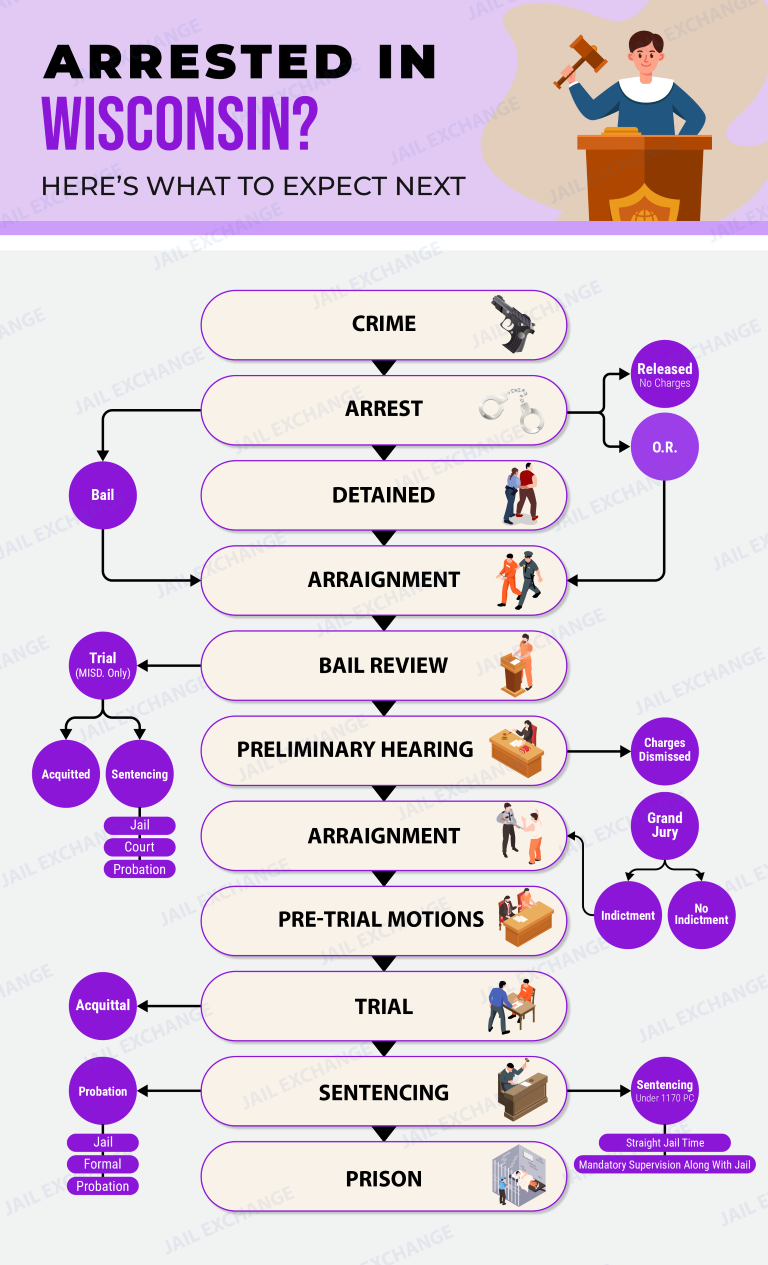
Arrests made by deputies, Adams officers or Rome officers end with booking at the Adams County Jail in Friendship. For minor charges the usual result is release on a signature bond, where the person signs a promise to return and owes money only by missing court. Someone the jail keeps is scheduled for an initial appearance, normally inside 48 hours, and the judge or court commissioner frequently conducts it by video. That hearing sets conditions: possibly a cash amount, possibly no drinking, possibly an order to stay away from a named person or place. Domestic abuse arrests in Adams County come with a separate 72-hour rule barring contact with the alleged victim after release; the victim alone can waive it, in writing.
Penalties in Adams County misdemeanor cases
- Class A, the top grade (nine months, $10,000): battery, trespass into a dwelling, and thefts no greater than $2,500.
- Class B (ninety days, $1,000): disorderly conduct, sometimes carrying a domestic abuse label.
- Class C (thirty days, $500).
- OWI: an Adams County first offense is handled as a civil matter, carrying a forfeiture between $150 and $300 (court costs come on top), a revocation lasting six to nine months, an assessment and, after a refusal or a result of 0.15 or more, an interlock; having a child under 16 aboard changes it into a crime. Repeat it within ten years and it becomes a criminal misdemeanor carrying no less than five days behind bars, with half a year as the cap. By the fourth, Adams County prosecutors can generally file a felony.
Lawyer, outcome and timing
Requests for appointed counsel are processed by the public defender agency's Wisconsin Rapids staff (State Public Defender), (715) 303-5010, or can be started at the jail. The screening for eligibility is strict. When someone fails that screen but plainly cannot pay, an Adams County judge may be asked for a county-paid attorney, and granting it is discretionary. Outcomes include a dismissal or deferred prosecution agreement, fines, probation, or jail with Huber privileges for work. A six-person jury tries a misdemeanor. Adams County misdemeanors usually finish within two to six months.
Felony (for example, burglary, felony theft, drug possession with intent to deliver, substantial battery)
Burglaries of cabins and lake homes that sit empty for the winter, methamphetamine cases and repeat OWIs are staples of the Adams County felony calendar.
Path of a felony case
- Complaint and first appearance. Once the DA files a criminal complaint, a judge or commissioner checks it for probable cause, reads the charge to the defendant and sets bail. Voters amended the Wisconsin Constitution in 2023 so that, in violent-crime cases, cash and conditions can reflect how likely the defendant is to cause serious harm. Defendants who cannot pay remain at the Adams County Jail.
- Preliminary hearing. Ten days is the limit for a jailed defendant held on cash beyond his or her means, twenty for others. Its one question is probable cause, and many defendants waive it.
- Information and arraignment. The DA's information lists the final charges, and the defendant pleads to them.
- Plea or trial. Most Adams County felonies end in a plea agreement. Trials go to a twelve-member jury, which must be unanimous; a defendant who invokes the speedy-trial statute is generally tried inside ninety days, subject to exceptions.
- Sentencing, often after a presentence investigation.
How Adams County felonies are graded
- Burglary is Class F: as long as twelve and a half years, with a fine up to $25,000.
- Felony theft follows the dollar amount: $2,500.01 through $5,000 is Class I; up to $10,000 is Class H; beyond that is Class G, ten years.
- Substantial battery is Class I (three and a half years); aggravated battery is H or E.
- Intent to deliver ranges from Class I to Class C according to the substance and amount.
- For reference: life for Class A, then sixty, forty, twenty-five and fifteen years for B through E, and six for H.
Sentences
Every Wisconsin prison sentence combines a confinement term with an extended supervision term, and parole is off the table for offenses after 1999. The sentencing judge can open the door to boot-camp style Challenge Incarceration or to the Substance Abuse Program, each a possible route to earlier release. Up to a year is jail time in Friendship; a longer term is served in a state institution. A first felony often draws probation, sometimes with conditional jail. In Friendship, anyone who qualifies is defended through the State Public Defender, either from its Wisconsin Rapids staff or a private attorney under contract. Most felonies here take six months to a year.
Violent felony (for example, homicide, sexual assault, armed robbery)
Violent felonies are rare in Adams County; on a homicide or major assault, state DOJ investigators are usually brought in to help the Sheriff. High cash bail is the norm in these cases, and the accused remains at the Adams County Jail if the money cannot be raised.
Penalties
- First-degree intentional homicide, Class A: life is mandatory, and the Adams County judge rules on whether, and after how long, release to extended supervision may ever be sought. Wisconsin ended executions in 1853.
- Class B, sixty years: first-degree reckless homicide, and also second-degree intentional homicide.
- First-degree sexual assault: Class B, sixty years; a mandatory minimum attaches to certain offenses against young children.
- Armed robbery: Class C, forty years. Robbery with no weapon: Class E, fifteen.
Timeline and victims
The usual felony stages apply, but forensic testing, experts and motions add months; twelve to twenty-four months from charge to verdict is common in Friendship. Marsy's Law, a 2020 addition to the state constitution, protects a victim's rights to information, to attendance and to a voice at sentencing, and the DA's office, (608) 339-4217, helps victims exercise them. The State Public Defender also takes these cases for eligible defendants, frequently assigning senior trial lawyers.
Juveniles (under 17) arrested in Adams County
Wisconsin treats seventeen-year-olds as adults when they are charged with crimes. Children 10 through 16 accused of crimes in Adams County appear in Friendship before the circuit court in its role as juvenile court, in sessions closed to outsiders.
Intake and detention
Officers who take a youth into custody notify juvenile intake at Adams County Health & Human Services, (608) 339-4505. Intake picks among release to a parent, a nonsecure placement and secure detention; it may also close the referral, resolve it with deferred prosecution, or hand it to the DA, whose office makes the call on a delinquency petition. Adams County operates no juvenile detention center. Deputies transport a youth needing locked custody to another county's center that accepts Adams County placements, for example the Portage County Juvenile Detention Center on Strongs Avenue in Stevens Point (phone 715-346-1263). For a detained child, a custody hearing generally must follow within 24 hours of intake's decision, not counting a weekend or legal holiday.
Outcomes
- Deferred prosecution or a consent decree; with compliance, no delinquency finding is ever entered.
- After an adjudication: supervision, restitution, community service, counseling, or a stay in foster care, group care or a treatment facility.
- Type 2 placement; Type 1 commitment to the secure state schools in Irma (Lincoln Hills School, Copper Lake School); or, at the far end, the Serious Juvenile Offender program.
Adult court
The DA can petition to waive a youth aged 14 or more into adult court, and, in limited circumstances, an even younger child facing an especially grave accusation. Adult court also holds original jurisdiction, so no waiver is needed, over Adams County children 10 or older charged with committing or attempting first-degree intentional homicide, with first-degree reckless homicide, or with felony murder; the same applies to some youths with a prior delinquency record who are charged with particular new crimes. Parents should go through these rules with defense counsel; every child facing a delinquency petition may have a lawyer, whom the State Public Defender in Wisconsin Rapids usually supplies. Juvenile records are, in general, confidential.
Federal cases (U.S. District Court) from Adams County
Adams County cases under federal law fall within the Western District of Wisconsin, and they are filed and tried in Madison, about 75 miles south of Friendship.
- Western District clerk, Room 320, 120 N. Henry St., Madison 53703, (608) 264-5156
- U.S. Attorney, Suite 700, 222 W. Washington Ave., Madison 53703, (608) 264-5158
- Federal Defender Services of Wisconsin, Suite 1000, 22 E. Mifflin St., Madison 53703, (608) 260-9900; CJA panel lawyers in private practice cover conflicts
- Pretrial Services, Suite 340, 222 W. Washington Ave., Madison 53703, (608) 264-5165
When an Adams County case is federal
Federal prosecution is the exception here. When it happens, it usually involves meth or fentanyl distribution rings, firearms held by people whose records (a felony, a domestic-violence conviction) bar possession, a bank robbery, child pornography or online enticement, or fraud on a federal program. Adams County contains no reservation. The Ho-Chunk Nation owns trust parcels across central Wisconsin, but crimes on those lands generally stay in state court because of Public Law 280, and the Ho-Chunk Nation's judiciary operates alongside the state courts.
Federal court step by step
First comes an appearance in Madison before a magistrate judge, who arranges for the Federal Defender or a CJA lawyer if the Adams County defendant has no means to hire one. Wisconsin's cash bail practice does not carry over; the Bail Reform Act has the magistrate choose release on Pretrial Services conditions or continued custody, generally at a hearing three court days or less after the first appearance. A complaint must be followed within thirty days by an indictment. Trial is supposed to start within seventy days, a Speedy Trial Act target that judges regularly push back. Federal verdicts require all twelve jurors, though few cases reach a jury because most defendants plead. A probation officer's presentence report informs the judge's use of the advisory Guidelines, as well as any minimum sentence Congress requires. Federal prisoners are never paroled; a sentence handed to an Adams County defendant is about 85 percent prison time, with supervised release afterward. Appeals lie with the Seventh Circuit in Chicago.
Locating a federal inmate
Adams County families can check where a federal inmate is housed; following a name or register-number search, Adams County relatives can learn the facility from the Federal Bureau of Prisons inmate locator. Pretrial federal detainees whom the U.S. Marshals board at a county jail under contract are frequently listed on that jail's own roster. Adams County juveniles are seldom charged federally. On state charges, the State Public Defender's Wisconsin Rapids staff remain the contact.
Use this Adams County overview for orientation only; nothing here is legal advice, and procedures and phone numbers may shift. For advice about an actual charge, consult a Wisconsin criminal defense lawyer. Ask at the jail, or phone the State Public Defender's Wisconsin Rapids office at (715) 303-5010, to apply for a public defender. For custody information, call the Adams County Sheriff's Office at (608) 339-3304.