
Barron County Jail
Barron County Jail
Jail Phone Number
715-537-5559Barron County Inmate Search: Roster, Mugshots and Next Steps
Deputies and city officers across the county bring the people they arrest to the Barron County Jail, 1420 State Hwy 25 North, Barron, WI 54812. It is the lone adult jail in the county, run by the Sheriff's Office inside the Justice Center, where criminal court also sits. The answers below show how to track a person down and explain bail, charges, lawyers, visits, mail and deposits.
The Sheriff's current inmate roster is the place to begin, so scan it for the last name. Each row gives gender, birth year, age, charges and any release date, and the name opens a page with the booking date. Only people in custody at this moment appear, and a fresh arrest might not appear yet. A seven-day bookings list also shows the date each person came in.
Call the jail at 715-537-5559 and spell out the full name and date of birth. From there, staff can confirm the booking, list the charges and give the time of the first court hearing. Our bail guide covers release, and the court guide traces a case from first hearing to sentence.
Read inmate search answers
 Read inmate search answers
1. Which steps find a person on the Barron County roster?
This Sheriff's list covers every person held at the moment. To use it:
- Pull up the jail roster.
- Press Ctrl+F, or use your phone's page search, and type the last name.
- Compare birth year and age to rule out someone else with the same name.
- Tap the name. The detail page gives the booking date, height, weight and every charge with its Wisconsin statute and offense date.
- Look at the release date box. It stays blank for most people still inside.
Bail amounts and court dates come from the jail and the court. Call the jail at 715-537-5559, or search the name on Wisconsin Circuit Court Access, the free state case site.
↑ Back to the question list2. No match on the roster: what went wrong?
Most misses come down to one of these:
- Just brought in. The roster has no posted update times, so a fresh booking may not show yet.
- Already out. Only people held now are listed. The last-seven-days bookings list can show a release date for someone who left.
- Different spelling. Retry with a nickname or a maiden name. With a double surname, test each half alone.
- Held by someone else. An arrest in another county, by federal agents or on a state hold can put the person in a different place.
- Younger than 17. Kids that age are handled by juvenile intake and stay off this list.
Still lost? Call the jail at 715-537-5559. Sheriff's non-emergency dispatch also takes calls at 715-537-3106.
↑ Back to the question list3. Might another jail be holding them?
Just one adult lockup belongs to the county: the Barron County Jail, 1420 State Hwy 25 North, Barron, WI 54812, 715-537-5559. It was built in 2003 and 2004 and has 194 beds. Its roster includes both men and women.
- Home on a monitor. Some people serving a sentence do their time at home through the jail's electronic monitor program. They can still appear on the roster, marked "Electronic Monitoring."
- Burnett County overflow. When Burnett's own jail fills up, it sends people to other jails, and this one is on its list. That county's jail is at 7410 County Road K, Siren, WI 54872, 715-349-2128.
- Huber release. State law lets a sentencing judge let someone serving county time keep a job or attend school or counseling by day, returning to the jail afterward (Wis. Stat. 303.08). Ask the jail how it handles Huber.
- A neighbor's jail. An arrest in another county is booked into that county's jail. For instance, the Chippewa County Jail sits at 50 E Spruce Street, Chippewa Falls, WI 54729. Its jail administrator line is 715-726-7704.
If you can't tell who has the person, the Sheriff's Office can check at 715-537-3106.
↑ Back to the question list4. Does the Barron County roster include mugshots?
Yes. Tap a name on the Sheriff's inmate roster and the detail page carries the booking photos. Those mugshots appear beside the height, weight, hair and eye color.
Once a person is no longer on the roster, do not count on the photo being there. Ask the Sheriff's Office for it as a public record. Under Wis. Stat. 19.31 to 19.39, records held by the government start out open to the public. You may ask without saying who you are or why. The custodian looks at every request on its own facts. Police records about juveniles stay closed. Reporters ask the same way, at 715-537-3106.
- Immigration booking photos are requested through the ICE FOIA page.
- Mugshots from other federal agencies generally are not released, though the U.S. Marshals Service is free to release a photo of a fugitive it is chasing.
5. Who sends word of a release or jail transfer?
The state's WI VINE County Jails service costs nothing, keeps your identity private and offers English, Spanish and Hmong. It shows whether someone is in a Wisconsin county jail and which one. You can also sign up to hear when that person is released or moved. Anyone may use it, not only crime victims.
- Search or register on VINELink.
- Or phone 888-944-8463 (1-888-WI-4-VINE).
The state runs VINE together with local police and sheriffs. We could not confirm that the Barron jail takes part in VINE, so check VINE, look at the roster daily, and call 715-537-5559 to be sure.
↑ Back to the question list6. What decides release from the Barron County jail?
Release is the judge's call at the first hearing, which often happens over video from the jail. State law favors sending people home. Many walk out on a signature bond, owing nothing unless they skip court. Cash is set only to make a return to court likely (Wis. Stat. 969.02 and 969.03). When the charge is a violent crime, public safety may count too.
- No bondsmen. State law bans paid bail bonding (Wis. Stat. 969.12). The family pays the whole cash amount.
- Where to pay. Bail goes to the Clerk of Circuit Court, Room 2201, 1420 State Hwy 25 North, Barron, WI 54812, 715-537-6265, or to the jail in that building. Ask which payment types they take, and keep the numbered receipt.
- Money can be kept. After a guilty verdict or plea, the court can apply posted bail to restitution, fines and costs, no matter who paid it.
- Stuck after three days. If bail terms keep someone locked up for 72 hours past the first appearance, a judge must revisit them (Wis. Stat. 969.08).
- Domestic abuse arrests. Police keep a person arrested this way in custody until the bail amount is paid or a judge takes up the case. For 72 hours from the arrest, all contact with the alleged victim is off limits (Wis. Stat. 968.075).
Our bail page lays out every step. For the statutes in brief, see our Wisconsin bail law summary.
↑ Back to the question list7. Where are the charges spelled out?
Tap the person's name on the roster. The detail page lists each charge, its Wisconsin statute number and the date of the offense.
The charges can change once the District Attorney files a criminal complaint. To see what was filed, search the name on Wisconsin Circuit Court Access. It also shows the case number and status. The Clerk of Circuit Court can help too, at Room 2201, 1420 State Hwy 25 North, Barron, WI 54812, 715-537-6265.
State law sorts misdemeanors into three levels:
- Class A: as much as $10,000 and 9 months behind bars
- Class B: $1,000 and 90 days at most
- Class C: $500 and 30 days at most
Those limits are set by Wis. Stat. 939.51.
↑ Back to the question list8. Who appoints a defense lawyer for free?
A judge tells each defendant about their lawyer rights during the first hearing. Anyone who says they can't afford one is referred to the State Public Defender (Wis. Stat. 970.02). This county is served from Chippewa Falls.
- State Public Defender, 10 N Bridge St, Suite 200, Chippewa Falls, WI 54729, 715-908-8473. The office covers Barron, Chippewa and Rusk counties.
- Adults facing a misdemeanor or felony qualify if they meet the state's money rules.
- Applying takes about 15 minutes. The SPD application steps are online.
- Denied? Ask the court whether a county-paid lawyer is possible.
A family can also pay a private defense attorney. Wisconsin jail rules (DOC 350) let lawyers visit at reasonable hours.
↑ Back to the question list9. When are Barron County visiting days?
In-person visits happen on Tuesdays and Thursdays from 8:00 a.m. to 4:00 p.m. Call the jail at 715-537-5559 to book a time. Ask what ID to bring, what to wear and how many people may come.
Video visits run through Securus Technologies, the company the jail names for families. For help with a video account, Securus support answers at 877-578-3658. Our visiting guide walks you through your first trip to a jail.
↑ Back to the question list10. How can family fund a commissary account?
The jail takes deposits in two ways:
- In the lobby. Use the jail teller machine with cash or a credit card.
- By mail. Send a money order, best made out to the person, to the jail at 1420 State Hwy 25 North, Barron, WI 54812-3007. The lobby window won't take money orders.
The account pays for commissary: snacks, hygiene items, writing paper, clothing and phone time. A $20 booking fee is due at booking, so money brought that day helps. Never put cash in an envelope. Questions go to the jail at 715-537-5559. Our commissary guide lists typical items, and the money guide compares deposit options.
↑ Back to the question list11. Can they phone home or video chat?
Phone calls and video visits run through Securus Technologies, the company the jail's family page names. Set up a Securus account to take calls or pay for them.
- Securus customer support: 800-844-6591
- TTY for hearing-impaired callers: 877-710-1118
- Video visit help: 877-578-3658
It is safest to think staff could hear any call. Keep case details for the lawyer. Whether messages or tablets are offered is a question for the jail at 715-537-5559. Our jail phone guide and messaging guide go deeper.
↑ Back to the question list12. What mail address reaches a Barron County inmate?
Address personal letters like this:
Inmate's Full Name
C/O Barron County Jail
1420 State Hwy 25 North
Barron, WI 54812-3007
Write the full legal name as it shows on the roster. Then follow these rules:
- Photos are fine, but not Polaroids, nudity or gang content.
- Hand-drawn pictures from kids are welcome.
- Leave off glitter, glue, tape and other decorations. Musical cards are refused.
- Mail soaked in perfume or any liquid gets sent back.
- Staff pass along spoken messages only in emergencies, for example a family death, serious injury or illness, after they check it. Call 715-537-5559 and ask for the jail sergeant or officer in charge.
The lobby takes legal mail from lawyers or government offices only. Personal letters must come by U.S. mail. Our guide to inmate mail has more pointers.
↑ Back to the question list13. Can family pick up or drop off belongings?
To get back items the person had at arrest, call the jail at 715-537-5559. Ask about the release steps for property, any form the person signs, and the ID you should carry. The jail is at 1420 State Hwy 25 North, Barron, WI 54812.
You can also bring things in. The lobby accepts the person's driver's license, Social Security card or state ID, plus prescriptions in their original containers. Extra property, bills, junk mail and over-the-counter medicine without the nurse's okay are turned away.
↑ Back to the question list14. Sick, hurt or on medication: who helps?
Medical staff work at the jail full time, and they set up any outside appointments. Wisconsin's jail rules (DOC 350) require medical, mental health and emergency dental care. Lack of money can't block care. A health screening takes place within 14 days of arrival.
- Bring prescriptions to the lobby in the original containers. Jail medical staff must approve them.
- Worried about a health problem? Call 715-537-5559 and ask for medical staff.
- A written grievance, with a right to appeal, is how complaints are raised.
Every county jail gets a yearly visit from the DOC Office of Detention Facilities, 3099 East Washington Ave., Madison, WI 53704, 608-240-5000, which checks it against state standards.
↑ Back to the question list15. How do I check on, and clear, a warrant?
The Sheriff's active warrant list shows names, ages and charges, and clicking a name opens photos. Never try to catch anyone on it. Ask about a warrant at 715-537-3106, or leave an anonymous tip at 800-532-9008. A name search on Wisconsin Circuit Court Access may show a skipped hearing; the clerk or the Sheriff can say whether a warrant followed. A lawyer's guidance comes first. With that help, walk into the jail in the Justice Center with the lawyer, or have the clerk set a new court date. Clerk of Circuit Court: Room 2201, 1420 State Hwy 25 North, Barron, WI 54812, 715-537-6265.
↑ Back to the question list16. When is the next hearing scheduled?
Every criminal case here goes to circuit court at the Justice Center, the same building as the jail. Here are three ways to get a date:
- Search the name on Wisconsin Circuit Court Access. It shows charges, hearing dates and case status for free.
- Call the Clerk of Circuit Court, Room 2201, 1420 State Hwy 25 North, Barron, WI 54812, 715-537-6265, weekdays from 8:00 a.m. to 4:30 p.m.
- Ask the person's lawyer.
Some hearings happen remotely, and the county explains how on its remote court hearings page. City ordinance tickets in Barron go to the Barron Municipal Court, P.O. Box 156, Barron, WI 54812, 715-537-5631. Our court guide breaks down each hearing in plain words.
↑ Back to the question list17. Arrested on a federal charge: what follows?
Cases brought by federal agents here land in Wisconsin's Western District. Filings go to the clerk in Madison, inside the Robert W. Kastenmeier U.S. Courthouse, 120 N. Henry St., Room 320, Madison, WI 53703, 608-264-5156.
- One early step is a detention hearing. It decides between jail and release under conditions until trial (18 U.S.C. 3142).
- Before trial, the U.S. Marshals Service keeps federal prisoners. Its Western District office is at 120 N. Henry St., Suite 440, Madison, WI 53703, 608-661-8300. Call to ask where the person is.
- Federal Defender Services of Wisconsin represents people who can't pay. Its Madison office is at 22 East Mifflin Street, Suite 1000, Madison, WI 53703, 608-260-9900.
- Following sentencing, the Federal Bureau of Prisons inmate locator tracks where the person serves time.
18. Immigration detainer at the jail: what happens?
The steps of an immigration hold:
- The process opens with Form I-247A, which ICE delivers to the jail.
- This request, known as a detainer, seeks to keep the person up to 48 hours after they would otherwise be released (8 CFR 287.7(d)).
- Agents collect the person. Wisconsin cases fall under the Chicago Field Office, 101 W. Ida B. Wells Dr., Suite 4000, Chicago, IL 60605, 872-351-3990.
- Detainees in Wisconsin have been housed at Juneau's Dodge County Jail, with brief stays at the Sauk County Jail.
- Look the person up on the ICE Online Detainee Locator by A-number. Without the number, a full name plus birth nation works too.
ICE's Milwaukee check-in office is at 310 E. Knapp St., Milwaukee, WI 53202, 414-792-7198. The Sheriff's Office at 715-537-3106 can explain its own detainer practice.
↑ Back to the question list19. Sentenced to state prison: where will they be?
A state prison term opens with a stretch at a Department of Corrections intake site. Staff test and classify the person there over roughly 8 to 12 weeks, then send them on to a prison matched to their needs. Men entering intake can't have visitors for their first 3 days there.
- Wisconsin's prison lookup is the DOC Inmate and Offender Search; enter a name.
- JE's Wisconsin prison guide explains visits, mail and deposits at state facilities.
- For felonies since Dec. 31, 1999, parole is gone. A sentence is split: confinement first, then extended supervision served outside prison walls.
20. What changes for a teenager under 18?
Once a teen turns 17, criminal charges send them to adult court and the adult jail (Wis. Stat. 938.02). For anyone younger, the case starts with juvenile intake at the county's Health & Human Services, Government Center, 335 E Monroe Ave, Room 338, Barron, WI 54812, 715-537-5691. Ask for youth justice intake. The office is open weekdays from 8:00 to 4:30.
- A youth goes to secure detention only after an in-person intake interview, with few exceptions (Wis. Stat. 938.067).
- Youths kept in custody see a judge fast. The 24-hour window opens when the day of the hold ends, and the count passes over weekends and legal holidays (Wis. Stat. 938.21).
- A detained youth may be held at the Northwest Regional Juvenile Detention Center, 721 Oxford Ave., Suite 1001, Eau Claire, WI 54703. Eau Claire County Human Services answers at 715-839-2300. Ask intake where your child is.
21. Which police agencies serve Barron County?
The Wisconsin DOA put the county's population at 47,047 on Jan. 1, 2025. Not sure which agency arrested the person? The jail can tell you at 715-537-5559.
- Sheriff's Office, Room 1200, 1420 State Hwy 25 North, Barron, WI 54812, dispatch 715-537-3106. It also runs 911 and dispatch for the whole county.
- Rice Lake Police Department, 34 S Wilson Avenue, Rice Lake, WI 54868, 715-234-2116 in business hours. After hours, use county dispatch.
- Barron Police Department, 1456 E LaSalle Avenue, Barron, WI 54812, 715-537-3101
- Chetek Police Department, 101 Moore Street, Chetek, WI 54728, 715-924-4711
- Cumberland Police Department, 950 1st Avenue, Cumberland, WI 54829, 715-822-2754
- Cameron Police Department, 300 N First Street, Cameron, WI 54822, 715-458-2117
- Turtle Lake: for an arrest in the village, call county dispatch to reach the officers who cover it.
- Wisconsin State Patrol, 715-635-2141, based at W7102 Green Valley Road, Spooner, WI 54801. Troopers from that post cover ten counties, this one included.
Barron County bail and bond: cash only, no bondsmen, and where to start
Adults arrested in Barron County are locked up at the Barron County Jail, inside the Justice Center at 1420 State Highway 25 North, Barron, WI 54812. The Sheriff's Office runs it. Here you can learn who picks the bail amount, how to pay it, and when you get it back.
The jail's own list is the Barron County Inmate Search. Families also use our Barron County Jail Roster for the extras families ask about, like recent arrests, warrants, mugshots and what to do about a belongings pickup.
Next, dial 715-537-5559 and ask the jail staff if bail has been set and how they take it. After that, learn what the judge does at the first hearing on our Barron County court page.
1. Is my relative inside the Barron County Jail?
Start with Barron County Inmate Search. It tells you whether the person is in custody, and a booking that is only minutes old can take a while to show. If the name is missing, call the Sheriff's Office at 715-537-5814 and ask whether another county or agency has a hold. Have the full legal name and birth date ready.
The Sheriff's Office also covers anything the search cannot answer, such as why a hold exists.
↑ Back to the question list2. Where is the jail, and where is the courthouse?
The Sheriff's Office, Room 1200 of the Barron County Justice Center, runs the jail. The address is 1420 State Highway 25 North, Barron, WI 54812. The Clerk of Circuit Court works from the same address, so a family can reach both offices in one trip.
The juvenile clerk is in Room 2601 of that building.
↑ Back to the question list3. Can I hire a bail bondsman in Barron County?
No. Wisconsin ended paid bail bonding. Under Wis. Stat. 969.12(2), a surety must be a living person, not a company, and may never be paid for signing. Anyone who offers to arrange bail for a fee is not offering a court-approved bond.
Pay money only to the court or to the Sheriff's Office, and keep the receipt. If a stranger calls with an offer, hang up and dial 715-537-5814.
↑ Back to the question list4. What does the word bail actually cover in this state?
In Wisconsin law, bail means money and nothing else (Wis. Stat. 969.001). Everything else is a condition of release: no contact with a named person, travel limits, no weapons, check-ins, or a duty to return to custody at set hours.
A judge may also release a person on a signed promise to pay if court is missed, with no cash at all. Many people leave jail this way.
↑ Back to the question list5. Who sets the amount, and how soon?
A judge sets release terms at the first court appearance. State law says an arrested person must be brought before a judge in the county where the offense happened within a reasonable time, and court decisions require a judge to review a warrantless arrest within 48 hours.
A judge may order cash bail only after finding it necessary to make the person come back to court. For a violent-crime charge, the judge also weighs the safety of the community. Ask the clerk at 715-537-6265 for the hearing date.
↑ Back to the question list6. How do I pay cash bail here?
State law lets officers take bail only at a sheriff's office or police station, and the clerk may take payment as well. In Barron County, call the clerk at 715-537-6265 during court hours and the Sheriff's Office at 715-537-5814 at night or on weekends, and ask which payment types that window takes.
Bring photo ID, the person's full name, and the case number. Expect to pay the exact amount. Ask for a written receipt.
↑ Back to the question list7. May a friend or cousin put up the money?
Yes. The payer does not have to be related to the defendant. The payer should know the money is refunded to the person who made the deposit, not automatically to the defendant, so pay with your own name on the receipt.
A relative can also sign as an unpaid surety if the judge accepts that person as a Wisconsin resident able to cover the amount.
↑ Back to the question list8. Do I get the money back at the end?
If the case is dismissed or the defendant is found not guilty, the deposit goes back to the person who paid it. After a conviction, the court first subtracts bond costs, then pays restitution, then the judgment. Cash is lost if the court orders forfeiture because a condition was broken.
A forfeiture notice is mailed, and the court may enter judgment if nobody responds within 30 days (Wis. Stat. 969.13).
↑ Back to the question list9. Is there a ceiling on bail for a misdemeanor?
Yes. Bail for a misdemeanor cannot be higher than the largest fine the law allows for that offense (Wis. Stat. 969.02(8)).
The state's uniform misdemeanor bail schedule also says an arrested person is released without a cash bond unless one of these applies: no proper ID, danger to self or others, weak ties to the community, an earlier missed court date or citation, or a need to hold the person for an investigation.
↑ Back to the question list10. Why would a judge refuse release altogether?
Wis. Stat. 969.035 allows it only for listed serious charges, such as first-degree intentional homicide, or for a violent-crime charge against someone with a prior violent conviction. The district attorney must ask for it, and a hearing must start within 10 days.
The state must prove its case by clear and convincing evidence. A judge may deny release for up to 60 days after that hearing. Then the person must be released under the normal rules.
↑ Back to the question list11. What happens after an arrest for domestic abuse?
Officers must arrest when they have reasonable grounds to believe a domestic abuse crime occurred and one of the listed risk factors applies. Under Wis. Stat. 968.075(2m), the person cannot be let out until bail is posted or the person sees a judge.
After release, a 72-hour no-contact rule applies. The person must stay away from the alleged victim's home and cannot call or message the victim, directly or through others.
↑ Back to the question list12. Can the amount be lowered?
Yes, by asking the court. Either side can petition a judge to raise or lower bail or change conditions (Wis. Stat. 969.08). A person still held 72 hours after the first appearance because the terms cannot be met may ask the judge to review them, and the judge must state reasons on the record.
A lawyer can file that request. Call the clerk at 715-537-6265 to learn which judge has the case.
↑ Back to the question list13. Who is the free lawyer for people without money?
Barron County is served by the State Public Defender office at 10 N Bridge Street, Suite 200, Chippewa Falls, WI 54729. The phone is 715-908-8473. Ask the judge for a public defender at the first hearing, and call that office the same day if the person is already in the jail.
↑ Back to the question list14. What if the arrest took place in a different county?
Wis. Stat. 969.11 says a person arrested in another county is brought before a judge there to set release terms, or is returned to the county where the charge was filed. Paying in Barron County will not free someone held on another county's case.
Look the person up on Barron County Inmate Search, then call the Sheriff's Office to learn who holds them.
↑ Back to the question list15. What should I do if my child was arrested?
Call the juvenile clerk at 715-537-6399, Room 2601, Barron County Justice Center. Staff there can tell you the hearing time and which secure youth facility, if any, holds the child. Juvenile files are private, so the adult search will not show them.
The same public defender office on this page handles young clients.
↑ Back to the question list16. What if he skips a court date or moves?
Skipping a hearing can bring forfeiture and a new charge. Bail jumping under Wis. Stat. 946.49 is a Class A misdemeanor when the original charge was a misdemeanor and a Class H felony when it was a felony.
A released person must also tell the clerk in writing about a new address within 48 hours (Wis. Stat. 969.10). Call 715-537-6265 if something changes.
↑ Back to the question listBarron County bail contacts
- Jail: Barron County Jail, 1420 State Highway 25 North, Room 1200, Barron, WI 54812; 715-537-5814
- Custody lookup: Barron County Inmate Search
- Clerk of Circuit Court: 1420 State Highway 25 North, Barron, WI 54812; 715-537-6265
- Juvenile clerk: Room 2601, Barron County Justice Center; 715-537-6399
- Public defender: State Public Defender, 10 N Bridge Street, Suite 200, Chippewa Falls, WI 54729; 715-908-8473
- Sheriff's Office: Barron County Justice Center, Room 1200; 715-537-5814
Hours, payment types, and phone numbers can change, so confirm them with the office before you travel or pay. This page explains general rules only; it is not legal advice.
Visiting Barron County Jail
For a video visit at the jail, call the county’s appointment line at 715-637-6745. At-jail appointments are Tuesdays and Thursdays, 8 a.m.–4 p.m. Central, at 1420 State Highway 25 North. Confirm the visit length and whether there is any charge when you call.
Barron County uses Securus for video. If visiting from home, check actual availability and price in Securus Video Connect before booking. The prior Barron listing showed daily home video from 9 a.m. to 9 p.m. Central; use the current time shown when booking. Securus video support: 877-578-3658. General jail questions: 715-537-5559.

Securus Video Connect allows families to conduct scheduled face-to-face video visits with incarcerated loved ones from home. Using a computer with a webcam or the Securus mobile app, visitors can join live video sessions without traveling to the facility or waiting in jail visitor lobbies.
Important: Advance Registration and Visitor Clearance Required
Detention centers do not permit unscheduled or unverified video sessions. Correctional facilities require prospective visitors to submit government-issued photo identification and receive administrative clearance before booking an appointment, an approval process that can take up to 48 hours depending on facility staffing. You should verify your visitor approval status with the facility prior to scheduling. If you do not register well in advance, you will miss your loved one's scheduled visiting window for the week.
Step-by-Step Instructions to Register and Schedule a Video Visit
- Visit securustech.online or open the Securus mobile app.
- Register your account and upload a clear photograph of your government-issued ID (driver's license or passport) for facility background review.
- Wait for email confirmation indicating that facility administration has granted visitor approval.
- Select Schedule a Visit, choose your detention facility, and select the inmate.
- Browse the available schedule calendar, select an open 20- or 30-minute time slot, and pay the fee using a credit or debit card.
- Log into the website or app 10 minutes prior to the start time on a device with a functioning camera, microphone, and reliable high-speed internet connection.
What the Inmate Needs to Do
The inmate receives an alert on their housing unit video kiosk or personal tablet. At the scheduled time, they log in with their PIN and sit in front of the terminal. Inmates and visitors must strictly observe jail dress and conduct rules; sessions are monitored by staff and will terminate immediately upon any violation.
Official Provider: Securus Technologies Official Website
Customer Service Telephone: 1-800-844-6591
Support Hours: 24 hours a day, 7 days a week, 365 days a year
Supported Languages: English and Spanish
Other Services Provided by Securus Technologies
In addition to Securus Video Connect, Securus and its subsidiary JPay offer several other communication, financial, and visitation services:
- AdvanceConnect Prepaid Calling: Prepay for phone calling credits so your loved one can call your mobile phone directly.
• Learn more on our website: AdvanceConnect Calling Guide | • Visit official vendor page: Securus AdvanceConnect - Direct Bill Phone Calling: Establish an invoiced monthly billing account for qualified residential landlines.
• Learn more on our website: Direct Bill Phone Calling Guide | • Visit official vendor page: Securus Direct Bill - JPay Money Deposits (Trust & Canteen): Send money directly into an inmate's jail trust account for commissary store purchases.
• Learn more on our website: Money Deposits Guide | • Visit official vendor page: JPay Money Transfers - JPay Email Messaging & Photos: Send electronic letters, photos, and VideoGrams directly to their tablet or kiosk.
• Learn more on our website: Email Messaging Guide | • Visit official vendor page: JPay Email Services
What Happens in Barron County Criminal Court After an Arrest
The Barron County Justice Center, 1420 State Highway 25 North, Barron, WI 54812, is where criminal cases in this county are heard. The Barron County Jail sits in the same building. This page shows which court takes which kind of case, the steps from the first hearing on, and whom to phone.
Whether someone is being held shows up in the Barron County Inmate Search. Our Barron County Inmates in Custody list also gives recent arrests, charges, warrants and public defender contacts.
The Clerk of Circuit Court keeps hearing dates, at 715-537-6265 so have the full name handy. If you are trying to get someone released, start with our Barron County bail page.
1. Local courts in Barron County (circuit court and municipal courts)
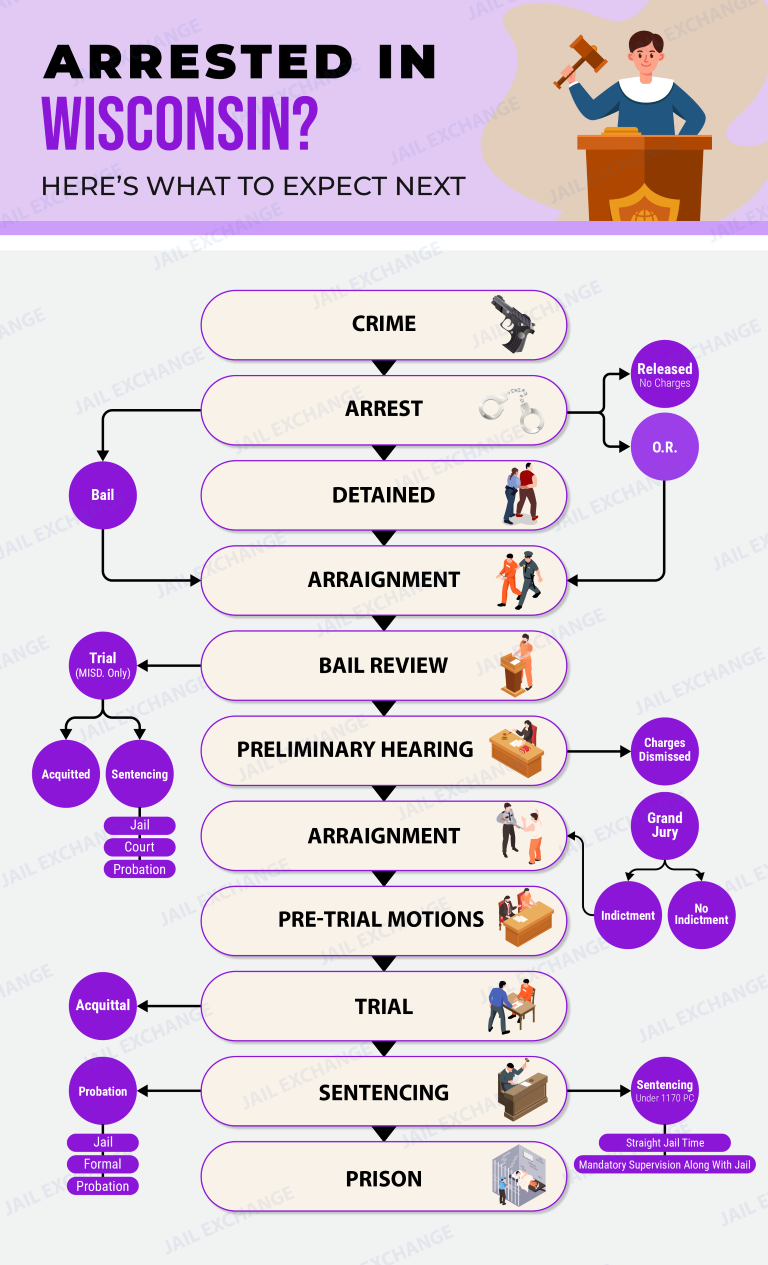
Which court hears your case. An ordinance citation, or a first-offense OWI (a civil forfeiture in Wisconsin rather than a crime, unless a passenger under 16 was in the vehicle), goes to the municipal court of the city or village where the stop happened if that place has one; Rice Lake, Barron, Chetek, Cumberland, Cameron and Turtle Lake do. Tickets written in towns, in other villages or by the Sheriff and State Patrol on county and state roads go to the circuit court instead. Misdemeanors and criminal traffic charges, such as a second OWI or driving after revocation, are filed in the Barron County Circuit Court, where criminal cases are divided among Branches 1, 2 and 3. Felonies stay in that same court from the initial appearance through the preliminary hearing, arraignment and trial.
Where pretrial inmates are held. The Sheriff's Office runs the county jail inside the Justice Center in Barron, so people booked in Rice Lake, Cumberland or any other part of the county end up in the same building where their first court hearing takes place. People serving county sentences may be allowed Huber release for work or treatment. To ask whether someone is in custody, or how much is owed to get them out, call the Sheriff's Office at (715) 537-3106.
- Barron County Circuit Court (Branches 1, 2 and 3), Barron County Justice Center, 1420 State Highway 25 North, Barron, WI 54812; Clerk of Circuit Court (715) 537-6265
- Barron County District Attorney, Justice Center, Room 2301, 1420 State Highway 25 North, Barron, WI 54812, (715) 537-6220
- Barron County Sheriff's Office, Justice Center, Room 1200, 1420 State Highway 25 North, Barron, WI 54812, (715) 537-3106
- Barron County Jail, Barron County Justice Center, 1420 State Highway 25 North, Barron, WI 54812, (715) 537-3106
- Wisconsin State Public Defender, Chippewa Falls office (the trial office assigned to Barron County), 10 North Bridge Street, Suite 200, Chippewa Falls, WI 54729, (715) 908-8473
- Barron County Department of Health and Human Services (juvenile intake and children's services), 335 East Monroe Avenue, Room 338, Barron, WI 54812, (715) 537-6359
Barron County has more municipal courts than most counties its size in northwest Wisconsin. Each one is part-time, run by an elected municipal judge, and limited to violations of local ordinances, which carry money forfeitures rather than jail. A municipal judge can order jail only as a way to enforce a forfeiture that goes unpaid. In some situations a defendant can ask to have a municipal case moved to the circuit court, for example by requesting a jury, so it is worth reading the citation and asking the clerk before the first date.
Circuit court
- Barron County Circuit Court, Barron County Justice Center, 1420 State Highway 25 North, Barron, WI 54812. Branch 1 (Room 2601), Branch 2 (Room 2602) and Branch 3 (Room 2603). Clerk of Circuit Court, criminal and traffic filings, (715) 537-6265.
Municipal courts
- Rice Lake Municipal Court (city of Rice Lake), 30 East Eau Claire Street, Rice Lake, WI 54868, (715) 234-1989
- Barron Municipal Court (city of Barron), P.O. Box 156, Barron, WI 54812, (715) 537-5631
- Chetek Municipal Court (city of Chetek), P.O. Box 537, Chetek, WI 54728, (715) 925-1051
- Cumberland Municipal Court (city of Cumberland), 900 First Avenue, Cumberland, WI 54829, (715) 822-3646
- Cameron Municipal Court (joint court for the village of Cameron and the town of Stanley), 300 North First Street, Cameron, WI 54822, (715) 458-2117
- Turtle Lake Municipal Court (joint court for the village of Turtle Lake and the village and town of Almena), P.O. Box 11, Turtle Lake, WI 54889, (715) 986-2241
- The village of New Auburn, which lies mostly in Chippewa County, has its own municipal court at P.O. Box 100, New Auburn, WI 54757, (715) 237-2423; ask that clerk whether a ticket from the Barron County side belongs there.
Prosecutor, defense and law enforcement
- Barron County District Attorney, Justice Center, Room 2301, Barron, (715) 537-6220
- State Public Defender, Chippewa Falls office, 10 North Bridge Street, Suite 200, Chippewa Falls, (715) 908-8473. Barron County no longer has its own trial office; Chippewa Falls staff and private lawyers under contract handle the county's appointments.
- Barron County Sheriff's Office, which operates the Barron County Jail, Justice Center, Room 1200, Barron, (715) 537-3106
- Rice Lake Police Department, 34 South Wilson Avenue, Rice Lake, WI 54868, (715) 234-2116
- Barron Police Department, 1456 East LaSalle Avenue, Barron, WI 54812, (715) 537-3101
- Chetek Police Department, 101 Moore Street, Chetek, WI 54728, (715) 924-4711
- Cumberland Police Department, 950 First Avenue, Cumberland, WI 54829, (715) 822-2754
- Cameron Police Department, 300 North First Street, Cameron, WI 54822, (715) 458-2117
- Turtle Lake Police Department, 114 Martin Avenue East, Turtle Lake, WI 54889, (715) 986-2241
- Juvenile intake: Barron County Department of Health and Human Services, 335 East Monroe Avenue, Barron, (715) 537-6359
2. Misdemeanor (for example, theft, battery, disorderly conduct, a second OWI)
Retail theft in Rice Lake, bar fights, domestic disturbances and repeat drunk-driving stops on Highway 53 make up a large share of the misdemeanor calendar in Barron.
From booking to the first hearing
An officer can cite and release a person for many misdemeanors. Someone taken into custody is booked at the Barron County Jail, where fingerprints, photos and a records check are done. Many people leave on a signature bond, a written promise to appear that can carry a dollar amount owed only if they miss court. Wisconsin has no commercial bondsmen; if a judge or court commissioner sets cash, the full amount is paid at the jail or the clerk's office by the defendant or a relative. After a domestic abuse arrest, the person must stay away from the alleged victim's home and avoid contact for 72 hours unless the victim waives that in writing. Anyone still in custody generally sees a judge or court commissioner at an initial appearance within about 48 hours, often by video from the jail.
Lawyers and court dates
At the initial appearance the defendant hears the charge, gets a copy of the complaint, and enters a plea or asks for time. People who cannot afford a lawyer apply to the State Public Defender, either through jail staff or by calling the Chippewa Falls office at (715) 908-8473; the SPD's financial test is strict, and a judge may appoint a lawyer at county expense for someone who falls just outside it. Most misdemeanors then move through a pretrial conference with the assistant district attorney.
What the example charges carry in Barron County
- Theft of property worth $2,500 or less: Class A misdemeanor, punishable in a Barron County courtroom by up to 9 months in jail, a fine of up to $10,000, or both.
- Battery: also Class A. A domestic abuse label adds a surcharge and can bar firearm possession.
- Disorderly conduct: Class B, with a 90-day jail cap and fines up to $1,000.
- Second OWI within 10 years: a criminal misdemeanor with a mandatory 5 days to 6 months in jail, a fine, license revocation and an ignition interlock order. A first OWI is a civil forfeiture of $150 to $300 plus costs, with a 6- to 9-month revocation and an alcohol assessment, and it goes to municipal court if the stop happened in one of the six municipalities with a court.
- Class C misdemeanors carry up to 30 days and $500.
Barron County misdemeanor trials, when they happen, are decided by six jurors. Typical outcomes include dismissal, a deferred prosecution agreement, a fine, probation, or county jail time with Huber privileges so the person can keep working. A defendant who demands a speedy trial can generally expect a misdemeanor trial within about 60 days, but most cases resolve in two to six months.
↑ Back to the question list3. Felony (for example, burglary, felony theft, drug possession with intent to deliver, substantial battery)
Methamphetamine cases make up a steady part of the felony caseload in Barron County, along with burglaries of cabins and farm buildings and thefts from employers. The District Attorney decides what to charge after reviewing police reports from the Sheriff and the city departments.
Steps in a Barron County felony
- Complaint and initial appearance. The DA files a criminal complaint, and the defendant appears before a judge or court commissioner, who reviews probable cause and sets conditions of release and any cash bail. Under a 2023 amendment to the state constitution, judges may weigh the risk of serious harm to the public when setting cash bail for people charged with violent crimes.
- Preliminary hearing. If the defendant is held because they cannot pay the amount set, the hearing is supposed to start within 10 days; otherwise within 20 days. The judge decides only whether there is probable cause that a felony was committed. Many defendants waive this hearing as part of negotiations.
- Information and arraignment. After a bindover, the DA files an information, and the defendant enters a plea at arraignment in one of the three branches.
- Plea or trial. Most felonies end in a plea agreement. A jury trial uses 12 jurors whose verdict must be unanimous; a speedy trial demand generally requires trial within 90 days.
- Sentencing. The judge may order a presentence investigation from the Department of Corrections before choosing between probation, county jail as a condition of probation, or prison.
Maximum penalties for the example charges
- Burglary: Class F felony, punishable by up to 12 years and 6 months and a $25,000 fine.
- Felony theft: Class I (up to 3 years 6 months) for more than $2,500 up to $5,000; Class H (up to 6 years) above $5,000 up to $10,000; Class G (up to 10 years) above $10,000.
- Possession with intent to deliver: the class depends on the drug and weight; methamphetamine, heroin and fentanyl cases climb from Class F up to Class C (40 years) at the highest amounts.
- Substantial battery: Class I. If great bodily harm results, the charge can rise to aggravated battery, a Class H felony, or Class E with a 15-year cap where that harm was the aim.
Under truth in sentencing, a Barron County prison sentence has two parts, initial confinement and extended supervision, and parole does not exist for crimes committed after 1999. A judge may find a defendant eligible for the Challenge Incarceration Program or the Substance Abuse Program, which can shorten the confinement portion. Terms of more than a year are served with the Department of Corrections. Six months to a year is a common span for a felony case.
↑ Back to the question list4. Violent felony (for example, homicide, sexual assault, armed robbery)
Barron County sees few homicides, but serious assaults and sexual assault cases reach the circuit court every year, often investigated by the Sheriff with help from the state Division of Criminal Investigation. A person accused of a violent felony is usually held at the Barron County Jail on a high cash bail with strict no-contact conditions.
Sentencing ranges in Barron
- First-degree intentional homicide: Class A, with a life sentence the court must impose. The judge decides whether the defendant may ever be released to extended supervision and, if so, sets the earliest date.
- Second-degree intentional homicide and first-degree reckless homicide: Class B felonies, each exposing a Barron County defendant to as much as 60 years.
- First-degree sexual assault: Class B, up to 60 years; when the victim is a young child, certain charges carry mandatory minimum confinement.
- Armed robbery: Class C, which permits a prison term of up to 40 years along with a fine as high as $100,000. Robbery without a weapon is Class E.
Wisconsin abolished capital punishment in 1853, so no Barron County case can lead to a death sentence.
What to expect
The steps match other felonies, but discovery, lab work, competency or mental health evaluations and expert witnesses stretch the timeline, and one to two years from charge to verdict is common. Public defender appointments in serious cases are often handled by experienced SPD staff attorneys from Chippewa Falls. Victims hold rights under Marsy's Law, the 2020 amendment to the Wisconsin Constitution, including notice of hearings and the right to be heard at sentencing; the victim/witness staff in the District Attorney's office can be reached at (715) 537-6220.
↑ Back to the question list5. Juveniles (under 17) arrested in Barron County
In Wisconsin, a 17-year-old charged with a crime goes to adult court. Juvenile court, which in Barron County is one of the circuit court branches sitting as juvenile court, handles delinquency cases for youths aged 10 through 16.
Intake
When police refer a juvenile, an intake worker with the Barron County Department of Health and Human Services ((715) 537-6359) decides whether to close the matter, offer a deferred prosecution agreement, or recommend a formal delinquency petition, which the District Attorney files. If intake decides to keep the child in secure custody, a judge or court commissioner should hold a custody hearing within 24 hours of that decision, not counting weekends and legal holidays.
Secure detention
Barron County has no juvenile detention center of its own. Counties in this part of the state typically hold detained youths at a regional facility, such as the Northwest Regional Juvenile Detention Center in Eau Claire, 721 Oxford Avenue. Health and Human Services intake can confirm where a particular child has been placed.
Possible results
- A deferred prosecution agreement or a consent decree, which suspends the case while the youth follows set rules.
- A delinquency finding followed by supervision at home, counseling, restitution or community service.
- Out-of-home placement, including a Type 2 placement under county supervision, or Type 1 commitment to Lincoln Hills School (boys) or Copper Lake School (girls) near Irma.
- The Serious Juvenile Offender program for the gravest offenses, which can last up to five years.
When a juvenile case moves to adult court
The DA can ask the juvenile court to waive its jurisdiction for some youths 14 and older, depending on the offense and the child's record. Adult court also has original jurisdiction, without a waiver hearing, over a child 10 or older accused of attempted or completed first-degree intentional homicide, first-degree reckless homicide or felony murder, and over some juveniles previously found delinquent who are accused of certain new crimes. The State Public Defender represents eligible children regardless of family income. Juvenile records are generally kept confidential.
↑ Back to the question list6. Federal cases (U.S. District Court) from Barron County
Barron County is part of the Western District of Wisconsin. Federal criminal cases from the county are filed with the clerk in Madison, about 200 miles to the southeast, and hearings are generally held there.
- U.S. District Court, Western District of Wisconsin, 120 North Henry Street, Room 320, Madison, WI 53703, (608) 264-5156
- U.S. Attorney's Office, Western District of Wisconsin, 222 West Washington Avenue, Suite 700, Madison, WI 53703, (608) 264-5158
- Federal Defender Services of Wisconsin, Madison office, 22 East Mifflin Street, Suite 1000, Madison, WI 53703, (608) 260-9900; Criminal Justice Act panel lawyers take conflict cases
What makes a Barron County case federal
Investigations of methamphetamine supply lines running between the Twin Cities and northwest Wisconsin are a common source of federal charges here, as are firearm possession by people with felony records, bank robbery, online child exploitation and fraud. The St. Croix Chippewa Indians of Wisconsin are reported to hold scattered trust parcels in and around the county, including near Turtle Lake. Wisconsin is a Public Law 280 state, so state courts, not federal courts, handle most crimes on those lands; the tribe also runs its own tribal court.
The federal process
After arrest, the defendant appears before a U.S. magistrate judge, hears the charge, and is appointed counsel if they qualify. Federal court does not use money bail the way the circuit court does: under the Bail Reform Act, the judge either releases the person on conditions monitored by U.S. Pretrial Services or orders detention, and a detention hearing is usually held within three court days of the government's request. When agents start the case with a criminal complaint, prosecutors have 30 days to obtain a grand jury indictment. The Speedy Trial Act sets a 70-day trial clock that is frequently extended.
Most defendants plead guilty. Trials use a 12-person jury that must be unanimous. Before sentencing, a probation officer writes a presentence report; the judge calculates the advisory Sentencing Guidelines and applies any mandatory minimum, such as those in many drug-quantity cases. There is no parole in the federal system, prisoners serve roughly 85 percent of the term with the Bureau of Prisons, and supervised release follows. A Barron County defendant convicted in Madison appeals to the Seventh Circuit, which sits in Chicago.
Locating someone in federal custody
The Federal Bureau of Prisons inmate locator lets you search by name or register number. A federal defendant awaiting trial in a county jail under a U.S. Marshals contract may also show up on that jail's inmate roster. Federal prosecution of juveniles from Barron County is rare.
↑ Back to the question listThis guide offers general information about criminal cases in Barron County and is not legal advice; court practices, municipal court arrangements and contacts can change. For advice about a specific charge, speak with a Wisconsin-licensed defense attorney. To apply for a public defender, call the State Public Defender's Chippewa Falls office at (715) 908-8473; to learn whether someone is in custody, call the Barron County Sheriff's Office at (715) 537-3106.
Information for this service is currently unavailable.

JailATM provides a secure electronic payment portal that allows friends and family members to deposit funds directly into an incarcerated person's jail trust and commissary account. Deposited money provides the financial balance needed for your loved one to purchase personal hygiene items, snacks, over-the-counter medical sundries, and correspondence supplies from the facility commissary.
Important: Facility Deposit Rules and Window Intake Vary
Once a person is booked and moved to a housing unit, facilities do not always allow cash drop-offs or phone payments directly to the jail window. Some might and you should confirm this by calling the facility and asking. But if you do not register online and fund your loved one's trust account immediately, they may be forced to wait days or weeks for standard paper processing, leaving them without essential soap, clean undergarments, basic medical sundries or snacks.
Step-by-Step Instructions to Register and Deposit Funds
- Obtain the inmate's legal first and last name, date of birth, and assigned facility booking ID number.
- Navigate to deposits.jailatm.com/webdeposits/ on your computer or mobile device.
- Click Sign In or Register to set up your verified user account using your email address and password.
- Select the state and the detention facility where the inmate is currently housed.
- Search for the inmate using their ID number or legal last name to confirm an exact roster match.
- Enter your desired deposit dollar amount and review the calculated transaction and convenience fees.
- Input your debit or credit card billing details, complete payment authorization, and save your digital receipt.
What the Inmate Needs to Do
The inmate does not need an internet account to receive funds. Once the electronic transaction clears, the balance posts directly to their jail trust ledger according to facility accounting schedules. The inmate can review their updated balance at a dayroom pod kiosk or on their weekly trust statement and place orders on their regular commissary day.
Official Provider: JailATM Official Website
Customer Service Telephone: 1-877-810-0914
Support Hours: Monday – Friday, 8:00 AM – 5:00 PM CST
Supported Languages: English and Spanish
Other Services Provided by JailATM
In addition to Trust & Commissary Money Deposits, JailATM provides several other communication, store, and visitation services at participating facilities:
- Commissary Gift Packs & Store Ordering: Order pre-approved snack boxes, food packages, and hygiene bundles sent directly to the jail.
• Learn more on our website: Commissary Gift Packs Guide | • Visit official vendor page: JailATM Store Orders - Digital Messaging & Picture Sharing: Send electronic messages and photos directly to an inmate's housing unit kiosk.
• Learn more on our website: Digital Messaging Guide | • Visit official vendor page: JailATM Messaging - Remote Video Visitation: Schedule and join live video visits from home using your computer or smartphone.
• Learn more on our website: Video Visitation Guide | • Visit official vendor page: JailATM Video Visits
Deposit Money for an Inmate in the Barron County Jail
Speed matters? Then go online: JailATM is the quickest route onto a Barron County Jail account. The jail sits inside the Barron County Justice Center, 1420 State Hwy 25 North in Barron.
Visiting in person? A teller machine in the lobby takes cash or a credit card. The lobby window turns away money orders, so leave those at home.
Mail is where a money order belongs. Make it payable to the inmate by their whole name, seal it alone, and send it to that same name with their inmate ID number, C/O Barron County Jail, 1420 State Hwy 25 North, Barron, WI 54812-3007. Cash and personal checks are never to be mailed.
Also expect a $20 fee charged at booking.
The Barron County Jail is on State Highway 25 North in the city of Barron and is run by the Barron County Sheriff. Personal letters must come through the U.S. Mail; the front lobby only takes legal papers dropped off by a lawyer or a government office. Check the inmate roster to be sure the person is still here before you write.
Mailing address for letters, books, legal mail and money orders:
Inmate's Full Name & Inmate ID#
C/O Barron County Jail
1420 State Hwy 25 North
Barron, WI 54812-3007
- Photos: Pictures are welcome, but not Polaroids, nude or sexual images, or anything showing gang signs.
- Kids' drawings: A child's hand-drawn picture is fine. Glitter, glue, tape and anything soaked in perfume or another liquid get the mail refused.
- Cards: No musical cards. Plain greeting cards are fine.
- Ink: Write with blue or black ink, not crayon, felt markers or colored pens.
- Return address: Your full name and address in the top left corner are required. Letters without one are likely to be destroyed.
- Money orders: Make a money order out to the person in jail, using their full name and their inmate ID number, and mail it alone with no letter or photos. The jail won't take cash or a personal check. For the quickest deposit, pay online.
- Publications: Books, magazines and newspapers must be new and come directly from the publisher. Other packages only come from the commissary provider.
- Not allowed to write: Co-defendants, inmates at this or any other lockup, and people under a no-contact order.
Mail goes out Monday through Friday, and there's no limit on how much someone can get. For short notes in between, try electronic messages.
Securus AdvanceConnect is a prepaid calling account that links directly to your mobile phone or landline number, allowing you to receive outbound calls from an incarcerated individual. Because correctional phone systems never allow incoming calls, funding an AdvanceConnect balance ensures calls are accepted immediately without being blocked by cell carriers.
Important: Mobile Networks Block Inmate Calls Without Prepaid Funds
Correctional facilities do not allow collect billing to cell phones, and mobile carriers automatically block incoming collect calls from detention centers. While some residential landlines may allow direct billing, mobile phones and VoIP services require an active prepaid AdvanceConnect balance, which you can verify with your phone provider. If you do not register online and fund your account right away, your loved one will hear an automated error message stating that your number cannot accept calls.
Step-by-Step Instructions to Register and Fund AdvanceConnect
- Go to securustech.online or open the Securus mobile app.
- Select Sign Up and create your account using your 10-digit telephone number and email address.
- Search for your facility by state and agency name, then add the inmate using their full legal name or booking ID.
- Select AdvanceConnect under calling accounts.
- Choose your deposit amount, review convenience and transaction fees, and enter your credit or debit card billing details.
- Authorize payment and confirm that your mobile phone allows calls from automated or unknown correctional numbers.
What the Inmate Needs to Do
The inmate picks up any dayroom phone or logs onto their handheld tablet, dials your 10-digit number, and enters their assigned PIN. The automated system verifies that your AdvanceConnect account has an active balance and connects the call. All calls are subject to recording and monitoring by facility staff.
Official Provider: Securus Technologies Official Website
Customer Service Telephone: 1-800-844-6591
Support Hours: 24 hours a day, 7 days a week, 365 days a year
Supported Languages: English and Spanish
Other Services Provided by Securus Technologies
In addition to AdvanceConnect Prepaid Calling, Securus Technologies and its subsidiary JPay provide several other communication, financial, and visitation services:
- Direct Bill Phone Calling: Establish a monthly billed calling account for verified landline numbers.
• Learn more on our website: Direct Bill Phone Calling Guide | • Visit official vendor page: Securus Direct Bill - Securus Video Connect: Schedule and join live video visits from home using your computer or smartphone.
• Learn more on our website: Video Visitation Guide | • Visit official vendor page: Securus Video Connect - JPay Money Deposits (Trust & Canteen): Send money directly into an inmate's jail trust account for commissary store purchases.
• Learn more on our website: Money Deposits Guide | • Visit official vendor page: JPay Money Transfers - JPay Email Messaging & Photos: Send electronic messages, photo attachments, and VideoGrams directly to their tablet or kiosk.
• Learn more on our website: Email Messaging Guide | • Visit official vendor page: JPay Email Services
Securus Direct Bill is an invoiced telephone calling service designed for approved residential landlines, law offices, and commercial businesses. Instead of prepaying funds in advance, calls received from an incarcerated individual are billed directly to your account on a monthly itemized billing invoice.
Important: Direct Bill Requires Credit Approval and Qualifying Lines
Direct Bill is not available for mobile cell phones, internet VoIP numbers, or customers with poor or unestablished telephone credit history. Correctional facilities enforce strict telecommunications billing rules, which you can verify by calling Securus customer care. If your line does not meet credit approval standards, you must open an AdvanceConnect prepaid account instead to receive incoming calls from your loved one.
Step-by-Step Instructions to Set Up a Direct Bill Account
- Contact Securus customer service at 1-800-844-6591 or submit an application via securustech.net.
- Provide your billing name, service address, and qualifying residential or business landline telephone number.
- Submit to a standard credit evaluation performed by Securus to determine billing eligibility.
- Establish your authorized monthly credit limit upon approval.
- When your phone rings with a call from the detention center, follow the recorded operator instructions and press the requested key to accept charges.
- Pay your monthly billing invoice online, by phone, or through the mail.
What the Inmate Needs to Do
The inmate dials your phone number from any dayroom telephone and keys in their assigned PIN. The automated system verifies that your account is in good standing and has not exceeded its monthly spending ceiling before connecting the call. All non-privileged conversations are recorded and monitored.
Official Provider: Securus Technologies Official Website
Customer Service Telephone: 1-800-844-6591
Support Hours: 24 hours a day, 7 days a week, 365 days a year
Supported Languages: English and Spanish
Other Services Provided by Securus Technologies
In addition to Direct Bill Calling, Securus and its subsidiary JPay offer several other communication, financial, and visitation services:
- AdvanceConnect Prepaid Calling: Fund a prepaid calling account tied to your mobile phone number.
• Learn more on our website: AdvanceConnect Calling Guide | • Visit official vendor page: Securus AdvanceConnect - Securus Video Connect: Schedule and join live video visits from home using your computer or smartphone.
• Learn more on our website: Video Visitation Guide | • Visit official vendor page: Securus Video Connect - JPay Money Deposits (Trust & Canteen): Send money directly into an inmate's jail trust account for commissary store purchases.
• Learn more on our website: Money Deposits Guide | • Visit official vendor page: JPay Money Transfers - JPay Email Messaging & Photos: Send electronic letters, photos, and VideoGrams directly to their tablet or kiosk.
• Learn more on our website: Email Messaging Guide | • Visit official vendor page: JPay Email Services

CIDNET Inmate Messaging provides a secure digital messaging and picture-sharing service for families of incarcerated individuals. Powered by CIDNET Data Points, outside contacts can compose electronic letters and upload JPEG photographs directly through the CIDNET web app, delivering correspondence to inmate screens within hours and avoiding paper mail sorting delays.
Important: Postal Mail Transition and Screening Rules Vary
Inmates cannot receive incoming phone calls, and physical postal mail policies differ across jurisdictions. While some detention centers accept handwritten envelopes, many facilities contracting with CIDNET have prohibited physical paper mail in favor of electronic mail scanning and direct digital messaging, which you can verify by checking facility rules. If you do not register online and purchase Data Points immediately, your loved one may face lengthy periods without direct written communication from family.
Step-by-Step Instructions to Register and Message an Inmate
- Log into your account at customer.cidnet.net or launch the CIDNET app.
- Ensure your identity verification (photo ID and selfie) is approved by the facility.
- Confirm your account has an active Data Point balance; purchase additional points if needed.
- Select Messages from your navigation menu and click on your linked contact.
- Type your message in the text editor and attach clear JPEG photo files if authorized by the facility's media rules.
- Review the estimated Data Point cost for the message length and image attachments.
- Click Send to submit your transmission to the institutional mailroom screening queue.
What the Inmate Needs to Do
All messages and photographs pass through facility screening filters. Once approved, the message arrives in the inmate's inbox on their housing unit kiosk or assigned tablet. The inmate opens the message, views the images, and types a digital response, which draws against available account points.
Official Provider: CIDNET Customer Portal | Encartele Corporate
Customer Service Telephone: 1-888-984-1903
Support Hours: Monday – Friday, 8:00 AM – 5:00 PM CST
Supported Languages: English and Spanish
Other Services Provided by CIDNET
In addition to Inmate Messaging, CIDNET provides several other communication and visitation options:
- Data Points (Unified Funding): Purchase universal credits that power voice calling, messaging, and video visits.
• Learn more on our website: CIDNET Data Points Guide | • Visit official vendor page: Buy CIDNET Data - Remote Video Visitation: Schedule and join live video visits from home using your computer or smartphone.
• Learn more on our website: CIDNET Video Visits Guide | • Visit official vendor page: CIDNET Video Visitation - Phone PINs & Voice Calling: Fund outbound voice telephone calls so your loved one can call your telephone directly.
• Learn more on our website: CIDNET Phone Calling Guide | • Visit official vendor page: CIDNET Voice Calling
CIDNET provides secure handheld wireless tablets designed specifically for correctional housing units. Operating over a private, encrypted facility network, these devices allow incarcerated individuals to exchange messages, place voice calls, conduct remote video visits, read approved digital books, access law library materials, and complete rehabilitative courses directly from their cells.
Important: Tablet Hardware Deployment and Rental Rules Vary
Detention centers do not manage tablet distribution identically. While some agencies issue individual personal tablets to every detainee at booking, others utilize shared pod docking stations or restrict tablet use to specific dayroom hours, which you should confirm with the facility directly. Although core educational and legal resources are generally provided free of charge, sending messages or making calls from the tablet requires an active balance of Data Points funded by friends or family.
Step-by-Step Instructions to Support Tablet Use
- Confirm that CIDNET handheld tablets are active and deployed at your loved one's specific detention facility.
- Register your verified user account at customer.cidnet.net.
- Complete identity verification by uploading your government photo ID.
- Link the inmate to your profile and purchase a reserve of CIDNET Data Points.
- Notify your loved one that funds are available so they can open the communication apps on their tablet.
What the Inmate Needs to Do
The inmate unlocks their assigned tablet using biometric verification or their unique facility PIN. Once logged on, they can browse institutional announcements, access educational materials, or select approved outside contacts to read messages and start calls. When quiet hours begin or tablets require recharging, inmates return devices to designated pod docking carts.
Official Provider: CIDNET Customer Portal | Encartele Corporate
Customer Service Telephone: 1-888-984-1903
Support Hours: Monday – Friday, 8:00 AM – 5:00 PM CST
Supported Languages: English and Spanish
Other Services Provided by CIDNET
In addition to Inmate Tablet Services, CIDNET provides several core communication channels:
- Data Points (Unified Funding): Purchase the digital currency required to power all tablet communications.
• Learn more on our website: CIDNET Data Points Guide | • Visit official vendor page: Buy CIDNET Data - Inmate Messaging & Digital Mail: Send text messages and photos directly to an inmate's tablet screen.
• Learn more on our website: CIDNET Messaging Guide | • Visit official vendor page: CIDNET Messaging Portal - Remote Video Visitation: Conduct scheduled live video calls directly to their tablet or pod kiosk.
• Learn more on our website: CIDNET Video Visits Guide | • Visit official vendor page: CIDNET Video Visitation
Barron County Juvenile Facilities
- Jail (Main): 715-537-5559
- Sheriff: 715-537-3106
The Barron County Jail serves the following cities and towns of Barron County: Almena, Barron, Barronett, Cameron, Chetek, Clinton, Cumberland, Dallas, Haugen, Lakeland, Lakewood, Maple Plain, Mikana, New Auburn, Prairie Farm, Rice Lake, Ridgeland and Turtle Lake.