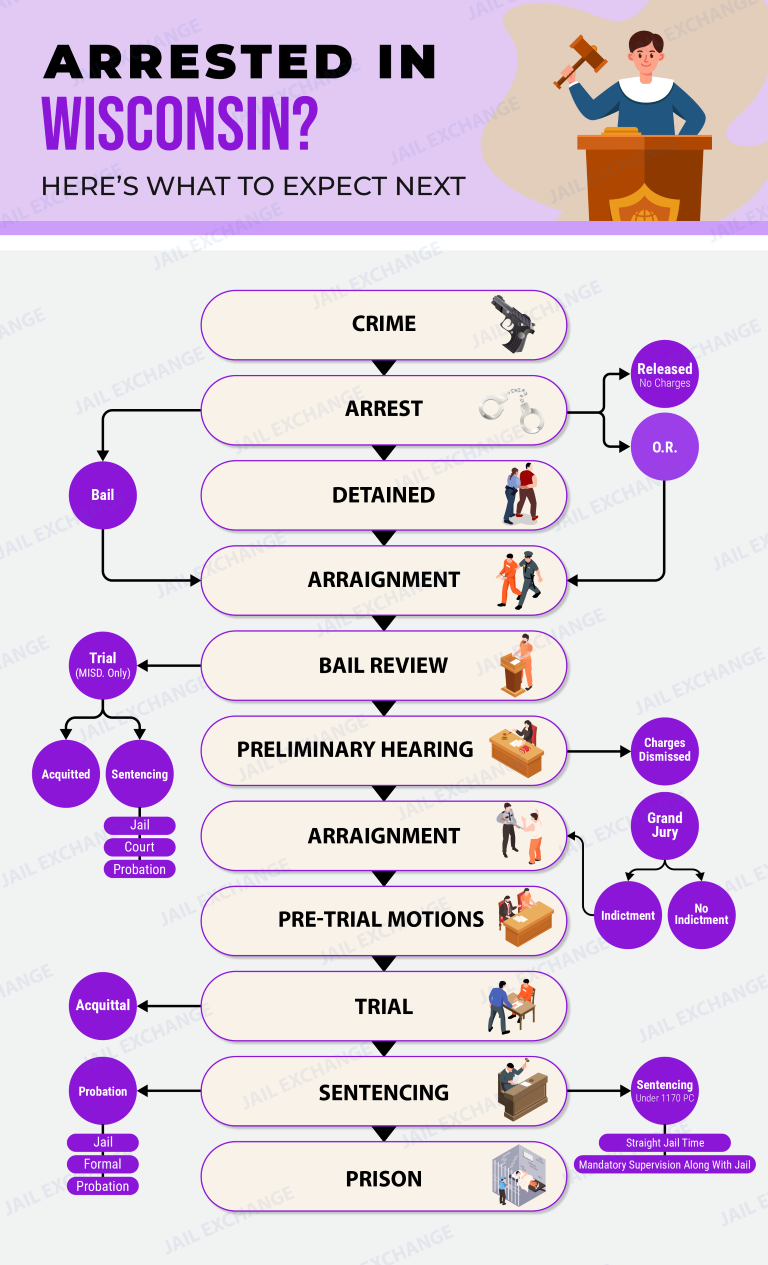
Criminal cases from the city of Eau Claire, the county seat, and from Altoona, Augusta, Fall Creek, Fairchild and the surrounding towns all land in one building: the Eau Claire County Courthouse on Oxford Avenue. Six judges sit in the Eau Claire County Circuit Court, and the only municipal court in the county, a joint court based in Augusta, takes ordinance tickets from Augusta and the town of Bridge Creek. Charges are brought by the elected Eau Claire County District Attorney. After an arrest, adults are booked into the Eau Claire County Jail, run by the Sheriff on the same downtown campus, and youths who must be locked up go to a regional juvenile center in that complex.
- Eau Claire County Circuit Court (six branches), Eau Claire County Courthouse, 721 Oxford Avenue, Eau Claire, WI 54703; Clerk of Circuit Court (715) 839-4816
- Eau Claire County District Attorney, 721 Oxford Avenue, Room 2310, Eau Claire, WI 54703, (715) 839-4828
- Eau Claire County Sheriff's Office, 721 Oxford Avenue, Suite 1400, Eau Claire, WI 54703, (715) 839-4709
- Eau Claire County Jail, 710 Second Avenue, Eau Claire, WI 54703, (715) 839-4702
- Wisconsin State Public Defender, Eau Claire office (covers Eau Claire, Buffalo and Pepin counties), 21 South Barstow Street, Floor 3, Eau Claire, WI 54701, (715) 502-1490
- Eau Claire County Department of Human Services (youth justice intake), 721 Oxford Avenue, Suite 1001, Eau Claire, WI 54703, (715) 839-7118; main line (715) 839-2300
Which court hears your case. A local ordinance ticket, or a first-offense OWI (treated in Wisconsin as a civil forfeiture, not a crime, unless a child under 16 was riding in the vehicle), is heard by the Augusta–Bridge Creek municipal court only when it was written in Augusta or the town of Bridge Creek; everywhere else in the county, including the city of Eau Claire and Altoona, those citations are filed in the circuit court, so check the court named on the ticket. Misdemeanors and criminal traffic offenses such as a second OWI or operating after revocation go to the Eau Claire County Circuit Court, where criminal and traffic calendars are spread across the six branches. A felony begins and ends in the same circuit court, from the initial appearance through the preliminary hearing, arraignment, plea or trial, and sentencing.
Where pretrial inmates are held. Everyone arrested in Eau Claire County by city police, the Sheriff, the State Patrol or university officers is taken to the jail at 710 Second Avenue, which connects to the courthouse, so in-custody defendants are brought to court without leaving the complex. Huber work release is available to some sentenced inmates. For custody status, charges or the cash amount set, call the jail at (715) 839-4702 or the Sheriff's Office at (715) 839-4709.
- Local courts in Eau Claire County (circuit court and municipal courts)
- After an arrest in Eau Claire County: booking, the pretrial program and release
- The State Public Defender in Eau Claire
- Diversion, deferred prosecution and treatment courts
- Misdemeanor (for example, theft, battery, disorderly conduct, a second OWI)
- Felony (for example, burglary, felony theft, drug possession with intent to deliver, substantial battery)
- Violent felony (for example, homicide, sexual assault, armed robbery)
- Juveniles (under 17) arrested in Eau Claire County
- Federal cases (U.S. District Court) from Eau Claire County
Local courts in Eau Claire County (circuit court and municipal courts)
Unlike many Wisconsin counties of its size, Eau Claire County has almost no municipal court system. State court statistics for 2024 list a single municipal court in the county, the joint court for Augusta and Bridge Creek. The city of Eau Claire, the largest city in the region, files its ordinance and traffic citations in circuit court instead. A municipal court can only impose forfeitures for local ordinance violations; it cannot send anyone to jail as a sentence, although a judge may order jail as a last resort when a forfeiture is not paid. In certain situations a defendant may be able to have a municipal citation transferred to the circuit court, so read the ticket and ask the municipal clerk before the return date.
Circuit court
- Eau Claire County Circuit Court, Eau Claire County Courthouse, 721 Oxford Avenue, Eau Claire, WI 54703. Six branches with six elected judges, plus a court commissioner who handles many first appearances. Clerk of Circuit Court (criminal, traffic and forfeiture filings) (715) 839-4816; juvenile clerk, Room 2201, (715) 839-4823.
Municipal court
- Augusta–Bridge Creek Joint Municipal Court (city of Augusta and town of Bridge Creek), P.O. Box 475, Augusta, WI 54722, (715) 286-2555
- Tickets from Eau Claire, Altoona, Fall Creek, Fairchild and the other towns and villages are generally handled by the circuit court unless the municipality has created its own court; the court listed on the citation controls.
Prosecutor, defense and police
- Eau Claire County District Attorney, 721 Oxford Avenue, Room 2310, (715) 839-4828; victim/witness unit (715) 839-4795
- State Public Defender, Eau Claire office, 21 South Barstow Street, Floor 3, (715) 502-1490
- Eau Claire County Sheriff's Office (operates the Eau Claire County Jail), 721 Oxford Avenue, Suite 1400, (715) 839-4709
- Eau Claire Police Department, 721 Oxford Avenue, Suite 1400, Eau Claire, WI 54701, (715) 839-4975
- Altoona Police Department, 1904 Spooner Avenue, Altoona, WI 54720, (715) 839-6090
- Augusta Police Department, 145 West Lincoln Street, Augusta, WI 54722, (715) 286-2252
- Fall Creek Police Department, 530 East Lincoln Avenue, Fall Creek, WI 54742, (715) 877-3231
- Fairchild Police Department, 331 Oak Street, Fairchild, WI 54741, (715) 334-6571
- Juvenile intake: Eau Claire County Department of Human Services, 721 Oxford Avenue, Suite 1001, (715) 839-7118
After an arrest in Eau Claire County: booking, the pretrial program and release
Officers can release a person on a citation for many lower-level offenses. When they decide to book instead, the person goes to the Eau Claire County Jail for fingerprints, photographs, property inventory, a medical screening and a warrant check. Visits there are video-only and must be scheduled a day ahead; money can be added for an inmate at a 24-hour kiosk in the jail lobby.
How release decisions are made
Since 2020 the county has run a pretrial program that uses the Public Safety Assessment, a scoring tool, to give the judge or court commissioner information before release conditions are set. People who are not let go at booking usually see the court commissioner within about 48 hours, often by video link from the jail. The commissioner may grant a signature bond, which is a written promise to return that carries a dollar amount only if the person misses court, or set cash with conditions such as no contact with a named person, no alcohol, or pretrial monitoring. Wisconsin does not allow commercial bail bondsmen, so a cash amount is paid in full, by the defendant or someone on their behalf, at the jail or the Clerk of Circuit Court; it is returned at the end of the case, less anything the court applies to fines or costs. Under a 2023 change to the state constitution, a judge setting cash for someone charged with a violent crime may consider the danger of serious harm to the public.
Domestic abuse arrests
When officers believe domestic abuse occurred, Wisconsin law often requires an arrest. The person released afterward must avoid the alleged victim's residence and avoid contacting that person for 72 hours, unless the victim signs a waiver.
Anyone who cannot pay for a lawyer can ask jail staff for a State Public Defender application right away; the Eau Claire office is described in the next section.
The State Public Defender in Eau Claire
The Wisconsin State Public Defender's Eau Claire trial office, on the third floor at 21 South Barstow Street ((715) 502-1490), handles appointments for Eau Claire County and also for Buffalo and Pepin counties. Staff attorneys carry many cases, and the agency assigns others to private Eau Claire lawyers who accept SPD appointments.
- Applying: an intake worker interviews people held at the Eau Claire County Jail; people who are out of custody call or visit the office, ideally before the first court date.
- Eligibility: the SPD uses a state financial standard that compares income, assets and household expenses. Many working people fall outside it.
- If you do not qualify: a circuit judge has discretion to appoint a lawyer at county expense when a defendant is over the SPD limit but still unable to hire counsel. Ask about this at the initial appearance.
Cash bail posted by the defendant can be counted as an asset, so tell the intake worker who supplied the money.
Diversion, deferred prosecution and treatment courts
Eau Claire County has invested heavily in alternatives to jail, coordinated through its Criminal Justice Coordinating Council. Defense lawyers, including State Public Defender staff, routinely ask the District Attorney whether a client qualifies.
- Post-charge diversion and deferred prosecution: for eligible adults, generally first-time defendants with no prior criminal record. The person signs an agreement, completes conditions such as treatment, restitution or community service, and the charge is dismissed or reduced at the end. Agreements typically run from a few months up to three years.
- Hybrid OWI / Drug Court: a combined court, formed in 2023 by merging the former drug court, AIM court and mental health court, for people facing felony or repeat misdemeanor charges who have a substance use disorder and score moderate to high risk.
- Veterans Treatment Court: running since 2011 for current or former service members 18 and older with substance use or mental health needs.
- Family Dependency Treatment Court: added in 2025 for child welfare cases in which substance use played a part.
- Deflection program: begun in 2024 and led by the Sheriff's Office, it steers some people toward recovery services before charges are filed.
Treatment court participants are generally at least 18, live in the area, and are assessed as medium or high risk. Participation is voluntary, involves frequent court check-ins and testing, and can mean short sanctions in the Eau Claire County Jail for violations. Questions can go to the treatment court supervisor at (715) 839-7626. Release conditions and any bond usually stay in place while a referral is screened.
Misdemeanor (for example, theft, battery, disorderly conduct, a second OWI)
With students from UW–Eau Claire and Chippewa Valley Technical College, a busy downtown bar district and the retail corridor along Golf Road and Hastings Way, Eau Claire's misdemeanor docket is dominated by shoplifting, intoxicated disturbances, domestic disorderly conduct and repeat OWI stops.
The first weeks of a case
Many people charged with a misdemeanor never spend a night in the Eau Claire County Jail; they receive a summons or are released on a signature bond soon after booking. The District Attorney's office files a criminal complaint, and at the initial appearance the court explains the charge, the possible penalties and the right to a lawyer. A defendant can apply to the State Public Defender's Eau Claire office at (715) 502-1490 if they cannot afford counsel. The case then moves to a pretrial conference, where most plea offers and diversion referrals happen.
Penalties for the example charges
- Theft (property worth up to $2,500): a Class A misdemeanor carrying as much as 9 months in the Eau Claire County Jail and a $10,000 fine.
- Battery: Class A as well. If the case carries a domestic abuse designation, a surcharge is added and federal law may bar the person from owning firearms.
- Disorderly conduct: Class B, with up to 90 days and a fine of up to $1,000.
- OWI, second offense within 10 years: a criminal misdemeanor with a mandatory jail term of 5 days to 6 months, a fine, a revocation of 12 to 18 months and an ignition interlock order. A first OWI is a non-criminal forfeiture of $150 to $300 plus costs, with a 6- to 9-month revocation, an alcohol or drug assessment, and an interlock if the test was 0.15 or higher or the driver refused; in this county it is usually filed in circuit court.
- Class C misdemeanors carry a maximum of 30 days and $500.
How misdemeanors end
Outcomes range from dismissal or a deferred prosecution agreement to a fine, probation, or a jail sentence, often with Huber privileges that allow work or school. When a misdemeanor goes to trial in Eau Claire, a six-person jury decides it. A defendant who files a speedy trial demand is generally entitled to a trial within about 60 days, but most Eau Claire misdemeanors resolve in two to six months.
Felony (for example, burglary, felony theft, drug possession with intent to deliver, substantial battery)
Methamphetamine and fentanyl distribution cases, often built by multi-agency drug investigators working alongside Eau Claire police and the Sheriff, account for a large share of felony filings here, along with residential burglaries, vehicle thefts and serious batteries.
The felony track in Eau Claire County
- Complaint and first appearance. The District Attorney files a criminal complaint. A defendant held at the Eau Claire County Jail sees the court commissioner, who confirms probable cause, appoints or confirms counsel and sets release conditions or cash bail, using the pretrial assessment when one has been done.
- Preliminary hearing. For someone who stays in custody because they cannot meet the amount set, the hearing generally must begin within 10 days of the first appearance; for others the limit is 20 days. The only question is whether there is probable cause to believe the defendant committed a felony. Waivers are common.
- Information and arraignment. Once a case is bound over, the DA files an information and the defendant pleads before one of the six circuit judges.
- Negotiation or trial. Most felonies end with a plea agreement. At trial, all twelve jurors in the Eau Claire courtroom must agree. Filing a speedy trial demand generally puts a felony on a 90-day trial clock.
- Sentencing. The judge may order a presentence investigation by the Department of Corrections and can choose probation (sometimes with local jail time as a condition) or prison.
Maximums for the example charges
- Burglary of a building or dwelling: Class F, up to 12 years 6 months in prison and a $25,000 fine.
- Theft over $2,500: Class I for $2,500.01 to $5,000 (3 years 6 months); Class H for more than $5,000 up to $10,000 (6 years); Class G above $10,000 (10 years).
- Possession with intent to deliver: the class turns on the substance and the weight; fentanyl, heroin and methamphetamine cases range from Class F to Class C, the last of which allows 40 years.
- Substantial battery: Class I. Causing great bodily harm can lead to aggravated battery charges at Class H, or Class E (15 years) when that harm was intended.
Wisconsin's truth-in-sentencing law splits a prison term into initial confinement and extended supervision, and there is no parole for offenses committed after 1999. Eligible people may be allowed into the Challenge Incarceration Program or the Substance Abuse Program, which can shorten confinement. Sentences of one year or less are served locally; anything longer means a state prison term with the Department of Corrections. Expect six months to a year from charge to resolution, and ask the State Public Defender lawyer whether the Hybrid OWI / Drug Court is an option.
Violent felony (for example, homicide, sexual assault, armed robbery)
Homicides are infrequent in Eau Claire County but draw intense attention when they occur, and sexual assault and armed robbery cases appear on the felony calendar each year. A defendant in one of these cases is usually held at the Eau Claire County Jail on substantial cash bail with no-contact orders, and the 2023 constitutional amendment allows the court to weigh the risk of serious harm when setting it.
What the law provides
- First-degree intentional homicide: Class A. Life imprisonment is mandatory; at sentencing the Eau Claire County judge either sets a date when the person may petition for extended supervision or orders that release will never be available.
- Second-degree intentional homicide; first-degree reckless homicide: Class B, each up to 60 years.
- First-degree sexual assault: a Class B felony carrying as many as 60 years for anyone convicted in Eau Claire County. Some offenses against young children carry mandatory minimum terms of initial confinement.
- Armed robbery: Class C, which allows up to 40 years in prison and a fine of up to $100,000. Unarmed robbery is a Class E felony.
Wisconsin has not had the death penalty since 1853.
Pace and rights
Forensic testing at the state crime laboratory, expert reports and possible competency evaluations slow these cases, and a year or two between charge and verdict is not unusual. The State Public Defender assigns experienced attorneys to homicide and serious sexual assault cases. Crime victims have rights under Marsy's Law, adopted in 2020, including notice of proceedings and the chance to speak at sentencing; the District Attorney's victim/witness unit can be reached at (715) 839-4795.
Juveniles (under 17) arrested in Eau Claire County
Wisconsin prosecutes 17-year-olds as adults. Delinquency cases involving children aged 10 through 16 go to the Eau Claire County Circuit Court sitting as juvenile court, with its own clerk in Room 2201 of the courthouse.
Intake and the custody hearing
Police refer the case to youth justice intake at the Eau Claire County Department of Human Services ((715) 839-7118). Intake staff can close the referral, set up a deferred prosecution agreement, or recommend that the District Attorney file a petition alleging delinquency. When intake decides a child must be held, the court should hold a custody hearing within 24 hours of that decision, excluding weekends and legal holidays.
Where youths are detained
The Northwest Regional Juvenile Detention Center is located in Eau Claire at 721 Oxford Avenue, and it takes in detained youths from Eau Claire County as well as from other counties in western Wisconsin. Families can call intake to find out whether a child has been placed there.
Outcomes
- A deferred prosecution agreement or a consent decree, both of which put the case on hold while the youth meets set conditions.
- An adjudication of delinquency followed by supervision, counseling, community service or restitution.
- Placement out of the home, including a Type 2 placement supervised by the county, or a Type 1 commitment to Lincoln Hills School (boys) or Copper Lake School (girls), the state facilities in Irma.
- For the most serious cases, the Serious Juvenile Offender program, which can last as long as five years.
When the case goes to adult court
For some youths 14 or older, the DA may petition the juvenile court to waive jurisdiction so the case proceeds in adult court; the judge looks at the offense, the child's history and other factors. Adult court generally starts with original jurisdiction, with no waiver needed, when a child 10 or older is accused of attempted or completed first-degree intentional homicide, first-degree reckless homicide or felony murder, and in certain cases involving a juvenile already found delinquent who commits specified new offenses. The State Public Defender represents children without regard to family income, and juvenile records are generally kept confidential.
Federal cases (U.S. District Court) from Eau Claire County
Eau Claire County belongs to the Western District of Wisconsin. Federal law names Eau Claire as a place where that court may sit, and the U.S. Courthouse at 500 South Barstow Street houses a U.S. Probation office and bankruptcy chambers, but the district's criminal cases are filed with the clerk in Madison and are generally heard there.
- U.S. District Court, Western District of Wisconsin, Clerk's Office, 120 North Henry Street, Room 320, Madison, WI 53703, (608) 264-5156
- U.S. Attorney's Office, Western District of Wisconsin, prosecutors' main office at 222 West Washington Avenue, Suite 700, Madison, WI 53703, (608) 264-5158
- Federal Defender Services of Wisconsin (Madison office), 22 East Mifflin Street, Suite 1000, Madison 53703, (608) 260-9900; when that office has a conflict, the court appoints a private Criminal Justice Act panel attorney
Which Eau Claire cases become federal
Drug-trafficking investigations that reach suppliers in the Twin Cities or Chicago, firearm possession by people barred from having guns, bank robberies, child pornography and online enticement, and large fraud schemes are the usual sources of federal charges from the Chippewa Valley. Tribal jurisdiction rarely affects Eau Claire County cases; because Wisconsin is a Public Law 280 state, state courts generally handle crimes on reservation and trust lands elsewhere in the state, with the exception of the Menominee Reservation in the northeast.
How a federal case moves
Following a federal arrest, an Eau Claire County defendant goes before a federal magistrate judge for an initial appearance, where counsel is appointed for those who qualify. The federal court does not set a cash bail amount the way the Eau Claire County Circuit Court does. The Bail Reform Act instead directs the magistrate judge either to release the person on conditions, with U.S. Pretrial Services supervising, or to order detention, generally after a hearing held within three court days of the government's motion. A case begun by complaint requires a grand jury indictment within 30 days, and the Speedy Trial Act's 70-day trial deadline is often extended for complex cases.
Guilty pleas end the large majority of federal prosecutions from the Chippewa Valley. If the case is tried, all 12 federal jurors must agree on the verdict. Before sentencing, the federal probation office prepares a presentence report; the judge works through the advisory Sentencing Guidelines and any mandatory minimum term. Federal prisoners have no parole, generally serve about 85 percent of their sentence in the Bureau of Prisons, and then begin supervised release. Appeals from Madison are taken to the Seventh Circuit, the federal appeals court in Chicago.
Finding a federal prisoner
Relatives trying to locate a federal prisoner from Eau Claire County can enter a name or register number in the Federal Bureau of Prisons inmate locator. Someone awaiting federal trial in a county jail that contracts with the Marshals Service may also be listed on that jail's own roster of inmates. Federal charges against juveniles from Eau Claire County are rare. Federal defendants do not use the State Public Defender; they are represented by Federal Defender Services or a CJA panel lawyer.
This Eau Claire County guide gives general information and is not legal advice; court assignments, programs and phone numbers change over time. Talk with a lawyer licensed in Wisconsin about any specific charge. Public defender applications go through the State Public Defender's Eau Claire office at (715) 502-1490; for jail and custody questions, call the Eau Claire County Jail at (715) 839-4702 or the Sheriff's Office at (715) 839-4709.