Merrill is the Lincoln County seat, and criminal cases from Merrill, Tomahawk and the surrounding towns are heard at the Lincoln County Courthouse on East Main Street. The Lincoln County Circuit Court has two branches, while ordinance tickets written in the cities of Merrill and Tomahawk go to their shared municipal court. The elected Lincoln County District Attorney files and prosecutes criminal charges. Adults who are booked and not released stay at the Lincoln County Jail, run by the Sheriff on East First Street, and cash bail can be posted there after hours.
- Lincoln County Circuit Court (Branches 1 and 2), Lincoln County Courthouse, 1110 East Main Street, Suite 205 (Clerk of Circuit Court), Merrill, WI 54452; clerk's office (715) 536-0319
- Lincoln County District Attorney, Lincoln County Courthouse, 1110 East Main Street, Suite 103, Merrill, WI 54452, (715) 536-0339
- Lincoln County Sheriff's Office, 1104 East First Street, Merrill, WI 54452, (715) 536-6272
- Lincoln County Jail, 1104 East First Street, Merrill, WI 54452, (715) 536-6272
- Wisconsin State Public Defender, Merrill office (serves Lincoln, Langlade, Price and Taylor counties), 807 East First Street, Merrill, WI 54452, (715) 536-9105
- Lincoln County Social Services (youth justice intake), 607 North Sales Street, Suite 202, Merrill, WI 54452, (715) 536-6200
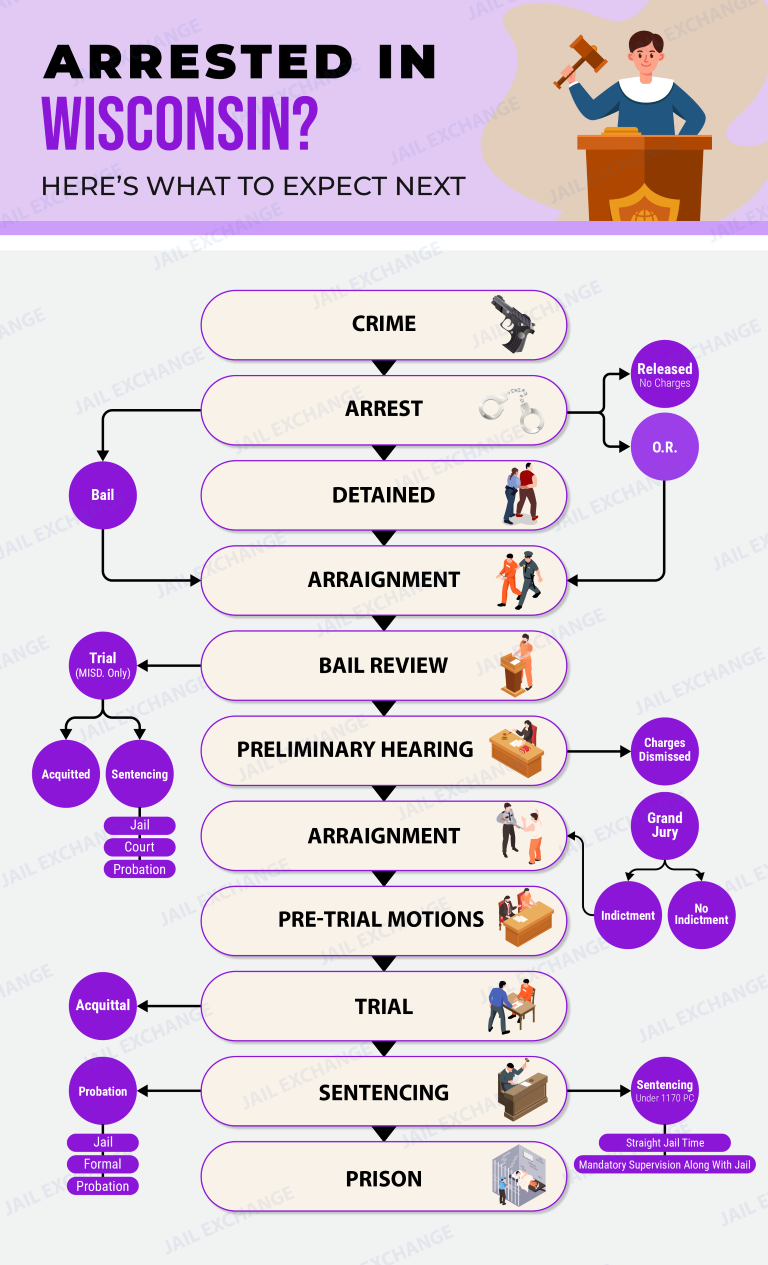
Which court hears your case. Ordinance violations and first-offense OWI cited by Merrill or Tomahawk police inside those cities go to the Merrill and Tomahawk Joint Municipal Court. A first OWI is a civil forfeiture in Wisconsin, not a criminal charge, as long as no child under 16 was in the car. The same kinds of tickets written by sheriff's deputies or state troopers, or issued in the towns and villages, are filed in the circuit court. Every misdemeanor and criminal traffic case, such as a second OWI or driving after revocation, belongs to the Lincoln County Circuit Court, where criminal files are split between Branch 1 and Branch 2. Felony cases stay in that court for every step, from the first appearance and preliminary hearing to arraignment and trial.
Where pretrial inmates are held. The Lincoln County Sheriff's Office keeps people awaiting trial, and those serving county sentences, in its jail at 1104 East First Street in Merrill. Arrests made in Tomahawk, about 20 miles north, are brought there too. The Sheriff's main line, (715) 536-6272, can confirm whether someone is in custody and what amount has been set.
- Local courts in Lincoln County (circuit court and municipal courts)
- Misdemeanor (for example, theft, battery, disorderly conduct, a second OWI)
- Felony (for example, burglary, felony theft, drug possession with intent to deliver, substantial battery)
- Violent felony (for example, homicide, sexual assault, armed robbery)
- Juveniles (under 17) arrested in Lincoln County
- Federal cases (U.S. District Court) from Lincoln County
Local courts in Lincoln County (circuit court and municipal courts)
Two courts handle nearly every Lincoln County case: the circuit court in Merrill and the joint municipal court the two cities created. The municipal court has an elected part-time judge and decides only local ordinance cases, so the penalty is a money forfeiture. A municipal judge cannot jail someone for the violation itself, though jail can follow as a means of collecting a forfeiture that is never paid. A defendant may, in some circumstances, be able to shift a municipal case to circuit court, such as by requesting a jury trial; check the deadlines printed on the citation.
Circuit court
- Lincoln County Circuit Court, Lincoln County Courthouse, 1110 East Main Street, Suite 205, Merrill, WI 54452. Clerk of Circuit Court main line (715) 536-0319; Branch 1 case questions (715) 536-0321; Branch 2 case questions (715) 536-0320. Keep the case number handy when calling.
Municipal court
- Merrill and Tomahawk Joint Municipal Court (cities of Merrill and Tomahawk), Merrill City Hall, 1004 East First Street, Merrill, WI 54452, (715) 539-3714
- Villages and towns in Lincoln County, and highways patrolled by the Sheriff or State Patrol, generally send ordinance and traffic citations to the circuit court unless a municipality has joined a court since; the citation says where to appear.
Prosecutor, defense and law enforcement
- Lincoln County District Attorney, Courthouse, Suite 103, Merrill, (715) 536-0339
- State Public Defender, Merrill office, 807 East First Street, Merrill, (715) 536-9105, which also covers Langlade, Price and Taylor counties
- Lincoln County Sheriff's Office, which runs the Lincoln County Jail, 1104 East First Street, Merrill, (715) 536-6272
- Merrill Police Department, 1004 East First Street, Merrill, WI 54452, (715) 536-8311
- Tomahawk Police Department (city of Tomahawk); after hours, calls can be routed through the Sheriff's dispatch at (715) 536-6272
- Juvenile intake: Lincoln County Social Services, Youth Justice Services, 607 North Sales Street, Suite 202, Merrill, (715) 536-6200
Misdemeanor (for example, theft, battery, disorderly conduct, a second OWI)
In Lincoln County, a typical misdemeanor docket includes retail thefts in Merrill, tavern fights, domestic disturbances, and repeat OWI stops on Highway 51 and Highway 64.
Getting out and getting to court
Many people charged with a misdemeanor are cited and released at the scene or leave the Lincoln County Jail on a signature bond, a signed promise to appear that may carry a dollar amount payable only after a missed court date. If cash is required, the Clerk of Circuit Court's office accepts cash, money orders and certified cashier's checks during business hours (no personal checks; cards carry an added fee), and the jail takes payments outside those hours. Commercial bonding companies are illegal in Wisconsin, so a relative or the defendant pays the full amount. A person arrested for domestic abuse is barred for 72 hours from contacting the alleged victim or going to the home they share, unless the victim signs a written waiver. Criminal initial appearances are held every weekday, so someone held over a weekend usually sees a judge or court commissioner on Monday.
Lawyers
To ask for appointed counsel, contact the State Public Defender's Merrill office at (715) 536-9105 or ask jail staff for an application. Its financial standard is strict. A judge may appoint a lawyer at county expense for someone who is denied by the agency but still cannot afford to hire one. After the initial appearance, most cases go to a pretrial conference with the prosecutor.
Maximum sentences for the sample charges
- Theft under $2,500: a Class A misdemeanor, punishable in Lincoln County by up to 9 months in jail and/or a $10,000 fine.
- Battery: Class A. A domestic abuse finding adds a surcharge and triggers firearm restrictions.
- Disorderly conduct: Class B, so no more than 90 days and a $1,000 fine.
- Second OWI within 10 years: criminal, with 5 days to 6 months of mandatory jail, revocation and an ignition interlock. A first OWI, by contrast, brings a forfeiture of $150 to $300 plus costs, a six- to nine-month revocation and an assessment, heard in the joint municipal court when Merrill or Tomahawk police wrote it.
- For a Class C misdemeanor, the ceiling is 30 days and $500.
When a Lincoln County misdemeanor is tried, six jurors decide it. Typical endings are dismissal, a deferred prosecution agreement, a fine, probation, or jail with Huber privileges that let the person keep working. A defendant who demands a speedy trial can generally expect one within about 60 days; most cases finish in two to six months.
Felony (for example, burglary, felony theft, drug possession with intent to deliver, substantial battery)
Methamphetamine sales, cabin and garage burglaries, and fourth or later OWIs account for a good share of Lincoln County felony filings. While the case is open, a defendant who cannot post the cash bail stays at the Lincoln County Jail in Merrill.
How a Lincoln County felony proceeds
- The complaint. The District Attorney's office reviews reports from the Sheriff, Merrill or Tomahawk police and files a sworn criminal complaint.
- First appearance. A judge or court commissioner checks probable cause, sets release terms and directs the defendant to the State Public Defender.
- Preliminary hearing. The deadline is 10 days if the defendant is held because the amount set cannot be paid, and 20 days otherwise. The judge asks only whether a felony probably occurred. Many Lincoln County defendants waive this step while talks with the prosecutor continue.
- Information and arraignment. Once bound over, the defendant is formally charged by an information and pleads before the Branch 1 or Branch 2 judge.
- Resolution. Most cases settle with a plea. A trial needs a unanimous verdict from 12 jurors, and a speedy trial demand generally calls for trial within 90 days.
- Sentencing. The judge can order a Department of Corrections presentence investigation and then choose probation, jail as a probation condition, or prison.
Exposure on the sample felonies
- Burglary: Class F, with as much as 12 years 6 months and $25,000 possible in Lincoln County.
- Felony theft: over $2,500 to $5,000 is Class I (3 years 6 months); from $5,000 up to $10,000 rises to Class H, six years at most; anything above $10,000 becomes Class G, with a 10-year maximum.
- Possession with intent to deliver: the drug and amount determine the class; methamphetamine, fentanyl and heroin counts climb to Class C, 40 years, at high weights.
- Substantial battery: Class I. If great bodily harm results, aggravated battery applies, a Class H felony, or Class E when the harm was intended.
Prison sentences in Wisconsin are bifurcated: a set term of initial confinement, then extended supervision, with no parole for offenses committed after 1999. The court may approve eligibility for the Challenge Incarceration Program or the Substance Abuse Program. Anything over a year is served in state prison rather than in Merrill. Plan on six to twelve months for a Lincoln County felony to finish.
Violent felony (for example, homicide, sexual assault, armed robbery)
Lincoln County records only a handful of homicides, but serious assaults and sexual assault cases are filed in the Merrill courthouse every year, sometimes with help from the state Division of Criminal Investigation. People charged with these offenses are usually held at the Lincoln County Jail on high cash bail; since a 2023 constitutional amendment, a judge may consider the risk of serious harm to others when setting it for violent crimes.
What these charges carry in Lincoln County
- First-degree intentional homicide: Class A, with a mandatory life term; the judge decides whether release to extended supervision will ever be allowed, and when.
- First-degree reckless homicide: Class B, up to 60 years. Second-degree intentional homicide sits in the same class.
- First-degree sexual assault: Class B, up to 60 years; charges involving very young children can require minimum confinement.
- Armed robbery: Class C, exposing a Lincoln County defendant to 40 years and a $100,000 fine. Plain robbery is a Class E offense.
Wisconsin abolished the death penalty in 1853, and no Lincoln County case can result in one.
Timeline and rights
Lab testing, forensic interviews, competency or mental health evaluations and expert witnesses commonly stretch these cases to one or two years. The State Public Defender's Merrill office typically places them with senior staff lawyers or experienced private attorneys. Victims have rights under Marsy's Law, the 2020 state constitutional amendment, such as notice of hearings and the chance to speak at sentencing; call the District Attorney's office at (715) 536-0339 for the victim-witness program.
Juveniles (under 17) arrested in Lincoln County
A 17-year-old who commits a crime in Lincoln County is charged as an adult. Children aged 10 through 16 go before the circuit court sitting as juvenile court, with filings handled through the Register in Probate.
Youth justice intake
Criminal referrals for a juvenile come from law enforcement to Lincoln County Social Services, Youth Justice Services ((715) 536-6200). The youth justice social worker, the child welfare manager and the District Attorney review each referral. After an intake inquiry, the options are counseling and closing the matter, a deferred prosecution agreement, or a referral to the District Attorney recommending a delinquency petition and formal supervision. If a child is kept in secure custody, a custody hearing should generally be held within 24 hours of the intake decision, leaving out weekends and legal holidays.
Secure detention
Lincoln County does not run a secure juvenile detention center. Youths from north-central Wisconsin who must be detained are typically taken to a regional center under contract, such as the Marathon County Juvenile Detention Facility at 7015 Packer Drive in Wausau. Social Services can tell a parent where a particular child is being held.
Possible outcomes
- A deferred prosecution agreement at intake, or a consent decree after a petition is filed.
- Adjudication with supervision at home, restitution, community service or counseling.
- Out-of-home care through a Type 2 placement supervised by the county, or a Type 1 correctional commitment to Lincoln Hills School (boys) or Copper Lake School (girls). Both state schools sit near Irma, in the northern part of Lincoln County itself.
- The Serious Juvenile Offender program for the most serious cases, which can last up to five years.
Transfer to adult court
For a child 14 or older, the District Attorney can ask the juvenile judge to waive jurisdiction, and the judge considers the offense, prior record and treatment options. Some cases start in adult court from day one. That generally happens when a child at least 10 years old is charged with killing someone through felony murder or first-degree reckless homicide, or with first-degree intentional homicide whether completed or attempted, and it can also happen when a youth with an earlier delinquency adjudication is accused of particular new offenses. The State Public Defender appoints lawyers for children in delinquency proceedings without considering parents' finances. Juvenile records are generally confidential.
Federal cases (U.S. District Court) from Lincoln County
Lincoln County belongs to the Western District of Wisconsin, and its federal prosecutions are filed in Madison, roughly a three-hour drive from Merrill.
- Federal courthouse (Western District), clerk's office in Room 320, 120 North Henry Street, Madison, WI 53703, (608) 264-5156
- U.S. Attorney for the Western District, 222 West Washington Avenue, Suite 700, Madison, (608) 264-5158
- Federal Defender Services of Wisconsin (Madison), 22 East Mifflin Street, Suite 1000, (608) 260-9900; when the defender has a conflict, the judge appoints a Criminal Justice Act panel attorney
Which Lincoln County cases go federal
Meth and fentanyl distribution networks reaching into Merrill and Tomahawk draw federal attention, as do felons or other prohibited people caught with guns, bank robberies, internet child exploitation cases and larger fraud schemes. Lincoln County contains no Indian reservation or national forest land, so federal-land and tribal jurisdiction questions seldom come up here. Lincoln Hills and Copper Lake are state, not federal, institutions.
Steps in a federal prosecution
The process starts with an appearance before a U.S. magistrate judge, where the defendant is told the charges and counsel is appointed for anyone who qualifies. In place of cash bail, the Bail Reform Act lets the court release a defendant under conditions supervised by Pretrial Services or hold the person in custody; if the government asks for detention, the hearing normally takes place within three court days. After a complaint, an indictment from a grand jury is generally due within 30 days. Trial is supposed to start within 70 days under the Speedy Trial Act, though judges routinely grant more time.
Few Lincoln County federal cases reach a jury; when one does, the panel has 12 members who must vote unanimously. A presentence report precedes sentencing, the judge computes the advisory Sentencing Guidelines, and mandatory minimums, common in drug-quantity cases, still bind the court. Sentences are served in the Bureau of Prisons without parole, at roughly 85 percent of the term, and then supervised release begins. Any appeal goes to the Seventh Circuit in Chicago.
Locating a federal inmate
For people in federal custody, the Federal Bureau of Prisons inmate locator accepts a name or a register number. A federal pretrial detainee housed in a county jail through a U.S. Marshals agreement can also turn up on the inmate list of that jail. Juveniles from Lincoln County are seldom charged federally. If the charges are in state court only, the State Public Defender's Merrill office, not the federal defender, handles appointed representation.
This page is general information about how criminal cases move through Lincoln County courts and is not legal advice; procedures, court arrangements and phone numbers can change. Talk with a Wisconsin defense attorney about any specific case. To apply for a public defender, call the State Public Defender's Merrill office at (715) 536-9105; to check whether someone is being held, call the Lincoln County Sheriff's Office at (715) 536-6272.