
Milwaukee County Jail
Milwaukee County Jail
Physical Address
Criminal Justice Facility949 North 9th Street
Milwaukee, WI 53233 Inmate mailing address
Jail Phone Number
414-226-7070Milwaukee County Inmate Search: Locating a Person Held Downtown or in Franklin
A person arrested here by city police, suburban police or deputies may be held at the Milwaukee County Jail at 949 N. 9th Street, Milwaukee, WI 53233. Sentenced men and women are often sent on to the Community Reintegration Center in Franklin. Answers below cover where they are, plus charges, attorneys, visits, mail, money and hearings.
Use the Sheriff's In Custody Locator. Begin with the surname. Adding a first name, gender or birth year cuts down the results. Each result gives bail, the custody date, the court date and the court branch, plus an image link for mugshots. Ask the jail how recent the list is.
Your best first move is a call. Ring 414-226-7070 and read out the full name and birth date. Ask where the person sits, what bail was set and when they go to court. Read our bail page before you post money, and our court page before the first hearing.
Read inmate search answers
 Read inmate search answers
1. What is the quickest way to look up a Milwaukee County inmate?
The locator lists people who are in custody at this moment. Try it this way:
- Open the In Custody Locator in your browser.
- Start with the surname only. If many names appear, add the given name too.
- Still too many names? Choose a gender and enter a four-digit birth year.
- Click the person's row to read bail, custody date, court date and court branch.
- Double-click the row for case details.
- Phone the jail for the booking number, which is the jail's own ID number. Staff and the mail room both use it.
The Sheriff's Office adds a warning: do not lean on this page for any legal action, because it can hold errors. A booking does not prove guilt. For a firm answer, phone Jail Records.
↑ Back to the question list2. Why does the locator come up empty for my person?
Check these causes one by one:
- Booking is not done. It can take hours after an arrest. Look again later.
- They are already free. Someone may have paid bail, a judge may have released the person, or a signed promise may have ended the hold.
- The spelling differs. Try initials, a nickname spelled out, a double last name or a former name. Leave the other boxes blank.
- They are at a police station. Some people wait there before a ride to the jail. Check the police directory below.
- They are in Franklin. The locator never says whether it lists the center's residents, so phone 414-427-4700.
- Another agency has them. Federal officers, immigration officers or a different county may be holding them.
- They are a child. Records for children are private.
Jail Records, at 414-226-7070, can settle it. That office sits on G-Level, which is the ground floor there.
↑ Back to the question list3. Which Milwaukee County building, or nearby jail, could hold them?
Two adult sites belong to the county, and a person could be in either.
- Milwaukee County Jail, 949 N. 9th Street, Milwaukee, WI 53233, 414-226-7070. The Sheriff's Office runs this main jail. People waiting for trial are held here. Youths aged 14 to 17 who face adult charges are held here too.
- Community Reintegration Center, 8885 S. 68th Street, Franklin, WI 53132, 414-427-4700. It was once called the House of Correction. It holds adult men and women who were sentenced in the county, and the Sheriff can ask it to hold people waiting for trial. Huber release and electronic monitoring run from this site, so no separate Huber building exists. A superintendent reports to the County Executive, not to the Sheriff.
We found no separate women's jail. To learn where a woman is housed, ask Jail Records.
If officers grabbed the person near the border, or for a neighbor's warrant, also check these:
- Ozaukee County Jail to the north, in Port Washington. Ask the Sheriff's general line for its address and phone.
- Waukesha County Jail to the west, 515 W. Moreland Blvd., Waukesha, WI 53188, 262-548-7170
- Waukesha County Huber Facility, 1400 Northview Road, Waukesha, WI 53188, 262-548-7181, where sentenced people can leave for jobs
- Racine County Jail to the south, 717 Wisconsin Avenue, Racine, WI 53403, 262-636-3929
Lake Michigan forms the east side. For anyone under 18, read the juvenile answer.
↑ Back to the question list4. Does a result on the Milwaukee County locator carry a mugshot?
Each result on the locator has an image box labeled "Click to View Image." Find your person and click it to learn if a mugshot opens. We could not test every case, so a photo may be missing for some people.
You may also ask for a booking photo under sections 19.31 through 19.39 of the Wisconsin Statutes. The records custodian rules on each request. The Sheriff's records line is 414-226-7085. State guidance says a record starts out open, and the requester owes no name or purpose. Police files about children are closed.
- News staff use the same request path through the Sheriff's Office.
- To get an ICE photo, file with the ICE FOIA page.
- The public cannot get federal mugshots. The one exception is the U.S. Marshals Service, which can release a photo when it is looking for a fugitive.
5. How can I hear when they leave or get transferred?
Use both of these.
- VINE. This free state service for county jails lets anyone see whether a person sits in one, and which. You can also set up alerts for a release or a move, with no name needed. English, Spanish and Hmong are offered. Open Wisconsin VINE or dial 888-944-8463. We could not confirm which local jails take part, so also phone the jail.
- Victim Witness Services in the District Attorney's office, 821 W. State Street, Room 405, Milwaukee, WI 53233, 414-278-4667, weekdays 8 a.m. to 5 p.m. It supports crime victims, and its web page points to VINE.
Look at the locator daily too. If the name vanishes, ask Jail Records whether the person went home or went elsewhere.
↑ Back to the question list6. What are the ways out of jail after a Milwaukee County arrest?
Whether the person goes free is up to a judge at the first court appearance, which state law sets for a reasonable time after arrest. If officers had no warrant, a judge has to rule on probable cause, generally within about two days. Often the person appears by video from the jail.
- A judge may release someone with no money down, or on a bond you sign that costs money only after a missed hearing.
- Cash bail is used only when money seems necessary to make the person come back. For violent charges, the judge can also think about danger to others.
- Paid bail bondsmen are banned (Wis. Stat. ch. 969). A family member pays the whole amount in cash, and it may come back later.
- Held three days past the first appearance with terms they can't meet? The judge must take another look at them.
To pay, use the Cashier's Office or the kiosk on G-Level of the Criminal Justice Facility, with a valid ID. The jail accepts cash, cashier's checks, money orders and major credit cards. Write a cashier's check to "Milwaukee County Sheriff's Office." Keep your receipt. A commissary balance may also cover a person's own bail.
When the case ends, a refund is mailed in roughly three weeks. Refund questions go to the Criminal Division at 414-278-4538. Our bail page gives every step, and the Wisconsin bail law guide covers the rules.
↑ Back to the question list7. Which crime is the person accused of?
An arrest and a charge are different things. The District Attorney chooses what to file. The adult office is at 821 W. State Street, Suite 405, Milwaukee, WI 53233, 414-278-4646.
After a case is opened, type the person's name into Wisconsin Circuit Court Access, a free state site. It lists each charge, the next hearings and the status of the case. It does not show who sits in jail. Courthouse computers offer it too. The locator's case details may help, and Jail Records can read you the booking charge.
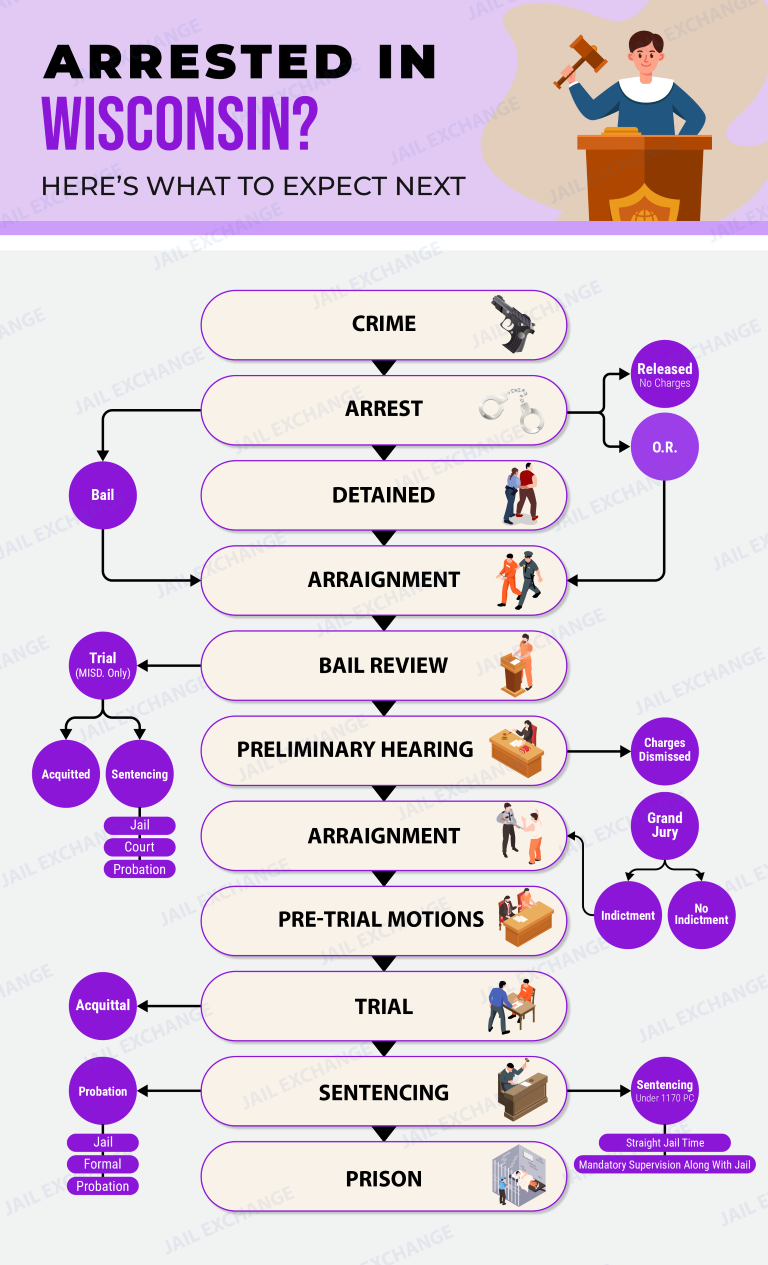
At the first appearance the judge states the charge aloud, and the person receives the complaint in writing. For a felony, a preliminary hearing comes within 10 days if bail over $500 keeps the person locked up, or within 20 days if they are out.
↑ Back to the question list8. Is there free legal help for someone in custody here?
A lawyer is discussed at the first hearing. Anyone who says money is short is referred to the State Public Defender. That agency serves adults facing a misdemeanor or felony who pass its income test. Applying takes around 15 minutes at the office for the county where the case sits.
- Adult cases: Milwaukee Trial Office, 819 N. 6th Street, Room 908, Milwaukee, WI 53203, 414-227-4130
- Youth and mental health cases: 10930 W. Potter Road, Suite D, Wauwatosa, WI 53226, 414-266-1182
When the agency turns someone down, the court may appoint counsel at county expense. Hiring your own attorney is also possible. Details are on the how to apply page.
↑ Back to the question list9. When and how can I visit someone in Milwaukee County custody?
The two sites work differently.
Downtown jail. Family, friends and lawyers can use video visits. Create an account and book a slot on the Sheriff's web page, where a fee list is linked. We found no posted visiting hours, so call 414-226-7070 before you plan. Staff watch and record each visit. Recording one yourself costs the person visits for good. People inside also receive tablets.
Franklin center. Visitors come in person on Saturday or Sunday between 7:00 a.m. and 7:00 p.m. The address is 8885 S. 68th Street, Franklin, WI 53132.
- Book on the scheduling site named by the center, between one week and 24 hours ahead.
- Each visit runs 30 minutes, and arriving late eats into it.
- You may come on only one of the two days. Up to two adults plus two kids may come together.
- Do not bring phones, tablets, strollers, car seats, diaper bags, food, drinks or gum.
- Wear tidy, family-friendly clothes.
A visit can be called off on short notice for health or discipline. See our visiting guide for extra advice.
↑ Back to the question list10. What are my options for funding their jail account?
An account is opened when the person is booked. It buys snacks, hygiene items and calls, and it can pay the person's own bail. The Sheriff's page lists four ways to add money:
- Online at the Access Corrections website, the service the Sheriff names.
- By phone at 866-345-1884, around the clock, with Visa or MasterCard.
- At a kiosk. One stands in the jail lobby, one on G-Level and one in the Franklin center lobby. The jail lobby kiosks never close.
- In cash at a store. Register with CashPayToday to get a barcode, then pay at stores such as Dollar General, Family Dollar, CVS or 7-Eleven.
You may add $300 a day, and a deposit may need a full day to show up. Questions about money go to the Cashier's Office at 414-226-7172. Never send cash in the mail. More tips: money guide and commissary guide.
↑ Back to the question list11. How will we stay in touch by phone, text or email?
Calls go out only. People inside cannot take incoming calls. A family member can load a prepaid call account, and any other call arrives as a collect call. Others may hear or record calls, so keep case details for your lawyer.
We found no confirmed text or email service at either site. Ask Jail Records at 414-226-7070 which tools are on offer, such as tablets. Two more references: our phone page and our email and text page.
↑ Back to the question list12. What goes on the envelope when I write to a Milwaukee County inmate?
Write the address on four lines:
- The person's full name
- Booking number, housing unit and cell number
- 949 N. 9th Street
- Milwaukee, WI 53233
Your own full name and complete address must appear as the return address on every letter. All incoming mail is scanned for contraband before delivery.
- Okay to send: letters, photos no bigger than 4x6 (no Polaroids), cashier's checks and money orders. UPS, FedEx and USPS all work.
- Not okay: greeting cards. The person gets a copy, and the card itself goes into property.
- Reading material: softcover books and magazines that come directly from the publisher or a store.
When a piece is rejected, you get a notice within 3 business days. You have 14 days to appeal in writing. Mail for a person who has already left comes back to you. For the Franklin center, phone 414-427-4700 and ask for its exact mail address first. See our mail guide too.
↑ Back to the question list13. Who may pick up their property, and how?
The jail keeps a person's things until release. A friend or relative who picks them up must be 18 or older, carry valid photo ID, and be named on a Property Release form. The person inside must request that form at least 24 hours early. Only approved items go out. The property room number is 414-226-7171.
The property room never handles cash. Money matters go to the Cashier's Office on the same level as Jail Records. You may also leave weather-ready clothes, such as a coat and boots, for the person to wear on release day.
Before a jury trial, you can drop off suit coats, sweaters, shirts and pants at the visiting desk, 949 N. 9th Street, Milwaukee, WI 53233, with ID. Come no earlier than 48 hours before. Hangers, shoes, belts, ties and socks are turned away, and you get a signed receipt.
↑ Back to the question list14. Who helps if they are ill or injured behind bars?
A contracted health company gives medical, dental and mental health care at the downtown jail. Phone the Sheriff's Inmate Health Services line, 414-226-7134, and have the drug name, dosage and prescriber ready. For an emergency, dial 911.
Under state jail rules, care cannot be refused because a person is broke. Staff must examine each new arrival within two weeks, and every jail needs a complaint process with an appeal. The Franklin center holds a national accreditation for health care. Call its main line, 414-427-4700, with medical worries about someone there.
↑ Back to the question list15. Is there a warrant, and how do I deal with it?
Deputies and local police serve warrants. The Sheriff's Warrants line is 414-278-4713. The Warrants Desk is inside Jail Records on G-Level, 949 N. 9th Street, Milwaukee, WI 53233. Call your town's police too. Type the name into Wisconsin Circuit Court Access, since a missed hearing can show there. Speak with a lawyer, then either surrender at the jail or call the clerk about getting a new date. The Clerk of Circuit Court, Criminal Division, sits in the Safety Building, 821 W. State Street, Room 117, Milwaukee, WI 53233.
↑ Back to the question list16. Where do I find their next hearing in Milwaukee County?
The locator shows a court date and branch for many people. Each office below answers for its own cases:
- Crimes and traffic: Clerk of Circuit Court, Safety Building, 821 W. State Street, Room 117, Milwaukee, WI 53233, 414-278-4538
- Children's cases: Children's Division, 10201 W. Watertown Plank Road, Room 1530, Milwaukee, WI 53226, 414-257-7700
- Civil suits only: Courthouse, 901 N. 9th Street, Room 104, Milwaukee, WI 53233, 414-278-5362. Do not use this number for a crime.
A city or village ticket belongs to a municipal court, and the ticket names it. Our court guide shows the steps of a case.
↑ Back to the question list17. What changes when federal agents made the arrest?
The federal courthouse for this area, in the Milwaukee Division of the Eastern District, is at 517 E. Wisconsin Ave., Room 362, Milwaukee, WI 53202, and the clerk's number is 414-297-3372.
- A judge may hold a detention hearing under 18 U.S.C. 3142 to decide between jail and release until trial.
- The U.S. Marshals Service oversees federal detainees. The downtown jail has an agreement with the U.S. Marshals Service to house federal detainees. The Marshals' office is at 517 E. Wisconsin Ave., Room 711, Milwaukee, WI 53202, 414-297-3707.
- If money is tight, Federal Defender Services provides lawyers at 411 E. Wisconsin Ave., Suite 2310, Milwaukee, WI 53202, 414-221-9900.
- Following sentencing, find the person with the Federal Bureau of Prisons inmate locator.
18. What happens if ICE wants to take the person?
- ICE may use Form I-247A, a detainer, to ask the jail to hold a person up to 48 hours after they would otherwise be released (8 CFR 287.7(d)).
- Ask the Sheriff's Office, 414-278-4700, how it treats detainers. We found no Wisconsin statute about them.
- ICE then collects the person. ICE has used two Wisconsin jails: the Dodge County Jail (Juneau) and, for brief stays, the Sauk County Jail.
- Search the ICE Online Detainee Locator using the person's full name and whatever details the form asks for. When the search shows no match, phone the ICE Chicago Field Office, 101 W. Ida B. Wells Dr., Suite 4000, Chicago, IL 60605, 872-351-3990.
The ICE site in Milwaukee, 310 E. Knapp Street, Milwaukee, WI 53202, 414-792-7198, handles check-ins and holds no one.
↑ Back to the question list19. Can I look up a person who got a prison sentence?
When a judge orders a prison term for a felony, the Department of Corrections spends about 8 to 12 weeks on intake, testing and placement. Next, a placement is made at a prison that fits. The main men's intake site allows no visits for the first three days.
- Use the DOC Inmate and Offender Search with the person's name.
- Our Wisconsin state prisons guide explains visits and mail.
A felony committed on or after Dec. 31, 1999 brings a split sentence: first confinement, then extended supervision at home. These cases do not get parole.
↑ Back to the question list20. Where do children and 17-year-olds go?
Wisconsin law counts age 17 as adulthood for criminal charges, so the adult jail and adult court handle them. The downtown jail runs high school classes for 14- to 17-year-olds held there.
A child younger than 17 goes through county juvenile intake, which decides about secure detention. A youth normally needs an in-person intake interview before detention, with a few narrow exceptions. Kids held in custody see a judge within 24 hours, counted from the close of the day the hold was decided. That clock skips weekend days and legal holidays.
Juvenile court meets at the Vel R. Phillips Youth & Family Justice Center, 10201 W. Watertown Plank Road, Milwaukee, WI 53226. The county's 32-bed secure care center for youth is inside it. To find out where a child is, phone the Children's Division at 414-257-7700. Because children's files are closed to the public, the adult locator will not list them.
↑ Back to the question list21. Who are the police departments and patrol agencies here?
The booking agency is whoever made the arrest. The state estimates 945,292 residents in the county as of Jan. 1, 2025. These are the agencies we found.
City of Milwaukee
- Milwaukee Police Department. Non-emergency 414-933-4444. District lines: District 1 (east of 16th St.) 414-935-7212, District 3 (west of 16th St.) 414-935-7232, District 5 414-935-7252, District 7 414-935-7272. Domestic violence and sexual assault line: 414-286-2997.
North side and lakeshore
- Bayside Police, 9075 N. Regent Road, Bayside, WI 53217, 414-206-3916
- Brown Deer Police, 4800 W. Green Brook Drive, Brown Deer, WI 53223, 414-371-2900
- Fox Point Police, 7300 N. Santa Monica Blvd., Fox Point, WI 53217, 414-351-8911
- Glendale Police, 5909 N. Milwaukee River Parkway, Glendale, WI 53209, 414-228-1753
- Shorewood Police, 4057 N. Wilson Dr., Shorewood, WI 53211, 414-847-2610
- Whitefish Bay Police, 5300 N. Marlborough Dr., Whitefish Bay, WI 53217, 414-351-9900. Shorewood and Whitefish Bay share this dispatch line.
West and southwest
- Wauwatosa Police, 1700 N. 116th Street, Wauwatosa, WI 53226, 414-471-8430
- West Allis: the city's police page lists only City Hall, 7525 W. Greenfield Ave., West Allis, WI 53214, 414-302-2489. Call and ask for the police.
- Greenfield Police, 5300 W. Layton Avenue, Greenfield, WI 53220, 414-761-5300
- Greendale Police, 5911 W. Grange Avenue, Greendale, WI 53129, 414-423-2121
- Hales Corners Police, 5635 S. New Berlin Road, Hales Corners, WI 53130, 414-529-6140
- Franklin Police, 9455 W. Loomis Road, Franklin, WI 53132, 414-425-2522
South
- Oak Creek Police, 301 W. Ryan Road, Oak Creek, WI 53154, 414-766-7640
- Cudahy Police, 5050 S. Lake Drive, Cudahy, WI 53110, 414-769-2260
For South Milwaukee, River Hills, St. Francis and West Milwaukee, ask the Sheriff's general line, listed below, which agency holds the person.
Campus police
- UWM Police, 3351 N. Downer Ave., Milwaukee, WI 53211, 414-229-4627
- Marquette University Police, 749 N. 16th Street, Milwaukee, WI 53233, 414-288-6800
Sheriff and State Patrol
- Sheriff's Office, 821 W. State Street, Room 107, Milwaukee, WI 53233, 414-278-4700. The Patrol Division line is 414-454-4100.
- Wisconsin State Patrol, Waukesha Post, 21115 E. Moreland Blvd., Waukesha, WI 53186, 262-785-4700. This post covers the county.
Milwaukee County bail and bond: the 24-hour window at the Criminal Justice Facility
Adults arrested in Milwaukee County are booked at the Milwaukee County Jail, also called the Criminal Justice Facility, 949 N 9th Street, Milwaukee, WI 53233. The county also runs the Community Reintegration Center, 8885 S 68th Street, Franklin, WI 53132, which holds adult men and women. Bail is paid downtown at all hours.
Use the Milwaukee County Inmate Search to learn where your person is. Our Milwaukee County Inmates in Custody page has recent arrests, charges, warrants, mugshots and property.
The jail records line answers at 414-226-7070. Ask which of the two buildings has the person, and how much bail is. For hearings and next steps, see our Milwaukee County court page.
1. Is my relative downtown at the jail or at the center in Franklin?
New arrests go to the Milwaukee County Jail, also called the Criminal Justice Facility, at 949 N 9th Street, Milwaukee, WI 53233. It is a Sheriff's Office facility. Search Milwaukee County Inmate Search first to see the booking and the bail.
The Community Reintegration Center, the former House of Correction, is at 8885 S 68th Street, Franklin, WI 53132. It holds adult men and women. Its phone is 414-427-4700. The County Executive appoints its superintendent.
↑ Back to the question list2. Where can bail be posted in the middle of the night?
At the Jail Records office on Level G, the ground floor, of the Criminal Justice Facility. Bail can be posted there 24 hours a day, every day.
People held at the Community Reintegration Center or another county facility are also paid for on Level G. You do not drive to Franklin.
↑ Back to the question list3. What payment methods work, and what are the limits?
Under $10,000, a kiosk on Level G takes cash with no fee, or a credit card with fees. At the window, accepted payments are cash, a cashier's check or money order made out to "Milwaukee County Sheriff's Office," and Visa or MasterCard. A card counts as a cash advance, so your card company may add a fee.
Checks and money orders are accepted only during normal banking hours, because staff call the issuing bank to verify them. A check they cannot verify is refused.
↑ Back to the question list4. What do I need to bring?
A valid picture ID is required from everyone paying in person. A card payer's ID must match the name on the card. Have the defendant's full name and, if you can, the booking or case number from Milwaukee County Inmate Search.
For bail of $10,000 or more, federal rules require IRS Form 8300. You can complete it at the window, and you need a valid Social Security number and a picture ID.
↑ Back to the question list5. Why can't I pay bail online?
Every bail form needs a surety's signature, so Milwaukee does not take bail online. A deposit to the person's commissary account works differently. The money lets the inmate self-bail, and then the inmate, not the payer, is the surety and gets any refund.
If you want your name on the bail so you get the refund, pay at the window. Commissary deposits by phone go through 866-345-1884.
↑ Back to the question list6. Can I hire a bondsman in Milwaukee?
No. Wis. Stat. 969.12 allows only an unpaid person living in Wisconsin to act as a surety, and no surety may be paid for it. Commercial bail bonding is not allowed in Wisconsin, in Milwaukee or anywhere else.
Ignore signs and texts that promise to post bail for a fee. Real bail is paid to the Sheriff's Office or the court, and it is refundable.
↑ Back to the question list7. Who sets bail, and how fast?
A judge, or a court commissioner on misdemeanor warrants, sets it at the first appearance. Wisconsin requires that appearance within a reasonable time, and court decisions require a probable-cause finding within 48 hours of an arrest without a warrant.
The Criminal Division is at the Safety Building, 821 W. State Street, Room 117, open weekdays 8 a.m. to 5 p.m. Call 414-278-4538. The Clerk of Circuit Court is at the Courthouse, 901 N 9th Street, Room 104, open to the public 8 a.m. to 4:30 p.m., phone 414-278-5362.
↑ Back to the question list8. What is pretrial services, and can it free my relative?
JusticePoint runs Milwaukee County Pretrial Services around the clock for people booked into the jail who are eligible for bail. It screens risk using the Public Safety Assessment. It prepares release when the court orders supervision, makes court reminder calls, and runs GPS monitoring watched 24 hours a day. The office is in the Safety Building, Room 417, at 414-278-2140.
A judge decides who gets supervision, case by case. Wisconsin courts may not require it for every defendant.
↑ Back to the question list9. Can the judge let the person go with no money?
Yes. A judge can release a person with no bail, or on an unsecured appearance bond, a signed promise to pay if the terms are broken. The judge can add conditions such as staying away from named people or wearing a monitor.
Money bail may be imposed only after a finding that it is needed to make sure the person returns, or, for a violent crime, under the totality of the circumstances.
↑ Back to the question list10. Can Milwaukee set misdemeanor bail above the maximum fine?
A misdemeanor bail cannot exceed the highest fine the law sets for that offense. State schedules cover traffic and misdemeanor matters and change each year.
No statewide price list exists for felonies. The judge weighs ability to pay, the charge, prior record, community ties, and the strength of the evidence.
↑ Back to the question list11. How does a domestic abuse arrest change release in Milwaukee?
An officer must arrest when the law's tests are met. Wis. Stat. 968.075 bars release until bail is posted or the person appears before a judge.
A 72-hour no-contact period follows the arrest. The person must avoid the victim's home and may not contact the victim, even through friends. An intentional violation can mean a $10,000 fine, nine months in jail, or both.
↑ Back to the question list12. Could Milwaukee County refuse bail altogether?
Only in a limited set of serious cases, and only after a hearing. The District Attorney asks under Wis. Stat. 969.035, and the hearing starts within 10 days. The state carries the burden of clear and convincing evidence.
An order can last up to 60 days after the hearing. The defendant can ask for release at any time and is entitled to an expedited trial calendar.
↑ Back to the question list13. What if my son was arrested on a misdemeanor warrant?
Walk-ins on misdemeanor bench warrants are handled at the Criminal Division in the Safety Building, Monday through Friday, afternoons only, first come first served after the scheduled calendar. The person appears before the court commissioner.
Call 414-278-4538 before you go. Bring ID and any papers that name the case.
↑ Back to the question list14. Where is the free lawyer?
The State Public Defender's Milwaukee Trial office is at 819 N 6th Street, Room 908. Call 414-227-4130. Request one when the case is first called.
After 72 hours in jail, a defendant who still cannot meet the release terms may ask the judge to review them, and the judge must give reasons on the record for keeping them.
↑ Back to the question list15. Where do teenagers go if they are held?
The Vel R. Phillips Youth and Family Justice Center, 10201 W. Watertown Plank Road, Wauwatosa, WI 53226, houses Milwaukee County's juvenile detention and Children's Court. The Children's Division line is 414-257-7700.
The State Public Defender's youth and mental health office, at 10930 W. Potter Road, Suite D, Wauwatosa, answers at 414-266-1182. A child's record is private, so the adult search will not list the child.
↑ Back to the question list16. How do I get the bail back?
The Clerk of Circuit Court issues refunds, at 414-278-4538. Expect three to four weeks after the case closes. The refund goes to the person named on the bail form, only if the defendant attended all appearances and committed no new crimes.
Have the case number and the defendant's name ready. If the bail is over $1,000, the clerk mails a notice and an affidavit within three weeks of closure. Unpaid fines and costs can come out of the deposit.
↑ Back to the question list17. What happens to the money if the person misses court?
The judge may forfeit the bail and issue a bench warrant. Notices go to both the defendant and the person who posted. Wis. Stat. 969.13 allows judgment on the deposit if the person does not appear within 30 days.
Skipping court on purpose is also the crime of bail jumping under Wis. Stat. 946.49. A released person must report a new address to the Clerk within 48 hours.
↑ Back to the question list18. Whom do I call for anything the search cannot answer?
The Sheriff's Office is at 821 W. State Street, Room 107, and answers at 414-278-4766. Use it for jail rules and release questions.
Court questions go to the Clerk at 414-278-5362. Do not pay anyone who calls you offering to "fix" the bail.
↑ Back to the question listMilwaukee County bail contacts
- Jail: Milwaukee County Jail (Criminal Justice Facility), 949 N 9th Street, Milwaukee, WI 53233; bail window on Level G, open 24 hours
- Sheriff's Office: 821 W. State Street, Room 107, Milwaukee, WI 53233; 414-278-4766
- Custody lookup: Milwaukee County Inmate Search
- Community Reintegration Center: 8885 S 68th Street, Franklin, WI 53132; 414-427-4700
- Clerk of Circuit Court: Courthouse, 901 N 9th Street, Room 104; 414-278-5362
- Criminal Division and refunds: Safety Building, 821 W. State Street, Room 117; 414-278-4538
- Pretrial Services: Safety Building, Room 417; 414-278-2140
- Public defender: Trial office, 819 N 6th Street, Room 908; 414-227-4130
- Juvenile: Vel R. Phillips Youth and Family Justice Center, 10201 W. Watertown Plank Road, Wauwatosa; 414-257-7700
Hours, fees, and rules at the bail window can change, and a judge may order a different amount. Confirm with the Sheriff's Office or the Clerk of Circuit Court before you pay. This guide does not replace a lawyer's advice.
Where and How Can I Pay Bail in Milwaukee County?

Bail can be paid at the Milwaukee County Jail Cashier’s Office, or Kiosk located on Level G of the Criminal Justice Facility.
Criminal Justice Facility
949 North 9th Street
Milwaukee, WI 53233
- Cash, cashier’s checks, money orders and all major credit cards are accepted.
- A valid form of identification must be presented when paying bail.
- Bank Cashier’s checks and Money orders must be made out to the Milwaukee County Sheriff's Office.
- You can pay bail 24 hours a day.
- You can pay up to $10,000.00 using credit cards at the Kiosk.
- You can pay with cash, cashier's check, money order and Visa or MasterCard credit cards. Persons posting bail with a credit card must have a valid picture ID that matches the name on the card.
- If you pay with a Money order or cashier Check, it needs to be verified by calling the bank, so this can only be done during business hours.
- Bail Refunds take 3-4 weeks and are handled through the Milwaukee County Circuit Court Clerk. Their number is: 414-278-4538. If you do call,you need the Court case number.
- An arrestee can also self-bail. You can do this by putting money in their commissary account. Refer to instructions on how to do this at our Inmate Money page.
Home video visits at Milwaukee County Jail
The Milwaukee County Sheriff directs family and friends to GettingOut (myViaPath) for home video. Check the current slots, booking requirements and price in myViaPath before booking or adding funds. Previously listed home windows were Monday, Wednesday, Thursday and Friday, 7:30 a.m.–2 p.m. and 3–8:30 p.m. Central; confirm what is actually available.
Before traveling to the downtown jail
Call 414-226-7070 to ask whether onsite family visits are currently offered and where to check in. The Criminal Justice Facility is at 949 North 9th Street. Previously listed onsite windows were Sunday, Tuesday and Saturday, 7:30–10:30 a.m., 12:30–5:30 p.m. and 6:45–8:15 p.m. Central. These are historical windows, not a current onsite schedule or confirmation that you can book a visit.
GettingOut / ViaPath Remote Video Visits
Provider: GettingOut (Telmate) • Rebranding as ViaPath Technologies (myViaPath Visits)

GettingOut Video Visitation allows friends and family members to conduct live, face-to-face video visits with incarcerated loved ones using a personal computer, laptop webcam, or the mobile application. Telmate and GTL operate under ViaPath Technologies, and the visiting service is transitioning from GettingOut Visits to myViaPath Visits; users may encounter either brand name depending on whether their county jail has completed the platform update.
Important: Advance Background Clearance Required
Detention centers do not permit unapproved drop-in video visitation. All visitors must submit valid government photo identification and pass administrative screening before an appointment can be booked, a review that can take up to 48 hours depending on facility staffing. You should verify your visitor approval status with the facility in advance. If you do not register ahead of time, you will miss your loved one's scheduled visiting slots for the week.
Step-by-Step Instructions to Schedule a Video Visit
- Open the GettingOut / myViaPath Visits app or go to www.gettingout.com / my.viapath.com.
- Register your profile and upload clear photographs of your government ID and a verification photo.
- Wait for the facility to issue visitor approval (you will receive an email confirmation).
- Select Schedule Visit, pick your detention facility, and select the inmate.
- Choose an available 25- or 30-minute time slot from the calendar and pay the visitation fee using a credit or debit card.
- Sign into the app or website 10 minutes prior to the start time on a device with a functioning camera, microphone, and stable internet connection.
What the Inmate Needs to Do
The inmate receives a schedule alert on their housing unit video kiosk or personal tablet. At the appointed time, they log in with their PIN and sit in front of the terminal. Inmates must follow institutional dress and conduct rules; corrections staff actively monitor sessions and will terminate any call immediately if rules are broken.
Official Providers: GettingOut Visits | myViaPath Visits
Customer Service Telephone: 1-866-516-0115 (GettingOut) • 1-877-650-4249 (ViaPath)
Support Hours: Monday – Friday, 7:00 AM – 11:00 PM CST; Saturday – Sunday, 8:00 AM – 7:00 PM CST
Supported Languages: English and Spanish
Other Services Provided by GettingOut / ViaPath
In addition to Remote Video Visits, GettingOut and ViaPath provide several other communication and financial options:
- Two-Way Text Messaging: Send electronic messages and photos straight to the inmate's screen.
• Learn more on our website: Two-Way Text Messaging Guide | • Visit official vendor page: GettingOut Messaging - Inmate Tablet Rentals & Content: Provide funds for educational modules, music streaming, and news.
• Learn more on our website: Tablet Rentals & Content Guide | • Visit official vendor page: GettingOut Tablets - AdvancePay Phone Calling: Keep a funded prepaid balance to receive calls directly on your phone.
• Learn more on our website: AdvancePay Phone Calling Guide | • Visit official vendor page: ViaPath ConnectNetwork Calling - Inmate Trust Deposits: Transfer money directly into their jail trust account for canteen goods.
• Learn more on our website: Inmate Trust Deposits Guide | • Visit official vendor page: ViaPath Trust Deposits
Milwaukee County Court Guide: Criminal Hearings in Milwaukee Explained
Milwaukee County has a large circuit court with 47 branches, and the courthouse is at 901 N. 9th Street, Milwaukee, WI 53233. Adults are booked at the Milwaukee County Jail, 949 N 9th Street, Milwaukee, WI 53233. Some people waiting for trial are moved to the Community Reintegration Center, 8885 S 68th Street, Franklin, WI 53132.
Look up a person in the Milwaukee County Inmate Search, the Sheriff's list of people held. For arrests, warrants, charges and mugshots, see our Milwaukee County Jail Roster page.
For criminal cases, the Clerk of Circuit Court answers at 414-278-4538. Ask about court dates by full name. If you want to free someone, our Milwaukee County bail page explains the payment window.
1. Local courts in Milwaukee County (circuit court and municipal courts)
Which court hears your case. A local ordinance ticket, or a first-offense OWI (a civil forfeiture in Wisconsin rather than a crime, unless a child under 16 was riding in the vehicle), is heard by the municipal court of the city or village where the stop happened; every municipality in Milwaukee County is served by one, so a first OWI on a City of Milwaukee street goes to the Milwaukee Municipal Court on North James Lovell Street, while one written by a Sheriff's deputy on a freeway or under a county or state citation is filed in the circuit court's traffic division. Misdemeanors and criminal traffic charges, a second OWI among them, go to the Milwaukee County Circuit Court, where a group of branches in the Misdemeanor/Traffic division (under the August 2025 rotation, Branches 5, 13, 31, 38, 41, 43 and 46) handle the calendar after the first hearing. Felonies stay in the circuit court from start to finish: the initial appearance and most preliminary hearings take place in the Safety Building and Criminal Justice Facility, and the case is then assigned to one of roughly 16 felony branches, some of which take only homicide and sexual assault cases, gun cases or drug cases. Judges rotate among divisions on a regular schedule, so the branch number on the court notice is the surest guide to the right courtroom.
Where pretrial inmates are held. Milwaukee County has two adult lockups. The Milwaukee County Jail, inside the Criminal Justice Facility at 949 N. 9th Street, is run by the Sheriff and is where every adult arrested in the county is booked and where most people charged with crimes wait for court. The Community Reintegration Center in Franklin, a separate county department led by a superintendent, mainly houses people serving county sentences of up to a year, including Huber work-release residents, but at the Sheriff's request it also holds some people awaiting trial; its maximum capacity is about 1,766 beds. Cash bail is posted for the person in custody, because Wisconsin bars commercial bail bondsmen. For booking, custody and release questions call the jail at (414) 226-7070, or the Community Reintegration Center at (414) 427-4700 if the person has been moved there.
- Milwaukee County Circuit Court, Milwaukee County Courthouse, 901 N. 9th Street, Milwaukee, WI 53233; Clerk of Circuit Court main office, Room 104, (414) 278-5362
- Clerk of Circuit Court, Criminal and Traffic Divisions, Safety Building, Room 117, 821 W. State Street, Milwaukee, WI 53233, (414) 278-4538
- Clerk of Circuit Court, Children's Division, Vel R. Phillips Juvenile Justice Center, Room 1530, 10201 W. Watertown Plank Road, Milwaukee, WI 53226, (414) 257-7700
- Milwaukee County District Attorney, Safety Building, Room 405, 821 W. State Street, Milwaukee, WI 53233, (414) 278-4646; Children's Court unit, 10201 W. Watertown Plank Road, (414) 257-7725
- Wisconsin State Public Defender, Milwaukee Trial Office, 819 N. 6th Street, Room 908, Milwaukee, WI 53203, (414) 227-4130
- Wisconsin State Public Defender, Milwaukee Youth/Mental Health Office, 10930 W. Potter Road, Suite D, Wauwatosa, WI 53226, (414) 266-1182
- Milwaukee County Sheriff's Office, Safety Building, Room 107, 821 W. State Street, Milwaukee, WI 53233, (414) 278-4700; non-emergency (414) 278-4788
- Milwaukee County Jail, Criminal Justice Facility, 949 N. 9th Street, Milwaukee, WI 53233, (414) 226-7070
- Community Reintegration Center (formerly the House of Correction), 8885 S. 68th Street, Franklin, WI 53132, (414) 427-4700
- Milwaukee County Department of Health and Human Services, Children, Youth and Family Services (juvenile court intake), at the Vel R. Phillips Juvenile Justice Center, 10201 W. Watertown Plank Road, Milwaukee, WI 53226; questions about a pending juvenile case can go to the Children's Division clerk at (414) 257-7700
- Vel R. Phillips Juvenile Justice Center (Milwaukee County's secure juvenile detention center), 10201 W. Watertown Plank Road, Milwaukee, WI 53226
- Milwaukee Police Department, Police Administration Building, 749 W. State Street, Milwaukee, WI 53233, non-emergency (414) 933-4444
- Suburban police departments: each of the other 18 municipalities has its own department, among them West Allis, Wauwatosa, Greenfield, Oak Creek, Franklin, South Milwaukee, Cudahy, St. Francis, Glendale, Brown Deer, Shorewood, Whitefish Bay, Fox Point, Bayside, River Hills, Greendale, Hales Corners and West Milwaukee; the Sheriff patrols the freeways, county parks and the airport
Cases that begin with a police contact in Milwaukee County land in one of two court systems. The Milwaukee County Circuit Court belongs to the statewide court system and hears all crimes plus many traffic forfeitures. The 17 municipal courts are created by local governments and decide only violations of city and village ordinances, which are civil cases that end in a forfeiture (a money penalty) rather than a criminal conviction. A municipal judge has no power to impose jail as a sentence; a stay in custody, or a driver's license suspension, can follow only when a forfeiture goes unpaid. Milwaukee County's circuit court takes jury trial requests and appeals coming out of these local courts, so in some circumstances a defendant can move an ordinance case to the circuit court, but the time limits are short and anyone considering it should read the citation and ask the municipal court clerk before the first court date.
Milwaukee County Circuit Court
- Milwaukee County Courthouse, 901 N. 9th Street, Milwaukee, WI 53233; Clerk of Circuit Court, Room 104, (414) 278-5362
- Criminal and Traffic Divisions, Safety Building, Room 117, 821 W. State Street, Milwaukee, WI 53233, (414) 278-4538 (also the line for refunds of cash bail)
- Children's Division, 10201 W. Watertown Plank Road, Room 1530, Milwaukee, WI 53226, (414) 257-7700
Municipal courts serving Milwaukee County communities
- Milwaukee Municipal Court (City of Milwaukee; three full-time judges), 951 N. James Lovell Street, Milwaukee, WI 53233, (414) 286-3800
- North Shore Municipal Court (joint court for the City of Glendale and the villages of Brown Deer and Bayside), 5909 N. Milwaukee River Parkway, Glendale, WI 53209, (414) 228-1752; some sessions have been held at Brown Deer Village Hall, 4800 W. Green Brook Drive, so check the location printed on the notice
- Cudahy Municipal Court (City of Cudahy), Cudahy City Hall, 5050 S. Lake Drive, Cudahy, WI 53110, (414) 769-2218
- Fox Point Municipal Court (Village of Fox Point), 7200 N. Santa Monica Boulevard, Fox Point, WI 53217, (414) 247-6637
- Franklin Municipal Court (City of Franklin), 9455 W. Loomis Road, Franklin, WI 53132, (414) 425-4768
- Greendale Municipal Court (Village of Greendale), 5911 W. Grange Avenue, Greendale, WI 53129, (414) 423-2127
- Greenfield Municipal Court (City of Greenfield), 5300 W. Layton Avenue, Greenfield, WI 53220, (414) 761-5366
- Hales Corners Municipal Court (Village of Hales Corners), 5635 S. New Berlin Road, Hales Corners, WI 53130, (414) 529-6145
- Oak Creek Municipal Court (City of Oak Creek), 301 W. Ryan Road, Oak Creek, WI 53154, (414) 766-7621
- River Hills Municipal Court (Village of River Hills), 7650 N. Pheasant Lane, River Hills, WI 53217, (414) 247-2302
- St. Francis Municipal Court (City of St. Francis), 3400 E. Howard Avenue, St. Francis, WI 53235, (414) 316-4315
- Shorewood Municipal Court (Village of Shorewood), 3930 N. Murray Avenue, 2nd floor, Shorewood, WI 53211, (414) 847-2617
- South Milwaukee Municipal Court (City of South Milwaukee), 2424 15th Avenue, South Milwaukee, WI 53172, (414) 762-2222, ext. 170
- Wauwatosa Municipal Court (City of Wauwatosa), 7725 W. North Avenue, Wauwatosa, WI 53213, (414) 471-8488
- West Allis Municipal Court (City of West Allis), 11301 W. Lincoln Avenue, West Allis, WI 53227, (414) 302-8181
- West Milwaukee Municipal Court (Village of West Milwaukee), 1345 S. 47th Street, West Milwaukee, WI 53214, (414) 645-5411
- Whitefish Bay Municipal Court (Village of Whitefish Bay), 5300 N. Marlborough Drive, Whitefish Bay, WI 53217, (414) 967-5125
The citation itself names the court, the date and the amount needed to pay it in full without appearing. A person who ignores a municipal citation can be found guilty by default, and an unpaid judgment can lead to a suspended driver's license or a commitment to jail until it is paid. People held on a state charge in the downtown jail who also have open municipal cases may need to contact the municipal court separately, because the two systems keep different records. Anyone held at the Milwaukee County Jail on a state case who cannot afford a lawyer should ask about the State Public Defender, which handles circuit court criminal cases but does not represent people in municipal ordinance cases.
↑ Back to the question list2. The downtown court complex, the Children's Court Center and the 47 branches
Adult criminal court in Milwaukee County happens in three linked downtown buildings. The Milwaukee County Courthouse at 901 N. 9th Street, the large stone building facing MacArthur Square, holds the Clerk of Circuit Court's main office, the jury room and many misdemeanor and felony courtrooms. The Safety Building at 821 W. State Street holds the clerk's Criminal and Traffic Divisions in Room 117, the District Attorney's office, the Sheriff's administration and several felony courtrooms, including those assigned to homicide, sexual assault, gun and drug calendars. The Criminal Justice Facility at 949 N. 9th Street contains the Milwaukee County Jail and a small number of courtrooms, one of them used for the felony mental health calendar.
Juvenile delinquency cases are heard at the Children's Court Center inside the Vel R. Phillips Juvenile Justice Center, on West Watertown Plank Road near the county grounds in Wauwatosa. Eight branches were assigned to the Children's Division in the August 2025 roster, and the same campus houses the juvenile detention center, the District Attorney's Children's Court unit and county intake staff.
The 47 branches are grouped into divisions: felony, misdemeanor and traffic, children's, family and civil. The felony division has the most judges, about 16 in the 2025 roster, with specialty assignments for homicide and sexual assault cases, gun cases (one branch also takes cases from a regional drug-trafficking task force), drug cases and a mental health calendar. Seven branches handle misdemeanors and traffic crimes. Court commissioners, who are lawyers appointed by the judges, handle intake court, set release conditions, take many preliminary hearings and hear warrant returns. Because judges rotate to new divisions periodically, the branch number printed on the notice, not a judge's name, is what to look for on the courthouse directories.
Visitors pass through security screening at each building. Anyone who misses a court date on a misdemeanor can usually return to court in the afternoon on a weekday to see a court commissioner about the warrant; felony warrants are handled through the Sheriff's office in Room G-1 of the Criminal Justice Facility.
↑ Back to the question list3. What happens after an arrest in Milwaukee County (booking, charging and intake court)
Booking. Milwaukee police officers, suburban officers and Sheriff's deputies bring adults they arrest to the Milwaukee County Jail on North 9th Street. Booking includes fingerprints, photographs, a property inventory, a records check for warrants and a medical and mental health screening. Some people arrested on minor matters are cited and released from the scene or the police district station instead, and receive a date to appear in court.
Charging. In Milwaukee County an arrest is not the same as a charge. Police present the case to an assistant district attorney at a charging conference, and the prosecutor decides whether to issue a criminal complaint, what to charge, whether to send the case to an early intervention program, or whether to decline it. A judge or court commissioner must find probable cause for a warrantless arrest within about 48 hours; if no charge is issued, the person is generally released, although charges can still be filed later.
Intake court and release conditions. Once a complaint is filed, the person in custody appears at the initial appearance, which in Milwaukee is held in an intake courtroom staffed by court commissioners, often with the defendant brought from the jail. The commissioner reviews the complaint, explains the charges and the right to a lawyer, and sets release conditions. Milwaukee uses pretrial screening with a risk assessment for most people in custody, and the results are shared with the court. Release can be on a signature bond, which is a promise to return with an amount owed only if the person fails to appear, or on cash bail, along with conditions such as no contact with an alleged victim, no possession of weapons, absolute sobriety, GPS or alcohol monitoring, or reporting to a pretrial supervision program.
Paying cash bail. Wisconsin law does not allow bail bondsmen, so the full cash amount must come from the defendant, family or friends and is posted at the jail or with the clerk. Money left after the case closes is refunded, usually within a few weeks, unless the judge applies it to fines, costs or restitution; questions about refunds go to the Criminal Division clerk at (414) 278-4538. Under a 2023 amendment to the Wisconsin Constitution, a judge setting cash bail for a person accused of a violent crime may consider the risk of serious bodily harm to the community, in addition to the risk that the person will not come back to court.
Domestic abuse arrests. Officers are generally required to arrest when they have probable cause to believe domestic abuse occurred and certain conditions are met. After release, the arrested person must avoid contact with the alleged victim for 72 hours unless the victim signs a waiver, and the release conditions set at intake usually extend a no-contact order for the life of the case.
↑ Back to the question list4. The Milwaukee County Jail and the Community Reintegration Center
The Milwaukee County Jail, sometimes called the Criminal Justice Facility after the building that houses it, is operated by the Milwaukee County Sheriff's Office at 949 N. 9th Street. It holds people who have just been arrested, people waiting for charging decisions and most adults whose criminal cases are pending in the circuit court. Because it is connected to the Safety Building and courthouse, deputies can move people to their hearings without taking them outdoors. For whether someone is in custody, the charge, the bail amount or how to post it, call (414) 226-7070.
The Community Reintegration Center at 8885 S. 68th Street in Franklin was known for decades as the House of Correction. It is run by its own county department under a superintendent, not by the Sheriff. Most residents are serving sentences of up to one year per conviction from the Milwaukee County courts, often with Huber privileges that let them leave for work, school or treatment, and some are on electronic monitoring or GPS at home. The Sheriff can also ask the center to hold people who are awaiting trial, so a person charged in Milwaukee County may be moved there from the downtown jail. Its main number is (414) 427-4700.
Both facilities post rules for visits, money deposits, phone calls and mail. Confirm where the person is housed before traveling, since transfers between the two buildings are common.
↑ Back to the question list5. The State Public Defender's Milwaukee offices
The Wisconsin State Public Defender has two trial offices for Milwaukee County. Adult criminal cases are handled by the Milwaukee Trial Office at 819 N. 6th Street, Room 908, (414) 227-4130. Cases in the Children's Court and mental health commitment cases go to the Milwaukee Youth/Mental Health Office at 10930 W. Potter Road, Suite D, Wauwatosa, (414) 266-1182.
Public defender staff screen many people at the Milwaukee County Jail before or at intake court, so a person in custody can ask for an interview there. People who are out of custody should contact the Milwaukee Trial Office as soon as they receive a summons or are released on bail, ideally before the next court date. The agency applies a strict financial test set by state law, looking at income, assets and household expenses; anyone whose application is approved receives a staff attorney or a private lawyer the agency appoints and pays. A person who earns too much to qualify under that test but still cannot hire a lawyer can ask the judge to appoint one at county expense, and the court decides those requests case by case. Applicants may later be billed for part of the cost of representation.
↑ Back to the question list6. The District Attorney, early intervention and diversion in Milwaukee County
The Milwaukee County District Attorney's Office, the largest prosecutor's office in Wisconsin, works from Room 405 of the Safety Building at 821 W. State Street, (414) 278-4646, with a Children's Court unit at the Watertown Plank Road campus, (414) 257-7725. Assistant district attorneys are organized into teams by type of case, such as homicide, sexual assault, domestic violence, drugs, firearms and general crimes, and they decide what to charge, what release terms to request and what to offer in plea negotiations.
The office has run an early intervention effort for many years that sends some cases away from a standard prosecution. Two main tracks exist:
- Pre-charge diversion is aimed at people who score low risk on a validated screening tool and are not excluded by the type of offense. The person signs an agreement, with a lawyer, and must stay out of trouble and complete any required steps; on success no charge is filed.
- Deferred prosecution agreements apply after a charge, usually for people who score moderate to high risk and need treatment or supervision. The defendant must have counsel and sign the agreement; the case is put on hold, and if the terms are met the charge is dismissed or reduced. The arrest record remains even when the agreement is completed.
Many of these programs are partly paid for through the state's Treatment Alternatives and Diversion grants. Eligibility depends on the charge, criminal history, risk screening and the position of any victim, and the District Attorney's office makes the final offer. A defense lawyer can ask the prosecutor to consider a case for one of these tracks, and anyone held at the Milwaukee County Jail who is offered one should talk it over with counsel before signing, since a failed agreement can lead to a conviction on the original charge. Release conditions, including any bail, are often adjusted when a person enters one of these programs.
↑ Back to the question list7. Milwaukee County treatment courts (drug, veterans, mental health)
Milwaukee County runs several treatment courts in which a judge, prosecutor, defense lawyer, case manager and treatment providers work together with participants over a period of many months. Participation is voluntary, requires agreement from the District Attorney's office, and usually involves frequent court check-ins, drug and alcohol testing, treatment and rewards or sanctions for progress or setbacks.
- Adult Drug Treatment Court, started in 2009, for people at moderate to high risk whose criminal behavior is tied to substance use. People may enter after a plea but before judgment, or as part of a sentence.
- Veterans Treatment Court, started in 2012, for veterans facing nonviolent charges connected to substance use or mental health needs, with volunteer veteran mentors.
- Mental Health Treatment Court, started in 2014, for people with serious and persistent mental illness, which can also serve as an alternative to revocation of probation.
Milwaukee County's published roster of treatment courts does not list a separate OWI court; repeat drunk-driving defendants are usually handled through the regular misdemeanor and felony branches, where judges commonly order assessments, interlock devices and alcohol monitoring, and some are considered for the drug court. A person in custody at the Milwaukee County Jail who wants to be screened should ask a defense lawyer to make a referral, because the coordinator's review usually takes a few weeks and bail or release terms may be adjusted while it happens.
↑ Back to the question list8. Misdemeanor (for example, theft, battery, disorderly conduct, a second OWI)
Misdemeanors charged in Milwaukee County include retail theft from a Southridge or Bayshore store, battery, disorderly conduct (often with a domestic abuse modifier), criminal damage, resisting an officer and a second OWI. Many people arrested for these offenses are released after booking at the Milwaukee County Jail on a signature bond or with a summons, while others stay in custody until they reach intake court, which is usually within a day or two.
Maximum penalties that apply in Milwaukee County misdemeanor court:
- A Class A misdemeanor, such as theft of property worth $2,500 or less, simple battery or criminal trespass to a dwelling, can bring up to 9 months in jail, a fine as high as $10,000, or both.
- A Class B misdemeanor, such as disorderly conduct, carries as much as 90 days and a fine capped at $1,000.
- A Class C misdemeanor is limited to 30 days and a $500 fine.
- A second OWI within 10 years is a crime with a mandatory jail term that ranges from 5 days to 6 months, plus a fine, license revocation, an alcohol and drug assessment and an ignition interlock order. A first OWI, by contrast, is a civil forfeiture of $150 to $300 plus costs, with a 6- to 9-month revocation, unless a child under 16 was in the car. Third offenses are also misdemeanors with longer mandatory jail, and a fourth offense is generally a felony.
How the case moves. After the initial appearance in intake court, the case is assigned to a misdemeanor branch at the courthouse. The next stage is usually a pretrial conference where the prosecutor and defense lawyer discuss a resolution. The defendant can plead guilty or no contest, ask for a bench trial, or demand a jury of 6. A defendant who formally demands a speedy trial is generally entitled to trial within about 60 days in a misdemeanor case, though delays the defense asks for are not counted.
Outcomes. Results range from dismissal or a deferred prosecution agreement to fines, probation supervised by the state Department of Corrections, or jail. A Milwaukee County jail sentence is often served at the Community Reintegration Center in Franklin, frequently with Huber privileges for work or treatment, and some people serve part of it on electronic monitoring if the sheriff or superintendent allows. Most misdemeanor cases are finished in two to six months. A State Public Defender lawyer from the Milwaukee Trial Office, (414) 227-4130, can represent anyone who qualifies.
↑ Back to the question list9. Felony (for example, burglary, felony theft, drug possession with intent to deliver, substantial battery)
Felony arrests in Milwaukee County often involve stolen cars, burglary, illegal firearm possession, drug dealing, fleeing an officer, substantial battery or theft above $2,500. People arrested for these offenses are usually held at the Milwaukee County Jail until a prosecutor issues a complaint and a court commissioner sets cash bail or other release terms in intake court.
Milwaukee County felony sentence limits by class:
- Class C: up to 40 years in prison and a fine of up to $100,000.
- Class D: no more than 25 years and $100,000.
- Class E: up to 15 years and as much as $50,000 (robbery and some aggravated batteries fall here).
- Class F: as long as 12.5 years and $25,000; burglary of a building or dwelling is a Class F felony.
- Class G: up to 10 years and $25,000, which applies to theft of property worth more than $10,000.
- Class H: up to 6 years and $10,000, covering theft between $5,000 and $10,000 and some aggravated batteries.
- Class I: up to 3.5 years and $10,000, which includes substantial battery and theft over $2,500 up to $5,000.
For possession with intent to deliver, the class depends on the drug and the weight; fentanyl, heroin and cocaine cases climb steeply with the amount involved, and dealing near a school, park or public housing can add penalties.
The steps. The District Attorney files a criminal complaint and the defendant has an initial appearance in intake court. A preliminary hearing must be held within 10 days if the person is in custody and cannot post bail, or within 20 days if not; in Milwaukee it is often held before a court commissioner, and the defense frequently waives it, sometimes as part of a negotiation. If the commissioner finds probable cause, or the hearing is waived, the prosecutor files an information and the defendant is arraigned and enters a plea, after which the case goes to an assigned felony branch for pretrial conferences, motions and plea talks. Most cases end with a plea agreement; those that go to trial are decided by a 12-person jury that must agree unanimously. Grand juries are almost never used, though a judge can conduct a John Doe proceeding in rare investigations. A felony speedy trial demand generally requires trial within about 90 days, subject to delays the defense causes.
Sentencing. Wisconsin's truth-in-sentencing law splits a prison term into initial confinement and extended supervision, with no parole for crimes committed after 1999. A judge can find someone eligible for earned release programs such as the Challenge Incarceration Program or the Substance Abuse Program. Probation is common for first felony convictions, often with conditional jail time served locally; terms longer than a year go to a state prison run by the Department of Corrections. A felony in Milwaukee County typically takes six to twelve months to resolve, longer when the defendant is out of custody.
↑ Back to the question list10. Violent felony (for example, homicide, sexual assault, armed robbery)
Milwaukee County assigns homicide and sexual assault prosecutions to a small group of felony branches in the Safety Building, and the District Attorney's office staffs them with specialized prosecutors and victim-witness advocates. People charged with these crimes nearly always remain at the Milwaukee County Jail throughout the case unless they can post a high cash bail; under the 2023 constitutional change, the court may weigh the danger of serious harm to the public when setting that amount for violent charges.
Penalties a Milwaukee County judge can impose for the most serious charges:
- First-degree intentional homicide (Class A): a mandatory life sentence, with the judge deciding whether the defendant can ever petition for release to extended supervision and, if so, after how many years.
- Second-degree intentional homicide and first-degree reckless homicide (each Class B): up to 60 years. First-degree reckless homicide is frequently charged in fatal drug overdose cases, where the person accused of supplying the drug is prosecuted.
- First-degree sexual assault (Class B): up to 60 years; offenses against young children can carry mandatory minimum prison terms.
- Armed robbery, such as a gas station or phone store holdup with a gun (Class C): a prison term as long as 40 years; a robbery committed without a dangerous weapon drops to Class E.
Wisconsin abolished the death penalty in 1853. Federal charges, which are separate, are covered later on this page.
What to expect. The case follows the felony path described above, but with more evidence, more expert witnesses and more pretrial motions, so the time from charge to trial or plea is usually one to two years. Victims have rights under Marsy's Law, the 2020 amendment to the Wisconsin Constitution, including the right to be notified of hearings, to be heard at release and sentencing decisions and to have their privacy respected. Sentences for these crimes are served in state prison, with extended supervision after release. Public defender lawyers from the Milwaukee Trial Office, (414) 227-4130, often handle homicide and sexual assault cases, and the agency also appoints experienced private lawyers when there is a conflict.
↑ Back to the question list11. Juveniles (under 17) arrested in Milwaukee County
Wisconsin's juvenile courts take delinquency cases for children aged 10 through 16. A 17-year-old arrested anywhere in Milwaukee County is treated as an adult: booked into the Milwaukee County Jail, charged by the District Attorney, and taken through intake court like anyone else, with release terms such as bail set the same way.
Intake. When a younger child is taken into custody, the police contact juvenile intake workers with the Milwaukee County Department of Health and Human Services, Children, Youth and Family Services, whose staff work at the Vel R. Phillips Juvenile Justice Center on West Watertown Plank Road. Intake decides whether the youth goes home to a parent, goes to a non-secure placement or shelter, or is held in secure detention at the same campus. Intake can also close a case, arrange an informal agreement called a deferred prosecution agreement, or refer it to the District Attorney's Children's Court unit, which decides whether to file a delinquency petition.
Custody hearing. If a child is kept in detention, a judge or court commissioner must generally hold a custody hearing within 24 hours after the intake decision, not counting weekends and legal holidays, to decide whether continued custody is necessary. The child has a right to a lawyer; the State Public Defender's Milwaukee Youth/Mental Health Office, (414) 266-1182, represents most juveniles regardless of family income.
Court and outcomes. Delinquency cases are heard by the Children's Division branches at the same complex. After a plea hearing and, if contested, a fact-finding hearing decided by a judge rather than a jury, outcomes can include a consent decree, which suspends the case under conditions; supervision at home; community service, restitution and counseling; placement in a foster home, group home or residential center; Type 2 placement under county supervision; or, for serious cases, commitment to the state's Type 1 secure facilities, Lincoln Hills School for boys and Copper Lake School for girls in Irma. Milwaukee County has worked to reduce its use of the state schools and runs a secure residential program for some committed youth on the Watertown Plank Road campus. The Serious Juvenile Offender Program is available for the gravest offenses and can last up to five years. Juvenile records are generally confidential.
Adult court. The District Attorney can ask a judge to waive a case into adult court for a child 14 or older, and for certain very serious offenses for some younger children; the judge considers the child's history, the seriousness of the offense and the services available in the juvenile system. Adult court also has original jurisdiction, without a waiver, when a child aged 10 or older is accused of attempted or first-degree intentional homicide, first-degree reckless homicide or felony murder, and when a juvenile who has already been adjudicated delinquent is accused of certain additional crimes.
↑ Back to the question list12. Federal cases (U.S. District Court) from Milwaukee County
Milwaukee County lies in the Eastern District of Wisconsin, and federal crimes from the county are prosecuted in the district's Milwaukee Division at the U.S. Courthouse, 517 E. Wisconsin Avenue, about a mile east of the county courthouse; the clerk's office is at (414) 297-3372. Milwaukee is the district's headquarters, and the division also takes cases from 11 other southeastern and central Wisconsin counties.
When a case becomes federal. Federal prosecutors in Milwaukee most often charge drug trafficking (frequently fentanyl and cocaine investigations by multi-agency task forces), firearm possession by people with felony convictions or other prohibited persons, carjacking, bank robbery, child exploitation, wire, bank and health care fraud, and violent crime tied to gangs. Many federal gun cases begin as Milwaukee police arrests that are referred for federal review, and the same conduct can sometimes be charged in either court system. Offenses at federal property, such as the Clement J. Zablocki VA Medical Center on West National Avenue, may also be prosecuted federally. The Forest County Potawatomi Community holds trust land in the Menomonee Valley, where its casino operates, but because Wisconsin has Public Law 280 jurisdiction, state courts generally handle crimes committed there.
Who prosecutes and defends. The U.S. Attorney's Office for the Eastern District of Wisconsin is in the same building, 517 E. Wisconsin Avenue, Suite 530, (414) 297-1700. People who cannot pay a lawyer are represented by Federal Defender Services of Wisconsin, whose Milwaukee office is at 411 E. Wisconsin Avenue, Suite 2310, or by a private lawyer from the court's Criminal Justice Act panel when the defender has a conflict. U.S. Probation and Pretrial Services is in Room 001 of the courthouse, (414) 297-1425.
The process. After a federal arrest the defendant sees a U.S. magistrate judge for an initial appearance. When prosecutors seek to keep the defendant locked up, the detention hearing normally follows within three court days. Federal judges in Milwaukee do not set money bail the way state commissioners do; under the Bail Reform Act they either release the person on conditions monitored by Pretrial Services or order detention until trial. A case started by complaint must be followed by a grand jury indictment within 30 days, and the Speedy Trial Act sets a 70-day trial clock that is regularly extended. Most federal defendants plead guilty, often under a written plea agreement; trials use a 12-person jury that must be unanimous. Before sentencing, a probation officer writes a presentence report, and the judge considers the advisory Sentencing Guidelines along with any mandatory minimum, such as those in many drug and firearm statutes. There is no parole in the federal system, and prisoners serve roughly 85 percent of the sentence in the Bureau of Prisons before supervised release. A Milwaukee federal conviction is appealed to the Seventh Circuit, the federal appeals court in Chicago that also hears cases from Illinois and Indiana.
Finding a federal prisoner. To learn where a person charged in the Milwaukee federal courthouse is held or serving time, search the Federal Bureau of Prisons inmate locator by name or BOP register number. A federal defendant awaiting trial in a Wisconsin county jail that houses detainees for the Marshals may be listed on that county's own roster too. Federal charges against juveniles are rare and are usually referred to the state system.
↑ Back to the question listThis Milwaukee County guide is general information, not legal advice, and court assignments, phone numbers and procedures change. For a specific case, speak with a lawyer; to ask about a public defender, call the State Public Defender's Milwaukee Trial Office at (414) 227-4130 (or the Youth/Mental Health Office at (414) 266-1182 for juvenile cases), and for custody questions call the Milwaukee County Jail at (414) 226-7070.

icare (operated by Aramark Correctional Services) is a specialized gift package and commissary program that allows family members to order brand-name snack bundles, confectioneries, hygiene kits, and freshly prepared hot meals sent directly to an incarcerated loved one. Every package is packed to adhere strictly to facility security regulations.
Important: Order Cutoffs and Delivery Windows Vary by Jail
Detention centers do not manage care package deliveries under identical schedules. While some facilities allow weekly orders, others restrict deliveries to bi-weekly or monthly distribution windows, and spending limits vary from jail to jail. You should verify the facility's active cutoff schedule and order allowances by calling them directly. If an order is submitted after the weekly processing deadline, delivery will be held until the following cycle, leaving your loved one waiting an extra cycle for fresh meals or personal snacks.
Step-by-Step Instructions to Place an icare Package Order
- Obtain the inmate's legal first and last name, date of birth, and assigned booking or inmate ID number.
- Visit www.icaregifts.com on your computer or mobile device.
- Select Find a Loved One and choose the state and detention facility.
- Search for the inmate using their ID number or legal last name to unlock the facility-specific catalog.
- Browse available fresh food items, snack packs, candy selections, and hygiene kits, adding items up to the facility's spending cap.
- Proceed to checkout, enter your debit or credit card billing details, and submit your order.
- Save your digital receipt and confirmation tracking number for your records.
What the Inmate Needs to Do
The inmate does not need an internet account to receive care packages. Aramark prepares the shipment in tamper-evident security packaging and delivers it directly to the facility commissary department. Staff inspect the delivery and distribute it during scheduled housing unit delivery rounds, where the inmate signs the delivery manifest.
Official Provider: icare Gifts Official Website
Customer Service Telephone: 1-888-439-5020
Support Hours: Monday – Friday, 8:00 AM – 9:00 PM EST; Saturday – Sunday, 9:00 AM – 5:00 PM EST
Supported Languages: English and Spanish
Other Services Associated with Aramark Corrections
Depending on individual facility agreements, additional trust funding and commissary services may be available:
- Inmate Trust Fund Deposits: Transfer funds directly to an inmate's jail trust account for independent commissary spending.
• Learn more on our website: Inmate Trust Deposits Guide | • Visit official vendor page: icare Inmate Services
Buy Commissary for an Inmate in the Milwaukee County Jail
Milwaukee County Jail Inmate Commissary - Sending Money or Purchasing Commissary for an Inmate
Milwaukee County Jail allows inmates to purchase commissary. This can be snacks, hygiene products, stamps, stationary, clothing and even electronics.
You can buy commissary for an inmate using an online service called icare gifts.

There is a monthly limit of $200-300 on how much inmates can spend on commissary items.
This amount is subject to change so call the facility at 414-226-7070 in order to confirm the amount that cannot be exceeded.
Inmates have access to both an in-house commissary store, and commissary packages that can be purchased and shipped to the inmate by friends and family.
Scroll down for information on the Milwaukee County Jail's service they use for you being able to purchase commissary items online and have them shipped directly to the inmate.
You can also go to our Inmate Money page for information on how to send money to an inmate.

Access Secure Deposits (Smart Deposit) allows families and friends to securely transfer money directly into an incarcerated person's jail trust account using a debit or credit card. Deposited funds become immediately available for your loved one to purchase essential hygiene goods, over-the-counter medication, food items, and writing materials from the facility commissary.
Important: Inmate Banking Policies Vary by Facility
Once a person is booked and moved to a cell, facilities do not always allow cash drop-offs or phone payments directly to the jail. Some might and you should confirm this by calling the facility and asking. But if you do not register online and fund your loved one's trust account immediately, they may be forced to wait days or weeks for standard paper processing, leaving them without essential soap, clean undergarments, basic medical sundries or snacks.
Step-by-Step Instructions to Register and Access Service
- Obtain the inmate's legal first and last name, date of birth, and official six- to ten-digit Booking or Inmate ID number.
- Visit the official Access Corrections portal at www.accesscorrections.com or download the Access Corrections mobile app.
- Select the state and the exact detention facility or county jail where the inmate is currently housed.
- Add the inmate as a contact and confirm their identity from the facility roster.
- Enter your debit or credit card billing information, choose your deposit amount, review the facility processing fee, and submit your payment.
- Save and print your transaction confirmation number for verification.
What the Inmate Needs to Do
The inmate does not need internet access to receive your deposit. Once approved, the funds post directly to their facility account balance. The inmate can verify their balance at the dayroom kiosk or on their trust statement and start ordering items on the next designated commissary day.
Official Provider: Access Corrections / Keefe Group Official Website
Customer Service Telephone: 1-866-345-1884
Support Hours: 24/7/365
Supported Languages: English and Spanish
Other Services Provided by Access Corrections / Keefe Group
In addition to Access Secure Deposits (Trust Money), Access Corrections / Keefe Group provides several other communication, financial, and visitation services at participating correctional facilities:
- Digital Messaging & Photos: Send digital letters and pictures straight to the inmate's kiosk or tablet.
• Learn more on our website: Digital Messaging & Photos Guide | • Visit official vendor page: Access Corrections / Keefe Group Digital Messaging & Photos - Commissary Care Packages: Order pre-approved food boxes, thermal clothes, and snack bundles directly to the jail.
• Learn more on our website: Commissary Care Packages Guide | • Visit official vendor page: Access Corrections / Keefe Group Commissary Care Packages
Deposit Money for an Inmate in the Milwaukee County Jail
Kiosks, a website, a phone line, store counters and the mail all feed the same account at the Milwaukee County Central Jail, inside the Criminal Justice Facility at 949 North 9th Street. Deposits go in seven days a week, and that account covers commissary, self-bail and other costs.
- Round-the-clock kiosks stand in the jail lobby and on G-Level. One more is in the lobby of the Community Reintegration Center in Franklin.
- The web: Access Corrections.
- A phone call to 866-345-1884, day or night, paying with Visa or MasterCard.
- Cash at a store through CashPayToday at Dollar General, Family Dollar, CVS or 7-Eleven.
- The mail: a cashier's check or money order payable to the person or to the Milwaukee County Sheriff's Office, with the person's name and ID number on the memo line. Send it with nothing else to Att: Inmate Deposit, Milwaukee County Central Jail, Criminal Justice Facility, 949 North 9th Street, Milwaukee, WI 53233. Cash and personal checks should never go in the envelope.
No more than $300 can go in per day, and posting may take up to 24 hours. For anything about the account, the Cashier's Office answers at 414-226-7172.
The Milwaukee County Central Jail is the Sheriff's downtown jail inside the Criminal Justice Facility on North 9th Street. Every piece of mail is checked for hidden contraband before it reaches the person, and anything that arrives after someone has been released goes back to the sender.
Letters, photos, publications and money orders:
Inmate's Full Name & booking number, housing unit, cell number
Milwaukee County Jail
949 N. 9th Street
Milwaukee, WI 53233
- First line of the address: The person's full name, then their booking number, housing unit and cell number. All of these show in the in-custody search.
- Your own details: Write your full name and full address, apartment number included. Mail without them is sent back or taken.
- How to ship: Downtown, the jail takes letters and parcels only when they arrive by regular post, UPS or FedEx.
- Photographs: Prints up to 4 x 6 inches are allowed. Polaroids are not.
- No greeting cards: Cards of every kind are banned. If one comes in, the person is handed a copy and the card itself is stored with their belongings.
- Books and magazines: Softcover only, shipped by a publisher, a distributor or another business straight to the person by name. Sources with a record of sending contraband are blocked, and pornographic or weapons-related content is rejected.
- Money orders: Money orders and cashier's checks may be mailed, by themselves in an envelope, made out to the inmate's full name with their booking number on it. If you are unsure, call 414-226-7070 to confirm. Leave cash and personal checks out of the mail, or add funds online.
- If mail is turned away: Both you and the person get a written notice with the reasons within three business days. You can appeal in writing to the Jail Commander within 14 days, and the mail is held while the appeal is open.
Short notes can also be sent as electronic messages.
GettingOut / ViaPath Inmate Phone Calling
Provider: GettingOut (Telmate) • Rebranding as ViaPath Technologies (myViaPath)GettingOut telephone services (operated under Global Tel*Link / Telmate and transitioning to ViaPath Technologies / myViaPath) allow incarcerated individuals to place outbound voice calls from housing-unit telephones and handheld tablets directly to approved family contacts. Funding a prepaid phone balance ensures calls connect to cellular devices and residential lines without carrier collect call blocks.
Important: Cell Carriers Automatically Block Jail Collect Calls
Inmate phone networks do not permit incoming calls, and wireless cell providers do not support traditional collect billing. While some residential landlines might allow direct carrier billing, mobile numbers require a funded prepaid account or inmate PIN debit balance, which you can verify with your phone provider. If you do not register online and add calling funds promptly, your loved one will receive an automated disconnect announcement when dialing your line.
Step-by-Step Instructions to Set Up and Fund Calling
- Visit www.gettingout.com or the updated my.viapath.com portal.
- Register your account using the primary 10-digit telephone number where you want to receive calls.
- Search for the facility and add the inmate using their full legal name or facility booking ID.
- Select Phone Deposits or AdvancePay from your dashboard.
- Select your deposit dollar amount and enter your debit or credit card billing details.
- Authorize payment, save your confirmation receipt, and confirm that your mobile phone allows calls from automated or unknown correctional numbers.
What the Inmate Needs to Do
The inmate approaches any housing-unit telephone or opens the phone application on their handheld tablet, enters their assigned PIN, and dials your 10-digit number. The system verifies that your account has an active prepaid balance and connects the call once you accept the automated prompt. All non-privileged conversations are recorded and monitored by the facility.
Official Providers: GettingOut Website | myViaPath Portal
Customer Service Telephone: 1-866-516-0115 (GettingOut) • 1-877-650-4249 (ViaPath)
Support Hours: Monday – Friday, 7:00 AM – 11:00 PM CST; Saturday – Sunday, 8:00 AM – 7:00 PM CST
Supported Languages: English and Spanish
Other Services Provided by GettingOut / ViaPath
In addition to Phone Calling, GettingOut and ViaPath provide several communication, financial, and visitation services:
- Two-Way Text Messaging: Send digital text messages and photos directly to an inmate's tablet or kiosk.
• Learn more on our website: Digital Messaging Guide | • Visit official vendor page: GettingOut Messaging - Remote Video Visits: Schedule and join live video visits from home using your computer or smartphone.
• Learn more on our website: Video Visitation Guide | • Visit official vendor page: GettingOut Video Visits - Inmate Tablets & Media: Fund tablet entertainment, music streaming, games, and news modules.
• Learn more on our website: Tablet Rentals & Content Guide | • Visit official vendor page: GettingOut Tablets - Inmate Trust & Commissary Deposits: Transfer funds directly into their jail trust ledger for commissary store purchases.
• Learn more on our website: Inmate Trust Deposits Guide | • Visit official vendor page: ViaPath Trust Deposits
GettingOut / ViaPath Inmate Messaging
Provider: GettingOut (Telmate) • Rebranding as ViaPath Technologies (myViaPath)GettingOut (a service of Global Tel*Link / Telmate) provides an instant two-way digital messaging and photo-sharing platform connecting families with incarcerated individuals via housing-unit kiosks and handheld tablets. The provider is actively rebranding as ViaPath Technologies (under the myViaPath platform); depending on the facility contract, local booking sheets and tablets may still refer to the service as GettingOut, GTL, or ViaPath, but both brand portals grant access to the same centralized messaging balance.
Important: Contact Authorization and Digital Mail Rules Vary
Inmate digital messaging rules are not uniform across all county detention centers. While some jails allow immediate two-way messaging upon registration, others require initial contact invitations or administrative ID verification, which you should verify directly with the facility. If you delay setting up an online profile and funding your Friends & Family messaging account, your loved one may face lengthy periods without direct family communication.
Step-by-Step Instructions to Register and Message an Inmate
- Visit www.gettingout.com or the newly branded my.viapath.com portal, or install the GettingOut / myViaPath mobile app.
- Create a user profile using your primary email address and 10-digit mobile phone number.
- Complete identity verification by uploading a clear photo of your government-issued driver's license or state ID and taking a verification selfie if requested.
- Search for the inmate by selecting the state, correctional facility, and their legal name or booking ID.
- Send an outside contact connection request to link your account to their tablet profile.
- Deposit funds into your 'Friends & Family Account' using a debit or credit card to cover message and photo-sharing costs.
- Compose your text message in the chat box, attach approved photos, and submit it for jail screening.
What the Inmate Needs to Do
The inmate powers on their assigned pod tablet or approaches a housing-unit kiosk and logs into the messaging application with their PIN. They accept your incoming contact invitation on the screen. Once approved by institutional monitors, incoming messages appear in their inbox, and the inmate types a reply directly on the screen.
Official Providers: GettingOut Website | myViaPath Portal
Customer Service Telephone: 1-866-516-0115 (GettingOut Support) • 1-877-650-4249 (ViaPath Support)
Support Hours: Monday – Friday, 7:00 AM – 11:00 PM CST; Saturday – Sunday, 8:00 AM – 7:00 PM CST
Supported Languages: English and Spanish
Other Services Provided by GettingOut / ViaPath
In addition to Two-Way Text Messaging, GettingOut and ViaPath provide several other communications and visitation options:
- Remote Video Visits: Schedule and join live web-based video visits from your computer or smartphone.
• Learn more on our website: Video Visitation Guide | • Visit official vendor page: GettingOut Video Visits - Inmate Tablet Rentals & Media: Fund tablet entertainment, music streaming, games, and news modules.
• Learn more on our website: Tablet Rentals & Content Guide | • Visit official vendor page: GettingOut Tablets - AdvancePay Phone Calling: Prepay for telephone calls so your loved one can dial your mobile phone directly.
• Learn more on our website: AdvancePay Phone Calling Guide | • Visit official vendor page: ViaPath ConnectNetwork Calling - Inmate Trust Deposits: Transfer funds directly into their jail trust account for commissary store purchases.
• Learn more on our website: Inmate Trust Deposits Guide | • Visit official vendor page: ViaPath Trust Deposits
GettingOut / ViaPath Inmate Tablets & Media
Provider: GettingOut (Telmate) • Rebranding as ViaPath Technologies (myViaPath)GettingOut provides specialized, secure handheld tablets for county jail inmates, offering access to messaging apps, telephone calling, legal research tools, eBooks, vocational training, and premium entertainment rentals. As part of GTL and Telmate's transition to ViaPath Technologies, tablet firmware and management platforms are moving to the myViaPath system.
Important: Tablet Feature Availability Varies by Facility
Jails manage tablet distribution according to individual facility contracts. While basic educational and legal materials are often provided without cost, access to music streaming, games, podcasts, and premium movies requires an active funded account. You should confirm the tablet rules with the facility directly. Registering and funding their media balance right away ensures your loved one has productive resources and recreation during their stay.
Step-by-Step Instructions to Fund Inmate Tablet Services
- Confirm that GettingOut / ViaPath handheld tablets are active at your loved one's specific detention facility.
- Navigate to www.gettingout.com or my.viapath.com.
- Sign into your verified user profile and link the inmate's legal name and booking ID number.
- Select Make a Deposit and choose either your Friends & Family Account (for messaging) or the inmate's personal Inmate Account (for entertainment and song rentals).
- Choose your deposit amount, review convenience fees, and complete payment with a credit or debit card.
- Notify your loved one that their tablet account balance has been funded.
What the Inmate Needs to Do
The inmate unlocks their assigned tablet or signs one out from the pod charging station using their biometric verification or PIN. Once logged in, their available balance appears on the screen, allowing them to download songs, stream educational content, and communicate with approved family members.
Official Providers: GettingOut Website | myViaPath Portal
Customer Service Telephone: 1-866-516-0115 (GettingOut) • 1-877-650-4249 (ViaPath)
Support Hours: Monday – Friday, 7:00 AM – 11:00 PM CST; Saturday – Sunday, 8:00 AM – 7:00 PM CST
Supported Languages: English and Spanish
Other Services Provided by GettingOut / ViaPath
In addition to Tablet Media & Rentals, GettingOut and ViaPath provide several other communication and account services:
- Two-Way Text Messaging: Send electronic letters and photos straight to the inmate's screen.
• Learn more on our website: Two-Way Text Messaging Guide | • Visit official vendor page: GettingOut Messaging - Remote Video Visits: Meet face-to-face over secure live video from home.
• Learn more on our website: Video Visitation Guide | • Visit official vendor page: GettingOut Video Visits - AdvancePay Phone Calling: Prepay for phone calling credits so your loved one can call your telephone directly.
• Learn more on our website: AdvancePay Phone Calling Guide | • Visit official vendor page: ViaPath ConnectNetwork Calling - Inmate Trust Deposits: Transfer cash directly into an inmate's jail ledger for commissary purchases.
• Learn more on our website: Inmate Trust Deposits Guide | • Visit official vendor page: ViaPath Trust Deposits
Milwaukee County County Jails
Milwaukee County Juvenile Facilities
Nearby counties
- Jail (Main): 414-226-7070
- Arrest Warrants: 414-278-4713
- Inmate Accounts: 414-226-7172
- Inmate Property: 414-226-7171
- Sheriff: 414-278-4700
The Milwaukee County Jail serves the following cities and towns of Milwaukee County: Bayside, Brown Deer, Cudahy, Fox Point, Franklin, Glendale, Greendale, Greenfield, Hales Corners, Milwaukee, Oak Creek, River Hills, Saint Francis, Shorewood, South Milwaukee, Wauwatosa, West Allis, West Milwaukee and Whitefish Bay.