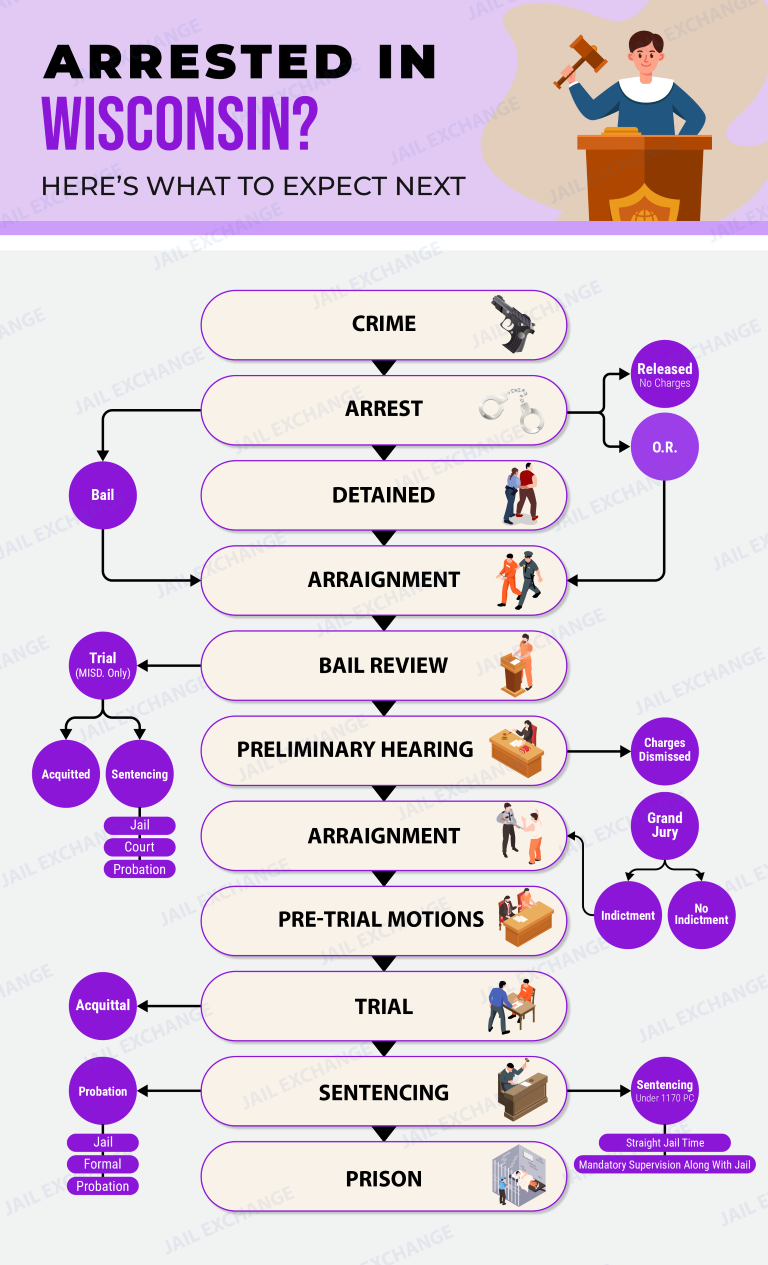
Rhinelander is the county seat of Oneida County, and its courthouse on South Oneida Avenue houses the two-branch Oneida County Circuit Court, which decides every criminal case filed in the county. Wisconsin municipal courts hear only local ordinance tickets, and the state's directory lists none in Oneida County, so most of that work also lands in the circuit court. Charges are brought by the elected Oneida County District Attorney. Adults booked after an arrest anywhere from Minocqua to Three Lakes are held by the Sheriff at the Oneida County Jail on East Winnebago Street in Rhinelander, where cash bail is also accepted.
- Oneida County Circuit Court (Branches 1 and 2), Oneida County Courthouse, 1 South Oneida Avenue, P.O. Box 400, Rhinelander, WI 54501; Clerk of Circuit Court (715) 369-6120
- Oneida County District Attorney, Oneida County Courthouse, 1 South Oneida Avenue, P.O. Box 400, Rhinelander, WI 54501, (715) 369-6133
- Oneida County Sheriff's Office, 2000 East Winnebago Street, Rhinelander, WI 54501, (715) 361-5100
- Oneida County Jail, 2000 East Winnebago Street, Rhinelander, WI 54501, (715) 361-5180
- Wisconsin State Public Defender, Rhinelander office (serves Oneida, Vilas, Forest and Florence counties), 158 South Anderson Street, Suite 1, Rhinelander, WI 54501, (715) 750-2170
- Oneida County Department of Social Services (juvenile intake), Courthouse, 1 South Oneida Avenue, Rhinelander, WI 54501, (715) 362-5695; after hours through the Sheriff at (715) 361-5100
Which court hears your case. An ordinance citation or a first-offense OWI is a civil forfeiture case in Wisconsin, not a crime (the exception is a first OWI with a passenger under 16 in the car). Such a ticket goes to the municipal court of the city, village or town where it was written if that municipality has one; because the state directory shows no municipal court in Oneida County, these cases are generally heard by the Oneida County Circuit Court, but the citation itself names the court. Misdemeanors and criminal traffic charges, including a second OWI, are filed in the circuit court, where both branches share the criminal and traffic calendars along with a court commissioner. Felonies stay in the same court from the initial appearance through the preliminary hearing and any trial.
Where pretrial inmates are held. Deputies, Rhinelander and Minocqua officers, Three Lakes police, the State Patrol and conservation wardens all bring adult arrestees to the Sheriff's jail on Rhinelander's east side, next to the Sheriff's Office. Inmates serving sentences there may be granted Huber release for work or treatment. For custody status, charges or release conditions, call the jail at (715) 361-5180 or the Sheriff's main line at (715) 361-5100.
- Local courts in Oneida County (circuit court and municipal courts)
- Misdemeanor (for example, theft, battery, disorderly conduct, a second OWI)
- Felony (for example, burglary, felony theft, drug possession with intent to deliver, substantial battery)
- Violent felony (for example, homicide, sexual assault, armed robbery)
- Juveniles (under 17) arrested in Oneida County
- Federal cases (U.S. District Court) from Oneida County
Local courts in Oneida County (circuit court and municipal courts)
The Wisconsin court system's municipal court directory (its most recent edition is from 2021) names no municipal court for the city of Rhinelander or for Oneida County's towns, including Minocqua, Woodruff, Hazelhurst, Pelican, Newbold, Crescent and Three Lakes. Ordinance and first-offense OWI citations written in the county are therefore generally answered in the circuit court unless a town has created its own court since then, so check the court named on the ticket. Where municipal courts do exist in Wisconsin, they decide only ordinance cases that carry forfeitures, can jail someone only for failing to pay, and in some situations let a defendant ask to have the case moved to circuit court.
Circuit court
- Oneida County Circuit Court, two branches, Oneida County Courthouse, 1 South Oneida Avenue, P.O. Box 400, Rhinelander, WI 54501. The Clerk of Circuit Court's office, which has deputy clerks assigned to criminal and to traffic files, answers at (715) 369-6120, weekdays 8:00 a.m. to 4:30 p.m.
Tribal court
- Lac du Flambeau Tribal Court (Band headquarters community), Peace Pipe Rd., Lac du Flambeau 54538, (715) 588-4200. Lac du Flambeau Band lands reach into western Oneida County; the tribal court applies the Band's own laws, while state criminal charges still go to the circuit court.
Prosecution and defense
- Oneida County District Attorney, Courthouse, Rhinelander, (715) 369-6133
- State Public Defender (Rhinelander trial office), Suite 1, 158 S. Anderson St., (715) 750-2170
Law enforcement
- Oneida County Sheriff's Office, which operates the Oneida County Jail, 2000 East Winnebago Street, Rhinelander, (715) 361-5100
- Rhinelander Police Department, 201 North Brown Street, Rhinelander, WI 54501, (715) 365-5300
- Minocqua Police Department, 418 East Chicago Avenue, P.O. Box 346, Minocqua, WI 54548, (715) 356-3234
- Three Lakes Police Department, 1795 Erie Street, P.O. Box 5, Three Lakes, WI 54562, (715) 546-2211
- Lac du Flambeau Tribal Police (patrols Band land, including the Oneida County portion), Lac du Flambeau, (715) 588-7717
Juvenile intake
- Oneida County Department of Social Services, Courthouse, 1 South Oneida Avenue, Rhinelander, (715) 362-5695
Misdemeanor (for example, theft, battery, disorderly conduct, a second OWI)
Oneida County's population swells each summer with cabin owners and visitors to the Minocqua chain of lakes, and the misdemeanor docket in Rhinelander follows the season: shoplifting from resort-town stores, bar fights, disorderly conduct and impaired driving or boating.
From arrest to first court date
For many lower-level offenses an officer simply issues a citation or summons and lets the person go. When someone is booked into the Oneida County Jail instead, the jail may release them on a signature bond under a standard schedule; that is a written promise to return, sometimes with a set sum owed if a court date is missed. A cash amount, if ordered, must be paid in full by the defendant or someone on their behalf, because commercial bail bond businesses are not permitted in Wisconsin. A person arrested for domestic abuse cannot contact the alleged victim for 72 hours after release unless the victim waives that in writing. Anyone still held usually goes before a judge or the court commissioner, often by video from the jail, within about 48 hours.
Getting a lawyer
The State Public Defender's Rhinelander office on South Anderson Street screens Oneida County defendants; jail staff can supply an application, or call (715) 750-2170. The SPD's income-and-asset test is strict. A defendant who fails it but genuinely cannot hire a lawyer can ask the circuit judge to appoint one at county expense.
Possible penalties in Oneida County
- Theft of property worth $2,500 or less is a Class A misdemeanor, as is ordinary battery: each carries up to 9 months in jail in Rhinelander and a fine of up to $10,000.
- Disorderly conduct, frequently charged with a domestic abuse modifier, is a Class B misdemeanor with a ceiling of 90 days and $1,000.
- Second OWI within 10 years: a criminal case with mandatory confinement of at least 5 days (up to 6 months), fines, revocation and an ignition interlock. The first offense, by comparison, is a $150 to $300 forfeiture plus costs, a 6- to 9-month revocation, an alcohol or drug assessment, and an interlock when the test showed 0.15 or more or the driver refused.
- A Class C misdemeanor tops out at 30 days and $500.
A six-member jury decides misdemeanor trials. Common results are dismissal, deferred prosecution, a fine, probation, or jail time with Huber privileges. Expect a case to run two to six months; a defendant who files a speedy trial demand is generally entitled to trial within 60 days.
Felony (for example, burglary, felony theft, drug possession with intent to deliver, substantial battery)
Break-ins at seasonal cabins left empty over the winter, methamphetamine and fentanyl delivery, and fourth or later OWI charges (a fourth offense is generally a felony) make up a large share of Oneida County felony filings.
Step by step
- Criminal complaint and initial appearance. The District Attorney files a written complaint. At the first hearing the judge or commissioner confirms there is probable cause, explains the charges and sets release terms, often with cash bail and conditions such as no drinking or no contact. Since a 2023 change to the state constitution, judges may weigh the risk of serious harm to the public when setting conditions for people charged with violent crimes.
- Preliminary hearing. Required within 10 days for a defendant who stays in custody because the cash amount has not been posted, or within 20 days for others. The only question is whether probable cause exists that the defendant committed a felony. In Rhinelander it is often waived, sometimes in exchange for a plea offer.
- Information and arraignment. After bindover the prosecutor files an information, the formal charging document, and the defendant enters a plea in front of the assigned branch.
- Resolution. Plea agreements resolve most cases. If the case is tried, a 12-person jury must agree unanimously, and a speedy trial demand generally requires the trial to start within 90 days.
Maximum penalties for the listed charges
- Burglary of a home, cabin or business: Class F, punishable by up to 12 years 6 months and $25,000.
- Felony theft: Class I when the property is worth more than $2,500 (up to 3.5 years), Class H above $5,000 (6 years) and Class G above $10,000, which can mean a decade in prison.
- Possession with intent to deliver: the felony class rises with the type and weight of drug and can reach Class C.
- Substantial battery: Class I. Injuries amounting to great bodily harm can bring an aggravated battery charge, Class H or Class E.
A Wisconsin prison sentence is bifurcated into a term of initial confinement and a period of extended supervision; there has been no parole for offenses committed after 1999. A sentence of one year or less is served locally, and longer terms go to the Department of Corrections, where eligible inmates may earn early release through the Challenge Incarceration Program or the Substance Abuse Program. Six to twelve months is a typical span for an Oneida County felony. The State Public Defender's Rhinelander office represents qualifying felony defendants throughout.
Violent felony (for example, homicide, sexual assault, armed robbery)
People charged with the most serious offenses in Oneida County usually remain in the Oneida County Jail through the case unless they can post the cash bail set at the initial appearance, which in these cases tends to be high and comes with strict conditions. The Sheriff's Office and the state Division of Criminal Investigation often handle the investigation together.
Penalty ranges
- First-degree intentional homicide (Class A): life in prison is mandatory. At sentencing the judge either sets a date when the person may petition for extended supervision or orders life without that possibility.
- Second-degree intentional homicide, along with first-degree reckless homicide: each Class B, with up to 60 years; reckless homicide is the charge Wisconsin uses in many fatal drug-delivery cases.
- First-degree sexual assault: Class B, up to 60 years, and certain offenses against young children carry mandatory minimum prison terms.
- Armed robbery: Class C, up to 40 years; unarmed robbery is a Class E felony carrying up to 15 years.
A death sentence is not possible: Wisconsin abolished capital punishment in 1853.
What to expect
Forensic testing, expert witnesses and motion hearings commonly stretch these prosecutions to one or two years. Crimes on Lac du Flambeau Band land within Oneida County are tried in this circuit court like any other state case, because Wisconsin holds criminal jurisdiction there under Public Law 280. A defendant who qualifies is represented by the State Public Defender, which often assigns its most experienced lawyers or private counsel to homicide cases. Under Marsy's Law, crime victims have state constitutional rights to be notified, to be present and to be heard; the District Attorney's victim/witness staff can be reached at (715) 369-6133.
Juveniles (under 17) arrested in Oneida County
Under Wisconsin law a 17-year-old charged with a crime goes to adult court. Children aged 10 through 16 come before the Oneida County Circuit Court sitting as the juvenile court, and the juvenile clerk works in the Register in Probate's office at the courthouse.
Intake
Police send juvenile referrals to the Oneida County Department of Social Services at the courthouse, (715) 362-5695; after hours, intake is reached through the Sheriff at (715) 361-5100. The intake worker may close the case, arrange a deferred prosecution agreement, or recommend that the District Attorney file a delinquency petition. If the child is placed in secure custody, a judge or commissioner generally must hold a custody hearing within 24 hours after the intake decision, not counting weekends and legal holidays.
Secure detention
Oneida County has no juvenile detention center of its own. A youth who must be locked up is typically taken to a center in another county under contract, such as the Marathon County Juvenile Detention Center in Wausau; intake staff will tell the family where the child is.
Possible outcomes
- Deferred prosecution or a consent decree, which pause the case while the youth follows conditions.
- Supervision at home with counseling, restitution, community service, school attendance or electronic monitoring.
- Out-of-home placement in foster care, a group home or a residential treatment center, or Type 2 placement.
- Type 1 placement in a state juvenile correctional facility, Lincoln Hills School for boys or Copper Lake School for girls, both near Irma.
- The Serious Juvenile Offender program for the gravest offenses.
When a youth is tried as an adult
Prosecutors may petition to waive juvenile jurisdiction for a youth 14 or older accused of certain offenses, and in limited cases for younger children. Adult court has original jurisdiction, as a rule, over a child 10 or older accused of attempted or completed first-degree intentional homicide, first-degree reckless homicide or felony murder, and over some youths with a prior delinquency adjudication who are accused of specified new crimes. The State Public Defender's Rhinelander office represents children in juvenile delinquency matters. Juvenile court records are generally confidential.
Federal cases (U.S. District Court) from Oneida County
Oneida County is in the Western District of Wisconsin. Federal charges from Rhinelander, Minocqua or anywhere else in the county are filed with the district's only clerk's office, in Madison, and the hearings take place there, roughly 200 miles south.
- Clerk of the U.S. District Court for the Western District of Wisconsin, Madison courthouse at 120 North Henry Street (Room 320), (608) 264-5156
- United States Attorney for the Western District, the office that would prosecute an Oneida County federal case, Suite 700 at 222 West Washington Avenue in Madison, (608) 264-5158
- Federal Defender Services of Wisconsin, Madison staff office on the tenth floor (Suite 1000) of 22 East Mifflin Street, (608) 260-9900; conflict cases are assigned to private Criminal Justice Act panel attorneys
- U.S. Pretrial Services and Probation, Suite 340 in the same West Washington Avenue building (number 222), (608) 264-5165
Which Oneida County cases become federal
Most arrests in the county stay in state court with the State Public Defender handling indigent defense. The federal prosecutors in Madison generally take Oneida County matters involving interstate drug distribution, guns possessed by people barred from having them, bank robbery, online child exploitation and large fraud schemes. Parts of the county fall within the Nicolet side of the Chequamegon-Nicolet National Forest, and offenses on that federal land may be prosecuted federally, although state charges are often possible as well. Lac du Flambeau Band land in the western part of the county is under Wisconsin's Public Law 280 criminal jurisdiction, so crimes there are usually charged in state court, with the tribal court handling tribal-law matters; the Menominee Reservation, far to the southeast, is the only place in Wisconsin where federal courts take that role.
The federal process
After an arrest or indictment, the defendant first sees a U.S. magistrate judge, who appoints counsel when needed. Federal court does not use cash bail the way state court does: under the Bail Reform Act the judge either releases the person on conditions supervised by Pretrial Services or orders detention, and a detention hearing usually takes place within three court days of the government's request. A grand jury indictment must follow within 30 days of an arrest on a complaint. The Speedy Trial Act sets a 70-day trial clock, though continuances are common.
Guilty pleas resolve most federal cases; any trial goes to 12 jurors, who must all agree. Sentencing comes after a probation officer writes a presentence report; the Oneida County defendant's range is then set using the advisory Sentencing Guidelines and any required minimum term. There is no federal parole, so prisoners serve roughly 85 percent of their sentence in the Bureau of Prisons before beginning supervised release. A conviction can be appealed to the Seventh Circuit, which sits in Chicago and covers Wisconsin, Illinois and Indiana.
Locating a federal defendant
Look the person up by name or register number with the Federal Bureau of Prisons inmate locator. A defendant awaiting federal trial in a county jail under a Marshals Service contract may also be listed on that jail's inmate roster. Federal prosecution of juveniles is rare.
This guide gives general information about criminal cases in Oneida County, Wisconsin, and is not legal advice; procedures, staff and phone numbers change. For help with a specific case, talk with a Wisconsin criminal defense lawyer. To apply for a public defender, call the State Public Defender's Rhinelander office at (715) 750-2170; to ask whether someone is in custody, call the Sheriff's jail staff at (715) 361-5180.