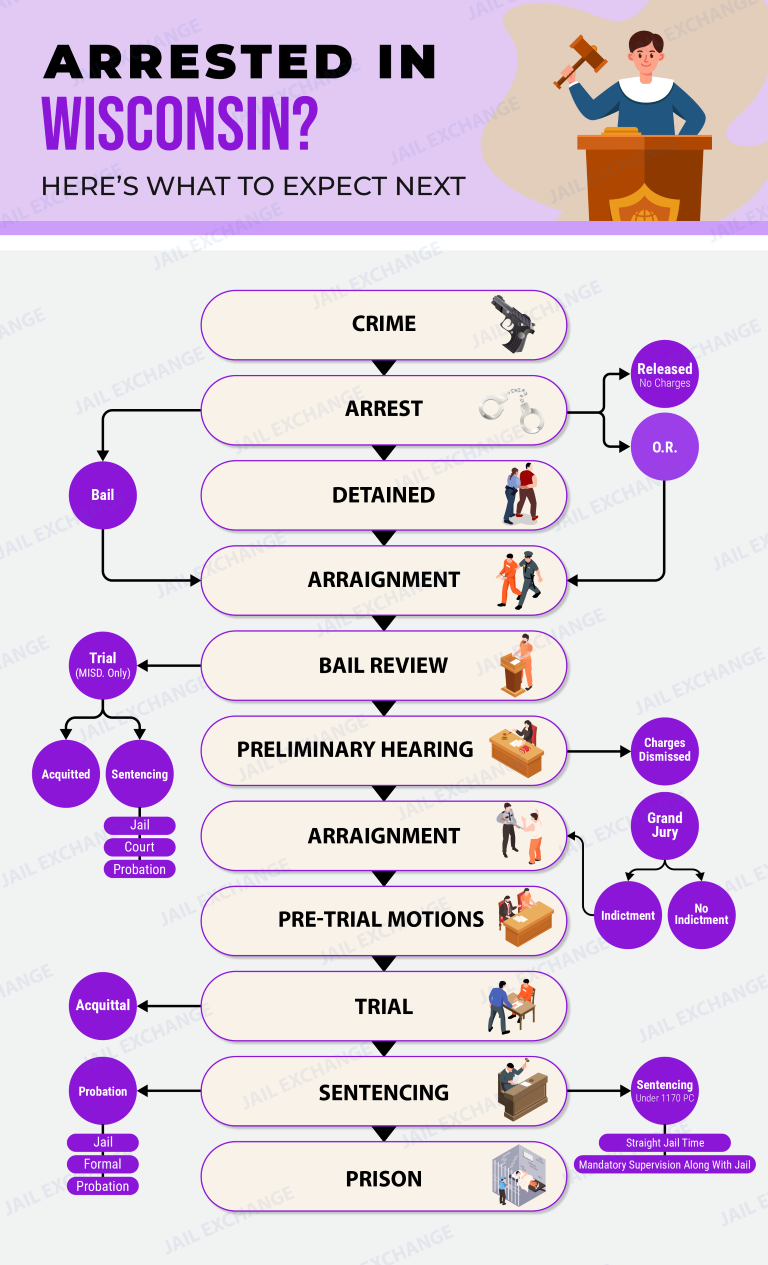
Rock County Youth Services Center Criminal Court Process
Criminal Court Process for Rock County Wisconsin
Rock County sits on the Illinois line along Interstates 90 and 39, and its county seat is Janesville; Beloit is the other large city. Criminal charges are heard by the Rock County Circuit Court, a seven-branch court in the Rock County Courthouse in downtown Janesville, while a group of city, village and town municipal courts handle local ordinance tickets. The elected Rock County District Attorney prosecutes state charges. Adults who are arrested and not released are booked into the Rock County Jail, run by the Rock County Sheriff's Office on U.S. Highway 14 on Janesville's east side.
- Rock County Circuit Court and Clerk of Circuit Court, Rock County Courthouse, 51 South Main Street, Janesville, WI 53545; Clerk (criminal and traffic) (608) 743-2200
- Rock County District Attorney, Rock County Courthouse, 51 South Main Street, Janesville, WI 53545, (608) 757-5615
- Rock County Sheriff's Office, 200 East U.S. Highway 14, Janesville, WI 53545, (608) 757-8000
- Rock County Jail, 200 East U.S. Highway 14, Janesville, WI 53545, (608) 757-8000; jail records (608) 757-7958
- Wisconsin State Public Defender, Janesville office (serves Rock County), 101 East Milwaukee Street, Suite 503, Janesville, WI 53545, (608) 758-6170
- Rock County Pretrial Services (operated by JusticePoint), 1717 Center Avenue, Suite 150, Janesville, WI 53546, (608) 741-3400
- Rock County Human Services Department (youth justice intake), 1717 Center Avenue, Janesville, WI 53546, (608) 757-5200
- Rock County Juvenile Detention Center, 210 East U.S. Highway 14, Janesville, WI 53545
Which court hears your case. Ordinance violations and a first-offense OWI, which Wisconsin treats as a civil forfeiture rather than a crime unless a child under 16 was in the vehicle, go to the municipal court of the city, village or town where the stop happened if that community has one; Beloit, Milton, Edgerton, Evansville, Clinton, Footville, Orfordville and the Town of Turtle all run such courts. Janesville does not appear in the state's municipal court directory, so its ordinance citations, like those from other communities without a court, are heard in the circuit court. Misdemeanors and criminal traffic charges, such as a second OWI or driving after revocation, belong to the Rock County Circuit Court, where several of the seven branches are assigned to a criminal division. A felony also starts and ends in the circuit court: initial appearance, preliminary hearing, arraignment, and plea or trial all take place at 51 South Main Street.
Where pretrial inmates are held. Every law enforcement agency in Rock County, from the Janesville and Beloit police to the State Patrol on the interstates, brings adults who will be held to the Rock County Jail at 200 East U.S. Highway 14, Janesville. People charged in Rock County stay there until they post bail or their case ends; anyone sentenced to less than a year usually serves the time there as well, often with Huber work-release or electronic monitoring. To check whether someone is in custody, call the Sheriff's Office at (608) 757-8000.
- Local courts in Rock County (circuit court and municipal courts)
- The Rock County Courthouse and its seven branches
- What happens after an arrest in Rock County (booking, initial appearance and release)
- The Rock County Jail on Highway 14
- Public defenders and appointed lawyers in Rock County
- The District Attorney, diversion and deferred prosecution in Rock County
- Treatment courts in Rock County (drug, OWI and veterans)
- Misdemeanor (for example, theft, battery, disorderly conduct, a second OWI)
- Felony (for example, burglary, felony theft, drug possession with intent to deliver, substantial battery)
- Violent felony (for example, homicide, sexual assault, armed robbery)
- Juveniles (under 17) arrested in Rock County
- Federal cases (U.S. District Court) from Rock County
1. Local courts in Rock County (circuit court and municipal courts)
Two kinds of courts touch criminal and quasi-criminal matters in Rock County. The circuit court is the state trial court for the whole county. Municipal courts are run by individual communities, sometimes jointly, and decide only violations of local ordinances, which are punished by forfeitures (money penalties) rather than jail. A municipal judge can order jail only as a way of enforcing an unpaid forfeiture in limited situations. In some instances a defendant can ask to have a municipal case moved to the circuit court, for example by requesting a jury; the rules and deadlines are technical, so check with the court or a lawyer promptly.
Circuit court
- Rock County Circuit Court (Branches 1 through 7), Rock County Courthouse, 51 South Main Street, Janesville, WI 53545. Clerk of Circuit Court, second floor, (608) 743-2200 for criminal, traffic and general questions.
Municipal courts serving Rock County communities
- Beloit Municipal Court (City of Beloit), 100 State Street, Beloit, WI 53511, (608) 364-6613
- Clinton Municipal Court (Village of Clinton), P.O. Box 129, Clinton, WI 53525, (608) 676-5304
- Edgerton Joint Municipal Court (City of Edgerton and the Towns of Albion and Fulton), 12 Albion Street, Edgerton, WI 53534, (608) 884-2671
- Evansville-Union Municipal Court (City of Evansville and Town of Union), P.O. Box 529, Evansville, WI 53536, (608) 490-0544
- Footville Municipal Court (Village of Footville), P.O. Box 445, Footville, WI 53537, (608) 876-6005
- Milton City Municipal Court (City of Milton), 690 South Janesville Street, Milton, WI 53563, (608) 868-6910
- Milton Joint Municipal Court (Towns of Milton, Harmony and Lima), 23 First Street, Milton, WI 53563, (608) 868-6656
- Orfordville Municipal Court (Village of Orfordville), P.O. Box 409, Orfordville, WI 53576, (608) 879-9212
- Turtle Municipal Court (Town of Turtle), 6016 County Trunk J, Beloit, WI 53511, (608) 362-0655
- Brodhead Municipal Court (City of Brodhead, which lies mostly in Green County but extends into Rock County), P.O. Box 168, Brodhead, WI 53520, (608) 897-4176
Janesville, the Town of Beloit and the remaining towns are not listed in the state's municipal court directory, so ordinance citations written there are filed in the Rock County Circuit Court.
Prosecution, defense and juvenile intake
- Rock County District Attorney, 51 South Main Street, Janesville, WI 53545, (608) 757-5615
- State Public Defender, Janesville office, 101 East Milwaukee Street, Suite 503, Janesville, WI 53545, (608) 758-6170
- Rock County Human Services, Youth Justice, 1717 Center Avenue, Janesville, WI 53546; northern Rock County supervisor (608) 757-5913, southern Rock County supervisor (608) 363-6226
Law enforcement
- Rock County Sheriff's Office, 200 East U.S. Highway 14, Janesville, WI 53545, (608) 757-8000
- Janesville Police Department, Police Services Building, 100 North Jackson Street, Janesville, WI 53548, (608) 755-3100
- Beloit Police Department, 100 State Street, Beloit, WI 53511
- Town of Beloit Police Department, 1133 East Inman Parkway, Beloit, WI 53511, (608) 364-2984
- Police departments in Milton, Edgerton, Evansville, Clinton and Orfordville patrol their own communities; the Sheriff covers the towns.
- Rock County's 911 Communications Center takes non-emergency calls for agencies across the county at (608) 757-2244.
People held at the Rock County Jail on a circuit court charge deal with the clerk in Janesville, not a municipal court, when they post bail or ask about a court date.
2. The Rock County Courthouse and its seven branches
The Rock County Courthouse at 51 South Main Street, on the Rock River in downtown Janesville, holds the courtrooms for all seven circuit court branches along with the Clerk of Circuit Court, the District Attorney and the court commissioners. Rock County belongs to the state's Fifth Judicial Administrative District, which also includes Dane, Green and Lafayette counties.
How the work is divided
Rock County's judges are grouped into criminal, civil and juvenile divisions, and assignments rotate from time to time, so the branch number on a summons is the best guide to which courtroom to find. Court commissioners, who are appointed judicial officers, commonly conduct initial appearances, set release conditions and handle some preliminary hearings, leaving trials, plea hearings and sentencings to the elected judges. Most courtrooms are on the second through fourth floors; the clerk's office on the second floor accepts filings and payments.
Practical points
- Expect a security screening at the entrance and allow extra time to clear it before a scheduled hearing.
- Court dates, branch assignments and case histories can be checked by calling the clerk at (608) 743-2200.
- People in custody appear from the Rock County Jail in person or by video, depending on the hearing.
- Cash bail on a circuit court case can generally be posted with the clerk during business hours as well as at the jail.
Appeals from Rock County go to District IV of the Wisconsin Court of Appeals in Madison and, if review is granted, to the Wisconsin Supreme Court.
3. What happens after an arrest in Rock County (booking, initial appearance and release)
Booking
After an arrest anywhere in the county, the officer either issues a citation and releases the person or transports them to the Rock County Jail in Janesville. Booking there means photographs, fingerprints, a property inventory, medical and mental-health screening, and a records check for warrants. Many people facing lower-level misdemeanors are released after booking on a signature bond, a written promise to appear that may carry a dollar amount owed only if the person misses court.
Initial appearance
Someone who stays in custody is brought before a judge or court commissioner for an initial appearance, usually within about 48 hours of a warrantless arrest and often by video from the jail. The court reads the charge from the criminal complaint the District Attorney has filed, explains the right to a lawyer, and decides the conditions of release. Pretrial Services staff from JusticePoint may screen defendants at the jail beforehand, and the court can order pretrial supervision as a condition of release.
Release conditions
- Signature bond: release on a promise, sometimes with a set amount owed if the person fails to appear.
- Cash bail: a set amount that must be paid in full by the defendant or someone on their behalf. Wisconsin does not permit commercial bail bondsmen, so there is no bail-agent fee; the money is returned at the end of the case, minus anything the court applies to fines, costs or restitution.
- Conditions: no contact with an alleged victim, no alcohol or drugs, no new crimes, reporting to Pretrial Services, or electronic monitoring.
A 2023 change to the Wisconsin Constitution allows judges, when someone is charged with a violent crime, to consider the risk of serious bodily harm to the public in deciding conditions and the amount of cash. After a domestic abuse arrest, Wisconsin law usually requires the person to stay away from the alleged victim's residence and avoid contact for 72 hours unless the victim waives it in writing.
Crossing the state line
Beloit sits directly on the Illinois border opposite South Beloit. A person arrested in Illinois on a Rock County warrant is held there and must either waive extradition or go through an extradition hearing before being brought back to Janesville.
4. The Rock County Jail on Highway 14
The Rock County Jail stands at 200 East U.S. Highway 14 in Janesville, next to the Sheriff's Office headquarters and the county's juvenile detention center. It is the only county jail in Rock County, and it holds people awaiting trial on state charges, people serving county jail sentences, and people held on probation holds and warrants from other places.
Contacts
- Sheriff's Office and jail operations (24 hours): (608) 757-8000
- Inmate and jail records (weekdays): (608) 757-7958
Posting money and sentenced inmates
Cash bail set by the court can be posted at the jail; ask the jail which forms of payment it accepts and whether a fee applies before you go. Sentenced inmates with Huber privileges may leave the jail for work, school or treatment. The Sheriff's Community Programs Bureau runs an electronic monitoring program that lets some Huber-eligible inmates serve their sentence at an approved Rock County residence, and RECAP, a five-month in-custody alcohol and drug treatment program for people sentenced by the courts or referred by probation agents as an alternative to revocation.
5. Public defenders and appointed lawyers in Rock County
Indigent defense in Rock County is provided by the Wisconsin State Public Defender (SPD) Janesville office, 101 East Milwaukee Street, Suite 503, Janesville, WI 53545, (608) 758-6170. Staff attorneys handle many cases and private lawyers who accept SPD appointments handle the rest.
How to apply
- Ask for the public defender at the jail; SPD staff can take applications from people held at the Rock County Jail.
- If you are out of custody, call or visit the Janesville office as soon as you are charged, ideally before your first court date.
- Bring proof of income, assets and household expenses. Wisconsin's financial eligibility test is strict, and money posted as bail can count as an available asset.
Someone who does not qualify under the SPD test but still cannot afford a lawyer can ask the judge to appoint counsel at county expense; whether that happens depends on the court's own review of the person's finances. Municipal court cases do not carry a right to an appointed lawyer, because they cannot lead to a criminal conviction.
6. The District Attorney, diversion and deferred prosecution in Rock County
The Rock County District Attorney's Office, in the courthouse at 51 South Main Street ((608) 757-5615), reviews referrals from police agencies and decides whether to file a criminal complaint. The office cannot charge a case until a police agency refers it, and once a person is charged, the office talks with that person's lawyer rather than the defendant directly. Victims are notified when charges are filed or declined.
Alternatives to a conviction
The office runs three programs from the courthouse's fourth floor (Floor 4R), reachable at (608) 757-5677:
- Diversion: for some people charged with crimes or county ordinance violations who meet the program's criteria. Participants attend an education session and pay any restitution ordered; the charge is then dismissed.
- Domestic Violence Intervention Program (DVIP): for some people charged with domestic violence offenses who accept responsibility and receive an offer from the assistant district attorney. Completing group sessions leads to a reduced or amended charge.
- Deferred Prosecution Program (DPP): for people assessed as low to medium risk who do not fit diversion. The defendant signs a written agreement and enters a plea, but the judgment of conviction is held off; finishing the program brings a dismissal, while failing it sends the case back to court for sentencing.
Pretrial Services at (608) 741-3400 conducts the risk and substance-use screening for these programs, including for defendants still at the Rock County Jail after their initial appearance. A person released on bail who is offered one of these programs should talk it over with a lawyer before signing anything, because some agreements require a guilty plea up front.
7. Treatment courts in Rock County (drug, OWI and veterans)
Rock County operates several treatment courts that pair close judicial supervision with substance-use or mental-health treatment, in place of or alongside a standard sentence:
- Drug Treatment Court, for defendants whose offenses are driven by addiction.
- OWI Treatment Court, for repeat impaired drivers, often people facing a third or later OWI.
- Veterans Treatment Court, for military veterans whose charges are tied to service-related problems such as substance use or post-traumatic stress, usually with volunteer veteran mentors.
- Family Recovery Court, a related program for parents in child welfare cases rather than criminal cases.
Participants appear before the treatment court judge regularly, submit to frequent testing, attend treatment and earn incentives or sanctions, which can include short stays at the Rock County Jail. Entry usually follows a referral from the defense lawyer, prosecutor, judge or a probation agent, followed by an eligibility screening; eligibility rules differ by program and often exclude violent offenses. Admission can be a condition of bond, part of a deferred agreement, or part of a probation sentence, and successful graduates may see charges reduced or jail time stayed. The Sheriff's Community Programs Bureau and the circuit court coordinate these programs; ask the public defender or the clerk at (608) 743-2200 how to request a screening.
8. Misdemeanor (for example, theft, battery, disorderly conduct, a second OWI)
Shoplifting at the big-box stores along Milton Avenue and in Beloit, domestic disturbances, bar fights and repeat OWI stops on the interstates make up much of the misdemeanor docket in Rock County. These cases are prosecuted by the District Attorney in the Rock County Circuit Court.
From arrest to the first court date
Many people are cited and released or freed from the Rock County Jail on a signature bond with a court date. A person held in custody sees a court commissioner or judge, usually by video, who sets release conditions. At the first appearance the defendant can enter a plea of not guilty, guilty or no contest, and should ask about the State Public Defender (Janesville office, (608) 758-6170) if jail is possible and they cannot pay a lawyer.
Penalties under Wisconsin law, as applied in Janesville courtrooms
- Class A misdemeanor (up to 9 months in jail and/or a $10,000 fine): theft of property worth $2,500 or less, battery, criminal damage to property, criminal trespass to a dwelling.
- Class B misdemeanor (up to 90 days and/or $1,000): disorderly conduct, which Rock County prosecutors often charge with a domestic abuse modifier that brings a mandatory assessment and surcharge.
- Class C misdemeanor (up to 30 days and/or $500): a small group of minor offenses.
- Second OWI within 10 years: a criminal misdemeanor with mandatory jail of 5 days to 6 months, a fine, license revocation, an alcohol and drug assessment and an ignition interlock order. A first OWI is a civil forfeiture ($150 to $300 plus costs, 6 to 9 months of revocation, an assessment, and an interlock at a 0.15 or higher test or a refusal) heard in a municipal court or the circuit court, unless a child under 16 was a passenger, which makes it a crime.
How cases end
Many Rock County misdemeanors are resolved through diversion, deferred prosecution or a plea to a reduced charge. Anyone who insists on a trial in a Rock County misdemeanor is entitled to have six jurors decide it. Sentences range from fines and costs to probation or county jail, which is often served with Huber work release or electronic monitoring. A speedy trial demand generally requires trial within 60 days for a misdemeanor, but most people do not make one. Expect two to six months from charge to resolution.
9. Felony (for example, burglary, felony theft, drug possession with intent to deliver, substantial battery)
Rock County's location on the I-90/I-39 corridor between Chicago, Rockford and Madison brings a steady stream of drug-delivery cases, along with burglaries, vehicle thefts and serious batteries in Janesville and Beloit. Every felony stays in the Rock County Circuit Court from start to finish.
Step by step
- Complaint and initial appearance. The District Attorney files a criminal complaint. At the initial appearance, often by video from the Rock County Jail, a court commissioner or judge reviews the complaint and sets bail and conditions.
- Preliminary hearing. A judge or commissioner decides whether there is probable cause to believe a felony was committed. It must be held within 10 days if the defendant is in custody on cash the defendant cannot pay, or within 20 days otherwise. Defendants frequently waive it, sometimes as part of plea talks.
- Information and arraignment. The District Attorney files an information, the formal charging document, and the defendant enters a plea at the arraignment before an assigned criminal-division judge.
- Motions and plea talks. Discovery, suppression motions and negotiations follow. Most felonies end with a plea agreement.
- Trial. Twelve jurors hear a felony trial in Janesville, and their verdict must be unanimous. Once a Rock County defendant files a speedy trial demand, the trial generally must begin within 90 days.
- Sentencing. The judge may order a presentence investigation by the Department of Corrections before sentencing.
Maximum terms for the example charges
- Burglary: a Class F felony, so a Rock County judge can impose as much as 12½ years and a $25,000 fine.
- Theft over $2,500: Class I (up to 3 years 6 months) for $2,500 to $5,000, Class H (up to 6 years) for $5,000 to $10,000, and Class G (up to 10 years) or higher for larger amounts.
- Possession with intent to deliver: the class depends on the drug and the weight; fentanyl, heroin, cocaine and methamphetamine cases can reach Class C (up to 40 years) at high amounts.
- Substantial battery: Class I. Aggravated battery: Class H, or Class E (up to 15 years) when great bodily harm was intended.
Wisconsin's truth-in-sentencing law splits a prison term into initial confinement and extended supervision, with no parole for crimes committed after 1999; some inmates qualify for the Challenge Incarceration Program or the Substance Abuse Program, which can shorten confinement. Terms under a year are served in county jail; longer ones go to the Department of Corrections. Most Rock County felony cases take six months to a year. Ask the State Public Defender's Janesville office about representation at the first hearing.
10. Violent felony (for example, homicide, sexual assault, armed robbery)
Homicides, shootings, armed robberies and sexual assaults in Rock County are investigated by the Janesville or Beloit police, the Sheriff's detectives, or the state Division of Criminal Investigation, and they are prosecuted by the most experienced assistant district attorneys. Release is the first major battle: judges may set high cash bail, and under the 2023 constitutional amendment they may weigh the danger of serious harm to the public. A defendant who cannot meet the conditions remains at the Rock County Jail.
Penalties
- First-degree intentional homicide: Class A; a Rock County Circuit Court conviction brings life in prison automatically. The judge decides whether the defendant may ever petition for release to extended supervision, and if so, when.
- First-degree reckless homicide, including many overdose-death prosecutions, and second-degree intentional homicide: Class B, up to 60 years.
- First-degree sexual assault: Class B, up to 60 years; certain child sexual assault charges carry mandatory minimum confinement.
- Armed robbery: a Class C felony that can put a Rock County defendant away for as long as 40 years. Robbery without a weapon: Class E, up to 15 years.
Wisconsin abolished the death penalty in 1853, so no Rock County case can be capital.
What to expect
The steps are the same as any felony, but forensic work, expert witnesses, competency or mental-responsibility questions and heavy motion practice usually stretch these cases to one to two years. Victims have constitutional rights under Marsy's Law (adopted in 2020), including notice, the right to be heard at release and sentencing hearings, and restitution; the District Attorney's victim-witness staff can explain them. The State Public Defender assigns experienced attorneys to homicide and major-felony cases for defendants who qualify.
11. Juveniles (under 17) arrested in Rock County
In Wisconsin, juvenile court covers offenses committed by children ages 10 through 16. A 17-year-old charged with a crime goes to adult court, is booked at the Rock County Jail and handled like any other adult defendant. Rock County's juvenile cases are heard by the circuit court sitting as juvenile court, generally the branch assigned to the juvenile division, in the courthouse at 51 South Main Street.
Intake
When police refer a youth, a Rock County Human Services Youth Justice intake worker reviews the case. Intake teams cover northern Rock County ((608) 757-5913) and southern Rock County, including Beloit ((608) 363-6226); the department's main address is 1717 Center Avenue, Janesville. The worker can close the case, offer a deferred prosecution agreement, or recommend that a delinquency petition be filed, which the District Attorney's Office does.
Secure detention
A youth who must be held is placed at the Rock County Juvenile Detention Center, 210 East U.S. Highway 14, Janesville, next to the Sheriff's Office. If a child is held, a custody hearing before a judge or juvenile court commissioner generally must take place within 24 hours after the intake decision, not counting weekends and legal holidays. The youth has a right to a lawyer, and the State Public Defender represents children in delinquency cases without the adult financial test.
Possible outcomes
- Dismissal, a deferred prosecution agreement, or a consent decree, which suspends the case under conditions.
- A delinquency adjudication followed by supervision at home, counseling, restitution or community service.
- Placement in a foster home, group home or residential treatment center (Type 2 placements included).
- For serious offenses, a Type 1 juvenile correctional placement at Lincoln Hills School (boys) or Copper Lake School (girls), or the Serious Juvenile Offender program.
Rock County youths in adult court
The District Attorney can ask the juvenile court to waive a youth into adult court, generally for youths 14 or older depending on the offense. Adult court also has original jurisdiction, with no waiver hearing, over a child 10 or older accused of first-degree intentional homicide or an attempt, first-degree reckless homicide, and certain other homicides, and over some youths previously adjudicated delinquent who are accused of certain new violent crimes. Juvenile records are generally confidential.
12. Federal cases (U.S. District Court) from Rock County
Rock County lies in the Western District of Wisconsin. Federal charges from Janesville, Beloit and the rest of the county are filed and heard at the federal courthouse in Madison, about 40 miles north of Janesville.
- U.S. District Court, Western District of Wisconsin, Clerk, 120 North Henry Street, Room 320, Madison, WI 53703, (608) 264-5156
- U.S. Attorney's Office (prosecutes federal cases from Rock County), Suite 700, 222 West Washington Avenue, Madison, WI 53703, (608) 264-5158
- Federal Defender Services of Wisconsin (Madison), Suite 1000, 22 East Mifflin Street, Madison, WI 53703, (608) 260-9900; private lawyers on the Criminal Justice Act panel are appointed when the defender has a conflict
- U.S. Probation and Pretrial Services (supervises federal defendants on release), Suite 340, 222 West Washington Avenue, Madison, WI 53703, (608) 264-5165
Why a Rock County case might go federal
Federal agents and prosecutors focus on interstate drug trafficking along I-90 and I-39, guns possessed by people with felony records or used in drug deals, bank robberies, child exploitation, and fraud, sometimes picking up a case that began with the Janesville or Beloit police. Rock County contains no national forest or national park land. Wisconsin is a Public Law 280 state, so crimes on tribal trust land elsewhere in Wisconsin are generally handled by state courts, with the Menominee Reservation the main exception.
How federal cases move
A federal arrestee first appears before a U.S. magistrate judge in Madison, who explains the charges and appoints the Federal Defender or a panel lawyer for someone who cannot pay. There is no cash bail schedule: under the Bail Reform Act the judge either releases the defendant on conditions supervised by Pretrial Services or orders detention, and if the government seeks detention, a hearing is usually held within three court days. A case begun by complaint needs a grand jury indictment within 30 days, and the Speedy Trial Act sets a 70-day trial clock that is frequently extended. Most cases end in plea agreements; if a Rock County defendant goes to trial instead, all 12 federal jurors must agree on the verdict.
Sentencing follows a presentence report and the advisory federal Sentencing Guidelines, subject to any mandatory minimum. Federal prison has no parole; inmates serve roughly 85 percent of the sentence in the Bureau of Prisons and then a term of supervised release. Appeals from Rock County federal convictions go to the U.S. Court of Appeals for the Seventh Circuit, which hears them in its Chicago courthouse. Juveniles rarely face federal prosecution.
Locating a federal prisoner
Families of Rock County defendants can enter a name or an eight-digit register number in the Federal Bureau of Prisons inmate locator. Anyone the U.S. Marshals are housing in a county jail by contract while a Rock County federal case is pending can also turn up on the roster of that jail.
This Rock County guide offers general information and is not legal advice; court assignments, programs and contact numbers change. For help with a specific charge, talk with a Wisconsin defense lawyer or the State Public Defender's Janesville office at (608) 758-6170. To find out whether someone is in the county's custody, call the Rock County Sheriff's Office at (608) 757-8000.
Criminal Court Process for Rock County Wisconsin
Rock County Wisconsin Criminal Court System – Definitions
It might be helpful to define some words that will be used on this site, when explaining the Wisconsin Court System and how it works. The definitions on this site are for general information and not legal advice. It is always preferred to follow information given by your attorney or local authorities.
If you scroll down below this content, and the listing of the courts in Rock County, you will find a simple flowchart diagram and a video that will help you visualize the stages of the Criminal Court Process.
Arrest is when Wisconsin, Rock County or local police take a person into custody and start the legal process. The arrested person may or may not be immediately jailed.
In less serious crimes, the person may only be given a citation ordering that they appear in municipal or Rock County court on a certain date. In cases involving more serious crimes, the person is usually placed in the county jail until an arraignment, or a judge decides the next step.
Booking is when the Rock County sheriff or local police gather information such as the detainee’s name, address and why the person is being arrested. Booking also includes fingerprinting, criminal history, investigation, and verification of identity. Bail for lower-level crimes may be set right after booking so the arrested can “bail or bond out” before being detained.
The prosecution, sometimes called “the government” or “the people” or “the state” is the side that presses the charges and seeks punishment for the offense. These are attorneys that work for the state of Wisconsin, Rock County or a city or town. The prosecuting attorney for Rock County or the district is called the District Attorney or Assistant District Attorney. A U.S. Attorney prosecutes federal cases.
Jurisdiction is an important term in the court system that means whether a court has the obligation or duty or right to handle a case. For example, if you run a red light in your town or city, a municipal court would likely have jurisdiction over your case, but the next town or city over would not have jurisdiction over your case. If you attempted to flee from police when they attempted to stop you after you ran the red light, it becomes a more serious crime, and the municipal court might not have jurisdiction so you might be assigned to a higher-level court that has jurisdiction over the more serious crime. Jurisdiction varies from state to state and sometimes county to county.
Arraignment is when a judge determines whether the charges are supported by the prosecution’s initial evidence and tells the arrested what they are charged with, and the person says whether they are guilty or not guilty. At this time, the person is called the defendant, and the opposing side is called the prosecution. If there is reason to believe that the arrested is guilty, the judge will set bail conditions or send the defendant to jail or release them ROR (release on recognizances). An arraignment is not a trial, and the defendant is entitled to a trial within a reasonable amount of time after the arraignment.
Bail is money paid that is held by the Rock County or municipal court to make sure that the arrested does not flee the area before their trial. Bail amounts and other conditions are determined at the arraignment. Once the case is over, the bail money is returned to the defendant. If a person does not pay bail, they remain in the Rock County Jail until their trial.
Bail can be denied if the court feels that the arrested would be a danger to others if released. Sometimes the court decides that there is a good chance that the arrested will show up for trial and not flee so they are released on their own promise, or recognizance without having to pay bail.
A bond proceeding is the determination of how much bail is to be paid and usually happens at the same time as an arraignment. During bond proceedings, the defendant can have an attorney present but does not have the right to an attorney. A judge or court officer in the {county extended} or municipal court sets bail. Judges in Wisconsin rely on a statewide bail schedule, which sets out a recommended range of bail amounts for different offenses. Judges can still exercise discretion in setting bail above or below the recommended range.
Wisconsin is one of a few states that does not allow posting bail for profit, meaning that a court or bondsman cannot charge a percentage of the bond as in other states. If the defendant fails to appear in court when required to, the police or sheriff’s office will be given a warrant to arrest the defendant.
If the defendant is not released on their own recognizance, the Rock County court will allow the defendant, family or friend to pay up to 10% of the bail/bond amount. If the defendant does not appear in court, the court keeps the 10% and the court could demand the full bail amount and place an arrest warrant through the sheriff’s department.
If possible, it is important to have family involvement after being arrested. Not only can they make calls and communicate on your behalf, but family support will show the court that there are people who will make sure that the defendant makes it to court.
A criminal defense attorney (also called lawyer or counsel) is hired or retained to represent the arrested as early as possible after the arrest. If there is a chance that the case might go to trial and the defendant cannot afford an attorney, the 6th Amendment of the U.S. Constitution requires that the court provide an attorney. This is called indigent representation and a public defender or assigned attorney would represent the defendant in all proceedings. Indigent representation is only available misdemeanor and felony cases that could result in jail time, juvenile cases, and certain appeal cases.
If the arrested cannot afford a lawyer, the Wisconsin court would assign indigent representation, usually called a public defender in Wisconsin or a contracted attorney in special cases to represent the person for free or a small fee or a reduced rate. A right to an attorney is in the 6th Amendment of the U.S. Constitution; that all people that are going to be heard in trial are entitled to be represented by a lawyer and if they cannot afford one, the court will provide one.
Indigent representation is available for juvenile cases, certain appeals, misdemeanor and felony cases that could result in jail time. In Wisconsin, a violation does not result in jail time, so the State of Wisconsin is not obligated to provide an attorney. In Wisconsin, all indigent defense is funded by the state and not the county. The following link will take you to the Wisconsin State Public Defender site.
For less serious cases or civil cases, there are pro bono volunteers who volunteer legal services for free or for a small fee. They often will hold clinics to teach people how to represent themselves in court or expunge their record which means to legally erase or eliminate a criminal or arrest record from public view. The State Bar of Wisconsin offers a webpage regarding pro bono and reduced rate attorney services at the following link.
Many courts will provide forms and help for people who want to represent themselves, called pro se. Here is a link for legal self-help in Wisconsin.
The following link provides self-help information for juvenile matters.
A district court can refer to the first level of the legal system, or a minor court. District courts are in the community. A district court can also refer to a U.S. Federal District Court that hears federal cases. There are two U.S. federal district courts in Wisconsin, with offices throughout the state. It is important that you check the address of the court you are to appear in rather than to ask someone because that person might give you directions to the wrong “district” court. Being late to court can land you in custody as well.
Pretrial proceeding is the process where both sides (prosecution and defense) gather information, interview witnesses, request records, videos etc. Pretrial proceedings also include communications with the judge assigned to the case and these appearances are either in person or by on-line conferencing. Some pretrial proceedings may not require a defendant’s appearance, allowing an attorney to appear in their place. The information that is gathered is called discovery and both sides must share the information that they have gathered. This information does not include conversations between the arrested and their attorney.
Most cases do not go to trial because both sides reach a plea deal, where both sides try to reach a reasonable punishment based on what was learned in the pretrial proceedings. A plea deal can only happen if the accused person admits they are guilty in exchange for a lighter punishment. The reason they must admit guilt is because it would not be fair to punish someone who claims they are not guilty. There are times in plea bargaining when the prosecution agrees to give a lighter sentence in exchange for information leading to the arrest of a more serious criminal related to the crime.
Trial is where both sides share their information in front of a judge or a judge and jury. After listening to all the evidence, the judge or jury decides the verdict which is whether the person is guilty or not guilty. If a court has only a judge hearing both sides, it is called a bench trial. If a jury is selected, it is called a jury trial. If the defendant is found not guilty, they are released. If they are found to be guilty, the next step is sentencing.
Sentencing is the punishment that the judge decides the person should get. This could be jail or prison time, fines, community service, probation, or a combination.
Appeal is asking for a higher court to hear the case again at an appellate court. If the accused person thinks something went wrong at trial or has new information that was not available during the trial or that the sentence is too harsh, the defense attorney can ask for an appeal. It is not unusual for an appeal when there is a long jail sentence, but an appeal can be denied if the appellate court feels that the original trial or sentencing was fair.
Wisconsin Misdemeanor vs Felony
In Wisconsin, a misdemeanor is divided into Class A or B or C. Examples of misdemeanors are trespassing, simple assault, petty theft and shoplifting.
- Class A misdemeanors have punishments of jail for up to 9 months and/or pay a fine up to $10,000.
- Class B misdemeanors have punishments of jail for up to 90 days and/or pay a fine up to $1000.
- Class C misdemeanors have punishments up to 30 days and fines up to $500.
A felony crime is a more serious crime than a misdemeanor and are divided into different classes which are general guidelines and are based on the crime, prior criminal history and other factors. Examples of felony crimes are murder, rape, theft, aggravated assault, drug trafficking, kidnapping and identity theft.
In Wisconsin, felonies are divided into 9 classes.
- Class A being the most serious that results in life imprisonment.
- Class B has a maximum sentence of 60 years in state prison.
- Class C has a maximum sentence of 40 years in state prison and/or $100,000 fine.
- Class D has a maximum sentence of 25 years in state prison and/or $100,000 fine.
- Class E has a maximum sentence of 15 years in state prison and/or $50,000 fine.
- Class F has a maximum sentence of 12 years in state prison and/or $25.000.
- Class G has a maximum sentence of 10 years in state prison and/or $25,000 fine.
- Class H has a maximum sentence of 6 years in state prison and /or $10,000 fine and
- Class I has a maximum sentence of 3 ½ years in state prison and/or a fine of $10,000.
The Rock County Clerk of Court is an elected official whose responsibilities for Criminal Court’s administrative issues include receiving criminal warrants, receiving bail, creating the trial schedule, receiving fees, fines and maintaining court records.
A warrant is used to get someone to appear in court or to law enforcement. There must be good reason to believe that the person is involved in a crime. The warrant gives authority to arrest the person and search for evidence for the investigation of the crime.
A criminal summons is issued to request that a person appear in court at a particular time and date. It does not involve an arrest. A traffic ticket, summary citation or lesser misdemeanor could be considered a summons if you are given a court date.
A summary citation, commonly referred to as a ticket, is a criminal summons by a law enforcement officer either in person or via mail accusing the defendant of a minor offense, stating potential fine, listing the court having jurisdiction and instructions for addressing the issue. Defendants may or may not be required to appear in court or handle the matter by entering a plea via mail.
Fines are usually paid to the District Court or clerk of court and payment methods can be found on the District Court or Rock County Clerk of Court website. If you do not pay your fine on time, you can lose your driver’s license, must pay additional fees or even have a warrant for your arrest. It is important to read the instructions on the ticket issued by the police officer or court at the time of your arrest. For a parking ticket or summary citation, the fine amount and how to send payment should be on the ticket.
Wisconsin Criminal Court System - How it Works
Municipal courts are the same as a city or town court and handle violations of city ordinances (city laws), traffic violations, parking violations and criminal misdemeanor offenses such as disorderly conduct, underage drinking and trespassing that occur within the city or towns police jurisdiction. There are 229 municipal courts in Wisconsin and some towns use a court jointly.
Circuit courts handle misdemeanors and felonies from beginning (preliminary hearings) to end (settlement or trial). Circuit courts also handle some traffic matters and juvenile cases.
Specialty Courts serve people who would benefit from alcohol, drug and other rehabilitative services. Wisconsin offers a problem-solving court that oversees specialty courts as drug treatment, OWI, mental health, juvenile, domestic violence and veterans courts.
The Wisconsin Courts of Appeal will hear cases and correct errors or allow information from the lower courts that lead to the appeal. They do not hear the case as if it were new.
The Wisconsin Supreme Court is like our United States’ Supreme Court because it has a panel of judges that rule on matters that have to do with someone’s constitutional rights or policies and laws. The Wisconsin State Supreme Court deals with the state constitution or laws or policies. Sometimes the Supreme Court will hear criminal cases on appeal when there is a question on the state laws or procedures that lead to the appeal.
The criminal cases are usually referred from the district courts of appeal.
FEDERAL COURT
Federal Court deals with crimes involving violations of United States laws. Federal crimes include federal drug trafficking, federal tax evasion and fraud that crossed state lines and include crimes that occur on federal property as post offices or federal buildings.
Cases involving crimes that involve the FBI or DEA or Immigration agencies are federal crimes. Terrorism is a federal crime.
There are some differences in the Federal court system as compared to the Wisconsin state court system. For example, the attorneys who work for the courts are called United States Attorneys and Federal judges are called District Court Judges (not to be confused by local state district courts).
Federal Magistrate Judges hear the case early on, but they do not decide on the cases at a trial like the Federal District Court Judges. In a federal case, a grand jury is used for indictments.
There are two U.S. Federal Judicial Districts in Wisconsin.