
Waukesha County Huber Facility
Waukesha County Huber Facility
County Jail
262-548-7181Waukesha County Inmate Search: Find Someone Held on Moreland Boulevard
After an arrest, deputies and city officers drive adults to the county jail at 515 West Moreland Blvd., Waukesha, WI 53188. Sentenced people who go out to work may sleep at the Huber Facility, 1400 Northview Road, Waukesha, WI 53188. Below, you will find help with charges, lawyers, visits, deposits, letters and hearings.
Your first stop is the Sheriff's current inmate list. The Sheriff says the PDF refreshes every hour. Each line shows a name and where that person is held. You will not see charges, bail or mugshots there, so press Ctrl+F and type the surname.
Then phone the jail at 262-548-7170, which staff answer day and night. Have their complete name and birthday on hand. Then ask what they were booked for, whether bail is set and when they next see a judge. Our bail guide explains release. Our court guide explains the courtroom side.
Read inmate search answers
 Read inmate search answers
1. How do I read the Waukesha County inmate list?
One list covers the jail and the Huber Facility. Follow these steps:
- Open the inmate list. It is a long PDF. On a recent morning it ran about 17 pages.
- Check the date and "as of" time printed at the top. That shows how current the list is.
- Use your browser's search tool, Ctrl+F on a computer, and type the last name.
- Read the line. It gives last name, first name and a placement. "County Jail" means the person is inside. "Electronic Monitoring" means the person wears a monitor and lives outside.
- If you find a match, call 262-548-7170 and ask about the charge and bail, since the list leaves those out.
Only people now in custody appear, so a name that disappears may mean a release.
↑ Back to the question list2. Their name is not on the list. Now what?
Here are the usual reasons:
- Too soon. The list refreshes hourly, and booking takes time.
- Already out. A release removes the name, since the list shows people now in custody.
- Spelling. Try the formal first name, an alias, a changed spelling or a married name.
- Another place. The person may have moved to a different jail, a federal hold or an immigration hold.
- A child. A child under 17 is handled by juvenile intake, not the adult jail. See the question about young people.
Phone the jail desk at 262-548-7170. Say you cannot find the name, and ask staff to check the full name and birth date.
↑ Back to the question list3. Could another Waukesha County site or a nearby jail have them?
The county runs these adult sites:
- The county jail, 515 W. Moreland Blvd., Waukesha, WI 53188, 262-548-7170. It is a 481-bed maximum security jail. It holds men and women, both waiting for trial and sentenced.
- The Huber Facility, 1400 Northview Road, Waukesha, WI 53188, 262-548-7181. This minimum security site is for work release. It also takes approved transfers from other counties. Call to ask who is housed there now.
- The Huber and electronic monitoring office, 515 W. Moreland Blvd., Waukesha, WI 53188, 262-548-7182. A county court must approve monitoring for sentenced people. They show on the list as "Electronic Monitoring."
Arrests by city police and deputies lead to the county jail, so a city lockup is rarely the stop. The Sheriff's jail page also lists the Milwaukee County Jail at 414-226-7070 as a useful number. If the arrest took place close to another county, ask that county's Sheriff: Washington 262-335-4378, Racine 262-636-3822, Walworth 262-741-4400, Jefferson 920-674-7310, Dodge 920-386-3726 or Ozaukee 262-284-7172.
↑ Back to the question list4. Does the Waukesha County list show mugshots?
No. The PDF is plain text and carries no photos. Still, a booking photo may be available on request. Wisconsin's public records statutes, which begin at Wis. Stat. 19.31, let anyone ask the keeper of a record for a copy, and that keeper decides each request on its facts. Call the Sheriff's Records Division at 262-548-7156, weekdays 8:00 a.m. to 4:30 p.m., 515 W. Moreland Blvd., Waukesha, WI 53188, and ask who handles photo requests.
- Journalists may ask the Sheriff's Office for photos too.
- Police records about children are mostly closed to the public.
- Photos that ICE holds come through ICE's FOIA request page.
- Federal mugshots stay private. One exception is the U.S. Marshals Service, which may share a photo when, for example, someone is a fugitive.
5. Will I be told if they are freed or transferred?
There are two good tools.
- VINE is free and anonymous. The state Department of Corrections runs it in English, Spanish and Hmong. You can check whether someone is in custody, and ask for a message if that changes. Go to VINELink or call 888-944-8463. The Sheriff's jail page points victims to VINELink. The state does not list which jails take part, so also confirm with the jail.
- The hourly list. Search the name once a day. If it vanishes, the person was released or moved, so call to learn which.
VINE is not just for victims, because it also shows where a person is held. A different state service, Notis, serves enrolled victims and covers state prison and supervision.
↑ Back to the question list6. What happens with bail and release in Waukesha County?
A judge decides at the first court date. Wisconsin starts from release. A judge may allow release on a written promise to return, which many people call a signature bond. Conditions, such as no contact, can come with it. Cash bail is used when money is the only way to bring the person back. If the charge is a violent crime, danger to others can weigh in.
Paid bail bondsmen are not allowed in Wisconsin (Wis. Stat. 969.12). Relatives put up the whole cash sum themselves, and it goes to the court. Pay at one of these places:
- Bail set by the Criminal/Traffic Court: the Courthouse Business Center, Room 112, 515 W. Moreland Blvd., Waukesha, WI 53188. It is open weekdays from 8:00 a.m. to 4:30 p.m., except holidays.
- All other bail: the Sheriff's bail window at Door #8 of the Law Enforcement Center, same address, any hour. Bring cash, certified funds, a cashier's check or a Visa, Discover or MasterCard card.
Call the jail at 262-548-7170 for the exact amount, and save your receipt. After a conviction, the court may use bail money for restitution, fines and costs. The first intake hearing often starts near 1:15 p.m., and release can take hours after it. Our bail page has the full steps, and the Wisconsin bail laws page covers state rules.
↑ Back to the question list7. What are they accused of doing?
The inmate list shows no charges. In court the judge states the accusation and gives the person the written complaint. Before that, try these:
- Ask the jail at 262-548-7170 what the booking was for.
- Try WCCA, the state's free case lookup (Wisconsin Circuit Court Access). After a case is filed it lists charges, hearings and status. It is no jail roster.
- Call the Criminal/Traffic Division, Room 0-0800, 515 W. Moreland Blvd., Waukesha, WI 53188, 262-548-7484.
The District Attorney, 262-548-7076, chooses which charges to file.
↑ Back to the question list8. Who can be their lawyer if the family cannot pay?
The judge raises the subject of counsel at the first appearance. Those without money for a lawyer are sent to the State Public Defender, an agency that gives lawyers to adults charged with a misdemeanor or felony if they meet income rules.
- State Public Defender, 407 Pilot Ct, Suite 500, Waukesha, WI 53188, 262-521-5173
- Apply through the Public Defender's application page. It takes around 15 minutes.
When the office refuses, the court may name a lawyer that the county pays. Or the family can hire an attorney. Lawyers can set up a contact visit by calling 262-548-7171 on weekdays from 7:00 a.m. to 3:00 p.m., one business day ahead.
↑ Back to the question list9. Can I visit? Rules for the jail and the Huber site
Public visits at the jail happen over video. You can sit at a screen in the jail lobby or connect from home.
- Lobby video. First come, first served. Bring a photo ID (children under 18 are exempt). One inmate per visitor each day, two visits a week, and no more than two visitors per session.
- Times. Mornings and afternoons on most days, a break around midday, and Saturday afternoons only. Call 262-548-7170 to confirm.
- From home. Sign up at the GTL visit site. Sessions run daily from 4:00 to 9:00 p.m. Checking a new visitor can take up to 72 hours, so register early.
- Huber Facility. Video only, Wednesdays and Saturdays, by appointment. Call 262-896-8196 on Tuesdays from 11:30 a.m. to 2:30 p.m. Visitors must be 18 or older.
Children under 12 may not wait alone in the lobby. Dress modestly. People on cell restriction cannot have home video visits. Our visiting page has more tips.
↑ Back to the question list10. How do I load money onto their account?
An account pays for store items, hygiene products and calls. A deposit does not free anyone. Pick one of three ways:
- Lobby kiosk. It sits in the public lobby at 515 W. Moreland Blvd., Waukesha, WI 53188, and works during visiting hours. It takes cash plus Visa and Mastercard, and posts at once. Fees are $3.95 for $5 to $20, $4.95 up to $100 and $5.95 up to $200.
- Online or by phone. Use ConnectNetwork, the site the jail names. Have the full name, inmate number, birth date and Site ID 206. "Trust Fund" covers the store and general phone account, with a phone line at 888-988-4768. "Advanced Pay" funds calls to one number, at 800-483-8314.
- Mail. Use a certified check, cashier's check or money order, never cash or a personal check. Make it payable to "Waukesha County Jail FBO" plus the person's name. Mail it to Attention: Correctional Services Assistant, P.O. Box 0217, Waukesha, WI 53187-0217.
At the Huber Facility, 1400 Northview Road, Waukesha, WI 53188, family can drop off money and property on Wednesdays and Saturdays from 9:00 a.m. to 9:00 p.m. See our deposit guide and commissary page. Gift packs are sold by iCareGifts.
↑ Back to the question list11. What are the rules for their phone calls and tablet?
Jail phones work from 7:30 a.m. to 10:30 p.m. A debit or prepaid account pays for calls, and each person gets a PIN at booking. Fund the account with the steps in the money answer. Each person also uses a tablet to read scanned mail and to send request forms to staff, the Public Defender, probation and the courts.
Staff do not take phone messages for people inside. Ask the jail at 262-548-7170 what calls cost and whether text or email tools are offered. Our pages on jail phone calls and email and texts have more.
↑ Back to the question list12. Where do I mail letters to someone in the Waukesha County jail?
Letters go to a scanning center in Maryland, not to the jail itself. Use this layout:
Waukesha County Jail, WI
[Full Name] #[inmate no.]
P.O. Box 247
Phoenix, MD 21131
- Only direct letters and photos are scanned. Boxes and catalogs come back to you. The person reads the scan on a tablet. The center keeps the original for 30 days.
- Photos may not show sexual acts, front nudity or buttocks. Inmates cannot write letters to each other.
- Do not send legal mail to Maryland. It comes back unforwarded. Send legal mail, checks and money orders to: First and Last Name, Waukesha County Jail, P O Box 0217, Waukesha, WI 53187-0217.
- Packages are refused, except legal mail.
- At the Huber Facility, write to the person at 1400 Northview Road, Waukesha, WI 53188. Publications are accepted only from the publisher.
Our mail guide adds tips. Call 262-548-7170 with questions.
↑ Back to the question list13. Can family collect their belongings?
Whatever the person had on or brought in at booking stays with the jail until release. To hand items to family sooner, the person files a request on the tablet. It names the helper, the items, the reason and the pickup day. Pickups happen seven days a week during visiting hours. The helper shows photo ID and signs.
A car or items held as evidence are released by appointment at Door #8, 515 W. Moreland Blvd., Waukesha, WI 53188. Call 262-896-8140 or 262-548-7138. People inside can also send account money to family. The first three transfers are free, then 25 cents each.
↑ Back to the question list14. How do they get medical help while locked up?
Families cannot file a medical request. The person writes one on a paper form and gives it to a nurse during medicine rounds. State jail standards bar a jail from denying medical, mental health or emergency dental care over an inability to pay. A $25 co-pay applies to sick calls, doctor, psychiatrist and medicine visits. Chronic care, the first physical, labs, x-rays and the yearly dental visit cost nothing.
If you worry about their health, call the jail at 262-548-7170. Name the drug and the doctor, and state the daily amount. Say so if it is a mental health crisis. In an emergency, dial 911. At release the person may ask for a five-day supply of medicine. People on Huber arrange their own care.
↑ Back to the question list15. Can I find out whether a warrant exists?
Deputies serve warrants, and city officers do so in their towns. Phone the Sheriff's main line, 262-548-7117, and ask for Warrants. We found no county or state wanted page, so a call is the surest check. Look up the name on the free court case search too. A lawyer can help you end a warrant. Plan to turn yourself in at the jail, 515 W. Moreland Blvd., Waukesha, WI 53188, or ask the Clerk of Circuit Court for a fresh date. That office is Room 0-0800 of the Courthouse, same address, 262-548-7484.
↑ Back to the question list16. Whom do I ask for the next hearing date?
Criminal cases are heard at the Courthouse. Call the Criminal/Traffic Division of the Clerk of Circuit Court, Room 0-0800, 515 W. Moreland Blvd., Waukesha, WI 53188, 262-548-7484, weekdays 8:00 a.m. to 4:30 p.m. Visitors enter at Door #2, open 7:30 a.m. to 5:00 p.m., and pass a security check.
- The county has 12 circuit court branches and five court commissioners.
- Look up the name on WCCA to see hearing dates. A public computer at the courthouse works too.
- A ticket or an ordinance charge belongs to a municipal court, so contact the city, village or town that wrote it.
To follow a case from start to end, use our court guide.
↑ Back to the question list17. Where does a federal case go from here?
People charged in federal court from here appear in Milwaukee (Eastern District of Wisconsin, Milwaukee Division), in the Federal Building and Courthouse, 517 E. Wisconsin Ave., Room 362, Milwaukee, WI 53202, 414-297-3372.
- A federal judge soon holds a detention hearing. It settles jail or release until trial (18 U.S.C. 3142).
- Until trial, the U.S. Marshals Service is in charge of the person. The Sheriff has an agreement with the U.S. Marshals Service to house federal detainees, so this jail may hold the person. Ask the Marshals, 517 E. Wisconsin Ave., Room 711, Milwaukee, WI 53202, 414-297-3707.
- For a free federal lawyer, call Federal Defender Services, 411 East Wisconsin Avenue, Suite 2310, Milwaukee, WI 53202, 414-221-9900.
- Follow the case on PACER.
- Once sentenced, find the person with the Bureau of Prisons locator.
18. Might immigration authorities take them from the jail?
- The first paper is Form I-247A, called a detainer.
- Its request is a hold of up to 48 hours after they would otherwise be released (8 CFR 287.7(d)). Then ICE can take custody. The Sheriff's jail website lists an Immigration and Customs Enforcement 287(g) program page. Ask the jail, 262-548-7170, how this applies to one person. No enacted Wisconsin law on detainers was found.
- ICE may place people in the Dodge County Jail in Juneau, WI, which ICE has inspected as a detention site.
- The ICE Online Detainee Locator can help you look for someone in ICE custody.
- If it shows nothing, call the ICE Chicago Field Office, 101 W. Ida B. Wells Dr., Suite 4000, Chicago, IL 60605, 872-351-3990.
19. How do I find a person who went to state prison?
Someone sentenced to prison starts at an intake site. Staff assess the person for about 8 to 12 weeks, and then a fitting prison is chosen. Visits do not start until day four at the men's intake site. For felonies committed since the end of 1999, a sentence has two parts: time inside, then extended supervision outside. Parole is not part of these sentences.
- Search the Department of Corrections offender locator.
- Our Wisconsin prison guide lists each prison's visit and mail rules.
- Questions about supervision: Probation and Parole, 262-521-5132.
20. What about a child or a 17-year-old?
Wisconsin treats 17-year-olds charged with crimes as adults. They face the adult jail and adult court. A child under 17 is handled by juvenile intake, which is run by Health and Human Services, 514 Riverview Ave, Waukesha, WI 53188, 262-548-7212, weekdays 8:00 a.m. to 4:30 p.m. State law says an intake worker must be reachable day and night. Outside office hours, ask the arresting police how to reach one.
Except in narrow cases, no child is sent to secure detention until an intake worker meets with them in person. Within one day of when the hold was decided, a court must hear why the child is kept. The count skips Saturdays, Sundays and court holidays. Ask intake which center holds a child. The most serious youth sentences go to Lincoln Hills School for boys or Copper Lake School for girls.
↑ Back to the question list21. Which police agencies work in Waukesha County?
About 417,230 people live here (state estimate, January 1, 2025). Many communities run their own police, and deputies serve the remaining areas. These are non-emergency numbers. Each street address is the municipal hall.
- Sheriff: 515 W. Moreland Blvd., Waukesha, WI 53188. The 24-hour communications center is at 1621 Woodburn Road, Waukesha, WI 53188, 262-446-5070. Deputies patrol the villages of Lisbon and Merton.
- State Patrol, Waukesha Post: 21115 East Moreland Boulevard, Waukesha, WI 53186, 262-785-4700
Cities
- Waukesha: 1901 Delafield St, Waukesha, WI 53188, 262-524-3831 (records 262-524-3770)
- Brookfield: 2000 N. Calhoun Rd., Brookfield, WI 53005, 262-787-3702
- Muskego: W182S8200 Racine Ave., Muskego, WI 53150, 262-679-4130
- New Berlin: 3805 S. Casper Dr., New Berlin, WI 53151, 262-782-8101
- Oconomowoc: 174 E. Wisconsin Ave., Oconomowoc, WI 53066, 262-567-4401
- Pewaukee (city): W240N3065 Pewaukee Rd., Pewaukee, WI 53072, 262-691-0921
- Delafield: city hall, 500 Genesee St., Delafield, WI 53018, 262-646-6220
Villages
- Butler: 12621 W. Hampton Ave., Butler, WI 53007, 262-415-2251
- Chenequa: 31275 W. County Road K, Chenequa, WI 53029, 262-367-2239
- Eagle: 820 E. Main St., Eagle, WI 53119, 262-594-2400
- Elm Grove: 13600 Juneau Blvd., Elm Grove, WI 53122, 262-780-6671
- Hartland: 210 Cottonwood Ave., Hartland, WI 53029, 262-367-2323
- Lannon: 20399 W. Main St., Lannon, WI 53046, 262-251-4930
- Menomonee Falls: W156N8480 Pilgrim Rd., Menomonee Falls, WI 53051, 262-532-8701
- Mukwonago: 440 River Crest Ct., Mukwonago, WI 53149, 262-363-6435
- North Prairie: 130 N. Harrison St., North Prairie, WI 53153, 262-392-2229
- Oconomowoc Lake: 35328 W. Pabst Rd., Oconomowoc, WI 53066, 262-567-5301
- Pewaukee (village): 235 Hickory St., Pewaukee, WI 53072, 262-691-5678
- Summit: 37100 Delafield Rd., Summit, WI 53066, 262-567-1134. The directory lists the same number for Dousman, 118 S. Main St., Dousman, WI 53118.
- Sussex: N64W23760 Main St., Sussex, WI 53089, 262-246-5237
- Lac La Belle: W359N6812 Brown St., Oconomowoc, WI 53066, 920-474-4812
Towns
- Town of Brookfield: 645 N. Janacek Rd., Brookfield, WI 53045, 262-796-3798
- Town of Mukwonago: W320S8315 Beulah Rd., Mukwonago, WI 53149, 262-363-5188
- Town of Oconomowoc: W359N6812 Brown St., Oconomowoc, WI 53066, same number as Lac La Belle
For other places, such as Big Bend, Vernon, Wales, Genesee or Ottawa, phone the communications center listed first and ask who covers them.
↑ Back to the question listWaukesha County bail and bond: the Door 8 window, the Business Center, and the rules behind them
Adults arrested in Waukesha County are held at the Waukesha County Jail, 515 West Moreland Boulevard, Waukesha, WI 53188. Sentenced people on work release are housed at the Huber Facility, 1400 Northview Road, Waukesha, WI 53188. Read on to learn where bail is paid and how it works in Wisconsin.
Put a name in the Waukesha County inmate search to check custody. Our Waukesha County Recent Arrests page is the place for warrant questions, booking photos and how belongings are returned.
The jail desk picks up day and night at 262-548-7170. Ask how much the bail is and where to pay it. Hearing dates are on our Waukesha County criminal court page.
1. Is the person I am looking for inside the Waukesha County Jail?
Search Waukesha County Inmate Search first. If the booking is brand new, wait and look again. The jail desk, open every day around the clock, is at 262-548-7170. The public entrance for jail visitors is at the southwest corner of the Law Enforcement Center, off Riverview Avenue.
↑ Back to the question list2. Which Waukesha phone number do I use for what?
Use 262-548-7170 for the jail, 262-548-7122 for the Law Enforcement Center, and 262-446-5070 for non-emergency police help. The Sheriff's Business Office, 262-548-7117, answers weekdays from 8:00 a.m. to 4:30 p.m. The Clerk of Circuit Court is a separate office at 262-896-8525.
↑ Back to the question list3. Can I hire a bondsman in Waukesha?
No. Wisconsin has not allowed paid bonding since 1979. A surety must be an individual who lives in the state, and no one may be paid for the role. A company or person who offers a bond for a percentage is not working lawfully.
The legal options are release without money, a signed promise, and the cash deposit the judge sets.
↑ Back to the question list4. Where do I pay when the court has set the bail?
If the bail was set in Waukesha County Criminal/Traffic Court, pay at the Business Center, Room 112, in the Courthouse during business hours, 8:00 a.m. to 4:30 p.m., Monday through Friday, except holidays. The Courthouse is open 7:30 a.m. to 5:00 p.m. Visitors enter through Door 2 and pass security screening.
↑ Back to the question list5. Where do I pay at night, on weekends, or for other bail?
All other bail goes through the Sheriff's Department. The bail window at Door 8 in the Law Enforcement Center lobby is open 24 hours a day, every day. It accepts cash, certified funds, cashier's checks, Visa, Discover, and MasterCard. Money orders are taken too.
Ask the jail at 262-548-7170 for the exact amount before you come, bring the full legal name and date of birth, and keep the written receipt for the refund.
↑ Back to the question list6. Is a deposit at the lobby kiosk the same as bail?
No. The kiosk and SmartDeposit fund an inmate's account for store and phone use. At the kiosk, cash (no $1 bills) carries a $3.25 fee and a $500 limit, and cards carry a $4.95 fee and a $100 limit. SmartDeposit is at 866-394-0490. None of this releases anyone. Only bail paid at the Business Center or the Door 8 window does.
↑ Back to the question list7. How soon does a judge see the person?
Within a reasonable time. Court decisions use about 48 hours as the limit for a warrantless arrest. Remote appearance by video is allowed. The Clerk of Circuit Court at 262-896-8525 has the date and courtroom once a case is open.
↑ Back to the question list8. Are bail, bond, and conditions of release different things?
Bail means money. A bond is the document. A cash bond is posted in money. An unsecured appearance bond means a signature and a debt only if terms are broken. Rules like no contact, curfew, or no weapons are conditions of release. A judge may use all three tools in one order.
↑ Back to the question list9. How does the judge choose the number?
The judge may order bail only after finding it is needed to secure appearance, or, on a violent charge, after weighing the whole picture. Ability to pay, the charge, the evidence, prior record, and probation status count. Misdemeanor bail cannot top the largest fine for the offense. There is no statewide felony schedule.
↑ Back to the question list10. Can a misdemeanor arrest end with no cash?
Often. The statewide misdemeanor schedule tells officers to release without cash unless a reason applies, such as no proper ID, a risk of harm to someone, no community ties, a missed court date or citation before, or an investigation that needs the person held.
↑ Back to the question list11. Does Waukesha County have a pretrial program?
Yes. It is one of the counties with a program and has been a pilot site. A judge can order supervision instead of cash or in addition to it. A court cannot enroll everyone charged without an individual decision, so a lawyer should ask in the specific case.
↑ Back to the question list12. What does it mean if the court holds someone with no bail?
The court can refuse release only in narrow cases. These include some homicide and sexual assault charges and violent charges against a person with a violent past. A prosecutor must ask. The hearing begins within 10 days, with a clear and convincing proof standard. The hold ends at 60 days after the hearing at the latest.
↑ Back to the question list13. What happens to release after a domestic abuse arrest?
Release is delayed. Officers must arrest in qualifying cases and cannot free the person until bail is posted or a judge has acted. On release the person gets 72 hours with no contact and no entry to the alleged victim's home, and signs an acknowledgment. A knowing violation can cost up to $10,000, up to nine months in jail, or both.
↑ Back to the question list14. What is the Huber facility?
Huber is work release for people sentenced to county jail. They may leave for a job, school, treatment, or family duties at set hours. The Huber Facility is at 1400 Northview Road, Waukesha, 262-548-7181. It does not apply to someone awaiting trial who cannot pay bail.
↑ Back to the question list15. What follows a no-show after bail is posted?
Forfeiture and a warrant are the usual results. Bail jumping may be charged as well, a Class A misdemeanor on a misdemeanor case or a Class H felony on a felony case. Moves must be reported to the Clerk in writing within 48 hours.
↑ Back to the question list16. Can I get the bail payment back?
You can if the case is dismissed or the defendant is acquitted, because the person who paid is repaid. After a conviction, what remains once bond costs are taken goes first to restitution, then to the judgment. Forfeited money is not refunded.
↑ Back to the question list17. Will Waukesha County take property?
No filing steps for property appear in state law. A signer must be a Wisconsin resident and a person, not a company, and the judge decides how ability to pay is shown. Ask the Clerk at 262-896-8525 before signing.
↑ Back to the question list18. How do I collect a car or belongings, or do court-ordered fingerprints?
Property and vehicle release is by appointment only, at Door 8: call 262-896-8140 or 262-548-7138. Court-ordered ID processing and DNA swabs need no appointment, Monday through Friday, 8:00 a.m. to 3:45 p.m.; call 262-896-8166 or 262-896-8167.
↑ Back to the question list19. Who is the public defender for Waukesha County?
The State Public Defender's Waukesha office, 407 Pilot Court, Suite 500, serves the county at 262-521-5173. Counsel is requested from the judge at the first appearance, and the office decides eligibility.
↑ Back to the question list20. Where are Waukesha County teens held when locked detention is ordered?
Waukesha County's own juvenile detention center closed on October 1, 2021. Youths who need locked detention are held under contract in Washington, Rock, or Dane counties. Washington County's center is at 500 Rolfs Avenue, West Bend, 262-306-2247. Juvenile Court is at 262-548-7449, and Waukesha County Inmate Search does not list minors.
↑ Back to the question listWaukesha County bail contacts
- County jail: Waukesha County Jail, 515 West Moreland Boulevard, Waukesha, WI 53188; 262-548-7170
- Bail and bond: Pay bail at Business Center Room 112 (court-set bail, weekdays) or the Door 8 lobby window (24 hours)
- Sheriff's Department: Law Enforcement Center, 515 West Moreland Boulevard; 262-548-7122; Business Office 262-548-7117
- Clerk of Circuit Court: Courthouse, 515 West Moreland Boulevard; 262-896-8525
- Huber Facility: 1400 Northview Road, Waukesha; 262-548-7181
- Custody lookup: Waukesha County Inmate Search
- Public defender: 407 Pilot Court, Suite 500, Waukesha; 262-521-5173
- Juvenile: Juvenile Court 262-548-7449; Washington County Juvenile Detention, 500 Rolfs Avenue, West Bend, 262-306-2247
Window hours, fees, and payment rules change, so call the jail before you pay. This is a general guide, and only a lawyer can advise on a case.
Waukesha County Huber Facility Remote Bail Deposits
ConnectNetwork / ViaPath Online Bail Payments
Provider: ConnectNetwork / GTL • ViaPath Technologies Financial (TouchPay)

At facilities serviced by ConnectNetwork (GTL) and ViaPath Technologies, online cash bail, appearance bonds, and release fees are processed through ViaPath's payment division, TouchPay Direct. This electronic service enables friends and family to post bond remotely around the clock using a major credit or debit card, eliminating the need to obtain cashier's checks or bring physical cash to the detention center booking lobby.
Important: Verify Bond Status Before Processing Bail Payments
Bail posting procedures are not uniform across all municipal courts and county detention facilities. While many jails accept card payments around the clock, some require magistrate confirmation or impose physical intake processing periods. Always call the booking desk to verify that booking is complete, an exact cash bond amount has been set, and no additional holds or warrants exist from other jurisdictions, as credit card transaction fees cannot be refunded once authorized.
Step-by-Step Instructions to Pay Cash Bail Online
- Contact the jail booking department directly to verify that the defendant is eligible for release and to obtain the facility's TouchPay Site ID.
- Navigate to web.connectnetwork.com or touchpayonline.com.
- Select Bail and enter the facility's dedicated Site ID number or select your state and county jail.
- Enter the defendant's full legal name, date of birth, and assigned booking or docket ID number.
- Review the bond balance, enter the authorized payment amount, and note the non-refundable processing surcharge.
- Enter your Visa, MasterCard, or debit card details and submit the transaction.
- Save the transaction confirmation number and immediately call the jail booking desk to confirm the payment has posted to their records.
What the Inmate Needs to Do
The booking officer checks the facility's electronic accounting terminal to verify the cleared bond transaction. Staff then print the official court release agreement, escort the individual to the intake desk to sign the bond conditions, and complete standard discharge and personal property return procedures.
Official Providers: ConnectNetwork Portal | myViaPath
Customer Service Telephone: 1-866-232-1899 (Bail Line) • 1-877-650-4249 (ViaPath Support)
Support Hours: 24 hours a day, 7 days a week, 365 days a year
Supported Languages: English and Spanish
Other Services Provided by ConnectNetwork / ViaPath
In addition to Online Bail Payments, ConnectNetwork and ViaPath manage several core communication and financial channels:
- Video Visitation: Conduct scheduled live video calls with your loved one from your home computer or mobile phone.
• Learn more on our website: Video Visitation Guide | • Visit official vendor page: ConnectNetwork Video Visits - Inmate Messaging: Send digital text messages and photo attachments directly to an inmate's account.
• Learn more on our website: Digital Messaging Guide | • Visit official vendor page: ConnectNetwork Messaging - Inmate Tablets: Learn how handheld devices provide access to messaging, phone calls, and media.
• Learn more on our website: Tablet Services Guide | • Visit official vendor page: ViaPath Tablet Programs
Visiting someone at Waukesha County Huber Facility
This is the Huber Facility at 1400 Northview Road, not the main jail. The facility’s 2019 rulebook lists one visit per week and a Tuesday booking line: call 262-896-8196 between 11:30 a.m. and 2:30 p.m. Central to make an appointment. Those Tuesday hours are for calls, not for visits. Ask the facility to confirm current availability, eligibility, and check-in before traveling.
Previously listed Huber appointment windows
Wednesday and Saturday, 9–9:30 a.m., 10–10:30 a.m., 3:30–4 p.m. and 4:30–5 p.m. Central. Prior guidance asks visitors to arrive 15 minutes early; confirm the actual slot and requirements when you book.
Ask Huber staff whether home video is available for the person you want to visit. The main jail’s schedule does not establish a Huber visit.
ConnectNetwork Video Visitation (powered by GTL and ViaPath Technologies) allows friends and family members to schedule and conduct live, face-to-face video visits with incarcerated loved ones from home. Using an internet-connected smartphone, tablet, or PC equipped with a webcam, visitors connect directly through housing-unit video stations or assigned tablets, eliminating the need to travel to the correctional facility.
Important: Advance Registration and Visitor Clearance Required
Detention centers do not permit unscheduled or unverified video sessions. Correctional facilities require prospective visitors to submit government-issued photo identification and receive administrative clearance before booking an appointment, an approval process that can take up to 48 hours depending on facility staffing. You should verify your visitor approval status with the facility prior to scheduling. If you do not register well in advance, you will miss your loved one's scheduled visiting window for the week.
Step-by-Step Instructions to Register and Schedule a Video Visit
- Visit web.connectnetwork.com or download the ConnectNetwork mobile application.
- Register your account and upload a clear photograph of your valid government ID for institutional review.
- Search for your facility by state and agency name, then link your loved one using their legal name or booking ID.
- Wait for email notification confirming that facility administration has approved your visitor status.
- Select Video Visits, view the facility's open calendar schedule, and select an available time slot.
- Pay any required session fees using a debit or credit card and save your appointment confirmation.
- Log into the portal 10 to 15 minutes before your scheduled start time with a working camera, microphone, and stable high-speed internet connection.
What the Inmate Needs to Do
The inmate receives an on-screen prompt on their pod kiosk terminal or handheld tablet alerting them to the upcoming visit. At the scheduled time, they log into the terminal with their assigned PIN, position themselves in front of the screen, and conduct the session. Visitors and inmates must follow all facility dress codes and behavior rules; sessions are monitored and will be disconnected immediately if rules are broken.
Official Providers: ConnectNetwork Portal | myViaPath
Customer Service Telephone: 1-877-650-4249
Support Hours: Monday – Friday, 7:00 AM – 11:00 PM CST; Saturday – Sunday, 8:00 AM – 7:00 PM CST
Supported Languages: English and Spanish
Other Services Provided by ConnectNetwork / ViaPath
In addition to Video Visitation, ConnectNetwork and ViaPath operate several financial and communication tools:
- Inmate Messaging: Send electronic messages and photos directly to an inmate's tablet or kiosk.
• Learn more on our website: Digital Messaging Guide | • Visit official vendor page: ConnectNetwork Messaging - Inmate Tablets: Discover educational programs, phone access, and entertainment offered on facility tablets.
• Learn more on our website: Tablet Programs Guide | • Visit official vendor page: ViaPath Tablet Programs - AdvancePay Phone Calling: Prepay for phone calling credits so your loved one can call your mobile device directly.
• Learn more on our website: AdvancePay Phone Guide | • Visit official vendor page: ConnectNetwork Phone Services - Online Bail Payments: Post court appearance bonds securely online to avoid in-person lobby visits.
• Learn more on our website: Bail & Bond Guide | • Visit official vendor page: TouchPay Bail Services
Waukesha County Criminal Court Help: Misdemeanors, Felonies and Youth Cases
State crimes from this county are handled in the city of Waukesha. After an arrest, adults wait at the Waukesha County Jail, 515 West Moreland Boulevard, Waukesha, WI 53188. A sentenced person on work release may instead be sent to the Huber Facility, which is on Northview Road in Waukesha. Below, you will see which court gets each kind of case and the steps ahead.
Check the Waukesha County inmate search if you are unsure that your person is still in jail. Our Waukesha County Jail Roster page explains how lawyers for people who cannot pay are found, plus warrants and charges.
For scheduling questions, call the criminal and traffic office of the Clerk of Circuit Court at 262-548-7484. If you need to know how to pay bail, go to our Waukesha County bail page.
1. Local courts in Waukesha County (circuit court and municipal courts)
Which court hears your case. A municipal ordinance ticket, or a first-offense OWI (in Wisconsin a civil forfeiture, not a crime, unless a child under 16 was in the vehicle), is heard by the municipal court that serves the city, village or town where the stop or incident happened, for example the City of Waukesha Municipal Court, the Menomonee Falls court or the joint Lake Country Municipal Court in Oconomowoc; a community with no municipal court sends those citations to the circuit court, and tickets written by the Sheriff or State Patrol under county ordinance or state forfeiture law are also filed there. Misdemeanors and criminal traffic offenses, such as a second OWI or operating after revocation, are filed in the Waukesha County Circuit Court and handled through its Criminal/Traffic Division. Felonies never leave the circuit court: the initial appearance, the preliminary hearing, the arraignment and any trial all happen at 515 W. Moreland Boulevard, with court commissioners handling many of the early hearings and the case later assigned to one of the 12 branches carrying a criminal calendar.
Where pretrial inmates are held. The Sheriff's Department runs its own jail, so people from every Waukesha County community who cannot make release are kept at the Waukesha County Jail on Moreland Boulevard, a short walk through the government campus from the courtrooms. Sentenced inmates with work-release privileges are moved to the separate Huber Facility. Cash bail is posted by the defendant, relatives or friends, because Wisconsin law does not allow commercial bail bondsmen. To ask whether someone is in custody or how to post money, call the jail at (262) 548-7170.
- Waukesha County Circuit Court (12 branches), Waukesha County Courthouse, 515 W. Moreland Boulevard, Waukesha, WI 53188; Criminal/Traffic Division mail to P.O. Box 1627, Waukesha, WI 53187-1627; criminal and traffic information line (262) 548-7484
- Waukesha County Juvenile Court clerk, (262) 548-7449
- Waukesha County District Attorney, Courthouse, Room 2-0700, 515 W. Moreland Boulevard, Waukesha, WI 53188, (262) 548-7076; Victim/Witness Assistance (262) 548-7071
- Wisconsin State Public Defender, Waukesha office, 407 Pilot Court, Suite 500, Waukesha, WI 53188, (262) 521-5173 (walk-in interviews weekday afternoons, 1:00 to 4:00 p.m.)
- Waukesha County Sheriff's Department, 515 W. Moreland Boulevard, Waukesha, WI 53188, (262) 548-7122; non-emergency dispatch (262) 446-5070
- Waukesha County Jail, 515 W. Moreland Boulevard, Waukesha, WI 53188, (262) 548-7170
- Waukesha County Huber Facility (work release for sentenced inmates), Waukesha, (262) 548-7181
- Waukesha County Department of Health and Human Services (juvenile intake and youth services), Human Services Center, 514 Riverview Avenue, Waukesha, WI 53188, (262) 548-7212
- Wisconsin Department of Corrections, Waukesha Probation and Parole, (262) 521-5132
- Police departments (non-emergency lines): Waukesha (262) 524-3770; Brookfield (262) 787-3702; Menomonee Falls (262) 532-8701; New Berlin (262) 782-8101; Muskego (262) 679-4130; Oconomowoc (262) 567-4401; City of Pewaukee (262) 691-0921; Village of Pewaukee (262) 691-5678; Mukwonago (262) 363-6435; Hartland (262) 367-2323; Elm Grove (262) 780-6671; Butler (262) 415-2251. Communities without their own department, such as the Village of Lisbon, are patrolled by the Sheriff.
Waukesha County has seven cities, 22 villages and eight towns, and most of them send their ordinance cases to a municipal court rather than to the county. Several smaller communities share a joint court; the largest, the Lake Country Municipal Court, also takes cases from a handful of towns and villages in neighboring Washington and Jefferson counties. Anything charged as a crime under state law, from a shoplifting complaint in Brookfield to a homicide, goes to the circuit court in Waukesha instead.
The circuit court
- Waukesha County Circuit Court, Criminal/Traffic Division, Waukesha County Courthouse, 515 W. Moreland Boulevard, Waukesha, WI 53188 (mail: P.O. Box 1627, Waukesha, WI 53187-1627), (262) 548-7484. The counter is open weekdays from 8:00 a.m. to 4:30 p.m., and visitors pass through security screening at the main courthouse entrance. Misdemeanors, criminal traffic, felonies, county and state forfeiture tickets, and bail payments are all handled through this division.
Municipal courts serving Waukesha County communities
- Big Bend Joint Municipal Court (Village of Big Bend and Village of Waukesha), W230 S9185 Nevins Street, Big Bend, WI 53103, (262) 662-4218
- City of Brookfield Municipal Court, 2100 N. Calhoun Road, Brookfield, WI 53005, (262) 796-6660
- Town of Brookfield Municipal Court, 645 N. Janacek Road, Brookfield, WI 53045, (262) 796-3780
- Village of Butler Municipal Court, 12621 W. Hampton Avenue, Butler, WI 53007, (262) 783-2525
- Village of Elm Grove Municipal Court, 13600 Juneau Boulevard, Elm Grove, WI 53122, (262) 780-6676
- Lake Country Municipal Court (joint court for the Cities of Delafield and Oconomowoc; the Towns of Delafield, Merton, Oconomowoc and Ottawa; and the Villages of Chenequa, Dousman, Hartland, Lac La Belle, Lisbon, Merton, Nashotah, Oconomowoc Lake, Summit and Sussex, plus member communities in Washington and Jefferson counties), City of Oconomowoc Public Safety Building, 630 E. Wisconsin Avenue, Oconomowoc, WI 53066, (262) 569-0920
- Village of Lannon Municipal Court, 20399 W. Main Street (P.O. Box 456), Lannon, WI 53046, (262) 293-9233
- Village of Menomonee Falls Municipal Court, W156 N8480 Pilgrim Road, Menomonee Falls, WI 53051, (262) 532-4370
- Village of Mukwonago Municipal Court, 627 S. Rochester Street (P.O. Box 206), Mukwonago, WI 53149, (262) 363-6433
- City of Muskego Municipal Court, W182 S8200 Racine Avenue, Muskego, WI 53150, (262) 679-4114
- City of New Berlin Municipal Court, Public Safety Building, 16300 W. National Avenue, New Berlin, WI 53151, (262) 780-8154
- North Prairie Joint Municipal Court (Village of North Prairie, Village and Town of Eagle, Town of Mukwonago and Village of Vernon), 130 N. Harrison Street, North Prairie, WI 53153, (262) 392-2265
- City of Pewaukee Municipal Court, W240 N3065 Pewaukee Road, Pewaukee, WI 53072, (262) 691-9083
- Village of Pewaukee Municipal Court, 235 Hickory Street, Pewaukee, WI 53072, (262) 691-5678
- City of Waukesha Municipal Court, 201 Delafield Street, Waukesha, WI 53188, (262) 524-3705
The Town of Genesee and the Village of Wales do not show up in county listings of communities with a municipal judge, so ordinance citations written there are generally filed in the circuit court; the citation itself names the court and the first date. Membership in the joint courts shifts from time to time (the City of Delafield, which once had its own court, now appears in the Lake Country agreement), so it is worth calling the number printed on the ticket.
Municipal judges in Waukesha County decide only ordinance violations and first-offense OWI cases. The penalty is a forfeiture (a money judgment) rather than a criminal conviction, and the court cannot impose jail as a sentence, although a person who ignores an unpaid forfeiture can face a license suspension or a short commitment. In some situations a defendant may ask to have a municipal case moved to the circuit court, for example by requesting a jury, so anyone weighing that option should read the notice carefully or speak with a lawyer. A municipal court will not appoint a public defender, because no jail sentence is at stake.
↑ Back to the question list2. The Moreland Boulevard courthouse and the 12 circuit court branches
Waukesha County forms its own judicial circuit, and all 12 elected circuit judges hold court in the Waukesha County Courthouse at 515 W. Moreland Boulevard. The building also houses the District Attorney, and the Sheriff's Department and the Waukesha County Jail are on the same campus, which means people in custody can be brought to court without leaving the complex. Public parking is in the north lot across Moreland Boulevard; space near the Law Enforcement Center is limited.
The judges divide the work among criminal, civil, family, juvenile and probate assignments, and those assignments rotate periodically, so the branch number printed on a notice matters more than a judge's name. Six circuit court commissioners assist the judges. In criminal matters they commonly preside over initial appearances, set or review bail, and conduct preliminary hearings, after which a felony is sent to the assigned branch for arraignment, motions, plea and trial.
Clerk's office staff in the Criminal/Traffic Division keep the files, take payments and answer scheduling questions at (262) 548-7484. They cannot give legal advice, and the court warns that a relative or friend who is not a licensed Wisconsin lawyer may not speak for a defendant. Appeals from Waukesha County go to District II of the Wisconsin Court of Appeals, headquartered in Waukesha, and from there to the Wisconsin Supreme Court.
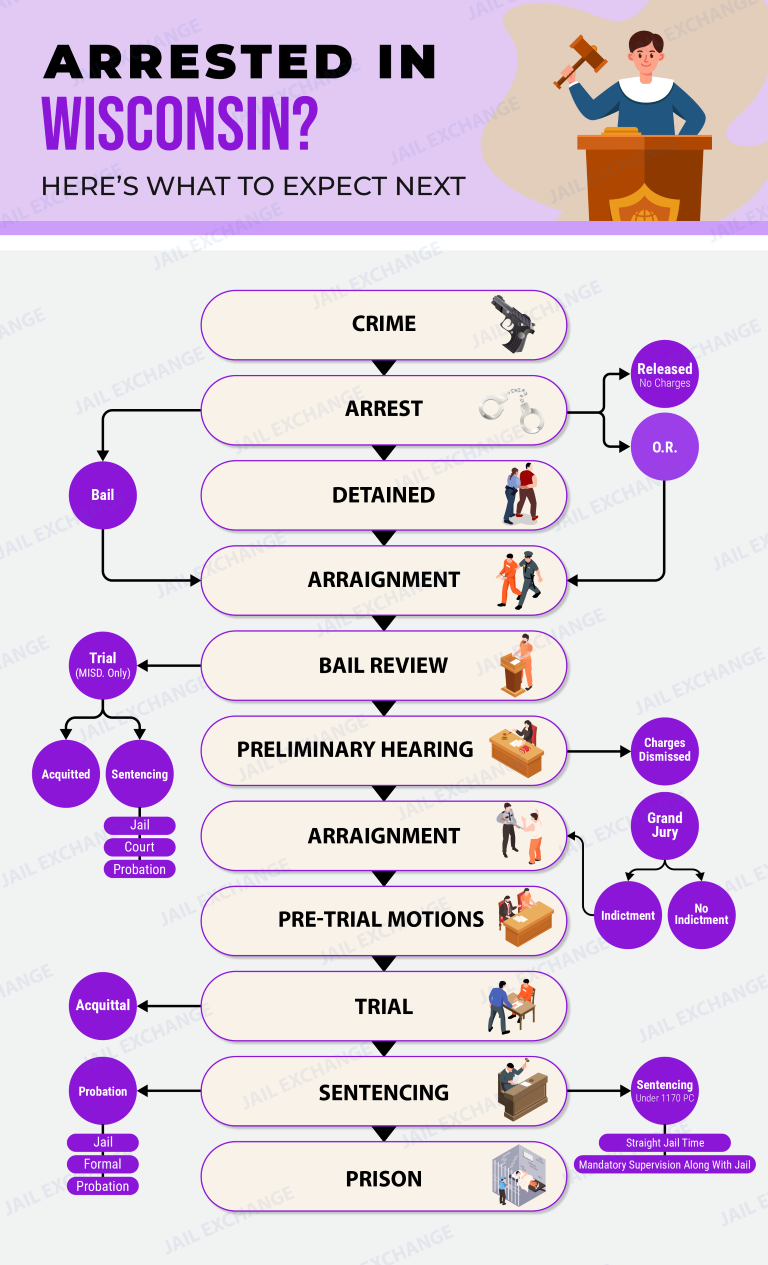
↑ Back to the question list3. What happens after an arrest in Waukesha County (booking, pretrial screening and the first hearing)
Whether the arrest is made by the Sheriff, the State Patrol or one of the roughly two dozen local police departments, an adult who is taken into custody on a state charge is brought to the Waukesha County Jail for booking: fingerprints, photographs, a property inventory, a medical and safety screening, and a records check for warrants. Officers often release people accused of lower-level misdemeanors on a citation or a signature bond, which is a written promise to return to court, sometimes with a dollar amount that becomes due only if the person fails to appear.
Waukesha County has operated a pretrial program since 1994. Its staff screen new jail bookings using the Public Safety Assessment, a risk tool, and give the court commissioner information about the person's record and ties to the community. When the court releases someone under supervision, the program checks in with them while the case is pending and can refer them to treatment or other community services instead of keeping them in jail.
Anyone still held must be brought before a judge or court commissioner promptly, usually within about 48 hours, and in Waukesha the in-custody calendar is often handled by video from the jail. At this initial appearance the person receives the criminal complaint, hears the charges and possible penalties, and learns about the right to a lawyer, and release conditions are set. Those conditions can include no contact with an alleged victim, no alcohol or drugs, testing, GPS monitoring or a cash amount. A 2023 amendment to the Wisconsin Constitution allows judges to weigh the risk of serious harm to the public when setting conditions and cash amounts for people charged with violent crimes.
Domestic abuse arrests follow special rules. Officers must arrest in many such situations, and a person released after a domestic abuse arrest may not contact the alleged victim or return to that residence for 72 hours unless the victim waives the restriction in writing. Violating that rule can bring a new charge.
↑ Back to the question list4. The Waukesha County Jail and the Huber Facility
The Sheriff's Department runs two adult facilities. The Waukesha County Jail, at 515 W. Moreland Boulevard, is the secure jail where arrestees are booked and where people awaiting trial are housed; call it at (262) 548-7170. The Waukesha County Huber Facility, (262) 548-7181, holds sentenced inmates whom a judge has granted Huber privileges, which let them leave during the day for work, school, treatment or child care and return afterward.
Family members who want to post bail should first call the jail to confirm the amount, the accepted forms of payment and whether a hold from another county or agency would keep the person in custody anyway. Because commercial bondsmen are barred in Wisconsin, the money comes from the defendant or someone acting for them. When the case ends, cash posted for a defendant can be applied to fines, costs or restitution before any balance is refunded, so whoever posts it should ask how that works.
Someone sentenced to less than a year serves the time in county custody, often at the Huber Facility if the judge allows. A sentence of a year or more is a prison sentence served through the Wisconsin Department of Corrections, and the person leaves the county jail for a state reception center.
↑ Back to the question list5. The State Public Defender's Waukesha office
Waukesha County residents who cannot afford a lawyer for a criminal case apply to the Wisconsin State Public Defender, whose Waukesha office is at 407 Pilot Court, Suite 500, Waukesha, WI 53188, (262) 521-5173. Representation is not automatic. People who are out of custody fill out a financial application at the office during walk-in interview hours, weekdays from 1:00 to 4:00 p.m.; people held in the Waukesha County Jail are usually interviewed there.
Bring the criminal complaint, the notice of the next court date, a Social Security number and proof of income, bank balances, vehicles and property, plus records of expenses such as rent or child support. Missing paperwork can delay the appointment of a lawyer, so it is worth applying right after the first hearing rather than waiting until a few days before the next one.
The State Public Defender uses a strict financial test set by statute, and many working people fall just above it. When that happens, a Waukesha County judge may still appoint a lawyer at county expense if the person truly cannot afford one, so a defendant who is turned down should tell the court. Many State Public Defender cases are assigned to private lawyers who accept appointments, so the attorney who calls may work at a private firm. Questions about bail conditions are also worth raising with that lawyer early, since a motion to modify release terms can be filed at any stage.
↑ Back to the question list6. The District Attorney, pre-charge diversion and deferred prosecution in Waukesha County
The Waukesha County District Attorney's office, in Room 2-0700 of the courthouse, (262) 548-7076, reviews police reports from every agency in the county and decides whether to file a criminal complaint, what to charge, and what to offer in plea negotiations. Its Victim/Witness Assistance unit, (262) 548-7071, keeps victims informed of hearings and helps with restitution requests, and under Marsy's Law, approved by Wisconsin voters in 2020, victims have constitutional rights to notice and to be heard.
The office runs two kinds of alternatives to a conviction. A pre-charge diversion program lets some people, usually those with little or no record and a lower-level offense, complete conditions such as classes, community service or restitution before any complaint is filed. A post-charge deferred prosecution agreement is used after charges are filed: the defendant typically signs an agreement, sometimes enters a plea that is held open, and follows conditions for a set period, after which the charge is dismissed or reduced. Eligibility is decided by prosecutors, so a defendant or their lawyer has to ask.
People held in the Waukesha County Jail while one of these offers is being discussed can ask their lawyer whether bail conditions can be adjusted so they can begin the required programs. Statewide, Treatment Alternatives and Diversion (TAD) grants support treatment courts and diversion efforts in many counties, and Waukesha's two treatment courts are described next.
↑ Back to the question list7. Waukesha County treatment courts (drug court and OWI court)
The Waukesha County OWI Treatment Court, which began in 2006 as the first court of its kind in Wisconsin, works with people convicted of a third or fourth OWI. Participants spend at least a year moving through four phases of frequent alcohol and drug testing, continuous alcohol monitoring, treatment, case management and regular appearances before the treatment court judge.
The Waukesha County Drug Treatment Court, started in 2012, is meant for high-risk, drug-dependent defendants facing nonviolent charges. It uses a post-plea, pre-disposition model: the person enters a plea under a binding agreement, completes a program lasting at least 12 months, and the plea agreement's terms are carried out on graduation. Someone sitting in the Waukesha County Jail who wants to be screened should raise it with their defense lawyer, because referrals usually come through the attorneys and the court.
Both courts expect regular attendance and quick consequences for missed tests or new use, which may include short jail stays or changes to bond conditions. Defendants who are not eligible may still be offered treatment as a condition of probation or deferred prosecution.
↑ Back to the question list8. Misdemeanor (for example, theft, battery, disorderly conduct, a second OWI)
A Waukesha County misdemeanor usually starts with a citation and a court date or with a short stay at the Waukesha County Jail followed by a signature bond. The District Attorney files a criminal complaint in the circuit court, and the first hearing is the initial appearance, where the defendant gets a copy of the complaint and enters a plea, most often not guilty to start.
Wisconsin sorts misdemeanors by class, and Waukesha County judges sentence within these limits:
- Class A (up to 9 months in jail and/or a fine up to $10,000): retail theft or theft of property worth $2,500 or less, battery, criminal trespass to a dwelling, criminal damage to property.
- Class B (up to 90 days and/or up to $1,000): disorderly conduct, which prosecutors often charge with a domestic abuse modifier after a household dispute.
- Class C (up to 30 days and/or up to $500): a small group of minor offenses.
OWI. A first OWI is a civil forfeiture of $150 to $300 plus costs, with a 6- to 9-month license revocation, an alcohol and drug assessment, and an ignition interlock if the test showed 0.15 or more or the driver refused; it is a crime only if a passenger under 16 was in the car. A second OWI within 10 years is a criminal misdemeanor carrying mandatory jail of 5 days to 6 months, and it is filed in the circuit court in Waukesha, not in a municipal court. Later offenses carry heavier penalties, and a fourth is generally a felony.
After the first hearing the case moves to pretrial conferences, where the lawyers exchange police reports and video and negotiate. Most cases end in a plea agreement, dismissal, a deferred prosecution agreement or a reduced charge. A defendant who goes to trial has a jury of six. Sentences include fines, probation supervised by the Department of Corrections, and county jail, which may be served with Huber work-release privileges at the Waukesha County Huber Facility. A defendant can make a speedy trial demand, which generally requires trial within 60 days in a misdemeanor case. Most Waukesha misdemeanors are resolved in two to six months. The State Public Defender's Waukesha office at (262) 521-5173 takes misdemeanor applications when jail is a possible sentence.
↑ Back to the question list9. Felony (for example, burglary, felony theft, drug possession with intent to deliver, substantial battery)
A felony arrest in Waukesha County generally means a night or more in the Waukesha County Jail before the initial appearance. The District Attorney files a criminal complaint, and a court commissioner reads the charges, appoints or confirms counsel and sets bail and conditions of release. Pretrial program staff may recommend supervised release instead of a cash amount.
Preliminary hearing. A person charged with a felony has a right to a preliminary hearing, where a commissioner or judge decides whether there is probable cause to believe a felony was committed. It must be held within 10 days of the initial appearance if the defendant is in custody on cash the person cannot post, and within 20 days otherwise. Many defendants waive it as part of negotiations. If the case is bound over for trial, the District Attorney files an information, the formal charging document, and the defendant is arraigned on it in the assigned branch.
Wisconsin felony classes and maximum penalties applied in the Waukesha County Circuit Court:
- Class E: up to 15 years and $50,000 (for example, robbery).
- Class F: up to 12.5 years and $25,000 (burglary).
- Class G: up to 10 years and $25,000 (theft above $10,000).
- Class H: up to 6 years and $10,000 (theft from $5,000 to $10,000; some aggravated batteries).
- Class I: up to 3.5 years and $10,000 (substantial battery; theft over $2,500 up to $5,000).
Possession with intent to deliver is classed by the drug and the amount, so a small quantity of one substance may be a Class I felony while a large quantity of heroin, fentanyl or cocaine can be Class C or higher.
Felony sentences under Wisconsin's truth in sentencing law are bifurcated: a term of initial confinement in prison followed by extended supervision in the community, with no parole for crimes committed after 1999. Judges can make some defendants eligible for the Challenge Incarceration Program or the Substance Abuse Program, which can shorten confinement. Many felony cases end with probation and conditional jail time in the county instead. A Waukesha felony jury seats 12 people, and its verdict has to be unanimous; once a defendant files a speedy trial demand in a felony case, trial generally must begin within 90 days. A typical Waukesha County felony takes 6 to 12 months to resolve. The State Public Defender's Waukesha office, (262) 521-5173, handles felony applications, including from people in jail.
↑ Back to the question list10. Violent felony (for example, homicide, sexual assault, armed robbery)
The most serious Waukesha County cases follow the same felony path, but the stakes at each stage are higher. A person charged with a violent offense is almost always held at the Waukesha County Jail through the initial appearance, and because of the 2023 constitutional amendment, the court may consider the risk of serious bodily harm to the community when deciding the cash bail amount and other conditions. High cash amounts are common, and defendants often stay in custody through trial.
Penalties for the most serious offenses:
- First-degree intentional homicide: Class A felony, mandatory life imprisonment; the judge either sets a date when the person may petition for extended supervision or orders life without that possibility.
- Second-degree intentional homicide (Class B, up to 60 years), and the same Class B ceiling for first-degree reckless homicide, the charge Wisconsin prosecutors use in many fatal drug overdose cases.
- First-degree sexual assault: Class B, up to 60 years; offenses against young children can carry mandatory minimum terms.
- Armed robbery: Class C, up to 40 years and a $100,000 fine.
Wisconsin abolished the death penalty in 1853 and has not restored it.
Homicide and sexual assault cases in Waukesha County often involve months of discovery, expert testimony and motion hearings before a trial date holds, and many take one to two years. Victims and their families have rights under Marsy's Law to be notified, to attend and to speak at sentencing, and the District Attorney's Victim/Witness unit assists them. A defendant who qualifies is represented by the State Public Defender, which assigns experienced trial lawyers to serious felonies; call the Waukesha office at (262) 521-5173.
↑ Back to the question list11. Juveniles (under 17) arrested in Waukesha County
Wisconsin treats 17-year-olds as adults in criminal cases, so a 17-year-old arrested in Waukesha County goes through the adult process and the Waukesha County Jail. Children ages 10 through 16 are handled by the circuit court sitting as juvenile court, with its own clerk at (262) 548-7449.
Intake. When police take a child into custody, they contact juvenile intake through the Waukesha County Department of Health and Human Services, 514 Riverview Avenue, (262) 548-7212. An intake worker decides whether the child goes home to a parent, goes to non-secure shelter care (the county contracts with Lad Lake for that), or is held in secure detention. Waukesha County's own juvenile detention center closed on October 1, 2021, and the county now contracts for secure beds with neighboring counties: the department lists Washington, Rock and Dane counties, which typically means the Washington County Juvenile Detention Center in West Bend, the Rock County Youth Services Center in Janesville or the Dane County Juvenile Detention Center in Madison. If a child is held, a custody hearing generally must take place within 24 hours of the intake decision, not counting weekends and legal holidays. Children are not released on cash bail the way adults are; the judge or commissioner decides whether the child stays in custody or goes home under conditions.
The petition. The District Attorney's office decides whether to file a delinquency petition. Many first referrals are closed with a deferred prosecution agreement between the family, intake and the prosecutor. Children have a right to a lawyer in delinquency cases, and the State Public Defender represents most of them without a parental income test.
Outcomes. A case may end with a consent decree (a supervised agreement without a finding of delinquency) or, after a plea or trial before a judge, a dispositional order. Options include supervision at home, counseling, community service and restitution, out-of-home placement, a Type 2 placement in the community, or a Type 1 commitment to the state's secure juvenile facility, Lincoln Hills School for boys or Copper Lake School for girls, both near Irma. The Serious Juvenile Offender program covers longer commitments for grave offenses.
Adult court. Prosecutors can ask the juvenile court to waive jurisdiction so that a child 14 or older (and in some very serious cases a younger child) is tried as an adult. In addition, adult court has original jurisdiction over a child 10 or older accused of attempted or completed first-degree intentional homicide, first-degree reckless homicide or felony murder, and over some youths already found delinquent who are charged with certain new offenses; a judge can sometimes return those cases to juvenile court. Juvenile court records are generally confidential, with limited exceptions.
↑ Back to the question list12. Federal cases (U.S. District Court) from Waukesha County
Waukesha County is part of the Eastern District of Wisconsin and is assigned to its Milwaukee Division, so federal charges from Brookfield, Oconomowoc, Menomonee Falls or anywhere else in the county are heard at the U.S. Courthouse, 517 E. Wisconsin Avenue, Milwaukee, WI 53202 (clerk (414) 297-3372). The U.S. Attorney's Office for the district, 517 E. Wisconsin Avenue, Suite 530, Milwaukee, (414) 297-1700, prosecutes these cases.
When a case turns federal. Conduct in Waukesha County becomes a federal case when it violates federal law and federal agents or prosecutors take it, often after a joint investigation with local police. Typical examples are drug trafficking conspiracies along the Interstate 94 corridor, gun possession by a convicted felon or other prohibited person, bank robbery, child exploitation offenses and fraud schemes involving mail, wires, banks or federal programs. The same conduct can sometimes be charged in both systems. No tribal reservation lies in Waukesha County, and Wisconsin's state courts hold criminal jurisdiction over most reservation land in the state under Public Law 280, the Menominee Reservation being the main exception.
Defense lawyers. Federal Defender Services of Wisconsin represents people who cannot afford counsel from its Milwaukee office at 411 E. Wisconsin Avenue, Suite 2310, (414) 221-9900; when it has a conflict, the court appoints a private lawyer from the Criminal Justice Act panel.
How the case moves. Following a federal arrest in Waukesha County, the first court stop is an initial appearance before a U.S. magistrate judge in Milwaukee. Federal magistrates in Milwaukee rarely set cash bail. When the government asks to keep a defendant locked up, the detention hearing usually follows within three court days, and under the Bail Reform Act the magistrate either orders release on conditions monitored by U.S. Probation and Pretrial Services, (414) 297-1425, or orders the person detained until trial. A case begun by complaint must generally be followed by a grand jury indictment within 30 days, and the Speedy Trial Act sets a 70-day clock for trial that is often extended. Most defendants plead guilty, and the rest go before a jury of 12 in Milwaukee whose verdict requires all 12 to agree. A federal probation officer writes a presentence report for the Milwaukee judge, who weighs the advisory Sentencing Guidelines and any mandatory minimum the statute requires. There is no federal parole: prisoners serve roughly 85 percent of the sentence with good-conduct credit, in a Bureau of Prisons facility, followed by supervised release. Appeals go to the U.S. Court of Appeals for the Seventh Circuit in Chicago.
To locate someone in federal custody, use the Federal Bureau of Prisons inmate locator and search by name or register number. Because the U.S. Marshals Service rents beds in some county jails for federal defendants awaiting trial, such a person can also appear on the roster of whichever jail is holding them. Federal prosecution of people under 18 is rare and generally limited to serious offenses.
↑ Back to the question listThis guide gives a general overview of how criminal cases move through the Waukesha County courts and is not legal advice; branch assignments, municipal court memberships, programs and phone numbers change. Anyone charged with a crime should talk with a Wisconsin criminal defense lawyer. To apply for a public defender, call the State Public Defender's Waukesha office at (262) 521-5173; for questions about someone in custody, call the Waukesha County Jail at (262) 548-7170 or the Sheriff's Department at (262) 548-7122.

icare (operated by Aramark Correctional Services) is a specialized gift package and commissary program that allows family members to order brand-name snack bundles, confectioneries, hygiene kits, and freshly prepared hot meals sent directly to an incarcerated loved one. Every package is packed to adhere strictly to facility security regulations.
Important: Order Cutoffs and Delivery Windows Vary by Jail
Detention centers do not manage care package deliveries under identical schedules. While some facilities allow weekly orders, others restrict deliveries to bi-weekly or monthly distribution windows, and spending limits vary from jail to jail. You should verify the facility's active cutoff schedule and order allowances by calling them directly. If an order is submitted after the weekly processing deadline, delivery will be held until the following cycle, leaving your loved one waiting an extra cycle for fresh meals or personal snacks.
Step-by-Step Instructions to Place an icare Package Order
- Obtain the inmate's legal first and last name, date of birth, and assigned booking or inmate ID number.
- Visit www.icaregifts.com on your computer or mobile device.
- Select Find a Loved One and choose the state and detention facility.
- Search for the inmate using their ID number or legal last name to unlock the facility-specific catalog.
- Browse available fresh food items, snack packs, candy selections, and hygiene kits, adding items up to the facility's spending cap.
- Proceed to checkout, enter your debit or credit card billing details, and submit your order.
- Save your digital receipt and confirmation tracking number for your records.
What the Inmate Needs to Do
The inmate does not need an internet account to receive care packages. Aramark prepares the shipment in tamper-evident security packaging and delivers it directly to the facility commissary department. Staff inspect the delivery and distribute it during scheduled housing unit delivery rounds, where the inmate signs the delivery manifest.
Official Provider: icare Gifts Official Website
Customer Service Telephone: 1-888-439-5020
Support Hours: Monday – Friday, 8:00 AM – 9:00 PM EST; Saturday – Sunday, 9:00 AM – 5:00 PM EST
Supported Languages: English and Spanish
Other Services Associated with Aramark Corrections
Depending on individual facility agreements, additional trust funding and commissary services may be available:
- Inmate Trust Fund Deposits: Transfer funds directly to an inmate's jail trust account for independent commissary spending.
• Learn more on our website: Inmate Trust Deposits Guide | • Visit official vendor page: icare Inmate Services
Buy Commissary for an Inmate in the Waukesha County Huber Facility
Waukesha County Huber Facility Inmate Commissary - Sending Money or Purchasing Commissary for an Inmate
Waukesha County Huber Facility allows inmates to purchase commissary. This can be snacks, hygiene products, stamps, stationary, clothing and even electronics.
You can buy commissary for an inmate using an online service called icare gifts.

There is a monthly limit of $200-300 on how much inmates can spend on commissary items.
This amount is subject to change so call the facility at 262-548-7181 in order to confirm the amount that cannot be exceeded.
Inmates have access to both an in-house commissary store, and commissary packages that can be purchased and shipped to the inmate by friends and family.
Scroll down for information on the Waukesha County Huber Facility's service they use for you being able to purchase commissary items online and have them shipped directly to the inmate.
You can also go to our Inmate Money page for information on how to send money to an inmate.
GettingOut / ViaPath Trust & Commissary Deposits
Provider: GettingOut (Telmate) • Rebranding as ViaPath Technologies (myViaPath)
GettingOut and ViaPath Technologies provide electronic inmate trust banking solutions that allow family and friends to transfer money directly into an incarcerated person's jail trust and commissary account. Deposited funds give inmates the financial balance needed to purchase food items, personal hygiene products, stationery, and over-the-counter medical goods from the jail store.
Important: Facility Banking Policies Vary Across Jails
Once a person is booked and moved to a housing unit, facilities do not always allow cash drop-offs or phone payments directly to the jail window. Some might and you should confirm this by calling the facility and asking. But if you do not register online and fund your loved one's trust account immediately, they may be forced to wait days or weeks for standard paper processing, leaving them without essential soap, clean undergarments, basic medical sundries or snacks.
Step-by-Step Instructions to Deposit Trust Funds
- Confirm the inmate's legal first and last name, date of birth, and assigned jail booking identification number.
- Navigate to www.gettingout.com or the updated my.viapath.com portal.
- Sign into your verified profile and select Deposit Funds.
- Select the detention center where the inmate is currently housed.
- Choose Trust Account / Commissary and specify your deposit amount.
- Enter your credit or debit card billing information, review transaction fees, and submit payment.
- Save your digital receipt and confirmation number for your records.
What the Inmate Needs to Do
The inmate does not need an internet account to receive funds. Once the electronic transaction clears, the balance posts directly to their jail trust ledger according to facility accounting schedules. The inmate can review their updated balance at a dayroom pod kiosk or on their tablet and place orders on their regular commissary day.
Official Providers: GettingOut Website | myViaPath Portal
Customer Service Telephone: 1-866-516-0115 (GettingOut) • 1-877-650-4249 (ViaPath)
Support Hours: Monday – Friday, 7:00 AM – 11:00 PM CST; Saturday – Sunday, 8:00 AM – 7:00 PM CST
Supported Languages: English and Spanish
Other Services Provided by GettingOut / ViaPath
In addition to Trust Deposits, GettingOut and ViaPath provide several other communication and visitation options:
- Phone Calling Accounts: Prepay for phone calling credits so your loved one can call your telephone directly.
• Learn more on our website: Phone Calling Accounts Guide | • Visit official vendor page: ViaPath Phone Accounts - Two-Way Text Messaging: Send electronic messages and photos directly to an inmate's tablet or kiosk.
• Learn more on our website: Digital Messaging Guide | • Visit official vendor page: GettingOut Messaging - Remote Video Visits: Schedule and join live video visits from home using your computer or smartphone.
• Learn more on our website: Video Visitation Guide | • Visit official vendor page: GettingOut Video Visits - Inmate Tablets & Media: Fund tablet entertainment, music streaming, games, and news modules.
• Learn more on our website: Tablet Rentals & Content Guide | • Visit official vendor page: GettingOut Tablets
Deposit Money for an Inmate in the Waukesha County Huber Facility
Wednesdays and Saturdays, 9:00 a.m. to 9:00 p.m., family can drop off money at the Waukesha County Huber Facility, 1400 Northview Road in Waukesha. No visit appointment is needed.
Not those days? Two other ways:
- Kiosk at the jail: It's in the public lobby of the jail, 515 W. Moreland Blvd. in Waukesha, and runs during visiting hours. Cash, Visa and Mastercard all work, and the money posts right away.
- Mail: A certified check, cashier's check or money order payable to "Waukesha County Jail FBO" followed by the person's name, sent to Attention: Correctional Services Assistant, P.O. Box 0217, Waukesha, WI 53187-0217. Leave cash and personal checks out.
Someone on Huber may hold up to $15 in cash, plus another $50 in their outerwear locker. The Sheriff controls wages earned on work release.
Information for this service is currently unavailable.
ViaPath AdvancePay Phone Calling Accounts
Provider: ViaPath Technologies • Formerly ConnectNetwork / Global Tel*Link (GTL)
AdvancePay is the primary prepaid telecommunications service operated by Global Tel*Link (GTL) and ConnectNetwork, which have unified under the corporate identity of ViaPath Technologies (and the myViaPath platform). By funding an AdvancePay account, telephone charges are deducted per minute whenever an incarcerated loved one calls your specific telephone number, preventing calls from being rejected by cellular carriers.
Important: Cell Carriers Automatically Block Jail Collect Calls
Inmate telephone networks do not permit incoming calls, and wireless cell providers automatically block traditional collect billing by default. While select traditional landlines may support operator billing, cell phones and internet-based lines require an active AdvancePay balance, which you can verify with your carrier. If you do not register your number online and add funds immediately, your loved one will hear an automated operator announcement stating your line is blocked from receiving correctional calls.
Step-by-Step Instructions to Open and Fund AdvancePay
- Visit web.connectnetwork.com or the updated my.viapath.com portal, or launch the ConnectNetwork / ViaPath mobile application.
- Click Sign Up and register using your primary 10-digit cellphone number and email address.
- Select Add Facility, pick your state, and choose the detention center or state prison where the inmate is held.
- Search for the inmate using their full legal name or facility booking ID number and link them to your contact directory.
- Select AdvancePay Phone and choose your deposit amount ($25, $50, or custom).
- Enter your debit or credit card billing details, accept the administrative transaction fee, and complete the payment.
- Check your phone settings to confirm that automated or unknown correctional numbers are not routed straight to spam.
What the Inmate Needs to Do
The inmate approaches any housing pod telephone, enters their assigned PIN and voice biometric recognition phrase, and dials your 10-digit number. ViaPath's automated operator confirms your active prepaid balance and connects the call. All personal telephone calls are subject to recording and monitoring by facility investigators.
Official Providers: ConnectNetwork Portal | myViaPath Portal
Customer Service Telephone: 1-877-650-4249 (Automated & Live Support)
Support Hours: Automated Service 24/7; Live Operators Monday – Friday, 8:00 AM – 10:00 PM EST
Supported Languages: English and Spanish
Other Services Provided by ViaPath Technologies (ConnectNetwork)
In addition to AdvancePay Phone Calling, ViaPath / ConnectNetwork provides several other communication, financial, and visitation services:
- ConnectNetwork Trust Fund Deposits: Transfer money directly into an inmate's jail trust account for commissary store purchases.
• Learn more on our website: Inmate Trust Deposits Guide | • Visit official vendor page: ConnectNetwork Trust Deposits - ViaPath PIN Debit Phone Calling: Give the inmate their own calling funds to contact any approved phone number independently.
• Learn more on our website: PIN Debit Phone Calling Guide | • Visit official vendor page: ViaPath PIN Debit Calling - ViaPath Messaging & Photo Sharing: Send digital messages, photos, and video attachments directly to their terminal.
• Learn more on our website: Digital Messaging Guide | • Visit official vendor page: ViaPath Messaging Services - GettingOut Video Visitation & Tablets: Schedule face-to-face remote video visits and manage handheld tablet communications.
• Learn more on our website: Remote Video Visitation Guide | • Visit official vendor page: GettingOut Video Visits
ViaPath PIN Debit Phone Calling Accounts
Provider: ViaPath Technologies • Formerly ConnectNetwork / Global Tel*Link (GTL)ViaPath PIN Debit (hosted on ConnectNetwork and myViaPath) provides incarcerated individuals with their own calling funds. Unlike AdvancePay (which only funds calls placed to your specific phone number), PIN Debit funds belong directly to the inmate, allowing them to call attorneys, bondsmen, employers, or extended family members across multiple approved telephone numbers.
Important: AdvancePay Only Funds a Single Phone Number
When someone is arrested, they often need to contact multiple people—including legal defense counsel, bail agents, employers, and relatives. If you only fund an AdvancePay account, your loved one will have no calling balance to dial anyone else, as rules and call authorizations vary by facility. Adding funds directly to ViaPath PIN Debit grants them the calling flexibility needed to handle critical legal and family arrangements without delay.
Step-by-Step Instructions to Fund a PIN Debit Account
- Sign into your account at web.connectnetwork.com or my.viapath.com.
- Click on PIN Debit under the communications menu.
- Select the state and facility, and link the inmate's booking identification number.
- Enter the deposit dollar amount and review the payment transaction fee.
- Enter your debit or credit card details and submit the payment.
- Notify your loved one that their personal PIN calling balance has been credited.
What the Inmate Needs to Do
The calling balance appears under the inmate's personal identification PIN. When they pick up any dayroom telephone or tablet, they select the 'PIN Debit' prompt from the automated menu to place calls to any approved number on their personal contact list.
Official Providers: ConnectNetwork Portal | myViaPath Portal
Customer Service Telephone: 1-877-650-4249
Support Hours: Automated Deposits 24/7/365; Live Agents Monday – Friday, 8:00 AM – 10:00 PM EST
Supported Languages: English and Spanish
Other Services Provided by ViaPath Technologies (ConnectNetwork)
In addition to PIN Debit Calling, ViaPath / ConnectNetwork provides several other communication, financial, and visitation services:
- AdvancePay Dedicated Phone Calling: Fund calls placed specifically to your personal phone number.
• Learn more on our website: AdvancePay Calling Guide | • Visit official vendor page: ConnectNetwork AdvancePay - ConnectNetwork Trust Fund Deposits: Deposit money for commissary food, hygiene supplies, and stationery.
• Learn more on our website: Inmate Trust Deposits Guide | • Visit official vendor page: ConnectNetwork Trust Deposits - ViaPath Messaging & Photo Sharing: Send digital messages and photos directly to their kiosk or tablet.
• Learn more on our website: Digital Messaging Guide | • Visit official vendor page: ViaPath Messaging Services - GettingOut Video Visitation & Tablets: Schedule face-to-face remote video visits from home.
• Learn more on our website: Remote Video Visitation Guide | • Visit official vendor page: GettingOut Video Visits
Email with an Inmate in the Waukesha County Huber Facility
Sending an Email, Text or Secure Electronic Message to an Inmate
The Waukesha County Huber Facility provides a service which allows secure electronic messaging for their inmates.
The email service they use is called TextBehind.

TextBehind is not directly connected to the internet like normal email, but instead each correspondence is first intercepted by the jail's servers. This gives the staff an opportunity to review the messages before delivering them to both inmates and the people that the inmates are communicating with.
Electronic messages received by the inmates are read either on kiosks within the inmate's unit, or or on tablets provided by the third party service that oversees the program.
Allowing inmates access to email has many upsides:
- It is less expensive than regular mail.
- It allows for faster turnaround of communication.
- It allows the jail to monitor inmate communication in real time.
- Because the jail receives a portion of the revenue, it brings the jail revenue they wouldn't have otherwise.
- It is an inmate privilege that they don't want to have taken away, and thus can be used as a way to control behavior.
- It keeps unwanted contraband from entering the facility in the physical mail.
For a list of Frequently Asked Questions and Answers about TextBehind inmate emailing and texting, scroll down for more information about it or call the jail at 262-548-7181.
ViaPath Technologies (formerly GTL / ConnectNetwork) deploys secure, correctional-grade handheld tablets to incarcerated individuals across state prison systems and county jails. Operating over private, secure internal networks, these tablets provide access to educational courses, legal research materials, job readiness resources, streaming music, podcasts, eBooks, and direct messaging with approved family contacts.
Important: Tablet Hardware Deployment and Rental Rules Vary
Detention centers do not manage tablet distribution identically. While some agencies issue individual personal tablets to every detainee at booking, others utilize shared pod docking stations or restrict tablet use to specific dayroom hours, which you should confirm with the facility directly. Although core educational and legal resources are generally provided free of charge, sending messages, listening to music, or making phone calls from the tablet requires an active balance funded by outside contacts.
Step-by-Step Instructions to Support and Fund Tablet Use
- Confirm that ViaPath or ConnectNetwork handheld tablets are deployed at your loved one's specific facility.
- Log into your account at web.connectnetwork.com or my.viapath.com.
- Ensure the inmate is linked to your contact list using their legal name and booking ID number.
- Deposit funds into their Inmate Account (for independent media, games, and music purchases) or your Messaging/Phone Account.
- Review all transaction charges, complete payment with a credit or debit card, and save your receipt.
- Notify your loved one that funds are available so they can download media or purchase subscriptions on their device.
What the Inmate Needs to Do
The inmate unlocks their assigned tablet by entering their unique facility PIN or using biometric verification. They can access free rehabilitative and legal content at no charge, or open communication and media applications to draft messages, place phone calls, or stream music using available balances. Devices are docked during quiet hours and shift changes for secure recharging and data synchronization.
Official Providers: ConnectNetwork Portal | myViaPath
Customer Service Telephone: 1-877-650-4249
Support Hours: Monday – Friday, 7:00 AM – 11:00 PM CST; Saturday – Sunday, 8:00 AM – 7:00 PM CST
Supported Languages: English and Spanish
Other Services Provided by ConnectNetwork / ViaPath
In addition to Tablet Programs, ConnectNetwork and ViaPath provide several other core communication and financial channels:
- Inmate Messaging: Exchange digital text messages and photographs directly with an inmate's tablet.
• Learn more on our website: Digital Messaging Guide | • Visit official vendor page: ConnectNetwork Messaging - Video Visitation: Conduct scheduled live video calls with your loved one from your home computer or smartphone.
• Learn more on our website: Video Visitation Guide | • Visit official vendor page: ConnectNetwork Video Visits - AdvancePay Phone Calling: Prepay for phone calling credits so your loved one can call your mobile device directly.
• Learn more on our website: AdvancePay Phone Guide | • Visit official vendor page: ConnectNetwork Phone Services - Trust Money Deposits: Send canteen funds directly into an incarcerated person's jail trust account.
• Learn more on our website: Trust Deposits Guide | • Visit official vendor page: ViaPath Trust Deposits
Waukesha County County Jails
Waukesha County Juvenile Facilities
- County Jail: 262-548-7170
- Adult Probation: 262-521-5132
- Criminal Court: 262-548-7484
- District Attorney: 262-548-7076
- Huber Facility: 262-548-7181
- Juvenile: 262-548-7449
- Police: 262-524-3831
- Public Defender: 262-521-5173
- Sheriff: 262-548-7122
The Waukesha County Huber Facility serves the following cities and towns of Waukesha County: Big Bend, Brookfield, Butler, Chenequa, Delafield, Dousman, Eagle, Elm Grove, Hartland, Lac La Belle, Menomonee Falls, Merton, Mukwonago, Muskego, Nashotah, New Berlin, Oconomowoc, Okauchee Lake, Pewaukee, Pewaukee City, Sussex, Wales and Waukesha.