Winnebago County Jail Criminal Court Process
Criminal Court Process for Winnebago County Wisconsin
Winnebago County Criminal Court Help: Misdemeanors, Felonies and Youth Cases
Criminal cases in Winnebago County are decided at the courthouse in Oshkosh, even for people who live up in Neenah or Menasha. Adults held before trial stay at the Winnebago County Jail, 4311 Jackson Street, Oshkosh, WI 54901. Below, you will see which court hears your case and what each step means.
Try the Winnebago County inmate search to learn if a family member is in custody. Our Winnebago County Inmate Lists page also explains new arrests, outstanding warrants and how a court-appointed lawyer is requested.
The Clerk of Circuit Court can be reached at 920-236-4848. Ask for the next court date and the courtroom. To learn how to pay bail, read our Winnebago County bail page.
1. Local courts in Winnebago County (circuit court and municipal courts)
Which court hears your case. Breaking a local ordinance, or a first-offense OWI (a civil forfeiture under Wisconsin law and not a crime, unless a child under 16 was in the vehicle), puts the case in the municipal court of the place where it happened if that community runs one: the Menasha/Neenah, Fox Crossing, Omro and Winneconne courts cover those parts of the county. Elsewhere, including the City of Oshkosh, the citation generally goes to the circuit court. Every misdemeanor and criminal traffic charge, like a second OWI, is filed in the Winnebago County Circuit Court, which also hears felonies through the initial appearance, preliminary hearing, trial and sentencing. The county's circuit court commissioners conduct many of the first hearings before a case moves to one of the six judges.
Where pretrial inmates are held. Police from Oshkosh, Neenah, Menasha, Fox Crossing, Omro, Winneconne and UW Oshkosh, along with sheriff's deputies, take arrested adults to the Sheriff's Office jail at 4311 Jackson Street. People who have not posted bail stay there until their case is resolved or their release terms change; the jail also houses sentenced inmates, and the Sheriff runs a separate work release unit for those with Huber privileges. Youths who must be detained go to a juvenile detention center outside the county (see the juvenile section). For custody information, call (920) 236-7380.
- Winnebago County Circuit Court (Branches 1 through 6) and Clerk of Circuit Court, Winnebago County Courthouse, 415 Jackson Street, Oshkosh, WI 54901 (mail: P.O. Box 2808, Oshkosh, WI 54903-2808), main (920) 236-4848; criminal/traffic division (920) 236-4856
- Winnebago County District Attorney, 448 Algoma Boulevard, Oshkosh, WI 54901 (mail: P.O. Box 2808, Oshkosh, WI 54903-2808), (920) 236-4977
- Winnebago County Sheriff's Office, 4311 Jackson Street, Oshkosh, WI 54901, (920) 236-7300; from the Neenah area (920) 727-2888
- Winnebago County Jail, 4311 Jackson Street, Oshkosh, WI 54901, inmate information (920) 236-7380; booking (920) 236-7381
- Wisconsin State Public Defender, Oshkosh office (serves Winnebago and Waushara counties), 303 Pearl Avenue, Suite B, Oshkosh, WI 54901, (920) 424-3304
- Winnebago County Department of Human Services, juvenile court intake, 220 Washington Avenue, Oshkosh, WI 54901, (920) 236-1155; Neenah office, 211 N. Commercial Street, Neenah, WI 54956, (920) 729-2777
Two court systems handle tickets and charges written in Winnebago County. The circuit court in Oshkosh is the state trial court for the entire county; it is the only court here with authority over crimes. Municipal courts are local bodies that a city or village creates, sometimes jointly with neighbors, to hear violations of its own ordinances. A municipal judge decides cases such as local traffic tickets, underage drinking, disorderly conduct written under a city code, and first-offense OWI, and can order forfeitures, license penalties and similar sanctions. Jail is not a possible sentence for the ordinance violation; it can come only as an enforcement step when a forfeiture goes unpaid. Some defendants may be able to transfer a municipal case to circuit court, but that right is limited and time-sensitive, so raise it with the court clerk or a lawyer before the first appearance.
The circuit court
- Winnebago County Circuit Court, Branches 1 to 6, Winnebago County Courthouse, 415 Jackson Street, Oshkosh, WI 54901; Clerk of Circuit Court main line (920) 236-4848, criminal/traffic division (920) 236-4856, Register in Probate and juvenile court office (920) 236-4833. Callers in the Fox Cities can use (920) 727-2880 and enter the last four digits of an Oshkosh courthouse number as the extension.
Municipal courts serving Winnebago County communities
- Menasha/Neenah Municipal Court (Cities of Menasha and Neenah), 211 Walnut Street, Neenah, WI 54956, (920) 886-6285
- Fox Crossing Municipal Court (Village of Fox Crossing, formerly the Town of Menasha), 2000 Municipal Drive, Neenah, WI 54956, (920) 720-7107
- Omro Municipal Court (City of Omro), Omro, WI 54963 (mail: P.O. Box 399), (920) 685-7035
- Winneconne Joint Municipal Court (Village of Winneconne; ordinance cases from the Towns of Winneconne, Vinland, Clayton, Neenah and Winchester, plus the Outagamie County Town of Hortonia), 30 South 1st Street, Winneconne, WI 54986, (920) 582-4381
The statewide municipal court directory, last published in 2021, lists no municipal court for the City of Oshkosh or the Winnebago County part of Appleton, and towns outside the Winneconne court's membership, such as Algoma, Black Wolf, Nekimi and Omro, have none either. Ordinance tickets from those areas are generally filed in the circuit court at 415 Jackson Street unless the community has created or joined a court since then; the citation names the court and the date to appear. City of Oshkosh ordinance cases are prosecuted by the city's own attorneys, while the District Attorney handles county ordinance and traffic violations elsewhere.
Prosecution, defense, police and juvenile intake
- Winnebago County District Attorney, 448 Algoma Boulevard, Oshkosh, WI 54901, (920) 236-4977
- Wisconsin State Public Defender, Oshkosh office, 303 Pearl Avenue, Suite B, Oshkosh, WI 54901, (920) 424-3304
- Winnebago County Sheriff's Office, 4311 Jackson Street, Oshkosh, WI 54901, (920) 236-7300 or (920) 727-2888
- Oshkosh Police Department, 420 Jackson Street, Oshkosh, WI 54901, (920) 236-5700
- Neenah Police Department, 2111 Marathon Avenue, Neenah, WI 54956, (920) 886-6000
- Menasha Police Department, 430 First Street, Menasha, WI 54952, (920) 967-3500
- Fox Crossing Police Department, 2000 Municipal Drive, Neenah, WI 54956, (920) 720-7109
- Omro Police Department, 205 S. Webster Avenue, Omro, WI 54963, (920) 685-7007
- Winneconne Police Department, 30 S. First Street, Winneconne, WI 54986, (920) 582-9944
- University of Wisconsin Oshkosh Police Department, 738 High Avenue, Oshkosh, WI 54901, non-emergency (920) 424-1216
- Appleton Police Department (covers the Winnebago County portion of Appleton), 222 S. Walnut St., Appleton, (920) 832-5500
- Winnebago County Department of Human Services, juvenile court intake, Oshkosh (920) 236-1155, Neenah (920) 729-2777
The State Public Defender does not appoint lawyers in municipal court, because an ordinance violation cannot itself bring jail time; anyone charged with a crime in circuit court may apply. Cash bail on an ordinance matter is unusual, and most people receive a citation and a court date.
↑ Back to the question list2. The Winnebago County Courthouse and its six branches
The Winnebago County Courthouse stands at 415 Jackson Street in downtown Oshkosh. Expect a security screening line at the entrance. Defendants from Neenah, Menasha and Fox Crossing generally travel south to Oshkosh for their circuit court dates. The District Attorney's office is nearby at 448 Algoma Boulevard.
Branches and courtrooms
- Branch 1 — Courtroom 410
- Branch 2 — Courtroom 419
- Branch 3 — Courtroom 240
- Branch 4 — Courtroom 211
- Branch 5 — Courtroom 320
- Branch 6 — Courtroom 531
- Circuit court commissioners — Rooms 141 and 150
Courtroom assignments are taken from the clerk's staff listing dated mid-2026 and can change; the notice of hearing shows the courtroom and branch. Each branch hears a mix of case types, and the clerk's criminal/traffic division at (920) 236-4856 can tell you which branch has a case. Circuit court commissioners handle initial appearances and other early hearings, and the Register in Probate and juvenile court office is reached at (920) 236-4833.
Families posting cash bail should ask the clerk or the jail which location is accepting payment at that hour. A defendant with no lawyer who wants one should apply to the State Public Defender's Oshkosh office on Pearl Avenue, a short drive from the courthouse, before the first hearing if possible.
↑ Back to the question list3. What happens after an arrest in Winnebago County (booking, first appearance and bail)
Booking at Jackson Street. Arrested adults are brought to the Winnebago County Jail booking area, (920) 236-7381, where staff record personal details, fingerprint and photograph the person, inventory property and check for warrants and holds. Many people arrested for minor misdemeanors leave after booking with a citation or on a signature bond; the rest wait to see a court official.
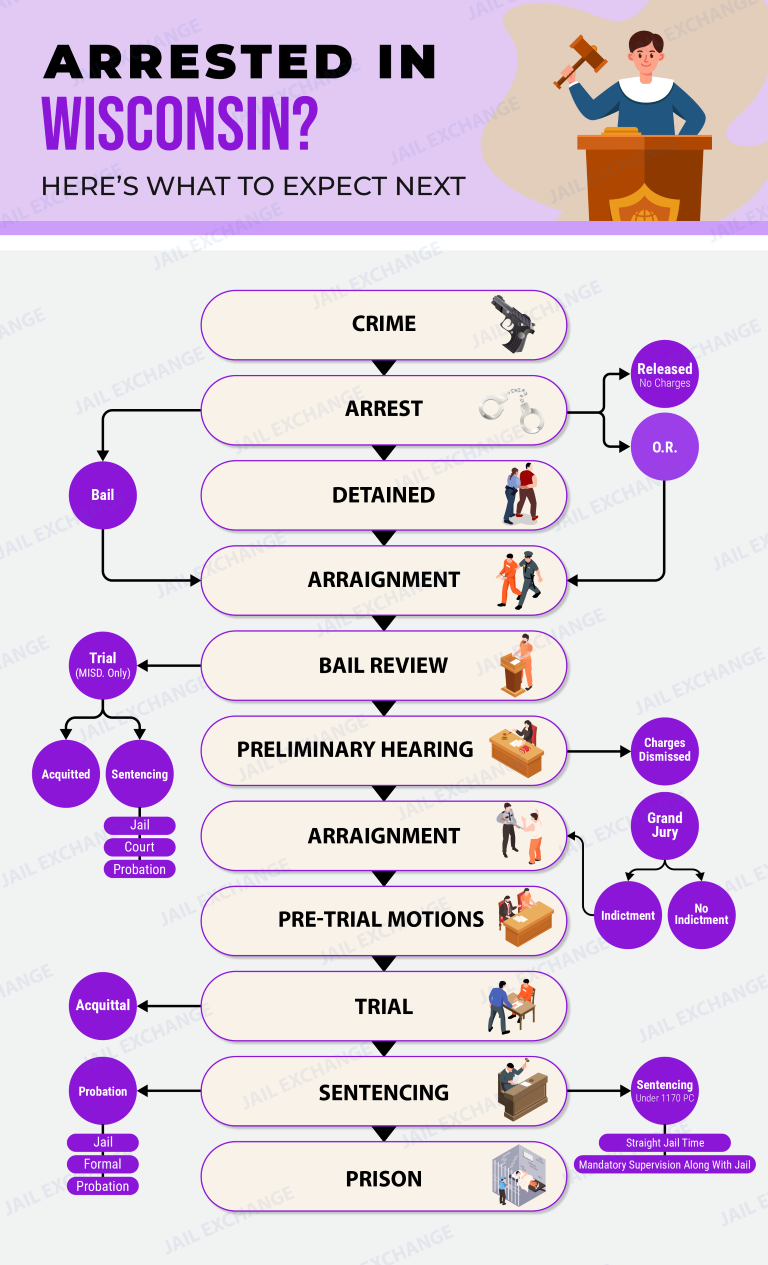
Initial appearance. A person held without a warrant must generally have a probable cause review within 48 hours, and most in-custody defendants appear before a circuit court commissioner within a day or two, often by video link from the jail. The commissioner reviews the complaint, explains the charges and the right to a lawyer, and sets terms of release.
How release works. A signature bond lets the defendant go on a written promise to return, sometimes with a set amount owed if the defendant does not appear. Cash bail requires money up front. Either type can carry conditions such as no contact with a complaining witness, no alcohol or drugs with testing, no new crimes, or staying away from a location. Wisconsin bars commercial bail bondsmen, so cash bail is paid by the defendant or a friend or relative at the jail or the clerk's office. Under a 2023 amendment to the state constitution, judges and commissioners setting cash bail for violent crimes may consider the risk of serious harm to the public among other factors.
Domestic abuse cases. Wisconsin requires arrest in many domestic abuse situations, and after release the arrested person generally may not contact the alleged victim for 72 hours unless the victim signs a waiver. Courts commonly continue no-contact orders as conditions of release.
The next hearing. In a misdemeanor case, the defendant enters a plea and is set for a pretrial conference. In a felony case, the next step is a preliminary hearing, due within 10 days for an in-custody defendant who cannot meet bail and within 20 days otherwise. Anyone in custody can ask jail staff for a State Public Defender application at any point.
↑ Back to the question list4. The Winnebago County Jail and work release
The Winnebago County Jail is part of the Sheriff's Office complex at 4311 Jackson Street, Oshkosh, WI 54901. It holds people awaiting an initial appearance, defendants who have not posted bail, and people serving county jail sentences.
- Inmate information: (920) 236-7380
- Booking: (920) 236-7381
- Huber coordinator: (920) 232-1915
- Sheriff's Office records: (920) 236-7301; warrants: (920) 236-7304
- North-county callers can reach Oshkosh sheriff numbers toll-free through (920) 727-2888 by dialing the last four digits as an extension.
Huber and work release
Many people sentenced to county jail in Winnebago County are granted Huber privileges, which allow them to leave for a job, school, treatment or child care and return afterward. Those inmates are housed in the Sheriff's work release unit, and the Huber coordinator schedules an appointment and supplies the forms needed before the sentence begins. Some sentenced inmates may be placed on GPS monitoring instead.
Jail staff can confirm whether someone is in custody and what bail is set, but they cannot give legal advice. To ask about representation, call the State Public Defender's Oshkosh office at (920) 424-3304; its staff can meet people in custody. Federal pretrial detainees may also be housed in northeastern Wisconsin county jails under U.S. Marshals agreements (see the federal section).
↑ Back to the question list5. Public defenders and appointed lawyers in Winnebago County
Eligible defendants in Winnebago County are represented by the Wisconsin State Public Defender's Oshkosh office, 303 Pearl Avenue, Suite B, Oshkosh, WI 54901, (920) 424-3304, which also covers Waushara County. Some clients get a staff attorney from the Pearl Avenue office; others are assigned to private lawyers who accept appointments from the agency, especially when there are co-defendants or conflicts.
Applying
- People held in the Winnebago County Jail can ask jail staff for an application or tell the commissioner at the first appearance that they want a public defender.
- People who are out of custody should contact the Oshkosh office promptly after receiving a summons, citation for a crime, or complaint, bringing pay stubs, benefit statements and information about debts and expenses.
- The agency applies a strict financial eligibility standard written into state law, which compares a household's income and assets with the expected cost of a private lawyer for that kind of case.
A defendant who is turned down by the State Public Defender but still cannot pay a lawyer can ask the circuit court to consider appointing counsel at county expense; the court decides case by case, and repayment may be ordered later. Do not wait until trial to raise it. A lawyer can also request a hearing to lower cash bail or convert it to a signature bond.
↑ Back to the question list6. The District Attorney, deferred prosecution and diversion programs
The Winnebago County District Attorney's Office at 448 Algoma Boulevard ((920) 236-4977) reviews police referrals from every agency in the county, decides which charges to file, and prosecutes criminal cases in the circuit court, including those from the City of Oshkosh. The same number serves victims and witnesses with questions about a pending case.
Programs listed for Winnebago County
- Diversion and Deferred Prosecution Program (DDP). A post-charge, post-plea program for drug-motivated offenses. Participants commit to 12 months that include an alcohol and drug assessment, recommended treatment and six straight months of clean drug tests. A fee applies, payable in a lump sum or monthly.
- UW Oshkosh pre-charge drug diversion (since 2016). Students involved in on-campus drug incidents may sign a deferred prosecution agreement before any charge is filed, with a similar 12-month treatment and testing commitment.
- Other diversion options offered at the prosecutor's discretion, including a domestic violence diversion, a failure-to-pay-child-support diversion, a worthless check program, and Crossroads, an individualized program built around each participant's needs.
- Sheriff's Office deflection program (since 2025). A self-referral, recovery-focused program that connects people with treatment, including medication-assisted treatment, outside the court process.
Wisconsin's Treatment Alternatives and Diversion (TAD) grants help counties fund programs of this kind. No one has a right to diversion: the District Attorney decides who is offered it, often considering the charge, prior record and the victim's input. Agreements may require admitting the facts or entering a plea, so the terms should be reviewed with defense counsel; the State Public Defender's Oshkosh office advises the clients it represents. Diversion does not by itself end bail conditions already set by the court.
↑ Back to the question list7. Winnebago County treatment programs (Safe Streets drug court, SSTOP for repeat OWI, teen court)
Winnebago County's alternatives to ordinary sentencing are run under the county's Safe Streets program. Contact for the adult programs is the county's substance use disorder services, (920) 236-4622.
- Safe Streets Drug Court (adult drug court, started 2006). A four-phase program for adults charged with non-violent offenses driven by drug or alcohol use. Participants appear in court often, submit to frequent random testing, attend group and individual counseling, and are expected to hold full-time work. Progress earns incentives; violations bring sanctions.
- SSTOP (Safe Streets Treatment Options Program). A probation and treatment program for Winnebago County residents convicted of a second or third OWI, combining supervision with substance use treatment.
- Winnebago County Teen Court. For youths aged 12 to 16 who admit an ordinance violation or misdemeanor, a jury of their peers decides an appropriate sentence in place of a fine or a juvenile court appearance. Contact (920) 236-4776.
The county's program listings do not describe a separate mental health or veterans treatment court, so ask defense counsel whether any new program has opened. Admission to the drug court or SSTOP usually comes through a referral from the defense lawyer, the prosecutor or the probation agent, followed by screening. Defendants with a State Public Defender lawyer should ask that attorney early. Admission does not change existing bail terms unless the court orders it.
↑ Back to the question list8. Misdemeanor (for example, theft, battery, disorderly conduct, a second OWI)
Misdemeanors make up most of the criminal filings at 415 Jackson Street. In Winnebago County they range from retail theft at stores along Koeller Street and battery outside bars near the UW Oshkosh campus to domestic disorderly conduct in Neenah and second-offense OWI arrests on Highway 41.
Penalty ranges
- Class A misdemeanor — county jail of up to 9 months and fines of up to $10,000. This class includes battery, theft of $2,500 or less, and criminal trespass to a dwelling.
- Class B misdemeanor — no more than 90 days behind bars and $1,000 in fines. Disorderly conduct is Class B, and it often carries a domestic abuse modifier.
- Class C misdemeanor — no more than 30 days and $500.
- Second OWI inside 10 years — a misdemeanor with a mandatory jail term of 5 days to 6 months, fines, license revocation, an assessment and an ignition interlock order. Winnebago County residents convicted of a second or third OWI may be screened for SSTOP. A first OWI is normally a civil forfeiture unless a child under 16 was in the vehicle, and a fourth OWI is generally a felony.
Steps in the case
After booking at the Winnebago County Jail, many misdemeanor defendants are released on a signature bond; others are released after a commissioner sets terms at the initial appearance. Once the DA files a complaint and the defendant enters a not-guilty plea, the case goes to pretrial conferences in front of the assigned judge. Plea negotiations, diversion offers and dismissals resolve most cases. If the case is tried, a jury of six decides it, and a defendant who demands a speedy trial is generally entitled to trial within about 60 days. Penalties include fines, probation and county jail, often with Huber work release. Winnebago County misdemeanor cases usually close within two to six months. To apply for a lawyer, contact the State Public Defender's Oshkosh office.
↑ Back to the question list9. Felony (for example, burglary, felony theft, drug possession with intent to deliver, substantial battery)
Winnebago County felony cases often begin with investigations by city police or the Lake Winnebago Area Metropolitan Enforcement Group, the regional drug task force, and they all proceed in the circuit court in Oshkosh.
Maximum sentences by class
- A — life
- B — 60 years
- C — 40 years; fine up to $100,000
- D — 25 years; $100,000
- E — 15 years; $50,000
- F — 12½ years; $25,000 (burglary)
- G — 10 years; $25,000
- H — 6 years; $10,000
- I — 3½ years; $10,000 (substantial battery)
For theft, the line between misdemeanor and felony is $2,500: above that, the charge is Class I up to $5,000, Class H up to $10,000, and Class G beyond. Aggravated battery is charged as Class H, or Class E when great bodily harm was intended. The class of a possession-with-intent charge turns on the drug and the weight.
From complaint to sentence
- Complaint and first appearance. A commissioner sets cash bail or a signature bond after the DA files the complaint. Defendants who cannot post bail stay at the Winnebago County Jail.
- Preliminary hearing within 10 days if the defendant is in custody and cannot meet bail, or within 20 days if not. The only question is probable cause that a felony occurred; waivers are common.
- Information filed by the DA after bindover, then arraignment, where the defendant pleads.
- Motions and negotiation, which resolve most cases through pleas. At trial, 12 jurors must agree unanimously, and a speedy trial demand generally requires trial within about 90 days.
- Sentencing. Options include probation, conditional jail time and prison. Under truth-in-sentencing, a prison term is split into initial confinement and extended supervision, and parole does not exist for offenses after 1999; the Challenge Incarceration and Substance Abuse programs may shorten confinement for those who qualify. A year or less is served in the county jail, longer terms in the Department of Corrections.
Winnebago County felony cases usually take between six months and a year. The State Public Defender's Oshkosh office represents many Winnebago County felony defendants.
↑ Back to the question list10. Violent felony (for example, homicide, sexual assault, armed robbery)
A homicide, sexual assault or armed robbery charged in Winnebago County goes through the same hearings as other felonies, but with more at stake at each one. Cash bail is frequently set at an amount the defendant cannot meet, and the 2023 constitutional amendment permits the court to consider the danger of serious harm to others when setting conditions for violent crimes. Most such defendants remain in the Winnebago County Jail until trial or plea.
What the law provides
- First-degree intentional homicide, Class A: mandatory life imprisonment, with the judge setting an extended-supervision eligibility date or ordering life without release.
- Second-degree intentional homicide (Class B) carries up to 60 years, and so does first-degree reckless homicide.
- First-degree sexual assault, Class B: up to 60 years; some child sexual assault offenses require mandatory minimum prison terms.
- Armed robbery, Class C: as long as 40 years in prison, while strong-arm robbery is Class E with a 15-year cap.
There is no death penalty in Wisconsin, which ended capital punishment in 1853.
Investigations in these cases can involve the State Crime Laboratory, digital evidence and expert testimony, and defense motions over evidence and statements are common, so one to two years from charge to verdict is not unusual. Marsy's Law, approved by Wisconsin voters in 2020, gives victims constitutional rights to notice, to be present and to be heard at bail, plea and sentencing proceedings; the DA's victim/witness staff handle that contact. Senior State Public Defender staff, or private lawyers the agency appoints, represent many defendants facing these charges.
↑ Back to the question list11. Juveniles (under 17) arrested in Winnebago County
A 17-year-old accused of a crime in Winnebago County is charged in adult court, because Wisconsin treats 17-year-olds as adults for criminal purposes. Youths aged 10 to 16 are handled in juvenile court, which is the Winnebago County Circuit Court hearing delinquency cases under the Juvenile Justice Code.
Intake
Juvenile court intake is run by the Winnebago County Department of Human Services: (920) 236-1155 at 220 Washington Avenue in Oshkosh, or (920) 729-2777 at 211 N. Commercial Street in Neenah. The county's Youth Justice team ((920) 236-4655 in Oshkosh, (920) 729-2751 in Neenah) supervises youth in the community, and after hours the Crisis Center at (920) 233-7707 responds to youth and family emergencies. When police take a child into custody, intake decides whether the child goes home, to a nonsecure placement, or into secure detention.
Winnebago County has no secure juvenile detention center of its own. Youths who must be held are typically taken to a center that contracts with the county, such as the Fond du Lac County Juvenile Detention Center. A child held in custody is generally entitled to a hearing within 24 hours after the intake decision, not counting weekends and legal holidays. Delinquency cases do not involve the adult Winnebago County Jail or cash bail.
After intake
Intake may close a case, refer a youth to teen court for an eligible ordinance or misdemeanor matter, offer a deferred prosecution agreement, or forward the referral to the District Attorney, who files any delinquency petition. A petition can end with a consent decree, which suspends the case under conditions, or with an adjudication and a dispositional order, such as supervision at home, restitution, community service, counseling, out-of-home placement or, in the most serious cases, Type 2 or Type 1 placement at Lincoln Hills School (boys) or Copper Lake School (girls), or the Serious Juvenile Offender program. Children are entitled to counsel, and the State Public Defender's Oshkosh office represents juveniles in delinquency cases.
When a youth faces adult court
The DA may seek waiver into adult court for a child 14 or older charged with many felonies, and for some younger children accused of very serious offenses. Adult court also has original jurisdiction, usually without any waiver hearing, over children 10 and older charged with attempted or first-degree intentional homicide, first-degree reckless homicide or felony murder, and over youths previously found delinquent who are charged with certain new violent crimes. These provisions are complex, so a family should get a lawyer involved at once. Juvenile hearings and records are generally confidential.
↑ Back to the question list12. Federal cases (U.S. District Court) from Winnebago County
Winnebago County lies in the Eastern District of Wisconsin and is assigned to the court's Green Bay Division, which sits at 125 S. Jefferson Street, Suite 102, Green Bay, WI 54301; the clerk's office number is (920) 884-3720. Federal law also names Oshkosh as a place where the Eastern District may hold court, but the court's own division list places Winnebago County cases in Green Bay, so that is where hearings should be expected.
What makes a case federal
Federal charges from Oshkosh and the Fox Cities usually involve drug trafficking organizations, often after work by the regional drug task force with the DEA, guns possessed by felons or other prohibited people, bank robberies, online child exploitation, or fraud schemes using the mail, wires or federal programs. The facts gathered for this guide show no reservation or national forest land in Winnebago County. On the Oneida Reservation to the north, Wisconsin's Public Law 280 jurisdiction means state courts generally handle crimes; only the Menominee Reservation is under federal criminal jurisdiction for serious crimes involving tribal members.
The federal offices
- U.S. Attorney's Office for the Eastern District of Wisconsin, Green Bay branch, 205 Doty Street, Suite 301, Green Bay, WI 54301, (920) 884-1066
- Federal Defender Services of Wisconsin, with offices in Green Bay, Milwaukee and Madison, defends people who cannot afford counsel; conflict cases go to private attorneys on the court's Criminal Justice Act panel. The Wisconsin State Public Defender does not handle federal cases.
- U.S. Probation and Pretrial Services, Green Bay office (Room 301 of 125 S. Jefferson St.), (920) 884-7780
How a federal case proceeds
At the first appearance a U.S. magistrate judge informs the defendant of the charges and appoints counsel for those who qualify. Federal courts do not use the state's cash bail system; under the Bail Reform Act, a defendant is released on conditions monitored by Pretrial Services or held, and a detention hearing is usually held within three court days when the government asks for one. When a case starts by complaint, a grand jury indictment must follow within 30 days. The Speedy Trial Act sets a 70-day deadline for trial, frequently extended for complex cases. Most federal defendants plead guilty; a jury of 12 decides any trial, and its verdict must be unanimous. Sentencing follows a presentence report, with the judge weighing the advisory Sentencing Guidelines and any mandatory minimum. Because the federal system abolished parole, a prisoner serves roughly 85 percent of the term in the Bureau of Prisons and then begins supervised release. Appeals from Green Bay go to the Seventh Circuit, the federal appeals court seated in Chicago. Juveniles are seldom charged federally.
Locating a federal prisoner
Look the person up by name or register number using the Federal Bureau of Prisons inmate locator. Pretrial federal detainees housed by contract in a county jail for the U.S. Marshals Service can turn up on that county's jail roster too.
↑ Back to the question listThis guide provides general information about criminal cases in Winnebago County, Wisconsin, and is not legal advice; court practices, programs and contact information can change. Talk with a Wisconsin criminal defense lawyer about any specific case. To apply for a public defender, call the State Public Defender's Oshkosh office at (920) 424-3304; to check whether someone is in custody, call the Winnebago County Jail at (920) 236-7380 or the Sheriff's Office at (920) 236-7300.