
Kulani Correctional Facility (KCF)
Kulani Correctional Facility (KCF)
Prison Phone Number
808-932-4430Information for this service is currently unavailable.
Information for this service is currently unavailable.
Information for this service is currently unavailable.
Kulani Correctional Facility (KCF) Inmate Phone Service - Registering and Cost
An inmate in the Kulani Correctional Facility (KCF) can call you using one or more of the following three methods, however during booking the facility allows each offender at least one free call to a friend, family member or bond company.

1. If your phone service - usually your land line - accepts collect calls, then they can call you collect. Note: Mobile phones don't usually accept collect calls.
2. The Kulani Correctional Facility (KCF)'s commissary will sell your inmate a pre-paid calling card that they can use to phone you or others.
3. The inmate can call you using credits or money that you or someone else purchases from the facility’s inmate phone service. Call 808-932-4430 to get information on how to set this up by phone or online.
When your inmate is booked into the Kulani Correctional Facility (KCF), they provide the jail a list of a limited number of people that they will allow to visit them and receive their phone calls. These must first be approved by the facility.
Further information, including cost, daily phone call limits and times of the day and evening when calls can be made, including a complete list of Frequently Asked Questions and Answers, is below.
Information for this service is currently unavailable.
Information for this service is currently unavailable.

How to Search for State Prison Inmates in Hawaii
The Hawaii Department of Public Safety - Corrections Division began when they became a state in 1959.
Hawaii’s four correctional facilities have a general capacity of 4,000. Unsentenced individuals make up a good percentrage of the total incarcerated population. There are another 15,000 on probation or parole, and all of these are overseen by a staff of approximately 2,000.
The following will explain the tricks and hacks you can use to find any inmate in custody with the Hawaii Department of Corrections.
Since Hawaii does not have its own online inmate search, it contracts with Vinelink Inmate Search Notification System to keep track of inmates, both sentenced and unsentenced, that it has in custody. The Vinelink System is updated daily, and sometimes more often.
In order to search for an inmate, you have to know the exact spelling of their full name, first AND last. The only information you will get after looking up an inmate, is the facility in which they are being held, their age and their race.
You do not need to register an account with Vinelink, although if you are registered you will be able to get the inmate's date of birth and their full Inmate ID# in the listing, as well as get notified when the inmate is moved to another facility, or is released.
Step 1
- Go to the Hawaii Vinelink page.
- Enter their First and last Name.
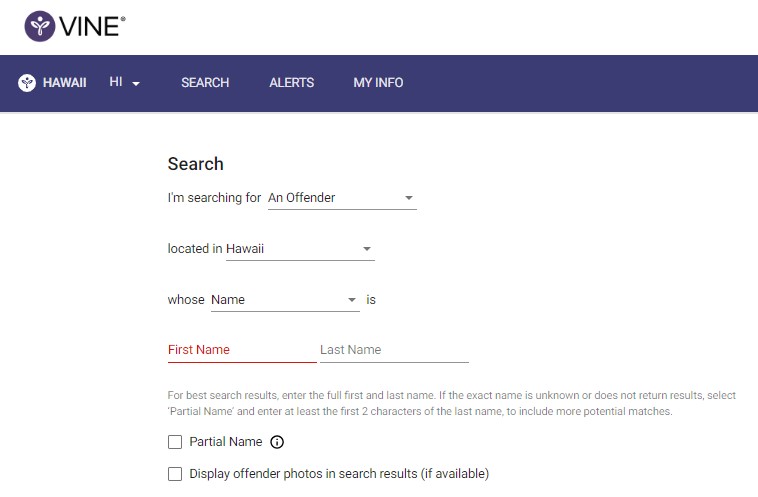
Step 2
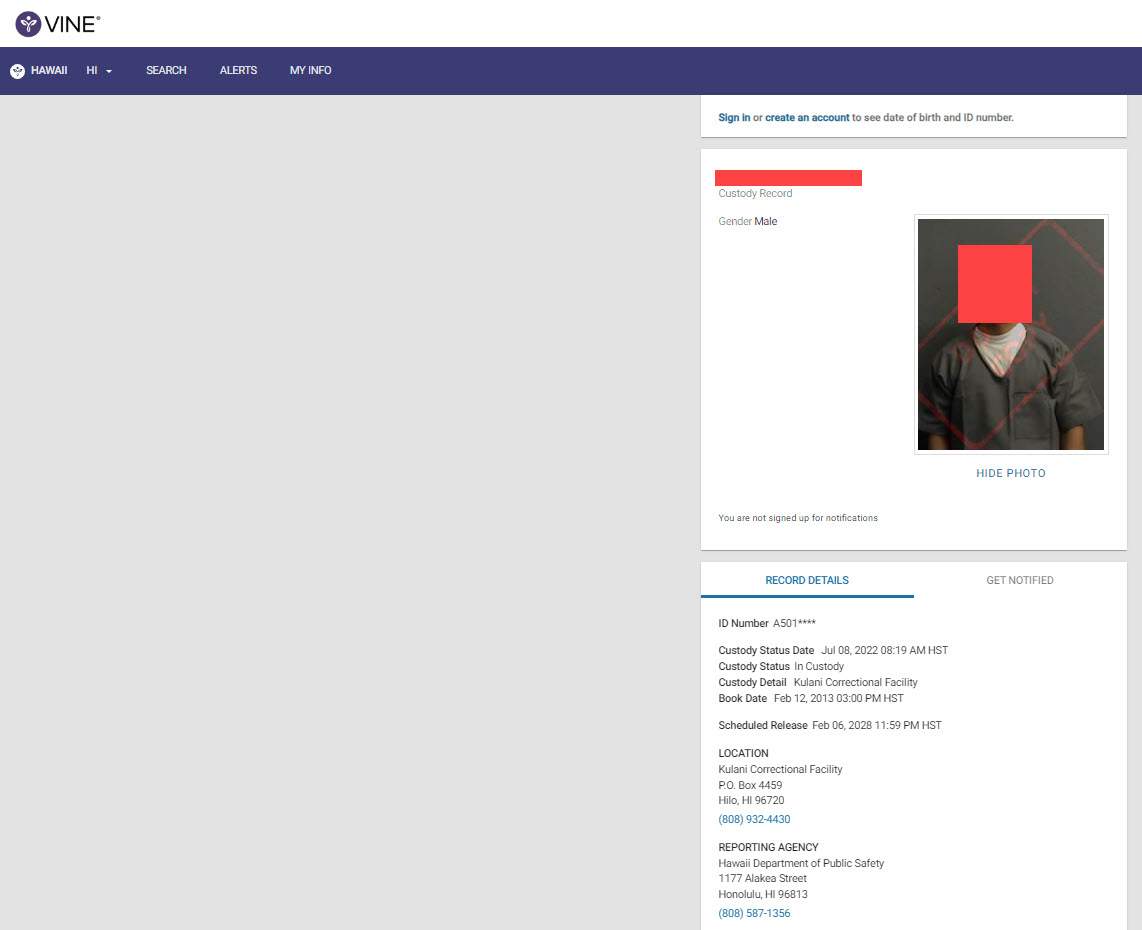
- Review the listing.
- At this stage you can create an account in order to see their Date of Birth, ID #, and be notified if they are moved to another facility, or if they are released.
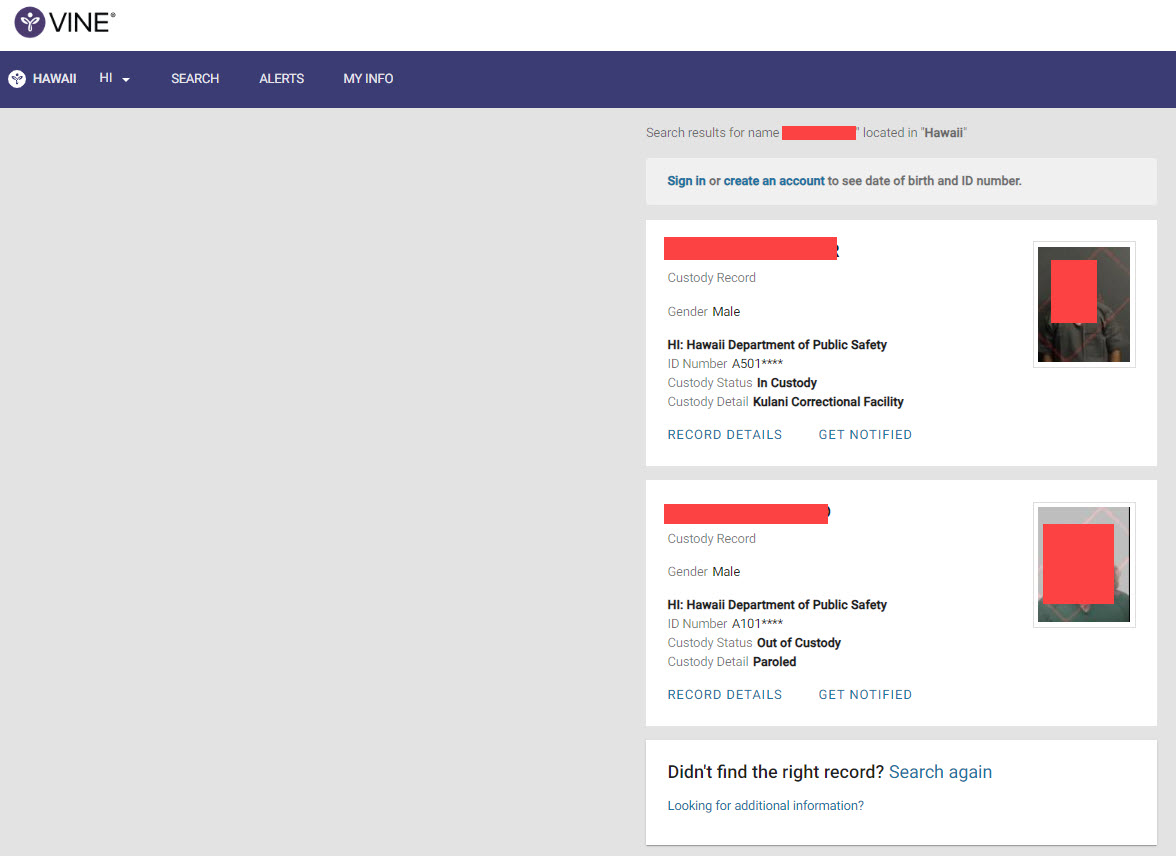
Local Jails in Hawaii
There are no city or county jails in Hawaii.
All offenders, while awaiting court dates for serious crimes, are held in one of Hawaii's State Prisons overseen by the Hawaii Department of Public Safety.
After an arrest, an offender in Hawaii is sometimes held in one of the state facilities until they either pay a bond or bail, which entitles them to be released upon a promise to return to court for their trial, or they are held until their trial.
If an offender is found guilty and is given a sentence of short sentence of a week or two, he or she will do their time in that same state facility.
If they are found guilty and given a longer sentence, they will be remanded to the Hawaii Department of Public Safety - Corrections Division to do their time. The only exception is if their crime is a federal offense. In that case they will be tried in a federal court and if found guilty, will be remanded to a federal prison.
State Inmate
Most states have Department of Corrections websites that allow you to type in a felon's first and last name and pull up inmates in that state.
If you need to find a sentenced inmate serving time in a state other than Hawaii, go here. To find an inmate in Hawaii, just scroll to the top of the page and click on the Inmate Search button.
Once you locate them click next to the inmate's name or on the link provided and it will show you which prison the inmate is housed in. If the inmate is no longer incarcerated, but is on parole/probation or discharged, it will tell you that as well. In addition, many state prison inmate pages show recent mug shots.
Federal Inmate
The federal prison system has its own inmate locator called the Bureau of Prisons Inmate Locator.
Type in the inmate's name and it will tell you where he or she is incarcerated and their projected release date. It also lists released federal prison inmates and the date they were released.
Federal inmates who are moved from one prison to another will show as "No longer in federal custody" on the system until they reach their next federal prison destination. This movement can take a few days to several months to complete, so keep checking back to find out where the inmate was taken.
ICE Inmates
The ICE Detainee Lookup allows friends, family members and interested parties to locate illegal and/or undocumented immigrants that are in the United States without permission.
Has the Inmate been recently arrested?... Try a County Jail
In many cases, the person you are looking for has either not been convicted or sentenced or has been sentenced and is awaiting transport to a State or Federal Prison and is still incarcerated in a City or County Jail.
To locate that person, go here to first find the State, and then the County where they were originally arrested or have been transported to. From there you can begin your search in our databases that contain the names and information of millions of inmates.
Jailexchange.com has all information on every jail and prison in the United States.
Phone
808-932-4430Mailing address (personal mail)
Kulani Correctional Facility (KCF)
HC 01 Box 9
Hilo, HI 96720
Once an inmate is convicted and sentenced for a violation of that state’s felony laws (and their sentence is more than one year in length), they are moved from the City or County Jail and sent to a State Prison in Hawaii. If the violation they are convicted of is a federal crime, they will be sent to a Federal Prison, but will not necessarily be doing their time in Hawaii.
Hawaii State Prisons are operated and maintained by the state government and are used to confine and rehabilitate criminals. State prisons are funded by state tax money. The fund is used to provide food and clothes to inmates and to hire employees to keep the prison running. Inmates in state prison enjoy certain privileges such as TV use and recreation, both indoor and outdoor. The number of privileges allowed depends on the security level of the prison, the inmate and the overall needs of the prison on a specific day.
Hawaii has minimum, medium and maximum security prisons. The Corrections Department in Hawaii also maintains low (or no) security residential settings and camps where inmates assist in state property maintenance and duties such as fighting fires. Almost all prisons provide ‘jobs’ where an inmate can earn a small hourly wage and even learn a trade. Some prisons even contract with call centers and handle phone calls on issues related to their state government. Criminals who have committed a violent crime or killed someone are likely housed in a maximum security prison. If the inmate in these prisons behave, they are also eligible to recreate and/or work as well.
In Hawaii Prisons rehabilitation is the stated goal but the reality is that they exist to punish inmates for their crimes and keep them from hurting or harming innocent people on the outside who follow the laws and live and act responsibly. The fact is that most prison systems are underfunded, overcrowded and are not able to spend time and money rehabilitating offenders. This is not the fault of the people hired to work in prisons, they are just victims of the lack of resources due to budgeting constraints.