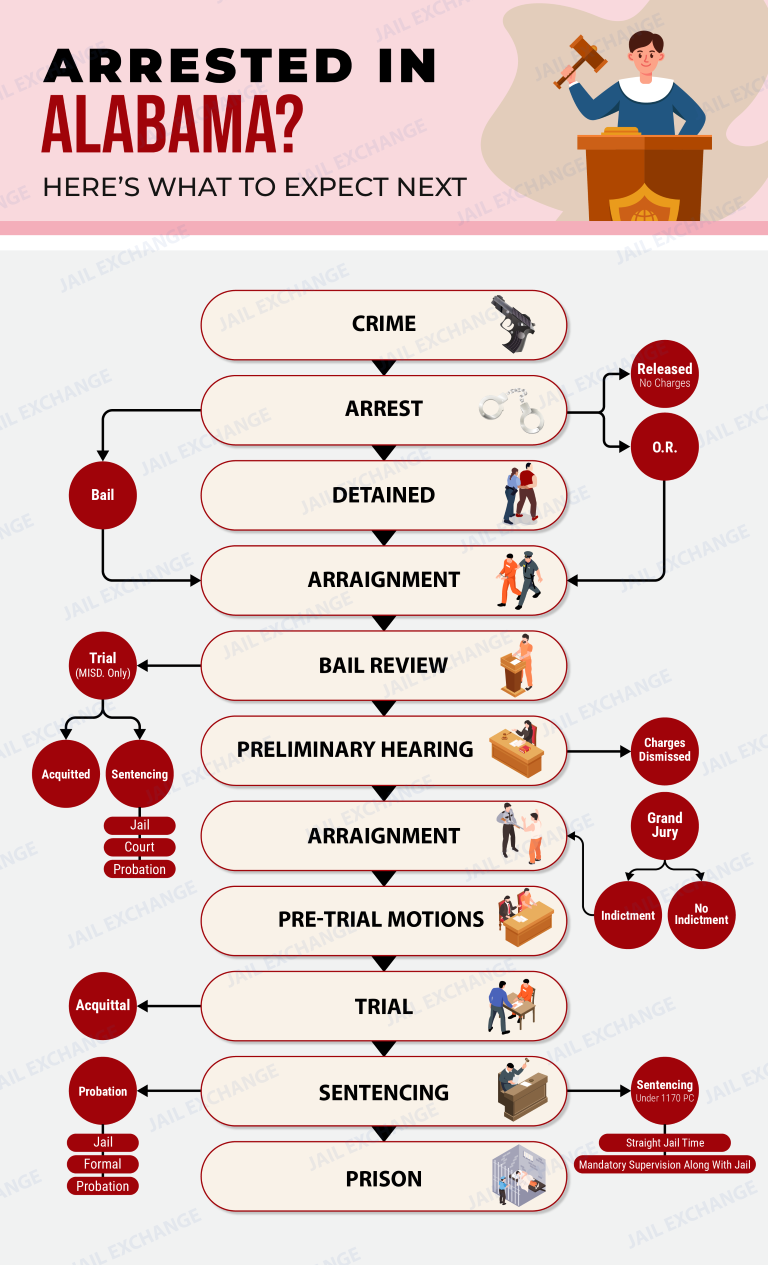
Marshall County Detention Center Criminal Court Process
Criminal Court Process for Marshall County Alabama
Marshall County Criminal Courts: Guntersville and Albertville
State criminal cases in Marshall County are split between two courthouses: the main one in Guntersville, the county seat, at 424 Blount Avenue, Suite 201, Guntersville, AL 35976, and a second at 133 South Emmett Street, Albertville, AL 35950. Adults held on those charges stay at the Marshall County Detention Center, 423 Blount Avenue, Guntersville, AL 35976. Read on for how a charge gets routed, what each hearing does, likely penalties, free lawyers and court records.
A court trip goes better once you know where the defendant is. Check the sheriff’s custody roster by name first. Our page on who is locked up today covers fresh arrests, warrants, charge lists, mugshots and getting belongings back: see the Inmate Search page. A roster entry shows the jail stay, while the clerk’s file follows the prosecution.
For a state case, call the Guntersville clerk at 256-571-7785 or the Albertville clerk at 256-878-4521. Give the defendant’s full name and request the upcoming setting, its room number, and a copy of any release order. Our Marshall bail page covers paying the clerk and then the jail once a bond is set.
1. Which court takes each kind of charge?
Three levels of court handle criminal cases here, and the officer who wrote the charge usually decides where it starts.
- City court: when Boaz, Arab or another town’s officer cites someone inside the city, that town’s municipal judge keeps the case.
- District Court: county misdemeanors brought by deputies or troopers, and the opening steps of each felony.
- Circuit Court: felonies once a Marshall grand jury votes to indict, and jury retrials when a lower-court verdict is appealed.
Marshall is the 27th Judicial Circuit, and its district and circuit judges sit in both Guntersville and Albertville. Look at the ticket or bond slip; the court’s name is printed there. Paper gone? The Guntersville clerk at 256-571-7785 can search by name.
↑ Back to the question list2. Where are the Guntersville and Albertville courthouses?
Both buildings hold Circuit and District Court, and each has a Circuit Clerk office open weekdays from 8:00 a.m. to 4:30 p.m.
- Guntersville: Marshall County Courthouse, 424 Blount Avenue, Suite 201, Guntersville, AL 35976, 256-571-7785. Its district courtroom is up on the second floor. The District Judge’s office line is 256-571-7779.
- Albertville: 133 South Emmett Street, Albertville, AL 35950, 256-878-4521. Here the district courtroom is on the ground floor, and the phone menu has a juvenile option.
A case is filed in one building, not both, so check the hearing notice for the right address before leaving home. The Guntersville courthouse stands right beside the county jail. The clerk’s county court website lists both offices.
↑ Back to the question list3. Which towns here run their own court?
Five cities hold their own municipal court for tickets and misdemeanors their officers write. Each one sets its own docket and bond, and a town judge can give a lawyer to a defendant who has little money and might be sent to jail.
- Albertville Municipal Court, 116 Sand Mountain Drive SW, Albertville, AL 35950, 256-891-8291
- Arab Municipal Court, City Hall, 740 North Main Street, Arab, AL 35016, 256-586-3540
- Boaz Municipal Court, 101 Line Avenue, Boaz, AL 35957, 256-593-6476
- Guntersville Municipal Court, office at 325 Gunter Avenue, Guntersville, AL 35976, with Wednesday court at Town Hall, 340 Blount Avenue, Guntersville, AL 35976, 256-571-7579
- Grant Municipal Court, 4766 Main Street, Grant, AL 35747, 256-728-2007
A person held on a city warrant has to settle it with that city’s court, even when they are sitting in the county jail. For an arrest in Douglas, Union Grove or out in the countryside, the sheriff’s line can say which agency filed it and which court will hear it.
↑ Back to the question list4. What should we expect at a Marshall first appearance?
Picked up with no warrant and still locked up? Within 48 hours, a judge has to decide if police had probable cause. When a warrant brought them in and nobody can pay the bond, the limit stretches to 72 hours. In domestic violence cases, Alabama holds off on setting bail for 24 hours.
When the defendant first stands before the bench, the charge gets read aloud, bond gets reviewed, and asks whether the defendant wants an appointed lawyer. On a misdemeanor, the person may also enter a plea that day. Talking about what happened, in court or on jail phones, can hurt the defense, so wait for a lawyer. For the date and courtroom, call the Albertville clerk at 256-878-4521 or the Guntersville office.
↑ Back to the question list5. How do misdemeanors like BUI or assault play out?
Summer on Lake Guntersville brings boating-under-the-influence arrests on top of the usual DUI, theft and assault cases. A magistrate sets most misdemeanor bonds from the state chart, which families cover with cash, a property pledge or a bondsman.
- Class A misdemeanors, such as third-degree assault, menacing and fourth-degree theft under $500: as long as 12 months locked up, with fines reaching $6,000.
- Class B: six months behind bars at most.
- Class C: three months at most.
- First DUI or BUI: up to one year in jail, with fines starting at $600.
Most of these cases end in a plea deal, diversion or dismissal. A judge, not a jury, decides the rest. The Guntersville clerk, 256-571-7785, can pull the file.
↑ Back to the question list6. How does a felony reach Circuit Court?
Felony suspects from every town in the county are booked at the Blount Avenue jail. At the first appearance a judge reviews bond and names a lawyer for anyone who cannot pay.
- The felony is filed in District Court in Guntersville or Albertville.
- Defense counsel may request a preliminary hearing so a district judge can test the state’s evidence for probable cause.
- Prosecutors present the case to a Marshall grand jury.
- If jurors indict, Circuit Court holds the arraignment.
- Motions follow, and the case ends with a plea, a dismissal or a jury trial.
The preliminary hearing is not a trial on guilt. For the indictment date, ask the Albertville clerk at 256-878-4521 or the Guntersville clerk.
↑ Back to the question list7. What sentences can a Marshall felony bring?
State law ranks felonies by class, from D up to A:
- Class D, which covers many drug possession charges: from one year and one day to five years.
- Class C, which covers vehicle break-ins and third-degree forgery: from one year and one day to ten years.
- Class B, which covers second-degree burglary and first-degree theft: a range starting at 2 years and reaching 20.
- Class A: anywhere from 10 years to 99, and life is possible.
For nonviolent Class C and D offenses, the presumptive sentencing standards often point to probation, Marshall County Community Corrections or a split sentence. Repeat felons face stiffer ranges because of the Habitual Felony Offender Act. Young adults get one break: a defendant still short of 21 when the offense happened may ask for youthful offender treatment. Granting it keeps the file sealed from public view, and the judge can impose no more than three years. Adult probation answers at 256-571-7830.
↑ Back to the question list8. How are violent felony cases handled here?
Violent felony defendants usually stay on Blount Avenue while release is argued. Aniah’s Law lets the 27th Circuit prosecutor request a hearing and ask the judge for no bail on counts like murder, kidnapping, first-degree robbery or burglary. Amendment 1, approved May 19, 2026, brought attempted murder under the same rule, along with gunshots aimed into an occupied dwelling or vehicle. When bond is allowed in these cases, it tends to be high with tight terms.
Attempted murder sits in Class A beside first-degree burglary and robbery, so prison can run from 10 years to 99 or life; when a firearm or deadly weapon is involved, the floor jumps to 20 years. A capital murder conviction leaves only two sentences, death or life without parole. Ask the DA’s office at 256-582-8113 for the hearing schedule.
↑ Back to the question list9. Who prosecutes and who defends?
State charges are prosecuted by the 27th Judicial Circuit District Attorney, 424 Blount Avenue, Suite 208, Guntersville, AL 35976, 256-582-8113. City prosecutors handle cases in each municipal court.
In District, Circuit or city court, a defendant without money for counsel can request an appointed attorney. Expect a sworn financial statement covering paychecks, belongings, bills and the people you support. Under Rule 6.3, a big change in money matters lets the judge reconsider. Many violent felony cases in this county are defended by appointed lawyers.
Montgomery’s Office of Indigent Defense Services, 100 North Union Street, Suite 680, Montgomery, AL 36104, 334-242-7059, oversees appointed counsel statewide. Talk to the appointed lawyer before signing a plea or giving up a preliminary hearing, and keep case details off the recorded jail phones.
↑ Back to the question list10. Where can I look up a Marshall court date?
The clerk’s file is the official record of each hearing. A few ways to reach it:
- Call the Guntersville clerk at 256-571-7785 or the Albertville clerk at 256-878-4521 with the defendant’s name and birth date.
- Visit either office during weekday hours; the public can look at files there for free.
- Search Alacourt Access, the state’s paid records service, where a name search costs $9.99.
- Check the county clerk’s website for office details and notices.
A city charge has its own calendar at that town’s court. Write down the case number, courtroom and time, and plan to get there ahead of the posted start time.
↑ Back to the question list11. How do I check for a Marshall County warrant?
County warrants are served by sheriff’s deputies working from 423 Blount Avenue, Guntersville, AL 35976, who pick up 256-582-2034 at any hour. The sheriff’s Most Wanted page opens after a short notice. For the rest of the state, try the ALEA wanted persons list. Court records sit on Alacourt Access, where name lookups cost $9.99. A city warrant belongs to that town’s court; Albertville’s is at Albertville Municipal Court, 116 Sand Mountain Drive SW, Albertville, AL 35950, 256-891-8291. To reset a missed date, go to the clerk at 424 Blount Avenue, Suite 201, Guntersville, AL 35976, 256-571-7785. Turning yourself in with a lawyer, bond cash in hand, beats a surprise arrest at work.
↑ Back to the question list12. Can a city or district conviction be appealed?
Yes. A conviction from one of the five town courts or from District Court may be taken to Circuit Court, and the notice is due within 14 days. That appeal means a whole new trial, this time with jurors. The case is heard again from the start, so the earlier verdict does not carry over. Appointed counsel is still available on appeal for someone who qualifies.
Fourteen days passes quickly, so call a lawyer the day of the verdict. The notice of appeal is filed through the court that heard the case, and bond on appeal may be set again. For Circuit Court files in Albertville, call 256-878-4521; Guntersville files are at 256-571-7785. Keep a copy of the judgment and every receipt.
↑ Back to the question list13. Where do federal charges from Marshall County go?
Huntsville is where these cases land: the Northeastern Division of Alabama’s Northern District, at the U.S. Courthouse, 660 Gallatin Street SW, Huntsville, AL 35801, 256-534-6495. The county moved into that division in December 2024, when federal court stopped meeting in Gadsden. A case turns federal when the crime breaks a federal law, such as a meth trafficking conspiracy, a felon with a gun, or fraud, or when it happens on Tennessee Valley Authority land around Lake Guntersville or the dam.
A magistrate judge runs the first appearance and any detention hearing under the Bail Reform Act, which weighs flight risk and danger instead of a cash figure. A defendant who cannot pay gets a federal defender or a CJA panel lawyer. The U.S. Marshals Service, 1729 5th Avenue North, Room 240, Birmingham, AL 35203, 205-829-6611, holds federal defendants before trial, sometimes at the Blount Avenue jail.
↑ Back to the question list14. Can ICE affect a Marshall criminal case?
A detainer leaves the criminal charges and the county bond exactly where they were. With Form I-247A, ICE asks the Guntersville jail for as much as 48 extra hours after the county lets go, so its officers have a chance to collect the person. Once that window closes without them, the detainer lapses.
The field office for this area is ICE New Orleans, 181 James Drive W, St. Rose, LA 70087, 504-318-2360. ICE uses Alabama jails for short stays, including Baldwin County Corrections Center, Etowah County Detention Center and Pickens County Detention Facility, and a longer stay often means a move out of the county. Search the online ICE locator by A-number. A defense lawyer should ask an immigration attorney how a plea could affect status.
↑ Back to the question list15. How are juvenile cases handled in Marshall County?
A district judge sits as the juvenile judge. Juvenile Probation, 256-891-9544, handles intake, and the intake officer decides whether the child goes home to family, gets an informal adjustment, or faces a delinquency petition. Youths ordered into secure custody are driven to Anniston, to Coosa Valley Regional Juvenile Detention Center, 4625 McClellan Boulevard, Anniston, AL 36204.
Ala. Code § 12-15-207 gives a held child the right to a detention hearing inside 72 hours. Juvenile court sets no money bail; the judge decides if the teen can safely go home. A child may have a lawyer, free when the family qualifies, and results range from dismissal and probation up to a DYS commitment. Under § 12-15-204, older teens, ages 16 and 17, start in adult court when the charge is capital, Class A, drug trafficking, or any felony where someone was killed or badly hurt or a deadly weapon came into play. Transfer hearings for youths 14 and up fall under § 12-15-203.
↑ Back to the question list16. How is a state prison sentence served?
A sentence longer than twelve months is a state prison term, served under ADOC. The wait for a state bed is spent in the Guntersville jail. Next comes a reception prison; there, officers size up escape risk, gang links, health and mental health, and then assign a permanent prison.
Track the transfer with the ADOC inmate search: type the six-digit AIS number when you know it; a surname also works. Past inmates and youthful offender files will not appear there. After the assignment, our Alabama prison pages explain mail and visits. Federal time is tracked separately, on the Bureau of Prisons locator. For release dates on the county side, call the jail at 256-582-2034.
↑ Back to the question list