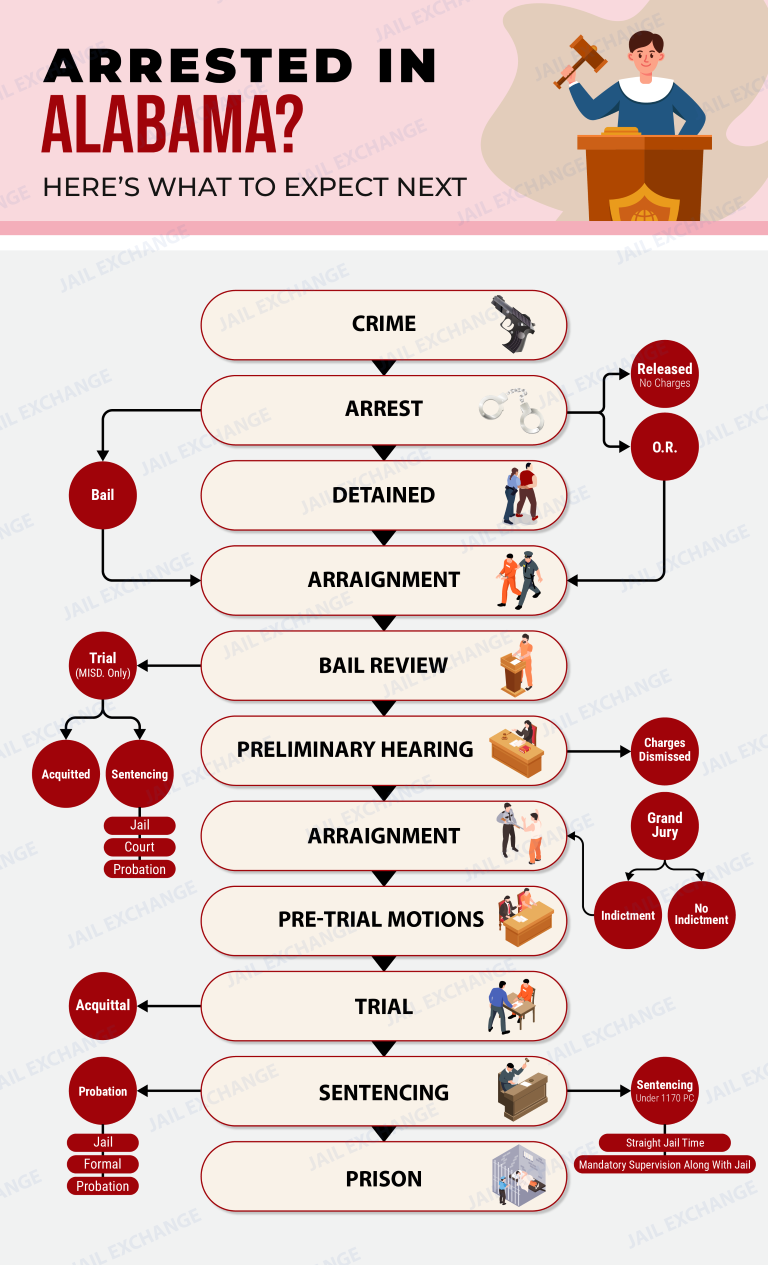
Mobile County Metro Jail Facility Criminal Court Process
Criminal Court Process for Mobile County Alabama
Mobile County Criminal Court Guide
From arraignment to verdict, here is how a criminal case moves in Mobile County. The 13th Judicial Circuit hears state charges at Government Plaza, 205 Government Street, Mobile, AL 36644. Adults who are not released spend the wait at the Mobile County Metro Jail, 450 St. Emanuel Street, Mobile, AL 36603, and many of them appear by video from there.
Before chasing a case number, open the sheriff's current inmate search and confirm the person is still there. Next, our Inmates in Custody page adds help with today's bookings, warrant checks, charge details, mugshots and getting belongings back. Government Plaza clerks search by the legal name together with the date of birth, so have both handy.
Make your first call to the Circuit Clerk at 251-574-8806. Ask three things: the case number, which court owns the charge, and the next appearance. For someone Metro still holds, the bail and bond page on our site sorts out the amounts, the Government Plaza payment windows and what slows a release.
1. Which Mobile courtroom handles which charge?
The 13th Judicial Circuit serves this one county, so state cases from Citronelle down to Dauphin Island all land at Government Plaza, 205 Government Street, Mobile, AL 36644. Cases split up like this:
- City court: a misdemeanor written by a city officer inside that city's police jurisdiction.
- District Court: deputy and trooper misdemeanors, traffic tickets, plus felony preliminary hearings.
- Circuit Court: felony trials, jury trials and rehearings of city or district convictions on appeal.
- Juvenile Court: anyone under 18, unless state law sends the case up to adult court.
Spots with no city government, like Theodore, Grand Bay, Wilmer and Eight Mile, feed their cases to District Court. The Circuit Clerk at 251-574-8806 can say which court has a file.
↑ Back to the question list2. Where are the Government Plaza criminal offices?
The state court offices cluster downtown. Phone first, case number in hand:
- Circuit Clerk: 205 Government Street, Suite 913, Mobile, AL 36644, 251-574-8806, weekdays 8:00 a.m. to 5:00 p.m.
- Circuit criminal desk: 251-574-8430, in the same building, for felonies.
- District Criminal Division: 205 Government Street, Room 338, North Tower, Mobile, AL 36644, 251-574-8511, for misdemeanors, traffic and preliminary hearings.
- District Attorney, 13th Judicial Circuit: 205 Government Street, Mobile, AL 36644, 251-574-8400.
- Public Defender: 151 Government Street, 4th Floor, Mobile, AL 36602, 251-319-6100.
The county court website covers every clerk division that works out of Government Plaza.
↑ Back to the question list3. Which city courts hear local cases?
Besides Government Plaza, eleven cities in the county keep a court for their own ordinance and misdemeanor charges. Use the one printed on the ticket or complaint:
- Mobile Municipal Court: 205 Government Street, 2nd Floor, North Tower, Mobile, AL 36644, 251-208-7055
- Prichard Municipal Court: 216 E. Prichard Avenue, Prichard, AL 36610, 251-452-7800, reached through City Hall
- Chickasaw Municipal Court: 224 N. Craft Highway, Chickasaw, AL 36611, 251-452-6453
- Saraland Municipal Court: 727 Saraland Boulevard South, Saraland, AL 36571, 251-675-5393
- Satsuma Municipal Court: 5464 Old Highway 43, Satsuma, AL 36572, 251-662-5305
- Creola Municipal Court: 9615 Old Highway 43, Creola, AL 36525, 251-675-8148
- Citronelle Municipal Court: 19135 S. Main Street, Citronelle, AL 36522, 251-866-0221
- Mount Vernon Municipal Court: Town Hall, 1565 Boyles Avenue, Mount Vernon, AL 36560, 251-829-6633
- Semmes Municipal Court: City Hall, One Main Street, Semmes, AL 36575, 251-649-8811
- Bayou La Batre Municipal Court: 13785 S. Wintzell Avenue, Bayou La Batre, AL 36509, 251-824-1825
- Dauphin Island Municipal Court: 1011 Bienville Boulevard, Dauphin Island, AL 36528, 251-861-5525
City judges name a lawyer when jail time is possible. A city conviction can be appealed to Circuit Court, where the case starts fresh.
↑ Back to the question list4. How does the first Mobile courtroom visit go?
Time limits come first. Someone held on a warrant goes before a judge or magistrate within 72 hours. For warrantless arrests, probable cause needs a judge's approval within 48 hours. Many Metro Jail prisoners, held at 450 St. Emanuel Street, Mobile, AL 36603, see the judge on a screen instead of riding to Government Plaza.
This first appearance is short. The judge reads the charge, looks at bond, and asks if the person can hire counsel. It is not a trial, so the person should not tell the story of the arrest. Asking for a lawyer is enough. Family can phone the clerk at 251-574-8806 to learn the next date.
↑ Back to the question list5. How do misdemeanors like DUI or shoplifting move forward?
Plenty of misdemeanors begin with a street ticket instead of a booking. After an arrest, release usually comes from the state bond chart, a bondsman, cash, a property pledge or a signed promise. A domestic violence arrest keeps the person at Metro for 24 hours or more first.
- Arraignment: the accusation is read to the defendant, who then pleads. Ask for counsel here.
- Penalties: Class A up to 1 year and $6,000; Class B up to 6 months and $3,000; Class C up to 3 months and $500.
- First DUI: up to 1 year, a $600 to $2,100 fine and a license suspension.
- Class A examples: fourth-degree theft under $500 and second-degree marijuana possession.
- Outcomes: dismissal, DA pretrial diversion, probation, fines, jail or a bench trial.
No jury sits below Circuit Court. An appeal filed within 14 days earns a brand-new trial there.
↑ Back to the question list6. How does a Mobile County felony reach trial?
After booking, a judge sets bond terms and, when needed, appoints counsel. Most felonies then move through four stages:
- A District Court preliminary hearing, if requested, to test probable cause.
- The DA presents the evidence to grand jurors, who decide on an indictment. A defendant may skip that and plead to a written information.
- Circuit Court arraignment, then discovery and motions.
- Either a negotiated plea or a jury trial at Government Plaza.
Sentence ranges: 366 days up to 5 years for Class D, 366 days up to 10 years for Class C, and 2 to 20 years for Class B. Theft of $500 to $1,499 and most simple drug possession count as Class D. Under Alabama's sentencing standards, community corrections or probation is the usual result for a lot of nonviolent Class C and D cases. A record of earlier felonies, though, can trigger the Habitual Felony Offender Act. The felony desk answers at 251-574-8430.
↑ Back to the question list7. Who can ask for youthful offender status?
Defendants under 21 when the crime happened can request youthful offender treatment. When the judge grants it, the court file is sealed from public view, and any sentence is capped at three years.
Timing matters. The lawyer should raise the request early, before any plea is entered. The judge has the final word and can say no. Youthful offender records stay off the state prison search. To start the conversation, the defense lawyer or the family can reach the Public Defender's Office at 151 Government Street, 4th Floor, Mobile, AL 36602, 251-319-6100.
↑ Back to the question list8. How are violent Mobile felony cases different?
Aniah's Law gives the DA a way to ask for no bail at all. After a hearing, a judge may keep someone locked up for murder, first-degree robbery or another crime on the statute's list. The May 19, 2026 amendment widened it to attempted murder and to gunshots fired into a building or car where people are. Anyone who loses the hearing stays at Metro Jail until trial.
- Class A sentences run from 10 years to 99 years or life, with gun minimums on top.
- Capital murder convictions bring death or life without parole.
- Homicides often skip ahead to the grand jury.
- Violent convictions shut out most probation and limit parole.
Capital defendants need death-penalty-qualified counsel, from the Public Defender's Office or appointed lawyers. Prosecution runs through the 13th Judicial Circuit District Attorney, 205 Government Street, Mobile, AL 36644, 251-574-8400.
↑ Back to the question list9. How is a lawyer appointed in Mobile County?
If hiring counsel is out of reach, say so at the first hearing. A judge makes the call after reviewing a sworn statement of income, property, debts and dependents. Once appointed, the Mobile County Public Defender's Office, 151 Government Street, 4th Floor, Mobile, AL 36602, 251-319-6100, handles District and Circuit Court cases. Its income limit is 125 percent of the federal poverty guideline, and the same defender usually stays on as the case climbs from District Court to Circuit Court.
City judges appoint counsel when jail is on the line. Under Rule 6.3, eligibility can be reconsidered if finances change. Statewide questions are answered by the Office of Indigent Defense Services, 100 North Union Street, Suite 680, Montgomery, AL 36104, 334-242-7059.
↑ Back to the question list10. Where can I look up a Mobile court date?
Hearing dates come from the court record, and the jail roster may lag behind. Ways to look one up:
- Phone: the Circuit Clerk at 205 Government Street, Suite 913, Mobile, AL 36644, 251-574-8806. Have the case number ready, or the name plus birth date.
- In person: public terminals at Government Plaza show county files at no charge.
- Online: Alacourt Access sells statewide records, at $9.99 for each case found by name.
- City cases: ring the city court printed on the ticket.
Settings get moved. The day before any trip downtown, check the date, time, courtroom and the purpose of the hearing with the clerk.
↑ Back to the question list11. How can I learn about a Mobile County warrant?
The sheriff's deputies carry out county warrants, based at 510 South Royal Street, Mobile, AL 36603; the front desk number is 251-574-2423. Three lookups help:
- The sheriff's warrant search, by name.
- ALEA's fugitive list, covering wanted people statewide.
- Alacourt Access, which shows filed charges for $9.99 a case.
If a warrant shows up, call a lawyer before walking in. A planned surrender at the Royal Street office, with bond money ready, tends to go far better than an arrest at work. For a fresh court date afterward, the clerk answers at 251-574-8806.
↑ Back to the question list12. Where do federal charges from Mobile County go?
The Southern District of Alabama, Southern Division, handles them at 155 St. Joseph Street, Mobile, AL 36602, 251-690-2371. Alongside drug, gun and fraud cases, its docket picks up Port of Mobile matters brought by the Coast Guard, Customs and Homeland Security Investigations.
- The opening hearing, before a magistrate judge, typically comes the next court day.
- Release follows the Bail Reform Act, with no bail chart and no bondsmen.
- Prosecutors can push for a detention hearing.
- A defendant without money is assigned a federal defender, or a lawyer from the CJA panel.
The U.S. Marshals Service, 155 St. Joseph Street, Suite 201, Mobile, AL 36602, 251-499-6620, chooses the holding jail, often Metro. Federal detainees held there appear on the Metro roster. After sentencing, check the federal inmate locator.
↑ Back to the question list13. Does an ICE detainer pause the Mobile case?
A detainer leaves the state case in place. Local charges still have to be resolved, and any bond still has to be paid. The detainer itself asks Metro for a hold of no more than 48 hours once the county case is done with them, so ICE can take custody. When ICE never arrives, Metro must release on the county charges.
Anyone with a detainer should tell the defense lawyer about it early, before any plea talks. The ICE New Orleans Field Office, 181 James Drive W, St. Rose, LA 70087, 504-318-2360, covers this area. After a transfer, ICE's online locator, searched by A-number and birth country, shows where they went.
↑ Back to the question list14. How are juvenile cases handled in Mobile County?
Anyone under 18 begins at juvenile intake inside the Mobile County Youth Detention Center, 2315 Costarides Street, Mobile, AL 36617, 251-574-1450. That building on Costarides Street also houses Juvenile Court and the secure detention unit.
- Intake picks release to a parent, a formal petition or detention.
- Detained children get a detention hearing within 72 hours, and a juvenile judge sets terms instead of bail.
- A judge may order informal adjustment, probation, counseling or treatment, or a DYS commitment, which puts the Alabama Department of Youth Services in charge.
- Some teens go straight to adult court. At ages 16 and 17, that happens with a capital crime, a Class A felony or drug trafficking. Adult court is also automatic for a felony involving a deadly weapon or dangerous instrument, and for one that causes a death or serious physical injury.
- Children 14 and up can be moved to Circuit Court after a hearing.
Families who cannot pay get a lawyer appointed by Juvenile Court.
↑ Back to the question list15. When does someone leave Metro for state prison?
ADOC, the state corrections system, takes over any sentence longer than a year. The person usually stays at Metro Jail, 450 St. Emanuel Street, Mobile, AL 36603, until ADOC transport arrives. The first state stop is a reception prison. Its staff sort out health care, mental health, custody level and gang concerns, then pick a permanent prison.
To follow along, type a name, or the AIS number with six digits, into the ADOC inmate search, and match the birth date when two names look alike. For visiting rules and mail at the assigned prison, use our state prison directory. To ask whether the person has left the county yet, call Metro at 251-574-6412.
↑ Back to the question list16. How can a family help avoid a missed court date?
Missing a setting can mean a new warrant and the bond money forfeited. Families can help in small, practical ways:
- Write every date, time and courtroom on a calendar at home.
- Register for VINELink custody alerts, which are free, while the person is held.
- Keep the lawyer's number saved in more than one phone.
- Plan the ride downtown with time to spare.
If a conflict comes up, the person or the lawyer should call the court before the hearing, never after. County cases go through the Circuit Clerk, 205 Government Street, Suite 913, Mobile, AL 36644, 251-574-8806. City cases go to the issuing city court, for example the Mobile Municipal Court, 205 Government Street, 2nd Floor, North Tower, Mobile, AL 36644, 251-208-7055.
↑ Back to the question list