Santa Rita Jail - Alameda County Detention Criminal Court Process
Criminal Court Process for Alameda County California
How a Criminal Case Moves Through the Alameda County Courts
Every adult criminal case that starts with an arrest in Alameda County, whether it happens in Oakland, Berkeley, Hayward, Fremont, Livermore or an unincorporated area, is heard by one court: the Superior Court of California, County of Alameda. Back around 2000, municipal courts statewide were folded into each county's superior court, which is why Oakland or Berkeley has no city criminal court of its own. The court’s historic headquarters is the René C. Davidson Courthouse, 1225 Fallon Street, Oakland, CA 94612, beside Lake Merritt, and its main directory line is (510) 891-6000. Criminal cases are spread across four buildings:
- Oakland courthouse, 661 Washington Street, Oakland, CA 94607: most misdemeanor arraignments and trials, and early felony hearings. Criminal clerk: (510) 627-4702
- René C. Davidson Courthouse, 1225 Fallon Street, Oakland: felony motions and trials. Criminal clerk: (510) 891-6009
- East County Hall of Justice, 5151 Gleason Drive, Dublin, CA 94568, next door to Santa Rita Jail: felony arraignments and preliminary hearings, plus East County misdemeanors. Criminal clerk: (925) 227-6792
- Fremont Hall of Justice, 39439 Paseo Padre Parkway, Fremont, CA 94538: South County misdemeanors and criminal trials. Criminal clerk: (510) 818-7501
The courthouse is picked by where police made the arrest and by the charge level. Check the citation or the court’s online case lookup before you drive. Below, open the charge level that fits for the usual steps in Alameda.
- Alameda misdemeanors (shoplifting, a first DUI, battery, trespass)
- Alameda felonies (burglary, grand theft, drug dealing, felony DUI)
- The gravest Alameda cases: homicide, sexual assault, armed holdups
- Alameda County Superior Court buildings and phones
- When an Alameda arrest becomes a federal case
- ICE detainers in Alameda County cases
- Searching for someone held after an Alameda arrest
- Who handles warrants from the Oakland, Hayward and Dublin courts?
1. Alameda misdemeanors (shoplifting, a first DUI, battery, trespass)
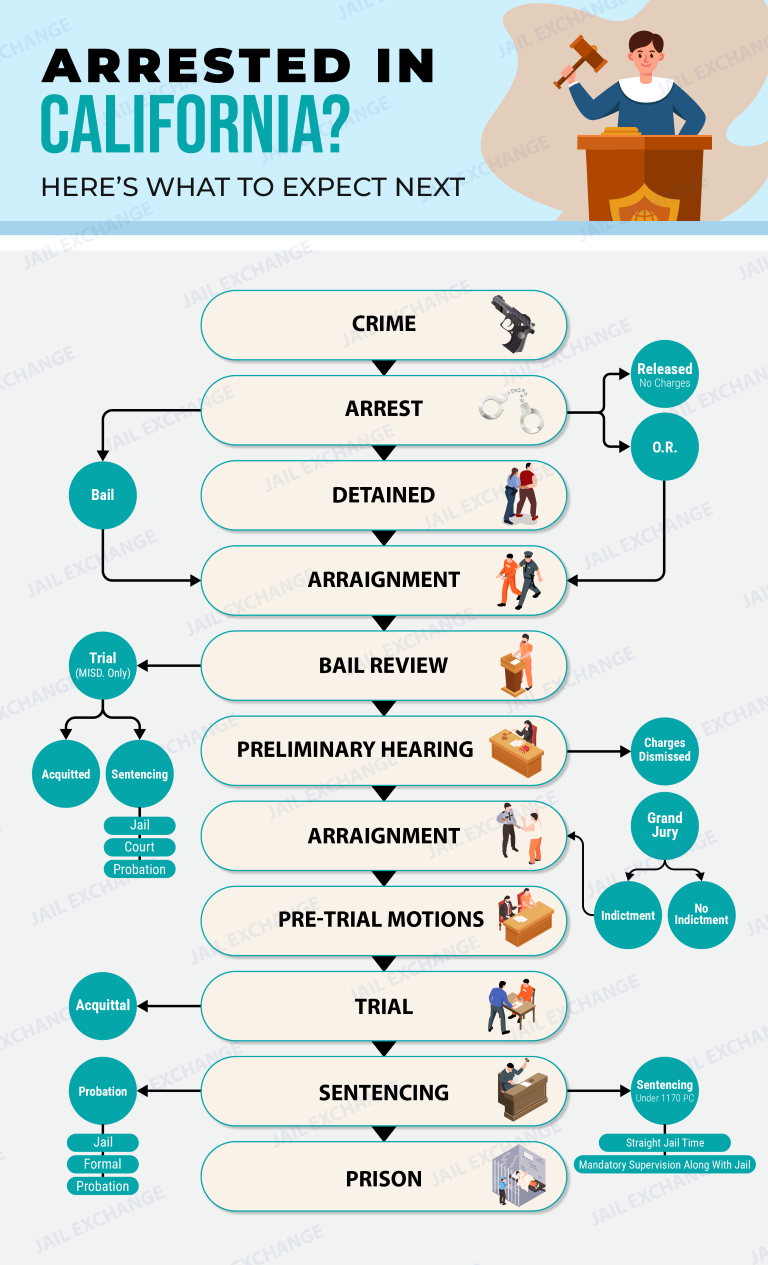
Most misdemeanor arrests in Alameda County never involve a night in jail. Police often write a ticket instead, and the person signs a promise to appear, most likely in Oakland, at the Fremont hall of justice, or at the east county hall of justice in Dublin. Not released after booking? A judge must see the person inside 48 hours, minus Sundays and holidays. The Alameda County District Attorney’s Office files the charges, including for arrests made inside Oakland and Berkeley.
The first hearing is the arraignment. That day the charges are read aloud, a plea goes in (nearly always not guilty early on), and the judge decides release terms. A lawyer is there from day one. The Alameda County Public Defender’s Office, set up under the county charter in 1927, represents anyone facing possible jail time who lacks money for counsel. The state no longer charges defendants for it. For many misdemeanors, a defense lawyer can appear on the defendant’s behalf without the defendant being present.
After arraignment come one or more pretrial conferences, where the large majority of cases are resolved through a plea agreement, a reduction or a dismissal. Many charges qualify for diversion, where finishing classes, counseling or similar terms leads the judge to dismiss the case; DUI, domestic violence and crimes that put a person on the sex-offender registry are excluded. A case that doesn’t settle goes to a 12-person jury. The law gives a defendant the right to a trial within 30 days of arraignment if held in jail, or 45 days if out of custody, although defense attorneys commonly waive that time to prepare.
The usual ceiling is half a year at Santa Rita and $1,000, though a handful allow 12 months. Probation, fines, community service or classes are far more common outcomes. Expect an Alameda misdemeanor to close in a matter of weeks or a few months.
2. Alameda felonies (burglary, grand theft, drug dealing, felony DUI)
Felonies are prosecuted by the Alameda County District Attorney and follow a longer path. Someone held at Santa Rita Jail is usually taken next door to the East County Hall of Justice in Dublin or to the Oakland courthouse in Oakland for arraignment on the complaint within 48 hours of arrest. At that first appearance the judge addresses release or bail. Since the California Supreme Court’s 2021 In re Humphrey decision, a judge setting bail must consider whether the person can actually pay it. In April 2026 the same court added, in In re Kowalczyk, that an Alameda judge may not use an out-of-reach amount to keep someone jailed; bail must generally be attainable.
Counsel is assigned at the start of the case for anyone without the means to hire a lawyer. The public defender handles most felonies. If it has a conflict, like two co-defendants needing separate counsel, the court picks a private lawyer from its approved panel.
The next big stage is the preliminary hearing, where a judge hears evidence and decides whether there is enough to hold the person for trial. It must take place within 10 court days of the arraignment unless the defense agrees to delay it. Prosecutors occasionally go to the county grand jury for an indictment instead, which skips the preliminary hearing. If the case moves forward, the District Attorney files a document called an “information,” the defendant is arraigned a second time, and trial must begin within 60 days unless time is waived. In practice, time is waived in most felony cases, and most end in a plea agreement worked out in one of the felony departments at the René C. Davidson Courthouse or in Dublin.
After a conviction, the county probation department prepares a report, and sentencing generally takes place within 20 court days of a verdict. Since 2011 realignment, lower-level felonies that are not serious or violent are often served at Santa Rita, not in state prison. Certain “wobbler” crimes may start as, or be cut down to, misdemeanors. A felony case in Alameda County commonly takes several months to more than a year from arrest to resolution.
3. The gravest Alameda cases: homicide, sexual assault, armed holdups
In Oakland, Hayward or Dublin, the gravest charges walk the usual felony road: first an arraignment, then a preliminary hearing (or an indictment), and last a trial. The difference lies in the penalties and the longer timeline. An Alameda judge can hold someone with no bail on a violent or sexual-assault felony if clear and convincing evidence shows release would likely lead to serious injury to someone. As a result, many people charged with these crimes in Alameda County remain at Santa Rita Jail for the life of the case.
These offenses count as “serious” or “violent” strikes under California’s Three Strikes law. With one earlier strike the term is doubled; with two, it can reach 25 to life. After a violent felony conviction, at least 85% of the prison term has to be served.
- Murder: second-degree murder carries 15 years to life, and first-degree murder carries 25 years to life. Add “special circumstances,” like a murder committed in a robbery or rape, and the sentence becomes death or life with no parole. Seeking death is the District Attorney’s call alone, and the state has paused executions since 2019.
- Armed robbery: robbery itself carries up to nine years. A gun adds 10 years when used, 20 when fired, or 25 to life when it causes great bodily injury. Judges gained power in 2018 to drop those add-ons.
- Rape: up to eight years, and longer with aggravating factors, plus registration as a sex offender at the highest tier.
Defense representation in these cases often comes from specialized units. Homicides go to the public defender’s senior trial lawyers, and a death-penalty case gets two qualified attorneys by court order. Marsy’s Law gives victims a right to hear about hearings, to speak at sentencing and to get restitution; the District Attorney’s Victim-Witness Assistance Division can be reached at (510) 272-6180. Investigation, expert witnesses and defense prep push these to one to three years, and a murder can top five.
4. Alameda County Superior Court buildings and phones
Courtrooms are spread across Oakland, the bay shore and the valley towns. Jail cases from Santa Rita often appear in Dublin or at Washington Street in Oakland.
- Shoreline hall of justice in Alameda: 2233 Shore Line Drive, Alameda, CA 94501 · 510-891-6005
- Berkeley courthouse: 2120 Martin Luther King Jr. Way, Berkeley, CA 94704 · 510-647-4439
- East County hall of justice: 5151 Gleason Drive, Dublin, CA 94568 · 925-227-6700
- Fremont hall of justice: 39439 Paseo Padre Parkway, Fremont, CA 94538 · 510-818-7500
- Hayward hall of justice: 24405 Amador Street, Hayward, CA 94544 · 510-690-2700
- Fallon Street courthouse (main civil and family): 1225 Fallon Street, Oakland, CA 94612 · 510-891-6000
- Washington Street criminal courthouse: 661 Washington Street, Oakland, CA 94607 · 510-627-4700
- Fairmont mental health court: 2060 Fairmont Drive, San Leandro, CA 94578 · 510-891-6332
- Juvenile justice center courts: 2500 Fairmont Drive, Suite C3013, San Leandro, CA 94578 · 510-618-1106
5. When an Alameda arrest becomes a federal case
Federal crimes from Alameda County are filed in the Oakland division of the Northern District of California. The Superior Court and county bail rules are left out entirely. The case usually moves like this:
- The first hearing is in front of a magistrate judge at Oakland federal courthouse, 1301 Clay Street, Oakland, CA 94612.
- Pretrial Services interviews the defendant and recommends release or detention.
- At the detention hearing, the judge looks at the charge, history and ties to the area. The government may ask for a three-day delay and the defense a five-day delay.
- If held, the person stays in a Marshals contract jail until trial or plea.
Families with questions about housing for a federal prisoner can reach U.S. Marshals Service, 1301 Clay Street, Oakland, 510-637-3666.
6. ICE detainers in Alameda County cases
An ICE detainer is paperwork, not a warrant signed by a judge, and it asks for up to two extra days of holding after release, with weekends or holidays left out. California's SB 54 stops Alameda's jail from honoring that hold, and only certain serious or violent convictions allow a release-date notice. A detainer does not change the Superior Court case or its dates, though a guilty plea can have immigration effects, so share status with the defense lawyer early.
The TRUTH Act gives the person a written choice before any ICE interview in the jail. Cases are run by San Francisco ICE field office, 630 Sansome Street, Room 590, San Francisco, CA 94111, 415-365-8800, and detention sites used for this area include:
- Mesa Verde ICE Processing Center: 425 Golden State Avenue, Bakersfield, CA 93301
- Golden State Annex: 611 Frontage Road, McFarland, CA 93250
- California City detention site: 22844 Virginia Boulevard, California City, CA 93505
7. Searching for someone held after an Alameda arrest
- Alameda County Inmate Search: put in last and first name. You get housing, charges, bail and court date. Blank result early on can mean booking is still underway at a city jail.
- VINELink (https://vinelink.vineapps.com/): pick California, then a name or booking number. It lists where people are held in many counties. Retry with a short spelling if nothing comes back.
- Federal Bureau of Prisons Inmate Locator (https://www.bop.gov/inmateloc/): type a register number or full name. Pretrial federal people may not show, so phone 510-637-3666.
- CDCR Inmate Locator (https://inmatelocator.cdcr.ca.gov/): name or CDCR number gives the prison, after transfer.
- ICE Online Detainee Locator System (https://locator.ice.gov/odls/): A-number with birth country, or name with birth country. Minors are left out. Call 415-365-8800 if nothing appears.
8. Who handles warrants from the Oakland, Hayward and Dublin courts?
Most warrants signed in these courtrooms are carried by Sheriff's deputies, who confirm status by phone at (510) 667-7721 once you give a legal name and birth date. That same call picks up statewide hits. You can read the case yourself in the Superior Court's criminal case portal, and any bench warrant appears on its docket. The criminal clerk's office on Washington Street, downtown, gives out fresh court dates. Many people then walk into Santa Rita Jail on Broder Boulevard in Dublin with a defense lawyer and settle the matter there, while others have counsel file a motion to recall it first.
This is a general picture of Alameda criminal cases, not legal advice. Someone charged can hire a defense lawyer or call the Alameda County Public Defender at (510) 272-6600.