Navigating the Los Angeles County Criminal Courts
Los Angeles County runs the largest trial court in the United States, with dozens of courthouses spread from Lancaster to Long Beach and from Malibu to Pomona. All of them belong to one institution, the Superior Court of California, County of Los Angeles. California eliminated its municipal courts around 2000 by merging them into a single superior court in each county, so even a misdemeanor filed in the City of Los Angeles is a superior court case, not a “city court” matter. The flagship criminal building is the downtown Criminal Justice Center, 210 W. Temple Street, Los Angeles, CA 90012, named for California’s first woman lawyer and the person who first championed the idea of a public defender. County listings give its felony intake line as (213) 893-0751 and its misdemeanor intake line as (213) 974-1568. Next door to the downtown jails, the Central Arraignment Courts at 429 Bauchet Street, Los Angeles, CA 90012 handle many in-custody first appearances.
Outside downtown, criminal cases are heard in regional courthouses close to where the arrest happened. Some of the major ones:
- Airport Courthouse, 11701 S. La Cienega Boulevard, Los Angeles, CA 90045 (West District)
- Van Nuys Courthouse West, 14400 Erwin Street Mall, Van Nuys, CA 91401, and San Fernando Courthouse, 900 Third Street, San Fernando, CA 91340 (San Fernando Valley)
- Antelope Valley Courthouse, 42011 4th Street West, Lancaster, CA 93534 (North District)
- Pasadena Courthouse, 300 E. Walnut Street, Pasadena, CA 91101 (Northeast District)
- Pomona Courthouse South, 400 Civic Center Plaza, Pomona, CA 91766 (East District)
- Compton Courthouse, 200 W. Compton Boulevard, Compton, CA 90220 (South Central District)
- Long Beach Courthouse, 275 Magnolia Avenue, Long Beach, CA 90802 (South District)
- Torrance Courthouse, 825 Maple Avenue, Torrance, CA 90503 (Southwest District)
- Norwalk Courthouse, 12720 Norwalk Boulevard, Norwalk, CA 90650 (Southeast District)
Many other branch courthouses also hear misdemeanors, so rely on the courthouse and department printed on your citation or bail paperwork, and use the court’s online location finder for directions and phone numbers. Pick a charge level below to read more.
- Misdemeanor charges (petty theft, a first DUI, simple battery, trespassing)
- Felony charges (burglary, grand theft, selling drugs, felony DUI)
- Violent and serious felonies (murder, rape, armed robbery)
- Every Los Angeles Superior Court courthouse, with phone numbers
- How a federal criminal case moves through court in Los Angeles
- ICE detainers and Los Angeles County courts
- Looking someone up after an arrest anywhere in Los Angeles County
Misdemeanor charges (petty theft, a first DUI, simple battery, trespassing)
Who prosecutes a misdemeanor in Los Angeles County depends on the city where it happened. Inside the City of Los Angeles, the Los Angeles City Attorney files the charges. Long Beach has its own elected City Prosecutor, and Santa Monica, Pasadena, Burbank, Glendale, Inglewood, Torrance, Redondo Beach and Hermosa Beach also prosecute their own misdemeanors. Everywhere else, including unincorporated areas patrolled by the Sheriff’s Department, the Los Angeles County District Attorney handles them.
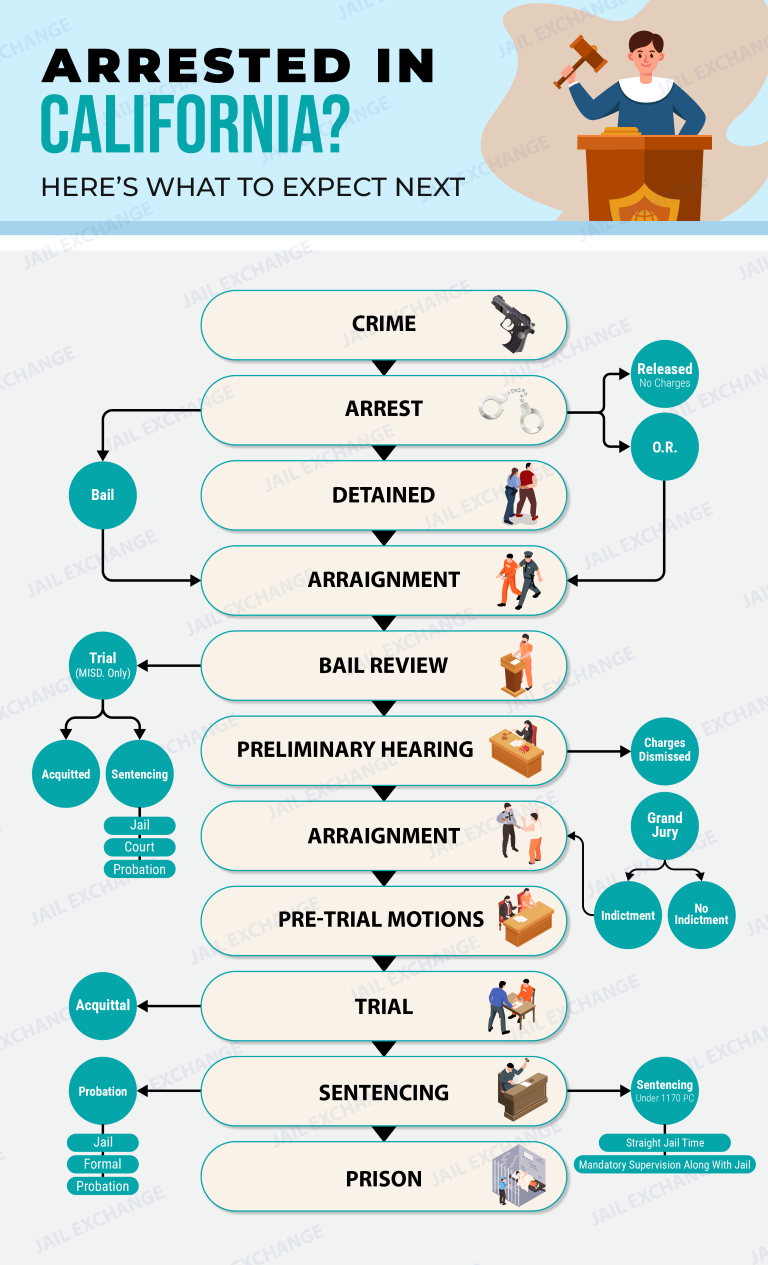
A large share of misdemeanor arrests end with a citation rather than a booking. He signs a promise to come back and gets a court date at the local courthouse. Someone who is booked, whether at a police station jail or the Sheriff’s Inmate Reception Center downtown, have an arraignment inside two days, a window that leaves out Sundays and holidays.
At arraignment the defendant hears the charges, usually pleads not guilty and learns the release terms. People who can’t afford a private lawyer and face possible jail are represented by the Los Angeles County Public Defender, the first government-run public defender office in the country, founded in 1914. California courts no longer charge defendants for appointed counsel. Under state law, a defense lawyer can often appear for a misdemeanor client who isn’t present.
Most misdemeanors are settled at pretrial conferences through a plea, a reduction or a dismissal. A judge may grant misdemeanor diversion, dismissing the charge once the person completes counseling, classes or other terms; DUI, domestic violence and offenses requiring sex-offender registration are excluded. Twelve jurors hear any trial. A jailed defendant can demand trial within 30 days of arraignment, or 45 if released, but most give up that deadline.
Most misdemeanors are capped at six months in county jail and a $1,000 fine; some allow up to a year. Summary probation, fines, community labor and classes are the typical outcomes. The whole process usually lasts anywhere from a few weeks to a few months.
Felony charges (burglary, grand theft, selling drugs, felony DUI)
City prosecutors stop at misdemeanors. Every felony in the county, including those arising in Los Angeles, Long Beach and Pasadena, is filed by the Los Angeles County District Attorney. A defendant held in custody is arraigned on the felony complaint within 48 hours, either downtown at the Central Arraignment Courts or the downtown Criminal Justice Center, or at the regional courthouse for the district where the arrest occurred. Release and bail are decided there. Since In re Humphrey (2021), the California Supreme Court has required judges to consider a person’s ability to pay before setting bail. In April 2026 the court added, in In re Kowalczyk, that money bail in Los Angeles and statewide must generally be attainable, so an unpayable amount cannot replace a lawful no-bail hearing.
Indigent defense in Los Angeles has three layers. The Public Defender takes most appointments at arraignment. A conflict sends the case to LA’s Alternate Public Defender. If that office is blocked too, a panel lawyer under county contract steps in.
The preliminary hearing comes within 10 court days of arraignment unless the defense waives the deadline. The judge hears the proof and rules on whether the case goes on to trial. The District Attorney sometimes goes to the county criminal grand jury instead, especially in high-profile cases, which replaces the preliminary hearing. Once a case is held to answer, the DA files an “information,” a second arraignment follows, and trial must start within 60 days unless time is waived. Waivers are the norm, and pleas resolve the great majority of felonies.
The Los Angeles County Probation Department writes a presentence report after a conviction, and sentencing usually occurs within 20 court days. Many lower-level felonies are served in county jail under 2011 realignment, and “wobblers” may be charged or reduced as misdemeanors. The county also operates a broad set of collaborative courts, such as drug, veterans and mental health courts, that can offer treatment-based alternatives for eligible defendants. A felony case usually takes several months and often more than a year.
Violent and serious felonies (murder, rape, armed robbery)
Many of the county’s homicide and major-crime trials take place at the downtown Criminal Justice Center downtown, though regional courthouses try serious cases as well. The procedure is the familiar felony sequence of arraignment, preliminary hearing or grand jury indictment, and trial. Bail is the first place the difference shows. Under article I, section 12 of the California Constitution, a judge can deny bail for a violent or sexual-assault felony on clear and convincing evidence that releasing the person carries a substantial likelihood of great bodily harm to others. Defendants in these cases frequently remain in the Sheriff’s custody until verdict.
These offenses qualify as strikes. A prior strike doubles the sentence, and two prior strikes can bring 25 years to life. For violent felonies, no less than 85% of the prison sentence has to be served.
- Murder: 15 years to life for second degree; 25 years to life for first degree. With a special circumstance, such as murder during a robbery or rape, the possible penalties are life without parole or death. Seeking death is solely the District Attorney’s decision, and California has been under an execution moratorium since 2019.
- Armed robbery: up to nine years on the robbery. Gun add-ons bring 10 more years when a firearm is used, 20 when fired, and 25 to life when someone suffers great bodily injury. Judges have had authority to strike those enhancements since 2018.
- Rape: up to eight years, more with aggravating factors, plus sex-offender registration at the highest tier.
Experienced trial lawyers from the Public Defender and Alternate Public Defender handle many of these cases, and two qualified attorneys are appointed whenever the prosecution seeks death. In LA, Marsy’s Law means a victim hears about each hearing, may speak before sentence and can get repaid. Lab work, experts and long investigations mean most of these cases last between one and three years. Murder trials in LA often need five or more.
Every Los Angeles Superior Court courthouse, with phone numbers
Criminal, juvenile and family cases in Los Angeles are split among the buildings below. Jail arraignments mostly begin on Bauchet Street, and later hearings shift to the courthouse covering the neighborhood or city where the arrest happened. Big trials and many felonies are heard on Temple Street.
- Central arraignment courthouse: 429 Bauchet Street, Los Angeles, CA 90012 · 213-617-5600
- Criminal justice center: 210 West Temple Street, Los Angeles, CA 90012 · 213-628-7700
- Civil courthouse on Hill Street: 111 North Hill Street, Los Angeles, CA 90012 · 213-830-0800
- Spring Street courthouse: 312 North Spring Street, Los Angeles, CA 90012 · 213-310-7000
- Metropolitan courthouse: 1945 South Hill Street, Los Angeles, CA 90007 · 213-745-3200
- Hollywood courthouse: 5925 Hollywood Boulevard, Los Angeles, CA 90028 · 323-441-1800
- East Los Angeles courthouse: 4848 East Civic Center Way, Los Angeles, CA 90022 · 323-881-5800
- Eastlake juvenile courthouse: 1601 Eastlake Avenue, Los Angeles, CA 90033 · 323-227-4399
- Children's court (Monterey Park): 201 Centre Plaza Drive, Monterey Park, CA 91754 · 323-307-8000
- Airport courthouse: 11701 South La Cienega Boulevard, Los Angeles, CA 90045 · 310-725-3000
- Alhambra courthouse: 150 West Commonwealth Avenue, Alhambra, CA 91801 · 626-293-2100
- Bellflower courthouse: 10025 East Flower Street, Bellflower, CA 90706 · 562-345-3300
- Beverly Hills courthouse: 9355 Burton Way, Beverly Hills, CA 90210 · 310-281-2400
- Burbank courthouse: 300 East Olive Avenue, Burbank, CA 91502 · 818-260-8400
- Catalina courthouse: 215 Sumner Avenue, Avalon, CA 90704 · 562-256-3100
- Chatsworth courthouse: 9425 Penfield Avenue, Chatsworth, CA 91311 · 818-407-2200
- Compton courthouse: 200 West Compton Boulevard, Compton, CA 90220 · 310-761-4300
- Downey courthouse: 7500 East Imperial Highway, Downey, CA 90242 · 562-658-0500
- El Monte courthouse: 11234 East Valley Boulevard, El Monte, CA 91731 · 626-401-2200
- Glendale courthouse: 600 East Broadway, Glendale, CA 91206 · 818-265-6400
- Inglewood courthouse: One Regent Street, Inglewood, CA 90301 · 310-419-1300
- Inglewood juvenile courthouse: 110 Regent Street, Inglewood, CA 90301 · 310-412-8301
- Antelope Valley courthouse: 42011 4th Street West, Lancaster, CA 93534 · 661-483-5500
- Lancaster juvenile justice center: 1040 West Avenue J, Lancaster, CA 93534 · 661-483-5924
- Long Beach courthouse: 275 Magnolia Avenue, Long Beach, CA 90802 · 562-256-3100
- Norwalk courthouse: 12720 Norwalk Boulevard, Norwalk, CA 90650 · 562-345-3700
- Pasadena courthouse: 300 East Walnut Street, Pasadena, CA 91101 · 626-396-3300
- Pomona courthouse south: 400 Civic Center Plaza, Pomona, CA 91766 · 909-802-1100
- San Fernando courthouse: 900 Third Street, San Fernando, CA 91340 · 818-256-1800
- Santa Clarita courthouse: 23747 West Valencia Boulevard, Santa Clarita, CA 91355 · 661-253-5600
- Santa Monica courthouse: 1725 Main Street, Santa Monica, CA 90401 · 310-255-1840
- Sylmar juvenile courthouse: 16350 Filbert Street, Sylmar, CA 91342 · 818-256-1180
- Torrance courthouse: 825 Maple Avenue, Torrance, CA 90503 · 310-787-3700
- Van Nuys courthouse east: 6230 Sylmar Avenue, Van Nuys, CA 91401 · 818-901-4600
- Van Nuys courthouse west: 14400 Erwin Street Mall, Van Nuys, CA 91401 · 818-989-6900
- West Covina courthouse: 1427 West Covina Parkway, West Covina, CA 91790 · 626-430-2600
- Whittier courthouse: 7339 South Painter Avenue, Whittier, CA 90602 · 562-968-2699
Courtrooms are called departments. Your notice or the online case search will name both the building and the department number, and the clerk's office for that building can confirm it by phone.
How a federal criminal case moves through court in Los Angeles
Federal crimes from anywhere in the county, from Lancaster down to Long Beach and out to Pomona, belong to the Western Division of the Central District of California. The Superior Court plays no part, and state bail rules do not apply. Families usually see these steps:
- Initial appearance: usually by the next court day, the person stands before a magistrate judge at First Street U.S. Courthouse, 350 West 1st Street, Los Angeles, CA 90012. The judge goes over the charges, tells him his rights, and assigns a federal public defender if needed.
- Pretrial Services report: before that hearing, an officer interviews the defendant and checks his history, then gives the judge a release recommendation.
- Detention hearing: under the Bail Reform Act, the judge decides whether any set of conditions can make sure he comes back and keeps the public safe. The prosecutor may ask to delay this by up to three days and the defense by up to five.
- Arraignment and later dates: a plea is entered and the case goes to a district judge for motions, plea talks or trial.
- Other federal building: more district judges and federal offices sit at 255 East Temple Street, Los Angeles, so some later hearings may be held there.
Federal defendants who are not released are held mainly at the Metropolitan Detention Center, 535 N Alameda St, Los Angeles (213-485-0439). For questions about where a pretrial prisoner is housed or moved, contact U.S. Marshals Service, 350 West 1st Street, Suite 3001, Los Angeles, 213-620-7676.
ICE detainers and Los Angeles County courts
An ICE detainer is a paper sent to the jail, not an order from a judge. It asks the Sheriff to report a release date and to hold the person up to 48 extra hours, not counting weekends and holidays, under 8 CFR 287.7. In California, SB 54 bars the Sheriff from that extra holding, and it limits release-date notices to people with certain serious or violent convictions.
For the court case itself, a detainer does not change the charges, the judge or the hearing dates. It can matter a lot for pleas, because some convictions carry harsh immigration results. California law expects defense lawyers to advise clients on that, so tell the lawyer early about the person's immigration status.
Before any ICE interview inside the jail, the TRUTH Act requires a written notice that the interview is voluntary and that a lawyer can be present. Immigration cases in this area are handled from Los Angeles ICE field office, 300 North Los Angeles Street, Room 7631, Los Angeles, CA 90012, 213-830-7911, and people are mostly held at:
- Adelanto ICE Processing Center: 10400 Rancho Road (East) and 10250 Rancho Road (West), Adelanto, CA 92301 · 760-561-6100
- Desert View Annex: 10400 Rancho Road, Adelanto, CA 92301
Immigration court hearings are a separate federal system with their own judges. They are not part of the Los Angeles Superior Court case.
Looking someone up after an arrest anywhere in Los Angeles County
Courts do not keep a list of who is in custody. Use these searches instead, starting with the county one:
- Sheriff and city lockups: Los Angeles County Inmate Search covers the Sheriff's jails and LAPD jails. Enter a last and first name, and a birth date if you have it. The record lists the facility, the charge, bail and the next hearing with its courthouse. An empty result in the first hours can just mean booking is not finished.
- VINE custody lookup: at VINELink (https://vinelink.vineapps.com/), pick California, then search by name or ID number. It shows who is held and where across many California jails, so it helps when you are not sure which county made the arrest. If there is no match, try other spellings later.
- Federal prisoners: at the Federal Bureau of Prisons Inmate Locator (https://www.bop.gov/inmateloc/), enter the register number or a full name. It lists the federal site and expected release date. Pretrial prisoners may not show up at all, so call the Marshals at 213-620-7676.
- State prison: at the CDCR Inmate Locator (https://inmatelocator.cdcr.ca.gov/), use the CDCR number or a last and first name. It shows the prison and arrival date, but only after transfer out of county custody.
- Immigration detention: at the ICE Online Detainee Locator System (https://locator.ice.gov/odls/), enter the A-number and country of birth, or the full name and country of birth. It names the center and gives its contact details. It leaves out anyone under 18. If no match appears after two days, phone 213-830-7911.
This summary of how Los Angeles County criminal cases generally proceed is general, not legal advice. For advice on an actual LA charge, hire defense counsel; for help with appointed counsel call the Los Angeles County Public Defender at (213) 974-2811 (the Alternate Public Defender’s main office is (213) 974-6626).