
LA COUNTY JAIL - Nidorf Juvenile
LA COUNTY JAIL - Nidorf Juvenile
Physical Address
16350 Filbert StreetSylmar, CA 91342
Jail Phone Number
818-364-2011Someone was arrested in Los Angeles County: how to find them in the largest jail system in the country
An arrest in this county can land a person in a Sheriff's jail or in a city lockup, so you may need to check more than one place. Most Sheriff's bookings go through the Inmate Reception Center, 450 Bauchet Street, Los Angeles, CA 90012. Men's Central Jail and Twin Towers sit nearby, women go to Century Regional Detention Facility in Lynwood, and the Castaic jails hold others. LAPD, Long Beach and other cities run short-stay jails.
Use the Sheriff's inmate search with a last and first name. It also covers LAPD lockups, and a match shows the booking number, where the person is held, bail so far and the next court date.
No match? Call the 24-hour line at 213-473-6100 and ask where the person is. Once you have a booking number, see our bail page and court page.
Read inmate search answers
 Read inmate search answers
1. Who has the person right now: a city police jail or the Sheriff?
That depends on who made the arrest. An LAPD officer takes an adult to one of the department's three jails: the Metropolitan Detention Center downtown at 180 North Los Angeles Street (213-356-3400), the 77th Street Regional Jail at 7600 South Broadway (323-786-5541), or the Valley Jail Section inside the Van Nuys station at 6240 Sylmar Avenue (818-374-9645). Deputies from a sheriff's station, and officers from many smaller cities, start with the station lockup. Long Beach, Pasadena, Glendale, Santa Monica, Burbank, Torrance and other cities with their own departments run their own jails.
A city or station jail is a short stop, usually a day or two. Anyone who isn't released and still needs to see a judge gets put on a bus to the Sheriff's booking center downtown. That's why a person can show one location in the morning and another by night.
Back to questions ↑2. How do I look someone up in the Sheriff's system?
Open Los Angeles County Inmate Search and enter a last name and first name. Adding a birth date narrows a common name a lot. The result shows the booking number, where the person is housed, the bail set so far, the next court date and courthouse, and a release date if one exists. The Sheriff warns that bookings less than two hours old aren't in the system yet.
When the search comes up empty, call 213-473-6100 and can also check LAPD's jails. Keep the booking number once you find it; mail, visits, money and court all run on that number.
Back to questions ↑3. What is the Inmate Reception Center?
It's the Sheriff's central booking point, at 450 Bauchet Street, just east of Union Station and north of the 101 freeway. Nearly every adult who will stay in county custody passes through it: fingerprints, photos, warrant checks, a medical and mental health screening, a property inventory and a classification interview that decides where the person will live. It's a processing hub, not housing, and there are no visits there.
The building is famous for long waits. On a busy weekend a person can spend many hours in its holding areas before getting a bed assignment. Releases also go out through this center, so families waiting on a release should be ready for a long night.
Back to questions ↑4. Which Sheriff's jail houses men?
After booking, most men go to one of these:
- Men's Central Jail, 441 Bauchet Street, the oldest and largest of the downtown jails, main lobby 213-974-4082
- Twin Towers Correctional Facility, 450 Bauchet Street, which holds people with mental health and medical needs along with the booking center, 213-893-5100
- The north county jail complex in Castaic, off The Old Road near Interstate 5: its North and South facilities and the North County Correctional Facility, all reached through 661-295-8840
The county has voted to close Men's Central Jail, but it is still operating, and it still houses thousands. Where a man lands depends on his charges, health and security level, and he can be moved without warning. See the pages for Men's Central Jail, Twin Towers, North County Correctional Facility and the Castaic north facility.
Back to questions ↑5. Where are women held?
Women arrested anywhere in the county go to the Century Regional Detention Facility, 11705 South Alameda Street, Lynwood, CA 90262, beside the Century Sheriff's Station at 11703 South Alameda Street (323-568-4800). The main number is 323-357-5100. It is the county's women's jail: it books women, houses them before trial and after sentencing, and runs its own visiting schedule. Women are not sent to the Bauchet Street buildings for housing.
Back to questions ↑6. Which sheriff's stations can hold a person?
Stations keep people for a short time, then send them to the booking center or release them. Call the desk of the station that made the arrest:
- Lancaster 661-948-8466 and Palmdale 661-272-2400 in the Antelope Valley
- Santa Clarita Valley 661-260-4000
- Century 323-568-4800, Compton 310-605-6500 and South Los Angeles 323-820-6700
- East Los Angeles 323-264-4151, Industry 626-330-3322 and Temple 626-285-7171
- Lakewood 562-623-3500, Norwalk 562-863-8711, Cerritos 562-860-0044 and Pico Rivera 562-949-2421
- Carson 310-830-1123, Lomita 310-539-1661 and Marina del Rey 310-482-6000
- West Hollywood 310-855-8850, Malibu/Lost Hills 818-878-1808 and Crescenta Valley 818-248-3464
- Altadena 626-798-1131, San Dimas 909-450-2700, Walnut/Diamond Bar 626-913-1715 and Avalon on Catalina Island 310-510-0174
7. Are most people still held on money bail before court?
Since October 1, 2023, far fewer are. The Superior Court's Pre-Arraignment Release Protocols put most misdemeanors and non-violent, non-serious felonies into three $0 groups. "Cite and release" charges usually end with a ticket at the scene. "Book and release" charges mean booking, then release on a written promise to appear. "Magistrate review" charges, such as some gun crimes, crimes against children or elders, and lower-level felonies by people on parole or post-release supervision, go to an on-call judge, who sets non-money conditions or holds the person until arraignment.
Serious and violent felonies, domestic violence and the other crimes listed in Penal Code 1270.1 still carry a dollar amount from the county bail schedule. That came after a federal judge in Urquidi v. City of Los Angeles barred LAPD and the Sheriff, in May 2023, from holding people before arraignment only because they couldn't pay. The schedule's amounts can be changed by a judge, and the arraignment judge looks at release again. Our Los Angeles County bail guide has amounts and payment steps.
Back to questions ↑8. What do the California Supreme Court bail cases mean for my relative?
Two rulings shape every bail hearing in the state. In re Humphrey (2021) held that LA judges setting money bail must check what the person can really pay and consider other conditions first. In re Kowalczyk, decided April 30, 2026, added that bail can be refused outright only in the narrow violent and sexual felony cases the state constitution lists. In other cases, when a judge decides money is needed, the amount should generally be one the person can reach. Ask the public defender to raise both at arraignment if the bail is far beyond the family's means.
Back to questions ↑9. How soon must a jailed LA defendant reach a judge?
Penal Code 825 sets the limit: two days from arrest, with Sundays and holidays excluded. Most in-custody arraignments for downtown arrests happen at the Central Arraignment Courts, 429 Bauchet Street, Los Angeles, CA 90012 (213-974-6531), across the street from the Inmate Reception Center at 450 Bauchet Street. Arrests elsewhere are heard at the courthouse covering that city, for example Van Nuys, Compton, Long Beach, Lancaster, Pomona, Pasadena, Torrance or the airport courthouse on La Cienega. The Inmate Search result lists the court and date once they're set.
If the prosecutor doesn't file charges in time, the person must be released. Prosecutors are the District Attorney for felonies everywhere, and for misdemeanors the City Attorney inside Los Angeles, the Long Beach City Prosecutor, or the District Attorney elsewhere. See Los Angeles court steps for what follows.
Back to questions ↑10. Who defends a Los Angeles arrestee without money for a lawyer?
The Los Angeles County Public Defender, the oldest government public defender office in the country, takes most cases at arraignment. If that office can't take a case for conflict reasons, the Alternate Public Defender steps in, and then to a panel of private lawyers paid by the county. There's no fee for any of them. Families can call the Public Defender's main line at 213-974-2811 before the first hearing to share information that may help with release.
Back to questions ↑11. How do I visit someone in a Sheriff's jail?
Every in-person visit has to be booked ahead through the Sheriff's online visit system, up to seven days out, and walk-ins are turned away. Men's Central Jail visits run Thursday through Sunday, 7 a.m. to 3 p.m.; Century, the women's jail, has visiting on Mondays and Fridays in the morning and on long weekend days. Plan to arrive about an hour early downtown, bring a valid photo ID and leave phones and bags in the car.
Visitors under 18 need an adult guardian. A person under investigation or on discipline can lose visits for a while. The rules differ by building, so read our Los Angeles visiting guide, and see video visits for visiting from home.
Back to questions ↑12. Where do letters go?
Men's mail for the downtown jails and Castaic goes to: full name, booking number, P.O. Box 86164, Terminal Annex, Los Angeles, CA 90086-0164. Women's mail goes to the person at the Century Regional Detention Facility, 11705 South Alameda Street, Lynwood, CA 90262. The jail forwards mail if the person is moved. Use plain paper and envelopes; glitter, lipstick, stickers, crayon and anything taped or glued gets the envelope rejected. Books and magazines must come from a publisher or seller. Details are on our Los Angeles inmate mail page.
Back to questions ↑13. How does money get onto a Los Angeles jail account?
The Sheriff takes postal money orders and cashier's checks by mail, up to $200 at a time, made out with the person's name and booking number. Lobby kiosks take cash, including at the Castaic visiting center. Online deposits go through the county's account vendor. The money buys snacks, hygiene items, stamps and calls, and is returned at release. It can't be used for bail.
Read about sending money, commissary, phone calls, messages and tablets in Los Angeles County jails.
Back to questions ↑14. What if the person needs medicine or mental health care?
The county's health department, not the Sheriff, runs jail medical and mental health care, and Twin Towers is the center for people with serious mental illness. For something urgent, the Sheriff lists a medical command center at 213-893-5544. Give the person's name, booking number, the medicine and the dose, and the prescribing doctor. LA public defenders may also seek court-ordered care or a mental health diversion program.
Back to questions ↑15. Where do teenagers go after an arrest?
LA's adult jails never house anyone under 18. The county Probation Department runs the juvenile halls. Los Padrinos Juvenile Hall in Downey, 7285 Quill Drive (562-940-8681), is the main intake hall for boys and girls awaiting court. Older youths committed for long-term treatment live at the secure youth treatment center in Sylmar. Under state law a child must be released within 48 hours, not counting non-court days, unless a petition is filed, and a detention hearing follows by the next court day. Teen cases are confidential and never appear in the Sheriff's adult lookup.
Back to questions ↑16. What should I check before I drive to Bauchet Street or Lynwood?
Search the name again right before you leave, because people move between buildings almost daily. Call 213-473-6100 to confirm the housing location, the bail amount, and whether there is a hold from another case. If you are picking someone up after a release, expect a long wait; a release order can take many hours to clear the booking center.
Back to questions ↑17. A caller says pay now or your relative stays in jail. Is it real?
Probably not. The Sheriff and the courts never take bail by gift card, wire transfer or a payment app, and deputies don't call families asking for money. Hang up and call 213-473-6100 yourself, or check the person's record online.
Back to questions ↑18. How do we search every system for someone arrested in Los Angeles County?
A person from an LA arrest can be in a city lockup, a Sheriff's jail, a federal jail, a state prison or an immigration center, and each one has its own search. Go through them in this order:
- Step 1, county and LAPD: open Los Angeles County Inmate Search. Type the last name, then the first name. Add the date of birth to cut down a long list. Click the right person to see the booking number, where he is housed, his charges, bail and court date. Not there? Booking at the Bauchet Street center can take most of a day, and Long Beach, Pasadena and some other cities keep separate lockups, so call the arresting city's police jail.
- Step 2, VINE: open VINELink (https://vinelink.vineapps.com/), choose California, and search by name or booking number. VINE is not only for victims. It shows people in custody and which jail has them, even in other counties. Nothing found? Try a shorter version of the name, or sign up for an alert so you hear when he is booked.
- Step 3, federal custody: open the Federal Bureau of Prisons Inmate Locator (https://www.bop.gov/inmateloc/). Search with the eight-digit register number, or with first and last name plus race, sex and age. You will see which federal facility has him and the release date if he has one. Most people waiting for trial downtown show up here only after they are sentenced, so for pretrial cases call U.S. Marshals at 213-620-7676.
- Step 4, state prison: open the CDCR Inmate Locator. Enter a CDCR number, or a last and first name. The page lists his prison and admission date. If he was just sentenced, he may sit in the county jail for a few weeks before the bus to state prison, so keep checking.
- Step 5, immigration: open the ICE Online Detainee Locator System (https://locator.ice.gov/odls/). Choose the A-number search if you have the number from his papers, and add his country of birth. Otherwise use the biographical search: exact full name, birth country and birth date if known. A match shows the center's name, address and phone. For a child, phone ICE instead, and a new ICE arrest can take a couple of days to appear. Still nothing? Call 213-830-7911.
19. Which court takes federal charges out of Los Angeles County?
A federal case in most cases starts when the DEA or U.S. Marshals Service make the arrest. Los Angeles County belongs to the Central District of California's Western Division, so hearings take place downtown in Los Angeles, 255 East Temple Street, Los Angeles, CA 90012. Clerk's phone: 213-894-1565. Within a day or so, they appear in front of a magistrate judge for an initial appearance. Unlike state court, federal judges don't search for a bail amount. A release hearing under the federal bail statute decides whether they go home. Pretrial services first meets them and sends a report to the judge.
Start on the jail's inmate list to see if they are there. The district's Marshals office in Los Angeles can say where the person is: 213-620-7676, 350 West 1st Street, Suite 3001, Los Angeles, CA 90012. During the case, U.S. Marshals can keep them in local jails. People given federal time are taken from the jail to a federal prison in time. Track them with the federal locator.
Back to questions ↑20. ICE hold: the steps for families
- Immigration officers learn about the arrest through booking prints staff share. Then ICE might place a detainer.
- Paying the bond will not end this hold.
- With a detainer, ICE asks the sheriff to hold the person in the Los Angeles County jail up to 48 hours after they would otherwise be released (8 CFR 287.7(d)). Across Los Angeles County's jails, SB 54 keeps release on the local schedule, and the Sheriff's Department notifies or transfers people to ICE just for a judicial warrant or for convictions on the state's serious-or-violent list. It's a straight 48 hours, measured from the moment they could leave.
- Officers from ICE can come for them at the jail while held. If ICE never collects them, that means they're released on the local case.
- Their next facility is up to ICE.
- For questions, contact ICE's Los Angeles field office at 213-830-7911. Address: 300 North Los Angeles Street, Room 7631, Los Angeles, CA 90012.
- The online detainee locator searches with the person's A-number and birth country. Lost the person's A-number? You can still search with the person's legal name plus the day they were born and the country they were born in.
21. Will a prison term mean a state unit, and what happens next?
Prison sentences are handled by the CDCR. Until then, most people wait in the Los Angeles County jail while the CDCR schedules the move. Once a bed opens, they're taken to a reception unit for processing. Prison staff rate each person for custody score, gang affiliation and health and mental health needs. The next step is the prison that fits them.
Families can look them up by full name with the CDCR locator. For each unit, see our California prison guide.
Back to questions ↑22. Can I look up Los Angeles County mugshots on the web?
Look the person up in the Los Angeles County inmate search. Los Angeles mugshots may or may not appear.
California's rule is Penal Code 13665. It is about social media only. Most nonviolent arrests fall under it. Sheriffs and police can't share them there. Posts must come down within 14 days. Fugitives and threats are the exceptions. Jail websites are outside this law. Most sheriffs in California skip photos anyway.
To ask for a booking picture that is not public, journalists should reach the Sheriff's Office, 213-229-1700. ICE intake photos aren't handed out by phone. The route is ICE's online FOIA request, which ICE then reviews. Federal agencies do not hand out mugshots to the press or the public. The exceptions are limited. U.S. Marshals can post a booking picture for a fugitive or escaped inmate, when sharing it would help catch them or caution residents, or when there's an urgent safety need.
Back to questions ↑23. Which police agency made the arrest in Los Angeles County?
- Los Angeles Police Department non-emergency: 877-275-5273
- Los Angeles County Sheriff's Department information: 213-229-1700
- Long Beach Police non-emergency: 562-435-6711
- Pasadena Police non-emergency: 626-744-4241
- Glendale Police non-emergency: 818-548-4911
- Burbank Police: 818-238-3000
- Santa Monica Police dispatch: 310-458-8491
- Torrance Police non-emergency: 310-618-5641
- Inglewood Police dispatch: 310-412-8771
- Pomona Police non-emergency: 909-622-1241
- El Monte Police: 626-580-2100
About 40 of the county's 88 cities contract with the Sheriff, so their arrests go through a sheriff's station listed above. Arrests on freeways are usually made by the California Highway Patrol, which uses the county jails.
Back to questions ↑24. Did my partner land in Twin Towers or the IRC because of a warrant?
Many people booked into Sheriff's custody downtown were picked up on a warrant by deputies, LAPD or a city force like Pasadena or Long Beach. On lacourt.org, the online criminal case summary shows open cases and whether a judge issued a warrant. Sheriff's deputies answer warrant questions by phone and check statewide records for families. Most see a judge at the Bauchet Street arraignment court by the second business day. If you have a warrant, counsel can schedule a surrender at the Inmate Reception Center, and the West Temple Street clerk (213-628-7700) can explain options.
Back to questions ↑Los Angeles County contacts
- Roster: Los Angeles County Inmate Search
- Inmate information (24 hours): 213-473-6100, covers Sheriff's and LAPD jails
- Booking center and men's jails: Inmate Reception Center and Twin Towers, 450 Bauchet Street; Men's Central Jail, 441 Bauchet Street, Los Angeles
- Women's jail: Century Regional Detention Facility, 11705 South Alameda Street, Lynwood, 323-357-5100
- Castaic jails: 29320 and 29330 The Old Road, Castaic, 661-295-8840
- LAPD main jail: Metropolitan Detention Center, 180 North Los Angeles Street, 213-356-3400
- Jail medical concerns: 213-893-5544
- Juvenile hall: Los Padrinos, 7285 Quill Drive, Downey, 562-940-8681
Visiting days, deposit rules and jail assignments change often in Los Angeles County. Call 213-473-6100 before you travel.
Bail in Los Angeles County starts with knowing which jail has him
Most adults arrested in this huge county are booked at the Inmate Reception Center, 450 Bauchet Street, Los Angeles, CA 90012. From there, men often go to Men's Central Jail or Twin Towers, and women go to the Century Regional Detention Facility in Lynwood. Some people end up at the Castaic jails, while Long Beach and other cities keep their own lockups. Below, you will learn what bail costs and how to pay it.
Begin with the Sheriff's online inmate search, which also covers LAPD jails. Our Los Angeles County Inmate Search page is the place to learn who is in custody and see recent arrests, then get help with warrants, mugshots, picking up property or a public defender.
Call the booking desk at 213-893-5327 right away. Ask if bail is set, how much it is, and whether a hold blocks release. To find out which courthouse will hear the case, open our Los Angeles County court page.
1. My son was arrested somewhere in Los Angeles County. How do I learn which building has him?
Start with Los Angeles County Inmate Search and type his full name. A booking can take about two hours to show up in the search. If the search is empty, call the Sheriff's inmate information line at 213-473-6100. Keep his full name, birth date and arrest date close by. The person on the line can read you his booking number too. You can sign up for release alerts through VINE at 877-411-5588.
2. What are the main county jails, and what does each one do?
The Sheriff lists the Inmate Reception Center, 450 Bauchet Street, downtown, 213-893-5327, for booking. It is temporary holding, and no visiting is allowed there. From there men may go to Men's Central Jail at 441 Bauchet Street or Twin Towers at 450 Bauchet Street. Women are held at Century Regional Detention Facility, 11705 South Alameda Street, Lynwood. Other buildings stand in Castaic: the North and South Facilities, and North County Correctional Facility. See the Los Angeles County jails list for every location.
3. Police, not deputies, arrested her. Does that change where she is?
Yes, at first. A city department may hold a person in its own jail, then send her to the county. The Los Angeles Police Department lists the county jail information line, 213-473-6100, for people looking for an arrestee, and its non-emergency number is 877-275-5273. Long Beach, Pasadena, Glendale, Santa Monica, and other cities have their own police. Call the department that made the arrest, then check the county search again the next day.
4. Which sheriff's stations have a lockup?
The Sheriff says to call the station desk for people held at a station. Some of the numbers: Lancaster, 661-948-8466; Palmdale, 661-272-2400; Santa Clarita Valley, 661-260-4000; Century, 323-568-4800; East Los Angeles, 323-264-4151; Lakewood, 562-623-3500; Norwalk, 562-863-8711. A person held at a station may later be moved to the Inmate Reception Center.
5. Who sets the dollar figure after an LA arrest?
Under Penal Code 1269b, the Superior Court adopts a countywide schedule. The 2026 felony and misdemeanor schedules took effect January 1, 2026. Since October 1, 2023, a Pre-Arraignment Release Protocol also applies. It marks most misdemeanors and many non-violent felonies as $0 bail before arraignment: cite and release, book and release, or review by a magistrate. The court says $0 bail does not apply to serious or violent crimes, which keep a dollar amount. Examples from the 2026 schedules: domestic battery without injury, $20,000; domestic battery with traumatic injury, $30,000; felony corporal injury to a partner under Penal Code 273.5, $50,000 ($100,000 with a prior conviction); assault with a deadly weapon other than a gun, $30,000; second-degree robbery, $50,000; first-degree robbery, $100,000; murder, $2,000,000, with special-circumstance murder not eligible for release. Petty theft, driving on a suspended license, and simple drug possession are listed at $0, and so is a first-offense drunk-driving misdemeanor. These pre-arraignment numbers do not bind the judge at arraignment. A warrant amount or a judge's order wins. For the exact number on your relative, search the name, then call 213-473-6100 and ask for the amount on every charge.
6. Where do I pay, and how late can I do it?
Penal Code 1269b allows the officer in charge of a jail, or the court clerk, to take bail at the listed amount, either in cash or as a bond from a licensed insurer. Sheriff's custody rules accept a bond or cash bail on any bondable charge, and when a person faces several charges the total posted must cover every charge that requires bail before release. Most county bookings pass through the Inmate Reception Center, 450 Bauchet Street, Los Angeles, CA 90012. For the exact amount and the window that will take it, call the Sheriff's custody line at 213-473-6100. The Sheriff also urges people to think carefully before posting bail and to talk to a public defender or other lawyer first.
7. How is putting money in his jail account different?
Funds placed on his account pay for calls and commissary, not bail. It never pays for release. The Sheriff takes deposits online through its deposit service, 866-345-1884, by mail up to $200 using a postal money order or certified bank cashier's check, and at cash kiosks at the Castaic jails' visiting center with photo ID. Bail is a separate payment.
8. Must we go through a bondsman?
A bondsman is for families who cannot pay the full amount. The California Department of Insurance says the charge is most commonly ten percent of the bond, companies must use their filed rates, and the premium is generally not refunded, even if charges are dropped. Look up any agent at insurance.ca.gov/bailbonds. Get the deal on paper, collateral and all.
9. Can property be used for a bond in Los Angeles?
Yes, in some cases, but the court must approve it. The county's rules on where the property sits and the equity it must hold should be confirmed before you start. Check with the clerk where the case sits before spending money on an appraisal.
10. He is still locked up. How soon will an LA judge see him?
The deadline is 48 hours after arrest (Sundays and holidays left out), under Penal Code 825. That first hearing is the arraignment. At that hearing bail may go up, down or away, and Penal Code 1318 lets the judge free someone on a signed promise to return. The courthouse is printed on the booking record or paperwork, and the Public Defender's office at that courthouse can tell you about the calendar.
11. Can a misdemeanor arrest end with a citation?
Often. For many misdemeanors, Penal Code 853.6 tells officers to cite and release adults. Exceptions include an open warrant, being too drunk, having no ID, or a domestic violence order. Ask the arresting agency, since some release decisions happen at the station before county booking.
12. Why is the record saying he cannot post bail?
Under article I, section 12 of the state constitution, an LA judge may refuse bail in capital cases, certain violent or sex felonies, and felony threat cases. The judge first needs clear and convincing proof of danger. Penal Code 1270.1 requires a hearing in open court before release in serious felonies and some domestic violence cases. Paid bail does not always mean he walks out. He may stay put if probation or parole has a hold on him, or if another county wants him on a warrant. Ask the information line, 213-473-6100, which one applies.
13. Can LA give him a free lawyer?
The Los Angeles County Public Defender represents people charged in county courts who have too little money to hire counsel. Request one when he first sees the judge, or phone the office at the courthouse where the arraignment is set, or the one nearest the arrest. Collect calls from custody are accepted, and the office suggests early morning or late afternoon. The directory line for all Public Defender offices is 213-974-2811. Citizenship does not disqualify anyone, and you are not asked to pay up front.
14. Where are arrested teens held, and who do I call?
The Probation Department runs the juvenile halls. Los Padrinos Juvenile Hall, 7285 Quill Drive in Downey, 562-940-8681, is the one with a published phone line, and its Movement Control desk can confirm whether a youth is still there. Probation also lists Central Juvenile Hall in Los Angeles, plus the Sylmar juvenile hall, 818-364-2011, the Malibu youth campus, 818-889-1353, and a youth center in Commerce, 323-981-4301, as secure youth treatment programs. For a teen, Welfare and Institutions Code 632 sets a detention hearing no later than the end of the court day after the petition is filed. Some small misdemeanors use a 48-hour limit.
15. He got out and missed a hearing. What happens?
The judge orders the bail forfeited. Under Penal Code 1305, the person has 180 days from the mailing of the notice, plus five days for mail, to be brought in. Tell the bondsman at once, and have the lawyer ask to recall the warrant.
16. When is money returned?
When the case closes and he made every date, LA refunds cash bail, minus any fines, fees or restitution owed. A bond company's premium does not. Keep the receipt.
17. Can Los Angeles bail be set out of our reach on purpose?
California's Supreme Court said no on April 30, 2026, in In re Kowalczyk. Money bail has to be fair and usually something a family can reach. If an LA judge thinks no amount would keep people safe, the court must hold a no-bail hearing under the state constitution. This builds on the 2021 Humphrey case, which began in San Francisco.
18. What goes on inside the Inmate Reception Center before anyone can be bailed out?
Almost every adult the Sheriff holds passes through Inmate Reception Center, 450 Bauchet Street, Los Angeles. It is slow on purpose, because each step has to be finished before housing or release. Plan on these stages:
- Paperwork and prints: deputies check the arrest report, take fingerprints and a booking photo, and look for open warrants anywhere in the state.
- Medical screening: nurses ask about injuries, medicine, drug or alcohol withdrawal, and mental health, and they may send the person to the jail clinic first.
- Belongings: cash, phones, keys and clothes are bagged and written on a receipt the person signs.
- Housing decision: staff look at the charge, past record and health to pick a unit. Men often end up at the Twin Towers or the men's central jail next door, women at the Lynwood jail, and many people later go north to Castaic.
- Going home: once bail posts or a judge orders release, the person walks out through this same building, so a release can still take many hours after you pay.
During that first day the online search may read "in transit" or show no housing at all. Give it time and check again before you assume a mistake.
19. My brother was picked up by the FBI in LA. Why won't a bail bondsman take the case?
A federal arrest leaves the Los Angeles court system entirely. The county bail schedule, the Sheriff's release desk and local bond agents have nothing to do with it. Here is the usual path in Los Angeles:
- The arrest: agents from the FBI, DEA, ATF, Homeland Security Investigations, the Secret Service or another U.S. agency make it, often at a home or workplace early in the morning.
- Court the same or next business day: he is brought to First Street U.S. Courthouse, 350 West 1st Street, Los Angeles, CA 90012 to see a magistrate judge. That judge explains the charges, decides on a lawyer and talks about custody.
- The pretrial interview: before that hearing, an officer from U.S. Pretrial Services, Central District of California asks him about his job, family, health and past record, then writes a short report for the judge.
- The detention hearing: the government can ask for up to three extra days to get ready, and his lawyer can ask for up to five. He stays locked up while he waits.
- The ruling: the judge may let him go on conditions such as a signed bond, a co-signer, travel limits, a curfew or an ankle monitor, or may keep him locked up until trial.
Any money involved is a federal bond set by that judge and filed with the federal clerk. Families sometimes sign as sureties or post property, but this is a court process, not a county bail slip.
20. Where are federal prisoners from Los Angeles kept while the case is open?
Most men and women waiting on a federal case from LA are held at the Metropolitan Detention Center, 535 N Alameda St, Los Angeles (213-485-0439), a federal jail a short walk from Union Station. When it runs out of space, the U.S. Marshals rent beds in other jails in Southern California, and someone can be moved with little warning.
The Marshals office for this district is U.S. Marshals Service, 350 West 1st Street, Suite 3001, Los Angeles, 213-620-7676. Ask them where a pretrial prisoner is housed if the online federal search comes up blank.
21. How does an ICE hold change things when someone in LA County jail makes bail?
An ICE detainer is a request from immigration officers. It asks the jail to tell them before the person goes home and to keep him up to 48 more hours, leaving out weekends and holidays, so agents can pick him up. That 48-hour limit comes from federal rule 8 CFR 287.7.
California changed this with SB 54 in 2017. Sheriff's deputies here do not hold anyone past their release time just because of a detainer. The law lets the jail share a release date only for people with certain serious or violent convictions on their record.
So for most people, a detainer does not stop a bail release. For the smaller group the law allows notice on, ICE may be waiting at the release door. Before any ICE interview inside the jail, the TRUTH Act says the person must get a written form explaining that they can say no or ask for a lawyer first.
Paying bail for someone with a detainer is a choice to talk over with a bond agent and an immigration lawyer. If ICE takes him after release, the bail is still owed to the county court case, and missing a state court date can forfeit it.
22. If ICE picks someone up after an LA release, where do they take him?
Immigration arrests from Los Angeles are handled by Los Angeles ICE field office, 300 North Los Angeles Street, Room 7631, Los Angeles, CA 90012, 213-830-7911. People are usually processed in that downtown building first, then moved to a longer-term center. For this area that mostly means:
- Adelanto ICE Processing Center: 10400 Rancho Road (East) and 10250 Rancho Road (West), Adelanto, CA 92301 · 760-561-6100
- Desert View Annex: 10400 Rancho Road, Adelanto, CA 92301
The Adelanto sites sit about 85 miles northeast of downtown in the high desert, so call before you drive out for a visit.
23. Which online searches show where a person from an LA arrest is being held?
Each agency keeps its own list. Work down this list in order, because a person can move from one to the next in a matter of days:
- County jails and LAPD lockups: open Los Angeles County Inmate Search. Type his last name and first name, and add the birth date if you know it. The result shows a booking number, the building he is in, how much bail is set and when he goes to court next. Nothing there? He could be sitting in a city police station, so wait a few hours and try again, or call the Sheriff's information line.
- Status in any California county: go to VINELink (https://vinelink.vineapps.com/) and choose California. Search by name or by booking number. Many families think of it only as a victim alert site, but it also lists people who are in custody and which facility has them. If nothing shows up, try fewer letters of the name or check back the next day.
- Federal custody: use the Federal Bureau of Prisons Inmate Locator (https://www.bop.gov/inmateloc/). Search by his federal register number, or by first and last name with age, race and sex if you know them. A match shows which federal site holds him and a planned release date. People still waiting for trial at the Metropolitan Detention Center, 535 North Alameda Street, Los Angeles, CA 90012 (213-485-0439), may not appear in that locator; the U.S. Marshals office at 350 West 1st Street, Suite 3001, Los Angeles, CA 90012 (213-620-7676) keeps their custody records.
- State prison: use the CDCR Inmate Locator (https://inmatelocator.cdcr.ca.gov/). Enter his CDCR number if you have it, or his last and first name. You will see the prison he is at and when he arrived. Someone just sentenced in an LA courtroom can stay in county custody for weeks before the transfer, so he will not appear there yet.
- Immigration custody: open the ICE Online Detainee Locator System (https://locator.ice.gov/odls/). The best search is his A-number plus his country of birth. Without that number, type his full name as it appears on his ID, pick the country he was born in, and add the birth date if you like. A match tells you which detention center has him and how to contact it. Adults only appear here, and new arrests can take a day or two to show. If you still find nothing, call 213-830-7911.
24. Which LA courthouses hear criminal and juvenile cases, and how do we call them?
Los Angeles Superior Court spreads its work over dozens of buildings. Most jail cases start downtown on Bauchet Street, right across from the booking center. After that, the case usually moves to the courthouse that covers the city where the arrest took place. Here is every courthouse, with its street address and main phone:
- Central arraignment courthouse: 429 Bauchet Street, Los Angeles, CA 90012 · 213-617-5600
- Criminal justice center: 210 West Temple Street, Los Angeles, CA 90012 · 213-628-7700
- Civil courthouse on Hill Street: 111 North Hill Street, Los Angeles, CA 90012 · 213-830-0800
- Spring Street courthouse: 312 North Spring Street, Los Angeles, CA 90012 · 213-310-7000
- Metropolitan courthouse: 1945 South Hill Street, Los Angeles, CA 90007 · 213-745-3200
- Hollywood courthouse: 5925 Hollywood Boulevard, Los Angeles, CA 90028 · 323-441-1800
- East Los Angeles courthouse: 4848 East Civic Center Way, Los Angeles, CA 90022 · 323-881-5800
- Eastlake juvenile courthouse: 1601 Eastlake Avenue, Los Angeles, CA 90033 · 323-227-4399
- Children's court (Monterey Park): 201 Centre Plaza Drive, Monterey Park, CA 91754 · 323-307-8000
- Airport courthouse: 11701 South La Cienega Boulevard, Los Angeles, CA 90045 · 310-725-3000
- Alhambra courthouse: 150 West Commonwealth Avenue, Alhambra, CA 91801 · 626-293-2100
- Bellflower courthouse: 10025 East Flower Street, Bellflower, CA 90706 · 562-345-3300
- Beverly Hills courthouse: 9355 Burton Way, Beverly Hills, CA 90210 · 310-281-2400
- Burbank courthouse: 300 East Olive Avenue, Burbank, CA 91502 · 818-260-8400
- Catalina courthouse: 215 Sumner Avenue, Avalon, CA 90704 · 562-256-3100
- Chatsworth courthouse: 9425 Penfield Avenue, Chatsworth, CA 91311 · 818-407-2200
- Compton courthouse: 200 West Compton Boulevard, Compton, CA 90220 · 310-761-4300
- Downey courthouse: 7500 East Imperial Highway, Downey, CA 90242 · 562-658-0500
- El Monte courthouse: 11234 East Valley Boulevard, El Monte, CA 91731 · 626-401-2200
- Glendale courthouse: 600 East Broadway, Glendale, CA 91206 · 818-265-6400
- Inglewood courthouse: One Regent Street, Inglewood, CA 90301 · 310-419-1300
- Inglewood juvenile courthouse: 110 Regent Street, Inglewood, CA 90301 · 310-412-8301
- Antelope Valley courthouse: 42011 4th Street West, Lancaster, CA 93534 · 661-483-5500
- Lancaster juvenile justice center: 1040 West Avenue J, Lancaster, CA 93534 · 661-483-5924
- Long Beach courthouse: 275 Magnolia Avenue, Long Beach, CA 90802 · 562-256-3100
- Norwalk courthouse: 12720 Norwalk Boulevard, Norwalk, CA 90650 · 562-345-3700
- Pasadena courthouse: 300 East Walnut Street, Pasadena, CA 91101 · 626-396-3300
- Pomona courthouse south: 400 Civic Center Plaza, Pomona, CA 91766 · 909-802-1100
- San Fernando courthouse: 900 Third Street, San Fernando, CA 91340 · 818-256-1800
- Santa Clarita courthouse: 23747 West Valencia Boulevard, Santa Clarita, CA 91355 · 661-253-5600
- Santa Monica courthouse: 1725 Main Street, Santa Monica, CA 90401 · 310-255-1840
- Sylmar juvenile courthouse: 16350 Filbert Street, Sylmar, CA 91342 · 818-256-1180
- Torrance courthouse: 825 Maple Avenue, Torrance, CA 90503 · 310-787-3700
- Van Nuys courthouse east: 6230 Sylmar Avenue, Van Nuys, CA 91401 · 818-901-4600
- Van Nuys courthouse west: 14400 Erwin Street Mall, Van Nuys, CA 91401 · 818-989-6900
- West Covina courthouse: 1427 West Covina Parkway, West Covina, CA 91790 · 626-430-2600
- Whittier courthouse: 7339 South Painter Avenue, Whittier, CA 90602 · 562-968-2699
Check the notice the jail hands out, or the case lookup, for the exact building and department before driving across town. Parking near Bauchet Street fills up early on weekday mornings.
Los Angeles County contacts
- County jails: Los Angeles County jails: Inmate Reception Center, 450 Bauchet Street, Los Angeles, CA 90012; booking 213-893-5327
- Bail guide: See bail and bond instructions for each Los Angeles County jail.
- Custody lookup: Los Angeles County Inmate Search
- Inmate information: 213-473-6100; release line 213-893-5347
- Sheriff's Department: Headquarters 213-229-1700; VINE 877-411-5588
- Police: LAPD non-emergency 877-275-5273
- Public defender: Directory line 213-974-2811, 210 West Temple Street, Los Angeles, CA 90012; or ask at the courthouse where the arraignment is set
- Youth detention: Los Padrinos Juvenile Hall, 7285 Quill Drive, Downey, CA 90242; 562-940-8681
LA bail figures, lobby hours and lockups shift a lot, and a judge can always pick another number. Call before traveling with money. This is a guide, not advice from a lawyer.
LA COUNTY JAIL - Nidorf Juvenile ON-SITE VISITATION SCHEDULE
16350 Filbert Street
Sylmar, CA 91342
818-364-2011
- Visits are 30 minutes.
- You must be on the inmate's visitor list.
- The actual visitation times may depend on the inmate and their housing location. Call 818-364-2011 and get your inmate's times and make an appointment to visit.
- Inmates are allowed one visit per week.
- A maximum of 2 guests are allowed per inmate.
- Visitors must have a government issued photo ID.
- Dress professionally with non-revealing clothing.
ON SITE VISITATION SCHEDULE - ALWAYS CALL 818-364-2011 TO CONFIRM VISITATION SCHEDULE!
| DAY | TIMES |
| SUNDAY | 9:00AM - 11:00AM 2:00PM - 4:00PM |
| MONDAY | 9:00AM - 11:00AM 2:00PM - 4:00PM 6:00PM - 8:00PM |
| TUESDAY | 9:00AM - 11:00AM 2:00PM - 4:00PM 6:00PM - 8:00PM |
| WEDNESDAY | 9:00AM - 11:00AM 2:00PM - 4:00PM 6:00PM - 8:00PM |
| THURSDAY | 9:00AM - 11:00AM 2:00PM - 4:00PM 6:00PM - 8:00PM |
| FRIDAY | 9:00AM - 11:00AM 2:00PM - 4:00PM 6:00PM - 8:00PM |
| SATURDAY | 9:00AM - 11:00AM 2:00PM - 4:00PM |
Navigating the Los Angeles County Criminal Courts
Every criminal case here belongs to the Superior Court of California, County of Los Angeles. The main downtown courthouse for crimes is the Criminal Justice Center at 210 West Temple Street, Los Angeles, CA 90012, and its clerk handles the paperwork. Other courthouses serve the areas where arrests happen, so this page helps you work out which building your case is in.
First, find the person with the Sheriff's inmate search, which lists the court and date once set. Our Los Angeles Jail Roster page is built around who is in custody, active warrants, mugshots, and how to get belongings back or reach a free lawyer.
Call the clerk at 213-628-7700 and ask which courthouse to go to, and when. Then read about getting someone out on bail so you are ready for costs.
1. Misdemeanor charges (petty theft, a first DUI, simple battery, trespassing)
Los Angeles County runs the largest trial court in the United States, with dozens of courthouses spread from Lancaster to Long Beach and from Malibu to Pomona. All of them belong to one institution, the Superior Court of California, County of Los Angeles. California eliminated its municipal courts around 2000 by merging them into a single superior court in each county, so even a misdemeanor filed in the City of Los Angeles is a superior court case, not a “city court” matter. The flagship criminal building is the downtown Criminal Justice Center, 210 W. Temple Street, Los Angeles, CA 90012, named for California’s first woman lawyer and the person who first championed the idea of a public defender. County listings give its felony intake line as (213) 893-0751 and its misdemeanor intake line as (213) 974-1568. Next door to the downtown jails, the Central Arraignment Courts at 429 Bauchet Street, Los Angeles, CA 90012 handle many in-custody first appearances.
Outside downtown, criminal cases are heard in regional courthouses close to where the arrest happened. Some of the major ones:
- Airport Courthouse, 11701 S. La Cienega Boulevard, Los Angeles, CA 90045 (West District)
- Van Nuys Courthouse West, 14400 Erwin Street Mall, Van Nuys, CA 91401, and San Fernando Courthouse, 900 Third Street, San Fernando, CA 91340 (San Fernando Valley)
- Antelope Valley Courthouse, 42011 4th Street West, Lancaster, CA 93534 (North District)
- Pasadena Courthouse, 300 E. Walnut Street, Pasadena, CA 91101 (Northeast District)
- Pomona Courthouse South, 400 Civic Center Plaza, Pomona, CA 91766 (East District)
- Compton Courthouse, 200 W. Compton Boulevard, Compton, CA 90220 (South Central District)
- Long Beach Courthouse, 275 Magnolia Avenue, Long Beach, CA 90802 (South District)
- Torrance Courthouse, 825 Maple Avenue, Torrance, CA 90503 (Southwest District)
- Norwalk Courthouse, 12720 Norwalk Boulevard, Norwalk, CA 90650 (Southeast District)
Many other branch courthouses also hear misdemeanors, so rely on the courthouse and department printed on your citation or bail paperwork, and use the court’s online location finder for directions and phone numbers. Pick a charge level below to read more.
Who prosecutes a misdemeanor in Los Angeles County depends on the city where it happened. Inside the City of Los Angeles, the Los Angeles City Attorney files the charges. Long Beach has its own elected City Prosecutor, and Santa Monica, Pasadena, Burbank, Glendale, Inglewood, Torrance, Redondo Beach and Hermosa Beach also prosecute their own misdemeanors. Everywhere else, including unincorporated areas patrolled by the Sheriff’s Department, the Los Angeles County District Attorney handles them.
A large share of misdemeanor arrests end with a citation rather than a booking. He signs a promise to come back and gets a court date at the local courthouse. Someone who is booked, whether at a police station jail or the Sheriff’s Inmate Reception Center downtown, have an arraignment inside two days, a window that leaves out Sundays and holidays.
At arraignment the defendant hears the charges, usually pleads not guilty and learns the release terms. People who can’t afford a private lawyer and face possible jail are represented by the Los Angeles County Public Defender, the first government-run public defender office in the country, founded in 1914. California courts no longer charge defendants for appointed counsel. Under state law, a defense lawyer can often appear for a misdemeanor client who isn’t present.
Most misdemeanors are settled at pretrial conferences through a plea, a reduction or a dismissal. A judge may grant misdemeanor diversion, dismissing the charge once the person completes counseling, classes or other terms; DUI, domestic violence and offenses requiring sex-offender registration are excluded. Twelve jurors hear any trial. A jailed defendant can demand trial within 30 days of arraignment, or 45 if released, but most give up that deadline.
Most misdemeanors are capped at six months in county jail and a $1,000 fine; some allow up to a year. Summary probation, fines, community labor and classes are the typical outcomes. The whole process usually lasts anywhere from a few weeks to a few months.
↑ Back to the question list2. Felony charges (burglary, grand theft, selling drugs, felony DUI)
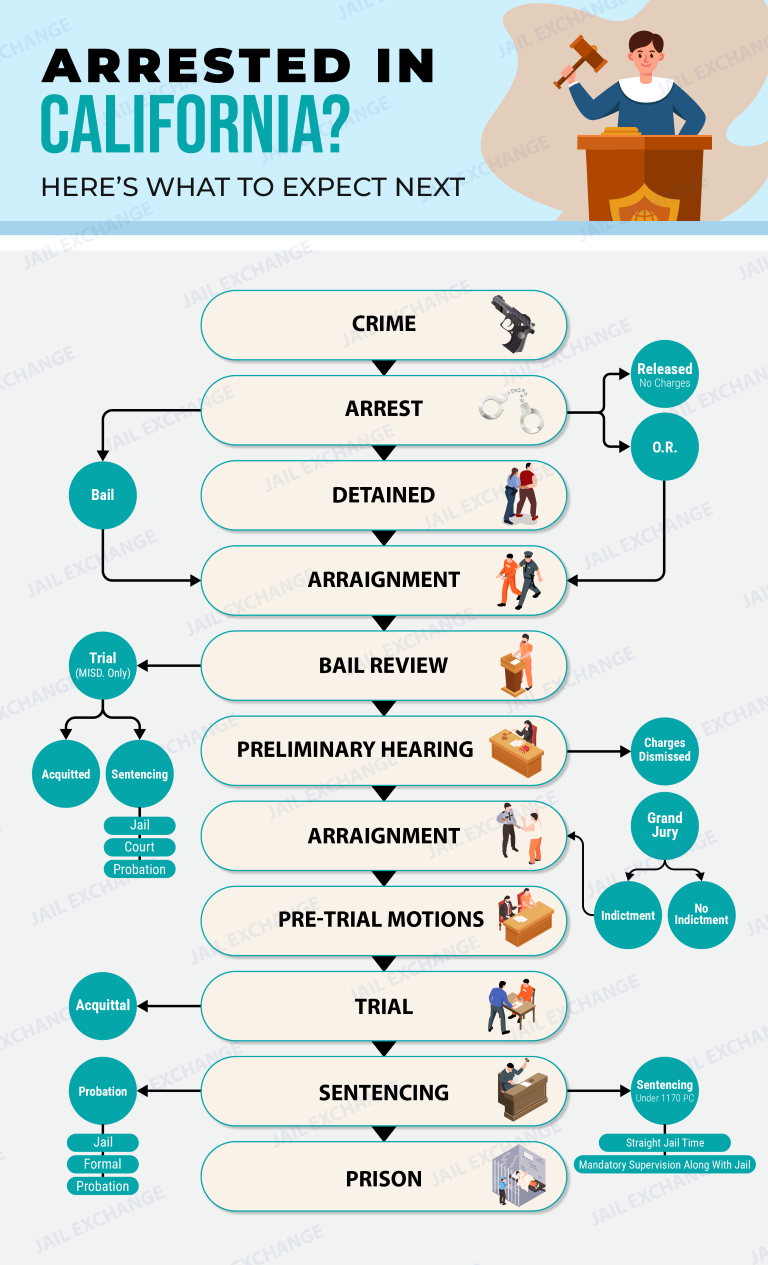
City prosecutors stop at misdemeanors. Every felony in the county, including those arising in Los Angeles, Long Beach and Pasadena, is filed by the Los Angeles County District Attorney. A defendant held in custody is arraigned on the felony complaint within 48 hours, either downtown at the Central Arraignment Courts or the downtown Criminal Justice Center, or at the regional courthouse for the district where the arrest occurred. Release and bail are decided there. Since In re Humphrey (2021), the California Supreme Court has required judges to consider a person’s ability to pay before setting bail. In April 2026 the court added, in In re Kowalczyk, that money bail in Los Angeles and statewide must generally be attainable, so an unpayable amount cannot replace a lawful no-bail hearing.
Indigent defense in Los Angeles has three layers. The Public Defender takes most appointments at arraignment. A conflict sends the case to LA’s Alternate Public Defender. If that office is blocked too, a panel lawyer under county contract steps in.
The preliminary hearing comes within 10 court days of arraignment unless the defense waives the deadline. The judge hears the proof and rules on whether the case goes on to trial. The District Attorney sometimes goes to the county criminal grand jury instead, especially in high-profile cases, which replaces the preliminary hearing. Once a case is held to answer, the DA files an “information,” a second arraignment follows, and trial must start within 60 days unless time is waived. Waivers are the norm, and pleas resolve the great majority of felonies.
The Los Angeles County Probation Department writes a presentence report after a conviction, and sentencing usually occurs within 20 court days. Many lower-level felonies are served in county jail under 2011 realignment, and “wobblers” may be charged or reduced as misdemeanors. The county also operates a broad set of collaborative courts, such as drug, veterans and mental health courts, that can offer treatment-based alternatives for eligible defendants. A felony case usually takes several months and often more than a year.
↑ Back to the question list3. Violent and serious felonies (murder, rape, armed robbery)
Many of the county’s homicide and major-crime trials take place at the downtown Criminal Justice Center downtown, though regional courthouses try serious cases as well. The procedure is the familiar felony sequence of arraignment, preliminary hearing or grand jury indictment, and trial. Bail is the first place the difference shows. Under article I, section 12 of the California Constitution, a judge can deny bail for a violent or sexual-assault felony on clear and convincing evidence that releasing the person carries a substantial likelihood of great bodily harm to others. Defendants in these cases frequently remain in the Sheriff’s custody until verdict.
These offenses qualify as strikes. A prior strike doubles the sentence, and two prior strikes can bring 25 years to life. For violent felonies, no less than 85% of the prison sentence has to be served.
- Murder: 15 years to life for second degree; 25 years to life for first degree. With a special circumstance, such as murder during a robbery or rape, the possible penalties are life without parole or death. Seeking death is solely the District Attorney’s decision, and California has been under an execution moratorium since 2019.
- Armed robbery: up to nine years on the robbery. Gun add-ons bring 10 more years when a firearm is used, 20 when fired, and 25 to life when someone suffers great bodily injury. Judges have had authority to strike those enhancements since 2018.
- Rape: up to eight years, more with aggravating factors, plus sex-offender registration at the highest tier.
Experienced trial lawyers from the Public Defender and Alternate Public Defender handle many of these cases, and two qualified attorneys are appointed whenever the prosecution seeks death. In LA, Marsy’s Law means a victim hears about each hearing, may speak before sentence and can get repaid. Lab work, experts and long investigations mean most of these cases last between one and three years. Murder trials in LA often need five or more.
↑ Back to the question list4. Every Los Angeles Superior Court courthouse, with phone numbers
Criminal, juvenile and family cases in Los Angeles are split among the buildings below. Jail arraignments mostly begin on Bauchet Street, and later hearings shift to the courthouse covering the neighborhood or city where the arrest happened. Big trials and many felonies are heard on Temple Street.
- Central arraignment courthouse: 429 Bauchet Street, Los Angeles, CA 90012 · 213-617-5600
- Criminal justice center: 210 West Temple Street, Los Angeles, CA 90012 · 213-628-7700
- Civil courthouse on Hill Street: 111 North Hill Street, Los Angeles, CA 90012 · 213-830-0800
- Spring Street courthouse: 312 North Spring Street, Los Angeles, CA 90012 · 213-310-7000
- Metropolitan courthouse: 1945 South Hill Street, Los Angeles, CA 90007 · 213-745-3200
- Hollywood courthouse: 5925 Hollywood Boulevard, Los Angeles, CA 90028 · 323-441-1800
- East Los Angeles courthouse: 4848 East Civic Center Way, Los Angeles, CA 90022 · 323-881-5800
- Eastlake juvenile courthouse: 1601 Eastlake Avenue, Los Angeles, CA 90033 · 323-227-4399
- Children's court (Monterey Park): 201 Centre Plaza Drive, Monterey Park, CA 91754 · 323-307-8000
- Airport courthouse: 11701 South La Cienega Boulevard, Los Angeles, CA 90045 · 310-725-3000
- Alhambra courthouse: 150 West Commonwealth Avenue, Alhambra, CA 91801 · 626-293-2100
- Bellflower courthouse: 10025 East Flower Street, Bellflower, CA 90706 · 562-345-3300
- Beverly Hills courthouse: 9355 Burton Way, Beverly Hills, CA 90210 · 310-281-2400
- Burbank courthouse: 300 East Olive Avenue, Burbank, CA 91502 · 818-260-8400
- Catalina courthouse: 215 Sumner Avenue, Avalon, CA 90704 · 562-256-3100
- Chatsworth courthouse: 9425 Penfield Avenue, Chatsworth, CA 91311 · 818-407-2200
- Compton courthouse: 200 West Compton Boulevard, Compton, CA 90220 · 310-761-4300
- Downey courthouse: 7500 East Imperial Highway, Downey, CA 90242 · 562-658-0500
- El Monte courthouse: 11234 East Valley Boulevard, El Monte, CA 91731 · 626-401-2200
- Glendale courthouse: 600 East Broadway, Glendale, CA 91206 · 818-265-6400
- Inglewood courthouse: One Regent Street, Inglewood, CA 90301 · 310-419-1300
- Inglewood juvenile courthouse: 110 Regent Street, Inglewood, CA 90301 · 310-412-8301
- Antelope Valley courthouse: 42011 4th Street West, Lancaster, CA 93534 · 661-483-5500
- Lancaster juvenile justice center: 1040 West Avenue J, Lancaster, CA 93534 · 661-483-5924
- Long Beach courthouse: 275 Magnolia Avenue, Long Beach, CA 90802 · 562-256-3100
- Norwalk courthouse: 12720 Norwalk Boulevard, Norwalk, CA 90650 · 562-345-3700
- Pasadena courthouse: 300 East Walnut Street, Pasadena, CA 91101 · 626-396-3300
- Pomona courthouse south: 400 Civic Center Plaza, Pomona, CA 91766 · 909-802-1100
- San Fernando courthouse: 900 Third Street, San Fernando, CA 91340 · 818-256-1800
- Santa Clarita courthouse: 23747 West Valencia Boulevard, Santa Clarita, CA 91355 · 661-253-5600
- Santa Monica courthouse: 1725 Main Street, Santa Monica, CA 90401 · 310-255-1840
- Sylmar juvenile courthouse: 16350 Filbert Street, Sylmar, CA 91342 · 818-256-1180
- Torrance courthouse: 825 Maple Avenue, Torrance, CA 90503 · 310-787-3700
- Van Nuys courthouse east: 6230 Sylmar Avenue, Van Nuys, CA 91401 · 818-901-4600
- Van Nuys courthouse west: 14400 Erwin Street Mall, Van Nuys, CA 91401 · 818-989-6900
- West Covina courthouse: 1427 West Covina Parkway, West Covina, CA 91790 · 626-430-2600
- Whittier courthouse: 7339 South Painter Avenue, Whittier, CA 90602 · 562-968-2699
Courtrooms are called departments. Your notice or the online case search will name both the building and the department number, and the clerk's office for that building can confirm it by phone.
↑ Back to the question list5. How a federal criminal case moves through court in Los Angeles
Federal crimes from anywhere in the county, from Lancaster down to Long Beach and out to Pomona, belong to the Western Division of the Central District of California. The Superior Court plays no part, and state bail rules do not apply. Families usually see these steps:
- Initial appearance: usually by the next court day, the person stands before a magistrate judge at First Street U.S. Courthouse, 350 West 1st Street, Los Angeles, CA 90012. The judge goes over the charges, tells him his rights, and assigns a federal public defender if needed.
- Pretrial Services report: before that hearing, an officer interviews the defendant and checks his history, then gives the judge a release recommendation.
- Detention hearing: under the Bail Reform Act, the judge decides whether any set of conditions can make sure he comes back and keeps the public safe. The prosecutor may ask to delay this by up to three days and the defense by up to five.
- Arraignment and later dates: a plea is entered and the case goes to a district judge for motions, plea talks or trial.
- Other federal building: more district judges and federal offices sit at 255 East Temple Street, Los Angeles, so some later hearings may be held there.
Federal defendants who are not released are held mainly at the Metropolitan Detention Center, 535 N Alameda St, Los Angeles (213-485-0439). For questions about where a pretrial prisoner is housed or moved, contact U.S. Marshals Service, 350 West 1st Street, Suite 3001, Los Angeles, 213-620-7676.
↑ Back to the question list6. ICE detainers and Los Angeles County courts
An ICE detainer is a paper sent to the jail, not an order from a judge. It asks the Sheriff to report a release date and to hold the person up to 48 extra hours, and weekends and holidays count, under 8 CFR 287.7. In California, SB 54 bars the Sheriff from that extra holding, and it limits release-date notices to people with certain serious or violent convictions.
For the court case itself, a detainer does not change the charges, the judge or the hearing dates. It can matter a lot for pleas, because some convictions carry harsh immigration results. California law expects defense lawyers to advise clients on that, so tell the lawyer early about the person's immigration status.
Before any ICE interview inside the jail, the TRUTH Act requires a written notice that the interview is voluntary and that a lawyer can be present. Immigration cases in this area are handled from Los Angeles ICE field office, 300 North Los Angeles Street, Room 7631, Los Angeles, CA 90012, 213-830-7911, and people are mostly held at:
- Adelanto ICE Processing Center: 10400 Rancho Road (East) and 10250 Rancho Road (West), Adelanto, CA 92301 · 760-561-6100
- Desert View Annex: 10400 Rancho Road, Adelanto, CA 92301
Immigration court hearings are a separate federal system with their own judges. They are not part of the Los Angeles Superior Court case.
↑ Back to the question list7. Looking someone up after an arrest anywhere in Los Angeles County
Courts do not keep a list of who is in custody. Use these searches instead, starting with the county one:
- Sheriff and city lockups: Los Angeles County Inmate Search covers the Sheriff's jails and LAPD jails. Enter a last and first name, and a birth date if you have it. The record lists the facility, the charge, bail and the next hearing with its courthouse. An empty result in the first hours can just mean booking is not finished.
- VINE custody lookup: at VINELink (https://vinelink.vineapps.com/), pick California, then search by name or ID number. It shows who is held and where across many California jails, so it helps when you are not sure which county made the arrest. If there is no match, try other spellings later.
- Federal prisoners: at the Federal Bureau of Prisons Inmate Locator (https://www.bop.gov/inmateloc/), enter the register number or a full name. It lists the federal site and expected release date. Pretrial prisoners may not show up at all, so call the Marshals at 213-620-7676.
- State prison: at the CDCR Inmate Locator (https://inmatelocator.cdcr.ca.gov/), use the CDCR number or a last and first name. It shows the prison and arrival date, but only after transfer out of county custody.
- Immigration detention: at the ICE Online Detainee Locator System (https://locator.ice.gov/odls/), enter the A-number and country of birth, or the full name and country of birth. It names the center and gives its contact details. It leaves out anyone under 18. If no match appears after two days, phone 213-830-7911.
8. With so many agencies, who actually holds my warrant?
Usually the Sheriff's Department or the police agency that filed the case; LAPD, Long Beach and dozens of city departments serve their own. The Sheriff's information line is (213) 229-1700, and statewide checks start there or with the agency holding the case. A case number or name in the Superior Court's criminal case summary shows whether a bench warrant issued. The Criminal Justice Center clerk at 210 West Temple Street handles new dates. Lawyers often arrange a surrender at the Inmate Reception Center, 450 Bauchet Street, and many ask the judge to recall the warrant first so you walk in with a hearing already set.
↑ Back to the question listThis summary of how Los Angeles County criminal cases generally proceed is general, not legal advice. For advice on an actual LA charge, hire defense counsel; for help with appointed counsel call the Los Angeles County Public Defender at (213) 974-2811 (the Alternate Public Defender’s main office is (213) 974-6626).
Buy Commissary for an Inmate in the LA COUNTY JAIL - Nidorf Juvenile
LA COUNTY JAIL - Nidorf Juvenile Inmate Commissary - Sending Money or Purchasing Commissary for an Inmate
The LA COUNTY JAIL - Nidorf Juvenile allows inmates to purchase commissary. This can be snacks, hygiene products, stamps, stationary, clothing and even electronics.
Call the facility at 818-364-2011 to ask whether there is a limit on how much an inmate can spend on commissary.
Inmates have access to both an in-house commissary store, and commissary packages that can be purchased and shipped to the inmate by friends and family.
Scroll down for further information on the commissary program, how it works, what type of things inmates can buy, how often they receive commissary, and a lot more.
You can also go to our Inmate Money page for information on how to send money to an inmate.
Deposit Money for an Inmate in the LA COUNTY JAIL - Nidorf Juvenile
The Easiest Way of Depositing Money for an Inmate
There are several methods for depositing money on an inmate's account. You can find out how to do this by calling the LA COUNTY JAIL - Nidorf Juvenile at 818-364-2011 and asking, or you can scroll down and review the different methods.
1. Mail an inmate a money order or cashier’s check from a trusted source such as the Post Office, a local bank, or Western Union. The money order should be be made out to either the inmate or the Los Angeles County Sheriff's Office, with the inmate’s name and ID# on the memo line of the check.
When mailing a money order or cashier’s check, send it an envelope by itself. Never send it with a letter or photos for your inmate, unless the facility allows it. Never send personal checks or cash.
2. Deposit cash or use a debit or credit card using a dedicated kiosk for this purpose. The machine is located in the lobby or visitation area of the LA COUNTY JAIL - Nidorf Juvenile.
3. The LA COUNTY JAIL - Nidorf Juvenile has a reception desk that may accept cash, money orders or cashier checks. Call 818-364-2011 to find out the specific hours for drop off times.
4. The LA COUNTY JAIL - Nidorf Juvenile may contract with a third party service which accept inmate deposits online, by mail or over the phone, or even in ATM machines you can find in check cashing stores and retail outlets across the country. Call 818-364-2011 for the company information, along with a list of these companies, or find it by scolling down below.
Send an Inmate Mail in the LA COUNTY JAIL - Nidorf Juvenile
The Barry J. Nidorf facility on Filbert Street in Sylmar used to be one of Los Angeles County's juvenile halls. In 2023 the Probation Department moved the youth who were still waiting on their cases to Los Padrinos Juvenile Hall in Downey and turned Nidorf into a Secure Youth Treatment Facility. Today it holds older youth with more serious cases who stay under juvenile court care instead of going to a state facility.
Letters, cards and reading material:
Barry J. Nidorf Secure Youth Treatment Facility
16350 Filbert Street
Sylmar, CA 91342
- Before you mail: If the youth is still waiting for court, they are most likely at Los Padrinos, not at Nidorf.
- Return address: Write your name and full address in the top left corner, or the letter may never be handed over.
- Writing: Blue or black ink. No markers, crayons, colored pens or lipstick marks, and no perfume on the paper.
- Decorations: Skip the glitter, confetti and drawings on the envelope.
- Greeting cards: Plain ones only. A musical card will be sent back.
- Stamps: They can't be sent in. Youth who have none are given a few each week.
- Publications: New books, magazines and newspapers have to come straight from the publisher.
For questions about mail at Nidorf, call 818-364-2011.
Information for this service is currently unavailable.
Send an Email or Text to an Inmate in the LA COUNTY JAIL - Nidorf Juvenile
LA COUNTY JAIL - Nidorf Juvenile is either providing or will soon provide secure electronic messaging for inmates. To learn more, scroll down or contact the jail at 818-364-2011.
Unlike traditional email services, messages sent to and from inmates are intercepted by the jail’s servers, giving staff the opportunity to review them before they are delivered to inmates or their contacts.
Inmates can read these messages on kiosks located in their units or on tablets provided by a third-party service managing the program.
The benefits of this system include:
- It is cheaper than sending regular mail.
- Faster message delivery.
- The jail can monitor communications in real time.
- It generates revenue for the facility.
- Inmates value the privilege, motivating good behavior.
- It helps prevent contraband from entering the jail through mail.
For more information, including Frequently Asked Questions, scroll down or call the jail at 818-364-2011.
Information for this service is currently unavailable.
Los Angeles County County Jails
Los Angeles County City Jails
Los Angeles County Juvenile Facilities
Nearby counties
- Juvenile Detention: 818-364-2011
- Adult Probation: 818-374-6635
- CHP: 323-982-4900
- LA County DA: 213-974-3512
- LA County Juvenile Detention: 323-226-8611
- LA County Juvenile Probation: 323-226-8611
- LA Police Dept: 877-275-5273
- LASD Bail: 213-473-6080
- LASD Booking: 213-893-5327
- LASD Cashier: 213-473-6049
- LASD General Info: 213-229-1700
- LASD Inmate Accounts: 213-893-5875
- LASD Inmate Info: 213-473-6100
- LASD Inmate Release: 213-893-5347
- LASD Property: 213-893-5352
- LASD Records: 562-345-4470
- LASD Sheriff: 323-267-4800
- LASD Visitation: 213-680-4887
- LASD Warrants: 213-830-0198
- LASD Work Release: 213-893-5345
- Public Defender: 213-974-2811