Rio Cosumnes Correctional Center Criminal Court Process
Criminal Court Process for Sacramento County California
From Arrest to Verdict: Sacramento County Criminal Courts
Criminal cases from every city in this county, from Elk Grove to Folsom, go to the Superior Court of California, County of Sacramento. Its criminal courthouse is the New Sacramento County Courthouse, 500 G Street, Sacramento, CA 95814, and the criminal line is 916-874-5522. People in custody wait at the Main Jail downtown or the Rio Cosumnes Correctional Center in Elk Grove.
The official inmate search shows the building that holds your person. Our Sacramento Recent Arrests page also lists who is in custody, warrants and charges.
Before you head downtown, call 916-874-5522 with the case number and confirm the courtroom and the time. Need to get your person out first? Our Sacramento bail page explains the steps.
- Sacramento misdemeanors: small thefts, first DUI, minor fights, trespass
- Sacramento felonies: burglary, major theft, drug dealing, DUI that injures someone
- Violent and serious felonies (murder, rape, armed robbery)
- Sacramento Superior Court locations
- Federal cases in Sacramento
- ICE detainers in Sacramento court
- Custody searches for Sacramento
- Before the trip to 500 G Street
- Who handles warrants out of the downtown courts?
1. Sacramento misdemeanors: small thefts, first DUI, minor fights, trespass
Whether an arrest happens on a downtown street in the state capital or in Elk Grove, Citrus Heights, Folsom, Rancho Cordova or Galt, the criminal case is filed in the same place: the Superior Court of California, County of Sacramento. Elk Grove, Folsom and Citrus Heights lack criminal courts of their own; one Sacramento Superior Court has handled all criminal cases since the state combined its courts around 2000. In spring 2026 the court moved its criminal and civil operations out of the aging downtown courthouse and the Hall of Justice on 6th Street and into a new 18-story building in the Railyards: the New Sacramento County Courthouse, 500 G Street, Sacramento, CA 95814. For criminal matters, call (916) 874-5522 and press 1. Adult criminal cases are now heard in two locations:
- New Sacramento County Courthouse, 500 G Street, Sacramento, CA 95814: criminal departments, including trial courts, and the criminal clerk’s office. Criminal line: (916) 874-5522, option 1
- Sacramento County Main Jail, 651 I Street, Sacramento, CA 95814: courtroom departments 60 through 63 on the first floor, used for in-custody proceedings. Phone: (916) 874-6936
Paperwork printed before April 2026 may still list the old downtown courthouse at 720 9th Street; those cases have moved to the new building, so check the court’s case search for the current department. Tap a charge type below to follow a Sacramento case step by step.
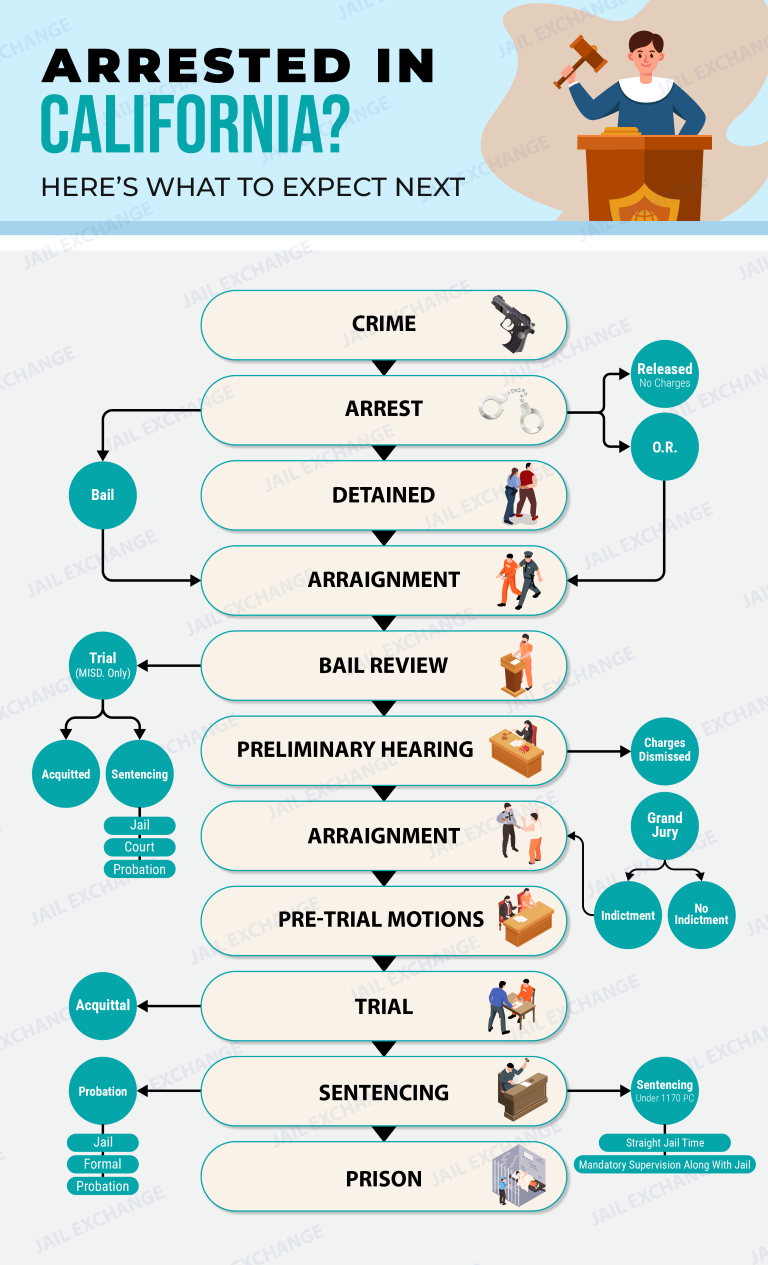
Countywide, the District Attorney handles misdemeanors, even those from Sacramento city police arrests. Usually the officer hands over a ticket and lets him go, so his first court visit is a set date at the new G Street courthouse. Those who are booked into the Main Jail on I Street are entitled to see a judge within 48 hours of arrest, a period that skips Sundays and court holidays, and those first hearings are often held in the courtrooms inside the jail building itself.
That first court date is the arraignment. Defendants receive a copy of the complaint, typically enter a not-guilty plea, and the judge decides whether they stay in custody or go home on conditions. Counsel is part of the hearing from the start: the Sacramento County Public Defender, headquartered at 700 H Street, represents most people charged with crimes in the county who can’t afford their own lawyer, and California no longer bills defendants for court-appointed counsel. At many Sacramento misdemeanor dates, his attorney may appear while he stays at work.
Next come pretrial conferences. Most Sacramento misdemeanors stop at this stage with a deal, a lesser count or a dismissal. A Sacramento judge may grant diversion, clearing the charge once he finishes counseling, classes or a similar program; drunk driving, domestic violence and registrable sex crimes are left out. Cases that don’t settle are tried to a jury of 12. By statute, trial must start within 30 days of arraignment for someone in jail and within 45 days for someone who is free, though defense lawyers often agree to extend those limits.
The common cap is six months locked up and a $1,000 fine; some misdemeanors reach a full year. In practice, outcomes more often involve probation, fines, community service or education programs. On G Street these usually wrap up in weeks, sometimes two or three months.
2. Sacramento felonies: burglary, major theft, drug dealing, DUI that injures someone
Felony cases are filed by the District Attorney on a document called a complaint. A person arrested on a felony is usually held at the Main Jail downtown or, after classification, at the Rio Cosumnes Correctional Center in Elk Grove, and must be arraigned within 48 hours. Release, bail and any no-contact orders are addressed at that first appearance. Since the 2021 In re Humphrey decision, a Sacramento judge has to factor in what he can afford before setting cash bail. The 2026 Kowalczyk ruling also bars Sacramento judges from setting bail that works like a no-bail order.
Anyone who can’t afford private counsel is assigned a lawyer at arraignment, most often from the Public Defender’s Felony Division. When the Public Defender already has a co-accused or other conflict, the county’s conflict program assigns an outside lawyer.
The preliminary hearing comes next and must be held within 10 court days of arraignment unless the defense waives that right. Testimony is heard, and the G Street judge decides if a trial is justified. Occasionally Sacramento prosecutors go to the grand jury instead and get an indictment. If it is held over, the DA files a formal information, he pleads to it, and trial is due in 60 days, a deadline most Sacramento defendants give up. The great majority of Sacramento felonies resolve through plea agreements in the trial departments at 500 G Street.
If the defendant is convicted, the Sacramento County Probation Department writes a report on background and sentencing options, and sentencing normally follows within 20 court days. Under 2011 realignment, lesser felony terms are often spent in a Sacramento jail, not state prison. A “wobbler” can be charged either way, or lowered to a misdemeanor down the road. The court’s collaborative courts, including drug, mental health and veterans treatment courts, offer treatment-based alternatives to eligible defendants. Plan on months for a Sacramento felony, and sometimes beyond a year.
3. Violent and serious felonies (murder, rape, armed robbery)
Custody is often the first major difference in a violent felony case. Under article I, section 12, a Sacramento judge can keep him jailed with no bail in a violent or sexual assault felony if clear and convincing evidence shows his release would likely put someone at risk of grave injury. Because of that, many defendants facing these charges in Sacramento County remain in the Main Jail throughout the proceedings, which still follow the familiar sequence of arraignment, preliminary hearing or indictment, and trial.
Sentencing exposure is the second difference. Murder, rape and armed robbery each count as strikes: a prior strike doubles the Sacramento sentence, and a second prior opens the door to 25 years to life. Violent felons also must serve 85% or more of the term.
- Murder: for first-degree murder the term is 25 years to life; for second-degree murder it is 15 years to life. A special-circumstance finding, like a killing during a robbery, narrows Sacramento sentencing to death or life with no parole. Seeking the death penalty is up to the DA alone; the state has paused executions since 2019.
- Armed robbery: as long as nine years for the robbery itself, with 10 more years for displaying a gun, 20 for shooting, and 25 to life when the shot seriously injures or kills. Judges gained the ability to strike those enhancements in 2018.
- Rape: up to eight years, longer when aggravating factors apply, with registration as a sex offender in the top tier.
The Public Defender puts its senior trial lawyers on murder cases, and any capital case requires two certified defense attorneys. Sacramento victims, through Marsy’s Law, get word of hearings, may speak before sentence, and can claim repayment. On G Street, violent felonies often last one to three years, and murders may top five.
4. Sacramento Superior Court locations
Criminal matters moved to 500 G Street on April 27, 2026; the criminal line is 916-874-5744.
- Main courthouse (all criminal and civil since April 27, 2026): 500 G Street, Sacramento, CA 95814 · 916-874-5744
- Family relations courthouse: 3341 Power Inn Road, Sacramento, CA 95826 · 916-875-3400
- Small claims and traffic center: 301 Bicentennial Circle, Sacramento, CA 95826 · 916-875-7746
- Juvenile courthouse: 9605 Kiefer Boulevard, Sacramento, CA 95827 · 916-876-7753
5. Federal cases in Sacramento
Sacramento hosts the main courthouse of the Eastern District of California. Arrests across the capital region go to a magistrate judge at Sacramento federal courthouse, 501 I Street, Sacramento, CA 95814 first, then on to a grand jury. Marshals: U.S. Marshals Service, 501 I Street, Suite 5600, Sacramento, 916-930-2030.
6. ICE detainers in Sacramento court
A detainer doesn't change how 500 G Street judges treat the case. SB 54 governs release; ICE can get a date only after a serious or violent conviction. Ask the defense attorney about immigration before pleading. San Francisco ICE field office, 630 Sansome Street, Room 590, San Francisco, CA 94111, 415-365-8800; detention sites:
- Mesa Verde ICE Processing Center: 425 Golden State Avenue, Bakersfield, CA 93301
- Golden State Annex: 611 Frontage Road, McFarland, CA 93250
- California City detention site: 22844 Virginia Boulevard, California City, CA 93505
7. Custody searches for Sacramento
- Sacramento County Inmate Search: Sheriff's jails.
- VINELink (https://vinelink.vineapps.com/): statewide.
- Federal Bureau of Prisons Inmate Locator (https://www.bop.gov/inmateloc/): federal; pretrial 916-930-2030.
- CDCR Inmate Locator (https://inmatelocator.cdcr.ca.gov/): state prison.
- ICE Online Detainee Locator System (https://locator.ice.gov/odls/): A-number or name and birth country; 415-365-8800.
8. Before the trip to 500 G Street
Ring the Sacramento criminal clerk, 916-874-5522, with the case number and confirm the courtroom and the hour it opens. While he sits in the Main Jail, 916-874-6752 can say whether he is on the court list that day.
9. Who handles warrants out of the downtown courts?
The Sheriff's Warrant Services bureau does; the main line is (916) 874-5115. Call with a full name and birth date, and staff will check local and statewide records. Warrant Services works out of the downtown Sheriff's headquarters. The Superior Court's Public Case Access System is free and shows the case. The main courthouse clerk at 500 G Street takes calls about new dates. Counsel can set a Main Jail surrender at 651 I Street, or ask a judge to recall the warrant, which often means a shorter day.
This outlines how Sacramento criminal cases move; it isn’t advice on his charge. For that, phone a defense attorney or the Sacramento County Public Defender at (916) 874-6411.