Douglas County Criminal Courts, Explained Simply
Whether an arrest happens in Highlands Ranch, Parker, Lone Tree, Castle Rock or out on a ranch road near Larkspur, the state case ends up at one big building: the Douglas County Courthouse, 4000 Justice Way, Suite 2009, Castle Rock, CO 80109. The main line is (720) 437-6200. Two courts work side by side inside. Douglas County Court hears misdemeanors and traffic, plus early felony steps. Douglas County District Court takes over the felony cases after that and handles the juvenile docket for minors.
Until recently, Douglas County was lumped together with Arapahoe County in the old 18th Judicial District. (A judicial district is a bundle of counties with one prosecutor and a common pool of judges.) That changed on January 14, 2025, when the brand-new 23rd Judicial District opened. Douglas is the giant of that trio; Elbert and Lincoln, its rural neighbors to the east, are the other two. Voters in those three counties now elect their own District Attorney, the lawyer who decides what charges to file for state crimes. Separate from all this, towns like Castle Rock, Parker, Lone Tree and Castle Pines have municipal courts. Those small courts handle tickets for breaking a town's own rules, such as some shoplifting or noise cases written under city code. (Statewide, only Denver differs: the city itself operates Denver County Court.)
Free case information: Reading full Colorado case files online for free isn't possible. At no charge, though, you can run a docket search at coloradojudicial.gov/dockets, which shows who has a hearing coming up and when. Need copies of what's in a file? Use the Judicial Branch's online records request, or simply call the Castle Rock clerks. Some businesses charge to search Colorado court records, and the state keeps a list of them in its guide to public records.
The federal side: Crimes against U.S. law go to Colorado's U.S. District Court. For Douglas County, that means the Alfred A. Arraj U.S. Courthouse at 901 19th Street in downtown Denver; the clerk's number is (303) 844-3433. The court has other spots around the state too, including Colorado Springs, Grand Junction and Durango. A case becomes federal when Congress made the act a crime, or when it happens on federal property. In Douglas County, the biggest chunk of federal land is the Pike National Forest in the hilly western part of the county, around places like Sedalia and Deckers. Bank robbery and large online fraud are common federal cases too. There are no Indian reservations in the county. Choose a charge type below.
- Castle Rock misdemeanors: shoplifting, first DUI, simple assault, trespass
- Felonies: burglary, car theft, drug dealing, a fourth DUI
- Violent crimes: murder, sexual assault, robbery with a weapon
- Douglas County courts and jail
- Douglas bond rules
- Federal cases from Douglas County
- Finding someone in a Douglas case
- ICE detainers in Douglas County
- Douglas dockets and warrants
Castle Rock misdemeanors: shoplifting, first DUI, simple assault, trespass
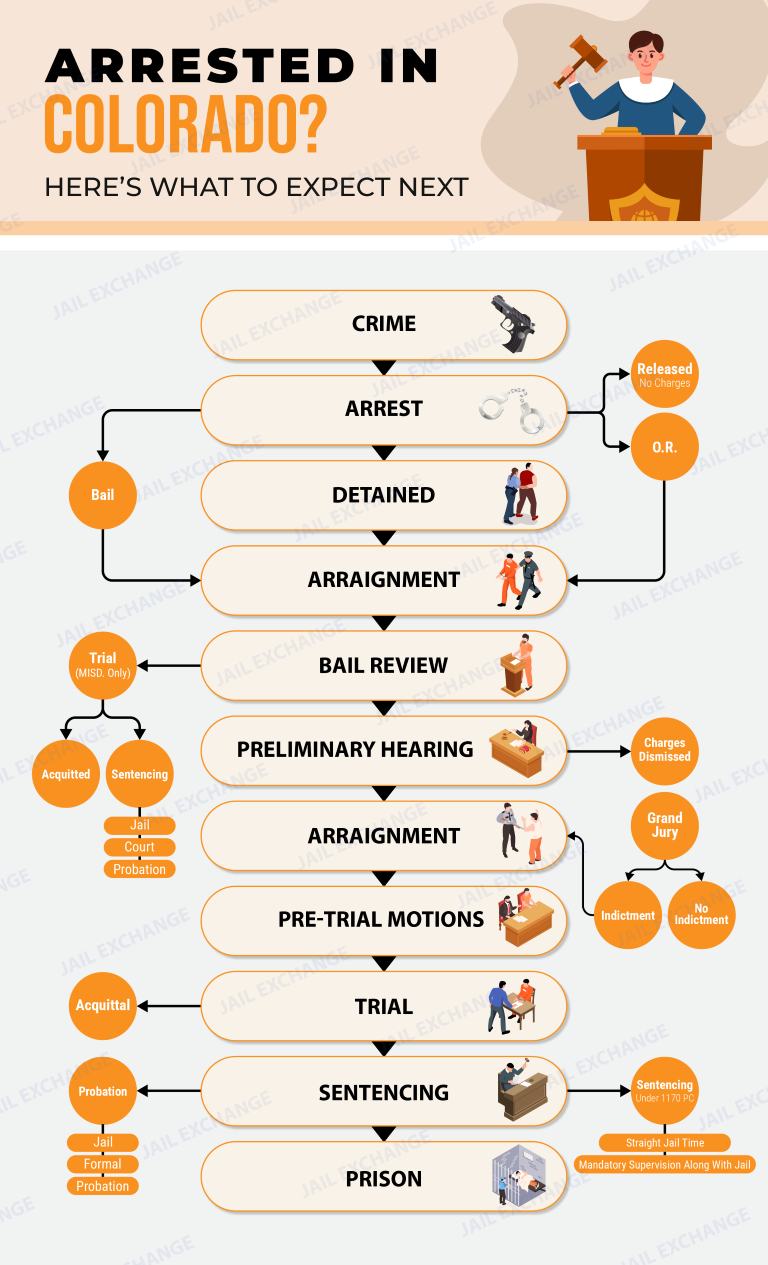
Often the officer writes a summons, a paper that tells the person which day to appear in court, and lets them go. Other times the person is booked into the Douglas County jail next to the courthouse. Colorado doesn't allow the jail to sit on a person: a judge must hold the bond hearing within 48 hours of the person's arrival. Bond is simply the set of conditions for getting out while the case is open. For petty and traffic charges, Colorado law doesn't let judges demand cash.
The arraignment is the first County Court date, where the charge is announced and the defendant gives an answer, such as "not guilty" for now. The 23rd District Attorney's office handles state misdemeanors; city prosecutors handle municipal court tickets. A person who might go to jail and can't pay for a lawyer can apply to have the Colorado State Public Defender appointed. Its Castle Rock office, in the Elk Crossing Business Center at 1161 S. Perry St., Suite 200, serves Douglas, Elbert and Lincoln counties; phone (303) 688-3081. When two defendants clash, one gets a contract attorney; the Office of Alternate Defense Counsel covers the bill.
Colorado's misdemeanor penalties got simpler in 2022. Third-degree assault and other class 1 misdemeanors top out at 364 days locked up, plus as much as $1,000. A class 2 means a max of 120 days and $750. Petty offenses max out at 10 days and $300. Drug misdemeanors are graded DM1 and DM2. DUI follows separate traffic rules, so even a first offense can mean losing a license for a while and sitting through alcohol education. A six-person jury hears misdemeanor trials if the defendant wants one.
Under 18: A kid accused of a misdemeanor goes through the juvenile court inside the same courthouse, not adult County Court. A first-time case can be steered into juvenile diversion run by the District Attorney, where a youth can fix things through restitution (paying back the victim), classes or service and avoid a record. A town court may keep certain teen tickets for ordinance or traffic violations. Locked-up youths get a detention hearing inside 48 hours, though weekends and holidays don't count toward that window.
Felonies: burglary, car theft, drug dealing, a fourth DUI
Felonies are crimes serious enough for prison. In Douglas County they open in County Court with a bond hearing and a formal advisement of the charges. From there the DA moves it toward District Court, and the defense has the option of demanding a preliminary hearing first. Think of a preliminary hearing as a checkpoint: a judge hears part of the evidence and rules on whether there is "probable cause," which is lawyer-speak for solid enough grounds to think this defendant did it. Under the state's criminal rules, that checkpoint should come within 35 days of the defense's request. Another route is a grand jury, where residents weigh evidence privately before voting on charges.
Colorado sorts felonies into classes. Class 2 normally means 8 to 24 years; class 3, 4 to 12; class 4, 2 to 6; class 5, 1 to 3; class 6, a year to 18 months. Lawyers call these the presumptive ranges. Drug felonies go from DF4 (6 to 12 months) up to DF1 (8 to 32 years). Drunk driving turns into a class 4 felony once a driver has three earlier alcohol driving convictions. Prison is not the only result; probation, community corrections and drug or veterans treatment courts are options for some people. After a not-guilty plea, a six-month speedy-trial deadline starts ticking. Felony juries have 12 members.
Under 18: Juvenile court is where nearly all teen felony cases are handled. The judge's job there is to protect the public and help the young person get back on track, using tools like probation, counseling, or placement in a facility of the Division of Youth Services (DYS), Colorado's agency for locked youth centers. A youth who is held before the case ends stays in a DYS detention center, not the adult jail. For felonies outside direct filing, moving a teen to adult court takes a transfer hearing, and that is possible only for kids 14 or older (or 12 or 13 for the gravest crimes).
Violent crimes: murder, sexual assault, robbery with a weapon
Cases like murder or armed robbery go through Castle Rock's District Court divisions. Judges can set high bonds and no-contact orders, and someone charged with first-degree murder can be held without bond when the evidence is strong. Since July 1, 2020, Colorado has had no death penalty. A class 1 felony now means life in prison without parole. When a crime is labeled a "crime of violence," for instance a robbery committed with a gun, state law requires a prison sentence at the top of the normal range or above it.
People hurt by violent crime have rights under the Colorado Victims' Rights Act, part of the state constitution. They can be notified of important hearings, attend them, talk to the prosecutor about plea deals and give a statement at sentencing.
Under 18: "Direct file" lets the DA skip juvenile court entirely, but only when the teen was at least 16 and the case involves murder or another top-level felony (class 1 or 2), or a listed violent sex crime. Other teens can be moved only after a transfer hearing in juvenile court. Even for murder, Colorado won't impose life without parole on someone who committed the crime as a minor. Young people in these cases are represented by the public defender's office when appointed, and they wait in a DYS detention center instead of the county jail.
Douglas County courts and jail
These offices handle Douglas criminal cases:
- Douglas County Combined Court: 4000 Justice Way, Suite 2009, Castle Rock, CO 80109; 720-437-6200; weekdays 7:30 a.m. to 4:30 p.m.
- Castle Rock Municipal Court: 100 Perry Street; 303-663-6133
- Parker Municipal Court: 20120 E. Mainstreet; 303-805-3195
- Lone Tree Municipal Court: 9220 Kimmer Drive, Suite 100; 303-339-8177
- Castle Pines Municipal Court: 7437 Village Square Drive, Suite 200; 720-545-8154
- Larkspur Municipal Court: the town of Larkspur runs a court for town tickets; it has no court page online, so check with the town for dates and where it meets
- District Attorney: 4000 Justice Way, Suite 2525-A; 720-733-4500
- Public Defender: 1161 S. Perry Street, Suite 200, Castle Rock; 303-688-3081
- Jail: Douglas County Detention Center, 4000 Justice Way; booking 303-660-7550; Sheriff's Office 303-660-7505
- Youth detention: Marvin W. Foote Youth Services Center, 13500 E. Fremont Avenue, Centennial; 303-768-7529
Bond steps are on our Douglas County bail page; the statute is Colorado bail law, C.R.S. Title 16, Article 4 (https://content.leg.colorado.gov/sites/default/files/images/olls/crs2024-title-16.pdf).
Douglas bond rules
- A judge must set bond inside 48 hours from her jail arrival.
- Petty and traffic charges rule out a cash bond.
- Douglas judges use the lightest terms that keep people safe and get her back to court.
- HB25-1015 makes credit card bond payment available online in Douglas County.
- Amendment I (2024) permits denying bail for first-degree murder when proof is evident or the presumption great.
Bond types are listed at Colorado Judicial Branch guide to bond types (https://www.coloradojudicial.gov/self-help/types-bonds).
Federal cases from Douglas County
The U.S. District Court for the District of Colorado handles Douglas federal cases:
- Courthouse: the Alfred A. Arraj U.S. Courthouse in Denver, 901 19th Street, Denver, CO 80294, 303-844-3433
- U.S. Marshals: U.S. Marshals Service, 901 19th Street, 3rd Floor, Denver, CO 80294, 303-728-7800
Detention is set by a magistrate judge, and custody runs through the Marshals.
Finding someone in a Douglas case
- County jail: Douglas County Inmate Search
- State prison: Colorado Department of Corrections inmate search (https://www.doc.state.co.us/oss/)
- Federal prison: Federal Bureau of Prisons Inmate Locator (https://www.bop.gov/inmateloc/); pre-sentence, 303-728-7800
- VINE: VINELink (https://vinelink.vineapps.com/) for status and alerts.
Our Douglas County inmate page lists more searches.
ICE detainers in Douglas County
C.R.S. 24-76.6-102 (https://content.leg.colorado.gov/sites/default/files/images/olls/crs2024-title-24.pdf) keeps Douglas deputies from holding anyone on a civil ICE detainer by itself.
- Field office: ICE Denver Field Office, 12445 East Caley Avenue, Centennial, CO 80111, 720-873-2899
- Locator: ICE Online Detainee Locator System (https://locator.ice.gov/odls/)
Douglas dockets and warrants
- Dockets: Colorado Judicial Branch docket search (https://www.coloradojudicial.gov/dockets)
- Records: court record request form (https://www.coloradojudicial.gov/recorddocument-request-form)
- Warrants: Douglas County Sheriff's Office, 303-660-7505
Nothing here is legal advice; it's a broad, simplified look at criminal cases in Douglas County. If you or your child has been charged, get a defense lawyer's advice or reach the Castle Rock public defender office at (303) 688-3081.
Phone the clerk at 720-437-6200 about the hearing, and booking at 303-660-7550 about her custody, before you travel or pay.