
Ferris School
Information for this service is currently unavailable.
Delaware’s Prisons and Treatment Centers: How a Case Moves Through Court
Delaware is split into three counties. New Castle sits at the top of the state, Kent is in the middle and Sussex covers the south. Here’s the twist: none of the three has its own jail. One state agency, the Department of Correction (DOC), runs every lockup in Delaware. That includes the place someone sleeps the night of an arrest, the prisons where long sentences are served and the centers for treatment and work release. So whether a person is picked up in Newark, Dover or Rehoboth Beach, they end up in a DOC building. Here are the sites, sorted by area:
- New Castle County
- Howard R. Young Correctional Institution (“Gander Hill”), 1301 East 12th Street, Wilmington, (302) 429-7700. Grown men, mostly detainees, meaning people whose cases aren’t finished yet.
- Baylor Women’s Correctional Institution, 660 Baylor Boulevard, New Castle, (302) 577-3004. The state’s prison for women from every county, before trial and after sentencing.
- Hazel D. Plant Women’s Treatment Facility, 620 Baylor Boulevard, New Castle, (302) 777-6800. Women in drug and alcohol treatment and work release.
- Plummer Community Corrections Center, 38 Todds Lane, Wilmington. Closed in March 2026. The men it used to take now go mostly to the treatment center near Smyrna, with some sent to Georgetown or placed on home confinement.
- Near Smyrna (where Kent and New Castle meet)
- James T. Vaughn Correctional Center, 1181 Paddock Road, near Smyrna, (302) 653-9261. Delaware’s biggest prison, about 2,600 men, including maximum security and Kent County men awaiting trial.
- Community Corrections Treatment Center (CCTC), 875 Smyrna Landing Road, near Smyrna, (302) 659-6100. A 250-bed center for men in treatment, plus the New Castle County work release program.
- Kent County
- Morris Community Corrections Center, 300 Water Street, Dover. Closed. Kent men who would have gone there now go mainly to CCTC near Smyrna, and a few to Georgetown.
- Sussex County
- Sussex Correctional Institution (SCI), 23203 DuPont Boulevard, Georgetown, (302) 856-5280. Sussex men awaiting trial, plus men serving medium- and minimum-security sentences.
- Sussex Community Corrections Center (SCCC), 23207 DuPont Boulevard, Georgetown, (302) 856-5790. Work release, treatment and a probation-violation program.
A quick word on “levels.” The DOC ranks supervision from Level I to Level V. Level V means prison. Level IV means a person lives at a state center but gets more freedom, such as leaving for a job. Hazel D. Plant, CCTC and SCCC are all Level IV.
The state courts. Delaware uses four kinds of court for criminal cases, and each county has its own set:
- Justice of the Peace (JP) Court is the first stop after an arrest. A magistrate, which is a JP judge, sets release terms and handles a few small charges.
- Court of Common Pleas decides most misdemeanors for adults and holds early hearings in felony cases.
- Superior Court tries felonies, the serious crimes.
- Family Court takes cases against kids, along with some adult misdemeanors where the victim is a family member or partner.
Where to find them in each county:
- New Castle: JP Court 11, 2 Penns Way, Suite 100A, New Castle, (302) 323-4450, open around the clock. JP Court 20, 824 N. Market Street, Wilmington, weekdays. Common Pleas ((302) 255-0900), Superior Court ((302) 255-0800) and Family Court ((302) 255-0300) all share the Leonard L. Williams Justice Center, 500 N. King Street, Wilmington.
- Kent: JP Court 7, 480 Bank Lane, Dover, listed as open 24 hours. Common Pleas ((302) 735-3900) and Superior Court ((302) 735-1900) are in the Kent County Courthouse, 414 Federal Street, Dover. Family Court is at 445 S. Governors Avenue, Dover, (302) 672-1000.
- Sussex: JP Court 3, Shortly Road, Georgetown, (302) 856-1445, open 6 a.m. to midnight. After 11 p.m., new arrests are sent up to JP Court 7 in Dover. Common Pleas ((302) 858-5700) and Superior Court ((302) 855-7055) are in the Sussex County Courthouse, 1 The Circle, Suite 2, Georgetown. Family Court moved into a new Georgetown building in November 2025, (302) 855-7400.
One office, the Delaware Department of Justice, led by the Attorney General, prosecutes crimes in every county. If someone can’t afford a lawyer, the Office of Defense Services, Delaware’s public defender, can step in. Its main office is at 820 N. French Street in Wilmington, (302) 577-5200, with branches in Dover, (302) 739-4476, and Georgetown, (302) 856-5310. When the defenders can’t take a case, often because they already speak for a co-defendant, the Office of Conflicts Counsel finds an outside lawyer, (302) 468-5074.
Free case lookup: The courts run a free search tool named CourtConnect. It sounds handy, but it only covers civil matters, like lawsuits and money judgments from JP Court, Common Pleas and Superior Court. You won’t find criminal charges on it. To follow a criminal case, try the courts’ calendars page. Superior Court posts its criminal trial and suppression hearing lists there, along with sentencing lists. (A suppression hearing is where a judge decides whether certain evidence can be used.) New Castle’s lists come out weekly, while Kent’s and Sussex’s come out monthly. Common Pleas doesn’t put its criminal dates on that page. Your other option is the phone. Superior Court criminal case management answers at (302) 255-0693 in New Castle, (302) 735-1902 in Kent and (302) 855-7046 in Sussex. You can also try the Common Pleas clerk numbers listed above. Before you dial, write down the person’s full legal name and date of birth.
Federal court: The whole state shares one federal courthouse. Cases there go before the U.S. District Court for Delaware, which meets in the J. Caleb Boggs Federal Building, 844 N. King Street, Wilmington, (302) 573-6170. So what decides whether a case is state or federal? Most crimes break Delaware law, so they stay in the state courts above. A case turns federal when it breaks a law written by Congress, or when it happens on land owned by the U.S. government. Some Delaware examples: a fight or theft on Dover Air Force Base, moving drugs or guns along I-95 or Route 13, smuggling through the Port of Wilmington, robbing a bank, or scamming people online. Choose a charge type below for the state steps.
- Misdemeanors and probation violations: shoplifting, DUI, disorderly conduct
- Felonies: break-ins, selling drugs, car theft, illegal gun possession
- Violent felonies: murder, rape, armed robbery, kidnapping
Misdemeanors and probation violations: shoplifting, DUI, disorderly conduct
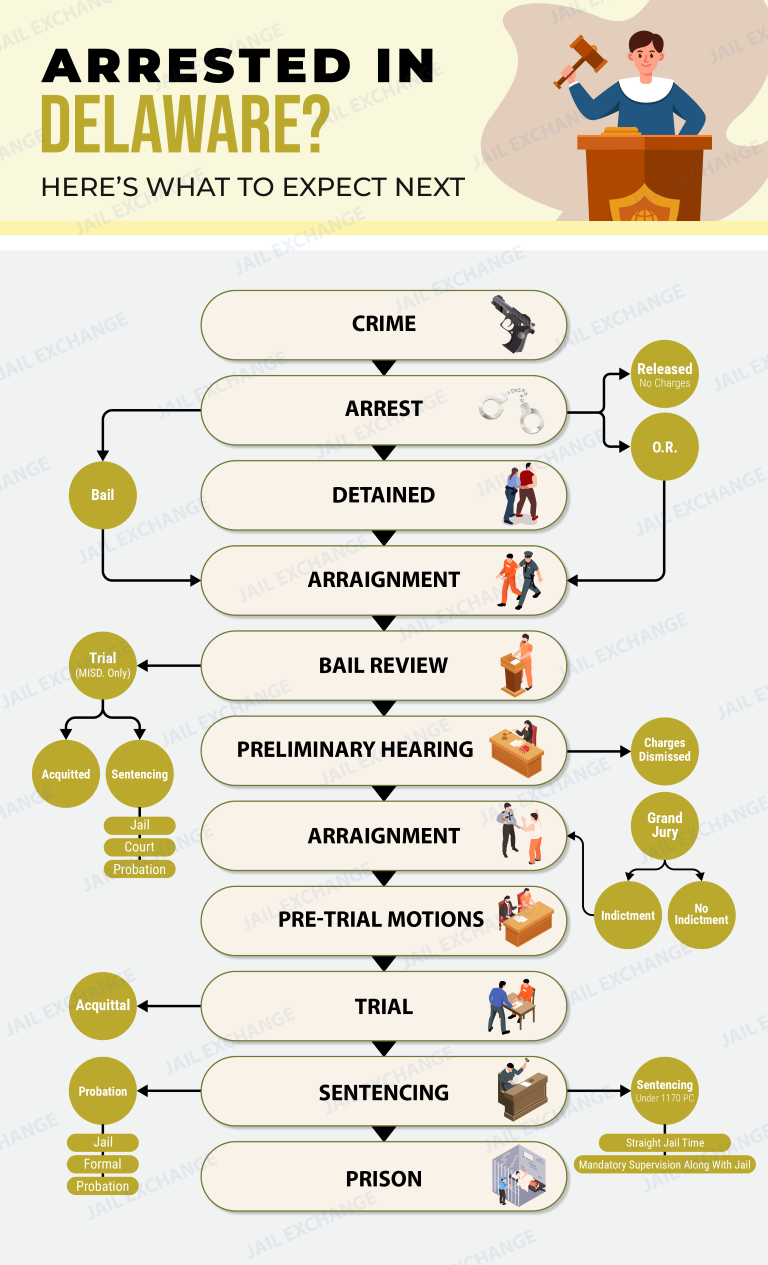
Lawmakers call the smaller crimes misdemeanors. Once someone is arrested, police bring the person to a JP Court, where a magistrate holds the initial presentment. Think of it as the opening step in court. The charges are explained, and the magistrate sets the rules the person must follow to go home.
Back in 2018, Delaware changed how bail works. Magistrates now look at a risk assessment, a score that guesses how likely someone is to skip court. Cash bail is used much less. Plenty of people charged with misdemeanors walk out the same day without paying anything, though they may have to check in with a pretrial officer or avoid contact with someone. A man who can’t meet the terms waits at Gander Hill, Vaughn or SCI, depending on the county. A woman waits at Baylor.
Most misdemeanor cases are decided in Common Pleas, and anyone charged there can ask for a jury. A handful of small charges finish in JP Court. If the alleged victim is a relative or partner, Family Court usually takes the case. The longest possible punishments are:
- Class A misdemeanor: up to a year locked up and a $2,300 fine
- Class B misdemeanor: up to six months and $1,150
- Unclassified misdemeanor: up to 30 days and $575, unless the specific law sets another limit
Probation violations at the treatment centers: Lots of people at Hazel D. Plant, CCTC and SCCC are there because of a violation of probation, or VOP. Probation lets a person serve a sentence out in the community if they follow rules. Failing a drug test, missing a check-in or breaking curfew are rule breaks. The probation officer can then use an administrative warrant, which is an arrest order that comes from the probation office instead of a judge. The person goes back to the court that gave the original sentence. That means Superior Court for a felony and Common Pleas for a misdemeanor. No jury sits in on it. The State just needs “some competent evidence” of a broken rule, which is much easier to meet than the proof needed at a trial. If the person admits the violation, that settles it. The judge can put them back on probation, move them up to a Level IV stay at a treatment center, or send them to prison for no longer than the suspended time left on the old sentence. At SCCC, the 250-bed Sussex Violation of Probation Center is built for short, strict stays with 5 a.m. wake-ups and community service.
Under 18: Kids’ cases go to Family Court instead of the adult courts. For a first small offense, police may give a teen a Juvenile Civil Citation. That means the teen completes a program in place of being formally charged.
Felonies: break-ins, selling drugs, car theft, illegal gun possession
A felony is a crime that can bring more than a year in prison. The case still opens with a JP magistrate. Men who aren’t released wait at the prison for their county: Gander Hill for New Castle, Vaughn for Kent and SCI for Sussex. Women from anywhere in Delaware wait at Baylor.
Next, a Common Pleas judge may hold a preliminary hearing. The question is whether there’s probable cause, meaning there’s a fair basis for thinking this person did the crime. Prosecutors can skip that step and go to a grand jury instead. That’s a group of local residents who look at the evidence in private. If they agree, they hand up an indictment, the official charge. After that, the case moves to Superior Court for an arraignment. At the arraignment, the charges are read out and the defendant says “guilty” or “not guilty.”
Delaware sorts felonies into seven classes, from A (worst) to G. Class B carries 2 to 25 years. The top limits for the rest are 15 years for C, 8 for D, 5 for E, 3 for F and 2 for G. Judges can look at the SENTAC guidelines, a chart of suggested sentences, but they aren’t required to follow them. Most felony cases end in a plea deal, where the defendant admits to a charge and gets something easier in return. If there is a trial, 12 jurors hear it. Many sentences step down over time, from prison to a Level IV center like CCTC or SCCC and then to probation.
Under 18: Family Court keeps nearly all teen felony cases. If a judge orders a teen held, the Division of Youth Rehabilitative Services runs two detention centers: the New Castle County Detention Center in Wilmington and Stevenson House in Milford. A judge has to review that detention within 14 business days and again at least every 21 days. A teen found responsible might get probation, counseling or a state youth program such as the Ferris School.
Violent felonies: murder, rape, armed robbery, kidnapping
Violent felonies are tried in Superior Court in the county where they happened. A judge may refuse release to someone who seems dangerous. Because of that, many of these people stay locked up for the whole case, men at Gander Hill, Vaughn or SCI and women at Baylor. These cases can drag on for a year or more. The Level IV treatment centers don’t hold people waiting on violent charges.
- Class A felony, such as first-degree rape: at least 15 years, up to life
- Class B felony, which includes most first-degree robbery: 2 to 25 years
- First-degree murder by an adult: a life sentence, and parole is never allowed
Delaware no longer has a death penalty. In Rauf v. State, decided August 2, 2016, the Delaware Supreme Court ruled the old law unconstitutional. Then, on September 26, 2024, Governor John Carney signed House Bill 70, which took it out of the law books.
Under Delaware’s Victims’ Bill of Rights, crime victims can be told about court dates and get a turn to talk in court when it’s time to sentence. The Attorney General’s Victim/Witness program answers toll free at (800) 870-1790. The county lines are (302) 577-8500 for New Castle, (302) 257-3293 for Kent and (302) 752-3263 for Sussex. The DOC has its own victim information line at (302) 857-5440.
Under 18: A few very serious charges send a teen’s case to Superior Court right away. For 16- and 17-year-olds, that list includes murder, first- or second-degree rape, first-degree assault and some armed robberies. For murder and the top rape charges, it can start as young as 13. The teen’s lawyer can then ask for a reverse amenability hearing. In plain words, that’s the teen’s chance to show the judge that Family Court can still help and that moving the case back is fair. If the judge says no, adult penalties apply.
This guide sketches how Delaware cases usually unfold; it isn’t legal advice. When a family member is facing charges, a lawyer is the right next step, or you can call the Office of Defense Services at (302) 577-5200.
Information for this service is currently unavailable.
Information for this service is currently unavailable.
Information for this service is currently unavailable.
Information for this service is currently unavailable.
Information for this service is currently unavailable.
Information for this service is currently unavailable.
New Castle County County Jails
New Castle County Juvenile Facilities
- Jail (Main): 302-993-3800
The Ferris School serves the following cities and towns of New Castle County: Arden, Ardencroft, Ardentown, Bear, Bellefonte, Christiana, Clayton, Delaware City, Elsmere, Middletown, Mill Creek, New Castle, Newark, Newport, Odessa, Townsend and Wilmington. At times this facility may also house inmates arrested in the following counties: Kent County and Sussex County.