DeSoto County Juvenile Detention Criminal Court Process
Criminal Court Process for DeSoto County Florida
DeSoto County Criminal Court in Arcadia: Your Plain-Language Guide
DeSoto County is cattle and citrus country on the Peace River, and Arcadia is its only city. For court purposes it joins Manatee and Sarasota counties to form Florida’s Twelfth Judicial Circuit. Two trial courts sit in Arcadia. DeSoto County Court deals with misdemeanors, criminal traffic matters (a DUI, say, or driving with no valid license) and local ordinance violations. DeSoto Circuit Court deals with felonies and holds the juvenile court that hears cases against young people. For the next steps, read our bond guide and inmate search guide.
The DeSoto County Courthouse is at 115 E. Oak Street, Arcadia, FL 34266, and its phone is (863) 993-4878. People arrested anywhere in DeSoto are held by the sheriff at the DeSoto County Jail, 208 E. Cypress Street, a few blocks away.
Free case lookup: The DeSoto County Clerk of the Circuit Court shares Florida’s free Online Court Records Search with dozens of smaller counties. On that page, pick “DeSoto” and press Go. Next, search with someone’s name, or with a case number if you know it. Up pop the charges, the next DeSoto hearing dates and every filing logged so far. By law, juvenile matters and other confidential records are hidden from public searches.
1. Arcadia misdemeanor court: DUI, petit theft, marijuana possession, battery
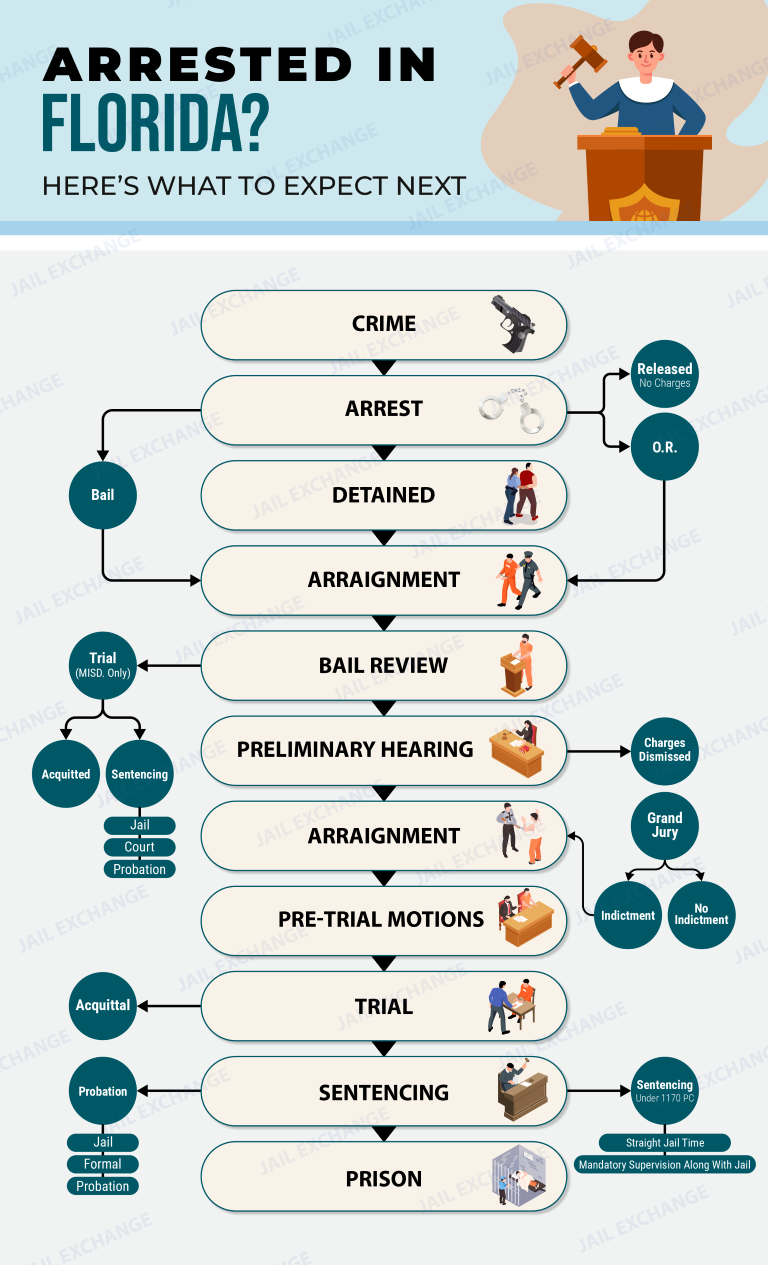
Florida calls its lower-level crimes misdemeanors. In DeSoto, a deputy or Arcadia police officer can either write a notice to appear, which is a promise-to-come-to-court form, or book the person into the Cypress Street jail. Florida’s rule 3.130 guarantees anyone booked a hearing called first appearance within a day. During that hearing, a DeSoto judge goes over the accusation and sets the rules of pretrial release, the time someone stays free while the case is pending. A Florida Supreme Court order took effect January 1, 2026, creating one statewide bond schedule with minimum amounts the DeSoto jail uses before that hearing. A few charges, such as domestic violence, keep people locked up until the judge sees them. Paying a bail bondsman? Expect a nonrefundable premium of 10% (or $100, if that’s more).
For DeSoto, the maximum for a first-degree misdemeanor is one year in jail and a $1,000 fine. A second-degree misdemeanor tops out at 60 days in jail plus $500. Arcadia’s cases are prosecuted by the Twelfth Circuit State Attorney, an elected officer whose main office is in Sarasota. The Twelfth Circuit Public Defender, also elected, defends people a judge finds unable to hire their own attorney. If the public defender has a conflict, Regional Conflict Counsel can be appointed. Under Florida law, a public defender fee can be charged, and it may become a lien if unpaid.
DeSoto first-time offenders may be offered pretrial diversion, which means doing classes or service work in exchange for a dropped charge. Those who choose trial are owed a start within 90 days of formal charges; that right can also be waived. Six DeSoto citizens make up the jury.
Under 18: In Arcadia, a child’s misdemeanor goes before the Circuit Court juvenile judge. For many first offenses, Florida lets officers write a civil citation rather than make an arrest, and the youngster finishes things like service hours or counseling. Custody triggers a detention hearing, held inside 24 hours, where a judge decides whether the youngster can go home. Kids who are detained are held at a Department of Juvenile Justice center; for the Twelfth Circuit that is the Manatee Regional Juvenile Detention Center in Bradenton.
2. DeSoto felony cases: cattle or equipment theft, meth sales, burglary, grand theft auto
Felonies are the crimes that can bring a stretch in a state prison. Here in Arcadia, felony cases also start with first appearance. Then the Twelfth Circuit prosecutors go through the reports and decide on formal charges. They file those charges in a paper called an information. Next is the arraignment in Arcadia, where the defendant pleads. After that, the lawyers exchange evidence, file motions and often work out a plea deal. Few DeSoto felony cases actually go to trial.
Florida’s felony levels set the ceiling. Third-degree convictions max out at 5 years, second-degree at 15, first-degree at 30. Life felonies and capital felonies rank higher still. Each defendant gets a Criminal Punishment Code scoresheet adding up points for the current crime, the harm done and past convictions. A high score makes a prison term the lowest sentence the judge may give. Florida’s 85% law then keeps a prisoner behind bars for most of the term. Taking property worth $750 or more, whether a trailer or a cow, is grand theft, a felony.
Felony defendants are owed a trial within 175 days of formal charges, though they may waive that limit. Most DeSoto felony juries have six people; twelve jurors are used only when the death penalty is possible.
Under 18: Felony cases against DeSoto teens usually stay in juvenile court, which aims to help kids get back on track with probation, services or a juvenile program. Florida does let the State Attorney “direct file” certain youth cases in adult court. Older teens (16 and 17) can be direct filed for most felonies. An Arcadia 14- or 15-year-old risks adult court only for charges named in Florida Statute 985.557; robbery, carjacking and home burglary are among them.
3. DeSoto’s violent felony cases: killings, holdups with a weapon, sexual battery, aggravated battery
When a DeSoto case involves serious violence, the steps stay the same but everything gets weightier. A judge may hold someone without bond after a pretrial detention hearing. When a firearm is used in crimes like robbery or aggravated battery, the 10-20-Life statute sets minimum prison terms: 10 years if the person had the gun, 20 if they fired it, and 25 to life if the shot killed or gravely injured someone. In Florida, rape is legally called sexual battery, and some forms carry a life sentence.
A first-degree murder charge in Arcadia must come from a grand jury indictment. A DeSoto conviction allows only death or life without parole. Florida changed its law in 2023 so that a death recommendation needs just 8 of the 12 jurors. Raiford’s Union Correctional Institution houses the men under death sentences, and Lowell Correctional Institution houses the women.
In Arcadia, as everywhere in Florida, a 2018 voter-approved amendment called Marsy’s Law shields crime victims. A victim can ask for notice of every court date, show up for each one, and describe the harm to the judge before a sentence is set. Help with all of this comes from victim advocates in the prosecutor’s office.
Under 18: Violence charges put DeSoto teens at the greatest risk of adult prosecution. At 14 or 15, armed robbery or aggravated battery can be direct filed. Florida Statute 985.56 adds another route: if death or life is a possible punishment, a DeSoto grand jury may indict a boy or girl of 12, 13 or any age, and the case then belongs to adult court. Execution, however, is barred for crimes committed under 18.
4. Where are Arcadia court warrants kept?
Many families look first at the shared Online Court Records Search, where a capias or failure-to-appear entry appears with the docket. The Sheriff's Office holds the active warrant file and takes questions at (863) 993-4700. Working through a lawyer usually means a surrender at the East Cypress Street jail followed by a prompt first appearance. Questions about a fresh date go to the clerk on East Oak Street. Florida's statewide wanted persons portal, run by FDLE, adds what other agencies publish.
Federal court: For U.S. cases, Arcadia looks south to Fort Myers: DeSoto’s federal crimes go to the Fort Myers Division (Middle District of Florida), meeting at 2110 First Street in Fort Myers, in the U.S. Courthouse and Federal Building. Federal charges come from breaking a law Congress passed for the whole country, or from crimes on federal property. DeSoto has little federal land, so most of its federal cases involve things like drug trafficking along U.S. 17 and State Road 70, illegal gun sales, ID theft, or forced-labor schemes on farms. Crimes inside DeSoto Correctional Institution near Arcadia are generally state matters, since it’s a Florida prison. No reservation lies in the county; the Seminole Tribe’s Brighton Reservation is to the east in Glades County. Choose a topic below.
Immigration holds. For DeSoto families facing an ICE detainer:
- the DeSoto bond judge must be told (F.S. 908.105)
- the DeSoto prosecutor gets notice
- bond is still possible in DeSoto
- the jail may hold them 48 more hours for ICE
- DeSoto counts weekends and holidays in that time
- a DeSoto forcible felony charge plus unlawful status in DeSoto means no release before first appearance (F.S. 907.041)
- at that point a DeSoto judge presumes detention, but the DeSoto defense can rebut it
Town courts. Since 1972 Article V changes, DeSoto has had no city courts. Any DeSoto city ordinance case is heard in DeSoto County Court instead, alongside misdemeanors.
Arcadia’s courts handle each case on its own facts, so read this DeSoto guide as background, not legal advice. Ask a lawyer, or call the Arcadia courthouse at (863) 993-4878.