Miami-Dade Pre-Trial Detention Center Criminal Court Process
Criminal Court Process for Miami-Dade County Florida
Miami-Dade Criminal Cases: What Happens and Where
Miami-Dade is the most crowded county in Florida, so its courts are big and busy. Still, the setup is easy to learn. There are two state trial courts. Miami-Dade County Court sorts out misdemeanors, criminal traffic offenses (DUI, hit-and-run with property damage) and local ordinance violations. Miami-Dade Circuit Court takes felonies plus juvenile delinquency, which is the court word for crimes by kids. The county forms the 11th Judicial Circuit all by itself; no other county is in it. Felony cases and many misdemeanor arraignments for people in jail are heard at the Richard E. Gerstein Justice Building, 1351 NW 12th St., Miami, FL 33125. County Court also meets at branch courthouses around the county. The Clerk of the Court and Comptroller’s main line is (305) 275-1155. Adults are held by Miami-Dade Corrections and Rehabilitation in three jails: Turner Guilford Knight (TGK) Correctional Center, Metro West Detention Center, and the Pre-Trial Detention Center beside the Gerstein building. See also our bail and bond page and our inmate lookup page.
Free case lookup: Miami-Dade isn’t on the shared records portal. The Clerk runs its own Criminal Justice Online System, where you can check felony and misdemeanor cases for free. Search with a case number or a defendant’s name; the site may ask you to set up a free account for some searches. It shows charges, hearing dates, bonds and outcomes. Sealed and expunged cases, juvenile records and other confidential material stay off the public view.
Federal court: Federal cases from here belong to the Southern District of Florida’s Miami Division. The main federal courthouse is the Wilkie D. Ferguson Jr. U.S. Courthouse, 400 North Miami Ave., Miami. A state case is a crime against Florida’s laws; a federal case is a crime against the nation’s laws or on property the U.S. government controls. Miami-Dade has a lot of that. Think PortMiami and Miami International Airport, where customs agents catch smuggled drugs, guns and cash. Think Homestead Air Reserve Base, Biscayne National Park, and the eastern part of Everglades National Park. Coast Guard crews also stop drug boats and migrant-smuggling trips offshore. Health care fraud cases are common here too. The Miccosukee Tribe has its reservation along the Tamiami Trail in western Miami-Dade, where tribal police work with state and federal officers. Pick a topic below.
1. Miami-Dade County Court charges: petit theft, DUI, resisting without violence, cannabis possession
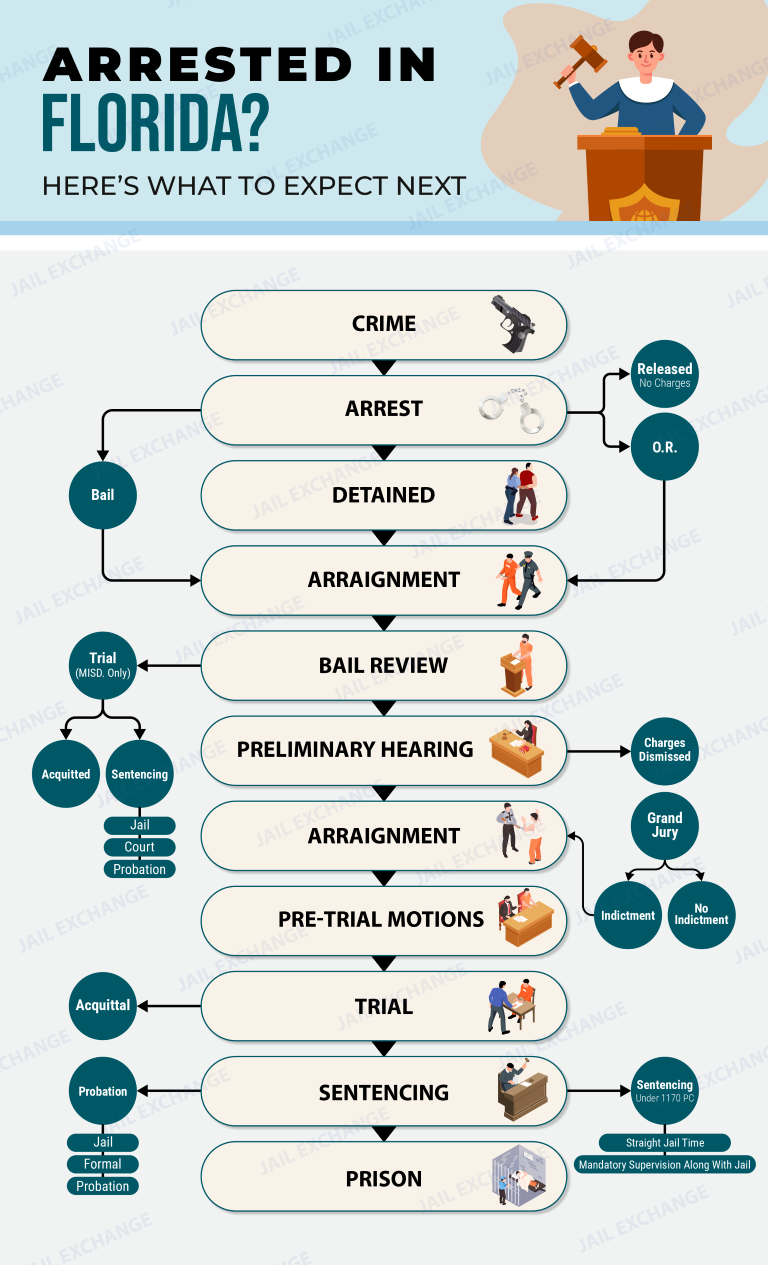
A misdemeanor charge in Miami-Dade doesn’t always mean a ride to jail. Police can give a notice to appear, which works like a court ticket. Anyone booked into a Miami-Dade jail sees a judge at a bond hearing, also called first appearance, within a day of being taken in. The Gerstein building runs these hearings every day, weekends and holidays included. Since the start of 2026, Florida has a statewide bond chart (Supreme Court order AOSC25-69) that sets a minimum bond for release before that hearing. Some arrests, such as domestic violence, must wait for the judge. A bond is cash or a pledge that lets you wait for trial at home. A licensed bail bond agent may post it for a premium that Florida’s insurance department lists at 10%, and that money doesn’t come back.
At arraignment, the accused person pleads. Miami-Dade first-degree misdemeanors, like most petit thefts or nonviolent resisting, are punishable by up to 12 months in jail and a $1,000 fine. Lesser, second-degree misdemeanors stop at 60 days and $500. The Miami-Dade State Attorney’s Office has diversion programs for many first-time adults; finishing the requirements gets the charge dismissed.
The State Attorney for the 11th Circuit is elected countywide and prosecutes all state crimes here. The Miami-Dade Public Defender, also elected, can be appointed when a judge decides you can’t pay a lawyer. A conflict, like two co-defendants who blame each other, sends one of them to Criminal Conflict and Civil Regional Counsel. Through section 938.29, judges may order repayment for appointed counsel, with a minimum of $50 per misdemeanor case, and it creates a state lien to collect it. A misdemeanor is supposed to reach trial within 90 days of formal charges under Rule 3.191, unless the defense waives that. Six jurors hear the trial.
Under 18: Children accused of misdemeanors are sent to Circuit Court’s juvenile section. Miami-Dade police often use civil citation (section 985.12) for a first minor offense. The youngster puts in service hours or counseling sessions, and because no arrest happens, no arrest record exists.
2. Felonies at the Gerstein building: burglary, cocaine trafficking, organized fraud, stolen cars
Felonies are the crimes that can bring state prison time. In Miami-Dade, after the bond hearing, an assistant state attorney decides what to charge and files an information in Circuit Court. Arraignment follows at the Gerstein building, then discovery, where evidence like videos and lab reports is shared, and depositions, which are sworn interviews of witnesses.
Florida felony levels run from third degree up. Stealing a car is third degree, worth up to 5 years. Breaking into an occupied home is second degree, worth up to 15. First-degree felonies can bring 30, and some carry life. Cocaine and fentanyl trafficking come with mandatory minimum terms based on weight. The judge then scores the case on the Criminal Punishment Code worksheet. Points for the offense and any past convictions add up to the lowest legal sentence. In Florida prisons, inmates serve no less than 85% of their sentence.
Rule 3.191 starts a 175-day felony countdown at formal charging. In busy Miami courtrooms, the defense often waives it. Six jurors decide non-capital felony trials, but plea deals close out the large majority.
Under 18: Children the court orders held are taken by the Department of Juvenile Justice to the Miami-Dade Regional Juvenile Detention Center, 3300 NW 27th Ave., Miami. It is the state-run center for Miami-Dade youth. Within a day, a Miami-Dade juvenile judge holds a detention hearing deciding custody or home with conditions.
3. The most serious Miami cases: murder, carjacking, armed home invasion, sexual battery
Violent felonies run on the same track, with a few big differences. Prosecutors may seek pretrial detention, keeping a person jailed until trial. And whenever a gun shows up, section 775.087, nicknamed 10-20-Life, applies. If a gun was possessed during a crime like carjacking or home invasion, the minimum is 10 years. If it was fired, 20 years. If the shot killed or seriously hurt someone, 25 years and possibly life.
Because first-degree murder is a capital felony, the choices are death or life without parole. A 12-member jury hears the penalty phase, and since 2023 a death recommendation needs at least 8 votes. Florida’s condemned men are mostly at Union Correctional in Raiford, with condemned women at Lowell.
Victims in Miami-Dade lean on Marsy’s Law, the 2018 amendment found at Article I, Section 16(b). Miami-Dade victims can stay informed, attend court, and speak at bond hearings, pleas, and sentencing.
Under 18: Under section 985.557, prosecutors may choose a “direct file,” moving a teenager’s felony to adult court. Most felonies qualify once a youth turns 16. At 14 or 15, only grave crimes named in the statute count, such as murder, armed robbery, carjacking or sexual battery. No law has required a direct file since 2019. Section 985.56 adds one more path: indictment by grand jurors, open for children of every age when death or life is on the table.
4. How do I check a Miami-Dade warrant?
Most people look first at the clerk's Criminal Justice Online System, which lists each case with any capias. The Sheriff's Office holds Eleventh Circuit warrants and answers at (305) 743-7433; its warrants bureau confirms a name with a birth date. Counsel can arrange your surrender at Turner Guilford Knight, the county's intake jail. The clerk at the Justice Building on NW 12th Street handles new dates, and Hialeah, Homestead and Doral cases come through that court. Warrants from beyond the county are on FDLE's statewide wanted persons search.
Immigration holds. If ICE lodges a Miami-Dade detainer on someone:
- the Miami-Dade bond judge must be told (F.S. 908.105)
- Miami-Dade prosecutors are told as well
- Miami-Dade bond can still be granted
- the jail may hold them 48 more hours for ICE
- in Miami-Dade, weekends and holidays count
- a Miami-Dade forcible felony charge plus unlawful status in Miami-Dade means no release before first appearance (F.S. 907.041)
- at that point a Miami-Dade judge presumes detention, but the Miami-Dade defense can rebut it
Town courts. Looking for a Miami-Dade town court? There is none. Florida's 1972 Article V reform did away with Miami-Dade town courts, so Miami-Dade city ordinance cases go to Miami-Dade County Court.
Miami-Dade readers should use this page as background only, since it is not legal advice. Have a criminal defense attorney review your own facts, or call the Miami-Dade Clerk of the Court at (305) 275-1155 for help finding a case.