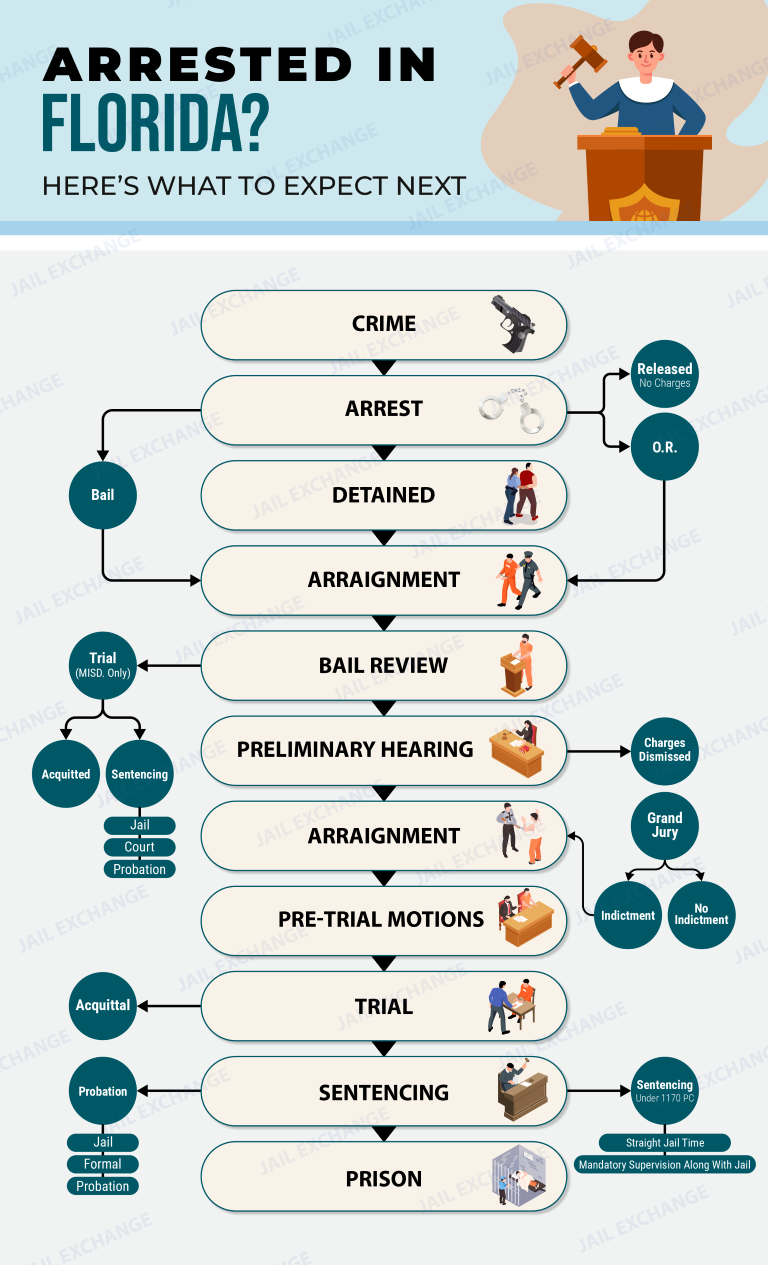
Taylor County Jail Criminal Court Process
Criminal Court Process for Taylor County Florida
Taylor County Criminal Court: A Simple Walk-Through
Taylor County stretches from the pine woods around Perry down to the Gulf fishing towns of Steinhatchee and Keaton Beach. Whatever the spot, a state charge brought in Taylor is decided in one of two courts. Taylor County Court hears misdemeanors, criminal traffic cases (driving with no valid license, for example) and violations of county or Perry city ordinances. Taylor Circuit Court hears felonies and every juvenile case. Taylor is part of Florida’s Third Judicial Circuit, which also covers Madison, Hamilton, Suwannee, Columbia, Lafayette and Dixie counties. For the next steps, read our bond guide and inmate search guide.
Taylor’s criminal cases are heard at the Taylor County Courthouse, 108 N. Jefferson Street, Perry, FL 32347, right in downtown Perry. The elected Clerk of Court and Comptroller runs the records office; staff can be reached at (850) 838-3506. Arrested adults are booked into the Taylor County Jail on U.S. 27 in Perry, which the Taylor County Sheriff’s Office operates.
Free case lookup: For a no-cost check on a Taylor case, start on the Taylor County Clerk’s website, then call the Clerk’s office at (850) 838-3506 or visit the Jefferson Street courthouse during weekday business hours (8 a.m. to 5 p.m.). Give the records clerk a full name or case number, and they can read you the Taylor charges and the next hearing date. Sealed matters, juvenile files and confidential information aren’t released to the public.
1. Taylor misdemeanors: DUI after a day on the water, fishing-season fights, petit theft, trespassing on timber land
Taylor deputies, Perry police, troopers and wildlife officers often write a notice to appear for small crimes. That paper gives a Perry court date, and you aren’t taken to jail. If you are booked on U.S. 27, rule 3.130 gives you a first appearance before a Perry judge in less than 24 hours. Release before that hearing follows a 2026 bond chart issued by Florida’s Supreme Court (AOSC25-69); its numbers are floors that Third Circuit judges can push higher. Domestic violence and a few other charges can’t be bonded out before the judge weighs in. A bond is cash or a promise that keeps you tied to the case until it ends. A Perry bail bondsman can post it for a premium of 10% of the bond (minimum $100), and they keep that fee.
Every state case in Perry is prosecuted by the Third Circuit’s elected State Attorney, who covers all seven Suwannee Valley and Big Bend counties. The elected Third Circuit Public Defender takes cases when a judge decides a defendant can’t afford private counsel. Conflict cases move to the state’s Regional Counsel lawyers. Florida Statute 938.29 permits a Taylor judge to bill a defendant for appointed-lawyer costs, and the amount can become a lien.
At most, a Taylor first-degree misdemeanor brings a year at the U.S. 27 jail plus $1,000. A second-degree misdemeanor brings 60 days plus $500. Perry misdemeanor defendants who keep their speedy-trial right must be tried inside a 90-day window that opens at formal charging. Juries of six Taylor residents decide misdemeanor trials. Pretrial diversion is commonly offered to first offenders, and finishing it gets the charge dismissed.
Under 18: A Circuit judge hears youth cases in the juvenile division at the Perry courthouse. Statute 985.12 lets a deputy hand a first-time Taylor teen a civil citation; the youngster completes volunteer hours or counseling and avoids an arrest. Perry has no juvenile lockup. Any Taylor youngster who needs secure detention is driven about an hour to Tallahassee’s Leon Regional Juvenile Detention Center, part of the Department of Juvenile Justice. Inside 24 hours, a Third Circuit judge rules on release.
2. Taylor felonies: burglary of camps and homes, timber or equipment theft, meth and pills, fleeing deputies
A Taylor felony is any charge for which a judge could order more than twelve months in a Florida prison. At first appearance the Perry judge sets bond and any pretrial release conditions, like check-ins, curfews, or an order to avoid the alleged victim. If the State Attorney’s Perry staff think the evidence is strong enough, they file an information listing each felony count. At arraignment in Perry, the defendant answers with a plea.
Felony penalties go by degree. Third degree, such as burglarizing a hunting camp nobody lives in, carries up to 5 years. Second degree, such as burglary of a home, carries up to 15. First degree carries up to 30. Points on a Criminal Punishment Code scoresheet, counted for the Taylor offense and any record, set the shortest sentence the judge may normally impose. Florida inmates must serve 85% of their prison sentence or more.
Taylor felony defendants are owed trial inside 175 days, but most waive that to let their lawyers prepare. Six jurors decide a felony trial in Perry, and they must all agree.
Under 18: Teen felony cases from Taylor usually stay juvenile, aiming at supervision, school and treatment. The exception is direct file under Statute 985.557: the Third Circuit State Attorney may treat 16- and 17-year-olds as adults on almost any felony charge, and 14- and 15-year-olds for the specific violent crimes the statute names. A 2019 change made these transfers optional in every case.
3. Taylor violent felonies: murder, armed robbery, sexual battery, stabbings and shootings
Violent Taylor cases go through the same stages, but with the strongest punishments in Florida law. Life felonies can mean life in prison. Capital felonies, such as first-degree murder, mean death or life without parole. A Taylor judge can deny bond when there’s strong proof of a capital or life felony.
Florida’s 10-20-Life law in Statute 775.087 adds mandatory prison time when a gun is involved: a Perry robber holding a gun gets ten years at least, firing means twenty at least, and killing or maiming means 25 years to life.
A Florida death penalty jury has 12 members, and since 2023 at least 8 must vote for death. Union Correctional Institution in Raiford holds the men on death row; Lowell Correctional Institution in Marion County holds the women.
Victims in Taylor cases are protected by Marsy’s Law in the Florida Constitution. They may be informed about hearings, attend them, and speak when a judge considers release, a plea or a sentence. The State Attorney’s victim advocates explain these rights.
Under 18: A Taylor grand jury, using Statute 985.56, can indict (formally accuse) a child, however young, if Florida punishes that crime with death or life imprisonment, and adult court then takes over. Florida never sentences anyone to death for a crime committed under 18, and a juvenile can receive life only after a special sentencing hearing.
4. Who holds warrants from the Perry courthouse?
Taylor's clerk keeps Third Circuit records on its website, and a capias is visible on the docket of the case. Warrants themselves belong to the Sheriff's Office, where staff at (850) 584-4225 will check a name. Hiring a lawyer to time your surrender at the Highway 27 jail east of downtown is the smoothest route and helps with release. Suite 102 on Jefferson Street is where the clerk resets hearings, and Steinhatchee and Keaton Beach cases go there too. For other places, FDLE lists warrants in its statewide public wanted search.
Federal court: Neighboring Suwannee uses the Middle District, while Taylor’s federal cases go to the Tallahassee Division of Florida’s Northern District. That court sits at the Joseph Hatchett U.S. Courthouse, 111 North Adams Street, Tallahassee, FL 32301, a little over an hour northwest of Perry. Federal court handles crimes against laws made by Congress and crimes on federal property, while the Perry courthouse handles Florida law. Taylor’s long, empty coastline is part of the story. In the 1970s and ’80s, smugglers’ boats unloading “square grouper” (slang for marijuana bales) along the Steinhatchee and Keaton Beach shore drew federal drug agents to Taylor. Running drugs or people across the Gulf is still a federal offense, and Coast Guard crews still patrol. Breaking federal fishing rules in Gulf waters, dumping pollution into rivers in violation of federal clean-water laws, robbing a bank, and having a gun after a felony conviction can all bring federal charges too. You won’t find a military post, a national forest or Seminole tribal land anywhere in Taylor. Pick a section below.
Immigration holds. For Taylor families facing an ICE detainer:
- the judge at the Taylor bond hearing hears about it (F.S. 908.105)
- the Taylor prosecutor gets notice
- a Taylor judge can still set bond
- ICE may keep the person up to 48 hours past release
- in Taylor, weekends and holidays count
- for Taylor forcible felony cases, unlawful status blocks Taylor release before first appearance (F.S. 907.041)
- then the Taylor court presumes detention, and the Taylor defense can push back
Town courts. Since 1972 Article V changes, Taylor has had no city courts. Any Taylor city ordinance case is heard in Taylor County Court instead, alongside misdemeanors.
This Taylor County walk-through is meant for learning; it does not count as legal advice. When a charge is real, contact a criminal defense lawyer, or call the Taylor County Clerk at (850) 838-3506.