
Union County Detention Center
Union County Detention Center
Physical Address
3440 Northeast 39th AvenueGainesville, FL 32609
Jail Phone Number
352-955-2105Union County Jail, Lake Butler
Union is one of Florida's smallest counties.
Arrests in Lake Butler, Worthington Springs and Raiford are booked at the Union County Jail on NW 1st Street. Union's inmate search is VINELink, since the county has none of its own; or call 386-496-2501.
More is in our court process guide.
Read inmate search answers
 Read inmate search answers
1. Union jail address
The jail is at 50 NW 1st Street, Lake Butler, FL 32054. The jail and the Union County Sheriff's Office use the same number: 386-496-2501.
↑ Back to the question list2. Union inmate lookup
Type a name into VINELink to check Union custody. With so few beds, a phone call is often the fastest check. VINELink sends alerts when someone gets out.
↑ Back to the question list3. Bond in Lake Butler
Union is in the Eighth Judicial Circuit with Alachua. A judge reviews new arrests within 24 hours:
- ROR, no payment needed.
- Cash: Union's clerk keeps the full bond while the case is open and gives it back afterward, less costs.
- Bondsman: a 10 percent fee, $100 minimum per charge, not returned.
Bradford, Columbia or probation holds keep someone in Lake Butler. Miss a Union court date and a warrant follows. See our Union bail page.
↑ Back to the question list4. Is someone held on a warrant at the NW 1st Street jail?
It may well be; in this small farm county, the NW 1st Street jail books every warrant arrest from Raiford and Worthington Springs. The clerk's office at 386-496-3711 can share the case number and the next hearing. Each docket on the online court records search lists any capias. Local warrant checks run through the Sheriff's Office, and FDLE's statewide database handles everything filed farther afield. Is the warrant yours? Then a lawyer can set your surrender so you pick the day, bring paperwork and see a judge quickly.
↑ Back to the question list5. Public defender
The Eighth Circuit Public Defender represents Union clients judged indigent. The $50 fee may be waived.
↑ Back to the question list6. Visiting in Lake Butler
Visits must be arranged; ask about video. Call 386-496-2501. See visits and remote visits.
↑ Back to the question list7. Phones
Lake Butler inmates can't get calls; they phone out on money relatives prepay. See phones, messages and tablets.
↑ Back to the question list8. Money
Union commissary is paid from deposits. Ask the jail which methods work. See money and commissary.
↑ Back to the question list9. Mail
Address with name, booking number and 50 NW 1st Street. No stickers. See mail rules.
↑ Back to the question list10. Union juveniles
Union kids under 18 are charged in juvenile court. When a judge orders them held, they usually go to the Alachua Regional Juvenile Detention Center in Gainesville, 352-955-2105, and get a hearing inside 24 hours. Parents can call 386-496-2501.
↑ Back to the question list11. Medical
Phone 386-496-2501 about medicines, seizures, insulin or suicide risk.
↑ Back to the question list12. Union federal cases
The U.S. District Court, Middle District of Florida, hears Union federal cases in Jacksonville at 300 N. Hogan St., Jacksonville, FL 32202.
Union federal arrestees appear before a Jacksonville magistrate first; detention is set at a hearing. The U.S. Marshals (904-301-6670) may house them in county jails. After sentencing, see the BOP locator.
↑ Back to the question list13. ICE detainers in Union
- NW 1st Street booking prints reach DHS.
- ICE may issue an I-247A detainer.
- Union can hold the person awaiting federal transfer up to 48 hours after they would otherwise be released (8 CFR 287.7(d)).
- F.S. 908.105: Lake Butler's bond judge and the prosecutor receive the hold, and it enters the court file.
- F.S. 907.041: a Union forcible-felony defendant who lacks lawful status won't be released ahead of first appearance; the judge there presumes detention, which can be challenged.
- F.S. 908.11: 287(g) is required; the Lake Butler sheriff agreed to task force and warrant service roles.
- Union families can enter a name at ICE's locator; ICE can also be reached at its Miami field office, 2805 SW 145th Ave., Miramar, FL 33027, 954-843-5800.
14. State prison
Union County is home to several state prisons, yet anyone sentenced in Lake Butler still passes through FDC reception before assignment. Find them with FDC's offender search and get prison addresses from our Florida prisons page.
↑ Back to the question list15. Union mugshots
Request booking photos from the Union County Sheriff's Office at 386-496-2501. Most are public; F.S. 119.071 exempts some.
ICE photos require an ICE FOIA filing. Union federal mugshots surface only on Marshals wanted posters.
↑ Back to the question list16. Union police numbers
- Union County Sheriff's Office: 386-496-2501
Union has no city police department in our records; the sheriff covers the county. Emergencies: 911.
↑ Back to the question listUnion County contacts
- Inmate search
- VINELink (Florida inmate search)
- Jail
- Union County Jail, 50 NW 1st Street, Lake Butler, FL 32054, 386-496-2501
- Sheriff
- 386-496-2501
Union County bail and bond: finding the Lake Butler jail and getting a bond posted
Union adults are booked at the Union County Jail, 50 NW 1st Street, Lake Butler.
Your first move is Union County Inmate Search. Union's search shows custody, charges, and any bond.
For anything it cannot tell you, call 386-496-2501, the number listed for the jail and the sheriff's main line. The sections below explain how bail works in Florida's Eighth Judicial Circuit.
1. Step one: is my relative booked?
Put the full name into Union County Inmate Search. If there is a match, note the booking number and each charge. If there is none, wait a few hours and search again, since processing takes time. Then call 386-496-2501 and ask if a neighboring agency or another county's jail took the person.
2. Which building holds people from Union County?
Plan on the Lake Butler jail on NW 1st Street, which the Union County Sheriff's Office operates, according to its listing. Because lists of county jails can lag behind real changes, call 386-496-2501 to confirm that the jail is holding your family member before you bring money. If the search shows a different location, follow that.
3. How is the first number chosen?
Florida now has a statewide bond schedule. Under Florida Statutes section 903.011, the Supreme Court adopts it each year, and a chief judge may set local amounts higher without approval. A schedule is used only when an officer or jail employee releases a person before the first court hearing. A judge is never bound by it.
4. Where do I find the Eighth Circuit amounts?
Union County shares the Eighth Judicial Circuit with Levy, Gilchrist, Bradford, Baker and Alachua counties. The chief judge's current bond order is the controlling list for the circuit. Rather than guess from other counties, whose circuits use different numbers, read the figure on Union County Inmate Search for your loved one's charge, and ask the jail whether it came from the schedule or a judge.
5. Why is there no number at all?
Section 903.011(6) says some people may not be released before a first appearance or bail decision. In Union, examples include people on release at arrest, three-plus arrests in six months, and certain serious charges. Section 903.046 adds others, such as registered sex offenders until their first appearance. A blank amount can also mean booking is not finished.
6. How soon is there a hearing?
Florida Rule of Criminal Procedure 3.130 requires a first appearance within 24 hours of arrest, in person or by video. The judge decides release terms under rule 3.131 and rule 3.132. At that Union hearing, the judge appoints a lawyer right away for someone who asks, qualifies, and can't pay.
7. Who can lower it?
Only a judge. Under section 903.011(4), a Union judge alone sets or changes bail and can revisit the money part if the person cannot pay it. A lawyer's motion is the usual route. Jail staff in Lake Butler cannot bargain over the number.
8. How do I hand over the money?
Phone 386-496-2501 to ask if Union's jail bonding window or the clerk of court takes payment, the hours, and the payment types it accepts. Carry ID with a photo, the booking number and the full bond amount. Cash and surety release must carry the same dollar amount under section 903.011. Take a receipt.
9. What does a bail agent have to follow?
The Florida Department of Financial Services licenses and oversees Union bail agents and puts the state bond premium at 10 percent of bail. On a $2,000 bond, that is $200. The Union agent keeps the fee once the person you're helping is out but must pay it back if there is no release. Union collateral is due back within 21 days once the bond is discharged. Be wary of any discount that seems too good. Get the fees, collateral, and no-show terms on paper, and read the bond instructions.
10. Do I need Union County land to pledge property?
The statute is wider than that. Union follows section 903.05: non-company sureties must be Florida residents or own Florida real estate. The paperwork steps and the equity the county wants are for the jail or clerk to explain. Ask at 386-496-2501 before gathering deeds. The Union County Courthouse is at 55 West Main Street, Lake Butler.
11. What if an old warrant is attached?
Each charge carries its own bond, so one payment may not free the person if another hold is listed. A probation hold can block release until a judge acts (section 903.0351 covers certain probation violations). Read every line of the record on Union County Inmate Search, then ask the jail what is left to clear.
12. Where is a teenager from Union County taken?
The Department of Juvenile Justice screens Union County youth at 3440 NE 39th Avenue, Gainesville, 352-955-2105. Detention is at the Alachua Regional Juvenile Detention Center there, a 45-bed facility that lists Union among its counties. Parents and guardians may visit on Thursday from 7:30 to 8:30 p.m., and on Saturday and Sunday from 2:00 to 3:00 p.m. The adult search does not list juveniles.
13. How do we get a lawyer at no cost?
Tell the judge at first appearance that the person cannot pay. The judge reviews income and appoints the Eighth Circuit public defender on the spot for those who qualify. The Eighth Circuit Public Defender lists a Bradford and Union office at 945 North Temple Avenue, Starke, and a main office at 151 SW 2nd Avenue, Gainesville, 352-338-7370. Call the main number and ask which lawyer has the Union County case.
14. What if court is missed after release?
A Union court may forfeit the bond under section 903.26, and the clerk tells whoever signed as surety. Failing to appear can also make the person ineligible for a recognizance bond later, per section 903.046. Speak with a lawyer first, then the bail agent, and get the case reset.
15. How do ICE holds work at the Union jail?
- ICE uses Form I-247A to ask Union jailers for more time.
- That extra hold in Union lasts up to 48 hours.
- Saturdays, Sundays and holidays all count in Union.
- Paying a Union bond will not lift the detainer.
- F.S. 908.105 says the Union bond judge must be told.
- The Union prosecutor is told too.
- Florida law (F.S. 908.11) puts the Union sheriff in the 287(g) program.
- ICE lists these 287(g) models for Union:
- Task Force Model
- Warrant Service Officer
- To find a person ICE took from Union, try the ICE locator.
Union County contacts
- Jail
- Union County Jail, 50 NW 1st Street, Lake Butler, FL 32054; 386-496-2501
- Bond guide
- Bail and bond instructions
- Custody lookup
- Union County Inmate Search
- Courthouse
- 55 West Main Street, Lake Butler, FL 32054
- Public defender
- 151 SW 2nd Avenue, Gainesville, FL 32601; 352-338-7370; Bradford and Union office, 945 North Temple Avenue, Starke
- Circuit
- Eighth Judicial Circuit (Alachua, Baker, Bradford, Gilchrist, Levy, Union)
- Juvenile
- Alachua Regional Juvenile Detention Center, 3440 NE 39th Avenue, Gainesville, FL 32609; 352-955-2105
Details such as hours, payment types, and dollar amounts can shift, and each judge decides the real terms for a case. Verify with the jail before you pay anything. This Union page is for learning and is not legal advice.
Union County Detention Center Inmate Visitation
Friends and Family – Official county jail pages describe Union County Detention Center as a 36-bed facility on the north side of the courthouse in Lake Butler, but they do not publish visiting days or clock hours. Call the jail at 352-955-2105 before you go so staff can give you the current schedule, any identification or appointment rules, and confirmation that the person you hope to see is still in custody there.
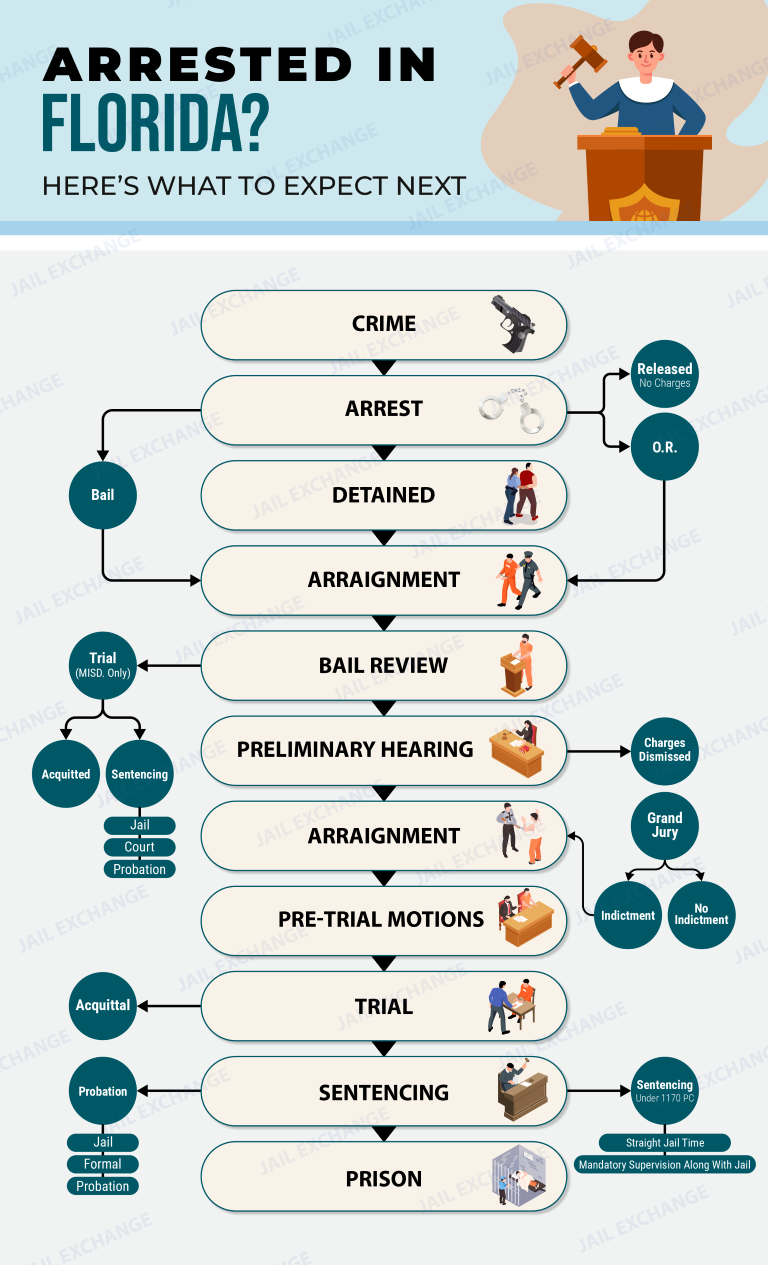
Union County, Florida: How a Criminal Case Moves Through Court
Union is one of Florida’s smallest counties, yet its courts run like everyone else’s. There are two trial courts. Union County Court takes misdemeanors (the lighter crimes), traffic crimes (driving on a suspended license is a common one) and violations of local ordinances. Union County Circuit Court takes felonies (the serious crimes) and cases about kids under 18. Union is part of Florida’s 8th Judicial Circuit. Its circuit partners are Alachua, Baker, Bradford, Gilchrist and Levy. You can also check our bond guide and inmate search guide.
Criminal hearings take place at the Union County Courthouse, 55 W. Main Street, Lake Butler, FL 32054. The clerk keeps the files there; call (386) 496-3711. After an arrest, adults go to the Union County Jail in Lake Butler, run by the sheriff. The town of Raiford in Union County is home to Union Correctional Institution, the state prison that holds Florida’s death row for men.
Free case lookup: Union’s clerk uses the free statewide system called the Online Court Records Search. Pick “Union” from the county list. After that, enter a case number or someone’s first and last name. You’ll see dates, charges and how the case ended. The law keeps certain records out of sight, such as most juvenile files, sealed cases and private details like Social Security numbers.
1. Misdemeanors in Union County Court: petit theft, simple battery, first DUI, trespassing
For small crimes, a deputy might hand you a notice to appear. That ticket lists the day you owe the court a visit. Get taken to jail, though, and Florida gives the system 24 hours to put you in front of a judge. Lawyers call this quick hearing first appearance. For anyone who leaves jail ahead of it, the floor on bail now comes from a single statewide list the Florida Supreme Court put in place for 2026. Think of a bond as a deal: you put up cash or a pledge, and you return for court. Certain arrests, domestic violence among them, keep a person locked up until the judge weighs in. Bondsmen keep a 10% cut of the bond amount (no less than $100) when they post it for you.
First-degree misdemeanors are the top tier: as much as 1 year behind bars and fines reaching $1,000. For the second degree, the cap is 60 days and a $500 fine. Common examples are petit theft (taking something worth under $750) and simple battery (touching or hitting someone on purpose against their will). A first DUI adds a suspended license and DUI school.
The State Attorney for the 8th Circuit, who is chosen by voters, handles the prosecution of all state crimes in Union County. If a judge finds that you can’t afford a lawyer, the 8th Circuit Public Defender can be appointed. Conflict cases, such as two people charged together, are handed to a separate state lawyer office, Criminal Conflict and Civil Regional Counsel. Keep in mind that, per Fla. Stat. 938.29, someone found guilty may be charged for the public defender’s work, and the bill can become a lien. First-timers may qualify for pretrial diversion, a program where the charge is dropped after you finish classes or community service. If you want a trial, Florida’s speedy trial rule puts a misdemeanor on the calendar for trial inside 90 days of formal charges, unless you agree to wait. A jury of six decides.
Kids under 18: A young person who gets in trouble for a first small offense may be offered a civil citation instead of being arrested. That is a program with tasks like community service or counseling, and finishing it keeps an arrest record from being made. A juvenile judge in Circuit Court handles any youth case that is filed.
2. Felonies in Union County: burglary, drug sales, grand theft, dealing in stolen property
A Union County felony is serious enough to bring a state prison term. After the arrest and first appearance, the State Attorney weighs the evidence. If it is strong enough, that office files an information, which is the formal charge. Next comes the arraignment, where the accused tells the court “not guilty,” “guilty” or “no contest.” Felony defendants get a speedy trial window of 175 days after formal charges are filed, yet lots of them waive it to give their lawyer time to prepare.
Florida ranks felonies by degree. The lowest level, third degree, has a 5-year limit. Second degree goes as high as 15. First-degree felonies go up to 30 years, and some, called life felonies, can mean life in prison. To figure out the lowest legal sentence, the court fills out a Criminal Punishment Code scoresheet, a form scoring both the offense and any earlier convictions. Prisoners in Florida have to complete 85% or more of their time before release. Gun crimes are tougher under the 10-20-Life law (Fla. Stat. 775.087): a gun in hand during certain crimes means a 10-year minimum; pulling the trigger doubles that to 20; and wounding or killing a person with it carries 25 years up to life.
Most Union felony cases end with a plea deal, and the others go to a jury of six. Probation, drug court and treatment are possible outcomes, depending on the score and the charge.
Kids under 18: A teen accused of a felony who must be held is usually sent to Gainesville, to the Department of Juvenile Justice’s Alachua Regional Juvenile Detention Center. No more than 24 hours later, a detention hearing settles whether the teen heads home. Prosecutors may move some cases to adult court. This is called a direct file. They can do it for most felonies by 16- and 17-year-olds, and, for kids aged 14 or 15, only a named list of grave felonies. Since 2019, Florida no longer forces this. It is the prosecutor’s choice.
3. Murder, armed robbery, sexual battery and other violent felonies
These cases take the same road as other felonies. What changes is how much is on the line. Bail is often very high, or a judge may hold the person with no bond at all after a special hearing. A no-contact order with the victim is a common condition. Armed robbery and many sexual battery charges are first-degree felonies or life felonies.
In Florida, first-degree murder is classed as a capital felony. That label means the only punishments are life without parole or death. A Union County grand jury has to approve that charge. A grand jury is a group of local citizens who meet in private to decide if there’s enough proof. If the jury convicts, it then votes on death. Since a 2023 law, a death recommendation needs at least 8 of the 12 jurors. Capital trials use 12 jurors instead of six. Union Correctional Institution, in this county, is where Florida’s condemned men are kept. For women, it’s Lowell Correctional Institution, a prison close to Ocala.
Victims in Union County are protected by Marsy’s Law, spelled out in Florida’s constitution under Article I, Section 16(b). Thanks to it, they can learn about hearings, show up for them and talk to the judge at sentencing. Victim advocates from the prosecutor’s office guide them through it.
Kids under 18: For crimes with a possible death or life sentence, grand jurors can return an indictment against a child of any age, which shifts the case to adult court (Fla. Stat. 985.56). Death sentences are off the table for anyone under 18, per the U.S. Supreme Court. A teen facing life also gets an extra sentencing hearing first.
4. Where are Lake Butler court warrants kept?
The Union County Jail on NW 1st Street stands steps from the courthouse, and a planned surrender there goes smoothly when a lawyer calls ahead. The Sheriff's Office keeps Eighth Circuit warrants, and deputies at (386) 496-2501 can check a name. Dockets on the online court records search show whether a capias was signed. New dates come from Room 103, the clerk's office on West Main, and Raiford and Worthington Springs matters land there too. Outside agencies post to FDLE's statewide wanted persons database.
Federal court: Union sits within the territory of the Middle District of Florida, a U.S. District Court, and its Jacksonville Division. Hearings take place in Jacksonville, at 300 North Hogan Street, in the Bryan Simpson United States Courthouse. What makes a case federal instead of state? It has to break a law passed by Congress, or happen on land the national government controls. Union has almost no federal land, so most federal cases from here involve things like drugs shipped across state lines, gun possession by someone with a past felony, mail or bank fraud, or child exploitation online. Florida’s Seminole and Miccosukee tribal lands are all in the southern half of the state, far from Lake Butler. Pick a topic below.
Immigration holds. Key Union facts on ICE detainers:
- the judge at the Union bond hearing hears about it (F.S. 908.105)
- the Union prosecutor gets notice
- bond is still possible in Union
- the jail may hold them 48 more hours for ICE
- Union counts weekends and holidays in that time
- F.S. 907.041: in Union, an unauthorized alien facing a Union forcible felony charge stays in the Union jail until first appearance
- at that point a Union judge presumes detention, but the Union defense can rebut it
Town courts. Looking for a Union town court? There is none. Florida's 1972 Article V reform did away with Union town courts, so Union city ordinance cases go to Union County Court.
Remember to treat this Union County guide as general information, not legal advice. Laws change and cases differ, so consult a defense lawyer or phone the Union County Clerk of Court, (386) 496-3711.
Buy Commissary for an Inmate in the Union County Detention Center
Union County Detention Center Inmate Commissary - Sending Money or Purchasing Commissary for an Inmate
The Union County Detention Center allows inmates to purchase commissary. This can be snacks, hygiene products, stamps, stationary, clothing and even electronics.
Call the facility at 352-955-2105 to ask whether there is a limit on how much an inmate can spend on commissary.
Inmates have access to both an in-house commissary store, and commissary packages that can be purchased and shipped to the inmate by friends and family.
Scroll down for further information on the commissary program, how it works, what type of things inmates can buy, how often they receive commissary, and a lot more.
You can also go to our Inmate Money page for information on how to send money to an inmate.
Deposit Money for an Inmate in the Union County Detention Center
The Easiest Way of Depositing Money for an Inmate
There are several methods for depositing money on an inmate's account. You can find out how to do this by calling the Union County Detention Center at 352-955-2105 and asking, or you can scroll down and review the different methods.
1. Mail an inmate a money order or cashier’s check from a trusted source such as the Post Office, a local bank, or Western Union. The money order should be be made out to either the inmate or the Union County Sheriff's Office, with the inmate’s name and ID# on the memo line of the check.
When mailing a money order or cashier’s check, send it an envelope by itself. Never send it with a letter or photos for your inmate, unless the facility allows it. Never send personal checks or cash.
2. Deposit cash or use a debit or credit card using a dedicated kiosk for this purpose. The machine is located in the lobby or visitation area of the Union County Detention Center.
3. The Union County Detention Center has a reception desk that may accept cash, money orders or cashier checks. Call 352-955-2105 to find out the specific hours for drop off times.
4. The Union County Detention Center may contract with a third party service which accept inmate deposits online, by mail or over the phone, or even in ATM machines you can find in check cashing stores and retail outlets across the country. Call 352-955-2105 for the company information, along with a list of these companies, or find it by scolling down below.
Send an Inmate Mail in the Union County Detention Center
When mailing a letter or postcard to an inmate, please address your mail as follows:
3440 Northeast 39th Avenue
Gainesville, FL 32609
- All mail sent to an inmate at the Union County Detention Center must include the sender's name and mailing address in the top left corner of the envelope or postcard.
- Failure to include your return address will most likely result in your mail NOT being delivered and your letter destroyed.
- Always use blue or black ink. Do NOT use felt markers or crayons.
- Do NOT include drawings, nor should you draw on the envelope or postcard.
- Do NOT enclose glitter, confetti or anything else in envelope.
- Do not use lipstick, perfume, colored ink or markers, or crayons.
- When greeting cards are allowed, they should be plain and not be musical.
- When books, newspapers and magazines are allowed, they must be new, and only be sent directly from the publisher.
- Packages, when allowed, must only be sent directly to an inmate from the third-party vendor outlined on our Commissary Page.
Inmates have their mail delivered Monday thru Friday. There is no limit on how much mail they can receive. Inmates are allowed to send mail to friends and family, but NOT to co-defendants, other inmates in this or other jails or prisons, and NOT from people they have a 'no contact' order in place from.
The Union County Detention Center has a zero-tolerance policy regarding mail violations.
Follow these instructions exactly to help ensure that your inmate receives his/her mail and not have it thrown away.
Scroll down for a list of Frequently Asked Questions and Answers regarding how to send an inmate mail, or call the Union County Detention Center at 352-955-2105 with your questions.
ViaPath AdvancePay Phone Calling Accounts
Provider: ViaPath Technologies • Formerly ConnectNetwork / Global Tel*Link (GTL)

AdvancePay is the primary prepaid telecommunications service operated by Global Tel*Link (GTL) and ConnectNetwork, which have unified under the corporate identity of ViaPath Technologies (and the myViaPath platform). By funding an AdvancePay account, telephone charges are deducted per minute whenever an incarcerated loved one calls your specific telephone number, preventing calls from being rejected by cellular carriers.
Important: Cell Carriers Automatically Block Jail Collect Calls
Inmate telephone networks do not permit incoming calls, and wireless cell providers automatically block traditional collect billing by default. While select traditional landlines may support operator billing, cell phones and internet-based lines require an active AdvancePay balance, which you can verify with your carrier. If you do not register your number online and add funds immediately, your loved one will hear an automated operator announcement stating your line is blocked from receiving correctional calls.
Step-by-Step Instructions to Open and Fund AdvancePay
- Visit web.connectnetwork.com or the updated my.viapath.com portal, or launch the ConnectNetwork / ViaPath mobile application.
- Click Sign Up and register using your primary 10-digit cellphone number and email address.
- Select Add Facility, pick your state, and choose the detention center or state prison where the inmate is held.
- Search for the inmate using their full legal name or facility booking ID number and link them to your contact directory.
- Select AdvancePay Phone and choose your deposit amount ($25, $50, or custom).
- Enter your debit or credit card billing details, accept the administrative transaction fee, and complete the payment.
- Check your phone settings to confirm that automated or unknown correctional numbers are not routed straight to spam.
What the Inmate Needs to Do
The inmate approaches any housing pod telephone, enters their assigned PIN and voice biometric recognition phrase, and dials your 10-digit number. ViaPath's automated operator confirms your active prepaid balance and connects the call. All personal telephone calls are subject to recording and monitoring by facility investigators.
Official Providers: ConnectNetwork Portal | myViaPath Portal
Customer Service Telephone: 1-877-650-4249 (Automated & Live Support)
Support Hours: Automated Service 24/7; Live Operators Monday – Friday, 8:00 AM – 10:00 PM EST
Supported Languages: English and Spanish
Other Services Provided by ViaPath Technologies (ConnectNetwork)
In addition to AdvancePay Phone Calling, ViaPath / ConnectNetwork provides several other communication, financial, and visitation services:
- ConnectNetwork Trust Fund Deposits: Transfer money directly into an inmate's jail trust account for commissary store purchases.
• Learn more on our website: Inmate Trust Deposits Guide | • Visit official vendor page: ConnectNetwork Trust Deposits - ViaPath PIN Debit Phone Calling: Give the inmate their own calling funds to contact any approved phone number independently.
• Learn more on our website: PIN Debit Phone Calling Guide | • Visit official vendor page: ViaPath PIN Debit Calling - ViaPath Messaging & Photo Sharing: Send digital messages, photos, and video attachments directly to their terminal.
• Learn more on our website: Digital Messaging Guide | • Visit official vendor page: ViaPath Messaging Services - GettingOut Video Visitation & Tablets: Schedule face-to-face remote video visits and manage handheld tablet communications.
• Learn more on our website: Remote Video Visitation Guide | • Visit official vendor page: GettingOut Video Visits
ViaPath PIN Debit Phone Calling Accounts
Provider: ViaPath Technologies • Formerly ConnectNetwork / Global Tel*Link (GTL)ViaPath PIN Debit (hosted on ConnectNetwork and myViaPath) provides incarcerated individuals with their own calling funds. Unlike AdvancePay (which only funds calls placed to your specific phone number), PIN Debit funds belong directly to the inmate, allowing them to call attorneys, bondsmen, employers, or extended family members across multiple approved telephone numbers.
Important: AdvancePay Only Funds a Single Phone Number
When someone is arrested, they often need to contact multiple people—including legal defense counsel, bail agents, employers, and relatives. If you only fund an AdvancePay account, your loved one will have no calling balance to dial anyone else, as rules and call authorizations vary by facility. Adding funds directly to ViaPath PIN Debit grants them the calling flexibility needed to handle critical legal and family arrangements without delay.
Step-by-Step Instructions to Fund a PIN Debit Account
- Sign into your account at web.connectnetwork.com or my.viapath.com.
- Click on PIN Debit under the communications menu.
- Select the state and facility, and link the inmate's booking identification number.
- Enter the deposit dollar amount and review the payment transaction fee.
- Enter your debit or credit card details and submit the payment.
- Notify your loved one that their personal PIN calling balance has been credited.
What the Inmate Needs to Do
The calling balance appears under the inmate's personal identification PIN. When they pick up any dayroom telephone or tablet, they select the 'PIN Debit' prompt from the automated menu to place calls to any approved number on their personal contact list.
Official Providers: ConnectNetwork Portal | myViaPath Portal
Customer Service Telephone: 1-877-650-4249
Support Hours: Automated Deposits 24/7/365; Live Agents Monday – Friday, 8:00 AM – 10:00 PM EST
Supported Languages: English and Spanish
Other Services Provided by ViaPath Technologies (ConnectNetwork)
In addition to PIN Debit Calling, ViaPath / ConnectNetwork provides several other communication, financial, and visitation services:
- AdvancePay Dedicated Phone Calling: Fund calls placed specifically to your personal phone number.
• Learn more on our website: AdvancePay Calling Guide | • Visit official vendor page: ConnectNetwork AdvancePay - ConnectNetwork Trust Fund Deposits: Deposit money for commissary food, hygiene supplies, and stationery.
• Learn more on our website: Inmate Trust Deposits Guide | • Visit official vendor page: ConnectNetwork Trust Deposits - ViaPath Messaging & Photo Sharing: Send digital messages and photos directly to their kiosk or tablet.
• Learn more on our website: Digital Messaging Guide | • Visit official vendor page: ViaPath Messaging Services - GettingOut Video Visitation & Tablets: Schedule face-to-face remote video visits from home.
• Learn more on our website: Remote Video Visitation Guide | • Visit official vendor page: GettingOut Video Visits
Send an Email or Text to an Inmate in the Union County Detention Center
Union County Detention Center provides, or will soon provide, secure electronic messaging for inmates. For details, scroll down or contact the jail at 352-955-2105.
The system used for inmate email is different from regular email. All messages are intercepted by the jail’s servers, giving staff a chance to review them before they are delivered to inmates or their contacts.
Inmates access their messages on kiosks within their housing units or on tablets provided by the third-party service overseeing the messaging program.
Offering inmates access to electronic messaging has several benefits:
- It is less expensive than traditional mail services.
- Faster communication turnaround times.
- Real-time monitoring by jail staff.
- It generates additional revenue for the facility.
- The privilege encourages good behavior from inmates.
- It keeps contraband out of the facility via physical mail.
For answers to Frequently Asked Questions, scroll down or call the jail at 352-955-2105.
Information for this service is currently unavailable.
Union County County Jails
Union County Juvenile Facilities
Nearby counties
The Union County Detention Center serves the following cities and towns of Union County: Lake Butler, Raiford and Worthington Springs.