
Hawaii Community Correction Center
Hawaii Community Correction Center
Jail Phone Number
808-933-0431How to Find an Inmate in Hawaii County and the Hawaii Community Correctional Center
The Big Island has one adult jail, the Hawaii Community Correctional Center (HCCC), a state-run jail at 60 Punahele Street, Hilo, HI 96720. It holds people from both East and West Hawaii who are waiting for court, plus people serving short sentences.
The quickest way to check on someone is VINELink for Hawaii: enter a first and last name, then open the match to see custody status, the facility and the person's state ID number. VINE refreshes from DCR records through the day, yet a person arrested in Kona or Hilo is first held in a Hawaii Police Department cellblock, and VINE does not show that stage. For an arrest in East Hawaii call 808-961-2213; for West Hawaii call 808-326-4646, ext.
293. Releases and transfers to a prison show up on VINE as a changed status. To follow charges and hearing dates, search the person on eCourt Kokua.
Read inmate search answers
 Read inmate search answers
1. Where are Big Island arrestees taken?
The Hawaii Police Department books adults at its stations first. People who are not released are then moved to HCCC in Hilo.
- Hawaii Community Correctional Center: 60 Punahele Street, Hilo, HI 96720. Call either 808-933-0431 or 808-933-0428. HCCC has 226 beds on two sites in Hilo.
- East Hawaii arrest information: 808-961-2213 (police headquarters, 349 Kapiolani Street, Hilo, HI 96720).
- West Hawaii arrest information: 808-326-4646, ext. 293 (Kona station, 74-611 Hale Makai Place, Kailua-Kona).
HRS 803-9 gives police 48 hours after an arrest to let the person go or file charges and bring them to a judge.
↑ Back to the question list2. Might my family member be at another Hawaii jail instead?
It happens. A Big Island resident arrested on Oahu or Maui is booked there first, and DCR can shift detainees between islands when beds run short. VINELink names the current spot. Contacts for the other three DCR jails:
- Oahu Community Correctional Center, Honolulu, 808-832-1777
- Maui Community Correctional Center, Wailuku, 808-243-5101
- Kauai Community Correctional Center, Lihue; call either 808-241-3050 or 808-241-3057
3. How do I search VINELink for an HCCC inmate?
DCR does not post an HCCC roster of its own. Its public custody tool is the statewide VINE service.
- Open VINELink Hawaii person search.
- Fill in the surname and first name; adding the birth date, when known, trims the list.
- Pick the right person. The page shows custody status, location and offender ID.
- Choose "Register" for a free alert by text, email or call when that status changes.
No internet? Call 1-877-846-3444 (TTY 1-866-847-1298). Federal prisoners and people still at a police station are not in VINE.
↑ Back to the question list4. Is the VINELink search on a phone app?
Yes. DCR tells families they can download the free VINELink app to look people up and get alerts.
- Apple: VINELink in the App Store
- Android: VINELink in Google Play
5. Will HCCC staff tell me who is locked up?
HCCC's posted rules say staff do not give out inmate details or take messages by phone. Use VINELink, or the police arrest lines above for a brand-new arrest. If there is a family emergency, call 808-933-0431 and ask for the Watch Commander.
↑ Back to the question list6. How is bail set for a Hawaii County arrest?
- For some minor charges, the police station may accept bail so the person goes home without going to HCCC.
- Everyone else sees a judge, often in Hilo or at the Keahuolu Courthouse in Kona. HRS 804-9 says bail must be reasonable for the charge and the person's money situation.
- The Intake Service Center, in Hilo (808-933-8830) or Kona (808-323-4565), checks the detainee's ties and record and sends a bail report to the judge.
- A judge can refuse bail in some very serious cases under HRS 804-3.
- A bondsman keeps the fee it charges. Cash put up in full at the courthouse comes back to whoever paid it after the final ruling, provided the defendant showed up each time.
A 2026 bill on ability-to-pay findings (HB 1516) failed its final Senate vote on May 1, 2026, so these steps are current. See our Hawaii County bail page.
↑ Back to the question list7. Is there a Big Island warrant search?
There is no public online warrant list in Hawaii. Ways to check:
- Call the Hawaii Section of the state Sheriff Division at 808-933-8833.
- Call the Hawaii Police Department non-emergency line at 808-935-3311.
- Look for a bench warrant entry in the case on eCourt Kokua.
Talking to a lawyer before turning yourself in can make the process faster and safer.
↑ Back to the question list8. What courts serve Hawaii County?
- Third Circuit Court, Hilo (felonies and District Court cases for East Hawaii): Hale Kaulike, 777 Kilauea Avenue, Hilo, HI 96720, 808-961-7440.
- Keahuolu Courthouse (West Hawaii): 74-5451 Kamakaeha Avenue, Kailua-Kona, HI 96740, 808-322-8700.
- South Kohala District Court: Waimea Civic Center, 67-5187 Kamamalu Street, Kamuela, HI 96743, 808-443-2030.
The District Court takes misdemeanors, traffic crimes and first appearances on felonies. Felonies are tried in Circuit Court. Track cases on eCourt Kokua.
↑ Back to the question list9. Is there a public defender on the Big Island?
Yes. The state Office of the Public Defender has two Hawaii County offices:
- Hilo: 275 Ponahawai Street, Suite 201, Hilo, HI 96720, 808-974-4571.
- Kona: 81-948 Waenaoihana Loop, Suite 110, Kealakekua, HI 96750, 808-322-1945.
Whether someone qualifies is settled by the judge at arraignment.
↑ Back to the question list10. How do HCCC visits work?
HCCC sets visit slots by housing unit, mostly on weekends and state holidays, and a slot can be called off on short notice. Call the visit line at 808-933-0522 before you drive in. You need to be on the approved list and show photo ID. Read our HCCC visit guide and our page on video visits from home.
↑ Back to the question list11. How do calls, messages and tablets work at HCCC?
Inmates call out from an approved list they fill out when booked. Calls can go to landlines and cell phones, inter-island, mainland or overseas, and are recorded unless placed to an attorney, the state Ombudsman, or the ACLU. No three-way calls. Families cannot phone in to an inmate.
Set up service with help from our pages on HCCC phone accounts, messages and texts and tablets.
↑ Back to the question list12. How do I put money on an HCCC account?
HCCC takes a cashier's check or bank check made out to "HCCC/" plus the inmate's name, with the sender's name and address on it. Online deposits through the state's inmate phone provider are also offered. The account pays for store items and fees.
Learn more on our HCCC deposit page and store page.
↑ Back to the question list13. Where do I mail a letter to HCCC?
Mail goes to the jail in Hilo. Address it this way:
Inmate first and last name, ID number
c/o Hawaii Community Correctional Center
60 Punahele Street
Hilo, HI 96720
- Your full name and return address must be on the envelope.
- Stickers, glitter, glue, stamps of ink, kiss marks and drawings get mail returned.
- Books, magazines and food are not allowed.
- Only mail from the inmate's attorney counts as legal mail.
See our HCCC mail page.
↑ Back to the question list14. What happens when a Big Island teen is arrested?
A child under 18 goes to Family Court, which is part of the Third Circuit in Hilo (808-961-7440) and Kona (808-322-8700). Youth are never placed at HCCC. Parents can call the police arrest lines above to find out where the child was taken and when the Family Court hearing is.
↑ Back to the question list15. What if my loved one at HCCC is sick or hurt?
Call 808-933-0431, ask for the Watch Commander, and explain the medical need along with the person's name and ID. The DCR Health Care Division is at 808-587-1250. For property taken at booking, ask the jail how to arrange a pickup.
↑ Back to the question list16. What if the Big Island arrest is federal?
All federal cases in the state go to Hawaii's U.S. District Court in Honolulu, 300 Ala Moana Boulevard, Room C-338, Honolulu, HI 96850, 808-541-1300.
- The person is flown to Oahu by the U.S. Marshals for a first hearing.
- A detention hearing decides release on conditions or custody until trial.
- Federal pretrial detainees are kept at FDC Honolulu, 351 Elliott Street, Honolulu, HI 96819, 808-838-4200.
- Use the BOP Inmate Locator to find them, both before trial and after a sentence sends them to a federal prison.
17. What are the steps of an ICE detainer at HCCC?
- ICE sends Form I-247A to the jail when it thinks a person in custody may be removable.
- The form asks the jail to hold the person for up to 48 more hours after release would happen, counted around the clock, weekends and holidays included.
- No Hawaii statute directs jails on these holds, so federal rule 8 CFR 287.7 governs.
- Officers from the ICE Honolulu office, 595 Ala Moana Boulevard, Honolulu, HI 96813, 808-532-2742, take custody.
- Detainees are usually flown to FDC Honolulu, and some are later moved to the mainland.
- Check the ICE Detainee Locator by alien number, or by name with birth nation.
18. Where does someone go after a felony prison sentence?
Terms longer than one year mean a move to state prison. The person is first classified at intake by DCR and then sent to the prison that matches their security level and programs. Some men are housed in a contract prison on the mainland. VINELink keeps showing the current location, and our Hawaii state prisons page covers each facility.
↑ Back to the question list19. Are Hawaii County mugshots posted online?
No. Neither VINELink nor any Hawaii Police Department page posts booking photos. Hawaii law still treats mugshots as public:
- The Office of Information Practices said in Opinion 94-12, a 1994 ruling on a Hawaii County Police request, that booking photos fall under HRS Chapter 92F as public records. A follow-up, Opinion 03-09, kept that rule.
- Media and the public can request a mugshot from the Hawaii Police Department.
- Once an arrest is a year old with no outcome, its mugshot is restricted unless prosecution is active or there was a conviction (HRS Chapter 846). Expunged arrests are sealed (HRS 831-3.2).
- ICE photos: request through ICE FOIA.
- Federal mugshots are not released, except the U.S. Marshals Service may put one out to help catch a fugitive.
20. What are the Big Island police numbers?
The Hawaii Police Department covers the whole island, home to 210,043 people on July 1, 2025 (DBEDT county estimate, released March 27, 2026). Non-emergency: 808-935-3311.
- Hilo (headquarters): 349 Kapiolani Street, 808-935-3311
- Kona (Kailua-Kona): 808-326-4646
- Puna (Keaau and Pahoa): 808-965-2716
- Kau (Naalehu): 808-939-2520
- Hamakua (Honokaa): 808-775-7533
- South Kohala (Waimea): 808-887-3080
- North Kohala (Kapaau): 808-889-6540
Hawaii County bail and bond: the Hilo jail, the Kona cellblock, and the first court date
Hawaii Island arrests are held in two steps.
Police keep people in a cellblock at the Hilo or Kona station first. Then the state-run Hawaii Community Correctional Center in Hilo takes anyone who stays in custody. Check who is held right now with Hawaii County Inmate Search.
For questions the search cannot answer, call the jail at 808-933-0431. Bail rules are set by state law and the Third Circuit courts, not by a county sheriff.
1. Can I look up a person held in Hilo or Kona online?
Yes. Type the name into Hawaii County Inmate Search. Use it to see whether the person is in custody, the charge, the bail amount, and release. Someone arrested a few hours ago may not show yet. Then check the police cellblock: 808-961-8100 for East Hawaii and 808-326-4646, ext. 293 for West Hawaii. Those numbers come from the Hawaii Police Department's booking page.
2. Does Hawaii County have a county jail?
No. The jail on this island belongs to the state. The Department of Corrections and Rehabilitation runs the Hawaii Community Correctional Center at 60 Punahele Street in Hilo. Its main office is 808-933-0431, and inmate questions go to 808-933-0428. The Hawaii Police Department only holds people briefly in its cellblocks.
3. I was told he is in Kona. Is there a jail there?
Kona has a police cellblock, not a long-term jail. Police direct families to the Kona cellblock for West Hawaii arrests. A person who stays in custody is taken to the Hilo jail, and news reports describe deputies driving prisoners between Hilo and Kona for court. Plan to ask where he sleeps tonight. Start with the Kona cellblock at 808-326-4646, ext. 293, then the Hilo jail.
4. What happens in the police cellblock?
Officers book the person and hold him until his first court date. Staff from the Intake Service Center try to finish a bail report in the cellblock before that hearing. The report covers family ties, health needs, and the risk of missing court. The Hilo station is at 349 Kapiolani Street, and the Kona station is at 74-611 Hale Makai Place. For other police questions call 808-935-3311.
5. How soon will a judge see him?
State law, HRS 803-9, says police must free a person or charge him and bring him before a magistrate within 48 hours. The first hearing is usually in District Court. On the east side that is Hilo. On the west side it is Kona. Call the court at 808-961-7470 (Hilo) or 808-322-8700 (Kona) for the day's calendar. A judge hears the bail question at arraignment, or as soon as practical afterward.
6. Who picks the bail amount?
It depends on the charge. For offenses with a top penalty of two years or less, HRS 804-5 lets the police chief or a named officer admit a person to bail. For anything bigger, a judge must do it. HRS 804-9 tells the judge to weigh the charge, the possible punishment, and what the person can pay. Amounts depend on the charge and the case, so no dollar figures are listed here. The Third Circuit's main office, 808-961-7440, can say what applies.
7. Where do I pay bail, and when?
The Judiciary says bail is taken at the court Monday to Friday, 7:45 a.m. to 4 p.m. It lists Hale Kaulike, 777 Kilauea Avenue, as the Hilo courthouse. Call the Hilo fiscal office at 808-961-7424 to confirm the bail counter. In Kona the courthouse is Keahuolu, 74-5451 Kamakaeha Avenue, and the fiscal office is 808-322-8767. After hours, call the Hilo cellblock at 808-961-8100 and ask where to go. Take the receipt to the jail, and the jail releases him.
8. Can I pay bail online or with a card?
Not for this island yet. The state's online bail portal covers only Oahu's First Circuit District Court, for set bail of $10,000 or less, and weekend hours. Hawaii Island families pay in person. Ask the fiscal office which payment forms it takes before you drive, because the Judiciary's pages do not list them.
9. What does the Intake Service Center do?
It is a state pretrial office inside the corrections system. It writes bail reports for people who cannot afford bail, and it supervises some who are released before trial. The Hilo office is at 1420 Kilauea Avenue, Suite 10, 808-933-8830. The Kona office is at Hualalai Medical Center, 75-184 Hualalai Road, Suite 103, 808-323-4565. Ask for the officer on your relative's case and bring proof of work, home, and family.
10. Can he go home without paying anything?
Sometimes. Under HRS 804-3, bail includes release on your own word, supervised release, and conditional release. A judge may choose these after reading the Intake Service Center report. Conditions can include ankle monitoring, a curfew, drug tests, or no contact with the victim. News reports from early 2026 describe Hilo judges freeing felony defendants with conditions like these. A lawyer should ask for it at the first hearing.
11. What will a bail bond agent cost?
HRS 804-62 caps the one-time fee at 5 to 15 percent of the bond, with a minimum of $50. Extra charges are allowed for a bond on appeal or one that runs more than a year. A licensed agent who breaks the rule can be fined and lose the license. Read the contract before you sign it. Ask what collateral is required and what happens if he misses court.
12. Can my house or land back the bond?
Yes, with limits. HRS 804-11.5 requires land in Hawaii that you own, with equity at least double the bail. You file the county tax assessor's value and a sworn list of the deed details and every debt against it. The court clerk records a state lien at the Bureau of Conveyances, and you pay that fee. Land on the mainland does not qualify. Start with the Hilo fiscal office, 808-961-7424.
13. Can a judge refuse bail altogether?
In some cases. HRS 804-3 lets a court deny bail for murder and for class A or B felonies after a hearing, if the person is a serious risk to flee, harm someone, or threaten witnesses. The state constitution, article I, section 12, also limits release for offenses punishable by life in prison. A hold from another case can block release too. Ask the court at 808-961-7440.
14. The bail is too high. What can we do?
A lawyer can ask the judge to lower it. HRS 804-9 says bail should be fair to poor and rich people alike, so show the person's job, home, and income. The Intake Service Center reviews eligible jail inmates about every three months. Call the public defender if you cannot hire a lawyer: Hilo 808-974-4571, Kona 808-327-4650.
15. Which court will hear the case?
The Third Circuit covers the whole island. Misdemeanors and petty offenses go to District Court. Felonies go to Circuit Court. Court offices answer for Hilo at 808-961-7470, for Kona at 808-322-8700, and for Waimea (South Kohala) at 808-443-2030. Waimea Civic Center is at 67-5187 Kamamalu Street in Kamuela. Puna cases are handled out of Hilo, and Kau cases out of Kona.
16. Is Kulani the same as the Hilo jail?
No. Kulani Correctional Facility is a state prison on this island for sentenced inmates. It is not a pretrial jail. Prisons such as Halawa on Oahu also hold sentenced inmates. Pretrial inmates are held at the Hilo jail. Kulani's office line is 808-932-4430.
17. Where is a teenager held after an arrest?
Police may bring an arrested youth to the Big Island Juvenile Intake and Assessment Center in East Hawaii before any court step. The Judiciary lists one secure juvenile detention facility, Hale Hoomalu, next to the Kapolei court complex on Oahu. Youths sentenced to the state are sent to the Hawaii Youth Correctional Facility in Kailua, Oahu. Call Family Court juvenile intake for the child's location: Hilo 808-961-7670, Kona 808-443-2190, Waimea 808-443-2000.
Hawaii County bail contacts
- Jail
- Hawaii Community Correctional Center, 60 Punahele Street, Hilo, HI 96720; office 808-933-0431; inmate line 808-933-0428
- Bail help
- Bail and bond instructions for the Hilo jail
- Custody lookup
- Hawaii County Inmate Search
- Police cellblocks
- Hilo, 349 Kapiolani Street, 808-961-8100; Kona, 74-611 Hale Makai Place, 808-326-4646, ext. 293; non-emergency 808-935-3311
- Courts
- Hilo, Hale Kaulike, 777 Kilauea Avenue, 808-961-7470; Kona, Keahuolu Courthouse, 74-5451 Kamakaeha Avenue, 808-322-8700; Waimea, 808-443-2030; chief court administrator 808-961-7440
- Intake Service Center
- Hilo, 1420 Kilauea Avenue, Suite 10, 808-933-8830; Kona, 75-184 Hualalai Road, Suite 103, 808-323-4565
- Public defender
- Hilo, 275 Ponahawai Street, Suite 201, 808-974-4571; Kona, 75-1000 Henry Street, Suite 209, 808-327-4650
- Juvenile
- Family Court juvenile intake: Hilo 808-961-7670; Kona 808-443-2190; Waimea 808-443-2000
Hours and payment rules can change, so phone the fiscal office before you bring money. This page is a plain-language guide, not legal advice.
Hawaii Community Correctional Center: Visits by Housing Unit
HCCC is a state-operated community jail, with its main site at 60 Punahele Street, Hilo, HI 96720 and a separate Hale Nani site. Call 808-933-0431 to confirm the person's location and approved visiting appointment.
Weekend and holiday onsite sessions
The DCR-linked schedule, effective April 2, 2022, lists:
- Pretrial, Punahele/Komohana/HN Makai: half-hour slots from 8:00–10:30 a.m. and 12:15–1:15 p.m.
- Sentenced, Punahele: 1:15–1:45 p.m. or 1:45–2:15 p.m.
- Sentenced, HN Mauka/Makai: 1:15–2:00 p.m. or 2:00–2:45 p.m.
- Sentenced, Waianuenue: half-hour slots from 8:00–10:30 a.m. and 12:15–2:15 p.m.
The inmate requests a slot and tells the visitor once approved. The notice limits visits to one visitor and one visit weekly, with 20 minutes of visiting time. Arrive 15 minutes early. Facility parking is restricted to ADA visitors. Ask the Watch Commander about current screening requirements and any operational changes before traveling.
Visiting without traveling to Hilo
DCR also confirms GTL/ViaPath tablet video through GettingOut for approved visitors during assigned tablet times. Some features, including video, carry charges. Set up the correct account and check the cost and availability before adding funds; GettingOut support is 866-516-0115.
The onsite route is useful when you lack an internet-capable device. Confirm the approved appointment and the correct Hilo or Hale Nani entrance rather than arriving without arrangements. Do not bring weapons, drugs or other contraband onto facility property, including in your vehicle.
GettingOut / ViaPath Remote Video Visits
Provider: GettingOut (Telmate) • Rebranding as ViaPath Technologies (myViaPath Visits)

GettingOut Video Visitation allows friends and family members to conduct live, face-to-face video visits with incarcerated loved ones using a personal computer, laptop webcam, or the mobile application. Telmate and GTL operate under ViaPath Technologies, and the visiting service is transitioning from GettingOut Visits to myViaPath Visits; users may encounter either brand name depending on whether their county jail has completed the platform update.
Important: Advance Background Clearance Required
Detention centers do not permit unapproved drop-in video visitation. All visitors must submit valid government photo identification and pass administrative screening before an appointment can be booked, a review that can take up to 48 hours depending on facility staffing. You should verify your visitor approval status with the facility in advance. If you do not register ahead of time, you will miss your loved one's scheduled visiting slots for the week.
Step-by-Step Instructions to Schedule a Video Visit
- Open the GettingOut / myViaPath Visits app or go to www.gettingout.com / my.viapath.com.
- Register your profile and upload clear photographs of your government ID and a verification photo.
- Wait for the facility to issue visitor approval (you will receive an email confirmation).
- Select Schedule Visit, pick your detention facility, and select the inmate.
- Choose an available 25- or 30-minute time slot from the calendar and pay the visitation fee using a credit or debit card.
- Sign into the app or website 10 minutes prior to the start time on a device with a functioning camera, microphone, and stable internet connection.
What the Inmate Needs to Do
The inmate receives a schedule alert on their housing unit video kiosk or personal tablet. At the appointed time, they log in with their PIN and sit in front of the terminal. Inmates must follow institutional dress and conduct rules; corrections staff actively monitor sessions and will terminate any call immediately if rules are broken.
Official Providers: GettingOut Visits | myViaPath Visits
Customer Service Telephone: 1-866-516-0115 (GettingOut) • 1-877-650-4249 (ViaPath)
Support Hours: Monday – Friday, 7:00 AM – 11:00 PM CST; Saturday – Sunday, 8:00 AM – 7:00 PM CST
Supported Languages: English and Spanish
Other Services Provided by GettingOut / ViaPath
In addition to Remote Video Visits, GettingOut and ViaPath provide several other communication and financial options:
- Two-Way Text Messaging: Send electronic messages and photos straight to the inmate's screen.
• Learn more on our website: Two-Way Text Messaging Guide | • Visit official vendor page: GettingOut Messaging - Inmate Tablet Rentals & Content: Provide funds for educational modules, music streaming, and news.
• Learn more on our website: Tablet Rentals & Content Guide | • Visit official vendor page: GettingOut Tablets - AdvancePay Phone Calling: Keep a funded prepaid balance to receive calls directly on your phone.
• Learn more on our website: AdvancePay Phone Calling Guide | • Visit official vendor page: ViaPath ConnectNetwork Calling - Inmate Trust Deposits: Transfer money directly into their jail trust account for canteen goods.
• Learn more on our website: Inmate Trust Deposits Guide | • Visit official vendor page: ViaPath Trust Deposits
How Criminal Cases Work in Hawai'i County (the Big Island)
Hawaii County Criminal Court Guide
Hawai'i County covers the entire Island of Hawai'i, the largest island in the chain, where the drive between Hilo on the east side and Kailua-Kona on the west can take two hours or more. Hilo is the county seat.
The state, not the county, runs every courtroom: the Hawai'i State Judiciary is a single unified system, and this island makes up the Third Circuit. (There is no Fourth Circuit today; the former West Hawai'i circuit was folded into the Third in the 1940s.) Adult criminal cases move between two courts. The District Court of the Third Circuit handles petty misdemeanors, misdemeanors, traffic crimes and the first appearances in felony cases.
The Circuit Court of the Third Circuit decides felonies and misdemeanor cases in which a jury is requested. Because of the island's size, the Third Circuit runs full courthouses in both East Hawai'i and West Hawai'i, plus a District Court in Waimea. The Hawai'i County Office of the Prosecuting Attorney brings charges, and the state Office of the Public Defender keeps separate offices in Hilo and Kona.
1. Misdemeanor (for example, petty theft, a first DUI, simple assault, trespass)
Minor criminal charges on the Big Island are heard in the District Court of the Third Circuit, at Hale Kaulike in Hilo, the Keahuolu Courthouse in Kona or the South Kohala District Court in Waimea. Deputy prosecutors from the Hawai'i County Office of the Prosecuting Attorney handle them from offices in all three towns.
Where people are held after arrest
The Hawai'i Police Department holds arrested people in its station cellblocks, and many are released after posting bail or receiving a citation. When there is no warrant, a judge must find probable cause within 48 hours for anyone still in custody. The island has one jail, the Hawai'i Community Correctional Center in Hilo, which houses pretrial detainees at its Punahele Street facility and its nearby Hale Nani annex, including a unit for women. There is no jail in West Hawai'i, so a person arrested in Kona or Kohala who stays in custody is usually taken across the island to HCCC in Hilo and driven back to Kona by state sheriffs for court. The state's intake service staff interview new detainees and report to the judge on release options.
Appointed counsel
If you face possible jail and cannot pay a lawyer, ask the judge to appoint the Office of the Public Defender. East Hawai'i cases are covered by the Hilo office at (808) 974-4571, and West Hawai'i cases by the Kona office at (808) 327-4650. If the office has a conflict, a private attorney is appointed.
Resolution
District Court judges decide misdemeanor cases without juries. Because a misdemeanor can mean up to a year in jail, the defendant may demand a jury, which shifts the case to the Circuit Court for a 12-person trial. Petty misdemeanors usually stay in District Court. Many Big Island misdemeanors end in dismissal, a reduced plea, or a deferred acceptance of a guilty or no-contest plea that leads to dismissal once an eligible first-time offender completes the court's terms. Court rules generally call for trial within six months unless the defense agrees to delay.
Penalties and time frame
Petty misdemeanors carry up to 30 days and a $1,000 fine; misdemeanors carry up to a year and a $2,000 fine. A first OVUII conviction brings a $250 to $1,000 fine, a 14-hour rehabilitation program, community service or 48 hours to 5 days in jail, and at least a one-year license revocation. Expect a misdemeanor case to take one to four months.
2. Felony (for example, burglary, theft over $750, drug distribution, assault in the second degree)
Every felony arising on the Island of Hawai'i is prosecuted by the county's Office of the Prosecuting Attorney and decided by the Third Circuit Court, sitting either in Hilo or in Kona. The maximum terms depend on the class of felony: 5 years for class C, 10 for class B and 20 for class A.
Getting from District Court to Circuit Court
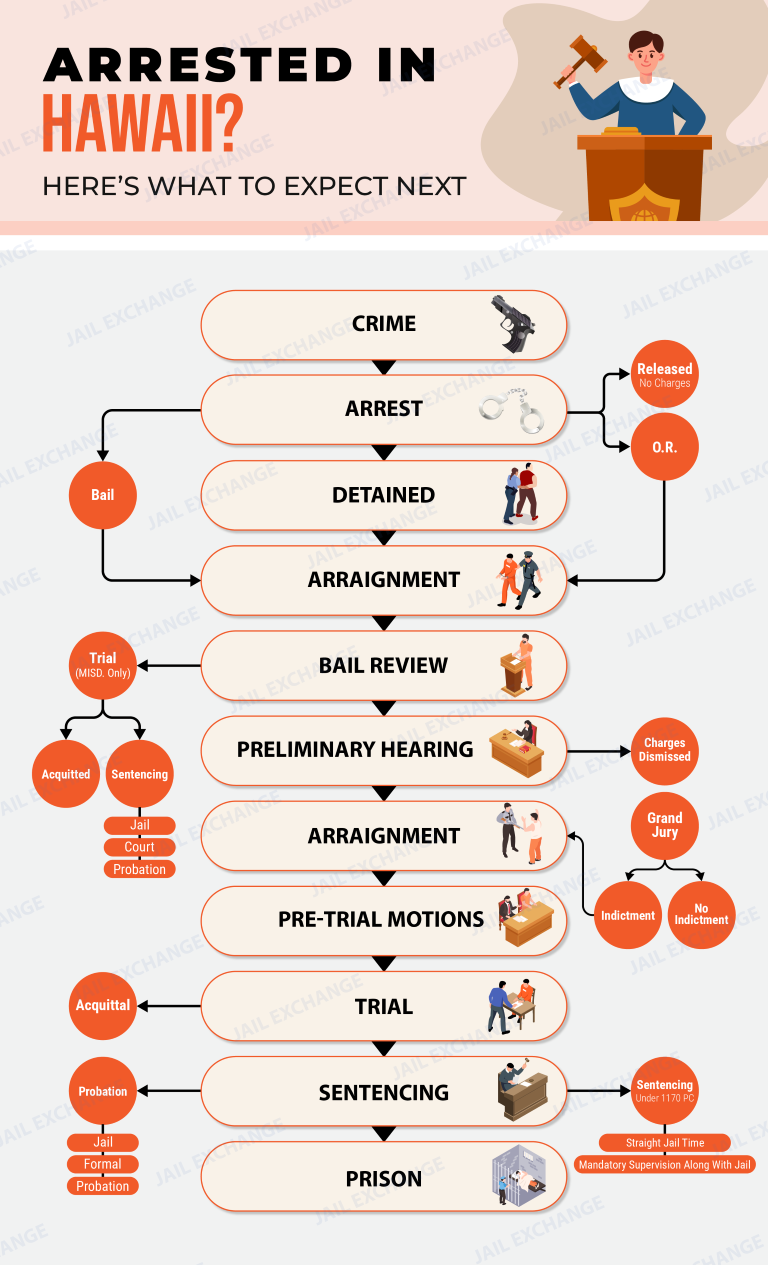
A felony case opens with an initial appearance in District Court, where bail and release conditions are set. Prosecutors may then hold a preliminary hearing, present the case to the Third Circuit grand jury for an indictment, or file a felony information that a judge reviews with supporting evidence. A detained defendant whose preliminary hearing has not started within two days of the initial appearance can generally ask to be released on recognizance.
Detention during the case
Defendants who are not released are held at HCCC in Hilo. For West Hawai'i defendants, that means spending pretrial time on the opposite side of the island from their families and their courthouse, with sheriffs making the long transport for each hearing. Bail, supervised release and release on recognizance are all options the judge can consider.
The Public Defender in Hilo and Kona
Indigent felony defendants are represented by the Public Defender's Hilo office, (808) 974-4571, or its Kona office, (808) 327-4650, depending on where the case is filed. Conflict cases go to appointed private counsel.
Pleas, trials and sentencing
After arraignment in Circuit Court, the large majority of Big Island felonies are settled by plea agreement. A defendant who goes to trial is judged by 12 jurors who must agree unanimously. Eligible first-time defendants charged with class B or C felonies may receive a deferred plea, and the Third Circuit runs a Drug Court that substitutes intensive, supervised treatment for prison in qualifying cases. Probation is a frequent outcome for lower-level felonies, while repeat offenders may face mandatory minimum terms. Felony cases here generally take six months to a year and a half.
3. Violent felony (for example, murder, sexual assault, armed robbery)
Murder, first-degree sexual assault and armed robbery cases on the Big Island are usually charged by grand jury indictment and tried in the Third Circuit Court in Hilo or Kona. The path through the courts is the same as for other felonies, but the stakes are higher at bail, at plea negotiations and at sentencing.
Bail decisions
Under Hawai'i law a judge can deny bail outright for an offense carrying life without parole, and can refuse release in other serious cases after finding a serious risk of flight, new crimes or harm to witnesses or the public. Many defendants facing these charges remain at the Hawai'i Community Correctional Center in Hilo until their case ends.
Defense representation
The Public Defender's Hilo office, (808) 974-4571, and Kona office, (808) 327-4650, defend eligible clients in serious felony cases. A conflict leads to appointment of private counsel.
Sentencing exposure
- Murder: first-degree murder (such as the killing of multiple people or of a police officer) means life without parole. Second-degree murder means life with the possibility of parole, with the minimum term fixed by the Hawai'i Paroling Authority. The state has no death penalty, having abolished it in 1957.
- Sexual assault in the first degree: a class A felony with a 20-year prison term and no probation.
- Robbery in the first degree: a class A felony with a 20-year prison term; using a firearm can add a mandatory minimum.
Probation and deferred pleas are generally off the table for class A felonies. Hawai'i's victims' rights statute guarantees victims notice of major court events and an opportunity to be heard at sentencing. A violent felony case on the Big Island typically lasts one to three years, and homicide prosecutions can run longer.
Courthouses and offices on the Big Island:
- Hale Kaulike (Hilo courthouse), 777 Kilauea Avenue, Hilo, HI 96720, (808) 961-7515
- Keahuolu Courthouse (Kona), 74-5451 Kamakaeha Avenue, Kailua-Kona, HI 96740, (808) 322-8703
- South Kohala District Court, Waimea Civic Center, 67-5187 Kamamalu Street, Kamuela, HI 96743, (808) 443-2030
- Office of the Prosecuting Attorney, Hilo, Aupuni Center, 655 Kilauea Avenue, Hilo, HI 96720, (808) 961-0466
- Office of the Prosecuting Attorney, Kona, West Hawai'i Civic Center, 74-675 Kealakehe Parkway, Kailua-Kona, HI 96740, (808) 322-2552
- Office of the Prosecuting Attorney, Waimea, Holomua Center, 64-1067 Mamalahoa Highway, Kamuela, HI 96743, (808) 887-3017
- Office of the Public Defender, Hilo Office, 275 Ponahawai Street, Suite 201, Hilo, HI 96720, (808) 974-4571
- Office of the Public Defender, Kona Office, 75-1000 Henry Street, Suite 209, Kailua-Kona, HI 96740, (808) 327-4650
- Hawai'i Community Correctional Center (HCCC), 60 Punahele Street, Hilo, HI 96720, visitation (808) 933-0522
Your case is normally heard on the side of the island where the arrest happened, so a Kona arrest goes to Keahuolu and a Hilo or Puna arrest goes to Hale Kaulike. Check your citation or bail paperwork for the exact courtroom. Select the type of charge below.
This overview of criminal court procedure on the Island of Hawai'i is general information, not legal advice. Anyone facing charges should consult a defense attorney or contact the Office of the Public Defender in Hilo at (808) 974-4571 or in Kona at (808) 327-4650.
Information for this service is currently unavailable.
ViaPath / ConnectNetwork Trust Fund Deposits
Provider: ViaPath Technologies • Formerly ConnectNetwork / GTL Financial
ViaPath Technologies (formerly GTL / ConnectNetwork) operates secure banking software enabling family members to deposit cash or card funds directly into an incarcerated person's jail trust account. Deposited funds allow the inmate to purchase commissary food items, clothing, personal hygiene goods, and medical copays, or transfer balances to phone time.
Important: Jail Trust Account Policies Differ by Agency
Once a person is booked and moved to a cell, facilities do not always allow cash drop-offs or phone payments directly to the jail window. Some might and you should confirm this by calling the facility and asking. But if you do not register online and fund your loved one's trust account immediately, they may be forced to wait days or weeks for standard paper processing, leaving them without essential soap, clean undergarments, basic medical sundries or snacks.
Step-by-Step Instructions to Deposit Trust Funds
- Confirm the inmate's legal name, date of birth, and assigned booking or institutional ID number.
- Log into your account at web.connectnetwork.com or my.viapath.com.
- Select Trust Fund from the available services dashboard.
- Select the facility and confirm your loved one's profile matches the active housing roster.
- Specify the deposit dollar amount and enter your debit or credit card billing details.
- Authorize the transaction and record the confirmation tracking number for your financial records.
What the Inmate Needs to Do
The inmate does not need an internet connection to receive trust funds. Once payment clears, the balance posts directly to their accounting profile in the jail's internal system. The inmate can review their updated balance at the pod kiosk or on their tablet and place their regular weekly store order.
Official Providers: ConnectNetwork Portal | myViaPath Portal
Customer Service Telephone: 1-877-650-4249
Support Hours: Automated Deposits 24/7/365; Live Agents Monday – Friday, 8:00 AM – 10:00 PM EST
Supported Languages: English and Spanish
Other Services Provided by ViaPath Technologies (ConnectNetwork)
In addition to Trust Fund Deposits, ViaPath / ConnectNetwork provides several other communication and calling options:
- AdvancePay Phone Calling Accounts: Keep a dedicated balance to receive telephone calls directly on your cell phone.
• Learn more on our website: AdvancePay Calling Guide | • Visit official vendor page: ConnectNetwork AdvancePay - ViaPath PIN Debit Phone Calling: Give the inmate calling funds to contact any approved phone number independently.
• Learn more on our website: PIN Debit Calling Guide | • Visit official vendor page: ViaPath PIN Debit - ViaPath Messaging & Photo Sharing: Send digital messages and photos directly to their kiosk or tablet.
• Learn more on our website: Digital Messaging Guide | • Visit official vendor page: ViaPath Messaging - GettingOut Video Visitation & Tablets: Schedule face-to-face remote video visits from home.
• Learn more on our website: Video Visitation Guide | • Visit official vendor page: GettingOut Video Visits
Deposit Money for an Inmate in the Hawaii Community Correction Center
The Hawaii Community Correctional Center (HCCC) in Hilo is run by the state Department of Corrections and Rehabilitation, not a county sheriff. Only people on the person's approved visitor list can put money on their trust account.
- Online or by phone: Open an account at GTL/ViaPath ConnectNetwork, pick Hawaii Community Correctional Center, add the person and pay with a credit or debit card. You can also set up a deposit by phone at 1-877-650-4249. The limit is $300 per person in a month, fees may apply, and money reaches the facility in 1 to 2 business days.
- Cashier's check or bank check by mail: Make it payable to HCCC/ and the person's full name, and put your own name and address on the check. Mail it apart from any letters to the person's first and last name, Attn: Business Office/Inmate Account, 60 Punahele Street, Hilo, Hawaii 96720, with your name and address as the return address.
- Lobby kiosk: HCCC planned a lobby payment kiosk for approved visitors (cash, credit or debit, fees may apply). The jail chooses not to publish whether it is running now. The only way to find out is to call 808-933-0431.
Do not drop off money at HCCC. Money orders, cash, personal checks, paychecks and welfare checks are refused. A check without a full name and address can be held or sent back. Deposits can be taken for court-ordered restitution and crime victim fines.
Hawaii Community Correctional Center is the jail for the whole Big Island. Its main building sits on Punahele Street in downtown Hilo, and its work-release program, Hale Nani, is in Panaewa about five miles away. Together the two sites have 226 beds. All letters go to the Hilo address below, where staff open and read incoming mail before it is passed out, because paper can carry drugs that were soaked in and dried.
Personal and legal mail:
Inmate's Full Name & SID #
Hawaii Community Correctional Center
60 Punahele Street
Hilo, HI 96720
- Your information: Print your full name and full return address in the top left corner. Mail missing either one comes back to you.
- Their information: Use the first and last name they were booked under and their SID number from the state inmate lookup.
- Money: Mail a cashier's check or bank check payable to "HCCC/" and the person's full name, with your name and address on it. Address that envelope to the Business Office/Inmate Account at the same street address, and keep it separate from your letters. Money orders, personal checks, paychecks, welfare checks and cash are all refused, and money can't be dropped off at the jail. Electronic deposits are open to approved visitors.
- Books and packages: Books, magazines, newspapers and food can't be sent in. Stamps and writing supplies are sold on commissary.
- What gets letters returned: Stickers, ink stamps, glitter, glue, bookmarks, lipstick or kiss marks, drawings, and anything sexual or threatening. Stick to blue or black pen, with no crayon, marker or colored ink.
- Attorney mail: Mark it "LEGAL MAIL" and include the lawyer's name, agency, bar number and address. Court and government letters are opened as regular mail.
You can write as often as you like. Faster options are tablet messages, or call 808-933-0431 with mail questions.
ViaPath AdvancePay Phone Calling Accounts
Provider: ViaPath Technologies • Formerly ConnectNetwork / Global Tel*Link (GTL)AdvancePay is the primary prepaid telecommunications service operated by Global Tel*Link (GTL) and ConnectNetwork, which have unified under the corporate identity of ViaPath Technologies (and the myViaPath platform). By funding an AdvancePay account, telephone charges are deducted per minute whenever an incarcerated loved one calls your specific telephone number, preventing calls from being rejected by cellular carriers.
Important: Cell Carriers Automatically Block Jail Collect Calls
Inmate telephone networks do not permit incoming calls, and wireless cell providers automatically block traditional collect billing by default. While select traditional landlines may support operator billing, cell phones and internet-based lines require an active AdvancePay balance, which you can verify with your carrier. If you do not register your number online and add funds immediately, your loved one will hear an automated operator announcement stating your line is blocked from receiving correctional calls.
Step-by-Step Instructions to Open and Fund AdvancePay
- Visit web.connectnetwork.com or the updated my.viapath.com portal, or launch the ConnectNetwork / ViaPath mobile application.
- Click Sign Up and register using your primary 10-digit cellphone number and email address.
- Select Add Facility, pick your state, and choose the detention center or state prison where the inmate is held.
- Search for the inmate using their full legal name or facility booking ID number and link them to your contact directory.
- Select AdvancePay Phone and choose your deposit amount ($25, $50, or custom).
- Enter your debit or credit card billing details, accept the administrative transaction fee, and complete the payment.
- Check your phone settings to confirm that automated or unknown correctional numbers are not routed straight to spam.
What the Inmate Needs to Do
The inmate approaches any housing pod telephone, enters their assigned PIN and voice biometric recognition phrase, and dials your 10-digit number. ViaPath's automated operator confirms your active prepaid balance and connects the call. All personal telephone calls are subject to recording and monitoring by facility investigators.
Official Providers: ConnectNetwork Portal | myViaPath Portal
Customer Service Telephone: 1-877-650-4249 (Automated & Live Support)
Support Hours: Automated Service 24/7; Live Operators Monday – Friday, 8:00 AM – 10:00 PM EST
Supported Languages: English and Spanish
Other Services Provided by ViaPath Technologies (ConnectNetwork)
In addition to AdvancePay Phone Calling, ViaPath / ConnectNetwork provides several other communication, financial, and visitation services:
- ConnectNetwork Trust Fund Deposits: Transfer money directly into an inmate's jail trust account for commissary store purchases.
• Learn more on our website: Inmate Trust Deposits Guide | • Visit official vendor page: ConnectNetwork Trust Deposits - ViaPath PIN Debit Phone Calling: Give the inmate their own calling funds to contact any approved phone number independently.
• Learn more on our website: PIN Debit Phone Calling Guide | • Visit official vendor page: ViaPath PIN Debit Calling - ViaPath Messaging & Photo Sharing: Send digital messages, photos, and video attachments directly to their terminal.
• Learn more on our website: Digital Messaging Guide | • Visit official vendor page: ViaPath Messaging Services - GettingOut Video Visitation & Tablets: Schedule face-to-face remote video visits and manage handheld tablet communications.
• Learn more on our website: Remote Video Visitation Guide | • Visit official vendor page: GettingOut Video Visits
ViaPath PIN Debit Phone Calling Accounts
Provider: ViaPath Technologies • Formerly ConnectNetwork / Global Tel*Link (GTL)ViaPath PIN Debit (hosted on ConnectNetwork and myViaPath) provides incarcerated individuals with their own calling funds. Unlike AdvancePay (which only funds calls placed to your specific phone number), PIN Debit funds belong directly to the inmate, allowing them to call attorneys, bondsmen, employers, or extended family members across multiple approved telephone numbers.
Important: AdvancePay Only Funds a Single Phone Number
When someone is arrested, they often need to contact multiple people—including legal defense counsel, bail agents, employers, and relatives. If you only fund an AdvancePay account, your loved one will have no calling balance to dial anyone else, as rules and call authorizations vary by facility. Adding funds directly to ViaPath PIN Debit grants them the calling flexibility needed to handle critical legal and family arrangements without delay.
Step-by-Step Instructions to Fund a PIN Debit Account
- Sign into your account at web.connectnetwork.com or my.viapath.com.
- Click on PIN Debit under the communications menu.
- Select the state and facility, and link the inmate's booking identification number.
- Enter the deposit dollar amount and review the payment transaction fee.
- Enter your debit or credit card details and submit the payment.
- Notify your loved one that their personal PIN calling balance has been credited.
What the Inmate Needs to Do
The calling balance appears under the inmate's personal identification PIN. When they pick up any dayroom telephone or tablet, they select the 'PIN Debit' prompt from the automated menu to place calls to any approved number on their personal contact list.
Official Providers: ConnectNetwork Portal | myViaPath Portal
Customer Service Telephone: 1-877-650-4249
Support Hours: Automated Deposits 24/7/365; Live Agents Monday – Friday, 8:00 AM – 10:00 PM EST
Supported Languages: English and Spanish
Other Services Provided by ViaPath Technologies (ConnectNetwork)
In addition to PIN Debit Calling, ViaPath / ConnectNetwork provides several other communication, financial, and visitation services:
- AdvancePay Dedicated Phone Calling: Fund calls placed specifically to your personal phone number.
• Learn more on our website: AdvancePay Calling Guide | • Visit official vendor page: ConnectNetwork AdvancePay - ConnectNetwork Trust Fund Deposits: Deposit money for commissary food, hygiene supplies, and stationery.
• Learn more on our website: Inmate Trust Deposits Guide | • Visit official vendor page: ConnectNetwork Trust Deposits - ViaPath Messaging & Photo Sharing: Send digital messages and photos directly to their kiosk or tablet.
• Learn more on our website: Digital Messaging Guide | • Visit official vendor page: ViaPath Messaging Services - GettingOut Video Visitation & Tablets: Schedule face-to-face remote video visits from home.
• Learn more on our website: Remote Video Visitation Guide | • Visit official vendor page: GettingOut Video Visits
GettingOut / ViaPath Inmate Messaging
Provider: GettingOut (Telmate) • Rebranding as ViaPath Technologies (myViaPath)GettingOut (a service of Global Tel*Link / Telmate) provides an instant two-way digital messaging and photo-sharing platform connecting families with incarcerated individuals via housing-unit kiosks and handheld tablets. The provider is actively rebranding as ViaPath Technologies (under the myViaPath platform); depending on the facility contract, local booking sheets and tablets may still refer to the service as GettingOut, GTL, or ViaPath, but both brand portals grant access to the same centralized messaging balance.
Important: Contact Authorization and Digital Mail Rules Vary
Inmate digital messaging rules are not uniform across all county detention centers. While some jails allow immediate two-way messaging upon registration, others require initial contact invitations or administrative ID verification, which you should verify directly with the facility. If you delay setting up an online profile and funding your Friends & Family messaging account, your loved one may face lengthy periods without direct family communication.
Step-by-Step Instructions to Register and Message an Inmate
- Visit www.gettingout.com or the newly branded my.viapath.com portal, or install the GettingOut / myViaPath mobile app.
- Create a user profile using your primary email address and 10-digit mobile phone number.
- Complete identity verification by uploading a clear photo of your government-issued driver's license or state ID and taking a verification selfie if requested.
- Search for the inmate by selecting the state, correctional facility, and their legal name or booking ID.
- Send an outside contact connection request to link your account to their tablet profile.
- Deposit funds into your 'Friends & Family Account' using a debit or credit card to cover message and photo-sharing costs.
- Compose your text message in the chat box, attach approved photos, and submit it for jail screening.
What the Inmate Needs to Do
The inmate powers on their assigned pod tablet or approaches a housing-unit kiosk and logs into the messaging application with their PIN. They accept your incoming contact invitation on the screen. Once approved by institutional monitors, incoming messages appear in their inbox, and the inmate types a reply directly on the screen.
Official Providers: GettingOut Website | myViaPath Portal
Customer Service Telephone: 1-866-516-0115 (GettingOut Support) • 1-877-650-4249 (ViaPath Support)
Support Hours: Monday – Friday, 7:00 AM – 11:00 PM CST; Saturday – Sunday, 8:00 AM – 7:00 PM CST
Supported Languages: English and Spanish
Other Services Provided by GettingOut / ViaPath
In addition to Two-Way Text Messaging, GettingOut and ViaPath provide several other communications and visitation options:
- Remote Video Visits: Schedule and join live web-based video visits from your computer or smartphone.
• Learn more on our website: Video Visitation Guide | • Visit official vendor page: GettingOut Video Visits - Inmate Tablet Rentals & Media: Fund tablet entertainment, music streaming, games, and news modules.
• Learn more on our website: Tablet Rentals & Content Guide | • Visit official vendor page: GettingOut Tablets - AdvancePay Phone Calling: Prepay for telephone calls so your loved one can dial your mobile phone directly.
• Learn more on our website: AdvancePay Phone Calling Guide | • Visit official vendor page: ViaPath ConnectNetwork Calling - Inmate Trust Deposits: Transfer funds directly into their jail trust account for commissary store purchases.
• Learn more on our website: Inmate Trust Deposits Guide | • Visit official vendor page: ViaPath Trust Deposits
GettingOut / ViaPath Inmate Tablets & Media
Provider: GettingOut (Telmate) • Rebranding as ViaPath Technologies (myViaPath)GettingOut provides specialized, secure handheld tablets for county jail inmates, offering access to messaging apps, telephone calling, legal research tools, eBooks, vocational training, and premium entertainment rentals. As part of GTL and Telmate's transition to ViaPath Technologies, tablet firmware and management platforms are moving to the myViaPath system.
Important: Tablet Feature Availability Varies by Facility
Jails manage tablet distribution according to individual facility contracts. While basic educational and legal materials are often provided without cost, access to music streaming, games, podcasts, and premium movies requires an active funded account. You should confirm the tablet rules with the facility directly. Registering and funding their media balance right away ensures your loved one has productive resources and recreation during their stay.
Step-by-Step Instructions to Fund Inmate Tablet Services
- Confirm that GettingOut / ViaPath handheld tablets are active at your loved one's specific detention facility.
- Navigate to www.gettingout.com or my.viapath.com.
- Sign into your verified user profile and link the inmate's legal name and booking ID number.
- Select Make a Deposit and choose either your Friends & Family Account (for messaging) or the inmate's personal Inmate Account (for entertainment and song rentals).
- Choose your deposit amount, review convenience fees, and complete payment with a credit or debit card.
- Notify your loved one that their tablet account balance has been funded.
What the Inmate Needs to Do
The inmate unlocks their assigned tablet or signs one out from the pod charging station using their biometric verification or PIN. Once logged in, their available balance appears on the screen, allowing them to download songs, stream educational content, and communicate with approved family members.
Official Providers: GettingOut Website | myViaPath Portal
Customer Service Telephone: 1-866-516-0115 (GettingOut) • 1-877-650-4249 (ViaPath)
Support Hours: Monday – Friday, 7:00 AM – 11:00 PM CST; Saturday – Sunday, 8:00 AM – 7:00 PM CST
Supported Languages: English and Spanish
Other Services Provided by GettingOut / ViaPath
In addition to Tablet Media & Rentals, GettingOut and ViaPath provide several other communication and account services:
- Two-Way Text Messaging: Send electronic letters and photos straight to the inmate's screen.
• Learn more on our website: Two-Way Text Messaging Guide | • Visit official vendor page: GettingOut Messaging - Remote Video Visits: Meet face-to-face over secure live video from home.
• Learn more on our website: Video Visitation Guide | • Visit official vendor page: GettingOut Video Visits - AdvancePay Phone Calling: Prepay for phone calling credits so your loved one can call your telephone directly.
• Learn more on our website: AdvancePay Phone Calling Guide | • Visit official vendor page: ViaPath ConnectNetwork Calling - Inmate Trust Deposits: Transfer cash directly into an inmate's jail ledger for commissary purchases.
• Learn more on our website: Inmate Trust Deposits Guide | • Visit official vendor page: ViaPath Trust Deposits
Hawaii County Juvenile Facilities
- Jail (Main): 808-933-0431
- Alternative phone: 808-933-0428
The Hawaii Community Correction Center serves the following cities and towns of Hawaii County: Hilo, Kailua-Kona, Keaau and Pahoa.