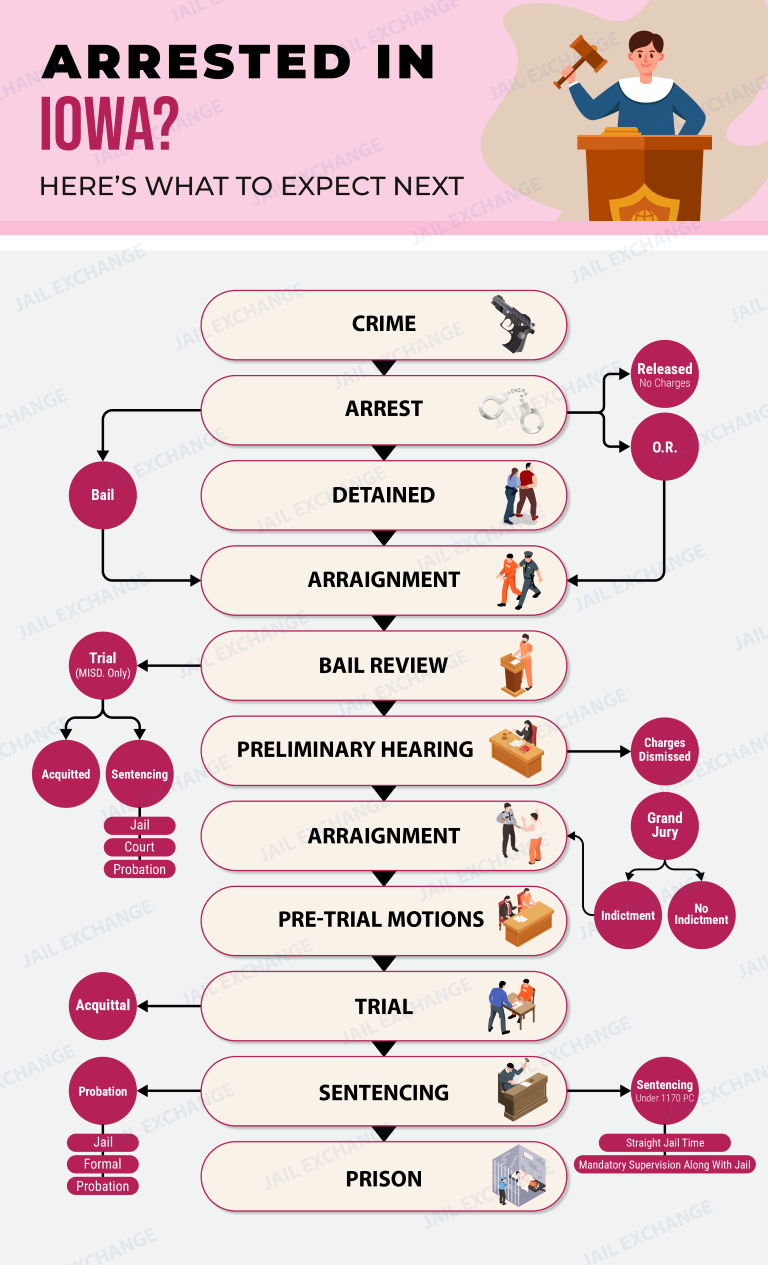
Information on the criminal court process for offenders arrested in Linn County Iowa and booked into the Linn County Correctional Center. From the arrest to the sentencing and everything in between.
It might be helpful to define some words that will be used on this site, when explaining the Iowa Court System and how it works. The definitions on this site are for general information and not legal advice. It is always preferred to follow information given by your attorney or local authorities.
Arrest is when Iowa, Linn County or local police take a person into custody and start the legal process. The arrested person may or may not be immediately jailed.
In less serious crimes, the person may only be given a citation ordering that they appear in Linn County district court, often before a magistrate, on a certain date. In cases involving more serious crimes, the person is usually placed in the county jail until an arraignment, or a judge decides the next step.
Booking is when the Linn County sheriff or local police gather information such as the detainee’s name, address and why the person is being arrested. Booking also includes fingerprinting, criminal history, investigation, and verification of identity. Bail for lower-level crimes may be set right after booking so the arrested can “bail or bond out” before being detained.
The prosecution, sometimes called “the government” or “the people” or “the state” is the side that presses the charges and seeks punishment for the offense. These are attorneys that work for the state of Iowa, Linn County or a city or town. The prosecuting attorney for Linn County or the district is called the County Attorney. A U.S. Attorney prosecutes federal cases.
Jurisdiction is an important term in the court system that means whether a court has the obligation or duty or right to handle a case. For example, if you run a red light in your town or city, a magistrate of the district court in that county would likely handle the ticket, since magistrates in this state try simple misdemeanors and traffic cases. If you attempted to flee from police when they attempted to stop you after you ran the red light, it becomes a more serious crime that a magistrate cannot try, so the case would move up to a judge of the district court with authority over the more serious charge. Jurisdiction varies from state to state and sometimes county to county.
Arraignment is when the arrested person is formally told the charge filed by the prosecution (a trial information or indictment) and says whether they are guilty or not guilty. At this time, the person is called the defendant, and the opposing side is called the prosecution. In Iowa, bail and other release conditions are normally set earlier, at the initial appearance before a magistrate soon after the arrest, and a judge can review or change them later. An arraignment is not a trial, and the defendant is entitled to a trial within a reasonable amount of time after the arraignment.
Bail is money or other security that the Clerk of District Court in Linn County keeps to make sure that the arrested comes back to court instead of fleeing the area before trial. A magistrate sets bail amounts and other conditions at the initial appearance, unless the person has already been released by posting the amount on the statewide uniform bond schedule.
Cash posted as bail goes back to whoever deposited it, who may not be the defendant, once the case ends. If a person does not pay bail, they remain in the Linn County Jail until their trial.
Bail can be refused outright before trial in Iowa only for someone charged with murder in the first degree of a peace or correctional officer, and Code section 811.1 adds limits for certain people awaiting sentencing or appealing a serious felony conviction. When safety is a concern in other cases, the court sets conditions such as supervision, travel limits or a no-contact order rather than refusing bail. Since July 1, 2026 (Senate File 2399), release on the defendant’s own promise, or recognizance, without paying bail is limited to defendants charged with a nonviolent, nondrug simple or serious misdemeanor.
A bond proceeding is the determination of how much bail is to be paid, and in Iowa it usually happens at the defendant’s first appearance before a magistrate, well before any arraignment. A defendant who wants the release conditions looked at again is entitled to a review, and the magistrate appoints counsel for it when the defendant has no means to hire one. A magistrate or judge of the district court in Linn County sets bail. Iowa judges work from a uniform bond schedule adopted by the Judicial Council, with one standard amount per offense class (for example, a single figure for every class D felony). A judge may set bail higher than the schedule, but since July 1, 2026 setting it lower, or at a percentage of the schedule amount, requires written reasons under Code section 811.2.
It is always important to have family involvement after being arrested. Not only can they make calls and communicate on your behalf (not all bond companies will accept collect calls), but family support will show the court that there are people who will make sure that the defendant makes it to court, not only for the defendant’s own good, but because they may have signed bond paperwork and responsible to pay if the defendant does not show in court. Chances of obtaining a bond from a bond company or clerk of court are better if family is involved.
(There have been phone scams where a bond company calls and informs a person that their family member has been arrested and they ask for financial information. A bondsman will not call asking for money without involvement of the arrested.)
With a personal recognizance release the defendant simply signs a promise to return to court (limited to the misdemeanors described above), while an unsecured appearance bond adds a signed promise to pay a set amount, with nothing paid up front, if the defendant does not show up to court. If the defendant does not show, the full amount will be due and the people who signed the paperwork will be responsible for paying the court
Cash bail. Iowa lets a defendant deposit the full bail in cash in place of a bond or, if the release order allows it, sign an appearance bond secured by money or other approved security in whatever sum the magistrate orders. Senate File 2399 ended the old option of depositing no more than ten percent of the bond, effective July 1, 2026. The Clerk of District Court holds the deposit until the required appearances are made, and a missed court date can lead the court to forfeit it.
Surety Bond is a bail bond signed by a surety who promises the court the full amount if the defendant fails to appear. Under Iowa Code section 811.3, the surety must be either an insurer authorized under section 515.48 to write bonds in the state or Iowa residents pledging their own property (see Property Bond below); the state has no separate license for individual bail bondsmen, so anyone selling a bail bond should name the insurance company behind it. The company’s charge and any collateral are set by its contract, so read it before signing, and that charge is not returned when the case ends. A company may also decline to write a bond for someone it considers a flight risk.
A Property Bond is a bond in which Iowa residents act as surety with property they own in the state, worth at least the amount of the bond, and swear to that in an affidavit. The property can be anywhere in the state, not only Linn County, and once the bond is filed with the clerk it becomes a lien on the signers’ real estate under Code section 811.4.
A criminal defense attorney (also called lawyer or counsel) is hired or retained to represent the arrested as early as possible after the arrest.
If there is a chance that the case might go to trial and the defendant cannot afford an attorney, the 6th Amendment of the U.S. Constitution requires that the court provide an attorney. This is called indigent representation and a public defender or assigned attorney would represent the defendant in all proceedings.
Indigent representation is only available misdemeanor and felony cases that could result in jail time, juvenile cases, and certain appeal cases. In Iowa, indigent representation is funded and supervised by the State Public Defender, which uses its own public defender offices in some counties and contract attorneys in others, as well as when a conflict or special need arises.
For less serious cases or civil cases, there are pro bono volunteers who volunteer legal services for free or for a small fee. They often will hold clinics to teach people how to represent themselves in court or expunge their record which means to legally erase or eliminate a criminal or arrest record from public view.
Many courts will provide forms and help for people who want to represent themselves, called pro se.
A district court can refer to the first level of the legal system, or a minor court. District courts are in the community. A district court can also refer to a U.S. Federal District Court that hears federal cases. There are two U.S. federal district courts in Iowa, with offices throughout the state. It is important that you check the address of the court you are to appear in rather than to ask someone because that person might give you directions to the wrong “district” court. Being late to court can land you in custody as well.
Pretrial proceeding is the process where both sides (prosecution and defense) gather information, interview witnesses, request records, videos etc. Pretrial proceedings also include communications with the judge assigned to the case and these appearances are either in person or by on-line conferencing. Some pretrial proceedings may not require a defendant’s appearance, allowing an attorney to appear in their place. The information that is gathered is called discovery and both sides must share the information that they have gathered. This information does not include conversations between the arrested and their attorney.
Most cases do not go to trial because both sides reach a plea deal, where both sides try to reach a reasonable punishment based on what was learned in the pretrial proceedings. A plea deal can only happen if the accused person admits they are guilty in exchange for a lighter punishment. The reason they must admit guilt is because it would not be fair to punish someone who claims they are not guilty. There are times in plea bargaining when the prosecution agrees to give a lighter sentence in exchange for information leading to the arrest of a more serious criminal related to the crime.
Trial is where both sides share their information in front of a judge or a judge and jury. After listening to all the evidence, the judge or jury decides the verdict which is whether the person is guilty or not guilty. If a court has only a judge hearing both sides, it is called a bench trial. If a jury is selected, it is called a jury trial. If the defendant is found not guilty, they are released. If they are found to be guilty, the next step is sentencing.
Sentencing is the punishment that the judge decides the person should get. This could be jail or prison time, fines, community service, probation, or a combination.
Appeal is asking for a higher court to hear the case again at an appellate court. If the accused person thinks something went wrong at trial or has new information that was not available during the trial or that the sentence is too harsh, the defense attorney can ask for an appeal. It is not unusual for an appeal when there is a long jail sentence, but an appeal can be denied if the appellate court feels that the original trial or sentencing was fair.
In Iowa, a misdemeanor is divided into Simple, Serious or Aggravated misdemeanors. Aggravated misdemeanors are the most serious and carry up to two years of imprisonment plus a fine of $855 to $8,540. A Serious misdemeanor brings a fine of $430 to $2,560 and can add up to 1 year in county jail. A Simple misdemeanor is the least serious misdemeanor and can be punished by a maximum of 30 days in county jail and/or a fine of $105 to $855.
A felony crime is a more serious crime than a misdemeanor and are divided into different classes which are general guidelines and are based on the crime, prior criminal history and other factors. Classes are: Class A, Class B, Class C or Class D felonies. Examples of felony crimes are murder, rape, theft, aggravated assault, drug trafficking, kidnapping and identity theft.
The Linn County Clerk of Court is appointed by the district judges of the judicial district, and the clerk’s responsibilities for Criminal Court’s administrative issues include receiving criminal warrants, receiving bail, creating the trial schedule, receiving fees, fines and maintaining court records.
A warrant is used to get someone to appear in court or to law enforcement. There must be good reason to believe that the person is involved in a crime. The warrant gives authority to arrest the person and search for evidence for the investigation of the crime.
A criminal summons is issued to request that a person appear in court at a particular time and date. It does not involve an arrest. A traffic ticket, summary citation or lesser misdemeanor could be considered a summons if you are given a court date.
A summary citation, commonly referred to as a ticket, is a criminal summons by a law enforcement officer either in person or via mail accusing the defendant of a minor offense, stating potential fine, listing the court having jurisdiction and instructions for addressing the issue. Defendants may or may not be required to appear in court or handle the matter by entering a plea via mail.
Fines are usually paid to the District Court or clerk of court and payment methods can be found on the District Court or Linn County Clerk of Court website. If you do not pay your fine on time, you can lose your driver’s license, must pay additional fees or even have a warrant for your arrest. It is important to read the instructions on the ticket issued by the police officer or court at the time of your arrest. For a parking ticket or summary citation, the fine amount and how to send payment should be on the ticket.
District courts handle most cases and there is one district court in every county in Iowa. It is at the district court that the charges are read and trials are held.
Juvenile court, for individuals under the age of 18 is a specialized court within district court. Iowa does not have municipal courts like many states although the municipal violations as parking violations, speeding or breaking town laws are heard by local magistrates within the local district court.
The Iowa Court of Appeals reviews cases that might have errors from the district courts. The case can be sent back to the district court or moved up to the supreme court.
Supreme Court is similar to our United States’ Supreme Court because it has a panel of judges that rule on matters that have to do with someone’s constitutional rights or policies and laws. The Iowa State Supreme Court deals with the Iowa state constitution or laws or policies. Sometimes the Supreme Court will hear criminal cases on appeal when there is question on the state laws or procedures that lead to the appeal. Every appeal from a district court is filed with the Supreme Court, which keeps some cases and transfers others to the Court of Appeals.
Criminal cases reach it on appeal from the district court, either directly or after the Court of Appeals rules and a party asks for further review.
Specialty courts or problem-solving courts are being adopted in many states to handle cases that involve non-violent and first-time offender cases in a way to where the offender can retain a job or responsibilities while following specific orders of the court as returned court appearances, periodic evaluations or testing for substances.
Federal Court deals with crimes involving violations of United States laws. Federal crimes include federal drug trafficking, federal tax evasion and fraud that crossed state lines and include crimes that occur on federal property as post offices or federal buildings.
Cases involving crimes that involve the FBI or DEA or Immigration agencies are federal crimes. Terrorism is a federal crime.
There are some differences in the Federal court system as compared to the Iowa state court system. For example, the attorneys who work for the courts are called United States Attorneys and Federal judges are called District Court Judges (not to be confused by local state district courts).
Federal Magistrate Judges hear the case early on, but they do not decide on the cases at a trial like the Federal District Court Judges. In a federal case, a grand jury is used for indictments.