Questions answered in this county guide
- Where does a family go for court information in Cumberland County?
- What are the steps in a minor criminal case in Cumberland County?
- What happens after a felony arrest in Cumberland County?
- What if someone faces murder, robbery, or another violent crime in Cumberland County?
- What happens when a person under 18 is arrested in Cumberland County?
- How does sentencing work for charges brought in Cumberland County?
- Where do federal criminal cases connected with Cumberland County go?
Where does a family go for court information in Cumberland County?
A family dealing with an arrest in Cumberland County may have questions about bail, future hearings and what happens next. Maine uses a Unified Criminal Docket, meaning Superior Court justices and District Court judges work within one criminal case system. The Cumberland County Superior Court listing is in Portland, while some early hearings may be scheduled at a District Court location. The prosecuting attorney is the local District Attorney's Office, and the clerk can confirm which courthouse is assigned to a particular case.
- Cumberland County Superior Court: 205 Newbury Street, Portland, ME 04101; (207) 822-4200.
- District Court locations to check: District Courts in Portland and Bridgton. Court assignments vary by town and charge.
- Prosecutor: District Attorney’s Office serving Cumberland County; criminal charges are brought for the State of Maine.
- Defense lawyer: Ask the court for a state-funded attorney if you cannot afford one. The court reviews financial eligibility.
- County jail: The holding facility after arrest may depend on the arresting agency, availability, and transfer arrangements; confirm where the person is being held before visiting.
Which courthouse should you go to? Do not assume every hearing is held at the Superior Court address shown above. Your summons, release paperwork or court notice should give the correct time and place. If it does not, call the clerk at (207) 822-4200. Cumberland County court eFiling for all case types began September 28, 2026; check the current filing requirements.
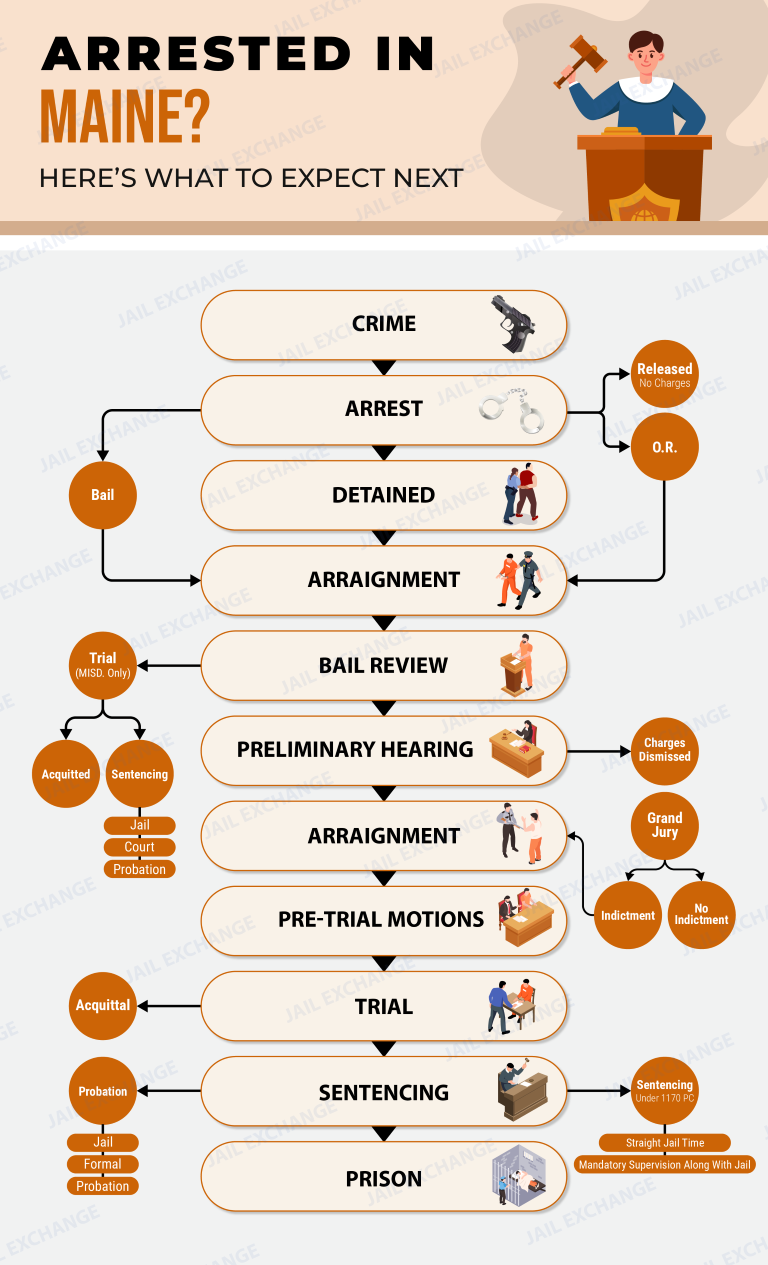
What happens after an arrest? Police may issue a summons or bring the accused person to a holding facility for booking. At booking, officers record identity details and the alleged offense. The person may receive release conditions, or a judge may have to decide bail. Booking is not a conviction, and it does not always mean someone will stay in jail until trial.
What are the steps in a minor criminal case in Cumberland County?
For a less serious accusation, the judge may schedule a hearing without requiring the person to stay in jail. In Cumberland County, examples may include certain theft, disorderly conduct or operating-under-the-influence charges, but the exact classification depends on the law and facts. An officer might give the person a summons with a future court date instead of taking them into custody.
Release and bail after booking
A person may be freed on a promise to attend court, meaning a promise to return to court, or be required to meet conditions such as not contacting someone, appearing for check-ins or posting money. Maine also uses bail commissioners in eligible cases. A judge can review bail. Family members should ask the jail or court what type of bail was ordered, who can accept payment, and which conditions apply; do not send money to anyone who has not been verified.
The first hearing
At the initial court appearance or arraignment, the court explains the charge and the person's rights and handles the plea when appropriate. Pleading not guilty means the state's attorneys must prove the charge; it does not mean the person has to explain the whole story that day. A judge can schedule other hearings to discuss evidence, possible agreements and trial.
If you cannot pay for a lawyer
Tell the court that you want to request an attorney and ask for the application and financial affidavit. Maine's Commission on Public Defense Services arranges representation for individuals who qualify. Being assigned counsel is not automatic in every case, and the court may require repayment of some costs.
Possible jail terms
- Class D: a jail sentence of less than one year, unless a special law applies.
- Class E: up to six months, unless an exception applies.
The main point for families is: Fines, probation, counseling, community service or other lawful conditions can also apply. A first OUI has its own special penalties, so do not use the general Class D or E maximum alone to predict the outcome. The time needed to finish a case varies and cannot be promised.
What happens after a felony arrest in Cumberland County?
A serious charge may require a grand jury indictment or another legally allowed charging procedure. In Cumberland County, someone arrested on a serious charge may be booked, have bail considered and appear in court before any trial is scheduled.
Charges and first appearances
Police reports go to prosecutors, who decide whether and how to charge the case. The court tells the accused person the charge and considers release conditions. Based on the facts and charge, a preliminary hearing, grand jury review or another procedure may be used. A grand jury indictment is a formal accusation, not proof that the accused is guilty.
Evidence, agreements and trial
Before trial, the defense can review evidence through discovery, ask the judge to decide legal questions and discuss a possible plea agreement with the state's lawyer. The accused person can choose to contest the charge. Maine Superior Court provides jury trials when the law gives that right; District Court does not hold jury trials. Because the criminal docket is unified, the clerk should confirm the correct location for each hearing.
Having a defense lawyer
For someone dealing with an arrest for the first time: Serious criminal charges can carry years in prison. When the person accused cannot afford counsel, ask the court promptly to evaluate eligibility for publicly funded defense representation. An attorney can explain charges, evidence, bail, plea offers and the right to trial.
Maine's usual maximum prison terms
- Class A: up to 30 years.
- Class B: up to 10 years.
- Class C: up to five years.
These are standard maximums, not predictions or guaranteed sentences. Maine law includes exceptions, mandatory minimums for some offenses and changes in sentencing class based on certain facts.
What if someone faces murder, robbery, or another violent crime in Cumberland County?
A person accused of a violent crime is still presumed innocent unless the alleged offense is proved. A Cumberland County case involving murder, a severe assault or another violent offense may include extra hearings, witnesses and expert evidence. The judge considers the legal standard for bail and safety-related conditions, rather than treating every violent accusation as an automatic denial of release.
What happens in court?
The state must prove the charged crime beyond a reasonable doubt at trial. Attorneys may examine witnesses, challenge evidence and file motions before the trial begins. In cases eligible for a jury, the trial is conducted in the Superior Court. The defendant can also resolve a case through a lawful plea, after the court makes sure the plea is voluntary.
Sentencing and murder charges
What this means for someone waiting on a court date: Do not treat every violent offense as carrying the same sentence. Most Class A crimes have a standard maximum of 30 years, subject to exceptions. Murder is governed by a separate sentencing law and is not subject to the usual Class A–E chart. Maine does not have a death penalty. Mandatory or longer sentences may apply to certain serious offenses or repeat convictions.
Families, victims and support
People accused of violent offenses should request legal help early. Crime victims can also contact the local District Attorney's victim-witness staff about notices and available services. The length of these cases depends on evidence, motions, witness availability and the court calendar, so it is not possible to give a reliable number of months for an individual Cumberland County prosecution.
What happens when a person under 18 is arrested in Cumberland County?
A teenager's case generally involves a Juvenile Community Corrections Officer and Juvenile Court. If a child is stopped or arrested in Cumberland County, police may issue a juvenile summons or take the youth into custody. A Juvenile Community Corrections Officer (JCCO) is notified and helps decide whether the child may go home with a parent or must be held for a court decision.
Can the case stay out of court?
Some cases are handled through an informal adjustment, which may require the young person to complete agreed steps instead of proceeding through a formal Juvenile Court case. If the matter goes to court, a judge considers whether the accusation was proved and what response best fits the law and the youth's needs.
Parents and guardians
In everyday terms: Parents or guardians must be notified of an arrest without undue delay and may be required at court hearings. Ask where the child is being held, whether there are release conditions and what the next court date is. Juvenile detention is handled differently from adult county-jail booking.
When a juvenile might face adult court
In certain serious cases, including murder or conduct that would be a Class A, B or C crime for an adult, prosecutors can ask for a bind-over hearing. The judge decides whether to move the case to adult criminal court. The transfer is not automatic just because the alleged offense is serious. Parents should ask immediately about a defense lawyer.
How does sentencing work for charges brought in Cumberland County?
Not every conviction in Cumberland County means jail or prison; the law sets a possible range, not an automatic sentence.
- Class A: up to 30 years in prison
- Class B: up to 10 years
- Class C: up to 5 years
- Class D: less than one year
- Class E: up to 6 months
Murder is sentenced under its own statute. Mandatory minimums, fines, restitution, and probation depend on the particular charge. An OUI conviction has its own required penalties, separate from the general class limits.
Where do federal criminal cases connected with Cumberland County go?
The main point for families is: A federal case from Cumberland County is prosecuted in the U.S. District Court for the District of Maine, rather than the local state criminal court. Federal crimes can involve certain interstate fraud schemes, federal drug trafficking, offenses involving federal property or federal officials, and immigration or firearms offenses covered by federal statutes. An act does not become a federal crime just because it is serious.
The District of Maine holds court in Portland and Bangor. Which courthouse hears a particular case depends on federal court assignment. A federal defendant ordinarily appears before a federal magistrate judge, may face a detention hearing, and can be charged by a grand jury before plea negotiations or trial. Federal sentencing follows federal statutes and applicable federal guidelines. The U.S. Marshals Service arranges pretrial custody; the Federal Bureau of Prisons handles most federal prison sentences.
This Cumberland County court guide is general educational information, not legal advice. Court locations, dates, bond amounts and release conditions vary by case. For questions about an actual hearing, contact the clerk at (207) 822-4200 or speak with a criminal defense lawyer.