Maurice Spear Campus Detention Unit Criminal Court Process
Criminal Court Process for Lenawee County Michigan
Lenawee County's District Court is the 2A District Court, 517-264-4675, at 425 North Main Street, Adrian, MI 49221. Serious felony charges are later decided in the Circuit Court. Until then, people wait at the Lenawee County Jail, which the Sheriff runs. Keep reading for each step of a case.
Not sure where your person is? Try the Lenawee County Inmate Search first. Then read Inmates in Custody on our site for charges and warrants.
For the next hearing date, call the 2A District Court at 517-264-4675 and ask the clerk. If you hope to post bond, our bail page lays it out.
Questions answered in this county guide
- Where are the courts and who can help in Lenawee County?
- What should someone expect in a Lenawee County misdemeanor case?
- Which hearings come before a felony trial in Lenawee County?
- How do courts in Lenawee County handle violent felony charges?
- What happens after a juvenile is taken into custody in Lenawee County?
- What fines, probation, jail or prison terms are possible in Lenawee County?
- What happens if federal prosecutors bring charges involving Lenawee County?
1. Where are the courts and who can help in Lenawee County?
Being taken to jail does not mean a person has been found guilty of a crime. In Lenawee County, Michigan , lower-level criminal charges and the opening stages of felony cases are in most situations handled in District Court . Most felony trials and felony sentencing belong in Circuit Court . Juvenile delinquency cases usually go through the Family Division of Circuit Court. The Lenawee County Prosecuting Attorney represents the state. Adrian is the county seat.
Someone you love was arrested in Lenawee County. What do you do first?
Write down the person’s full name and birth date, the arresting agency, the booking location, the court matter number if available, and the next hearing date. Ask the jail whether the person is still in custody and whether a bond or other release order has been entered. The jail handles custody; the court sets bond and court dates. The District Court ordinarily handles a misdemeanor case and the first felony hearings. The Circuit Court normally handles the felony after the preliminary stage. A relative may be able to attend public hearings, but the judge and appointed lawyer—not a jail officer—determine how the legal case moves forward.
- 2A District Court — 425 N. Main St., Adrian, MI 49221. 517-264-4675.
- District Court: Hears most misdemeanors and holds the first hearings in felony cases, including arraignment and preliminary examination.
- Circuit Court: Handles felony trials, pleas, sentencing, and appeals assigned by Michigan law.
- Family Division of Circuit Court: Handles juvenile delinquency proceedings and related matters.
- Lenawee County Prosecuting Attorney: Represents the state in local criminal prosecutions.
- Appointed defense lawyer: People who cannot afford counsel in qualifying criminal cases can request an appointed attorney.
- Local jail and custody: County sheriffs normally manage local jail custody; a court may order release with conditions or continued detention.
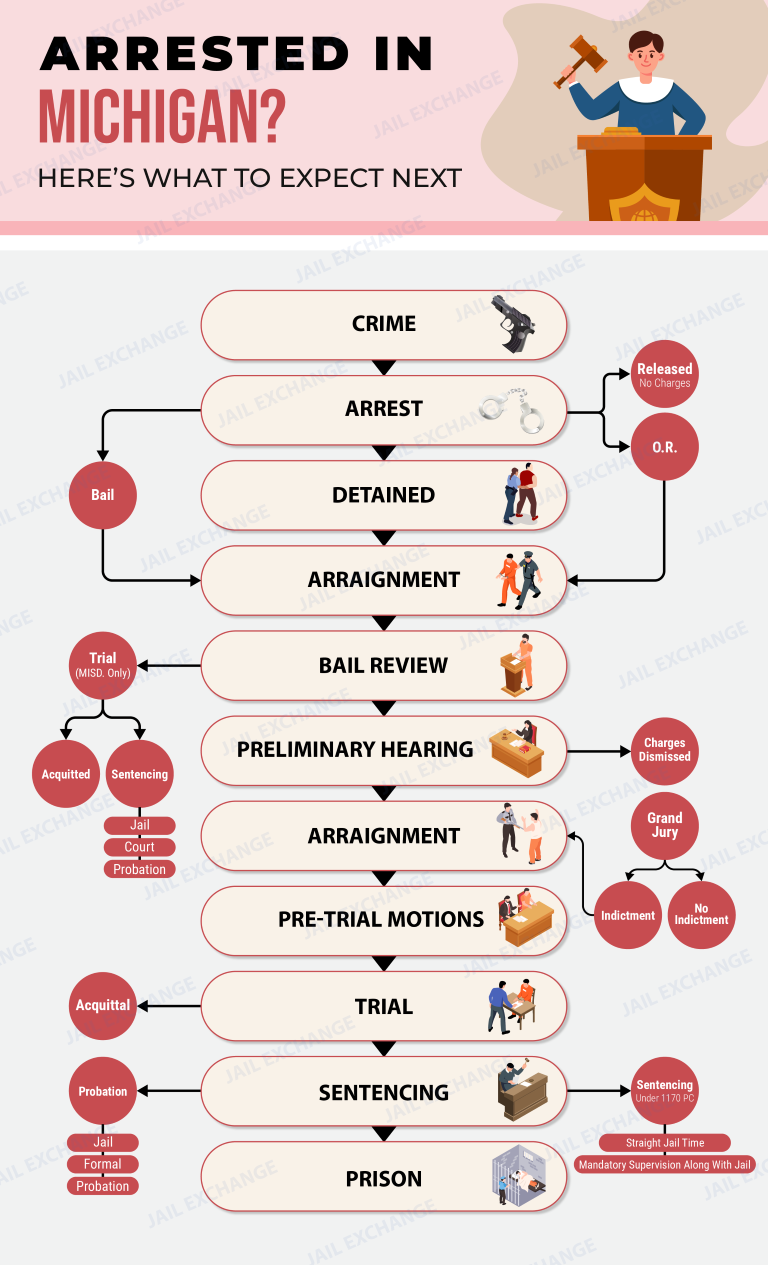
Where does a case start? A person arrested in Lenawee County may first be booked by police and brought before a judge or magistrate. The charge determines which court hears the court matter, and the written notice controls where the defendant must appear. Michigan District Courts decide most misdemeanors and handle the first steps of felonies. Circuit Court in most situations takes over a felony after a waiver or a finding of probable cause at the preliminary examination.
What happens to someone waiting in jail? The Lenawee County sheriff or another authorized jail may hold the person charged while a court considers release. Custody and release decisions are recorded as part of the criminal case. A courthouse and a detention center are not necessarily on the same property.
This guide explains the usual criminal court process in Lenawee County in plain language. The exact charge, criminal history, and judge’s findings affect the outcome. It is general information, not personal legal advice.
2. What should someone expect in a Lenawee County misdemeanor case?
In Lenawee County, a misdemeanor may start with a ticket or a notice to appear, while a more serious situation can lead to arrest and booking. Examples include certain assaults without serious injury, shoplifting and some impaired-driving charges. The criminal accusation written on the paperwork matters because Michigan has different penalties for different misdemeanors.
Getting to the first hearing and discussing release
Here is the practical point for a family: At arraignment, the judge tells the person charged what offense is charged, explains important rights and addresses a plea and release conditions. Some people can leave on a personal promise to return; others may have money bond, supervision, travel limits or no-contact orders. A judge can also deny release where the law permits. Bail is not a punishment or proof of guilt.
After the first court date
The Lenawee County District Court may schedule a pretrial hearing. Lawyers review police reports, videos and other evidence. The prosecuting attorney may offer an agreement, dismiss a charge or proceed to trial. The person charged can contest the evidence rather than accept a plea. Jury-trial rules depend on the offense and the legally available punishment.
How a person can obtain defense counsel
If the defendant faces a charge that qualifies for appointed counsel and does not have enough money to hire an attorney, the court can determine eligibility for a public defender or assigned lawyer. Request this help promptly; do not assume a defender is automatically assigned following booking.
Possible misdemeanor results
Michigan misdemeanors have different maximums. Common statutory limits include 90 or 93 days, one year, and in certain cases two years, with fines fixed by the particular statute. Some offenses also require driver-license action, restitution, classes or probation. The exact charge and prior record matter more than the county name.
3. Which hearings come before a felony trial in Lenawee County?
The important thing to understand is: A felony accusation in Lenawee County normally starts with a District Court arraignment, even when the eventual trial would be in Circuit Court. Prosecutors must establish the legal basis for moving the court matter forward. A felony carries the possibility of a state-prison sentence, although not every conviction results in prison time.
Probable cause conference and preliminary examination
Michigan usually sets a probable cause conference 7 to 14 days after felony arraignment and schedules the preliminary examination roughly 5 to 7 days after that conference, unless a legal waiver, adjournment or exception changes the schedule. At the preliminary examination the prosecution must show probable cause that a crime occurred and that this defendant committed it. That decision is not a determination that the person committed the crime.
How a serious case reaches Circuit Court
When the alleged offense is bound over, Lenawee County Circuit Court handles the felony case. The person facing charges may be arraigned again, and the parties exchange evidence, negotiate, file motions or set a trial. The prosecuting attorney has to establish guilt beyond a reasonable doubt at trial. Defendants who cannot afford legal counsel should ask the court about appointed representation.
What a felony sentence can involve
Michigan sentencing rules look at the offense statute, a record of earlier convictions, the sentencing guidelines when applicable, and any mandatory minimum. A nonviolent first offender might be eligible for probation or another lawful alternative, but some violent or repeat offenses require custody. Do not use a single felony-class chart to predict all Michigan sentences.
4. How do courts in Lenawee County handle violent felony charges?
For anyone trying to follow the process: Murder, armed robbery, criminal sexual conduct and assaults causing serious harm are examples of grave charges that could be prosecuted in Lenawee County. Seriousness by itself does not turn a Michigan crime into a federal case. Most such charges remain in the state Circuit Court unless federal law independently applies.
Detention and defense
A judge considers Michigan’s release rules, risk of flight, safety and legally relevant facts. A no-contact order or other condition may be imposed. Some defendants remain in jail while lawyers examine records, DNA or other scientific evidence. These charges need careful legal advice and frequently involve complicated court motions.
Trial and possible prison terms
First-degree murder carries mandatory life without parole for adults under Michigan law, subject to legally applicable exceptions and youth-sentencing rules. Second-degree murder can carry a sentence up to life imprisonment. Armed robbery and several serious criminal sexual conduct crimes can also carry very long terms. Other violent offenses have their own penalty sections. Michigan does not have the death penalty.
Victim and family support
The Lenawee County Prosecuting Attorney may have a victim-witness unit that explains hearing notices and available services. The defense attorney protects the legal rights of the person charged. The amount of time a case takes depends on witnesses, evidence, motions and the court calendar.
5. What happens after a juvenile is taken into custody in Lenawee County?
Put simply: A youth accused of breaking a criminal law in Lenawee County in most situations appears in the Family Division of Circuit Court instead of an adult District Court. Michigan juvenile proceedings emphasize the child’s age, the offense, safety, and whether services can address the problem.
Intake and the first decision
After police contact, juvenile court intake may review a complaint and decide whether it needs a formal petition. Some matters can be diverted or handled through services without a full court trial. If a youth is held, the law provides for prompt judicial review, and parents or guardians should ask where the child is housed.
Hearings and possible outcomes
If a formal petition is filed, the court explains the allegations and the child’s rights. An adjudication hearing decides whether the state's lawyer proved the allegation under the applicable legal standard. Outcomes may include supervision, probation, counseling, treatment, restitution, or placement through the youth-services system where authorized.
When a juvenile might face adult-style prosecution
Special laws permit designation or waiver for certain serious offenses and ages; an adult criminal matter is not automatic simply because someone is charged with a felony. Juvenile and youthful-offender rules are complicated, so ask for an attorney experienced in youth cases. Many juvenile records are not open to the public.
6. What fines, probation, jail or prison terms are possible in Lenawee County?
Someone arrested in Lenawee County does not receive a sentence just because the police wrote a charge on a report. The prosecutor has to establish the court matter or the person charged must enter a valid plea. If there is a conviction, the judge uses the exact charge and Michigan statute. The amounts below are legal limits for the listed offenses, not a promise that the judge will order those amounts. Fines can be accompanied by court costs, assessments and restitution to a victim.
Specific Michigan charges and their statutory punishments
- Simple assault or assault and battery (MCL 750.81(1)): Up to 93 days in jail and/or a fine up to $500 A basic assault charge without a different applicable enhancement.
- First domestic assault (MCL 750.81(2)): Up to 93 days in jail and/or $500 Prior offenses or added facts can raise penalties.
- Second domestic assault (MCL 750.81(4)): Up to 1 year in jail and/or $1,000 Prior qualifying conviction is required.
- First ordinary drunk-driving offense (OWI) (MCL 257.625(9)(a)): Up to 93 days in jail; $100–$500 fine; up to 360 hours community service Driver’s-license consequences and other costs may also apply.
- First high-BAC OWI, BAC at least .17 (MCL 257.625(1)(c), (9)(a)): Up to 180 days in jail; $200–$700 fine May include ignition-interlock and license restrictions.
- OWI with one prior conviction within 7 years (MCL 257.625(9)(b)): $200–$1,000 fine plus a lawful jail or community-service penalty Specific mandatory minimums and alternative sanctions apply.
- Home invasion, third degree (MCL 750.110a(4), (7)): Up to 5 years in prison and/or $2,000 A felony; the precise grade depends on conduct.
- Home invasion, second degree (MCL 750.110a(3), (6)): Up to 15 years in prison and/or $3,000 A felony; may involve entering a dwelling to commit certain crimes.
- Home invasion, first degree (MCL 750.110a(2), (5)): Up to 20 years in prison and/or $5,000 Aggravating factors include a dangerous weapon or someone lawfully present.
- Felony with no specific punishment stated (MCL 750.503): Up to 4 years in prison and/or $5,000 Default rule only: does not replace a statute that sets its own penalty.
- Misdemeanor with no specific punishment stated (MCL 750.504): Up to 90 days in jail and/or $500 Default rule only: many offenses set different limits.
- First-degree murder (adult conviction) (MCL 750.316): Life imprisonment without possibility of parole, subject to applicable constitutional/youth exceptions Michigan does not have the death penalty.
Why a felony's sentencing-guidelines range may be different
Michigan does not have one statewide table saying all Class A felonies get one sentence and all Class B felonies get another. For eligible felonies, the judge calculates an offense-variable score based on how the crime happened and a prior-record-variable score based on the person's record. Those scores, the crime's offense category and its sentencing classification produce a recommended minimum prison-term range. That recommended range is different from the statutory maximum, which is the most prison time allowed for that crime. Courts can depart from a recommendation when lawful and must explain a reasonable departure. Mandatory minimums can override ordinary guideline calculations.
For example, a five-year maximum for third-degree home invasion does not mean that everyone convicted must serve five years. A particular defendant may receive a lower prison minimum, probation or another lawful sentence depending on the sentencing law and case facts. Michigan prison sentences frequently state both a minimum and a maximum; parole eligibility and release do not automatically happen on the minimum date.
What about probation, restitution and jail?
A judge may order reporting to a probation officer, drug or alcohol testing, classes, treatment, community service, and repayment of a victim's proven losses. Violating probation can lead to another court hearing and a new penalty. Some people serve a local jail term instead of being sent to state prison; others qualify for an alternative sentence. A defendant's lawyer can request the sentencing-information report and explain the actual scored range before sentencing.
7. What happens if federal prosecutors bring charges involving Lenawee County?
Lenawee County is part of the U.S. District Court for the Eastern District of Michigan, Southern Division. This court handles violations of federal criminal law; it is separate from Michigan District Court, despite the similar names. The southeastern Lower Peninsula location of the county determines its federal judicial assignment.
Federal courthouse and contact
- Federal court: U.S. District Court, Eastern District of Michigan, Southern Division
- Courthouse: United States District Court — Eastern District of Michigan, Detroit courthouse. 231 W. Lafayette Boulevard, Detroit, MI 48226.
- Clerk’s office telephone: 313-234-5000.
What makes a crime federal?
Examples may involve trafficking drugs in violation of federal law, bank robbery involving a federally insured institution, certain firearm violations, federal tax crimes, fraud that uses interstate communications, immigration crimes, and offenses on federal property. Crossing a state line may be relevant to some laws, but is not required for every federal charge. A serious local assault or theft is not federal simply because it is serious.
Steps in a federal criminal case
A person may be arrested on a federal complaint or indictment and then appears before a U.S. magistrate judge. The judge reviews rights, counsel and detention or release. Serious federal charges ordinarily involve grand jury indictment unless a lawful exception applies. Discovery and motions follow; a plea or jury trial determines the outcome. A federal judge imposes sentence under federal statutes and sentencing rules, with any mandatory minimums applying where required.
Federal custody and sentences
The U.S. Marshals Service handles federal pretrial custody and transportation, frequently through contracted local facilities. People receiving federal prison sentences are in most situations placed by the Federal Bureau of Prisons. A person arrested within a Michigan county may therefore be housed far from the county jail and may need to be found through federal channels.