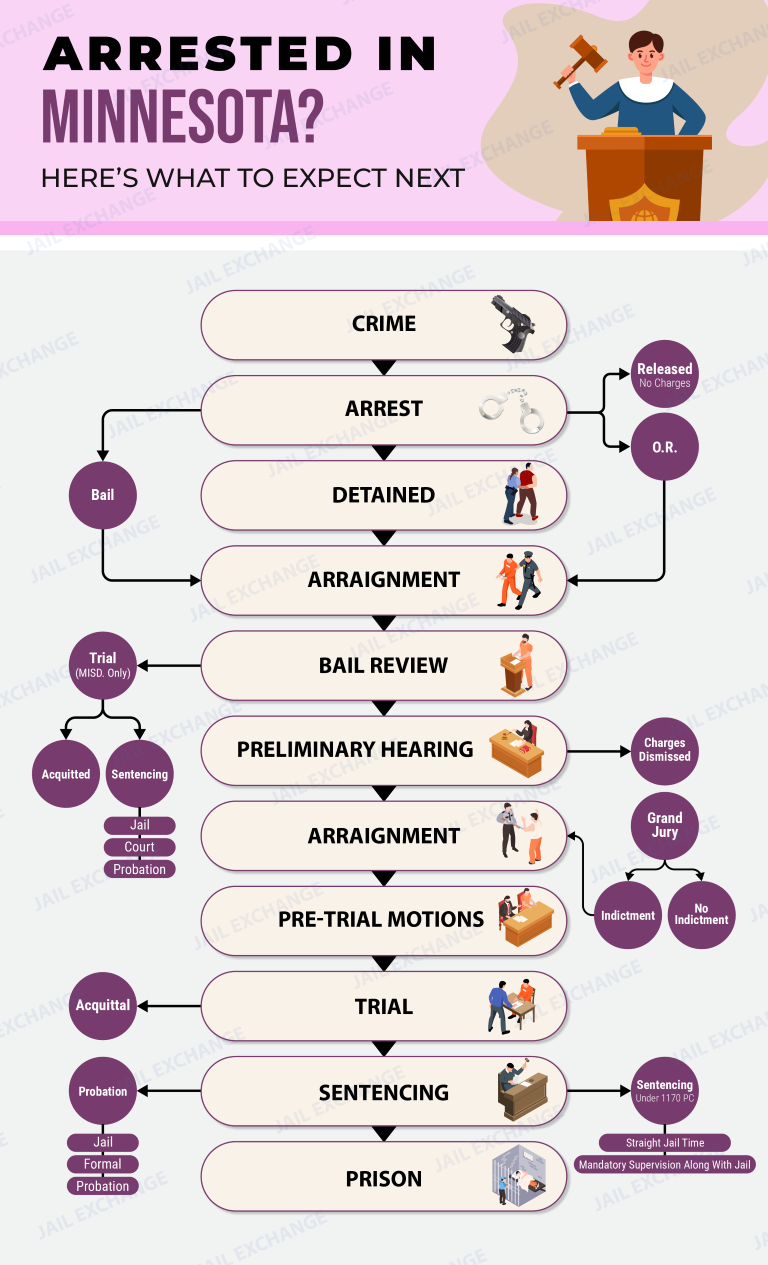
Itasca County Jail Annex Criminal Court Process
Criminal Court Process for Itasca County Minnesota
Itasca County Court Guide: Criminal Hearings in Grand Rapids Explained
Itasca County criminal cases go before Ninth Judicial District judges at the Itasca County Courthouse, 123 Fourth Street NE, Grand Rapids, MN 55744. The court administrator's office picks up at 218-327-2870. Until release, people taken into custody are held in the Itasca County Jail, which the Sheriff runs in Grand Rapids.
Do you know yet if your relative is in jail? Look them up by last name in the sheriff's custody search. The Itasca Inmates in Custody page we keep adds booking photos, charges and help picking up property.
Your next step is a call to 218-327-2870 on a weekday. Find out from the clerk when the first appearance is and in which room. When release depends on money, read our Itasca bail steps.
1. Misdemeanor (for example, theft, a first DWI, fifth-degree assault, trespassing)
Criminal cases from Itasca County are heard at the Itasca County Courthouse in Grand Rapids, the county seat, by judges of the Ninth Judicial District, Minnesota's largest district by area. The Itasca County Attorney files all felony and juvenile delinquency cases. Misdemeanors and gross misdemeanors from Grand Rapids, Cohasset, Coleraine, Nashwauk, Deer River and the county's other cities are generally prosecuted by the attorney each city retains. People arrested anywhere in the county are booked into the Itasca County Jail in Grand Rapids, operated by the Sheriff.
- Itasca County District Court / Court Administrator (Ninth Judicial District), Itasca County Courthouse, 123 Fourth Street NE, Grand Rapids, MN 55744, (218) 327-2870
- Itasca County Attorney's Office, Grand Rapids, (218) 327-2867
- Ninth District Public Defender, Grand Rapids Office (serves Itasca, Koochiching and Lake of the Woods counties), 102 3rd Street NE, Suite 250, Grand Rapids, MN 55744, (218) 327-4184
- Itasca County Sheriff's Office and Jail, 108 NE Fifth Street, Grand Rapids, MN 55744, Sheriff (218) 326-3477, Jail Division (218) 327-3477
Which court hears your case. No matter how serious the accusation, an Itasca County criminal case is filed in one place: the District Court in Grand Rapids. Minnesota abolished its old municipal courts long ago, so there is no separate city court for a Grand Rapids ordinance violation. The charge level instead determines who prosecutes and how many hearings there are. An offense committed inside a city limit at the misdemeanor or gross misdemeanor level is normally handled by that city's prosecutor, often an outside private attorney on contract; the same offense in an unorganized territory or township is handled by the Itasca County Attorney; and felonies are always the County Attorney's responsibility.
Where pretrial detainees are held. The Itasca County Sheriff operates the county jail at 108 NE Fifth Street in Grand Rapids, and that is where arrestees from the Sheriff's Office, the Grand Rapids Police Department, the State Patrol and other local departments are booked. A person who cannot post bail or meet the court's release conditions stays in the Grand Rapids jail while the case is pending. Call the Sheriff's Office at (218) 326-3477 to ask about someone in custody.
This section covers the three lowest levels of Minnesota offenses. Petty misdemeanors are noncriminal violations punished only by a fine. Misdemeanors and gross misdemeanors are crimes that can lead to jail in Grand Rapids, a criminal record and probation.
Arrest, booking and release
Many Itasca County misdemeanor cases start with a ticket or citation and no jail stay at all. When an officer does make a custodial arrest, the person is booked at the jail and may be able to post bail right away under a standard schedule. If not, Minnesota's 36-hour rule applies: the person must be taken before a judge within 36 hours, leaving out the day of the arrest, Sundays and legal holidays. Judges here usually set a no-conditions bail figure and a second, smaller amount that comes with requirements such as alcohol monitoring or staying away from a particular person. A bail bond agent may be used, since commercial bonding is legal in Minnesota.
Hearings in Grand Rapids
The first court date on a misdemeanor is the arraignment; a gross misdemeanor starts with a Rule 5 first appearance. Ask at that hearing for a public defender if you cannot pay a lawyer; the Ninth District Public Defender's Grand Rapids office, reachable at (218) 327-4184, handles appointed cases in the county. The case then moves to a pretrial conference with the city attorney or the Itasca County Attorney. Most settle there. If not, a six-member jury hears the trial and must reach a unanimous verdict.
What the penalties look like in Itasca County
- Petty misdemeanor in Itasca County: a fine capped at $300, with no possibility of jail.
- Misdemeanor (fifth-degree assault, trespass, or theft worth $500 or less): a maximum of 90 days in the Grand Rapids jail plus as much as $1,000 in fines.
- Gross misdemeanor (theft valued between $500 and $1,000, among others): as many as 364 days behind bars and fines reaching $3,000.
- First DWI arrest in Itasca County: normally fourth-degree DWI, a misdemeanor. An alcohol concentration of 0.16 or more, a child younger than 16 riding along, or a refusal to submit to testing turns it into a third-degree, gross misdemeanor charge. Expect an administrative license revocation that runs apart from the court case, a chemical use assessment, and in aggravated cases possible plate impoundment, ignition interlock or forfeiture of the vehicle.
Results range from outright dismissal or a continuance for dismissal to a stay of adjudication, probation, fines and short jail terms. A typical misdemeanor before the Grand Rapids bench lasts one to four months.
↑ Back to the question list2. Felony (for example, burglary, felony theft, drug sale, second-degree assault)
Felony charges can bring a sentence of more than one year in a Minnesota prison. Every Itasca County felony is prosecuted by the County Attorney, who files a criminal complaint in District Court rather than presenting the case to a grand jury.
Step by step in the Ninth District
- Booking and the Rule 5 appearance. After booking at the Grand Rapids jail, a person held on a felony sees a judge within the 36-hour limit. A probable-cause review must happen within 48 hours if there was no warrant. The judge confirms the charge, appoints the Grand Rapids public defender office when the defendant qualifies, and sets bail with and without conditions.
- Rule 8 hearing. Usually a few weeks later. The defense receives discovery, the prosecutor may make an offer, and the defendant can enter a plea.
- Omnibus hearing. The defense may challenge probable cause, a search, a statement to police or other evidence.
- Pretrial or settlement conference, then trial. A felony trial in Itasca County uses 12 jurors whose verdict must be unanimous. A defendant can demand a speedy trial, which must then start within 60 days.
- Sentencing, after a presentence investigation by probation.
Sentencing and maximum terms
The Minnesota Sentencing Guidelines govern felony sentences in Grand Rapids. A grid matches the offense's severity level against a criminal history score, and the result is a presumptive sentence that is either stayed (probation, sometimes with local jail time) or executed in prison. Itasca County judges may depart from it only when substantial and compelling reasons exist.
- Felony theft in Itasca County: a 5-year cap once the value tops $1,000, rising to 10 years past $5,000 and 20 years past $35,000.
- Burglary charged in Grand Rapids: 20 years is the top penalty for the first degree, with 10 for the second degree and 5 for the third.
- First-degree sale of drugs: the statutory ceiling is 30 years.
- Second-degree (dangerous weapon) assault: no more than 7 years, though using a firearm triggers a mandatory minimum.
A stay of imposition can leave a successful probationer with a misdemeanor rather than a felony on the record. Prison sentences are served about two-thirds in custody and one-third on supervised release. Most Itasca County felony cases take four months to a year.
↑ Back to the question list3. Violent felony (for example, murder, criminal sexual conduct, aggravated robbery)
The most serious charges filed in Itasca County follow the felony steps above, but judges set much higher bail and many defendants stay in the Grand Rapids jail through trial. A first-degree murder charge requires a grand jury indictment, the only Minnesota offense level where one is mandatory.
Penalties
- First-degree murder in Itasca County: a life sentence, without parole for premeditated killings and some other categories, and with parole eligibility after 30 years otherwise. There is no death penalty in Minnesota, which ended capital punishment in 1911.
- Second- and third-degree murder: maximums of 40 and 25 years respectively.
- First-degree criminal sexual conduct: as long as 30 years; a first offense carries a presumptive guidelines sentence of 144 months.
- Aggravated robbery in the first degree: a ceiling of 20 years in prison.
Counsel, victims and time frame
The Ninth District Public Defender's Grand Rapids office defends eligible people charged with these crimes. Victims have rights under chapter 611A of Minnesota Statutes, including being notified of key hearings and being heard before the Itasca County judge imposes sentence. Lab work, expert testimony and lengthy motions mean a violent felony case often takes one to two years, and sometimes more.
↑ Back to the question list4. Juveniles (under 18) arrested in Itasca County
When someone under 18 is accused of a crime in Itasca County, the case belongs to the juvenile division of the District Court in Grand Rapids. The Itasca County Attorney reviews the police report and decides whether to file a delinquency petition or send a first-time offender to a diversion program, which ends without a court record if completed.
A youth who is held is entitled to a detention hearing no more than 36 hours after being picked up, not counting weekends and holidays. Itasca County youth are not housed in the adult jail; a juvenile who needs secure detention is generally sent to the Northwestern Minnesota Juvenile Center in Bemidji, (218) 751-3196, one of the regional facilities Itasca County belongs to as a joint powers member. The public defender's Grand Rapids office represents qualifying juveniles.
For older youth charged with serious offenses, prosecutors have stronger tools. Extended Jurisdiction Juvenile (EJJ) status, available for youth aged 14 through 17, leaves the case with the juvenile judge but adds an adult sentence that is stayed unless the youth violates the terms. Certification moves a case to adult court and can be sought for anyone 14 or older; the burden shifts toward certification for a 16- or 17-year-old accused of a firearm offense or a crime with presumptive prison time. A 16- or 17-year-old charged with first-degree murder goes straight to adult court. Most juvenile records stay confidential, although certain felony matters involving youth 16 or older may be open to the public.
↑ Back to the question list5. Federal cases (U.S. District Court) from Itasca County
When a Grand Rapids-area arrest involves a federal crime, the case leaves the Fourth Street NE courthouse and goes to the U.S. District Court for the District of Minnesota. Itasca County belongs to the court's Fifth Division, headquartered at the Gerald W. Heaney Federal Building and U.S. Courthouse, 515 W. First Street, Duluth, MN 55802. Trial jurors are summoned to Duluth, and first appearances and detention hearings for northeastern counties are often held there as well, though some happen in Minneapolis or St. Paul. Clerk of Court: (612) 664-5000.
Which Itasca County cases go federal
Investigations by the FBI, DEA, ATF, Homeland Security Investigations, U.S. Postal Inspectors or the IRS produce most federal charges here: trafficking of significant drug quantities or across state lines, firearms offenses such as a felon with a gun, fraud schemes, child exploitation, bank robbery and immigration violations. Federal prosecutors can also adopt an arrest first booked at the Grand Rapids jail, and a person can face charges in both systems for the same act.
Bois Forte land in Itasca County
Minnesota is a Public Law 280 state, so the Itasca County Attorney prosecutes most crimes on reservation land in the county. The exception is the Bois Forte Reservation, whose Deer Creek sector lies in Itasca County: there, serious crimes by Native American defendants that are covered by the Major Crimes Act, such as murder, manslaughter, sexual abuse and assault causing serious bodily injury, are prosecuted federally.
People and offices
The U.S. Attorney's Office for the District of Minnesota prosecutes (Minneapolis: U.S. Courthouse, 300 S. 4th Street, Suite 600, Minneapolis, MN 55415, (612) 664-5600; St. Paul: 316 N. Robert Street, Suite 404, St. Paul, MN 55101, (651) 848-1950). The Office of the Federal Defender, 107 U.S. Courthouse, 300 S. 4th Street, Minneapolis, MN 55415, (612) 664-5858, defends people who qualify, with a CJA panel attorney appointed in conflict cases. The U.S. Marshals Service in Duluth, (218) 529-3620, is responsible for custody.
Steps and timelines
A U.S. magistrate judge holds the initial appearance, explaining the charges and appointing a lawyer. If the government asks for detention, a hearing generally takes place within 3 court days, and the Bail Reform Act leaves two outcomes: release under conditions supervised by U.S. Probation and Pretrial Services, or detention where no conditions assure appearance and public safety. Bondsmen have no role and money bail is rare. A case begun by complaint needs an indictment within 30 days of arrest, or a preliminary hearing, before arraignment. Trial is due within 70 days under the Speedy Trial Act, but continuances are common and plea agreements settle most cases; juries have 12 members and must agree unanimously. Sentencing, about three months on, follows a presentence report and the advisory Sentencing Guidelines, plus any mandatory minimum. Federal sentences carry no parole, so at least about 85% is served even with good-conduct time, in the Bureau of Prisons, and supervised release follows. Appeals are heard by the Eighth Circuit.
Detention. The Marshals contract with county jails across Minnesota, and sometimes beyond it, to hold federal pretrial detainees, so a person arrested in Itasca County may be moved to another county. The Duluth Marshals office can say where; sentenced people appear in the Bureau of Prisons inmate locator. Federal court rarely prosecutes anyone under 18.
↑ Back to the question listThe information above outlines the general criminal court process in Itasca County and should not be taken as legal advice. Anyone facing a charge should consult a defense lawyer or request appointed counsel; the Ninth District Public Defender's Grand Rapids office is at (218) 327-4184 and court administration is at (218) 327-2870.