
Pope County Jail
Pope County Jail
Douglas County Jail
320-762-2139How do you find someone who is in jail in Pope County?
Search for information about an inmate in the Pope County Jail and view their jail mugshot:
- Review the Jail Roster
- Look up the offender's criminal charges
- Find out their bond, and
- View their public mugshot in the roster.
Offenders from Pope County are transferred to Douglas County Jail.
If you cannot find the mugshot of the offender that has been arrested, it is because Pope County or the state of Minnesota has recently changed their policy regarding publicly posting them in the jail roster. However, you can write the jail at the following address and request a copy of an inmate's mugshot be mailed or sent by email to you. Make sure to include your email address in all correspondence.
Mail to:
Pope County Jail
Douglas County Jail
509 3rd Avenue West
Alexandria, MN 56308
Attention: Media Relations - Inmate Mugshot Request
Mail, click on the link below, or call the facility at 320-762-2139 for the information you are looking for.
Pope County Jail Inmate Search
For inmate services and facility information such as:
- Directions
- Visiting an Inmate
- Sending Money
- Mailing
- Emailing or Texting
- Receiving phone calls
- Sending Commissary
- Bail Bond Information
Click the link below.
Pope County bail and bond: Glenwood sheriff, courthouse and next steps
After a Pope County arrest, the Sheriff's Office at 130 East Minnesota Avenue, Glenwood, MN 56334, answers custody questions, and the person may be held in another county's jail. Recent Pope arrests show up on the Douglas County Jail roster in Alexandria, and our Pope County Jail page explains where to look. Further down, you'll see who picks the bail amount, which payments count and what follows a missed court date.
Search for your relative in the jail search, then look at the booking time and bail. Very new arrests may lag behind. Our Inmates in Custody page for Glenwood helps with charges, mugshots and getting belongings back.
Dial the Glenwood Sheriff's Office at 320-634-5411 and ask which county's jail is holding your person. Then ask where bail is paid and which payments work. Court dates and hearing steps are in our court guide.
1. Is my sister in jail after a Pope County arrest?
Put her name into Pope County Inmate Search and look at the booking time. A very new arrest can take a while to show. People arrested in Pope County may be held in another county's jail, and recent Pope arrests show up on the Douglas County Jail roster in Alexandria. If the search shows nothing, call the Sheriff's Office at 320-634-5411 and ask which jail is holding her.
↑ Back to the question list2. Which Pope County building do I visit for what?
Custody questions go to the Sheriff's Office at 130 East Minnesota Avenue, which answers 320-634-5411 at any hour. The courthouse at 130 East Minnesota Avenue holds the court administrator. Court hours are Monday to Friday, 8 a.m. to 4:30 p.m., and the court phone is 320-424-7170.
↑ Back to the question list3. How do I pay bail in Glenwood?
First ask the Sheriff's Office which jail is holding the person, since it may be another county's jail. Phone 320-634-5411 and ask where to go, whether the jail takes cash, a money order or a card, and what papers you need. The court administrator at 320-424-7170 can confirm what the judge ordered.
↑ Back to the question list4. How long can police hold someone before a judge sees them?
A person arrested without a warrant must appear before a judge within 36 hours, not counting the day of arrest, Sundays or legal holidays. A misdemeanor suspect held past that time must be released on a citation. The separate 48-hour rule covers a judge's finding of probable cause, and weekends count.
↑ Back to the question list5. Does Pope County have set bail amounts?
Ask the court administrator at 320-424-7170 about any local list; Minnesota has no statewide list. A Judicial Council policy tells courts to avoid relying on preset amounts. The judge looks at the charge, the evidence, family and work ties, record and safety of others.
↑ Back to the question list6. What are the judge's options at the first hearing?
The judge may hold the person without bail, order cash bail with or without conditions, accept a non-cash bond, or release with conditions or none. Several of these can be ordered together and the defendant picks. The starting point under court rules is release on a promise to appear or an unsecured bond.
↑ Back to the question list7. What does a bondsman charge near Glenwood?
An agent must charge the premium the surety filed with the state, never less, with a minimum of $100. For a bond above $10,000 the agent must collect at least 30 percent before posting. Ask for a written statement of the total, the note terms and any travel fee before signing anything.
↑ Back to the question list8. How do I check that a bondsman is allowed to work in Minnesota?
The agent needs a state insurance license for bail bonds and an approval from the State Court Administrator. The courts site publishes an approved agent list. Agents may not offer you a rebate and may not solicit inside the jail unless you or your lawyer asked.
↑ Back to the question list9. Could our land or a car cover the bond?
A judge can accept other security under the court rules. Ask the court administrator at 320-424-7170 about land in another county. If a bondsman takes your property, demand a numbered receipt, and know that a quitclaim deed cannot be taken as collateral.
↑ Back to the question list10. How do we get a public defender in Pope County?
Ask the judge at the first appearance, or use the online application on the Minnesota courts site. Call the court administrator at 320-424-7170 and ask how the local public defender can be reached. The judge decides who qualifies.
↑ Back to the question list11. Where does a minor go after a Pope County arrest?
In March 2023 the county board approved a contract with Prairie Lakes Youth Programs in Willmar, the closest facility, for juvenile detention. Confirm that it is still in use by calling 320-424-7170. A child's file is private and will not appear in the adult search.
↑ Back to the question list12. What do the words "held" or "no bail" mean on the record?
They can point to a probation hold, a warrant from another county, a no-contact order or a judge's order restricting release. Minnesota has no death penalty, so no charge is automatically denied bail. Get the reason from the court administrator.
↑ Back to the question list13. What if the charge is domestic assault?
The judge must look at whether release puts the victim at risk and can order no contact, a stay-away rule, a weapons surrender and limits on alcohol. The person may be unable to go home after release. Call the court before you plan the ride.
↑ Back to the question list14. What if my son misses court?
The judge may issue a warrant and begin forfeiture of the bond. With a bondsman, the court is supposed to send notice within 30 days of the missed hearing. Contact the lawyer and the agent the same day.
↑ Back to the question list15. Who gets the cash when the case is over?
The defendant owns cash bail, even if a parent paid. The court keeps it until the case ends, removes any fine or restitution, then sends the balance to the defendant or someone named in writing.
↑ Back to the question listPope County contacts for bail and bond
- Jail: Pope County Sheriff's Office, 130 East Minnesota Avenue, Glenwood, MN 56334; 320-634-5411; people may be held in another county's jail
- Bond guide: Pope County jail bail and bond help
- Custody lookup: Pope County Inmate Search
- District Court: Pope County Courthouse, 130 East Minnesota Avenue, Glenwood, MN 56334; 320-424-7170; Monday to Friday, 8 a.m. to 4:30 p.m.
- Public defender: Ask the court administrator at 320-424-7170
- Youth detention: Prairie Lakes Youth Programs, Willmar, under a 2023 county contract
This guide draws on sheriff, court and news pages that may be out of date, and a judge can order different terms. Call the office to confirm before you pay or drive. For advice about a particular case, talk with a lawyer.
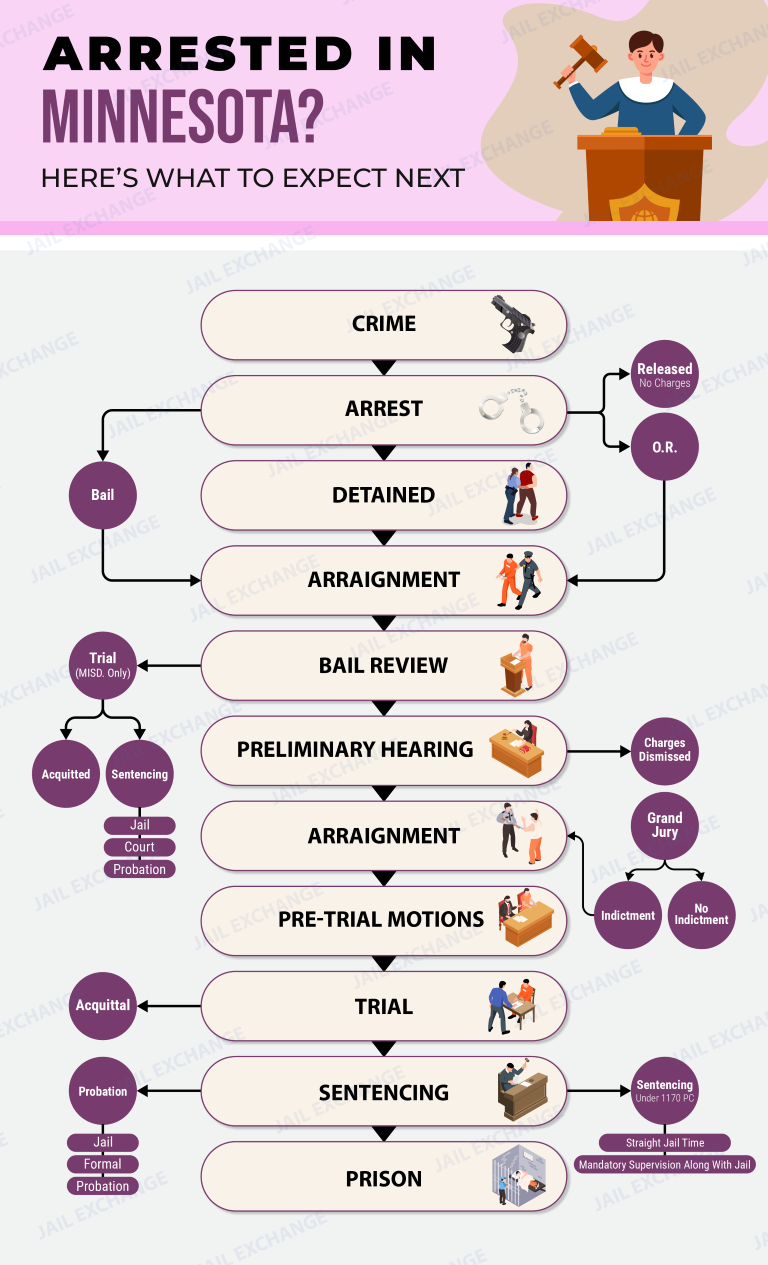
Pope County Criminal Courts in Glenwood: Hearings, Lawyers and Next Steps
Pope County's District Court, in the Eighth Judicial District, holds criminal hearings at the courthouse at 130 East Minnesota Avenue, Suite 309, Glenwood, MN 56334. Its court administration phone is 320-424-7170. Anyone a judge does not free may be held in another county's jail, so check our Pope County Jail page and call the Sheriff.
A quick way to confirm someone is locked up is the county inmate lookup; enter a last name and check the results. Our Jail Roster page walks through recent bookings, warrants and public defenders.
Next, call 320-424-7170 to ask about the first hearing and the case number. If the Sheriff's line, 320-634-5411, says bail is set, our bail steps explain how to pay.
1. Misdemeanor (for example, theft, a first DWI, fifth-degree assault, trespassing)
In Pope County, criminal charges are heard by the District Court at the county courthouse on East Minnesota Avenue in Glenwood, the county seat on the shore of Lake Minnewaska. Pope is one of the west-central counties in Minnesota's Eighth Judicial District. The Pope County Attorney prosecutes all felonies and juvenile delinquency cases, along with lesser offenses committed outside city limits, while Glenwood, Starbuck and other cities typically prosecute their own misdemeanors through a city attorney. Arrested adults who are not released may be held in another county's jail, and the Pope County Sheriff's Office in Glenwood can say where.
- Pope County District Court (Eighth Judicial District), Pope County Courthouse, 130 East Minnesota Avenue, Suite 309, Glenwood, MN 56334, (320) 424-7170
- Pope County Attorney's Office, Glenwood, (320) 634-4581
- Eighth District Public Defender (State Board of Public Defense), district management office, 316 Becker Avenue SW, Suite 301, Willmar, MN 56201, (320) 231-6064
- Pope County Sheriff's Office (booking and custody), 130 East Minnesota Avenue, Glenwood, MN 56334, (320) 634-5411
Which court hears your case. From a petty misdemeanor up through a felony, all Pope County criminal charges are handled by the same District Court in Glenwood; Minnesota does not operate city or municipal courts. What the charge level controls is the prosecutor and the steps the case will take. Misdemeanors and gross misdemeanors from inside a city are usually prosecuted by the city attorney or a private attorney the city hires, while the Pope County Attorney prosecutes those that happen in the townships. Felony prosecutions always belong to the County Attorney.
Where pretrial detainees are held. Adults arrested by the Pope County Sheriff's Office, the Glenwood Police Department or the State Patrol who are not released are booked by the Sheriff's Office in Glenwood and held at the jail that serves Pope County until they post bail, are released by a judge, or finish their case. To confirm where a person is being held, call the Sheriff's Office at (320) 634-5411.
The lower end of the Pope County criminal calendar includes petty misdemeanors, misdemeanors and gross misdemeanors. A petty misdemeanor is a civil-style violation, so the only penalty is a fine capped at $300. A misdemeanor may be punished with up to 90 days and $1,000, and a gross misdemeanor with up to 364 days and $3,000.
Citation or booking
Officers in Pope County frequently cite and release people accused of minor offenses, giving them a written date to appear in Glenwood. When someone is arrested instead, the Sheriff's staff books them into the jail and may release them once they post bail under the court's schedule. A person kept in custody must see a judge within 36 hours; the day of the arrest, Sundays and legal holidays do not count toward that limit.
The first hearing: arraignment
On a misdemeanor, the first appearance before an Eighth District judge is the arraignment. The judge reads the charge, explains your rights and sets release terms. The usual Minnesota approach is two bail options: a higher amount that comes with no conditions, or a lower amount that requires following rules such as no alcohol, no contact with the alleged victim, or electronic monitoring. Bail bond agents operate legally in Minnesota, so a family can pay a bondsman a fee rather than the full amount. This is also the time to ask for a public defender if jail is possible and you cannot afford private counsel.
After the arraignment
The case is next set for a pretrial conference with the prosecutor. In Glenwood, these cases often settle with a lesser charge, a continuance that leads to dismissal, or a stay of adjudication, where the Pope County court never enters a conviction as long as probation is completed. When a case is tried, the verdict comes from six jurors, and all six must agree.
Penalties a Glenwood judge may order
- Theft in Pope County: misdemeanor-level up to $500, gross misdemeanor from more than $500 through $1,000, felony above that.
- Fifth-degree assault: a misdemeanor for a first-time offender in Pope County, a gross misdemeanor if there is a qualifying prior.
- Trespassing in Glenwood or Starbuck: usually a misdemeanor, up to 90 days.
- First DWI in Pope County: a straightforward first offense is fourth-degree DWI, which a Glenwood judge can punish with no more than 90 days and $1,000. Prosecutors file third-degree DWI, a gross misdemeanor (364 days, $3,000), if they can show one aggravator: testing at 0.16 or more, carrying a passenger younger than 16, or refusing the test. Pope County drivers also face a separate administrative license revocation and a court-ordered chemical use assessment, and an aggravated DWI can add interlock, plate impoundment or loss of the vehicle.
Pope County misdemeanor cases generally take one to four months from start to finish.
↑ Back to the question list2. Felony (for example, burglary, felony theft, drug sale, second-degree assault)
The Pope County Attorney's Office charges felonies by filing a criminal complaint in District Court. Grand juries in Minnesota are reserved for offenses punishable by life imprisonment, so ordinary felony cases do not use one.
Rule 5 first appearance
The 36-hour rule also governs felony arrests in Glenwood, so a jailed defendant reaches the courtroom within that window, with arrest days, Sundays and holidays excluded. When the arrest happened without a warrant, the court must also make a probable-cause finding within 48 hours. This Rule 5 appearance is where the Pope County judge goes over the complaint, decides who qualifies for an Eighth District public defender, and fixes bail and release conditions.
The hearings that follow
Next is the Rule 8 hearing, a second appearance where the defense gets discovery and the prosecutor may make an offer. Then comes the omnibus hearing, at which a Pope County judge rules on defense motions to suppress evidence or to dismiss for lack of probable cause. A pretrial or settlement conference usually follows. If there is no plea, the case is tried to a 12-member jury that must reach a unanimous verdict. Pope County defendants who demand a speedy trial must get one within 60 days. A presentence investigation is completed before a felony sentencing.
Pope County felony sentencing
Judges begin with the Minnesota Sentencing Guidelines. The grid matches the severity ranking of the crime against the defendant's criminal history score to arrive at a presumptive sentence, which may be stayed with probation or executed as a prison term. A Pope County judge who wants a different sentence must state substantial and compelling reasons.
- Felony theft in Pope County: more than $1,000 can bring 5 years; more than $5,000, 10 years; more than $35,000, 20 years.
- Burglary: the Glenwood courtroom can impose as much as 20 years for first-degree, half that for second-degree, and 5 years for third-degree.
- First-degree drug sale: up to 30 years in prison.
- Assault in the second degree, which involves a dangerous weapon: up to 7 years, and a mandatory minimum applies if the weapon was a firearm.
A stay of imposition is a frequent result for lower-level felonies, and after successful probation the conviction is treated as a misdemeanor. A prison sentence is typically served two-thirds inside and one-third on supervised release. Expect a Pope County felony to last four to twelve months.
↑ Back to the question list3. Violent felony (for example, murder, criminal sexual conduct, aggravated robbery)
Violent felony cases in Pope County go through the same Rule 5, Rule 8 and omnibus stages as other felonies. Bail is generally set high, and many defendants wait for trial in custody at the jail serving Pope County. A charge of first-degree murder must be brought by grand jury indictment.
Sentences for violent offenses
- First-degree murder: life in prison, without the possibility of release for premeditated murder and some other variants, and with release eligibility after 30 years otherwise. Minnesota abolished capital punishment in 1911.
- Second-degree murder: up to 40 years; third-degree murder: up to 25 years.
- First-degree criminal sexual conduct: up to 30 years, and a first offense carries a presumptive sentence of 144 months.
- First-degree aggravated robbery: up to 20 years.
Defense, victim rights and timeline
Eligible defendants are represented by the Eighth District Public Defender. Crime victims in Pope County have rights under Minnesota Statutes chapter 611A, including being notified of hearings, attending them, and addressing the court at sentencing. With forensic evidence, expert testimony and extensive motions, a violent felony can take one to two years or longer to resolve.
↑ Back to the question list4. Juveniles (under 18) arrested in Pope County
When a young person under 18 is accused of a crime in Pope County, the matter is heard in the juvenile division of the District Court in Glenwood, and the Pope County Attorney decides whether to file a delinquency petition. A youth who cannot be released goes to Prairie Lakes Youth Programs in Willmar, the facility Pope County contracted with in 2023 as the closest one to the county, not to an adult jail. A judge must review that detention at a hearing held within 36 hours, a period that skips weekends and holidays.
Pope County frequently uses diversion for first-time offenders, letting them complete conditions such as restitution or community service without a formal adjudication. A youth age 14 through 17 facing a serious felony can be prosecuted as an Extended Jurisdiction Juvenile, receiving a juvenile disposition along with an adult sentence that is stayed. The Pope County Attorney may also ask that a youth 14 or older be certified to stand trial as an adult; at 16 or 17, certification is the presumption whenever the offense calls for presumptive prison or a firearm was used. First-degree murder charges against 16- and 17-year-olds from Glenwood or elsewhere in Pope County start in adult court. Eighth District public defenders take juvenile appointments, and while most juvenile files are sealed from public view, some felony matters involving older teens are not.
↑ Back to the question list5. Federal cases (U.S. District Court) from Pope County
Most arrests around Glenwood, Starbuck and Lake Minnewaska stay in state court. A case becomes federal when it involves a federal crime, typically one worked by the FBI, DEA, ATF, Homeland Security Investigations, U.S. Postal Inspectors or the IRS. Common examples include trafficking drugs in large amounts or across state lines, illegal gun possession by someone with a felony record, fraud schemes, child exploitation offenses, bank robbery and immigration crimes. An investigation started by the Pope County Sheriff can be adopted by federal prosecutors, and the state and federal governments are each free to charge the same conduct.
Pope County's federal cases belong to Division 6 of the District of Minnesota, heard at the Edward J. Devitt U.S. Courthouse and Federal Building, 118 S. Mill Street, Fergus Falls, MN 56537, about an hour northwest of Glenwood. Jurors for a trial are called from Division 6 counties. Even so, the first hearings are often held in Minneapolis or St. Paul. The Clerk of Court is at (612) 664-5000.
Who handles a Pope County federal case
- U.S. Attorney's Office for the District of Minnesota: U.S. Courthouse, 300 S. 4th Street, Suite 600, Minneapolis, MN 55415, (612) 664-5600; St. Paul office at 316 N. Robert Street, Suite 404, St. Paul, MN 55101, (651) 848-1950.
- Office of the Federal Defender: 107 U.S. Courthouse, 300 S. 4th Street, Minneapolis, MN 55415, (612) 664-5858. A private CJA panel attorney is appointed if the Federal Defender cannot take the case because of a conflict.
- U.S. Marshals Service: Minneapolis (612) 664-5900. The Fergus Falls office is staffed only while court is in session.
Process
Following a federal arrest, a magistrate judge explains the charges at the initial appearance and appoints counsel. Prosecutors who want someone held must ask for a detention hearing, usually conducted within three court days. Under the Bail Reform Act, defendants are released on conditions supervised by U.S. Probation and Pretrial Services unless no conditions will reasonably assure appearance and safety; commercial bondsmen have no part in it, and money bail is seldom set. If the charge started as a complaint, a grand jury must indict (or a preliminary hearing must be held) within 30 days of arrest, and arraignment follows. Judges frequently extend the 70-day trial deadline that the Speedy Trial Act sets. Most cases end with a plea agreement; a trial requires a unanimous verdict from 12 jurors. Sentencing, around three months after a plea or verdict, relies on a presentence report, the advisory Sentencing Guidelines and any mandatory minimum. Federal law has no parole: with good-conduct credit, people serve at least about 85% of the term in a Bureau of Prisons facility, then a period of supervised release. The Eighth Circuit hears appeals. Federal prosecution of minors is rare.
Pretrial federal detainees are housed by the Marshals in county jails under contract across Minnesota and at times in other states, so a person arrested in Pope County may be moved out of the county. Relatives can call the Marshals office to learn where someone is; sentenced prisoners can be found with the Bureau of Prisons inmate locator.
↑ Back to the question listNothing on this page is legal advice; it is a plain-language outline of how criminal cases tend to proceed in Pope County. For guidance on a real case, consult a defense attorney or ask for an Eighth District public defender at the first hearing. Pope County Court Administration can be reached at (320) 424-7170, and the public defender's Willmar office at (320) 231-6064.
Information for this service is currently unavailable.
Pope County has no jail of its own. When someone is arrested in Pope County, they're housed in Alexandria at the Douglas County Jail, 509 3rd Avenue West, and that's where their account lives too.
Not sure they were taken there? Confirm by calling 320-762-2139; give the person's legal name and their birthday when you ask.
- Deposit in person. Step through the Douglas County Jail's main door into the public vestibule, where a kiosk will swallow paper bills or read a credit or debit card. No waiting with this one: the balance updates the moment you finish.
- Deposit online. Use Inmate Canteen, pay with a card, and choose Douglas County when it asks for the facility.
- Deposit by mail. Write a check or money order out to the person, spelling their whole name, and address the envelope to Douglas County Jail, 509 3rd Ave W, Alexandria, MN 56308. Bills stay out of that envelope.
Pope County, Minnesota, does not run a jail of its own. People arrested in Pope County are booked and held at the Douglas County Jail in Alexandria, and they show up on the Douglas County inmate roster. Mail for them goes to the Douglas County Jail on 3rd Avenue West, with the person's full name on the first line.
Where to mail letters, legal papers, publications and money orders:
Inmate's Full Name & Inmate ID #
Douglas County Jail
509 3rd Avenue West
Alexandria, MN 56308
- By post only: The Douglas jail accepts inmate mail only from the U.S. Postal Service, and staff scan and inspect every piece for contraband.
- Money: Mail a check or money order made out to the person by name; it goes on their account soon after it arrives. Cash in an envelope is never allowed. The deposit kiosk in the jail's public entry also takes money, and you can drop money off there.
- Ink: Write in regular blue or black pen. Anything written or drawn in crayon or gel pen counts as contraband.
- Nothing stuck on: Keep stickers, glue and glitter off the letter and the envelope.
- Pictures and drawings: No lewd images, gang signs, gang symbols or gang graffiti.
- Food and drink: Nothing to eat or drink can be mailed in.
- Books and magazines: They must be new and come from the publisher or seller. Hardcovers and spiral-bound books are never allowed, and books about violence, sex, gangs, drugs or escapes are sent back.
- Stamps: Stamps in a letter are not allowed, but money sent for postage is.
- If they have left: A letter for someone released or moved is returned to you if it has a return address. Without one, it is destroyed, so always put your full name and address in the top left corner.
Information for this service is currently unavailable.
Information for this service is currently unavailable.
Information for this service is currently unavailable.
Pope County County Jails
Pope County Juvenile Facilities
Nearby counties
- Douglas County Jail: 320-762-2139
- Pope County Sheriff: 320-634-5411
The Pope County Jail serves the following cities and towns of Pope County: Cyrus, Glenwood, Hancock, Lowry and Starbuck.