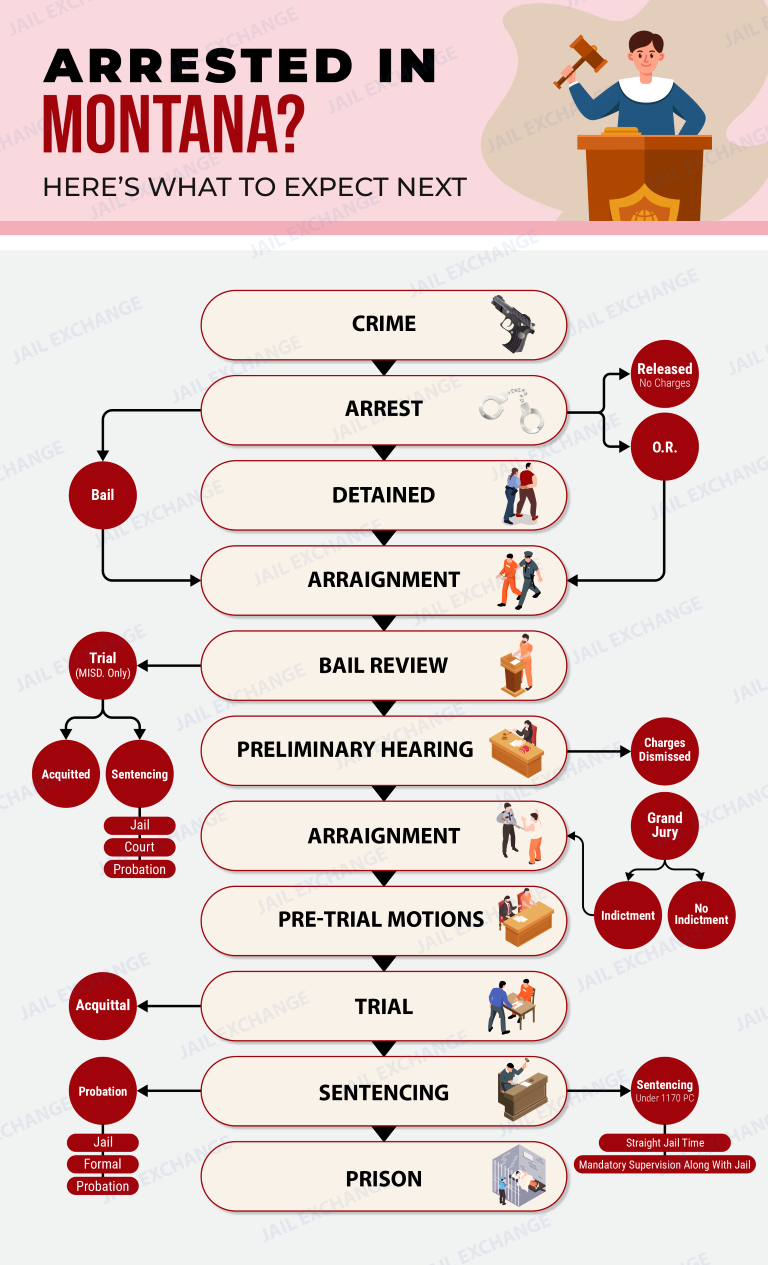
Broadwater County Detention Center Criminal Court Process
Criminal Court Process for Broadwater County Montana
Broadwater County Criminal Courts: How a Case Moves in Townsend
People arrested anywhere in this county wait at the Broadwater County Detention Center, 519 Broadway St., Townsend, MT 59644, next door to the courthouse. This page walks through the two courts in that building and the path a case follows, from the first hearing to the end.
The Sheriff's inmate roster shows who is in custody right now. For more on the arrest and jail stay, open our Inmate Lists page. It covers current inmates, warrant checks, the meaning of each charge, booking photos, appointed lawyers and personal items left behind.
Dial the jail at 406-266-3441, which is staffed at all hours. Check that the person is being held and learn the day of their first court appearance. To learn about getting them home before that day, read our bail page.
1. Small charge or serious one: which court gets it?
The possible punishment decides where a case lands:
- Justice Court is the county's misdemeanor court. Traffic crimes, shoplifting, game violations and the like all start here. Its own power reaches charges worth up to 6 months behind bars or a $500 fine, and it splits bigger misdemeanors with District Court (MCA 3-10-303).
- City court rules on breaks of town ordinances and may also take misdemeanors that happen inside town (MCA 3-11-103).
- District Court owns every felony. Montana calls a crime a felony when it can put someone in state prison for over one year (MCA 45-2-101).
- Youth Court is a branch of District Court for anyone not yet 18.
Even a felony usually opens with a brief Justice Court hearing, where bail gets set, before the file is sent up.
↑ Back to the question list2. Where do Broadwater County criminal courts meet?
All the local courts share the county courthouse. The general courthouse line is 406-266-9200.
- Justice Court and Townsend City Court, 515 Broadway St., Townsend, MT 59644. The judge's office is 406-266-9230, and the clerk is 406-266-9231. Open Monday through Friday from 8:00 a.m. to 5:00 p.m., but closed over the noon hour and on federal holidays.
- Clerk of District Court, First Judicial District, 515 Broadway St., Townsend, MT 59644, 406-266-9213. Open weekdays 8:00 a.m. to 5:00 p.m.
Not sure which court has the case? Ask the main line, and have the person's full name handy.
↑ Back to the question list3. How are Townsend city cases handled?
Townsend is the only incorporated town in the county, and its city court shares a judge, an office and a phone line with the Justice Court. The city has no police force of its own. It pays the Sheriff's Office to patrol, so deputies make the arrests inside town too.
- Since a 2023 city resolution, the County Attorney prosecutes criminal cases from the city. The city's own attorney handles civil matters.
- City ordinances can be read in the online city code.
- City Hall is at 110 Broadway, Townsend, MT 59644, 406-266-3911, for questions about city rules, not court cases.
Arrests in Toston, Winston, Radersburg, Wheatland and the rest of the county go to the Justice Court.
↑ Back to the question list4. What is the First Judicial District?
Montana has 22 judicial districts. The First covers just two counties: this one and Lewis and Clark County, home of Helena. Four district judges serve the district, along with a standing master who helps with some hearings.
The district judge handles felonies, Youth Court and appeals from the Justice Court. Felony files for local cases are kept by the Clerk of District Court in Townsend. To learn when and where the judge will hear a local case, call the clerk at 406-266-9213.
The state court locator lists the district's offices and judges.
↑ Back to the question list5. What must a judge explain at the opening hearing?
Police must bring an arrested person to a judge "without unnecessary delay" (MCA 46-7-101). In this county, that is normally the Justice Court judge, either face to face or on the jail's video hookup. State law gives the judge a checklist to cover out loud (MCA 46-7-102):
- what crimes are alleged
- that the person may have a lawyer, and one will be appointed if money is short
- how pretrial release works
- that silence is allowed, and statements can be quoted at trial
- that a guilty finding can take away firearm rights
- when the charge is a felony complaint, that a judge can be asked to test the evidence for probable cause
Bail or release is decided at this same hearing (MCA 46-9-109).
↑ Back to the question list6. How does a Broadwater County misdemeanor case move?
Misdemeanor complaints, whether from the county or from inside the city, are filed by the County Attorney in Justice Court. Next comes the plea. Someone who denies the charge gets a trial on the calendar, and six jurors can be requested by the defense or the state (MCA 46-17-201).
The clock matters. A misdemeanor not tried within 6 months of the plea must be dismissed, except when the defendant caused the delay or the court finds good cause (MCA 46-13-401). Common sentences:
- A first drunk driving conviction: from one full day up to half a year locked up, and $600 to $1,000 (MCA 61-8-1007)
- Stealing $1,500 or less: a fine capped at $1,500, a jail term capped at 6 months, or both (MCA 45-6-301)
- Assaulting a partner or relative the first time: one day to one year, with a $100 to $1,000 fine (MCA 45-5-206)
- Any misdemeanor whose law sets no penalty: as much as 6 months and $500 (MCA 46-18-212)
A deferred sentence of up to one year is possible. Following every rule can lead to the charge being wiped away (MCA 46-18-204). Appeals to District Court have to be filed within 10 days after judgment (MCA 46-17-311).
↑ Back to the question list7. What are the steps in a Broadwater County felony?
Most felony cases pass through five stops:
- Initial hearing. Justice Court sets bail.
- Charging. The Justice Court judge can test the evidence at a preliminary exam (MCA 46-10-105). The other route is for the County Attorney to get the district judge's permission to file an information, which is the felony version of a complaint (MCA 46-11-201). Grand juries are called only at a district judge's order.
- Arraignment. In District Court, the defendant receives the charging paper and answers it (MCA 46-12-201).
- Trial. Twelve jurors, and the verdict has to be unanimous. Both sides may agree in writing to let the judge decide instead (MCA 46-16-110).
- Sentence. This follows a guilty plea or verdict.
Where a statute names no other penalty, the top felony sentence is 10 years and $50,000 (MCA 46-18-213). Stealing over $1,500 can bring 10 years. Possessing dangerous drugs can bring 5, though a first conviction is presumed to earn a deferred sentence (MCA 45-9-102).
↑ Back to the question list8. How are violent and family violence cases treated?
Crimes that hurt or threaten people bring tighter rules:
- Holding before trial. Bail can be denied outright only in death penalty cases. A judge may still hold someone when no conditions would keep others safe (MCA 46-9-106).
- Partner or family assault. Arrest is the preferred response when someone was hurt, a weapon was used or an order was broken (MCA 46-6-311). The accused stays in jail until a judge sees them. A third conviction turns into a felony that can carry 5 years (MCA 45-5-206).
- No contact order. A standing order can keep the accused up to 1,500 feet away for 72 hours or until the first hearing (MCA 45-5-209).
- Tracking. Judges lean toward electronic monitoring in felony stalking and felony partner assault, where a device is on hand (MCA 46-9-108).
- No deferral for repeat felons. A person with a past felony can't get a deferred felony sentence (MCA 46-18-201).
9. Who prosecutes cases, and where is the public defender?
The County Attorney's Office charges every felony and the county's misdemeanors, plus criminal cases from the city. It is at 515 Broadway St., Townsend, MT 59644, 406-266-9226.
Defendants short on money may ask for a state public defender. That office represents people facing felonies, youth charges and misdemeanors with possible jail. The nearest branch is at 139 N. Last Chance Gulch, Helena, MT 59601, 406-444-0104. When that branch has a conflict, the work may shift to the Conflict Defender office at 555 Fuller Ave, Helena, MT 59601, 406-604-7581.
Applications go through the AdvOPD website. A judge reviews each person's finances and approves or denies the appointment (MCA 47-1-111).
↑ Back to the question list10. How do I find a case or a court date?
The state judiciary runs two free websites for case records. Type in a name or a case number:
- The limited court portal covers Justice Court and city court files.
- The District Court portal covers felony files.
Files about minors, plus sealed files, stay hidden. When a search comes up empty, use the phone. The Justice Court clerk at 406-266-9231 handles misdemeanor dates. The Clerk of District Court at 406-266-9213 handles felony dates. Spell the full name and give the birth date so the right file is pulled.
↑ Back to the question list11. How can I check for a warrant and take care of it?
The Sheriff's warrants page tells anyone who suspects a warrant to phone the District, Justice or City court at 406-266-9200. Deputies also keep a Most Wanted list. Because Townsend relies on the Sheriff for policing, those county pages serve the city as well. Statewide, the Montana offender search marks people wanted after running from parole, probation or prison. Open cases appear on the court portals. Got a warrant? Call a defense lawyer before anything else. Then walk into the jail at 519 Broadway St., Townsend, MT 59644, or ask the issuing court to reset the date. The jail answers at 406-266-3441.
↑ Back to the question list12. How do federal charges from Broadwater County work?
U.S. crimes from the county are heard by the Helena Division of the U.S. District Court for the District of Montana. The court meets at the Paul G. Hatfield Federal Courthouse, 901 Front Street, Helena, MT 59626, 406-441-1355. Call before you go, and plan on weekday clerk hours of 8:00 a.m. to 5:00 p.m.
- A detention hearing is held at the first appearance, and the judge rules on release before trial (18 U.S.C. 3142).
- The U.S. Marshals Service keeps federal prisoners and drives them to court. Its Helena office is at 901 Front Street, Suite 2200, Helena, MT 59626, and the district line is 406-200-6004.
- Pretrial reports are written by U.S. Probation and Pretrial Services, 901 Front Street, Suite 1200, Helena, MT 59626, 406-441-1160.
- The Townsend roster often shows people held on a federal detainer.
- Federal filings sit on PACER. Once a prison term begins, the Federal Bureau of Prisons inmate locator shows the place.
13. Can an immigration detainer change a state case?
A detainer does not stop the state case, but it changes the day of release. Through Form I-247A, immigration officers request that the jail hang on to the person for up to 48 hours after they would otherwise be released, giving agents time to arrive (8 CFR 287.7(d)).
- State law tells a Montana officer holding a detainer to arrest on it and tell the person the reason (MCA 27-16-801).
- Credible papers proving citizenship or legal immigration status end that duty.
- A 2025 change lets an officer who has stopped someone lawfully make a reasonable effort to learn whether they are here legally (MCA 46-5-401).
- After pickup, ICE's Salt Lake City Field Office takes over: 2975 Decker Lake Drive, Suite 100, West Valley City, UT 84119, 801-736-1200.
- Look the person up on the ICE Online Detainee Locator.
14. Where would a Broadwater County prison term be served?
Felons sentenced to the state come under the Montana Department of Corrections. Before moving on, they normally spend time in the local jail while the state evaluates them. The state then chooses Montana State Prison, the women's prison, a prerelease house, a treatment program or another placement.
- See where they are on the state offender search.
- The department's central office is at 5 S Last Chance Gulch Street, Helena, MT 59620, 406-444-3930.
- The parole board, formally the Board of Pardons and Parole, sits at 1002 Hollenbeck Road, Deer Lodge, MT 59722, 406-846-1404.
- Our Montana state prisons guide covers each facility.
15. How does Youth Court work for a teen charged here?
A district judge, acting as the Youth Court judge, hears charges against anyone younger than 18 (MCA 41-5-203). The public court websites leave youth files out.
- A locked-up teen must see a judge about probable cause within 24 hours, and Saturdays, Sundays and holidays are skipped (MCA 41-5-332).
- For certain grave crimes, prosecutors may seek leave to try a youth of 12 or older as an adult (MCA 41-5-206).
- Nobody younger than 16 can be placed in a state prison.
- Youths committed to the state may go to Pine Hills Correctional Facility, 4 North Haynes Avenue, Miles City, MT 59301, 406-232-1377.
Parents can call the Clerk of District Court at 406-266-9213 to ask about the hearing, or the Sheriff's Office at 406-266-3441 to ask where the youth is held.
↑ Back to the question list16. Where can Broadwater County crime victims turn?
The county's Victim/Witness Advocate works out of the courthouse at 515 Broadway St., Townsend, MT 59644, 406-266-9237. The advocate can explain victim rights, go with you to court, tell you about case events, and help with safety plans, restitution and protective orders.
- Before a plea bargain, a dismissal or a pretrial release, the prosecutor has to consult the victim. This covers felonies and any misdemeanor with an injury or a threat (MCA 46-24-104).
- Release alerts for state felony offenders come through VINE at 800-456-3076 or on VINELink. Signing up is up to you.
- Montana's victim compensation program covers up to $25,000 of crime-related bills. The crime should be reported within 72 hours and the claim filed within one year. Call 800-498-6455.