
New York City is huge, but its criminal courts follow a simple pattern that repeats in all five boroughs: Manhattan (The City), Brooklyn, Queens, the Bronx and Staten Island. Each borough has two main state courts for crimes. The Criminal Court of the City of New York handles arraignments (the first time an arrested person stands before a judge), plus misdemeanors and minor offenses called violations. The Supreme Court, Criminal Term handles felonies once a grand jury has charged them. That name confuses lots of people. In most states the “Supreme Court” is the highest court, but in New York it is a trial court. The top court here is the Court of Appeals in Albany.
Here is where each borough’s criminal courts sit, as listed by the state court system (nycourts.gov):
The citywide Criminal Court information line is (646) 386-4900.
Each borough elects its own District Attorney (the prosecutor, the lawyer who brings the case for the public): the Manhattan DA (New York County), Brooklyn DA (Kings County), Queens DA, Bronx DA and Staten Island DA (Richmond County). There is also a sixth prosecutor found nowhere else in the state, the Office of the Special Narcotics Prosecutor, which goes after serious drug felonies anywhere in the five boroughs.
If you can’t pay for a lawyer, the judge can appoint one. New York law requires that someone accused of a crime have a lawyer at arraignment, and the state Office of Indigent Legal Services keeps an eye on how well that works. In NYC, the appointed lawyer usually comes from one of these nonprofit offices:
When those offices can’t take a case, often because they already represent someone else in it (a “conflict”), the judge picks a private lawyer from the 18-B panel. It gets that name from Article 18-B of the County Law, and the government pays those lawyers.
Adults who are held go into the custody of the NYC Department of Correction, mostly to the jails on Rikers Island, which sits in the East River between Queens and the Bronx. A 2019 city law says Rikers must close by August 2027 and be replaced by four smaller jails, one each in Manhattan, Brooklyn, Queens and the Bronx. That deadline is now out of reach. As of 2026 the city expects all four new jails to be finished around 2032 and has talked about changing the law. Because violence at Rikers kept going on, a federal judge in 2025 ruled to hand day-to-day control to an outside remediation manager, and in 2026 that manager, Nicholas Deml, took charge of much of the jail system.
New York City Person in Custody Search
Looking up a case: The state’s free WebCriminal site (people often call it “WebCrims”) covers every NYC criminal court, both Criminal Court and Supreme Court. Despite the word “attorney” in its web address, anyone can use it now, and no account is needed. You can search by name or by case or summons number. Here’s the catch: it only shows cases that still have a future court date. Once a case is over, it drops off. The site warns that schedules can be outdated, so double-check with your lawyer or the courthouse. For a full record of past cases, the Office of Court Administration sells a statewide criminal history search for $95, online or by mail. The eCourts page also offers eTrack, which can send you email reminders about cases you follow.
Federal court: Two federal districts split the city. The Southern District of New York (SDNY) covers Manhattan and the Bronx; its criminal cases are heard downtown at the Daniel Patrick Moynihan Courthouse, 500 Pearl Street, and the Thurgood Marshall Courthouse, 40 Foley Square. The Eastern District of New York (EDNY) covers Brooklyn, Queens and Staten Island from 225 Cadman Plaza East in Brooklyn. A crime becomes federal when it breaks a law passed by Congress or happens on U.S. government property. Around NYC that includes the Statue of Liberty and Ellis Island, Governors Island, and the parts of Gateway National Recreation Area in Jamaica Bay and on Staten Island’s shore. Smuggling drugs or guns through JFK Airport or the ports, crimes on airplanes, bank robbery, mail theft, big fraud schemes and terrorism are classic federal cases too. People held for federal trial usually stay at the Metropolitan Detention Center in Brooklyn, not Rikers. The city has no Native American reservation. Statewide, a federal law (25 U.S.C. §232) gives New York’s own courts power over crimes on reservations, which is unusual compared with most states. Pick a section below.
Plenty of NYC misdemeanor arrests never involve a night in a cell. Officers often hand out a desk appearance ticket, or DAT. It’s a slip of paper telling you which Criminal Court to show up at and when. Since the 2020 reforms, police must give DATs for most misdemeanors and many class E felonies (the lowest felony level), with some exceptions. Smaller problems, like an open container, may get a summons that goes to a summons part of Criminal Court instead.
If you are held, the path goes like this. Police take you to the precinct, then to central booking in your borough, where you’re fingerprinted and your record is checked. The DA writes up the charges in a paper called a complaint. Then you’re brought to an arraignment courtroom. New York’s highest court ruled in 1991 (People ex rel. Maxian v. Brown) that people shouldn’t usually wait more than about 24 hours from arrest to arraignment. To keep up, Manhattan, Brooklyn and the Bronx run arraignments every day from 9 a.m. to 1 a.m. Queens runs them daily until 11 p.m., and Staten Island holds them on weekdays plus shorter weekend sessions.
At arraignment you meet your lawyer, hear the charges and enter a plea (usually “not guilty” at this stage). The judge also decides on release. Under New York’s bail reform (2020, later changed in 2020, 2022 and 2023), judges may not set cash bail for most misdemeanors. Most people walk out on their own promise to return, called ROR (release on recognizance), or with conditions like check-ins with a pretrial services program. Cash bail stays possible for a short list of “qualifying offenses,” such as some domestic violence cases.
How long can you get? A class A misdemeanor, like petit larceny (shoplifting) or third-degree assault, tops out at 364 days in jail. A class B misdemeanor tops out at 3 months. A violation, such as disorderly conduct, is not even a crime under state law and carries up to 15 days. Many NYC cases end with an ACD (adjournment in contemplation of dismissal). That means if you stay out of trouble for six months (a year in some cases), the case is dismissed and sealed. Under the speedy trial law (CPL 30.30), prosecutors must be ready for trial within 90 days on a class A misdemeanor and 60 days on a class B, not counting some delays.
NYC also has courts built to fix the problem, not just punish it. The Midtown Community Court near Times Square and the Red Hook center in Brooklyn mix sentences like community service with help such as job training, counseling and drug treatment. Every borough has treatment courts, such as drug courts, mental health courts and veterans courts. There are also Human Trafficking Intervention Courts for people arrested for prostitution.
NYC youth: Thanks to the Raise the Age law, which reached 16-year-olds in October 2018 and 17-year-olds in October 2019, a teen under 18 is not treated as an adult for most offenses. A 16- or 17-year-old charged with a misdemeanor goes to Family Court, not Criminal Court (most traffic offenses are the exception). Since late 2022, Family Court delinquency cases usually start at age 12. Before a case reaches a judge, the NYC Department of Probation often tries adjustment, a diversion step where the teen meets goals like school attendance or counseling and the case may never be filed.
A felony is a crime that can bring more than a year behind bars, in a state prison. Even felonies begin in Criminal Court, at the same arraignment described above. But Criminal Court can’t finish a felony. In New York, a felony needs an indictment, a formal charge voted by a grand jury. That’s a group of 16 to 23 regular residents of the borough who hear evidence in private and decide if there’s enough to charge. Sometimes the defendant agrees to skip the grand jury and is charged by a document called a superior court information, usually as part of a plea deal.
There’s a deadline when someone is locked up. Under CPL 180.80, if a jailed person hasn’t had a grand jury vote (or a preliminary hearing) within 120 hours of arrest, or 144 hours when a weekend or holiday falls in between, they generally must be released. Once indicted, the case moves up to Supreme Court, Criminal Term, at 100 Centre Street, 320 Jay Street, Kew Gardens, 265 East 161st Street or 26 Central Avenue. There, the defendant is arraigned again on the indictment.
Bail rules depend on the charge. For most nonviolent felonies, like many burglary, grand larceny and drug possession cases, the judge still can’t set cash bail and must release the person, though with conditions if needed. Violent felonies and other qualifying offenses allow bail or, in some cases, jail until trial.
Both sides then trade evidence under New York’s discovery law. The 2020 reform made prosecutors share police reports, videos and witness lists early. In 2025, lawmakers loosened it, and since August 2025 judges look at whether prosecutors worked hard to share everything, instead of tossing cases over small mistakes. On felonies, prosecutors must be ready for trial within 6 months (CPL 30.30).
Felonies are ranked by letter. The highest prison terms are: class B, 25 years; class C, 15 years; class D, 7 years; class E, 4 years. Class A felonies can bring life. Many defendants with drug or mental health needs can go to a treatment court instead; the Special Narcotics Prosecutor and the borough DAs both run diversion programs. Felony trials use 12 jurors, and all 12 must agree.
NYC youth: A 16- or 17-year-old charged with a felony is an adolescent offender. The case begins in the Youth Part, a special courtroom inside each borough’s Supreme Court with judges trained in youth issues. For nonviolent felonies, the case is usually sent to Family Court unless the DA shows “extraordinary circumstances.” Teens who must be held go to secure detention run by the city’s Administration for Children’s Services (ACS), at Crossroads in Brooklyn or Horizon in the Bronx. Since Raise the Age, no one under 18 is held on Rikers Island.
Violent crimes travel the same road as other felonies: arrest, central booking, arraignment in Criminal Court, grand jury, then Supreme Court. What changes are the stakes. Charges like robbery, gun possession, attempted murder and serious assault are listed in the law as violent felony offenses. For these, judges may set bail, and for the most serious ones they can order a person held with no release at all. When deciding, judges look at things like how likely the person is to come back to court.
Sentences for violent felonies are determinate, meaning the judge picks one fixed number of years instead of a range. For example, a first-time conviction for a class B violent felony such as first-degree robbery brings 5 to 25 years. People with prior violent felony convictions face much longer terms as “persistent” offenders. Big gun and gang cases are often taken by the DAs’ special units, and some are taken over by federal prosecutors in SDNY or EDNY.
Murder is the most serious charge. Second-degree murder brings a minimum term of 15 to 25 years, and the maximum is life in prison. First-degree murder, used for things like killing a police officer, a murder for hire or killing more than one person, can bring life without parole. That is the harshest sentence in New York. The state’s death penalty was ruled unconstitutional by the Court of Appeals in 2004 (People v. LaValle), and lawmakers never fixed it, so no one can be sentenced to death in New York today.
Victims have support too. Every DA’s office has a victim services unit to explain court dates and help people stay safe. The state Office of Victim Services can help pay costs like medical bills, counseling and funerals. In New York State, people sentenced to prison serve their time in state prisons run by the Department of Corrections and Community Supervision, not in city jails.
NYC youth: Younger teens, ages 13 to 15, can be charged as juvenile offenders in the Youth Part for murder and certain other violent crimes, like first-degree robbery or rape. Sixteen- and seventeen-year-olds charged with violent felonies usually stay in the Youth Part as adolescent offenders, though some cases can be moved to Family Court if the victim was not seriously hurt and no gun was shown. Even when a teen is tried in the Youth Part, the law lets judges give youthful offender treatment in many cases, which seals the record and lowers the sentence.
This guide to New York City’s criminal courts is general information, not legal advice. For help with an actual case, speak with a lawyer, or call the NYC Criminal Court information line at (646) 386-4900.
The Criminal Court System in New York State can be a complicated system to understand. In order to understand better, it might be helpful to define some words that will be used on this site. The definitions on this site are for general information and not legal advice. It is always preferred to follow information given by your attorney or local authorities.
If you scroll down below this content, and the listing of the courts in New York County, you will find a simple flowchart diagram and a video that will help you visualize the stages of the Criminal Court Process.
Arrest is when New York, New York County or local police take a person into custody and start the legal process. The arrested person may or may not be immediately jailed.
In less serious crimes, the person may only be given a citation ordering that they appear in municipal or New York County court on a certain date. In cases involving more serious crimes, the person is usually placed in the county jail until an arraignment, or a judge decides the next step.
Booking is when the New York County sheriff or local police gather information such as the detainee’s name, address and why the person is being arrested. Booking also includes fingerprinting, criminal history, investigation, and verification of identity. Bail for lower-level crimes may be set right after booking so the arrested can “bail or bond out” before being detained.
The prosecution, sometimes called “the government” or “the people” or “the state” is the side that press the charges and seeks punishment for the offense. These are attorneys that work for the municipal (or city) courts, county courts, circuit courts, courts of appeal and supreme court. In New York, the prosecuting attorney for the state or county is called an Assistant District Attorney or ADA or District Attorney or DA and a U.S. Attorney prosecutes for federal cases.
Jurisdiction is an important term in the court system that means whether a court has the obligation or duty or right to handle a case. For example, if you run a red light in your town or city, a municipal court would likely have jurisdiction over your case, but the next town or city over would not have jurisdiction over your case. If you attempted to flee from police when they attempted to stop you after you ran the red light, it becomes a more serious crime, and the municipal court might not have jurisdiction so you might be assigned to a higher-level court that has jurisdiction over the more serious crime. Jurisdiction varies from state to state and sometimes county to county.
District Court can be a New York State District Court (which are only in Nassau and parts of Suffolk County), or it can refer to a United States Federal District Court that hears federal cases and there are four US District Courts in New York. It is important to ask the arresting officer or court the exact address of the courthouse rather than trying to figure it out yourself and miss your court appearance.
Bail is money paid that is kept by the courts to make sure that the arrested does not flee the area before their trial. Bail amounts and conditions are determined at the arraignment. Once the case is over, the bail money is returned. If a person does not pay bail, they remain in jail until their trial. Bail can be denied if the court feels that the arrested would be a danger to others if released.
A bond proceeding is the determination of how much bail is to be paid and usually happens at the same time as an arraignment. During bond proceedings, the defendant can have an attorney present but does not have the right to an attorney. A judge or court officer in the {county extended} or municipal court sets bail.
Judges in New York rely on a statewide bail schedule, which sets out a recommended range of bail amounts for different offenses. Judges can still exercise discretion in setting bail above or below the recommended range.
A judicial public bond or personal recognizance bond is a bond where someone representing the defendant signs paperwork promising to pay the money if the defendant does not show up to court. If the defendant does not show, the full amount will be due and the people who signed the paperwork will be responsible for paying the court. Sometimes the court decides that there is a good chance that the arrested will show up for trial and not flee so they are released on their own promise, or recognizance.
Cash percentage in lieu of bonds. If the bond order permits, the defendant pays a percentage of the amount, (sometimes up to 100%) to the court, which then holds the money until the case is over. The amount is returned if the defendant is acquitted or the case is dismissed, or it can be used toward paying any court fines incurred by the defendant.
Surety Bond is when defendant pays a percentage of the bond amount (usually 10–15%) to a professional bondsman or bail bond company licensed to do business in New York, {county extended}. The bondsman then signs the bond on behalf of the defendant. The defendant does not receive any of the money back. If the bondsman feels the defendant is a flight risk, they can refuse to give a bond or charge a higher fee. For example, a bondsman may determine a defendant is a flight risk if they are from a state other than New York.
A Property Bond is a bond in which the bond is pledged in land or home real estate (mobile homes are not accepted). Usually, the property must be in New York County, and it must be worth at least the amount of the bond.
Transfer bond is transferable across state lines but generally a bond company will only assume the loan to adjoining states.
It is always important to have family involvement after being arrested. Not only can they make calls and communicate on your behalf (not all bond companies will accept collect calls), but family support will show the court that there are people who will make sure that the defendant makes it to court, not only for the defendant’s own good, but because they may have signed bond paperwork and responsible to pay if the defendant does not show in court. Chances of obtaining a bond from a bond company or clerk of court are better if family is involved.
(There have been phone scams where a bond company calls and informs a person that their family member has been arrested and they ask for financial information. A bondsman will not call asking for money without involvement of the arrested.)
A criminal defense attorney (also called lawyer or counsel) is hired or retained to represent the arrested as early as possible after the arrest. If the arrested cannot afford a lawyer, the New York court would assign indigent representation, usually called a public defender or an assigned or contracted attorney to represent the person for free or a small fee or a reduced rate, depending on the county. Indigent representation is only available for juvenile cases, appeals and cases that could result in jail time. It is not available for civil cases or cases that would not result in jail time.
In New York State, criminal attorneys can be asked by the courts to represent people periodically at a much-reduced rate. This is called an 18-B assignment.
A right to an attorney is in the 6th Amendment of the U.S. Constitution; that all people that are going to be heard in trial are entitled to be represented by a lawyer and if they cannot afford one, the court will provide one. This only applies to criminal cases and not to civil cases or criminal cases that would not result in jail time.
In New York State, the Office of Indigent Legal Services is the state agency that oversees indigent defense as a whole, but it is up to each county to fund and run their own indigent services.
For less serious cases or civil cases, there are pro bono volunteers who volunteer legal services for free or for a small fee. They often will hold clinics to teach people how to represent themselves in court. The attached link has a list of pro bono organizations in New York State.
Many courts will provide forms and help for people who want to represent themselves, called pro se. Here is a link for legal self-help in New York, and another website for which court to go to.
Pretrial proceeding is the process where both sides (prosecution and defense) gather information, interview witnesses, request records, videos etc. Pretrial proceedings also include communications with the judge assigned to the case and these appearances are either in person or by on-line conferencing. Some pretrial proceedings may not require a defendant’s appearance, allowing an attorney to appear in their place. The information that is gathered is called discovery and both sides must share the information that they have gathered. This information does not include conversations between the arrested and their attorney.
Most cases do not go to trial because both sides reach a plea deal, where both sides try to reach a reasonable punishment based on what was learned in the pretrial proceedings. A plea deal can only happen if the accused person admits they are guilty in exchange for a lighter punishment. The reason they must admit guilt is because it would not be fair to punish someone who claims they are not guilty. There are times in plea bargaining when the prosecution agrees to give a lighter sentence in exchange for information leading to the arrest of a more serious criminal related to the crime.
Trial is where both sides share their information in front of a judge or a judge and jury. After listening to all the evidence, the judge or jury decides the verdict which is whether if the person is guilty or not guilty. If a court has only a judge hearing both sides, it is called a bench trial. If a jury is selected, it is called a jury trial. If the defendant is found non-guilty, they are released. If they are found to be guilty, the next step is sentencing.
Sentencing is the punishment that the judge decides the person should get. This could be fines, community service, probation, jail time or a combination.
Appeal is asking for a higher court to hear the case again. If the accused person thinks something went wrong at trial or has new information that was not available during the trial or that the sentence is too harsh, the defense attorney can ask for an appeal. It is not unusual for an appeal when there is a long jail sentence, but an appeal can be denied if the appellate court feels that the original trial or sentencing was fair.
A misdemeanor crime in New York State is a crime that has a penalty such as fines, probation, community service or up to one year in a county jail. Common misdemeanor offenses include petty theft, simple assault, trespassing, some drug offenses or harassment.
A felony crime in New York State is a more serious crime than a misdemeanor and can be punished with more significant fines and prison (not jail) time over one year. Examples of felony crimes include murder, rape, theft, aggravated assault, drug trafficking, kidnapping, armed burglary and identity theft.
The New York County Clerk of Court is an elected official whose responsibilities for Criminal Court’s administrative issues include receiving criminal warrants, receiving bail, creating the trial schedule, receiving fees, fines and maintaining court records.
A warrant is used to get someone to appear in court or to law enforcement. There must be good reason to believe that the person is involved in a crime. The warrant gives authority to arrest the person and search for evidence for the investigation of the crime.
A criminal summons is issued to request that a person appear in court at a particular time and date. It does not involve an arrest. A traffic ticket, summary citation or lesser misdemeanor could be considered a summons if you are given a court date.
A summary citation, commonly referred to as a ticket, is a criminal summons by a law enforcement officer either in person or via mail accusing the defendant of a minor offense, stating potential fine, listing the court having jurisdiction and instructions for addressing the issue. Defendants may or may not be required to appear in court or handle the matter by entering a plea via mail.
Fines are usually paid to the District Court or clerk of court and payment methods can be found on the District Court or New York County Clerk of Court website. If you do not pay your fine on time, you can lose your driver’s license, must pay additional fees or even have a warrant for your arrest. It is important to read the instructions on the ticket issued by the police officer or court at the time of your arrest. For a parking ticket or summary citation, the fine amount and how to send payment should be on the ticket.
The Criminal Court System in New York City, Nassau County and parts of Suffolk County are different from all of the other counties and cities in the state of New York.
After someone is arrested in New York, which court to go can be complicated. It depends on where the crime occurred and what type of crime it was. To further complicate things, New York City, Nassau County and parts of Suffolk County process the arrested differently than the rest of New York State. The arresting police officers or police department are best suited to advise you of which court the arrested should go to until a lawyer is retained. The NY Unified Court website also provides a guide as to which court to use.
When someone is arrested in New York, they are usually brought to the local city, town or village police department where booking occurs before being seen in a justice court which is the name given to town or village courts.
Most traffic and vehicle offenses are handled in a justice court as well as misdemeanors. If you can say that the crime happened in the “Town of ___” or “Village of____”, and it was not a felony crime, you will most likely appear in a justice court. The judges are called justices of the peace are on call 24 hours/day to be available for arraignments and to issue orders of protection. There are 1,200 justice courts in New York State except for New York City.
If the offense occurred in one of about 60 cities in New York, your case will be heard in a city court which acts the same as a justice court.
District courts are only in Nassau and parts of Suffolk County, and they act like the justice courts, they can handle traffic matters, misdemeanor cases and conduct felony arraignments.
County Courts can handle most criminal cases from beginning to end or they can receive felony cases from justice courts (or district courts in Nassau and Suffolk County) that need to be further prosecuted or go to trial. County courts hear mostly criminal cases and some family court matters but not civil cases. If your case is appealed from the justice or city court, it will likely be heard in a county court.
The term Supreme Court in New York confuses a lot of people because it sounds like a high-level court that hears special cases and has a panel of justices. This is not so in New York. There is a supreme court in each county in New York State. A New York Supreme Court handles civil, divorce, criminal cases and some juvenile cases. Criminal cases are handled in a division of supreme court called the Criminal Term.
A New York Supreme Court is a trial level court for cases that handle more serious or complicated for county courts with the exception of New York City where most criminal felony cases are handled in New York City Supreme Court instead of a county court. A New York Supreme Court has an Appellate Division that hears appeals from the supreme court criminal term, from family court and from county courts.
New York Court of Appeals is the highest court in New York meaning that the decisions are final unless it is a matter for the U.S. Supreme Court. Most appeals are heard in a New York Supreme Court Appeals Division.
Family Court handles cases involving family and domestic issues, such as child custody, child support, and domestic violence. Juvenile crimes are usually heard in Family Court and there is a court in each county. Here is a link for more information on juvenile court.
Specialty Courts or Problem-Solving Courts are being adopted in many states as a way to handle cases that involve non-violent and first-time offender cases in a way to where the offender can retain a job or responsibilities while following specific orders of the court as returned court appearances, periodic evaluations or testing for substances. Problem-solving courts in New York include: Drug treatment courts, family treatment courts, human trafficking courts, mental health courts, opioid courts and veterans treatment courts. Follow this link to find out more about a problem-solving court in New York State.
The New York State Court System is complicated and there are factors that can change the court type and location, so it is important to follow the instructions given by the paperwork given by the police or judge at the time of the arrest or by your attorney.
If a crime is committed in New York City the initial process is different than the rest of New York State. If the crime is committed in one of the five boroughs (The Bronx, Kings County (Brooklyn), New York County (Manhattan), Queens County or Richmond County (Staten Island), the arrested is taken to the New York City Criminal Court which handles lower-level cases, arraignments and trials for misdemeanors which are crimes punished by a fine or imprisonment of less than one year. It also conducts arraignments, preliminary hearings and plea bargaining for some felonies.
The more serious felony cases are transferred to the New York County Supreme Court.
The New York County Supreme Court’s Criminal Term handles cases in parts. A part deals with a certain type of proceeding or crime. The parts in NYC Supreme Court Criminal Term include many conference and trial parts, youth part, narcotics part, domestic violence parts, diversion and mental illness parts. Here is more information on New York City’s Criminal Court.
New York Court of Appeals is the highest court in New York meaning that the decisions are final unless it is a matter for the U.S. Supreme Court. Most appeals are heard in a New York Supreme Court Appeals Division.
Family Court handles cases involving family and domestic issues, such as child custody, child support, and domestic violence. Juvenile crimes are usually heard in Family Court and there is a court in each county.
Here is a link for more information on juvenile court.
Specialty Courts or Problem-Solving Courts are being adopted in many states as a way to handle cases that involve non-violent and first-time offender cases in a way to where the offender can retain a job or responsibilities while following specific orders of the court as returned court appearances, periodic evaluations or testing for substances.
Problem-solving courts in New York include: Drug treatment courts, family treatment courts, human trafficking courts, mental health courts, opioid courts and veterans treatment courts. Follow this link to find out more about a problem-solving court in New York State.
The following link gives information regarding New York City’s Drug Treatment Court.
The New York State Court System is complicated and there are factors that can change the court type and location, so it is important to follow the instructions given by the paperwork given by the police or judge at the time of the arrest or by your attorney.
After someone is arrested in New York, which court to go can be complicated. It depends on where the crime occurred and what type of crime it was. To further complicate things, New York City, Nassau County and parts of Suffolk County process the arrested differently than the rest of New York State. The arresting police officers or police department are best suited to advise you of which court the arrested should go to until a lawyer is retained.
The initial process following an arrest in Nassau County is different than the rest of New York State in that the initial process does not occur in city, town or village court but in Nassau County District Court. The District Court in Nassau County handles traffic and vehicle matters, misdemeanor cases from beginning to end, including trial and preliminary proceedings in felony criminal cases. The felony cases will then be transferred to a county or supreme court for further prosecution and/or trial.
The Nassau County Court can handle most criminal cases from beginning to end or they can receive felony cases from district courts that need to be further prosecuted or go to trial. County courts hear mostly criminal cases and some family court matters but not civil cases. If the case is considered serious enough or is complicated, it will be moved to a New York State Supreme Court. If your case is appealed from the district court, it will likely be heard in the Nassau County Court.
The term Supreme Court in New York confuses a lot of people because it sounds like a high-level court that hears special cases and has a panel of justices. This is not so in New York. There is a supreme court in each county in New York State. A New York Supreme Court handles civil, divorce, criminal cases and some juvenile cases. Criminal cases are handled in a division of supreme court called the Criminal Term.
A New York Supreme Court is a trial level court for cases that handle more serious or complicated for county courts with the exception of New York City where most criminal felony cases are handled in New York City Supreme Court instead of a county court. A New York Supreme Court has an Appellate Division that hears appeals from the supreme court criminal term, from family court and from county courts.
New York Court of Appeals is the highest court in New York meaning that the decisions are final unless it is a matter for the U.S. Supreme Court. Most appeals are heard in a New York Supreme Court Appeals Division.
Family Court handles cases involving family and domestic issues, such as child custody, child support, and domestic violence. Juvenile crimes are usually heard in Family Court and there is a court in each county.
Here is a link for more information on juvenile court.
Specialty Courts or Problem-Solving Courts are being adopted in many states as a way to handle cases that involve non-violent and first-time offender cases in a way to where the offender can retain a job or responsibilities while following specific orders of the court as returned court appearances, periodic evaluations or testing for substances. Problem-solving courts in New York include: Drug treatment courts, family treatment courts, human trafficking courts, mental health courts, opioid courts and veterans treatment courts. Follow this link to find out more about a problem-solving court in New York State.
The New York State Court System is complicated and there are factors that can change the court type and location, so it is important to follow the instructions given by the paperwork given by the police or judge at the time of the arrest or by your attorney.
After someone is arrested in New York, which court to go can be complicated. It depends on where the crime occurred and what type of crime it was. To further complicate things, New York City, Nassau County and parts of Suffolk County process the arrested differently than the rest of New York State. The arresting police officers or police department are best suited to advise you of which court the arrested should go to until a lawyer is retained.
Parts of Suffolk County (Western Towns of Babylon, Huntington, Smithtown, Islip and Brookhaven) and all of Nassau County differ from the rest of New York State. The remaining towns of Suffolk County are like the rest of New York State where the court process starts in city, town or village court. In the five western towns of Suffolk County, all cases start at the District Court.
The initial process following an arrest in the Western Towns of Suffolk County is different than the rest of New York State in that the initial process does not occur in city, town or village court but in Suffolk County District Court. The District Court in Suffolk County handles traffic and vehicle matters, misdemeanor cases from beginning to end, including trial and preliminary proceedings in felony criminal cases. The felony cases will then be transferred to the Suffolk County Court or supreme court for further prosecution and/or trial.
Suffolk County Court can handle most criminal cases from beginning to end or they can receive felony cases from the district court in Suffolk County that need to be further prosecuted or go to trial. County courts hear mostly criminal cases and some family court matters but not civil cases. If the case is considered serious enough or is complicated, it will be moved to a New York State Supreme Court. If your case is appealed from the district court, it will likely be heard in a county court.
The term Supreme Court in New York confuses a lot of people because it sounds like a high-level court that hears special cases and has a panel of justices. This is not so in New York. There is a supreme court in each county in New York State. A New York Supreme Court handles civil, divorce, criminal cases and some juvenile cases. Criminal cases are handled in a division of supreme court called the Criminal Term.
A New York Supreme Court is a trial level court for cases that handle more serious or complicated for county courts with the exception of New York City where most criminal felony cases are handled in New York City Supreme Court instead of a county court. A New York Supreme Court has an Appellate Division that hears appeals from the supreme court criminal term, from family court and from county courts.
Family Court handles cases involving family and domestic issues, such as child custody, child support, and domestic violence. Juvenile crimes are usually heard in Family Court and there is a court in each county.
Here is a link for more information on juvenile court.
Specialty Courts or Problem-Solving Courts are being adopted in many states as a way to handle cases that involve non-violent and first-time offender cases in a way to where the offender can retain a job or responsibilities while following specific orders of the court as returned court appearances, periodic evaluations or testing for substances.
Problem-solving courts in New York include: Drug treatment courts, family treatment courts, human trafficking courts, mental health courts, opioid courts and veterans treatment courts. Follow this link to find out more about a problem-solving court in New York State.
The New York State Court System is complicated and there are factors that can change the court type and location, so it is important to follow the instructions given by the paperwork given by the police or judge at the time of the arrest or by your attorney.
Federal Court deals with crimes involving violations of United States laws. Federal crimes include federal drug trafficking, federal tax evasion and fraud that crossed state lines and include crimes that occur on federal property as post offices or federal buildings.
Cases involving crimes that involve the FBI or DEA or Immigration agencies are federal crimes. Terrorism is a federal crime.
There are some differences in the Federal court system as compared to the New York state court system. For example, the attorneys who work for the courts are called United States Attorneys and Federal judges are called District Court Judges (not to be confused by local state district courts).
Federal Magistrate Judges hear the case early on, but they do not decide on the cases at a trial like the Federal District Court Judges. In a federal case, a grand jury is used for indictments.
There are four U.S. Federal Judicial Districts in New York.
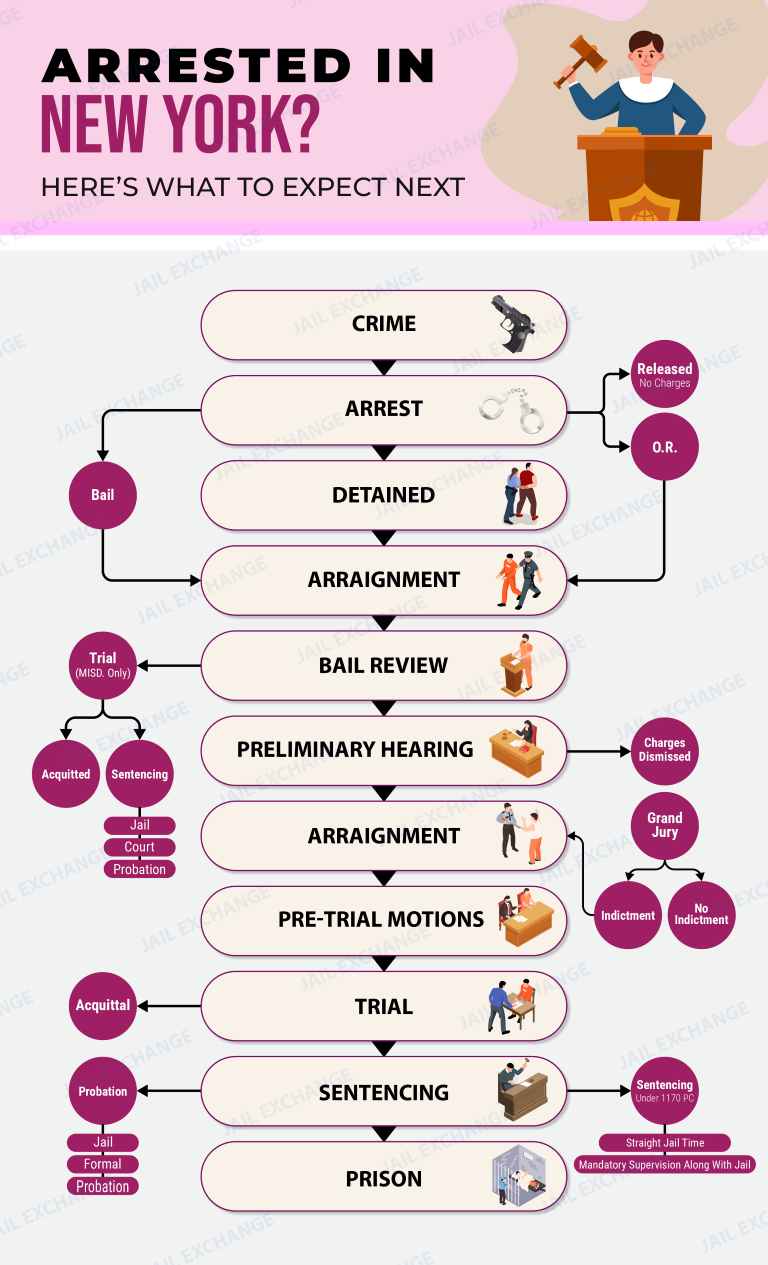
If a crime is committed in New York City the initial process is different than the rest of New York State. If the crime is committed in one of the five boroughs (The Bronx, Kings County (Brooklyn), New York County (Manhattan), Queens County or Richmond County (Staten Island), the arrested is taken to the New York City Criminal Court which handles lower-level cases, arraignments and trials for misdemeanors which are crimes punished by a fine or imprisonment of less than one year. It also conducts arraignments, preliminary hearings and plea bargaining for some felonies.
The more serious felony cases are transferred to the New York County Supreme Court.
The New York County Supreme Court’s Criminal Term handles cases in parts. A part deals with a certain type of proceeding or crime. The parts in NYC Supreme Court Criminal Term include many conference and trial parts, youth part, narcotics part, domestic violence parts, diversion and mental illness parts. Here is more information on New York City’s Criminal Court.
New York Court of Appeals is the highest court in New York meaning that the decisions are final unless it is a matter for the U.S. Supreme Court. Most appeals are heard in a New York Supreme Court Appeals Division.
Family Court handles cases involving family and domestic issues, such as child custody, child support, and domestic violence. Juvenile crimes are usually heard in Family Court and there is a court in each county.
Here is a link for more information on juvenile court.
Specialty Courts or Problem-Solving Courts are being adopted in many states as a way to handle cases that involve non-violent and first-time offender cases in a way to where the offender can retain a job or responsibilities while following specific orders of the court as returned court appearances, periodic evaluations or testing for substances.
Problem-solving courts in New York include: Drug treatment courts, family treatment courts, human trafficking courts, mental health courts, opioid courts and veterans treatment courts. Follow this link to find out more about a problem-solving court in New York State.
The following link gives information regarding New York City’s Drug Treatment Court.
The New York State Court System is complicated and there are factors that can change the court type and location, so it is important to follow the instructions given by the paperwork given by the police or judge at the time of the arrest or by your attorney.