
Clackamas County Jail
Clackamas County Jail
Physical Address
2206 Kaen RoadOregon City, OR 97045
Jail Phone Number
503-722-6777Clackamas County Inmate Search: Locating Someone at the Kaen Road Jail
Adults arrested anywhere from Lake Oswego to Estacada are booked into the Clackamas County Jail, 2206 Kaen Road, Oregon City, OR 97045. The Sheriff's Office runs it for everyone held before trial or serving jail time. Its other site, the Corrections Center, 9000 SE McBrod Ave., Milwaukie, OR 97222, 503-655-8262, is an 80-bed re-entry home with men's and women's units. Here you'll learn to track someone down there. You'll also find plain answers on charges, lawyers, visits, calls, mail, money, property, warrants and court dates.
Begin with the Sheriff's Adults in Custody list. Type a last name to see who is held, the charges and any bail. Each entry also gives the State Identification Number (SID), which you will need for mail and other lookups.
Can't find them, or need details? Phone the jail at 503-722-6777. Give the staff the person's legal name and birthday, then confirm they are held, the charges and their next court day. Then read our bail and release page to learn how they might get home.
Read inmate search answers
 Read inmate search answers
1. How do I search the Clackamas County jail roster?
Any phone or laptop can run the Sheriff's list. Here is the routine:
- Open the Adults in Custody list.
- Type the surname. If too many results appear, include a first name.
- Pick the right person from the results.
- Read the charges and any bail amount on the entry.
- Copy down the SID number. Jail staff, the court and the state prison system all use it.
The jail holds a lot of people. A 2025 county grand jury report put its funded size at 483 beds, so expect several results for common last names. If nothing fits, phone the jail at 503-722-6777.
↑ Back to the question list2. Their name isn't showing. What should I try?
A blank result can mean many things. Check these before you worry:
- Still in booking. Fresh arrests may need a little while before they show.
- Already out. The person may have been released on a promise, by a judge, or in one of the jail's frequent forced releases when it is full.
- Spelling. Search again with a middle name, both parts of a two-part surname, or a nickname.
- Another jail. Arrests on the Portland or Washington County side of a split city may go to those counties' jails.
- A minor. People younger than 18 are sent to youth detention instead.
Call the jail at 503-722-6777 for the quickest answer. For a letter proving someone was held, ask the Sheriff's Records Unit at 503-785-5200 about a verification of incarceration.
↑ Back to the question list3. Could a jail outside Clackamas County have them?
The Kaen Road jail holds nearly all adults arrested in the county. Several cities here cross county lines, though. Portland, Lake Oswego, Milwaukie, Tualatin, Wilsonville and Rivergrove all spill into Multnomah or Washington counties. Try these jails if the person isn't on the local list:
- Multnomah County Detention Center, 1120 SW Third Ave., Portland, OR 97204, 503-988-3689
- Washington County Jail, 215 SW Adams Ave., Hillsboro, OR 97123, 503-846-2600, answered 24 hours
- Marion County Jail, 4000 Aumsville Hwy SE, Salem, OR 97317, 503-581-1183
- NORCOR, the regional jail for Hood River and Wasco counties, 201 Webber Street, The Dalles, OR 97058, 541-298-1576
People serving a work release sentence may stay at the county's Corrections Center, 9000 SE McBrod Ave., Milwaukie, OR 97222, 503-655-8262.
↑ Back to the question list4. Are booking photos ever released in Oregon?
Plan on getting facts, not pictures. Under HB 3273 of 2021, Oregon police generally may not release booking photos. The law allows a few exceptions:
- The person in the photo can get it, and so can the parties in the case and the victim.
- Police may make one public when it serves police work, like tracking down someone who ran.
- A photo may be released once the person is convicted on that arrest.
Reporters and others with questions can call the Sheriff's Records Unit at 503-785-5200. A website that charges to take down a booking photo must do it within 30 days for $50 or less. For dismissed cases it must act within 7 days, for free.
ICE keeps its own photos, and the ICE records request page is where to ask for one. Federal booking pictures mostly stay sealed, unless the U.S. Marshals choose to publish one during a manhunt.
↑ Back to the question list5. Can VISOR warn me about a release or transfer?
VISOR, a free service from the Oregon Department of Corrections, fills the role VINE plays in other states. It covers people in county jails and state prisons.
- Search by name, SID or county ID number. A quick robot check comes first.
- Pick how alerts arrive: a call, an email or a text. Word comes when they get out, change facilities, escape or die.
- You can sign up with no account and stay anonymous. The person in custody is never told.
- Phone help is open around the clock at 855-691-6246.
For news and services from the Sheriff's Office, download its free app on Apple's App Store or Google Play. VISOR warns users not to rely on its alerts as their only safety plan.
↑ Back to the question list6. How does release work after a Clackamas County arrest?
Oregon's default is to let people out on their word. Money, which state law calls security, comes in only when a judge decides it is needed. Here is the short version:
- For many low-level charges, the jail may release the person without waiting for a judge.
- Serious charges, like domestic violence, sex crimes and Measure 11 crimes, wait for a judge. On weekdays, that hearing usually comes within about a day and a half.
- When security is set, the deposit is usually a tenth of that figure.
- The jail lobby at 2206 Kaen Road, Oregon City, OR 97045 takes the deposit in exact cash only, with no cards or checks.
- Oregon has no bail bond companies. Families pay the jail directly.
Our bail page covers amounts, refunds and holds step by step.
↑ Back to the question list7. Which crimes are they accused of?
The roster entry lists each booking charge. Those can change. The District Attorney decides what to file, and the final charges show up in the court record.
- Once the case is filed, put the name into the free OJD Records and Calendar Search.
- Try the District Attorney's Find Your Case page.
- Call the circuit court Criminal Unit at 503-655-8643, option 1, on weekdays.
Oregon crimes come in classes. A Class A felony is the most serious and a Class C misdemeanor is the lightest. Violations bring a fine, never jail. For a copy of a police report, ask the agency that made the arrest. Defense lawyers get the evidence through the case itself.
↑ Back to the question list8. Who provides a lawyer for someone locked up?
Anyone who can't afford a lawyer may ask for one at the first hearing. A court clerk visits the jail to help with the money form, called an Affidavit of Eligibility. The fee is usually $20 and can be waived.
- Indigent Defense Clerk: 503-655-8451
- Clackamas Indigent Defense Corporation, 1000 Courthouse Road, Oregon City, OR 97045, 503-722-4000, for the lawyer's name after approval
- Oregon State Bar Lawyer Referral, to hire one: 503-684-3763
Oregon's public defense is overseen by the Oregon Public Defense Commission, and the state has a shortage of these lawyers. A federal court order says a person jailed with no lawyer 7 days after the first appearance should generally be let out on conditions. Their case still goes on. Lawyers can visit or call their clients at the jail.
↑ Back to the question list9. How do video visits at the Clackamas County Jail work?
All visits are by video. You can visit from a screen in the jail lobby at 2206 Kaen Road, Oregon City, OR 97045, or from home on your own device.
- Get on the person's approved visiting list. Apply online or mail a paper form to Clackamas County Jail Visitation at the jail's address. It takes up to 72 hours. The list can be changed by mail once every 30 days.
- Book a 15-minute slot through the jail's video visit service.
- Pick a time: daily 8 to 10:30 a.m., 2:30 to 4:30 p.m. or 7 to 9:30 p.m.
- Bring government photo ID for any lobby visit.
Each person gets two free visits a week. Children under 12 need a parent or guardian age 18 or older. A lobby screen fits two children and one adult. Dress rules apply, and people on discipline may lose visits. Questions go to visitation at 503-722-6575, answered daily 10:30 a.m. to noon. Our visiting page has more help.
↑ Back to the question list10. How can family fund their jail account?
Family can load money three ways:
- Lobby kiosk at 2206 Kaen Road, Oregon City, OR 97045, open 7 a.m. to 11 p.m. every day. Pay there with bills or a card.
- Online with a card through the jail's account service.
- By phone at 866-516-0115.
Money sent by mail is returned to the sender. A service fee applies, and a deposit can take up to 72 hours to post. The money buys items like snacks, toiletries, paper, envelopes, pencils and stamps from commissary. Medical co-pays come out of the account automatically. A deposit here never counts as bail. Any balance is paid back by check at release. Our jail money page lists more tips.
↑ Back to the question list11. Phones and tablets: how do they stay in touch?
People in the jail can call out, but no one can call in to them. Calls are collect or paid from a phone account, last up to 15 minutes, and are recorded. Phones are on from late morning to late evening.
- Set up a phone account or leave a voicemail at 866-516-0115, open 24 hours.
- Written messages go through the housing unit tablets after you register with the jail's communications service.
- Staff won't pass along messages, so use the phone or tablet systems.
- To stop calls to your number, call 503-722-6221.
By state law, a jail's cut from each call minute is limited to five cents (ORS 169.681). See our jail phone page and messaging page for setup help.
↑ Back to the question list12. What is the right way to address jail mail?
Address every letter with the person's name and SID number, like this:
- Full name (SID number)
- c/o Clackamas County Jail, 2206 Kaen Road, Oregon City, OR 97045
Look up the SID on the jail list. The envelope needs your first and last name and complete return address. Legal mail uses the same address. Follow these rules:
- No cash, checks, money orders or cashier's checks.
- No stamps, stickers, Polaroid photos, padded or musical cards, or anything sprayed or smeared on paper.
- Send eight 4x6 photos at most.
- Books must come new from a store or publisher, as paperbacks with pages at most 8.5 x 11 inches, never spiral-bound. A person may keep three books and three magazines.
- Packages go only through the jail's approved package program.
Oregon law says outgoing letters must be sent on without being read or censored (ORS 169.076). Our mail page has examples.
↑ Back to the question list13. Can family pick up their phone, keys or wallet?
The jail bags up phones, keys, wallets and clothes at booking and holds them. For an early pickup, go to the jail front lobby at 2206 Kaen Road, Oregon City, OR 97045, 503-722-6777.
- The person in custody has to sign a release naming you.
- Carry photo ID.
- For someone already housed, come 8 to 11 a.m., 1 to 4:45 p.m. or 7 to 9:30 p.m.
- For a new arrest, pickup is allowed at any hour.
- Any cash is handed back as a check.
Staff can accept only a few things from you: court clothes a judge requested, glasses, medical gear and approved shoes. After release, the Transition Center at 2219 Kaen Road, Oregon City, OR 97045, 503-722-6199, offers re-entry help weekdays from 8 a.m. to 5 p.m.
↑ Back to the question list14. Who treats them if they get sick or injured?
The jail has its own clinic, staffed by a hired medical provider. A 2025 grand jury report calls it a 16-person clinic with 12 rooms for mental health care. The clinic has national accreditation and runs an opioid treatment program.
- If you fear for the person's safety or think they may hurt themselves, call the jail at 503-722-6777 right away.
- Give staff the names of needed medicines and the doctor who prescribed them.
- Small medical co-pays are taken from the person's account.
Under Oregon law, a jail may charge a reasonable health fee only if it still treats people who can't afford it (ORS 169.150). Jails must also offer emergency medical and dental care (ORS 169.076). The jail runs programs too, such as GED classes, recovery meetings, church services and a substance abuse program.
↑ Back to the question list15. Does Clackamas County have a warrant for them?
Warrants here are served by sheriff's deputies. Run a name through the Sheriff's Warrant Check, or phone 503-785-5210 to ask. Tips about wanted people go to 503-723-4949. Wider lists include Oregon DOC Most Wanted (tips 877-831-0389), the FBI's Portland office and the Marshals' national 15 Most Wanted.
To take care of it, have a lawyer set up a surrender at the jail, 2206 Kaen Road, Oregon City, OR 97045. Coming in after 7:30 a.m. may mean no judge until the next day. The circuit court is at 1000 Courthouse Road, Oregon City, OR 97045, 503-655-8447.
↑ Back to the question list16. When is their next hearing?
Most adult cases are heard at the circuit courthouse, 1000 Courthouse Road, Oregon City, OR 97045. Dates are easy to look up:
- Type the name into the OJD Records and Calendar Search.
- Open the case and look for future events.
- If the site is down or the case is missing, call the Criminal Unit at 503-655-8643, option 1.
City and justice court cases are left out of that search. Call the court that wrote the ticket, such as the Justice Court at 503-794-3800. The courthouse has free public computers too. Our court page maps out the county's courthouses and how a case moves.
↑ Back to the question list17. Who has them if the charge is federal?
A person facing federal charges stays with the U.S. Marshals Service until sentencing. Call the Marshals' Oregon office at 1000 Southwest 3rd Avenue, Room 401, Portland, OR 97204, 503-326-2209, to learn where they are housed. Federal detainees may be placed at FCI Sheridan's detention center, 27072 Ballston Road, Sheridan, OR 97378, 503-843-4442, or in a county jail holding federal prisoners by agreement.
- Cases from this county go to the Portland Division of the U.S. District Court for the District of Oregon, 1000 Southwest Third Avenue, Suite 740, Portland, OR 97204, 503-326-8000.
- A federal magistrate weighs jail versus release at a detention hearing (18 U.S.C. 3142).
- After sentencing, use the Federal Bureau of Prisons inmate locator. Search by name or by BOP register number.
18. What if ICE is involved?
Immigration matters are federal and move on their own track. This is how the federal side usually goes:
- ICE may send a detainer, Form I-247A, to a jail holding the person.
- That paper requests a hold of up to 48 hours after they would otherwise be released (8 CFR 287.7(d)).
- ICE officers may then pick the person up.
- Search the ICE Online Detainee Locator. It accepts an A-number. It also accepts a name together with a birth country.
Oregon's sanctuary laws limit step 2 (ORS 181A.820 to 181A.829; HB 3265 of 2021). Police and jails in Oregon may not act on an immigration request a judge has not signed. So a detainer alone is generally no reason for an Oregon jail to keep someone, and release details stay out of immigration enforcement.
ICE's local office for this county is at 4310 S Macadam Ave, Suite 300, Portland, OR 97239, 503-326-4165. It reports to the Seattle Field Office, 12500 Tukwila International Boulevard, Seattle, WA 98168, 206-277-2000.
↑ Back to the question list19. How can I locate them in an Oregon prison?
Use the state's Oregon Offender Search. Enter a name or the SID number from the jail list.
- New prisoners first go through intake at Coffee Creek Correctional Facility, 24499 SW Grahams Ferry Road, Wilsonville, OR 97070. That process lasts about 30 days.
- During intake, in-person visits are off, though phone calls and letters still get through. Mail goes to the Coffee Creek address with the SID number.
- Intake questions: 503-570-2259. Other DOC questions: 503-945-9090.
- Browse our Oregon state prison pages for each facility.
People on probation or post-prison supervision report to Parole & Probation, 1024 Main Street, Oregon City, OR 97045, 503-655-8603.
↑ Back to the question list20. What changes when the person is a minor?
Youth are never on the adult jail list. The county Juvenile Department takes their cases. Its Intake and Assessment Center is staffed around the clock: 503-650-3180. The main office is at 2121 Kaen Road, Oregon City, OR 97045, 503-655-8342.
- Youth who need to be detained are held at the Marion County Juvenile Detention Center, 2970 Center St NE, Salem, OR 97301, 503-588-5321.
- Juvenile court records are kept out of the state's online case search.
- For the most serious cases, the Oregon Youth Authority runs state youth facilities.
Parents should call intake first, then ask about the hearing date and whether a lawyer has been named.
↑ Back to the question list21. Which police agencies make arrests in Clackamas County?
The arresting agency holds the police report, so it helps to know which one it was. Call 911 only for emergencies. Non-emergency lines:
City police departments
- Gladstone Police Department, 18505 Portland Ave., Gladstone, OR 97027, 503-557-2797
- Lake Oswego Police Department, 380 A Ave., Lake Oswego, OR 97034, 503-635-0238
- Milwaukie Police Department, 3200 SE Harrison St., Milwaukie, OR 97222, 503-786-7400
- Molalla Police Department, 117 N Molalla Ave., Molalla, OR 97038, 503-829-8817
- Oregon City Police Department, 1234 Linn Ave., Oregon City, OR 97045, 503-905-3501
- Tualatin Police Department, 8650 SW Tualatin Road, Tualatin, OR 97062, 503-691-4800
- West Linn Police Department, 1800 8th Ave., West Linn, OR 97068, 503-655-6214
- Portland Police Bureau, for the Portland part of the county, 1111 SW 2nd Ave, Portland, OR 97201, 503-823-0000
Through county dispatch
- Canby Police Department, 1175 NW 3rd Ave., Canby, OR 97013, and Sandy Police Department, 39850 Pleasant St., Sandy, OR 97055, take non-emergency calls on the county line, 503-655-8211. The Sheriff uses the same line.
Sheriff's Office and contract cities
- Sheriff's main office, 9101 SE Sunnybrook Blvd, Clackamas, OR 97015, 503-785-5000
- Happy Valley Police, staffed by deputies, 16000 SE Misty Drive, Happy Valley, OR 97086, 503-783-3800
- Wilsonville Police, staffed by deputies, 30000 SW Town Center Lp E, Wilsonville, OR 97070, 503-682-1012
- Estacada is also patrolled by deputies under contract. Use the county non-emergency line.
- Barlow, Johnson City, Rivergrove and areas outside any city: call the county non-emergency line to learn which agency covers the address.
State police
- Oregon State Police, Portland Patrol Office, 8085 SE Deer Creek Lane, Milwaukie, OR 97222, 503-731-3020. From a cell phone, dial *OSP (*677).
Clackamas County Bail and Release
After any arrest here, booking happens at the Clackamas County Jail, 2206 Kaen Road, Oregon City, OR 97045. The Sheriff also runs the Corrections Center, 9000 SE McBrod Ave., Milwaukie, OR 97222, an 80-bed live-in program with separate men's and women's units for people on probation or post-prison supervision. Oregon law calls bail "security," and many people go home without paying any. This page explains who decides, what cash the jail takes, how refunds work and what can keep someone inside.
First, make sure your person is still booked. The Sheriff's Adults in Custody list shows who is held, along with charges and bail. Our Jail Roster page goes further on custody itself: who was just arrested, which warrants are open, what the charges mean, booking photos, property pickup and public defenders.
Call the jail at 503-722-6777. Ask three things: Is your person still inside? Has security been set? When is the first court date? Our court guide explains what that hearing looks like.
1. Who sets release terms after a Clackamas County arrest?
The release call belongs to a judge, made at the first court date, known as the arraignment. Before that hearing, a release assistance officer talks with the person in jail and writes a report for the judge (ORS 135.235). The judge also hears from the prosecutor and the defense lawyer.
- Timing. Anyone kept in custody gets arraigned within 36 hours, but Saturdays, Sundays and holidays don't count (ORS 135.010). A Friday night arrest may not see a judge until Monday or Tuesday.
- The decision. The judge should rule on release at that hearing. If the judge waits, a release hearing has to happen within 48 hours, with 5 days as the outer limit (ORS 135.245).
- Where. Hearings take place at the county courthouse, 1000 Courthouse Road, Oregon City, OR 97045, 503-655-8447. Many are done by video from the jail.
Some people never wait for a judge. The corrections sergeant on duty at the jail may let a person go on a signed promise when the charge is on the list of eligible nonviolent crimes. People a judge releases at arraignment usually walk out of the jail after 7 p.m. that day.
↑ Back to the question list2. What are Oregon's three kinds of release?
Oregon law names three ways out of jail before trial (ORS 135.230):
- Personal recognizance. They sign a written pledge to show up for each hearing. No money is paid. This is where every case starts (ORS 135.245).
- Conditional release. The person goes home with rules. Common rules are checking in with a release officer, keeping clear of the alleged victim and not leaving Oregon without the court's OK (ORS 135.250).
- Security release. Cash or property is put up as a guarantee. This is what most people mean by bail.
The judge must pick the lightest rule that still protects the victim and the community. Money comes in only when a promise or rules are not enough.
When a judge orders monitoring, Pretrial Services takes over. The person must check in within one judicial day of getting out. The office is at 1000 Courthouse Road, Room 1060, Oregon City, OR 97045. Call 503-655-8447 and press 3, weekdays 8 a.m. to noon or 1 to 4 p.m. Standard check-ins are often done by phone through an app. A trip out of Oregon needs an approved travel request form first.
↑ Back to the question list3. How much security is set in Clackamas County?
Oregon has no statewide price list for crimes. Since SB 48 of 2021, the presiding judge of each district signs a standing release order that follows the Chief Justice's statewide guidelines (ORS 135.233). This county is the 5th Judicial District, and its own order is PJO 2022-04, First Amended. The guidelines sort charges into three groups:
- Out on a promise: charges where no person was the target, like most such misdemeanors and Class C felonies. Plain driving while suspended belongs here too.
- Out with rules: DUII, person misdemeanors that don't involve domestic violence, and many Class B felonies.
- Kept until a judge decides: Measure 11 crimes, any Class A felony, sex crimes and domestic violence. Failure to appear, fleeing police and a felon with a gun are on this list too.
When security is set, the judge picks the amount for that one case. An arrest warrant states the amount needed for release (ORS 133.140). The family then usually pays 10 percent, and never less than $25 (ORS 135.265). On a $5,000 security amount, the deposit is $500. On $20,000, it is $2,000.
Want the figure for your person's case? Phone the jail at 503-722-6777 with the person's name and birthday ready.
↑ Back to the question list4. How do I post security at the Kaen Road jail?
Security is posted in the jail lobby, 2206 Kaen Road, Oregon City, OR 97045. The Sheriff's bail page says the lobby takes it 24 hours a day, while the jail's general lobby hours are 7 a.m. to 11 p.m. Call before a late-night trip. Then follow these steps:
- Call 503-722-6777. Confirm the person is held and get the exact amount for each case.
- Bring a government photo ID.
- Bring that exact amount in paper bills. Coins are refused.
- Tell the reception deputy you are there to post security. Fill out the Citizen Bail form.
- Wait for your receipt. It usually takes 20 to 30 minutes. Keep it safe, because the refund goes to the name on it.
- Plan on two hours or more before the person actually walks out.
Money added to a jail account is not security. It earns a deposit receipt, not a bail receipt, and it will not get anyone released.
↑ Back to the question list5. Can security be paid at a courthouse instead?
For state cases, the circuit court sends families to the jail lobby to post security. The courthouse handles questions after the money is in, such as refunds and changes. Its Criminal Unit is at 1000 Courthouse Road, Oregon City, OR 97045, 503-655-8643 (press 1). The counter and phones are open weekdays 8 a.m. to noon and 1 to 4 p.m.
Some arrests are city cases instead. A city court sets its own release terms, so call that court and ask how to post:
- Oregon City Municipal Court, 1234 Linn Avenue, Oregon City, OR 97045, 503-905-3675. Alternative number: 503-657-8154. Open weekdays 8 a.m. to 5 p.m.
- Milwaukie Municipal Court, 10501 SE Main St., Milwaukie, OR 97222, 503-786-7555. Open weekdays 8 a.m. to 5 p.m.
- Wilsonville Municipal Court, City Hall, 29799 SW Town Center Loop E, Wilsonville, OR 97070, 503-570-1587.
The county's Justice Court in Happy Valley hears some tickets and minor cases too. Its office is at 11750 SE 82nd Ave., Suite D, Happy Valley, OR 97086, 503-794-3800.
↑ Back to the question list6. What money does the Kaen Road jail accept?
Plan to pay in person with cash. Both the Sheriff and the circuit court list the same rules.
- Taken: the exact amount in paper money.
- Turned away: personal checks, money orders, cashier's checks, traveler's checks, credit cards, debit cards and coins.
Carrying a large amount of cash can feel risky. Oregon law protects it: police may not seize money that someone is posting for security unless they first get a search warrant or a forfeiture order (ORS 135.275).
The court warns about scam calls. A caller may claim to be jail staff and demand bail money by phone. Hang up. Then call the jail yourself at 503-722-6777 to check.
↑ Back to the question list7. Can a bail bondsman help in Oregon?
Commercial bail bonds and bail bondsmen have no place in Oregon's system. Families pay the deposit straight to the jail. No company takes a fee off the top. If an ad or a caller offers to "bond someone out" here, treat it with care and call the jail.
Family and friends can still help in two ways:
- Pay the 10 percent deposit. The refund goes to whoever is named on the receipt, so decide ahead of time who that will be.
- Put up the full amount another way. Instead of 10 percent, the law allows the whole security amount in cash, or stocks, bonds or Oregon property worth twice the amount. Property must be backed by a sworn statement (ORS 135.265). Ask the Criminal Unit at 503-655-8643 how to start.
Anyone who signs as a surety promises to pay the security amount if the person breaks the release deal (ORS 135.230). Only sign if you trust the person to show up.
↑ Back to the question list8. What can keep someone jailed after security is paid?
One payment may not free the person, since every case carries its own release terms. Before you pay, ask the jail at 503-722-6777 to read you every hold. Common ones are:
- A second case or warrant. Another court, city or county may also want the person.
- Probation or parole. The person's officer may ask that they stay held. Parole & Probation is at 1024 Main Street, Oregon City, OR 97045, 503-655-8603, weekdays 8 a.m. to 5 p.m.
- A charge that must see a judge. Domestic violence, sex crimes and other serious charges usually wait for the arraignment.
- A federal case. The U.S. Marshals decide those, not the county.
In a domestic violence, sex crime or bias crime case, the person may not contact the alleged victim, even by a call from jail or a message carried by a friend (ORS 135.247). Don't pass messages for them. It can lead to new charges.
Sometimes the reverse happens. The jail is often full, and in 2024 it made 3,688 forced releases, picking people who pose the least risk. Each person signs a promise to return (ORS 169.046). Their court date still stands.
↑ Back to the question list9. When can an Oregon judge deny release?
Most people have a right to release, but not everyone. Under Oregon's Constitution, murder, aggravated murder and treason are not bailable when the proof is evident (Or. Const. art. I § 43). State law repeats this (ORS 135.240).
A violent felony is one where someone was badly hurt, or was threatened with a serious injury. In those cases, a judge can hold a hearing. If the judge finds the person is a real risk to hurt the victim or others, release can be refused (ORS 135.240).
Victims have a constitutional right to have their safety weighed in release decisions (Or. Const. art. I § 43). The prosecutor speaks for the state at these hearings. That is the District Attorney's Office, 1000 Courthouse Road, Oregon City, OR 97045, 503-655-8431, open weekdays 8 a.m. to 5 p.m.
↑ Back to the question list10. How can a family ask for lower security?
If things change after the first hearing, the court may change the release terms or the security amount (ORS 135.285). Here is how families usually help:
- Talk with the defense lawyer. The lawyer files the request with the court.
- Collect papers that show strong local ties: a job, a home in the county, school or caregiving duties.
- Be honest about what the family can pay. Under the state's guidelines, what a family can afford should not decide whether someone gets out.
- Propose conditions that ease the court's fears, like regular Pretrial Services check-ins.
Lawyer shortages matter here too. Under a federal court order, a person who still has no lawyer while jailed 7 days after the first appearance usually has to be let out with rules attached. The charges don't go away. The Criminal Unit, at 503-655-8643, can say when such a hearing might be set.
↑ Back to the question list11. Can they get a free lawyer in Clackamas County?
Anyone too broke to hire a lawyer may request one at the arraignment. They fill out an Affidavit of Eligibility, a form about income and bills. If they are in jail, a court clerk meets them there to help. The court usually charges a $20 application fee, which can be waived, and a judge may order a contribution later. Lack of money never costs anyone their lawyer.
- Indigent Defense Clerk: 1000 Courthouse Road, Oregon City, OR 97045, 503-655-8451. Forms can also be emailed to CLA.Indigent@ojd.state.or.us.
- Clackamas Indigent Defense Corporation: the local public defense group, with an office in the same courthouse, 1000 Courthouse Road, Oregon City, OR 97045, 503-722-4000. Call after approval to learn who the lawyer is.
Public defense is paid for by the Oregon Public Defense Commission, a state agency. Lawyers are short across Oregon. At the end of 2025, roughly 2,500 Oregonians were still waiting for a public defender. About 160 of them sat in jail.
↑ Back to the question list12. Which courthouses handle Clackamas County cases?
Nearly all criminal cases land in one building. Still, several courts exist, and each has its own phone:
- Circuit Court (felonies and most misdemeanors), Clackamas County Courthouse, 1000 Courthouse Road, Oregon City, OR 97045, 503-655-8447. The building opened May 19, 2025, on the Red Soils Campus. Doors open weekdays 7 a.m. to 5 p.m.; service counters 9 a.m. to 4 p.m.
- Justice Court (tickets and some minor cases), 11750 SE 82nd Ave., Suite D, Happy Valley, OR 97086, 503-794-3800.
- Oregon City Municipal Court, 1234 Linn Avenue, Oregon City, OR 97045, 503-905-3675.
- Milwaukie Municipal Court, 10501 SE Main St., Milwaukie, OR 97222, 503-786-7555.
- Wilsonville Municipal Court, 29799 SW Town Center Loop E, Wilsonville, OR 97070, 503-570-1587.
- Federal cases go to the Mark O. Hatfield U.S. Courthouse, 1000 Southwest Third Avenue, Suite 740, Portland, OR 97204, 503-326-8000.
Old addresses on Main Street in Oregon City are no longer used for court. Other city courts are listed on our court guide.
↑ Back to the question list13. When is security money refunded or lost?
When the case ends and every rule was followed, the court clerk refunds the deposit. The check is made out to whoever's name is on the receipt (ORS 135.265). The clerk keeps 15 percent as a fee, at least $5 and no more than $750, plus any interest. On a $1,000 deposit, $150 is kept and $850 comes back. Fines or other amounts the court applies can lower the refund.
Missing court changes everything (ORS 135.280):
- The judge can issue an arrest warrant.
- The court declares the whole security amount forfeited, not just the 10 percent that was paid.
- The person gets 30 days to come back and show it wasn't their fault. If not, the court enters a judgment for the full amount. Any surety owes it too.
- Skipping court is a crime on its own. A missed misdemeanor date is a Class A misdemeanor. A missed felony date is a Class C felony (ORS 162.195, 162.205).
For refund questions, call the circuit court at 503-655-8447 and have the receipt handy.
↑ Back to the question list14. How is their property returned at release?
Leftover account money is paid back by check when the person is released. Belongings are handed out at the jail's front lobby, 2206 Kaen Road, Oregon City, OR 97045, 503-722-6777.
- Show a photo ID.
- The person in custody must sign a release before anyone else can collect their things.
- For people already housed in the jail, pickup times are 8 to 11 a.m., 1 to 4:45 p.m. and 7 to 9:30 p.m.
- Property of someone just booked can be picked up at any time.
The jail does not take items over the counter, with a few exceptions: court clothes a judge asked for, glasses, medical equipment and approved shoes. For help after release, the Sheriff's Transition Center sits on the same campus at 2219 Kaen Road, Oregon City, OR 97045, 503-722-6199, weekdays 8 a.m. to 5 p.m. Our jail account page explains deposits.
↑ Back to the question list15. Who sets release in a federal case?
A federal charge filed here lands in the Portland Division of the U.S. District Court for the District of Oregon. Court papers are filed at the clerk's window inside the Mark O. Hatfield U.S. Courthouse, 1000 Southwest Third Avenue, Suite 740, Portland, OR 97204, 503-326-8000. The building is open weekdays 7 a.m. to 5 p.m.
- A federal magistrate judge decides release at a detention hearing, which often happens at the first court date (18 U.S.C. 3142). County security rules don't apply.
- U.S. Pretrial Services interviews the person first. Its Portland office is at 1000 Southwest Third Avenue, Suite 440, Portland, OR 97204, 503-326-8500.
- Federal custody before trial belongs to the Marshals. Their Portland office is at 1000 Southwest 3rd Avenue, Room 401, Portland, OR 97204, 503-326-2209. Phone them to find out which jail is holding the person. That could be a county jail working with the Marshals by contract, or the detention center at FCI Sheridan, 27072 Ballston Road, Sheridan, OR 97378, 503-843-4442.
- The Federal Public Defender is at 101 SW Main, Suite 1700, Portland, OR 97204, 503-326-2123.
Once someone is sentenced to federal prison, look them up in the Federal Bureau of Prisons inmate locator.
↑ Back to the question list16. Can ICE still take them after security is paid?
No. A security payment covers the state case only. Here is how an immigration hold works:
- A federal immigration officer may send the jail a Form I-247A. That form is an ICE detainer request.
- The form wants the jail to hold the person for up to 48 hours after they would otherwise be released (8 CFR 287.7(d)).
- ICE officers would then take the person into federal custody.
- To search for someone ICE holds, use the ICE Online Detainee Locator. Type in an A-number. A name plus birth country also works.
Oregon's sanctuary laws change step 2 here (ORS 181A.820 to 181A.829; HB 3265 of 2021). Oregon police and jails may not act on immigration requests unless a judge signed them. In practice, a detainer by itself generally won't keep anyone in an Oregon jail, and release details aren't handed over for immigration enforcement. A warrant signed by a judge is treated differently.
ICE's Portland office, part of the Seattle Field Office, is at 4310 S Macadam Ave, Suite 300, Portland, OR 97239, 503-326-4165, weekdays 9 a.m. to 4 p.m.
↑ Back to the question list17. Where would an Oregon prison term be served?
A prison sentence goes to the Oregon Department of Corrections. Everyone starts with intake at Coffee Creek Correctional Facility, 24499 SW Grahams Ferry Road, Wilsonville, OR 97070, which sits inside this county. The intake stay lasts roughly 30 days. After that, men head to whichever prison DOC assigns. Women remain at Coffee Creek for their whole term. Intake questions go to 503-570-2259.
- The state's Oregon Offender Search finds people by State ID (SID) number or name.
- Call DOC at 503-945-9090 for general questions.
- See our Oregon state prisons pages for each facility.
Shorter jail sentences are served in the county jail. Probation and parole are run by a separate office, Parole & Probation, 1024 Main Street, Oregon City, OR 97045, 503-655-8603.
↑ Back to the question list18. If a Clackamas County teen is picked up, what then?
Youth ages 12 to 17 are handled by the county Juvenile Department, not the adult jail. The Juvenile Department is at 2121 Kaen Road, Oregon City, OR 97045, 503-655-8342, Monday to Thursday 7 a.m. to 6 p.m. Its Intake and Assessment Center answers 24 hours a day at 503-650-3180.
- The county has no youth detention of its own. When a youth has to be locked up, the county uses the Marion County Juvenile Detention Center, 2970 Center St NE, Salem, OR 97301, 503-588-5321.
- Since SB 1008 of 2019, older teens charged with a Measure 11 crime stay in juvenile court unless a judge holds a waiver hearing and moves the case.
- Juvenile cases do not appear in the state's online court search.
Call the Intake and Assessment Center first. Ask where the youth is, whether they will be held and when the hearing is.
↑ Back to the question listPosting Bail at the Clackamas County Jail

Persons wishing to bail an adult in custody can do so 24 hours a day -- by going to the Clackamas County Jail lobby and notifying the reception deputy they wish to post bail for an adult in custody.
2206 Kaen Rd.
Oregon City, OR 97045
- The person posting bail must have a photo ID and prove they are a US citizen.
- Cash only. No checks.
People posting bail have three options available to them:
- Post the entire amount.
- Post a portion of the bail amount, with the adult in custody posting the remainder.
- Deposit money in the inmate's account.
When you post bail the court will retain 15% of the posted amount as a security release. The court may also order that fines or fees be paid from the posted amount. If the inmate doesn't show up for court, you lose the bail money.
Clackamas County Jail Inmate Visitation
Friends and Family – The jail in Clackamas County, Oregon does not post a public visiting schedule. Ask for the current days and hours by calling 503-722-6777. Three reasons often come up: privacy, security, and times arranged for a specific inmate or unit.
Get Ready to Call
- Have the inmate's name and date of birth ready, a booking number if you were given one, and your own ID.
- Many jails wait from 48 hours up to a week after booking before they assign a visit time; ask when the person will be eligible.
- State who you are and how you are related, ask specific questions, and stay respectful.
Details to Request
- whether registration or an approved visitor list is required and how to get added
- what identification you must show at check-in
- how much time ahead you need to book
- how long a session lasts
- the days and times that apply for a visit now
- if a child may be included, and what is required for that visit
- the rules on dress and on what you can bring inside
- whether visiting is done in person, by video, or both
Common Visiting Rules
A typical visiting program uses rules such as these. Confirm what this Oregon facility requires.
- Keep your behavior calm and cooperative; breaking the rules or causing a commotion can end the visit, and you can even be permanently barred from future visits.
- Most jails do not let visitors bring phones, wearable devices, jewelry, purses, or bags into the visiting area.
- If you were recently released from this jail, most facilities will not let you visit unless the sheriff or the jail administrator gives permission.
- Visits can be cancelled without notice, for example during a lockdown or count.
- Plan on carrying your ID and a car key only; other personal items are usually left outside.
Video or scheduled visits at Clackamas County Jail in Clackamas County, Oregon may be set up through GettingOut (ViaPath).
If staff direct you to a video or scheduling system, GTL/ViaPath (GettingOut) is the vendor named for Clackamas County Jail.
GettingOut / ViaPath Remote Video Visits
Provider: GettingOut (Telmate) • Rebranding as ViaPath Technologies (myViaPath Visits)

GettingOut Video Visitation allows friends and family members to conduct live, face-to-face video visits with incarcerated loved ones using a personal computer, laptop webcam, or the mobile application. Telmate and GTL operate under ViaPath Technologies, and the visiting service is transitioning from GettingOut Visits to myViaPath Visits; users may encounter either brand name depending on whether their county jail has completed the platform update.
Important: Advance Background Clearance Required
Detention centers do not permit unapproved drop-in video visitation. All visitors must submit valid government photo identification and pass administrative screening before an appointment can be booked, a review that can take up to 48 hours depending on facility staffing. You should verify your visitor approval status with the facility in advance. If you do not register ahead of time, you will miss your loved one's scheduled visiting slots for the week.
Step-by-Step Instructions to Schedule a Video Visit
- Open the GettingOut / myViaPath Visits app or go to www.gettingout.com / my.viapath.com.
- Register your profile and upload clear photographs of your government ID and a verification photo.
- Wait for the facility to issue visitor approval (you will receive an email confirmation).
- Select Schedule Visit, pick your detention facility, and select the inmate.
- Choose an available 25- or 30-minute time slot from the calendar and pay the visitation fee using a credit or debit card.
- Sign into the app or website 10 minutes prior to the start time on a device with a functioning camera, microphone, and stable internet connection.
What the Inmate Needs to Do
The inmate receives a schedule alert on their housing unit video kiosk or personal tablet. At the appointed time, they log in with their PIN and sit in front of the terminal. Inmates must follow institutional dress and conduct rules; corrections staff actively monitor sessions and will terminate any call immediately if rules are broken.
Official Providers: GettingOut Visits | myViaPath Visits
Customer Service Telephone: 1-866-516-0115 (GettingOut) • 1-877-650-4249 (ViaPath)
Support Hours: Monday – Friday, 7:00 AM – 11:00 PM CST; Saturday – Sunday, 8:00 AM – 7:00 PM CST
Supported Languages: English and Spanish
Other Services Provided by GettingOut / ViaPath
In addition to Remote Video Visits, GettingOut and ViaPath provide several other communication and financial options:
- Two-Way Text Messaging: Send electronic messages and photos straight to the inmate's screen.
• Learn more on our website: Two-Way Text Messaging Guide | • Visit official vendor page: GettingOut Messaging - Inmate Tablet Rentals & Content: Provide funds for educational modules, music streaming, and news.
• Learn more on our website: Tablet Rentals & Content Guide | • Visit official vendor page: GettingOut Tablets - AdvancePay Phone Calling: Keep a funded prepaid balance to receive calls directly on your phone.
• Learn more on our website: AdvancePay Phone Calling Guide | • Visit official vendor page: ViaPath ConnectNetwork Calling - Inmate Trust Deposits: Transfer money directly into their jail trust account for canteen goods.
• Learn more on our website: Inmate Trust Deposits Guide | • Visit official vendor page: ViaPath Trust Deposits
Clackamas County Criminal Court Guide
Most criminal cases go to the circuit courthouse on the Red Soils Campus in Oregon City. Adults who stay locked up while the case runs are held at the Clackamas County Jail, 2206 Kaen Road, Oregon City, OR 97045. People on probation or post-prison supervision may live instead at the Sheriff's 80-bed Corrections Center, 9000 SE McBrod Ave., Milwaukie, OR 97222, which has separate men's and women's sides. Read on for the right court, each courthouse, how cases move and how to find a date.
Start by learning where your person is right now. The Sheriff's Adults in Custody search lists everyone held in the jail. Everything else tied to an arrest sits on our Inmates in Custody page: fresh bookings, warrants still open, charge details, public defenders, booking photos and claiming property.
Phone the court's Criminal Unit at 503-655-8643 and press 1. Ask for the case number and when and where the next hearing is. If the goal is getting someone home before trial, see how release works on our bail and release page.
1. Felony, misdemeanor or ticket: where does it go?
The circuit court is Oregon's main trial court, and it handles both. Every felony from this county goes there. So do most misdemeanors.
- Felonies are the most serious crimes. They can bring prison time and are always filed in circuit court.
- Misdemeanors can bring up to 364 days in jail. The District Attorney files most of them in circuit court.
- City cases. Some cities run a municipal court for tickets and certain misdemeanors inside city limits. These courts belong to the city, not the state.
- Justice Court. The county's Justice Court hears traffic tickets and some minor cases. It is run by the county, not the state courts.
- Violations carry fines only, never jail.
Oregon has 36 circuit courts in 27 judicial districts (ORS 3.012). This county is a district of its own, the 5th.
↑ Back to the question list2. Where is the Clackamas County circuit courthouse?
The circuit court moved into a new building on May 19, 2025. It sits on the Red Soils Campus at 1000 Courthouse Road, Oregon City, OR 97045. The main line is 503-655-8447, and there is free parking.
- Building hours: weekdays 7 a.m. to 5 p.m.
- Service counters: weekdays 9 a.m. to 4 p.m.
- Criminal Unit: counter and phones weekdays 8 a.m. to noon and 1 to 4 p.m., 503-655-8643, option 1.
- Public Service Center and Court Help Desk: Room 1060, first floor. Filings are taken here.
- Courtrooms: floors 3 through 6.
The District Attorney, the public defense offices and Sheriff civil staff work in the same building. Papers from before mid-2025 may list old Main Street or Kaen Road sites. Those buildings no longer hold court. General questions can also go to cla.court.info@ojd.state.or.us.
↑ Back to the question list3. Do Milwaukie, West Linn and other cities run courts?
Several cities run their own municipal courts. These courts confirm their own details:
- Oregon City Municipal Court, 1234 Linn Avenue, Oregon City, OR 97045, 503-905-3675. Alternative number: 503-657-8154. Weekdays 8 a.m. to 5 p.m. It hears most traffic offenses and most misdemeanors inside the city, but not DUII.
- Milwaukie Municipal Court, 10501 SE Main St., Milwaukie, OR 97222, 503-786-7555. Weekdays 8 a.m. to 5 p.m. It handles minor traffic, parking and city code cases.
- Wilsonville Municipal Court, City Hall, 29799 SW Town Center Loop E, Wilsonville, OR 97070, 503-570-1587. Court meets the first and third Tuesdays, with arraignments at 2 p.m.
- West Linn Municipal Court, inside West Linn City Hall, 503-656-4263. It hears city code cases and state offenses other than felonies.
- Tualatin Municipal Court, meeting for now at 8650 SW Tualatin Road, Tualatin, OR 97062, 503-691-3025.
- Justice Court, 11750 SE 82nd Ave., Suite D, Happy Valley, OR 97086, 503-794-3800. The office is open weekdays 8 a.m. to noon and 1 to 5 p.m. Phones are answered 9 to noon and 1 to 4, but not on Tuesdays.
For a ticket or charge from Canby, Gladstone, Lake Oswego, Molalla, Sandy, Barlow, Rivergrove, Portland, Estacada (503-630-8270), Happy Valley (503-783-3800) or Johnson City (503-655-9710), call that city hall. You can also ask the circuit court at 503-655-8447 which court has the case.
↑ Back to the question list4. Arraignment day: what will the judge do?
The first hearing is the arraignment. A jailed person must have it within 36 hours, a count that skips Saturdays, Sundays and holidays (ORS 135.010). It often happens by video from the jail.
- Charges are read or explained, and the person is asked to plead (ORS 135.020).
- The judge covers the right to counsel. An application for a court-appointed one can be made right then (ORS 135.040).
- In a felony, the judge also explains the right to a preliminary hearing (ORS 135.070).
- The judge decides on release: a promise to return, release with rules, or a security amount (ORS 135.245).
For a felony, the person must be there in person. For a misdemeanor, a lawyer may stand in for them (ORS 135.030). Before arraignment, a release assistance officer usually interviews the person in jail. That report helps the judge decide.
↑ Back to the question list5. What happens in a DUII, theft or drug case?
A misdemeanor often starts with a citation or an arrest. The person must then see a judge, usually within 30 days of a citation (ORS 133.060). At arraignment the person enters a plea: guilty, not guilty or no contest. A not guilty plea leads to talks with the prosecutor. A trial follows only when the two sides can't agree.
Oregon sets these top jail terms for misdemeanors:
- Up to 364 days in jail for a Class A misdemeanor, such as many thefts and assaults
- Up to 6 months for Class B
- Up to 30 days for Class C
- Drug possession, since September 1, 2024 (HB 4002): a special drug misdemeanor, up to 180 days. Probation and treatment are the usual path, and the charge can be dismissed when the person finishes.
Treatment courts give some people a way out of jail time. This county runs an Adult Drug Court, a DUII Treatment Court, a Community Court and a Mental Health Court. Call the Treatment Court Office at 503-655-8495 to ask who qualifies.
Later, many old records can be sealed through a set-aside. A Class A misdemeanor usually needs a 3-year wait, and Class B or C needs 1 year (ORS 137.225).
↑ Back to the question list6. How do felony cases unfold in Clackamas County?
Felonies follow more steps, and each one takes time:
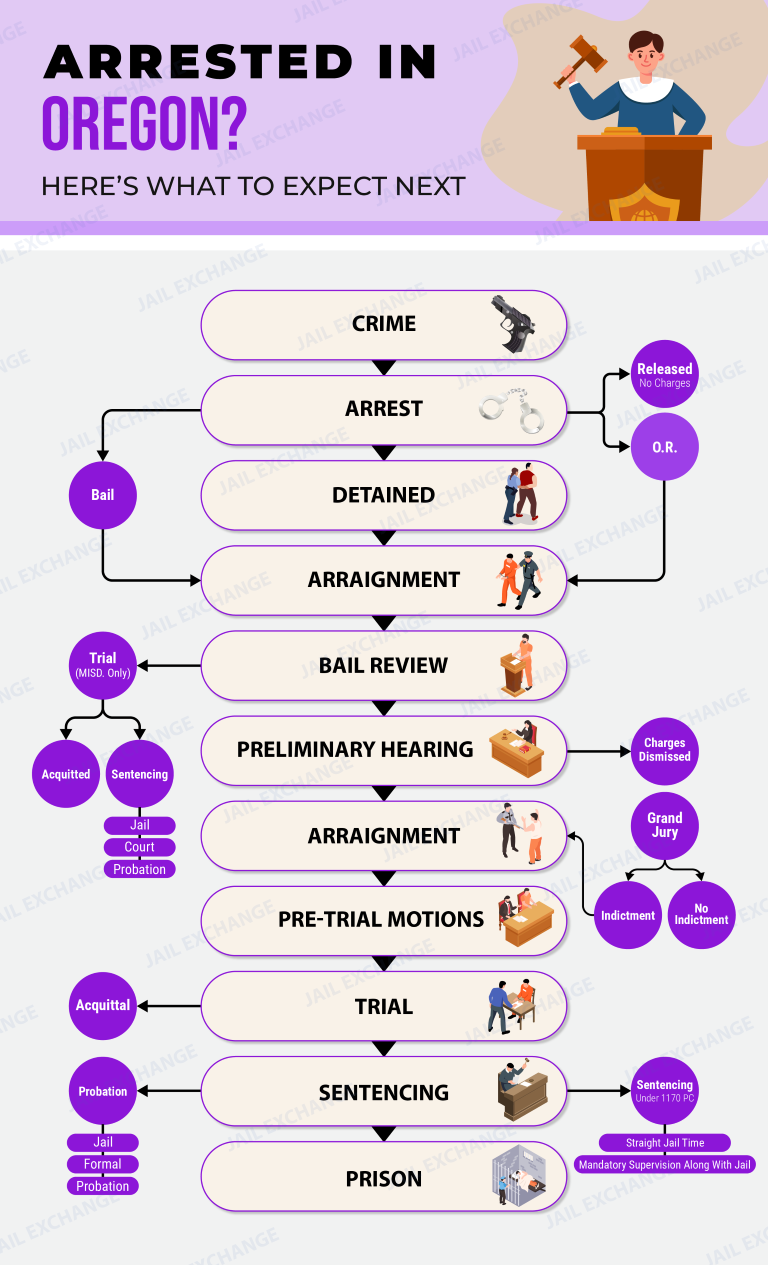
- Arraignment on the complaint in circuit court, where release is decided.
- Grand jury or preliminary hearing. A felony goes forward only after a grand jury votes an indictment, or a judge finds probable cause at a preliminary hearing (ORS 135.175). For someone in jail, that hearing should come within five judicial days (ORS 135.070).
- Plea talks and motions. Most cases end with a plea deal.
- Trial. A guilty verdict must be unanimous since the U.S. Supreme Court ruled in Ramos v. Louisiana (2020).
- Sentencing. Oregon uses a grid that weighs the crime and past record.
Prison caps run by class: a Class C felony can bring up to 5 years, Class B up to 10 and Class A up to 20. Many felony sentences end in probation instead, supervised by Parole & Probation, 1024 Main Street, Oregon City, OR 97045, 503-655-8603.
↑ Back to the question list7. What changes for violent or Measure 11 crimes?
Serious person crimes follow stricter rules from the very first day:
- Held for a judge. Under the statewide release guidelines, Measure 11 crimes, Class A felonies, sex crimes and domestic violence charges wait in jail for a judge's ruling.
- Release can be denied. Release is off the table for murder, aggravated murder or treason when the evidence of guilt is evident. For a violent felony, a judge may refuse release after a hearing on danger to others (ORS 135.240).
- No contact. In domestic violence cases, and in sex or bias crime cases, the accused may not reach out to the victim, not even through relatives (ORS 135.247).
- Mandatory minimums. Measure 11, passed by voters in 1994, locks in minimum prison terms, and good behavior can't shorten them. Murder, for example, carries at least 25 years.
Victims also have a right to speak about release and to be reasonably protected (Or. Const. art. I § 43).
↑ Back to the question list8. Are there special courts for addiction or mental illness?
Yes. The circuit court runs several treatment courts. These programs pair court check-ins with treatment, testing and close supervision. People who finish may get a lighter outcome or a dismissed charge.
- Adult Drug Court
- DUII Treatment Court
- Community Court
- Mental Health Court
- Domestic Violence Deferred Sentencing Program
- Family Treatment Court, for parents in child welfare cases
The District Attorney also lists an Impact Court for low-level cases tied to homelessness or addiction. Oregon's treatment courts follow ORS 3.450. To ask about joining, the defense lawyer is the best first step. The Treatment Court Office answers at 503-655-8495.
↑ Back to the question list9. Who prosecutes and who defends in Clackamas County?
Every Oregon county elects its own District Attorney (ORS 8.610). Here, the District Attorney's Office is in the courthouse at 1000 Courthouse Road, Oregon City, OR 97045, 503-655-8431. It is open weekdays 8 a.m. to 5 p.m. City prosecutors handle cases in the municipal courts.
If money is the problem, the state's public defense system steps in:
- Ask at arraignment and fill out the Affidavit of Eligibility. The Indigent Defense Clerk is at 503-655-8451. A clerk visits people held in the jail.
- The fee is usually $20, which a judge can waive. A judge may also order a later contribution.
- The Clackamas Indigent Defense Corporation has an office in the courthouse, 1000 Courthouse Road, Oregon City, OR 97045, 503-722-4000. Call once approved to learn your lawyer's name.
- The Oregon Public Defense Commission funds the system and has a trial office in Oregon City.
To hire a private lawyer instead, try the Oregon State Bar referral line at 503-684-3763.
↑ Back to the question list10. How can I find a hearing date online?
Oregon's state courts share one free search. Use the OJD Records and Calendar Search. No sign-up is needed.
- Open the search and pick the circuit court records option.
- Type the person's last and first name.
- Pick the matching case. It lists charges, events, results and upcoming dates.
The search shows basic facts, not court papers. Juvenile cases are kept out of it, and so are city and justice court cases. Lawyers and businesses can pay for OJCIN OnLine, which shows the official record.
If the site is down, the courthouse has free public computers. Staff at 503-655-8447 can also read you case details by phone, though they can't give legal advice. The District Attorney has a Find Your Case page as well.
↑ Back to the question list11. Could there be a warrant, and how do you clear one?
Sheriff's deputies carry out warrants countywide. Search a name on the Sheriff's Warrant Check, or call 503-785-5210 and ask for warrants. Agencies above the county keep their own lists: Oregon DOC Most Wanted, FBI Portland and the 15 Most Wanted list run by the U.S. Marshals. The OJD case search may show the case too.
Want it gone? Talk it over with a defense lawyer first, then walk into the jail, 2206 Kaen Road, Oregon City, OR 97045. The court says people who arrive before 7 a.m. should see a judge that day at 2 p.m. Case questions go to the circuit court, 1000 Courthouse Road, Oregon City, OR 97045, 503-655-8643.
↑ Back to the question list12. How do federal charges play out?
Any federal indictment here is handled by the Portland Division of the U.S. District Court for the District of Oregon. Its clerk's office is on Suite 740 of the Mark O. Hatfield U.S. Courthouse, 1000 Southwest Third Avenue, Suite 740, Portland, OR 97204, 503-326-8000.
- Prosecutor: the U.S. Attorney's Office, 1000 SW Third Ave, Suite 600, Portland, OR 97204, 503-727-1000.
- Defense: the Federal Public Defender, 101 SW Main, Suite 1700, Portland, OR 97204, 503-326-2123, or a lawyer the court appoints.
- Jail or home: a federal judge weighs that at a detention hearing (18 U.S.C. 3142). Federal Pretrial Services prepares a report first.
- Custody: the U.S. Marshals Service, 1000 Southwest 3rd Avenue, Room 401, Portland, OR 97204, 503-326-2209. People may be housed at the detention center at FCI Sheridan, 27072 Ballston Road, Sheridan, OR 97378, 503-843-4442, or a contract county jail.
When a federal prison sentence begins, track the person with the Federal Bureau of Prisons inmate locator.
↑ Back to the question list13. If ICE files a detainer, does the Oregon case stop?
The state case stays on track no matter what ICE does. A detainer is a separate federal request:
- ICE may lodge a Form I-247A, which asks for advance word before the person walks out.
- Its request: keep the person up to 48 hours after they would otherwise be released (8 CFR 287.7(d)).
- If ICE takes custody, state hearings can be missed. Tell the defense lawyer at once.
- Look for someone ICE is holding in the ICE Online Detainee Locator.
Oregon law adds limits (ORS 181A.820 to 181A.829; HB 3265 of 2021). Under those laws, an ICE paper carries weight in Oregon only when a judge has signed it. As a result, county jails generally won't keep someone on a detainer alone, and they won't hand ICE release details for enforcement. Inside a courthouse, a civil immigration arrest needs a judge's signed warrant or order (HB 3265). Any plea deal may carry immigration risks. Raise that with the defense lawyer before signing.
ICE's Portland office is at 4310 S Macadam Ave, Suite 300, Portland, OR 97239, 503-326-4165.
↑ Back to the question list14. Where are prison sentences served?
A judge sentences the person in circuit court. Short terms are served in the county jail. A prison term goes to the Oregon Department of Corrections.
- Intake: Coffee Creek Correctional Facility, 24499 SW Grahams Ferry Road, Wilsonville, OR 97070. This prison is in Wilsonville, inside the county. Intake lasts about a month, then men go to another prison while women remain at Coffee Creek.
- Find them: type a SID number or a name into the Oregon Offender Search.
- Questions: DOC at 503-945-9090.
- Facility pages: our Oregon prison listings.
After prison, most people serve post-prison supervision with county Parole & Probation, 1024 Main Street, Oregon City, OR 97045, 503-655-8603. Violating supervision can mean a return to jail.
↑ Back to the question list15. How are Clackamas County teens handled in court?
Anyone 12 through 17 is handled in juvenile court, which sits inside the circuit court system. The county Juvenile Department reviews each case and may handle it outside court, ask for probation, or send it to a judge. Its office is at 2121 Kaen Road, Oregon City, OR 97045, 503-655-8342, open Monday to Thursday 7 a.m. to 6 p.m.
- Detention: when a youth must be held, the stay is at the Marion County Juvenile Detention Center, 2970 Center St NE, Salem, OR 97301, 503-588-5321, never the adult jail.
- 24-hour help: the Intake and Assessment Center, 503-650-3180.
- Adult court: since SB 1008 (2019), a 15 to 17 year old facing a Measure 11 charge reaches adult court only after a waiver hearing.
- State custody: the Oregon Youth Authority runs youth prisons for the most serious cases.
Juvenile records stay out of the public online search.
↑ Back to the question list16. What rights do victims have in Clackamas County?
Oregon's Constitution gives crime victims real rights (Or. Const. art. I §§ 42 and 43). Some apply on their own, like speaking at a release hearing or sentencing. A victim has to request others, for example being told ahead of key hearings or when the accused gets out.
- Local help: the District Attorney's Victim Assistance Program, 1000 Courthouse Road, Oregon City, OR 97045. Its 24-hour crisis line is 503-655-8616.
- Release alerts: register with VISOR, the state's free notice service, or call 855-691-6246 any time.
- Costs: Crime Victims' Compensation through the Oregon DOJ can cover medical bills, counseling and lost wages after a violent crime. Call 800-503-7983.
- Restitution: victims have a right to prompt payment from the person convicted.

Access Securepak is an authorized correctional commissary care-package program that allows families to purchase customized food, snack, hygiene, apparel, and electronics packages sent directly to an incarcerated loved one. Every package is custom-packed to meet the strict security regulations of the specific jail or state prison.
Important: Delivery Schedules and Package Quotas
Jail package guidelines are not uniform across detention centers. Some facilities permit orders year-round, while others restrict deliveries to quarterly cycles or strict weekly deadlines that you should confirm with the facility directly. If you delay setting up your account, you risk missing the upcoming delivery cutoff, leaving your loved one waiting an extra cycle for fresh food, warm thermals, or personal toiletries.
Step-by-Step Instructions to Register and Access Service
- Visit the official Access Securepak online store at www.accesscatalog.com.
- Select the state and the specific jail or correctional institution from the dropdown menu.
- Enter the inmate's legal last name and inmate ID to verify their active housing and package eligibility.
- Browse the catalog of approved meats, cheeses, ramen soups, cookies, toiletries, and clothing.
- Add items to your cart up to the facility's maximum weight or dollar limit (usually $50 to $125 per order).
- Check out using your debit or credit card and save the order confirmation tracking number.
What the Inmate Needs to Do
The inmate does not need to order anything themselves. Securepak ships the sealed package directly to the correctional facility's commissary warehouse. Jail staff inspect the box and deliver it to the inmate during regular pod commissary distribution, where the inmate signs for the package.
Official Provider: Access Corrections / Keefe Group Official Website
Customer Service Telephone: 1-800-546-6283
Support Hours: Monday – Friday, 8:30 AM – 11:30 PM EST; Saturday, 11:00 AM – 5:00 PM EST
Supported Languages: English and Spanish
Other Services Provided by Access Corrections / Keefe Group
In addition to Access Securepak (Commissary & Gift Packages), Access Corrections / Keefe Group provides several other communication, financial, and visitation services at participating correctional facilities:
- Inmate Trust Money Deposits: Send cash directly to their personal account so they can buy items independently.
• Learn more on our website: Inmate Trust Money Deposits Guide | • Visit official vendor page: Access Corrections / Keefe Group Inmate Trust Money Deposits - Digital Messaging & Photos: Send fast electronic letters and digital pictures to their tablet.
• Learn more on our website: Digital Messaging & Photos Guide | • Visit official vendor page: Access Corrections / Keefe Group Digital Messaging & Photos
Buy Commissary for an Inmate in the Clackamas County Jail
Clackamas County Jail Inmate Commissary - Sending Money or Purchasing Commissary for an Inmate
Clackamas County Jail allows inmates to purchase commissary. Ask the jail what its commissary sells; snacks and hygiene items are common.
You can buy commissary for an inmate using an online service called Access Securepak.

Call the facility at 503-722-6777 to ask whether there is a limit on how much an inmate can spend on commissary.
Access Securepak's site shows whether friends and family can order commissary for an inmate at this jail.
Scroll down for information on the Clackamas County Jail's service they use for you being able to purchase commissary items online and have them shipped directly to the inmate.
You can also go to our Inmate Money page for information on how to send money to an inmate.
GettingOut / ViaPath Trust & Commissary Deposits
Provider: GettingOut (Telmate) • Rebranding as ViaPath Technologies (myViaPath)GettingOut and ViaPath Technologies provide electronic inmate trust banking solutions that allow family and friends to transfer money directly into an incarcerated person's jail trust and commissary account. Deposited funds give inmates the financial balance needed to purchase food items, personal hygiene products, stationery, and over-the-counter medical goods from the jail store.
Important: Facility Banking Policies Vary Across Jails
Once a person is booked and moved to a housing unit, facilities do not always allow cash drop-offs or phone payments directly to the jail window. Some might and you should confirm this by calling the facility and asking. But if you do not register online and fund your loved one's trust account immediately, they may be forced to wait days or weeks for standard paper processing, leaving them without essential soap, clean undergarments, basic medical sundries or snacks.
Step-by-Step Instructions to Deposit Trust Funds
- Confirm the inmate's legal first and last name, date of birth, and assigned jail booking identification number.
- Navigate to www.gettingout.com or the updated my.viapath.com portal.
- Sign into your verified profile and select Deposit Funds.
- Select the detention center where the inmate is currently housed.
- Choose Trust Account / Commissary and specify your deposit amount.
- Enter your credit or debit card billing information, review transaction fees, and submit payment.
- Save your digital receipt and confirmation number for your records.
What the Inmate Needs to Do
The inmate does not need an internet account to receive funds. Once the electronic transaction clears, the balance posts directly to their jail trust ledger according to facility accounting schedules. The inmate can review their updated balance at a dayroom pod kiosk or on their tablet and place orders on their regular commissary day.
Official Providers: GettingOut Website | myViaPath Portal
Customer Service Telephone: 1-866-516-0115 (GettingOut) • 1-877-650-4249 (ViaPath)
Support Hours: Monday – Friday, 7:00 AM – 11:00 PM CST; Saturday – Sunday, 8:00 AM – 7:00 PM CST
Supported Languages: English and Spanish
Other Services Provided by GettingOut / ViaPath
In addition to Trust Deposits, GettingOut and ViaPath provide several other communication and visitation options:
- Phone Calling Accounts: Prepay for phone calling credits so your loved one can call your telephone directly.
• Learn more on our website: Phone Calling Accounts Guide | • Visit official vendor page: ViaPath Phone Accounts - Two-Way Text Messaging: Send electronic messages and photos directly to an inmate's tablet or kiosk.
• Learn more on our website: Digital Messaging Guide | • Visit official vendor page: GettingOut Messaging - Remote Video Visits: Schedule and join live video visits from home using your computer or smartphone.
• Learn more on our website: Video Visitation Guide | • Visit official vendor page: GettingOut Video Visits - Inmate Tablets & Media: Fund tablet entertainment, music streaming, games, and news modules.
• Learn more on our website: Tablet Rentals & Content Guide | • Visit official vendor page: GettingOut Tablets
Deposit Money for an Inmate in the Clackamas County Jail
The Easiest and Securest Way of Depositing Money for an Inmate
There are several methods for depositing money on an inmate's account:
1. To send money online to an inmate in the Clackamas County Jail use gettingout / GTL / Viapath.

2. If you prefer to use your credit or debit card and deposit money over the phone, you can call them at 866-516-0115.
3. Deposit cash or use a debit or credit card using a dedicated kiosk for this purpose. The machine is located in the lobby or visitation area of the Clackamas County Jail.
4. The Clackamas County Jail may also allow you to *mail an inmate a money order or cashier’s check from a trusted source such as the Post Office, a local bank, or Western Union. The money order should be be made out to either the inmate or the Clackamas County Sheriff's Office, with the inmate’s name and ID# on the memo line of the check. To confirm this option call the facility at 503-722-6777.
*When mailing a money order or cashier’s check, send it an envelope by itself. Never send it with a letter or photos for your inmate, unless the facility allows it. Never send personal checks or cash.
5. The Clackamas County Jail has a reception desk that may accept cash, money orders or cashier checks. Call 503-722-6777 to find out the specific hours for drop off times.
Letters for the Clackamas County Jail on Kaen Road in Oregon City are delivered on paper. Put the person's name and their State Identification Number (SID) on the envelope; you can find the SID with the jail's adults in custody search. Mail is handed out Monday through Friday, usually within a day after staff process it, and mail for someone already released goes back to you unopened.
Personal mail, legal mail and publications all go here:
Inmate's Full Name & SID#
Clackamas County Jail
2206 Kaen Road
Oregon City, OR 97045
- Return address: Your first and last name, street address, city, state and ZIP code are required on all incoming mail.
- Photos: No more than eight 4x6 photos in one envelope, since a ninth gets the whole batch returned. Polaroid-type prints are banned, and so are pictures of weapons, drugs, drinking or nudity.
- Greeting cards: The jail's limit is 8½ x 10 inches. Padded or musical cards and cards with metal clasps are not allowed.
- Money: Cash, money orders, cashier's checks and personal or business checks are not accepted by mail. A letter holding cash is sealed and returned to the sender. Put money on the account online or at the lobby kiosk.
- Books: Softcover only, shipped from a publisher or a well-known bookstore, no bigger than 8½ x 11 inches and 2 inches thick. Hardbound and spiral-bound books are refused, and books with torn, removed or changed covers go back.
- How many: A person may keep three books and three magazines at once and must turn in old ones before getting new ones.
- Banned extras: Stamps, stickers, calling cards, writing paper and envelopes, news clippings, grease-stained paper, crayon or felt-tip drawings, CDs or disks, and anything that isn't paper. Use blue or black ink.
- Packages: Boxes mailed from home are refused. Family can order a gift package through the jail's approved commissary program instead.
- Rejected mail: Staff send a written notice with the reason within three working days. To ask for a review, write to the jail within seven days.
Trying to sneak contraband in through the mail is a Class C felony in Oregon. For quicker contact, try electronic messaging.
GettingOut / ViaPath Inmate Phone Calling
Provider: GettingOut (Telmate) • Rebranding as ViaPath Technologies (myViaPath)GettingOut telephone services (operated under Global Tel*Link / Telmate and transitioning to ViaPath Technologies / myViaPath) allow incarcerated individuals to place outbound voice calls from housing-unit telephones and handheld tablets directly to approved family contacts. Funding a prepaid phone balance ensures calls connect to cellular devices and residential lines without carrier collect call blocks.
Important: Cell Carriers Automatically Block Jail Collect Calls
Inmate phone networks do not permit incoming calls, and wireless cell providers do not support traditional collect billing. While some residential landlines might allow direct carrier billing, mobile numbers require a funded prepaid account or inmate PIN debit balance, which you can verify with your phone provider. If you do not register online and add calling funds promptly, your loved one will receive an automated disconnect announcement when dialing your line.
Step-by-Step Instructions to Set Up and Fund Calling
- Visit www.gettingout.com or the updated my.viapath.com portal.
- Register your account using the primary 10-digit telephone number where you want to receive calls.
- Search for the facility and add the inmate using their full legal name or facility booking ID.
- Select Phone Deposits or AdvancePay from your dashboard.
- Select your deposit dollar amount and enter your debit or credit card billing details.
- Authorize payment, save your confirmation receipt, and confirm that your mobile phone allows calls from automated or unknown correctional numbers.
What the Inmate Needs to Do
The inmate approaches any housing-unit telephone or opens the phone application on their handheld tablet, enters their assigned PIN, and dials your 10-digit number. The system verifies that your account has an active prepaid balance and connects the call once you accept the automated prompt. All non-privileged conversations are recorded and monitored by the facility.
Official Providers: GettingOut Website | myViaPath Portal
Customer Service Telephone: 1-866-516-0115 (GettingOut) • 1-877-650-4249 (ViaPath)
Support Hours: Monday – Friday, 7:00 AM – 11:00 PM CST; Saturday – Sunday, 8:00 AM – 7:00 PM CST
Supported Languages: English and Spanish
Other Services Provided by GettingOut / ViaPath
In addition to Phone Calling, GettingOut and ViaPath provide several communication, financial, and visitation services:
- Two-Way Text Messaging: Send digital text messages and photos directly to an inmate's tablet or kiosk.
• Learn more on our website: Digital Messaging Guide | • Visit official vendor page: GettingOut Messaging - Remote Video Visits: Schedule and join live video visits from home using your computer or smartphone.
• Learn more on our website: Video Visitation Guide | • Visit official vendor page: GettingOut Video Visits - Inmate Tablets & Media: Fund tablet entertainment, music streaming, games, and news modules.
• Learn more on our website: Tablet Rentals & Content Guide | • Visit official vendor page: GettingOut Tablets - Inmate Trust & Commissary Deposits: Transfer funds directly into their jail trust ledger for commissary store purchases.
• Learn more on our website: Inmate Trust Deposits Guide | • Visit official vendor page: ViaPath Trust Deposits
GettingOut / ViaPath Inmate Messaging
Provider: GettingOut (Telmate) • Rebranding as ViaPath Technologies (myViaPath)GettingOut (a service of Global Tel*Link / Telmate) provides an instant two-way digital messaging and photo-sharing platform connecting families with incarcerated individuals via housing-unit kiosks and handheld tablets. The provider is actively rebranding as ViaPath Technologies (under the myViaPath platform); depending on the facility contract, local booking sheets and tablets may still refer to the service as GettingOut, GTL, or ViaPath, but both brand portals grant access to the same centralized messaging balance.
Important: Contact Authorization and Digital Mail Rules Vary
Inmate digital messaging rules are not uniform across all county detention centers. While some jails allow immediate two-way messaging upon registration, others require initial contact invitations or administrative ID verification, which you should verify directly with the facility. If you delay setting up an online profile and funding your Friends & Family messaging account, your loved one may face lengthy periods without direct family communication.
Step-by-Step Instructions to Register and Message an Inmate
- Visit www.gettingout.com or the newly branded my.viapath.com portal, or install the GettingOut / myViaPath mobile app.
- Create a user profile using your primary email address and 10-digit mobile phone number.
- Complete identity verification by uploading a clear photo of your government-issued driver's license or state ID and taking a verification selfie if requested.
- Search for the inmate by selecting the state, correctional facility, and their legal name or booking ID.
- Send an outside contact connection request to link your account to their tablet profile.
- Deposit funds into your 'Friends & Family Account' using a debit or credit card to cover message and photo-sharing costs.
- Compose your text message in the chat box, attach approved photos, and submit it for jail screening.
What the Inmate Needs to Do
The inmate powers on their assigned pod tablet or approaches a housing-unit kiosk and logs into the messaging application with their PIN. They accept your incoming contact invitation on the screen. Once approved by institutional monitors, incoming messages appear in their inbox, and the inmate types a reply directly on the screen.
Official Providers: GettingOut Website | myViaPath Portal
Customer Service Telephone: 1-866-516-0115 (GettingOut Support) • 1-877-650-4249 (ViaPath Support)
Support Hours: Monday – Friday, 7:00 AM – 11:00 PM CST; Saturday – Sunday, 8:00 AM – 7:00 PM CST
Supported Languages: English and Spanish
Other Services Provided by GettingOut / ViaPath
In addition to Two-Way Text Messaging, GettingOut and ViaPath provide several other communications and visitation options:
- Remote Video Visits: Schedule and join live web-based video visits from your computer or smartphone.
• Learn more on our website: Video Visitation Guide | • Visit official vendor page: GettingOut Video Visits - Inmate Tablet Rentals & Media: Fund tablet entertainment, music streaming, games, and news modules.
• Learn more on our website: Tablet Rentals & Content Guide | • Visit official vendor page: GettingOut Tablets - AdvancePay Phone Calling: Prepay for telephone calls so your loved one can dial your mobile phone directly.
• Learn more on our website: AdvancePay Phone Calling Guide | • Visit official vendor page: ViaPath ConnectNetwork Calling - Inmate Trust Deposits: Transfer funds directly into their jail trust account for commissary store purchases.
• Learn more on our website: Inmate Trust Deposits Guide | • Visit official vendor page: ViaPath Trust Deposits
GettingOut / ViaPath Inmate Tablets & Media
Provider: GettingOut (Telmate) • Rebranding as ViaPath Technologies (myViaPath)GettingOut provides specialized, secure handheld tablets for county jail inmates, offering access to messaging apps, telephone calling, legal research tools, eBooks, vocational training, and premium entertainment rentals. As part of GTL and Telmate's transition to ViaPath Technologies, tablet firmware and management platforms are moving to the myViaPath system.
Important: Tablet Feature Availability Varies by Facility
Jails manage tablet distribution according to individual facility contracts. While basic educational and legal materials are often provided without cost, access to music streaming, games, podcasts, and premium movies requires an active funded account. You should confirm the tablet rules with the facility directly. Registering and funding their media balance right away ensures your loved one has productive resources and recreation during their stay.
Step-by-Step Instructions to Fund Inmate Tablet Services
- Confirm that GettingOut / ViaPath handheld tablets are active at your loved one's specific detention facility.
- Navigate to www.gettingout.com or my.viapath.com.
- Sign into your verified user profile and link the inmate's legal name and booking ID number.
- Select Make a Deposit and choose either your Friends & Family Account (for messaging) or the inmate's personal Inmate Account (for entertainment and song rentals).
- Choose your deposit amount, review convenience fees, and complete payment with a credit or debit card.
- Notify your loved one that their tablet account balance has been funded.
What the Inmate Needs to Do
The inmate unlocks their assigned tablet or signs one out from the pod charging station using their biometric verification or PIN. Once logged in, their available balance appears on the screen, allowing them to download songs, stream educational content, and communicate with approved family members.
Official Providers: GettingOut Website | myViaPath Portal
Customer Service Telephone: 1-866-516-0115 (GettingOut) • 1-877-650-4249 (ViaPath)
Support Hours: Monday – Friday, 7:00 AM – 11:00 PM CST; Saturday – Sunday, 8:00 AM – 7:00 PM CST
Supported Languages: English and Spanish
Other Services Provided by GettingOut / ViaPath
In addition to Tablet Media & Rentals, GettingOut and ViaPath provide several other communication and account services:
- Two-Way Text Messaging: Send electronic letters and photos straight to the inmate's screen.
• Learn more on our website: Two-Way Text Messaging Guide | • Visit official vendor page: GettingOut Messaging - Remote Video Visits: Meet face-to-face over secure live video from home.
• Learn more on our website: Video Visitation Guide | • Visit official vendor page: GettingOut Video Visits - AdvancePay Phone Calling: Prepay for phone calling credits so your loved one can call your telephone directly.
• Learn more on our website: AdvancePay Phone Calling Guide | • Visit official vendor page: ViaPath ConnectNetwork Calling - Inmate Trust Deposits: Transfer cash directly into an inmate's jail ledger for commissary purchases.
• Learn more on our website: Inmate Trust Deposits Guide | • Visit official vendor page: ViaPath Trust Deposits
Clackamas County Juvenile Facilities
- Jail (Main): 503-722-6777
- Community Corrections: 503-655-8603
- Court: 503-655-8447
- District Attorney: 503-655-8431
- Juvenile: 503-655-8342
- Sheriff: 503-785-5000
The Clackamas County Jail serves the following cities and towns of Clackamas County: Barlow, Canby, Damascus, Estacada, Gladstone, Happy Valley, Johnson City, Lake Oswego, Milwaukie, Molalla, Oregon City, Rivergrove, Sandy, Tualatin, West Linn and Wilsonville.