Multnomah County Detention Center Criminal Court Process
Criminal Court Process for Multnomah County Oregon
Multnomah County Criminal Court Guide
State criminal cases here belong to the circuit court for Oregon's 4th Judicial District. Trials happen at the Multnomah County Courthouse, 1200 SW 1st Ave, Portland, OR 97204, and first hearings take place one block away in the Justice Center. Adults waiting for court are held at MCDC, 1120 SW Third Avenue, Portland, OR 97204; people rated low or medium risk are moved to the open dorms of Inverness Jail, 11540 NE Inverness Drive, Portland, OR 97220. MCDC is the maximum-security booking jail. Each jail holds both men and women.
Wondering if the person is still in custody? Search the Sheriff's adult custody lookup by name. For everything else about the arrest itself, from who is booked today and open warrants to charges, mugshot limits, public defenders and property, see our Inmate Lists page.
Your first call should go to Criminal Operations at 971-274-0545, answered weekdays 8:30 to 10:30 a.m. and 1:30 to 4:00 p.m. Ask them for the case number, then the courtroom and next hearing date. Money questions about getting out are covered on our release and security page.
1. Do felony and misdemeanor cases share one court here?
Both go to the same place. The circuit court is Oregon's trial court, and every county has one. This county has about 795,391 people (Census estimate, July 1, 2025). The 4th Judicial District covers it and no other county (ORS 3.012).
- Misdemeanors, like most DUII or theft charges, are filed in circuit court. Arraignments for people still in jail happen in courtroom JC4.
- Felonies are filed there too. Class A and B felonies are arraigned in courtroom JC3, and Class C felonies in JC4.
- City violations and some city crimes can go to a municipal court, such as Troutdale's.
- Federal crimes go to the federal court for the District of Oregon, Portland Division.
Charging decisions belong to the District Attorney. Call 971-274-0545 if you are not sure which courtroom has the case.
↑ Back to the question list2. Where are the Multnomah County criminal courthouses?
The circuit court uses four buildings. All counters are open weekdays from 8 a.m. to 5 p.m. Phone lines run 8:30 to 10:30 a.m. and 1:30 to 4:00 p.m.
- Multnomah County Courthouse, 1200 SW 1st Ave, Portland, OR 97204. Trials, hearings and the District Attorney's main office. Criminal Operations: 971-274-0545.
- Justice Center courtrooms, 1120 SW Third Avenue, Floor 3, Portland, OR 97204, 971-274-0750. Arraignments, probation hearings and the Court Check-In window.
- East County Courthouse, 18480 SE Stark Street, Portland, OR 97233, 971-274-0700.
- Juvenile Justice Center, 1401 NE 68th Avenue, Portland, OR 97213, 971-274-0800. Youth cases and the juvenile court.
Other useful court lines: Records at 971-274-0570, Collections at 971-274-0560, and Oregon Relay at 711.
↑ Back to the question list3. Do Troutdale, Gresham and other cities run their own courts?
One city court here is confirmed. Troutdale Municipal Court has its office at 219 E. Historic Columbia River Highway, Troutdale, OR 97060, and holds court at 234 SW Kendall Ct, Troutdale, OR 97060. Call 503-674-7236. The office is open weekdays from 8 a.m. to 5 p.m. Court meets the second and fourth Wednesday of each month, with criminal arraignments at 1:30 p.m.
Fairview Municipal Court closed in May 2021. The city still handles tickets written before then at Fairview City Hall, 1300 NE Village Street, Fairview, OR 97024, 503-665-7929. Newer Fairview tickets go to Troutdale's court or to circuit court.
The small part of Lake Oswego inside this county may use Lake Oswego Municipal Court, 380 A Avenue, Lake Oswego, OR 97034, 503-635-0217.
For these places, ask the city or the circuit court where a ticket goes:
- Portland, Gresham, Maywood Park and Milwaukie: call circuit court Criminal Operations at 971-274-0545.
- Wood Village: City Hall, 24200 NE Halsey, Wood Village, OR 97060, 503-667-6211.
City courts are run by the cities, not the state, so the state's online case search leaves them out.
↑ Back to the question list4. What happens at the first hearing in the Justice Center?
The first hearing is called an arraignment. For someone in jail, the limit is 36 hours, and only weekdays that aren't holidays count (ORS 135.010). Here it happens in the third-floor courtrooms at the Justice Center, 1120 SW Third Avenue, Floor 3, Portland, OR 97204.
- The judge reads out each charge and takes a plea (ORS 135.020).
- A defense lawyer assigned to the courtroom enters a not-guilty plea.
- The judge makes a release decision. Recognizance and release assistance officers have often met the person already.
- The clerk hands out the next court date before anyone leaves.
Family members may watch. Come 30 to 45 minutes early and tell the clerk at the Court Check-In window, up on the third floor, whose case you came for, so staff can point you to the right room. For hearing times, phone 971-274-0750.
↑ Back to the question list5. How do DUII, theft and drug possession cases move?
Many misdemeanor cases start with a citation, a written order to come to court, instead of a night in jail (ORS 133.055). People who are out of custody are arraigned in courtroom JC1. A Rapid Resolution docket also meets there on Tuesdays at 1:00 p.m.
Each misdemeanor class has its own jail cap. The top level, Class A, can bring up to 364 days. Class B tops out at 6 months, and Class C at 30 days. A violation, like many traffic tickets, brings a fine and never jail.
Drug possession changed on September 1, 2024 (HB 4002). It is now a special drug misdemeanor; jail can reach 180 days. Prosecutors usually must offer probation with treatment, and the charge can be dismissed once the person finishes it. Some people are steered to treatment, called deflection, before any charge is filed.
DUII cases may qualify for the county's DUII Intensive Supervision Program, a treatment court. Ask the defense lawyer early.
↑ Back to the question list6. How does a Multnomah County felony case move?
A felony case has more steps than a misdemeanor. Here is the usual path:
- Arraignment in the Justice Center. Class A and B felonies go to courtroom JC3 on weekdays at 9:00 a.m. and 2:00 p.m.
- Grand jury or preliminary hearing. The case moves forward by an indictment from a grand jury or by a judge finding probable cause. For someone held in jail, a preliminary hearing comes within five court days (ORS 135.070).
- Pretrial hearings at the courthouse, where lawyers trade evidence and talk about plea offers.
- Trial. A guilty verdict from a jury must be unanimous, a rule set by Ramos v. Louisiana in 2020.
- Sentencing, guided by Oregon's grid of crime seriousness and past record.
Maximum prison terms depend on the class. Class A carries as much as 20 years, Class B as much as 10, and Class C as much as 5. The county also runs a Justice Reinvestment program called MCJRP. Ask the lawyer whether the case could qualify.
↑ Back to the question list7. What changes for Measure 11 and violent charges?
Measure 11, passed by voters in 1994, sets mandatory minimum prison terms for serious crimes against people. Those sentences get no cut for good behavior. A few examples: 25 years for murder, and 90 months for first-degree assault or first-degree robbery.
- Expect the person to be held until a judge rules on release.
- Treason, murder and aggravated murder cases can be held without release when the proof is evident (ORS 135.240).
- For other violent felonies, the DA may ask for a separate preventive detention hearing.
- The court's STEP program takes some Measure 11 cases, such as first-degree assault and robbery, with treatment and close watch.
Victims have a right to be heard at release and sentencing. No-contact rules are strict. A person jailed on a domestic violence, sex or bias charge may not reach the victim, even by asking a relative to call (ORS 135.247).
↑ Back to the question list8. Which office prosecutes, and where do appointed lawyers come from?
The prosecutor. Each Oregon county elects its own District Attorney (ORS 8.610). The main office is at 1200 SW 1st Avenue, Suite 5200, Portland, OR 97204, 503-988-3162, open weekdays 8 a.m. to 5 p.m. A branch works inside the East County Courthouse, 18480 SE Stark Street, Gresham, OR 97233.
The defense. At arraignment, ask for a court-appointed lawyer. The money form is called an Affidavit of Eligibility, and it is turned in at the Court Check-In Window, Justice Center, 1120 SW Third Avenue, Floor 3, Portland, OR 97204. The window is open weekdays from 8 a.m. to 4 p.m.
- A court screener checks the money form. There is usually a $20 fee, which a judge can waive; the court may also set a later payment.
- Appointed cases go to offices such as Metropolitan Public Defender, Multnomah Defenders Inc. and, for youth, Youth, Rights & Justice. The Oregon Public Defense Commission (OPDC) pays for this work.
- Oregon is short on public defenders. A federal order known as Betschart covers anyone held a full 7 days past the first hearing while still unrepresented; such a person generally goes free on conditions. The case goes on.
For private help, the Oregon State Bar's referral line is 503-684-3763.
↑ Back to the question list9. Which free tools show the case and next hearing?
Several free tools cover state cases here:
- OJD Records and Calendar Search: free, with no sign-up. Search by name for basic case facts and events. It shows no documents and no juvenile cases.
- County court calendars and live streams, from the circuit court's own site.
- The DA's daily Court Appearance List, posted by 5:00 p.m. each day.
- Text message hearing reminders from the state courts.
- OJCIN OnLine, a paid service that shows the official case record.
If a website is down, every courthouse has free public computers. Staff can also give case facts by phone, but not legal advice. Call Records at 971-274-0570.
↑ Back to the question list10. How do I check for a Multnomah County warrant and clear it?
Sheriff's deputies and city officers serve warrants here. The Sheriff's main line is 503-988-4300. To ask about a warrant, call the court at 971-274-0545, choose option 5, and give a case number or full name and birth date. A free, private warrant hotline run by Metropolitan Public Defender takes calls at 503-414-5453. Three official wanted pages cover Oregon: Oregon DOC Most Wanted, FBI Portland, and 15 Most Wanted from the Marshals. To clear it, the person and a lawyer can plan a surrender at the Justice Center jail, 1120 SW Third Avenue, Portland, OR 97204, or someone can phone the issuing court to ask for a new date. The court's main building is 1200 SW 1st Ave, Portland, OR 97204.
↑ Back to the question list11. What happens if the case goes to federal court?
Federal charges here land in the District of Oregon's Portland Division. The clerk works from the Mark O. Hatfield U.S. Courthouse, 1000 SW Third Avenue, Suite 740, Portland, OR 97204, 503-326-8000. The building is open weekdays from 7 a.m. to 5 p.m.
- The U.S. Attorney's Office handles the prosecution: 1000 SW Third Ave, Suite 600, Portland, OR 97204, 503-727-1000.
- A detention hearing under 18 U.S.C. 3142 decides home versus jail for the months before trial.
- Pretrial custody rests with the Marshals, whose district office is at 1000 SW 3rd Avenue, Room 401, Portland, OR 97204, 503-326-2209. People may be held at a contract jail or at FCI Sheridan, 27072 Ballston Road, Sheridan, OR 97378, 503-843-4442.
- The Federal Public Defender, 101 SW Main, Suite 1700, Portland, OR 97204, 503-326-2123, defends many people who can't pay.
After sentencing, the Federal Bureau of Prisons inmate locator lists the federal prison holding them.
↑ Back to the question list12. Can immigration officers stop the state case?
No, the state charges keep moving on their own track. This is how a detainer plays out:
- Step one: ICE, the immigration agency, sends what it calls a detainer (Form I-247A).
- The request covers a hold of up to 48 hours after they would otherwise be released (8 CFR 287.7(d)).
- In Oregon, the sanctuary laws (ORS 181A.820-181A.829; HB 3265, 2021) stop local police and jails from acting on an immigration request without a judge's signature. In practice, Oregon jails generally won't extend anyone's stay because of an ICE detainer, and they keep release information away from immigration enforcement.
- That law also blocks civil immigration arrests in a courthouse; only a judge-signed warrant or order allows one.
- If ICE does take the person, look them up with the ICE Online Detainee Locator. The ICE office for this area is at 4310 S Macadam Ave, Suite 300, Portland, OR 97239, 503-326-4165.
Pleas carry immigration risks for people who are not citizens, so raise this with the defense lawyer before agreeing to any deal.
↑ Back to the question list13. Where is an Oregon prison sentence served?
The first stop for anyone sentenced to the Oregon Department of Corrections is intake at Coffee Creek Correctional Facility, 24499 SW Grahams Ferry Road, Wilsonville, OR 97070. Intake staff answer questions at 503-570-2259. The process lasts about 30 days. Men are then moved to a long-term prison, and women serve their time at Coffee Creek.
- Search by name on the Oregon Offender Search.
- The DOC main line is 503-945-9090.
- Our Oregon state prisons page has details on every prison in the system.
Probation is a different office. The county's Department of Community Justice supervises it from 421 SW 5th Ave., Portland, OR 97204, 503-988-3747.
↑ Back to the question list14. What happens when the accused in Multnomah County is under 18?
Youth ages 12 to 17 go through juvenile court, not adult court. Hearings take place at the Juvenile Justice Center, 1401 NE 68th Avenue, Portland, OR 97213, 971-274-0800. The court's juvenile page explains the steps.
- A youth who must be held stays at the Donald E. Long Juvenile Detention Center in the same complex, 1401 NE 68th Ave, Portland, OR 97213, 503-988-3460.
- The DA's Juvenile Unit works in Room 2100 of the Donald E. Long Building, 503-988-3472.
- Since SB 1008 (2019), Measure 11 charges against youth ages 15 to 17 start in juvenile court. Moving to adult court takes a waiver hearing and a judge's approval.
- The state's online search skips juvenile cases, so phone the court for dates.
Youth the judge commits to state care are placed with the Oregon Youth Authority.
↑ Back to the question list15. How does Oregon protect crime victims' rights?
Oregon's Constitution gives victims real rights (Or. Const. art. I §§ 42 and 43). Some rights apply without asking: victims can address the judge at a release hearing and at sentencing. Other rights, such as being told ahead of hearings or a release, start only once the victim requests them.
- The DA's Victims Assistance team helps with court dates and requests: 503-988-3222.
- The county's Victim and Survivor Services line is 503-988-7606.
- Sign up with VISOR for free alerts by phone, text or email if the person gets out, moves or escapes. Its 24-hour line is 855-691-6246.
- Crime Victims' Compensation from the Oregon Department of Justice can cover costs like medical bills, counseling and funerals: 800-503-7983.
Victims also have the right to get restitution from the person convicted and to refuse an interview with the defense.
↑ Back to the question list16. Which treatment courts serve Multnomah County?
Some cases can move to a treatment court. These courts mix close supervision, drug testing, treatment and regular check-ins with a judge. The circuit court here runs:
- START, the adult drug court
- DISP, the DUII Intensive Supervision Program
- Mental Health Court
- STEP, for certain Measure 11 cases
- Veterans Treatment Court
The defense lawyer decides with the client whether to ask for one. Learn more on the court's treatment courts page, or call Criminal Operations at 971-274-0545.
↑ Back to the question listCriminal Court Process for Multnomah County Oregon
Multnomah County Oregon Criminal Court System – Definitions
It might be helpful to define some words that will be used on this site, when explaining the Oregon Court System and how it works. The definitions on this site are for general information and not legal advice. It is always preferred to follow information given by your attorney or local authorities.
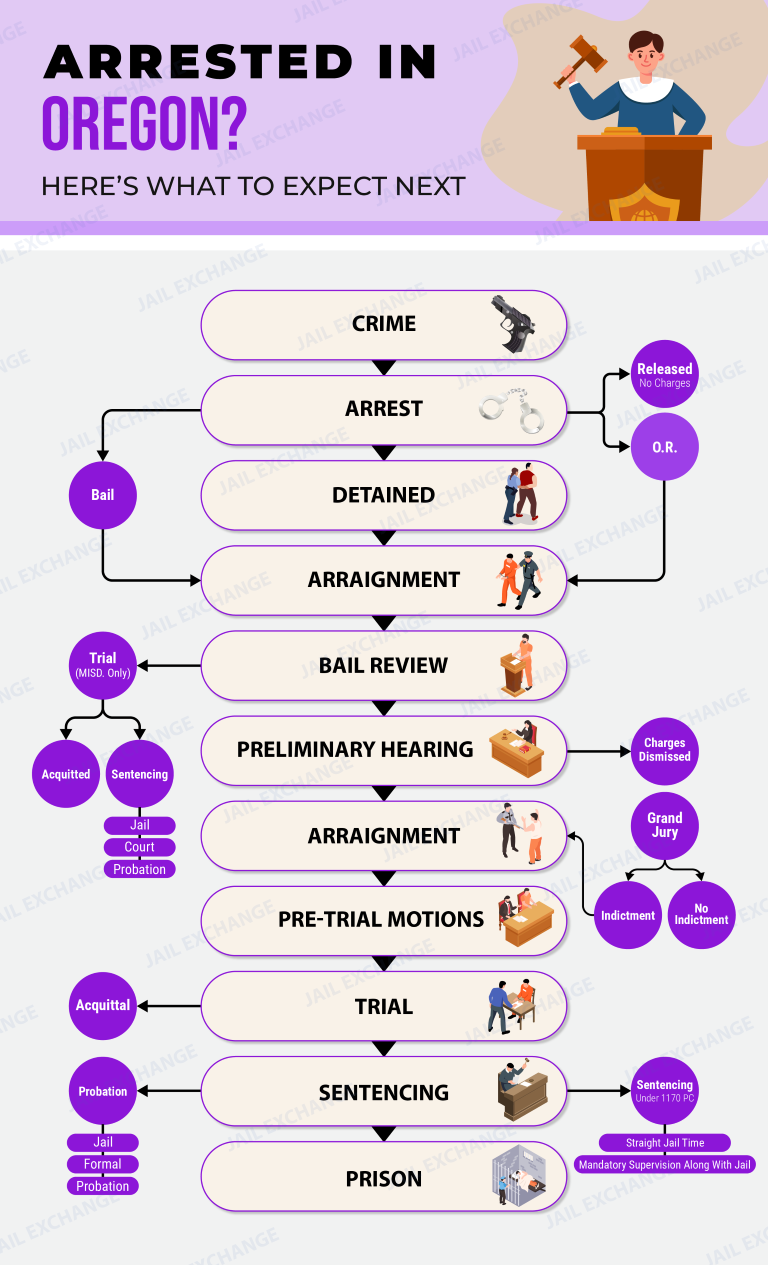
If you scroll down below this content, and the listing of the courts in Multnomah County, you will find a simple flowchart diagram and a video that will help you visualize the stages of the Criminal Court Process.
Arrest is when Oregon, Multnomah County or local police take a person into custody and start the legal process. The arrested person may or may not be jailed.
For many misdemeanors, police may give the person a criminal citation, which lists a date to appear in court. For more serious crimes, the person is usually held in the county jail until the arraignment, or until they are released.
Booking is when the Multnomah County sheriff or local police record the person’s name, address and charges, take fingerprints and check criminal history. A release officer may interview the person soon after booking. For many low-level charges, the jail can release the person on a promise to return under the county’s standing release order.
The prosecution, sometimes called “the state,” is the side that brings the charges and asks for punishment. In Oregon, each county elects a District Attorney, whose office prosecutes crimes on behalf of the state. A U.S. Attorney prosecutes federal cases.
Jurisdiction means whether a court has the right to handle a case. For example, if you run a red light in your city, the city’s municipal court may handle your case. If you then flee from police, it becomes a more serious crime, and the case may go to the circuit court instead.
Jurisdiction varies from state to state and sometimes county to county.
Arraignment is the first court hearing. The judge reads the charges and asks how the person pleads. A person in jail must be arraigned within 36 hours of being taken into custody, not counting Saturdays, Sundays and holidays. The judge also decides on release at this hearing. At this time, the person is called the defendant.
An arraignment is not a trial. For a felony, the case moves forward through a grand jury or a preliminary hearing, where a judge decides if there is enough evidence.
Bail, called “security” in Oregon law, is money put up to make sure the person comes back to court. When the case ends and every rule was followed, the court clerk returns 85% of the deposit to the person named on the receipt and keeps 15% (at least $5, at most $750).
If a person cannot pay the security, they stay in the Multnomah County Jail. Release can be denied for murder, aggravated murder or treason when the proof is strong, and for a violent felony if the person is a danger to others. Many people are released on their own promise, or recognizance, without paying.
Oregon does not use commercial bail bonds, so there are no bail bond companies.
In Oregon, a crime is either a felony or a misdemeanor and can bring jail time. A violation does not bring jail time. When a judge sets security, a person can get out of jail by:
Depositing 10% of the security amount, but never less than $25, with the court clerk or the jail.
Or putting up the full amount in cash, or stocks, bonds or property in Oregon worth twice the amount. The defendant, family or friends can pay.
It is always important to have family involvement after being arrested. Not only can they make calls and communicate on your behalf, but family support will show the court that there are people who will make sure that the defendant makes it to court.
(Beware of scams. No one from the court or jail will call asking for money to release someone. If you get a call like this, hang up and call the jail or the Multnomah County Sheriff’s Office yourself.)
A criminal defense attorney (also called lawyer or counsel) represents the defendant. A person has the right to a lawyer before being arraigned. If the person cannot afford one, they can ask for a court-appointed lawyer, called a public defender, at the first court appearance.
The person fills out a money form, and the court checks it. There is usually a $20 application fee, which the court can waive, and the judge may order the person to pay part of the cost. A person cannot be denied a lawyer because they cannot pay. If a person in jail still has no lawyer seven days after their first appearance, a federal court order generally requires their release on conditions. Since January 1, 2024, public defense in Oregon is run by the Oregon Public Defense Commission. The following link will take you to the Oregon Public Defense Commission.
For less serious criminal cases or civil cases, there are pro bono volunteers who volunteer legal services for free or for a small fee. They often hold clinics to teach people how to represent themselves in court. The attached link has a list of pro bono organizations in Oregon.
Many courts will provide forms and help for people who want to represent themselves, called pro se. Here is a link for legal self-help in Oregon.
Oregon has no state district courts. Its trial courts are circuit courts. In Oregon, “district court” means the U.S. District Court for the District of Oregon, which hears federal cases. It is important that you check the address of the court you are to appear in rather than to ask someone, because that person might give you directions to the wrong court. Being late to court can land you in custody as well.
Pretrial proceeding is the process where both sides (prosecution and defense) gather information, interview witnesses, request records, videos etc. Pretrial proceedings also include communications with the judge assigned to the case and these appearances are either in person or by on-line conferencing. Some pretrial proceedings may not require a defendant’s appearance, allowing an attorney to appear in their place. The information that is gathered is called discovery and both sides must share the information that they have gathered. This information does not include conversations between the arrested and their attorney.
Most cases do not go to trial because both sides reach a plea deal. In a plea deal, the defendant pleads guilty, often to a lesser charge or for a lighter sentence. Sometimes the prosecution offers a lighter sentence in exchange for information about a more serious crime.
Trial is where both sides share their information in front of a judge or a judge and jury. After listening to all the evidence, the judge or jury decides the verdict which is whether the person is guilty or not guilty. If a court has only a judge hearing both sides, it is called a bench trial. If a jury is selected, it is called a jury trial. A jury’s guilty verdict in a criminal case must be unanimous. If the defendant is found not guilty, they are released. If they are found to be guilty, the next step is sentencing.
Sentencing is the punishment that the judge decides the person should get. This could be jail or prison time, fines, community service, probation, or a combination.
Appeal is asking for a higher court to review the case. If the defendant thinks something went wrong at trial or that the sentence is too harsh, the defense attorney can file an appeal with the Oregon Court of Appeals. An appeal can be denied if the appeals court finds that the trial and sentencing were fair.
Oregon Felony vs Misdemeanor
In Oregon, a misdemeanor is Class A, B or C.
- Class A misdemeanors can bring up to 364 days in jail, a fine up to $6,250, or both.
- Class B misdemeanors can bring up to 6 months in jail, a fine up to $2,500, or both.
- Class C misdemeanors can bring up to 30 days in jail, a fine up to $1,250, or both. Examples of misdemeanors are trespassing and shoplifting.
A felony is a more serious crime than a misdemeanor. Felonies are Class A, B or C, and some crimes, such as murder, are unclassified. Examples of felony crimes are murder, rape, robbery, kidnapping and drug trafficking.
In Oregon, murder can bring a life sentence. Under Measure 11, some serious person crimes carry mandatory minimum prison terms, such as 25 years for murder.
- Class A felonies can bring up to 20 years in prison and a large fine.
- Class B felonies can bring up to 10 years in prison and a large fine.
- Class C felonies can bring up to 5 years in prison and a large fine.
The Multnomah County Circuit Court is a state court. Its staff, led by a trial court administrator, handle warrants, security deposits, the trial schedule, fees, fines and court records. Court staff are not elected. The elected County Clerk handles elections and county records, not criminal cases.
An arrest warrant is a judge’s order to arrest a person. In Oregon, it usually lists the security amount needed for release. A search warrant lets police search a place for evidence.
A criminal citation, often called a ticket, orders a person to appear in court on a certain date without being taken to jail. The person usually must appear within 30 days. If they do not appear, the judge can issue an arrest warrant.
Fines are paid to the court that handled the case, usually the circuit court, or the city’s municipal court or the county’s justice court. Read the instructions on the ticket or court papers. If you have questions, call that court.
Oregon Criminal Court System - How it Works
The Oregon Supreme Court and Court of Appeals hear appeals from the “lower courts”. The lower courts in Oregon include municipal, justice and circuit courts.
Municipal courts are run by cities, not the state. They handle city ordinance violations, traffic violations and some misdemeanors that happen inside the city. Not every city has one. Municipal courts do not hold felony trials.
Justice courts are set up by counties and are not part of the state courts. Their judges are elected Justices of the Peace. They handle traffic violations and some misdemeanors. Felony cases go to circuit court.
Oregon Circuit Courts are state trial courts in every county. They hear misdemeanor and felony cases and juvenile cases for youth under 18. Gilliam, Sherman and Wheeler counties also have county courts that handle juvenile cases. For juvenile court in Multnomah County, call the circuit court or visit the Oregon Judicial Department.
For more information on Oregon’s Tribal Courts, go to the Oregon State Legislature site.
Treatment Courts, sometimes called Specialty Courts or Problem-Solving Courts, serve people with drug, alcohol or mental health needs. Oregon has adult drug courts, DUII courts, mental health courts, veterans courts and others. Participants follow a plan with court check-ins, supervision, treatment and drug testing. Not every county has one.
The Oregon Supreme Court has seven elected justices. It rules on questions about the state constitution, laws and court rules. Sometimes it hears criminal cases on appeal.
Most criminal appeals go first to the Oregon Court of Appeals.
FEDERAL COURT
Federal Court deals with crimes involving violations of United States laws. Federal crimes include federal drug trafficking, federal tax evasion and fraud that crossed state lines and include crimes that occur on federal property as post offices or federal buildings. Terrorism is a federal crime.
In federal court, the prosecutors are called United States Attorneys, and they work for the U.S. Department of Justice. Federal trial judges are called District Court Judges.
Federal Magistrate Judges hear the case early on, but they do not decide on the cases at a trial like the Federal District Court Judges. In a federal case, a grand jury is used for indictments.
There is one U.S. Federal Judicial District in Oregon, the District of Oregon. It has divisions in Portland, Eugene, Medford and Pendleton, and the county decides which one hears a case. Learn the steps in a federal case.