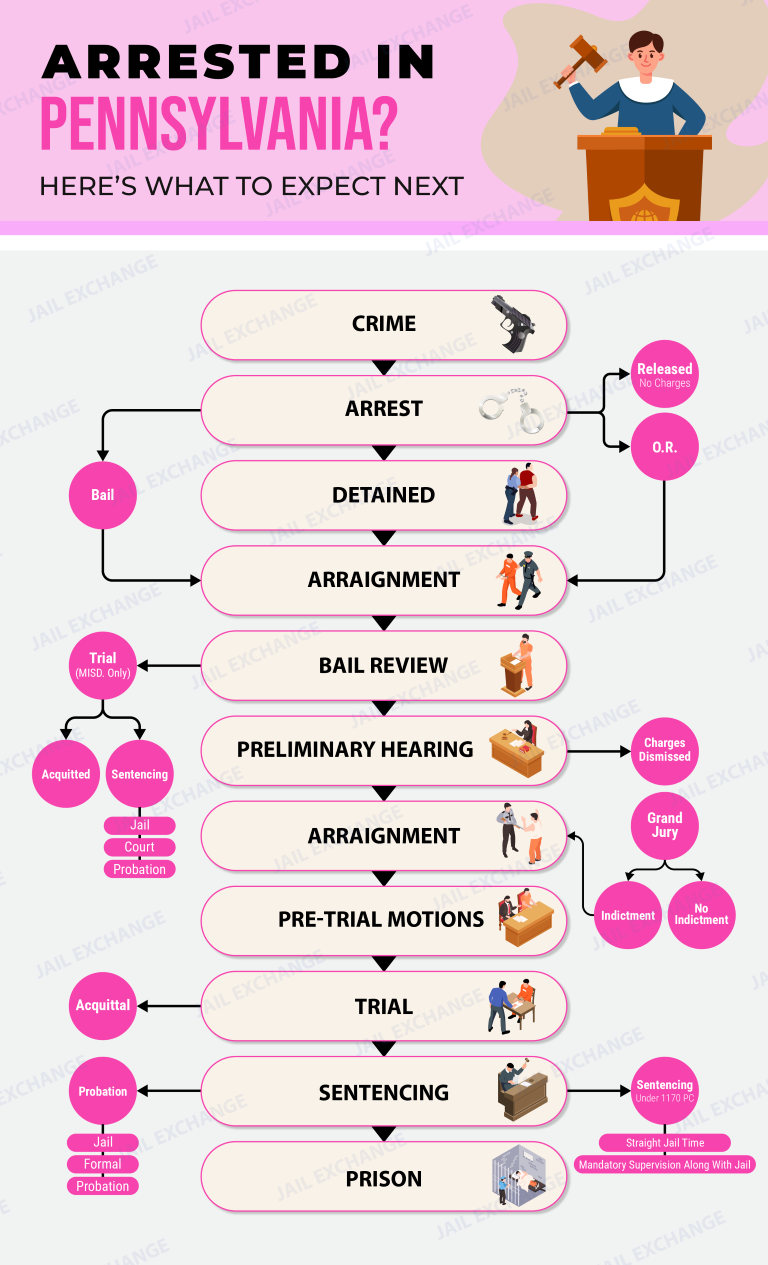
Lancaster County Prison Criminal Court Process
Criminal Court Process for Lancaster County Pennsylvania
Lancaster County Criminal Court Guide
A new criminal charge here first lands at one of 19 district courts, then moves up to the Court of Common Pleas at the courthouse, 50 North Duke Street, Lancaster, PA 17602. If the person stays locked up during the case, they wait at the Lancaster County Prison, 625 East King Street, Lancaster, PA 17602. That single building has an intake unit, maximum to minimum security housing and a work release unit. Below: each court's address, how a case moves and how to look one up.
To see if the person is in custody today, try the county prison's inmate locator. Our Inmates in Custody page carries on from that point: new bookings, the charges, warrants still open, mugshots, free lawyers and how to claim property.
On a weekday, phone Court Administration at 717-299-8041. Ask which district court office has the case and when the preliminary hearing is set. Then check our bail page to learn how to get the person released while the case goes on.
1. Which Pennsylvania court hears misdemeanors versus felonies?
Two levels of court share the work in this county:
- Magisterial District Courts are the local courts. Each is run by a Magisterial District Judge. They decide summary offenses, which are the smallest crimes, like most traffic tickets, disorderly conduct and many first retail thefts. They also hold the first two hearings in every misdemeanor and felony case and set bail.
- The Court of Common Pleas is the county's main trial court, the 2nd Judicial District. It takes misdemeanor and felony cases once a district judge sends them up. It also hears appeals of summary cases with a fresh trial.
A misdemeanor can bring up to 5 years in jail. A felony can bring up to 20 years, and murder can bring life or death. So the same district court office often handles both a speeding ticket and the first steps of a serious felony.
↑ Back to the question list2. Where are the Lancaster County courthouses?
Main courthouse. The Court of Common Pleas sits at 50 North Duke Street, Lancaster, PA 17602, 717-299-8041. It is open weekdays from 8:30 a.m. to 5:00 p.m. Mail goes to P.O. Box 83480, Lancaster, PA 17608. Inside the building:
- Clerk of Courts (criminal files), second floor, 717-299-8275, office hours 8:30 a.m. to 5:00 p.m., filing hours 8:30 a.m. to 4:30 p.m.
- Bail Administration and public defender applications, fifth floor, 717-295-3584
District courts. Most are open Monday to Friday, 8:30 a.m. to 4:30 p.m. Office 02-1-01 opens at 8:00 a.m. and closes at 4:00 p.m.
Offices in the city proper:
- 02-1-01, 641 Union Street, Lancaster, PA 17603, 717-299-7896
- 02-2-01, 123 Locust Street Rear, Lancaster, PA 17602, 717-299-7974
- 02-2-02, 150 North Queen Street, Suite 120, Lancaster, PA 17603, 717-295-2000
- 02-2-03, 1351 Elm Avenue, Lancaster, PA 17603, 717-299-7898
- 02-2-04, 796A New Holland Avenue, Lancaster, PA 17602, 717-299-7966
Offices just outside the city:
- 02-1-02, 2205 Oregon Pike, Lancaster, PA 17601, 717-569-8774
- 02-2-05, 2168 Embassy Drive, Suite 150, Lancaster, PA 17603, 717-735-2288 (alternative number 717-898-2511)
- 02-2-06, 841 Stehman Road, Millersville, PA 17551, 717-872-4361
- 02-3-02, 15 Geist Road, Lancaster, PA 17601, 717-656-2191
- 02-3-03, 324 Beaver Valley Pike, Willow Street, PA 17584, 717-464-4141
Offices in the boroughs and farm country:
- 02-1-03, 341 Chestnut Street, Columbia, PA 17512, 717-684-2761
- 02-3-01, 424 South Angle Street, Mount Joy, PA 17552, 717-653-4575
- 02-3-09, 5 Municipal Drive, Elizabethtown, PA 17022, 717-367-4330 (alternative number 717-653-1969)
- 02-2-08, 690 Furnace Hills Pike, Lititz, PA 17543, 717-626-0258
- 02-2-07, 609 East Main Street, Ephrata, PA 17522, 717-733-8688
- 02-3-07, 935 Stone Hill Road, Denver, PA 17517, 717-336-2801
- 02-3-06, 745B East Main Street, New Holland, PA 17557, 717-354-4206
- 02-3-05, 3 Heritage Drive, Suite 100, Gordonville, PA 17529, 717-768-3312
- 02-3-04, 25 East State Street, Quarryville, PA 17566, 717-786-7368
The court's website has an interactive map that shows which office covers each town. Court Administration can also tell you by phone.
↑ Back to the question list3. Does the city of Lancaster have its own court?
No. Outside Philadelphia and Pittsburgh, Pennsylvania has no city or town courts for crimes. Arrests inside the city go to one of the Magisterial District Courts with an office there. The same is true for every borough and township in the county.
A district court also hears local ordinance and summary cases, like a disorderly conduct citation or a traffic ticket. If the person loses a summary case, they can appeal to the Court of Common Pleas within 30 days of the plea or verdict. The appeal starts a brand-new trial. The Clerk of Courts charges a $49.00 filing fee for it, which is not paid back. Ask the Clerk about filing at 717-299-8275.
↑ Back to the question list4. What happens at the first court hearings?
A criminal case has two early hearings, both before a Magisterial District Judge.
Preliminary arraignment. This comes within hours of the arrest. A judge reads out the charges and hands over the written complaint. The person also learns they may have a lawyer. The judge sets bail and a date for the next hearing (Pa.R.Crim.P. 540).
Preliminary hearing. Someone kept in jail gets this hearing no later than day 14. A person who is out on bail waits no more than 21 days. The county says it takes place at the district judge's office. People still in custody appear by video from the prison. At this hearing the prosecutor must show a "prima facie" case. That means enough proof that a crime happened and that this person probably did it.
If the proof falls short, charges can be dismissed. If it is enough, the case is "held for court" and moves to the Court of Common Pleas. The defense can also waive this hearing and send the case straight up.
↑ Back to the question list5. How do DUI and retail theft cases move here?
Most first DUI and retail theft cases are misdemeanors or summary offenses. A first or second DUI at the general level is a misdemeanor with up to six months in jail (75 Pa.C.S. § 3803). A fourth DUI becomes a felony. Misdemeanor ranges run like this (18 Pa.C.S. §§ 1101, 1104):
- M1: up to 5 years and $10,000
- M2: up to 2 years and $5,000
- M3: up to 1 year and $2,500
- Summary offense: up to 90 days and $300
ARD for first offenders. Accelerated Rehabilitative Disposition is a second chance offered by the District Attorney and approved by a judge (Pa.R.Crim.P. 310). Finish it and the charge is dismissed, and it can be wiped from the record. Local rules:
- DUI ARD: apply by the preliminary hearing date, and no later than formal arraignment, with proof of insurance. It means a year of supervision and a license suspension of 0 to 90 days based on blood alcohol level. People with a DUI or ARD in the last 10 years, a crash that killed or badly hurt someone, a passenger under 14, or a blood alcohol level of .240% or more are left out.
- Non-DUI ARD: no deadline to apply. The fee is $950, or $650 for someone with a court-appointed lawyer, plus fines, costs and a supervision fee.
6. What path does a Lancaster County felony follow?
After the preliminary hearing sends a felony up, the case follows these steps in the Court of Common Pleas:
- The information. The District Attorney files the formal charges and may add or drop some.
- Formal arraignment. Usually a month or two later. The person gets the charges and enters a plea.
- Pretrial conference. Lawyers meet, and many plea deals are made here.
- Trial. A jury of 12 or a judge alone decides. A jury verdict must be unanimous, and guilt must be proven beyond a reasonable doubt.
- Sentencing. County probation writes a report on the person first. The judge then picks fines, probation, jail or prison, and restitution.
Felony limits (18 Pa.C.S. §§ 1101, 1103): F1 up to 20 years and $25,000; F2 up to 10 years and $25,000; F3 up to 7 years and $15,000. Appeals go to the Superior Court, then the Supreme Court.
↑ Back to the question list7. Are there drug, mental health or veterans courts?
Yes. The county runs three treatment courts with Adult Probation and Parole Services: Adult Drug Court, Mental Health Court and Veterans Court. They are for county residents 18 and older. Any charge can qualify except homicide and sex offenses that require registration.
Each court offers diversionary, modified and post-sentence tracks, so people can join at different points in a case.
To ask about a referral, call Adult Probation and Parole Services at 40 East King Street, Lancaster, PA 17608, 717-299-8181, and ask for the Office of Special Supervision.
↑ Back to the question list8. How are violent or very serious felonies different?
The biggest difference is bail. A judge can deny bail entirely when the charge carries death or life in prison, or if no conditions can keep others safe (Pa. Const. art. I, § 14). The prosecutor has to prove that with strong evidence at a hearing.
Penalties climb fast. First-degree murder brings death or life in prison. Second-degree murder brings life. Third-degree murder can bring up to 40 years (18 Pa.C.S. § 1102). Sentences that top out at five years or longer are served in a state prison.
Victims of violent crimes have extra rights. They can speak to the judge about bail, plea deals and the sentence. Murder and some armed crimes move 15- to 17-year-olds into adult court.
↑ Back to the question list9. Who prosecutes and defends in Lancaster County?
District Attorney. The DA's office brings every criminal case. It is at 50 North Duke Street, Lancaster, PA 17602, 717-299-8100, open weekdays 8:30 a.m. to 5:00 p.m. County Detectives and the Drug Task Force work under the DA. Non-DUI ARD papers can go to the office by mail, in person or by email at districtattorney@lancastercountypa.gov.
Public Defender. Without money for a lawyer, a person may apply for a public defender (16 P.S. § 9960.1 and following). Here, the application is filed face to face at the Bail Administration office on the courthouse's fifth floor, 50 North Duke Street, Lancaster, PA 17602, 717-295-3584, weekdays 8:30 a.m. to 4:00 p.m. Bring the complaint, the police affidavit, 30 days of income proof for you and any spouse, and a bank balance dated that day. The county's application page lists every paper.
Applicants swear to their income on a signed form. Lying on it counts as perjury.
↑ Back to the question list10. Which free site shows the docket and hearings?
The fastest tool is the free UJS Web Portal case search. No account is needed:
- Choose a search by participant name.
- Type the first name and last name, and pick Lancaster from the county list.
- Open the docket sheet that matches. It lists the charges, the bail amount, upcoming hearing dates and the courtroom.
A filing made today might not show up until later. Juvenile, sealed and expunged cases never show up there.
For a hearing at the courthouse, the court also runs a public court calendar. The Clerk of Courts staff point callers to the UJS portal and do not give legal advice. A written record check from the Clerk costs $21.50 and covers convictions in this county only.
↑ Back to the question list11. How would a family spot an open warrant and resolve it?
Bench warrants from the Court of Common Pleas are served by the Sheriff's Office, and its District Court Warrant Control Unit serves warrants from all 19 district judges. Police and constables serve warrants too. Check the Sheriff's Wanted Persons page, the Warrant Control Unit page and the DA's CrimeWatch page, or call the Sheriff at 717-299-8200. Wider lists come from the State Police, the Marshals fugitive list and the FBI. The Sheriff cannot cancel a district court warrant, so call the office named on the Sheriff's letter. For a bench warrant, go with a lawyer to the Sheriff at the courthouse, 50 North Duke Street, Lancaster, PA 17602. The Clerk of Courts answers at 717-299-8275.
↑ Back to the question list12. Who hears a federal case started by an arrest here?
The U.S. District Court for the Eastern District of Pennsylvania hears these cases. Under the court's assignment rule, a case from here goes to a judge who sits in one of three cities:
- The Gateway Building, 201 Penn Street, Reading, PA 19601
- Edward N. Cahn U.S. Courthouse, 504 West Hamilton Street, Allentown, PA 18101
- Holmes Building, 101 Larry Holmes Drive, Easton, PA 18042
The district's Clerk's Office can be reached at 215-597-7221. A federal judge settles release at a detention hearing held soon after arrest (18 U.S.C. 3142). The U.S. Attorney's Office, which prosecutes these cases, has a branch at 504 West Hamilton Street, #3701, Allentown, PA 18101, 215-861-8540. Defendants who can't afford counsel may get the Federal Community Defender, 601 Walnut Street, Suite 540 West, Philadelphia, PA 19106, 215-928-1100.
Jailed federal defendants are tracked by the Marshals before trial: U.S. Marshals Service, 601 Market Street, Room 2110, Philadelphia, PA 19106, 215-597-7272. After sentencing, use the Federal Bureau of Prisons inmate locator.
↑ Back to the question list13. Does an immigration detainer affect the state case?
Usually the criminal case in county court goes on as before, but an ICE detainer can change the day the person is due to walk out. The steps:
- ICE files Form I-247A with the prison, asking it to hold the person.
- The hold can last up to 48 hours after they would otherwise be released (8 CFR 287.7(d)).
- If ICE takes custody, the person moves into the federal immigration system.
- Track them on the ICE Online Detainee Locator.
The Third Circuit, the federal appeals court covering Pennsylvania, found in its 2014 Galarza v. Szalczyk ruling (3d Cir. 2014) that a detainer only asks; it does not order. A county that keeps someone only on a detainer can be liable for doing so. That is why each county jail sets its own policy. Call the prison at 717-299-7800 to ask about it. ICE's Philadelphia Field Office is at 114 North 8th Street, Philadelphia, PA 19107, 215-656-7164.
↑ Back to the question list14. Which prison holds someone after sentencing?
The longest possible term in the sentence, called the maximum, decides the place (42 Pa.C.S. § 9762). A maximum under two years means the county prison. A maximum of five years or more means a state prison. Between two and five years, the default is state prison. The person can stay local only when three parties agree: the county prison, the DA's office and the judge who imposed the sentence.
State inmates start out at a reception and classification center for testing. That stretch can last weeks or months before they move to a long-term prison. Look them up with the Department of Corrections inmate locator, or call the department at 1920 Technology Parkway, Mechanicsburg, PA 17050, 717-728-2573. Our Pennsylvania state prison pages describe each prison.
↑ Back to the question list15. How are charges against a Lancaster County teen handled?
Youth under 18 usually go through juvenile court under the Juvenile Act (42 Pa.C.S. § 6301). The case is handled by Juvenile Probation, 50 North Duke Street, Lancaster, PA 17602, 717-299-8161. Juvenile records do not appear on the public UJS portal.
If a youth must be held, they go to the Youth Intervention Center, 235 Circle Avenue, Lancaster, PA 17602, 717-299-7821, not the adult prison. The center also runs an evening and weekend program for youth 13 to 18.
For a youth aged 15 to 17, a murder charge sends the case to adult court from day one. Certain violent crimes with a deadly weapon do the same (42 Pa.C.S. § 6302). The defense lawyer can ask to have the case moved to juvenile court.
↑ Back to the question list16. How does Pennsylvania protect crime victims?
Pennsylvania's Crime Victims Act gives victims a voice (18 P.S. § 11.101 and following). Victims can:
- get basic information about services and be told of key court events
- comment on bail, and in many cases on plea deals and the sentence
- be told when the person is released from the county prison
- seek restitution for what the crime cost them
Victim and Witness Services is part of the District Attorney's office at 50 North Duke Street, Lancaster, PA 17602, 717-299-8100. For free release alerts, sign up with PA SAVIN on VINELink or call 866-972-7284. The state's Victims Compensation Assistance Program can help with costs at 800-233-2339.
A word to families of the accused: never contact the victim or pass along a message. That can break bail rules and lead to new charges.
↑ Back to the question list