Kingstree, on the Black River, is the county seat of Williamsburg County, a large and mostly rural Pee Dee county known for tobacco and timber. Magistrates in Kingstree and Hemingway, together with four town courts, handle lesser charges and bond hearings, and felonies are tried in the Court of General Sessions at the Williamsburg County Courthouse on West Main Street. Williamsburg is one of four counties in the Third Judicial Circuit, alongside Clarendon, Lee and Sumter, and General Sessions prosecutions are brought by the circuit's elected Solicitor. Anyone arrested as an adult is taken to the Williamsburg County Detention Center in Kingstree.
- Williamsburg County Clerk of Court, Williamsburg County Courthouse, 125 West Main Street, Kingstree, SC 29556, (843) 355-9321
- Williamsburg County Magistrate Court, Kingstree Central Office, 209 Short Street, Kingstree, SC 29556, (843) 355-9565
- Third Circuit Solicitor's Office, which prosecutes Williamsburg County General Sessions and juvenile cases
- Third Circuit Public Defender, Williamsburg County office, (843) 355-9321
- Williamsburg County Sheriff's Office, 200 South Jackson Street, Kingstree, SC 29556, (843) 355-6381
- Williamsburg County Detention Center, Kingstree, SC 29556, (843) 355-9696
Which court hears your case. Charges limited to 30 days in jail or a $500 fine are tried in Williamsburg County Magistrate Court, as are first-offense DUI, shoplifting worth $2,000 or less and the occasional statute that allows a summary-court fine of up to $1,000. Magistrates in Kingstree and at the Hemingway satellite office also issue warrants, decide release at bond hearings and hold preliminary hearings for felony charges. Arrests made by town police inside Kingstree, Hemingway, Greeleyville or Lane can be heard by that town's Municipal Court, which tries the same level of state charge plus town ordinance violations. The Court of General Sessions, meaning the Circuit Court on its criminal side, takes everything more serious once a Williamsburg County grand jury returns an indictment.
Where pretrial inmates are held. The Sheriff's Office operates the county detention center in Kingstree, and arrests by deputies, town police and the Highway Patrol are booked there. People who are not released after the bond hearing remain in the jail while their cases are pending, alongside some who are serving short sentences. For inmate status or release information, call the detention center at (843) 355-9696; the Sheriff's main office on South Jackson Street answers at (843) 355-6381.
- Local courts in Williamsburg County (magistrate and municipal courts)
- Misdemeanor (for example, shoplifting, a first DUI, third-degree assault and battery, trespassing)
- Felony (for example, burglary, grand larceny, drug distribution, first-degree assault and battery)
- Violent felony (for example, murder, criminal sexual conduct, armed robbery)
- Juveniles (under 18) arrested in Williamsburg County
- Federal cases (U.S. District Court) from Williamsburg County
Local courts in Williamsburg County (magistrate and municipal courts)
Williamsburg County spreads across more than 900 square miles, so its magistrates keep a central office in Kingstree and a satellite office in the eastern part of the county at Hemingway. Bond hearings for people held at the detention center are handled by the county magistrates. Four towns operate municipal courts.
Magistrate courts (county)
- Kingstree Central Office — 209 Short Street, Kingstree, SC 29556, (843) 355-9565
- Hemingway Satellite Office — Chavis One-Stop Complex, 2811 South State Highway 41-51, Hemingway, SC 29554, (843) 558-4145
Between them, the two offices cover the unincorporated county, including communities like Cades, Salters, Indiantown, Trio and Nesmith, for criminal and traffic cases, warrants, preliminary hearings and civil claims.
Municipal courts
- Kingstree Municipal Court — 401 North Longstreet Street, Kingstree, SC 29556, (843) 355-7484
- Hemingway Municipal Court — 110 South Main Street, Hemingway, SC 29554 (mailing P.O. Box 968), (843) 558-2424
- Greeleyville Municipal Court — Greeleyville, SC 29056 (mailing P.O. Box 212), (843) 426-2111
- Lane Municipal Court — Lane Town Hall, 345 South Lane Road, Lane, SC 29564, (843) 387-5151
Town courts in Greeleyville and Lane hold sessions only on set days, so phone ahead. Decisions of any Williamsburg County magistrate or municipal judge may be appealed to the Circuit Court; the notice is ordinarily due within 10 days after sentencing.
Misdemeanor (for example, shoplifting, a first DUI, third-degree assault and battery, trespassing)
Summary offenses in Williamsburg County are usually decided in Kingstree, at the Hemingway magistrate office, or in one of the town courts. Plenty of these cases begin with a ticket and no arrest. Someone taken into custody, as often happens with DUI or domestic calls, is driven to the Williamsburg County Detention Center in Kingstree for booking.
First appearance and release
State law gives the magistrate 24 hours to conduct a bond hearing. Options include release on one's own recognizance, a cash deposit, a surety bond arranged through a licensed bondsman, or a property bond. For alleged domestic violence, the judge commonly orders no contact, and the victim is informed and can be heard.
Trial and representation
In Williamsburg's summary courts, officers commonly present their own cases, with the Solicitor's office sometimes handling DUI and domestic violence prosecutions. Defendants may choose a bench trial or a jury of six. The Third Circuit Public Defender serves Williamsburg County and can be reached at (843) 355-9321; the application carries a $40 fee that may be waived.
Penalties
- Shoplifting valued at $2,000 or less: a magistrate or town judge may impose a fine or as long as 30 days.
- Third-degree assault and battery: 30 days and $500 are the upper limits.
- Trespass, first offense: a fine capped at $200 or a jail term capped at 30 days.
- First DUI: a reading under .10 brings 48 hours to 30 days in jail, which may be served instead as 48 hours of public service, with a $400 base fine plus assessments. Those numbers rise at .10 to under .16 and again at .16 and above. A six-month suspension applies (ignition interlock can shorten the time off the road), and the driver must finish ADSAP. Refusing the breath test is penalized by an administrative suspension.
Williamsburg misdemeanors often close with a dismissal, a fine, a suspended sentence, conditional discharge or a diversion program such as PTI or alcohol education. Records of dismissed or diverted charges can frequently be expunged. Most cases end within one to three months.
Felony (for example, burglary, grand larceny, drug distribution, first-degree assault and battery)
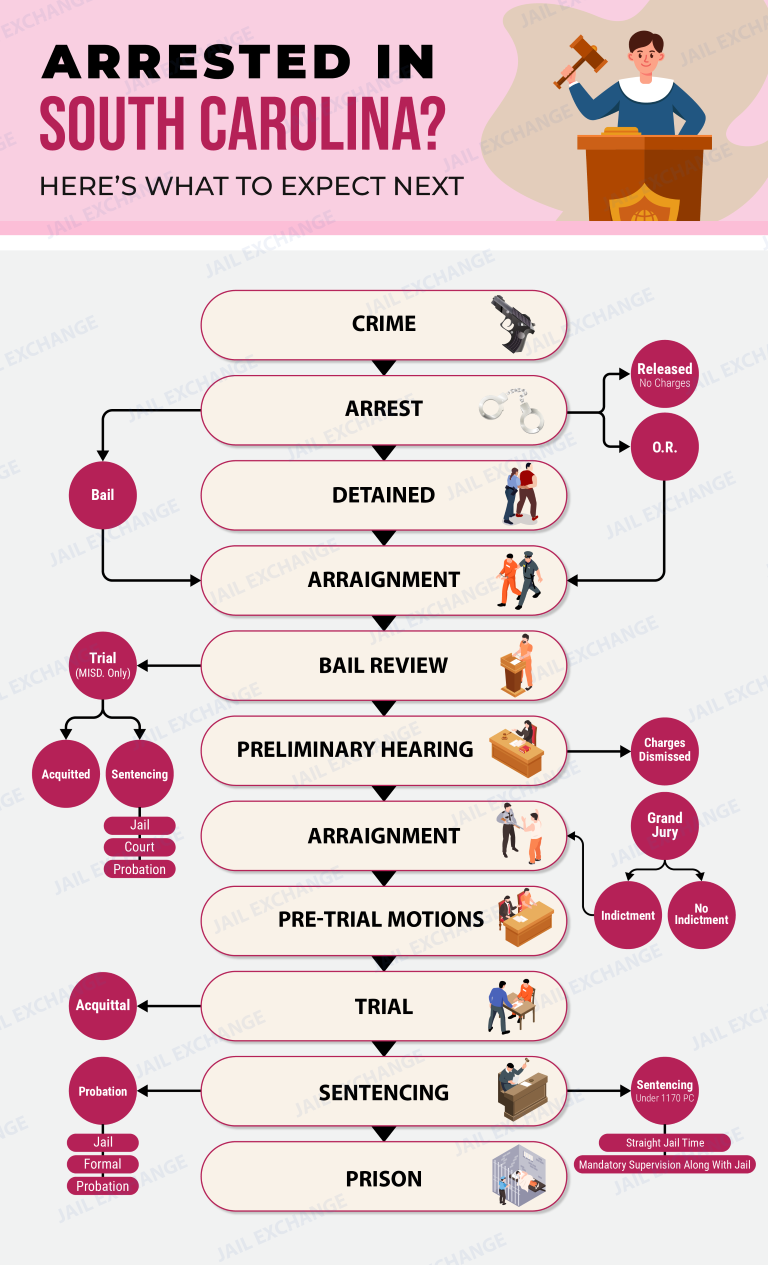
When a felony arrest happens in Williamsburg County, the person is booked at the Williamsburg County Detention Center and brought before a magistrate within 24 hours. The magistrate sets bond in most felony cases and can add conditions such as house arrest, electronic monitoring or orders to stay away from witnesses. Newer state laws require tighter scrutiny when the defendant was already on release for a violent charge.
The road to General Sessions
- Preliminary hearing: the defense must ask within 10 days of the bond hearing. A magistrate hears the officer's testimony and decides whether there is probable cause to send the case forward.
- Grand jury: the Third Circuit Solicitor presents the case to the Williamsburg County grand jury, which decides whether to indict.
- Court terms: circuit judges hold General Sessions in Kingstree on a rotating schedule, and indicted cases are called from the roster.
- Resolution: most defendants accept a plea agreement; those who go to trial face a 12-member jury that must reach a unanimous verdict.
Penalties for common felonies
- Burglary: second degree is capped at 10 years, or 15 when charged as violent; first degree carries 15 years to life.
- Grand larceny: up to 5 years for more than $2,000 but less than $10,000, and up to 10 years once the value hits $10,000.
- Drug distribution: penalties are tied to the drug involved, the amount and the number of prior offenses, and trafficking weights come with mandatory minimum terms.
- Assault and battery, first degree: up to 10 years. The aggravated charge, ABHAN, allows a sentence of up to 20.
Felony classes in South Carolina run from A (30 years maximum) to F (5 years maximum), and some offenses have penalties written into their own statutes. "No parole" offenses require 85 percent of the sentence to be served, and most prison sentences are served in the state Department of Corrections. Pretrial intervention through the Solicitor remains an option for many first offenders charged with nonviolent felonies.
Eligible defendants can get a lawyer from the Third Circuit Public Defender, (843) 355-9321. Williamsburg County felony cases generally take one to two years to be resolved.
Violent felony (for example, murder, criminal sexual conduct, armed robbery)
In Williamsburg County, only a circuit judge may set bond for murder, armed robbery, first-degree criminal sexual conduct and certain other violent crimes. Until that hearing, which can take days to schedule, the defendant is held at the Williamsburg County Detention Center. A circuit judge who grants release often requires GPS monitoring and no contact with the victim's family.
- Murder: not less than 30 years and up to life; the death penalty is possible if the Solicitor gives notice and an aggravating circumstance is proven. Executions resumed in South Carolina in 2024.
- Criminal sexual conduct in the first degree: up to 30 years, plus mandatory sex-offender registration.
- Armed robbery: 10 years minimum, 30 years maximum.
Violent offenses fall into the "most serious" and "serious" categories of the state's habitual-offender law, and repeat convictions can result in life imprisonment without parole. The Victims' Bill of Rights in the South Carolina Constitution guarantees victims notice of court events and a chance to speak, and the Third Circuit Solicitor's victim advocates keep them informed. A violent felony case in Williamsburg County can take two to three years or more to reach trial or plea.
Juveniles (under 18) arrested in Williamsburg County
Juvenile delinquency cases from Williamsburg County are heard by the Family Court in Kingstree. South Carolina's 2019 "raise the age" change means 17-year-olds generally start in Family Court as well, with exceptions for some serious offenses.
Intake and the Solicitor
After an arrest or referral, the state Department of Juvenile Justice (DJJ) office serving Williamsburg County conducts intake, talks with the youth and family, and passes a recommendation to the Third Circuit Solicitor. The Solicitor then chooses whether to file a petition, send the youth to juvenile arbitration or another diversion program, or drop the matter.
Secure detention
The county has no juvenile detention facility. A young person who cannot safely go home is typically placed at the DJJ Juvenile Detention Center in Columbia, a drive of roughly 80 miles. The youth then gets a Family Court detention hearing, which by law comes within 48 hours, leaving out weekends and holidays.
Outcomes
- For first or minor cases: arbitration, diversion or dismissal.
- Probation with conditions, community service, counseling or restitution.
- Assessment at a DJJ evaluation center before disposition.
- Indeterminate commitment to DJJ, ending no later than the youth's 21st birthday.
- Waiver to adult court in General Sessions, after a hearing, for older teens (generally 14 and up) charged with serious felonies.
Juveniles are entitled to a lawyer; the Third Circuit Public Defender, (843) 355-9321, represents those who qualify. Juvenile proceedings are generally closed, and many records can be expunged.
Federal cases (U.S. District Court) from Williamsburg County
Williamsburg County belongs to the Florence Division of the U.S. District Court for the District of South Carolina, a Pee Dee division that also takes in Chesterfield, Darlington, Dillon, Florence, Horry, Marion and Marlboro counties. Federal criminal cases from Kingstree, Hemingway and the rest of the county are heard about 40 miles north in Florence, where the court, the prosecutors and the federal defenders share one building.
- J.L. McMillan Federal Building and U.S. Courthouse, 401 West Evans Street, Florence, SC 29501; Clerk's Office (843) 676-3820
- U.S. Attorney's Office, Florence, McMillan Federal Building, 401 West Evans Street, Room 222, Florence, SC 29501, (843) 665-6688
- Federal Public Defender, Florence, 401 West Evans Street, Room 221, Florence, SC 29501, (843) 662-1510
A Williamsburg County matter turns into a federal prosecution when the conduct is a federal crime and the U.S. Attorney files charges, usually after an investigation by agencies such as the FBI, DEA, ATF, the U.S. Postal Inspection Service or Homeland Security Investigations. In rural Pee Dee counties these cases often involve drug distribution networks, firearms offenses by people barred from having guns, fraud against federal farm, disaster or benefit programs, and child exploitation.
The case moves through a series of steps after the arrest. The defendant first appears before a U.S. magistrate judge in Florence, who appoints the Federal Public Defender or a Criminal Justice Act attorney for a person who cannot pay. Federal judges do not use bail bondsmen; under the Bail Reform Act, the magistrate judge decides between release on conditions supervised by U.S. Pretrial Services and detention, with a detention hearing usually within three court days of a government request. Within 30 days of an arrest on a complaint, the government must obtain a grand jury indictment, after which the Speedy Trial Act's 70-day trial clock begins, often paused by continuances.
Nearly every case ends with a guilty plea. At trial, 12 jurors must vote unanimously. Sentencing follows a presentence investigation by U.S. Probation, with the judge applying the advisory Guidelines range and any statutory mandatory minimum. Because federal parole has been abolished, a sentence is served in the Bureau of Prisons, about 85 percent of it with good-conduct credit, and then supervised release begins. Appeals go to the Fourth Circuit.
The Federal Bureau of Prisons inmate locator lets relatives search by name or register number. Defendants waiting for trial are often placed in a county jail that houses prisoners for the U.S. Marshals, and such a person may be listed on that jail's own roster too. Juveniles are very seldom charged in federal court.
This Williamsburg County guide is general information about the criminal court process, not legal advice, and court schedules and contacts may change. Anyone charged in Williamsburg County should consult a criminal defense attorney or contact the Third Circuit Public Defender for Williamsburg County at (843) 355-9321, and confirm all court dates with the Clerk of Court.