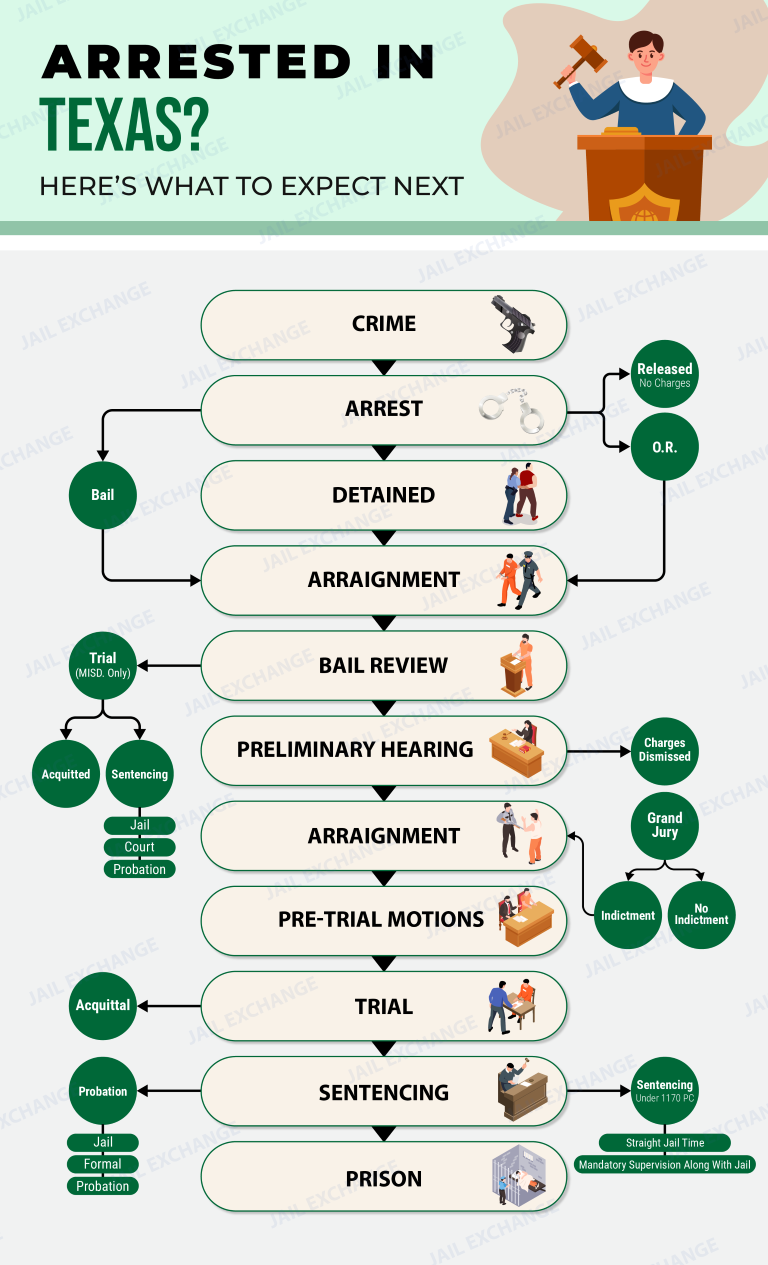
Lewisville City Jail Criminal Court Process
Criminal Court Process for Denton County Texas
Denton County Criminal Court Guide
Most criminal trials in this county happen in a single building, the Courts Building at 1450 E. McKinney Street, Denton, TX 76209. People held while their case is open are kept at the Denton County Jail, 127 N. Woodrow Lane, Denton, TX 76205, a campus with a main jail, pods, a barracks, a pre-trial intake building and a tower. Two cities also keep short-stay lockups. Below are the courts, case steps, lawyers, warrants and record searches.
The county's records portal tells you if someone is still in jail. It also holds case files and court dates. Our Inmates in Custody page answers the other custody questions: who is held now, recent bookings, charges, warrants, mugshots, defense lawyers and property release.
On a felony, ring the District Clerk at 940-349-2200. On a misdemeanor, ring the County Clerk at 940-349-2012. Ask for the case number, the court and the next setting. Still waiting for release? Our bail page covers bonds.
1. Felony or misdemeanor: which court takes the case here?
Each level of crime has its own court in Texas:
- Felonies go to a district court. Twelve district courts sit here: the 16th, 158th, 211th, 362nd, 367th, 393rd, 431st, 442nd, 462nd, 467th, 477th and 481st. The District Clerk can tell you which one has a given case.
- Class A and B misdemeanors go to County Criminal Courts No. 1 through 5 or a County Court at Law. The County Clerk files them.
- Class C offenses, punished by a fine alone, go to a justice of the peace court or a city's municipal court.
- Appeals: the last stop for any criminal appeal is the Court of Criminal Appeals.
Besides these, the county runs a Mental Health Treatment Court and a Veterans Treatment Court. Texas specialty courts like these usually last 12 to 24 months. The state lists every one on its specialty courts page.
↑ Back to the question list2. Where do Denton County criminal courts meet?
Two buildings matter most for criminal cases.
- Courts Building, 1450 E. McKinney Street, Denton, TX 76209. The District Clerk works on the 1st floor, 940-349-2200, open weekdays 8 a.m. to 4:30 p.m. The district and family courts are on the 3rd floor. The County Clerk's office, 940-349-2012, keeps business hours. The Magistrate Court, 940-349-1873, the Indigent Defense Office and the Criminal District Attorney are here too.
- Charlie J. Cole Building, 210 S. Woodrow Lane, Denton, TX 76205. Juvenile court meets here, and Juvenile Probation answers at 940-349-2400.
If you are unsure which courtroom to report to, the clerk who keeps the file can tell you by phone.
↑ Back to the question list3. Where do fine-only tickets get heard?
Fine-only Class C cases are split between six justice of the peace courts and the cities' own municipal courts. A ticket written by city police usually goes to that city's court, and the ticket shows its address. Justice courts take county-wide cases:
- Precinct 1, 1 Courthouse Drive, Suite 1100, Denton, TX 76208, 940-349-3170
- Precinct 2, 5533 FM 423, Suite 901, Frisco, TX 75036, 972-434-7200
- Precinct 3, 400 N. Valley Parkway, Suite 2012, Lewisville, TX 75067, 972-434-4750
- Precinct 4, 6200 Canyon Falls Drive, Suite 101, Flower Mound, TX 76226, 972-434-3910
- Precinct 5, 1400 FM 424, Suite 124, Cross Roads, TX 76227, 940-349-3460
- Precinct 6, 1029 W. Rosemeade Parkway, Carrollton, TX 75007, 972-434-7100
Lost the ticket? Call the agency that wrote it. For a city of Denton ticket, police answer at 940-349-8181. For a ticket from a deputy, ask the Sheriff's Office at 940-349-1600.
Class C rules are softer. Officers may write a citation instead of making an arrest for most of these offenses, except public intoxication (CCP art. 14.06). A personal bond is the usual way out (CCP art. 45A.107). Under CCP arts. 45A.252-45A.261, someone who can't afford a fine may get installments, community service credited at $150 for every 8 hours, or a waiver. Jail for an unpaid fine requires a hearing and a finding that the person acted without good faith. Unpaid justice court tickets can turn into warrants, so deal with them early. Precinct 3 takes online payments.
↑ Back to the question list4. Rights, lawyers and bail: what happens before the magistrate?
Within 48 hours, the arrested person sees a magistrate (CCP art. 15.17(a)). In this county, the hearing may be face to face or on a recorded two-way video screen. The Magistrate Court posts a weekly docket.
The magistrate must explain:
- the crime the person is accused of
- that hiring a lawyer is their right, and that a poor person can request one
- that they can stay silent, and that their words may be used against them
- that they may have a lawyer with them during questioning and can stop an interview
- that an examining trial is available on a felony
The magistrate helps fill out the lawyer request. It must reach the appointing office within 24 hours. Bail is set at this hearing, too. For a fine-only offense, release on a written promise to appear is allowed, except for people with certain past convictions (CCP art. 15.17(b)).
Two more protections apply. If the magistrate finds no probable cause, written findings are due within 24 hours (CCP art. 15.17(h)). Jail staff who spot possible mental illness must notify the magistrate within 12 hours (CCP art. 16.22).
↑ Back to the question list5. How does a DWI or theft misdemeanor travel through county court?
For Class A and B cases, the Criminal District Attorney's misdemeanor trial division files a charging paper called an information. The case then goes to a County Criminal Court or a County Court at Law. Most cases follow this path:
- Arraignment. In open court, the charge is formally read out and the person pleads to it (CCP art. 26.01).
- Settings before trial. Evidence gets shared, motions are argued and a deal may be reached.
- Plea or trial. Under CCP art. 26.13, a judge who won't follow a plea bargain must let the person withdraw the plea.
Here are the penalty ranges set by the Penal Code:
- Class A: jail of a year or less, a fine of $4,000 or less, or both (PC 12.21)
- Class B: jail of 180 days or less, a fine of $2,000 or less, or both (PC 12.22)
- Class C: a fine of $500 or less, and no jail (PC 12.23)
Other endings are possible. With deferred adjudication, there is no guilty finding, and the case is dismissed after up to two years of good conduct. Probation on a misdemeanor also runs up to two years (CCP arts. 42A.053, 42A.103), and the prosecutor's Pre-Trial Diversion Program serves low-risk, first-time offenders.
DWI cases often add bond rules. Pre-Trial Bond may order a car breath-test device installed within 7 days. The probation department has pages on its Victim Impact Panel and on interlock devices.
↑ Back to the question list6. From examining trial to verdict: how do felonies proceed?
District court felony cases pass through five stages:
- Examining trial. Under CCP art. 16.01, the accused may ask a judge, before any indictment, to test whether probable cause exists.
- Grand jury. In a closed room, grand jurors weigh the state's evidence, and nine votes are needed to indict (CCP art. 20A.301).
- Arraignment before the assigned district judge.
- Pretrial work, such as hearings on motions and evidence, plus any bargaining.
- Resolution by guilty plea or jury verdict, followed by a sentence.
Felony punishment ranges (PC 12.31-12.35), from most to least serious:
- Capital: execution, or life with no parole. If the defendant was under 18, life.
- First degree: between 5 and 99 years in prison, or a life term
- Second degree: anywhere from 2 years up to 20
- Third degree: anywhere from 2 years up to 10
- State jail felony: 180 days minimum, 2 years maximum, in a state jail facility
Every level below capital also allows a fine as high as $10,000. Earlier convictions can push the range higher (PC 12.42). A state jail felony can sometimes be punished as a Class A misdemeanor (PC 12.44). On a felony, a judge can set probation or deferred adjudication for as long as 10 years (CCP arts. 42A.103, 42A.053).
↑ Back to the question list7. How do violent or weapons cases differ?
Expect stricter treatment at almost every step:
- Bail can be refused. A 2025 change to the state constitution reaches crimes like aggravated robbery, murder and aggravated sexual assault. Bail must be denied when the prosecutor shows the person may run or may hurt someone (Tex. Const. art. I, §11d).
- Prosecutors can push back. They may seek a district judge's review of bail on a felony (CCP art. 17.029), and in listed cases appeal one they think is too low (CCP art. 44.01).
- No personal bond. The law rules it out for a long list of violent offenses, and for a person on supervision for a violent crime who is charged again (CCP art. 17.03).
- Family violence. A 4-hour hold after bond is required when more violence seems likely (CCP art. 17.291(b)). The alleged victim must be told before release (CCP art. 17.29).
- Protective orders. A magistrate can issue an emergency order at the first hearing. It lasts 61 to 91 days, or 91 to 121 days when there was serious injury or a weapon (CCP art. 17.292). Locally, the Magistrate Court issues these only while the accused is still in jail.
Capital murder is the gravest charge of all, punished only by death or by life without any parole (PC 12.31).
↑ Back to the question list8. Denton County prosecutors and appointed defense: who are they?
The Criminal District Attorney prosecutes both felonies and misdemeanors. Its office is at 1450 E. McKinney Street, Suite 3100, Denton, TX 76209, 940-349-2600. Separate teams handle felony and misdemeanor trials. The office also runs specialized treatment court programs.
For defense, the county appoints private lawyers in turn from lists the judges approve. To ask for one, contact the Indigent Defense Office on the 2nd floor of the Courts Building, 1450 E. McKinney St., Suite 2428, Denton, TX 76209, 940-349-1890. Hours are 8 a.m. to 4 p.m. Monday through Thursday, and 7 a.m. to 3 p.m. Friday.
- Ask the magistrate, use the jail kiosk, visit the office, or speak up at a court date.
- Appointed lawyers cover Class A and B misdemeanors and felonies.
- The county may later ask for some of the cost back.
- Here, an appointment has to happen fast: by the close of the next working day once the request lands (CCP art. 1.051(c)).
The county's indigent defense plans set the rules for each court.
↑ Back to the question list9. Where can a case number and next setting be found?
The fastest tool is the county's records portal. It searches case records, court calendars, and jail and bond records. The county warns that data entry can lag, and only the court's own file is the official record.
- Type a name, pick the matching case, and read the court and upcoming settings.
- For a first hearing, check the Magistrate Court's weekly docket.
- Felony questions go to the District Clerk, 940-349-2200.
- Misdemeanor questions go to the County Clerk, 940-349-2012.
Statewide, re:SearchTX shows charges and judgments after a free sign-up, but not hearing dates. DPS sells a conviction name search for finished cases.
↑ Back to the question list10. Could there be a Denton County warrant, and what clears it?
Sheriff's deputies, the county constables and city police each serve warrants here. Phone the Sheriff's warrants line, 940-349-1560, or the Constables' Warrant Division, 1 Courthouse Drive, Denton, TX 76208, 940-898-5696. Inside city limits, Denton police take calls at 940-349-8181. Check the Precinct 3 constable warrants page, the state's Texas 10 Most Wanted list and the records portal. Before acting, get advice from a defense lawyer. The usual fixes are surrendering at the issuing judge's court, or calling it to ask for a new setting. The District Clerk handles felony warrants at 1450 E. McKinney Street, 1st Floor, Denton, TX 76209, 940-349-2200.
↑ Back to the question list11. Which federal court takes cases from the Denton area?
Sherman Division court, part of the Eastern District of Texas, takes federal cases from this area. Judges hear them in two buildings:
- Paul Brown United States Courthouse, 101 East Pecan Street, Room 216, Sherman, TX 75090, 903-892-2921
- United States Courthouse, 7940 Preston Road, Room 101, Plano, TX 75024, 214-872-4800
Early on, a detention hearing decides release. The question is whether any mix of conditions makes it safe (18 U.S.C. 3142). A person kept in custody is the responsibility of the U.S. Marshals Service. Its Plano line is 214-705-9850, and its Eastern District headquarters sits at 211 West Ferguson Street, 4th Floor, Tyler, TX 75702, 903-590-1370.
- Prosecution: U.S. Attorney's Office, 101 E. Park Boulevard, Suite 500, Plano, TX 75074, 972-509-1201
- Free defense: Federal Public Defender, 600 E. Taylor Street, Suite 4000, Sherman, TX 75090, 903-892-4448
- After sentencing: the Federal Bureau of Prisons inmate locator
12. Does an immigration hold affect the Texas case?
A detainer does not stop or pause the Texas case. What it changes is release day.
- Immigration agents send over Form I-247A. On it, they request custody of the person from the jail.
- The jail may keep them up to 48 hours after they would otherwise be released (8 CFR 287.7(d)).
- Texas jails must honor detainers. The one exception is someone holding papers that show citizenship or lawful immigration status, as CCP art. 2A.060 provides.
- Under CCP art. 17.027(a-2), certain appointed magistrates can't release on bail anyone with a detainer.
- Under Government Code chapter 752, local agencies may not limit immigration enforcement. Separately, a 2025 law tells every county with a jail to request a 287(g) partnership, and the cutoff is December 1, 2026. The Sheriff's Office knows the local status; reach it at 940-349-1600.
- Once in federal hands, the person falls under the ICE Dallas Field Office, 8101 N. Stemmons Freeway, Dallas, TX 75247, 972-367-2200. Find them on the ICE Online Detainee Locator.
13. Where is a TDCJ sentence served?
A sentence to prison is carried out by the Texas Department of Criminal Justice. Intake comes first, then a move to a unit that fits the person. A state jail felony is served in a state jail (PC 12.35).
- The TDCJ inmate search takes a SID number, a TDCJ number, or a last name plus at least a first initial. Results lag a day or more and change only on working days.
- Unit details live on our Texas state prisons page.
- Probation is handled by the local probation department, 650 S. Mayhill Road, Denton, TX 76208, 940-349-3300. It has full offices in Denton and Lewisville, plus satellites in The Colony, Roanoke and Cross Roads.
14. How are Denton County juvenile cases handled?
Texas juvenile court is for offenses by children from age 10 through 16. Once a person has turned 17, adult court takes the case (FC 51.02(2)). Here, juvenile court meets in the Charlie J. Cole Building, 210 S. Woodrow Lane, Denton, TX 76205.
- Officers must notify a parent promptly (FC 52.02). A parent or the child's lawyer may stay with the child at the processing office (FC 52.025).
- The child may be held at the Juvenile Detention Center at the same address, 940-349-2470.
- A detention hearing is required by the second working day. Children taken in on a Friday or Saturday get that hearing on the first working day. The child has a lawyer by then (FC 54.01).
- An order to keep the child detained lasts at most 10 working days before the judge must review it.
- For some felonies, a youth can be certified to stand trial as an adult. The minimum age is 14 or 15, depending on the charge (FC 54.02).
For help, call Juvenile Probation at 940-349-2400.
↑ Back to the question list15. What support exists for victims of a crime?
Victims hold specific rights under CCP art. 56A.051. A few of them:
- the magistrate's weighing of their safety when deciding bail
- advance word of court dates, once they request it
- a waiting area kept apart from the defendant
- a victim impact statement the court considers before sentencing
Local help comes from the Criminal District Attorney's Victims' Assistance Division. For help, call the main office at 940-349-2600 and ask for victim assistance.
- Custody alerts: sign up with Texas IVSS-Counties, or call 866-268-8959 any hour, in English or Spanish. Signing up costs nothing and stays private. The person in jail won't learn who signed up.
- Money help: the Attorney General's Crime Victims' Compensation fund covers costs like medical bills and counseling, up to $50,000. Its line is 800-983-9933.