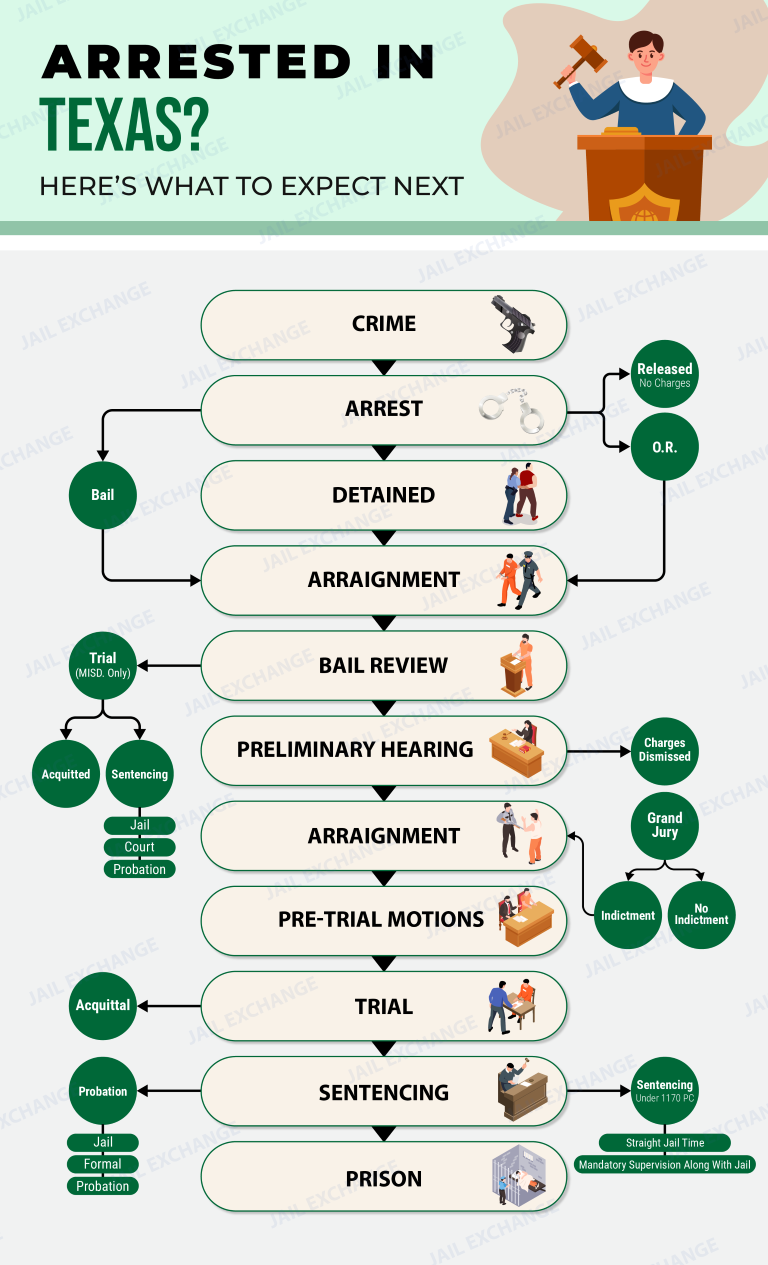
Gillespie County Jail Criminal Court Process
Criminal Court Process for Gillespie County Texas
Gillespie County Criminal Court Guide
Nearly every criminal file here passes through the old county courthouse at 101 West Main Street, Fredericksburg, TX 78624. Someone not yet bonded out waits a short drive east at the Gillespie County Jail, which the Sheriff keeps inside 1601 East Main Street, Fredericksburg, TX 78624. This guide sorts out each courtroom, the route a charge travels, plus who argues for the state and who argues for the defense.
Before anything else, confirm the person is still locked up. The Sheriff's website points to the county's court and justice records portal for that. Our who's held right now page rounds out the custody side: recent bookings, posted charges, outstanding warrants, mugshots, free-lawyer eligibility and reclaiming personal property.
Next, phone the clerk that fits the charge. Felonies go through the District Clerk at 830-997-6517, and misdemeanors through the County Clerk at 830-997-6515. Scribble three facts on paper: cause number, assigned judge, upcoming setting. If getting out comes first, our bond walkthrough handles that.
1. Misdemeanor or felony: which bench hears it?
The ceiling on punishment picks the courtroom. Locally that sorts out like so:
- Felonies land before the 216th District Court, whose single judge rides circuit between this county and Kerr County.
- Class A and Class B charges carry possible jail time. They're heard by either the County Court or the County Court at Law. One County Clerk files paperwork for both benches, so that office knows which judge holds any given cause.
- Class C charges carry only a money penalty. Justice courts hear those, or for a city officer's citation, the Municipal Court.
Appeals climb, at the very end, to Austin's Court of Criminal Appeals, highest in Texas for criminal matters.
↑ Back to the question list2. Gillespie County court offices: addresses and hours
Plan on the courthouse for most business. Clerk offices are open Monday through Friday.
- District Clerk, Room 204, 101 West Main Street, Fredericksburg, TX 78624, 830-997-6517. Courthouse hours are 9 a.m. to 4 p.m. This office indexes every District Court record and links to eFileTexas for lawyers.
- County Clerk, Room 109, same building, 830-997-6515. Open 8 a.m. to 4 p.m. Bring photo ID; staff ask for it on every visit.
- 216th District Court office, 700 Main Street, 2nd Floor, Kerrville, TX 78028, 830-792-2290. Because its judge splits time with Kerr County, phone Room 204 to learn when felony docket day returns to this side.
Summoned for jury duty? District Court jurors call 830-992-2610, and County Court jurors use 830-990-4117.
↑ Back to the question list3. Fine-only tickets: JP or Municipal Court?
Who wrote the citation, and where, settles it. A Fredericksburg officer's ticket from inside town can go to Municipal Court. Most other Class C cases sit with a justice of the peace for that precinct.
- Municipal Court: the city lists its office at 103 Industrial Loop, Suite 1000, Fredericksburg, TX 78624, 830-997-9935. Phone ahead, because city pages have shown two addresses and two sets of hours.
- JP Precinct 1: 830-307-6193.
- JP Precincts 2, 3 and 4: they share 830-307-3737. Read the precinct number off your citation and ask staff where that judge holds court.
Short on money for the fine? Texas judges have to look at options before jail. A payment plan works. So does community service, with eight hours knocking $150 off the balance. A full waiver can happen too. Locking someone up over an unpaid fine takes a hearing first. That hearing must show the person had the means, yet still refused (CCP 45A.252 to 45A.261).
↑ Back to the question list4. The 48-hour magistrate warning: what's said?
No later than 48 hours post-arrest, the accused stands before a magistrate, often by camera from the jail (CCP 15.17). During that short session the judge will:
- Name the offense charged.
- List the person's rights. Those cover silence, paying for their own attorney, having counsel present while officers question them, cutting off an interview, and on felonies, requesting an examining trial. Words spoken now may surface later as evidence.
- Take a request for a free lawyer, with help on the form.
- Fix the bond. For Class B and higher, a written public safety report gets reviewed first (CCP 17.022).
For a fine-only charge, the magistrate can often skip bond and hand over a written notice to show up later, though certain prior convictions block that (CCP 15.17(b)). When no probable cause turns up, the judge owes a written explanation inside 24 hours (CCP 15.17(h)).
↑ Back to the question list5. Gillespie County misdemeanor cases, step by step
Jailable misdemeanors skip the grand jury. The state's lawyer simply files paperwork known as an "information" in county court. From there, expect:
- Arraignment. The court checks who the defendant is, and that person answers the charge with guilty, not guilty or nolo contendere. Counsel can usually waive this by filing paperwork (CCP 26.01, 26.011).
- Plea bargaining. Most misdemeanors settle. Out loud on the record, the judge says whether the bargain stands. If the bench says no, the defendant may take the plea back out (CCP 26.13).
- Trial. Without any bargain, either a jury or the judge alone decides.
Penal Code chapter 12 sets these misdemeanor maximums:
- Class C: fine capped at $500, no jail (PC 12.23)
- Class B: 180 days' jail at most; fine ceiling $2,000 (PC 12.22)
- Class A: one year's jail at most; fine ceiling $4,000 (PC 12.21)
Lighter outcomes exist. Deferred adjudication means supervision without a conviction, and for misdemeanors it lasts at most two years. Finish it and the charge gets dismissed (CCP 42A.101, 42A.103, 42A.111). Ordinary community supervision after a misdemeanor conviction has the same two-year limit (CCP 42A.053).
↑ Back to the question list6. Inside a 216th District Court felony
Felonies pass through more gates:
- Examining trial. Pre-indictment, the defense can request this hearing, letting a magistrate gauge if the evidence reaches probable cause (CCP 16.01).
- Grand jury. Assistant DAs present evidence privately. No indictment issues without at least nine yes votes (CCP 20A.301).
- Plea entry before the 216th judge, also called the arraignment.
- Motions and bargaining. Here, too, most felonies settle.
- Trial, then punishment, when nothing settles.
How much time each felony level can mean (PC 12.32 to 12.35):
- Lowest tier, state jail felony: from 180 days up through 24 months, served in a state jail
- Third-degree: no less than two years; ten tops
- Second-degree: no less than two years; twenty tops
- First-degree: no less than five years; 99 or life tops
A fine reaching $10,000 can come on top at any level. Earlier felony convictions can raise the punishment bracket (PC 12.42). For felonies, both deferred adjudication and probation can stretch ten years (CCP 42A.103, 42A.053).
↑ Back to the question list7. Do violent charges change the process?
Yes, at several points:
- Bond. Personal bonds aren't available on most violent charges (CCP 17.03). Texans also approved Proposition 3 at the November 2025 election. Murder appears on its list, as do aggravated robbery, aggravated sexual assault and other crimes. If prosecutors prove danger or flight risk at a hearing, the judge has to refuse release (Tex. Const. art. I, §11d).
- State appeals. Starting in 2025, prosecutors may appeal a bond they view as too small on listed violent charges. The defendant remains locked up meanwhile (CCP 44.01).
- Guilty pleas. Under a 2025 statute, someone pleading guilty to certain grave felonies stays jailed through sentencing (CCP 27.20).
- Family violence. Right at the warning hearing, an emergency protective order may be signed. It lasts somewhere between 61 and 91 days. Add 30 more on each end, so 91 through 121, when the assault involved a weapon or caused serious harm (CCP 17.292).
- Capital murder. An adult convicted gets either a death sentence or life with parole ruled out. For anyone under eighteen at the offense, the sentence is plain life (PC 12.31).
8. Prosecutors and defense lawyers for Gillespie County
Felony prosecution is handled by the 216th District Attorney, an office this county splits with Kerr County. Find it at 402 Clearwater Paseo, Suite 400, Kerrville, TX 78028, 830-896-4744, weekdays 7:30 a.m. to 5 p.m. Its web page posts 216th calendars and how expunctions work.
Misdemeanors: the County Attorney's Office answers at 830-990-0675. Ask there whether that office or the DA holds a particular file.
No money for a lawyer? Say so at the magistrate warning. A state chart of managed defense programs points this county's appointments toward the Hill Country Regional Public Defender's Office, located at 550 Earl Garrett Street, Kerrville, TX 78028, 830-315-2788. Judges hand cases to a public defender office first where one exists (CCP 26.04). Read the local appointment rules on the indigent defense plan site kept for the Texas Indigent Defense Commission.
↑ Back to the question list9. Tracking a Gillespie County case or court date
Four routes, starting with the fastest:
- The county portal. The District Clerk's page and the Sheriff's page both link this public records portal. Type a name or cause number.
- 216th calendars. The District Attorney's Kerr County web page carries them.
- re:SearchTX. Signing up for this statewide records site costs nothing. Expect filings and judgments, but no hearing schedule.
- A clerk. Felony settings: 830-997-6517. Misdemeanor settings: 830-997-6515.
Room 109 staff won't run a criminal history search for you. Search at the counter or online instead. To order copies of criminal files, email countyclerk@gillespiecounty.gov. Pages run $1 apiece, and certifying adds $5.
↑ Back to the question list10. Warrant check: who to call, how to clear it
Sheriff's deputies, constables and Fredericksburg officers can each arrest on a warrant. To find out about one, dial the dispatch center at 830-990-8793 and choose the warrant menu option, or ring the Sheriff's Office at 830-997-7585. Online, check the Sheriff's warrants page, the city's Warrant Round Up page and DPS's Texas 10 Most Wanted. Whichever court issued it can verify it too. To resolve it, get legal advice, then either turn yourself in at 1601 East Main Street, Fredericksburg, TX 78624, or request a new setting from the issuing judge. Room 204 holds felony warrant paperwork.
↑ Back to the question list11. Federal charges out of the Hill Country
Federal prosecutions from around here go to federal court in Austin, part of the Western District of Texas. That clerk works at 501 West Fifth Street, Suite 1100, Austin, TX 78701, 512-916-5896.
- First stop is a federal magistrate judge. Should prosecutors seek detention, a hearing settles release on conditions versus custody until trial (18 U.S.C. 3142).
- Until trial, U.S. Marshals keep custody and frequently contract with county lockups for beds. Austin office: 501 West 5th Street, Suite 3300, Austin, TX 78701, 512-916-5393.
- The United States Attorney for this district prosecutes, headquartered at 601 NW Loop 410, Suite 600, San Antonio, TX 78216, 210-384-7100.
- Broke defendants often receive help from the Federal Public Defender, 504 Lavaca Street, Suite 960, Austin, TX 78701, 512-916-5025.
- Post-sentencing, the federal prisoner finder from BOP shows the assigned facility.
12. Immigration holds and a pending state case
The local prosecution continues. What shifts is the release day.
- ICE agents may lodge an I-247A detainer form. It requests continued custody of up to 48 hours after they would otherwise be released (8 CFR 287.7(d)).
- Texas jails must comply. Anyone who shows they're a citizen, or here lawfully, must be freed (CCP 2A.060).
- Since 2017, Texas has outlawed so-called sanctuary rules at the local level (GC 752.053). Next came S.B. 8 in 2025: by December 1, 2026, every sheriff running a lockup is required to hold a 287(g) agreement with ICE.
- Judges have to caution non-citizens that a guilty or no contest plea might bring removal (CCP 26.13).
- ICE's San Antonio Field Office: 3523 Crosspoint Drive, San Antonio, TX 78217, 210-564-3300. Search detainees with the ICE Online Detainee Locator.
13. After a Texas prison sentence
A state jail term gets served in one of the state-run state jail units. Longer terms, third degree and up, mean the Texas Department of Criminal Justice (PC 12.34, 12.35). Usually the person sits in the local lockup until a TDCJ transport arrives. Intake processing follows, and then a unit assignment.
- The state's TDCJ lookup takes a name, a TDCJ ID or an SID.
- For unit profiles, browse our Texas prison directory.
- Probation questions on a local case: Adult Probation, 830-997-3962.
14. Kids charged in Gillespie County
Juvenile court covers ages 10 to 16 on the offense date. Turn 17 first, and the case is an adult one (FC 51.02). A local juvenile board designates the juvenile court (FC 51.04).
- Police must alert a parent promptly once a youngster is in custody (FC 52.02).
- Any detained youth gets counsel and then a detention hearing on the second working day. For Friday or Saturday pickups, it's the first working day (FC 54.01).
- Ages 14 and 15 accused of a serious felony can be moved to adult court. That needs a full certification hearing first (FC 54.02).
Worried parents should phone Juvenile Probation, 830-307-3567, for the child's location and the upcoming court date.
↑ Back to the question list15. Gillespie County crime victims: what support exists?
CCP 56A.051 spells out victims' rights. Judges must consider a victim's safety while fixing bond. On request, victims get word of hearings. Before sentencing, they may submit an impact statement.
- Release alerts. Linked from the Sheriff's website, Texas IVSS-Counties sends free, confidential notices when someone is booked or let out. Live help runs 24 hours at 866-268-8959.
- Repayment. Through the Attorney General's Crime Victims' Compensation, eligible victims can recover up to $50,000 for medical care, counseling and missed wages. Phone 800-983-9933.
- Felony questions. Ring the 216th DA at 830-896-4744.