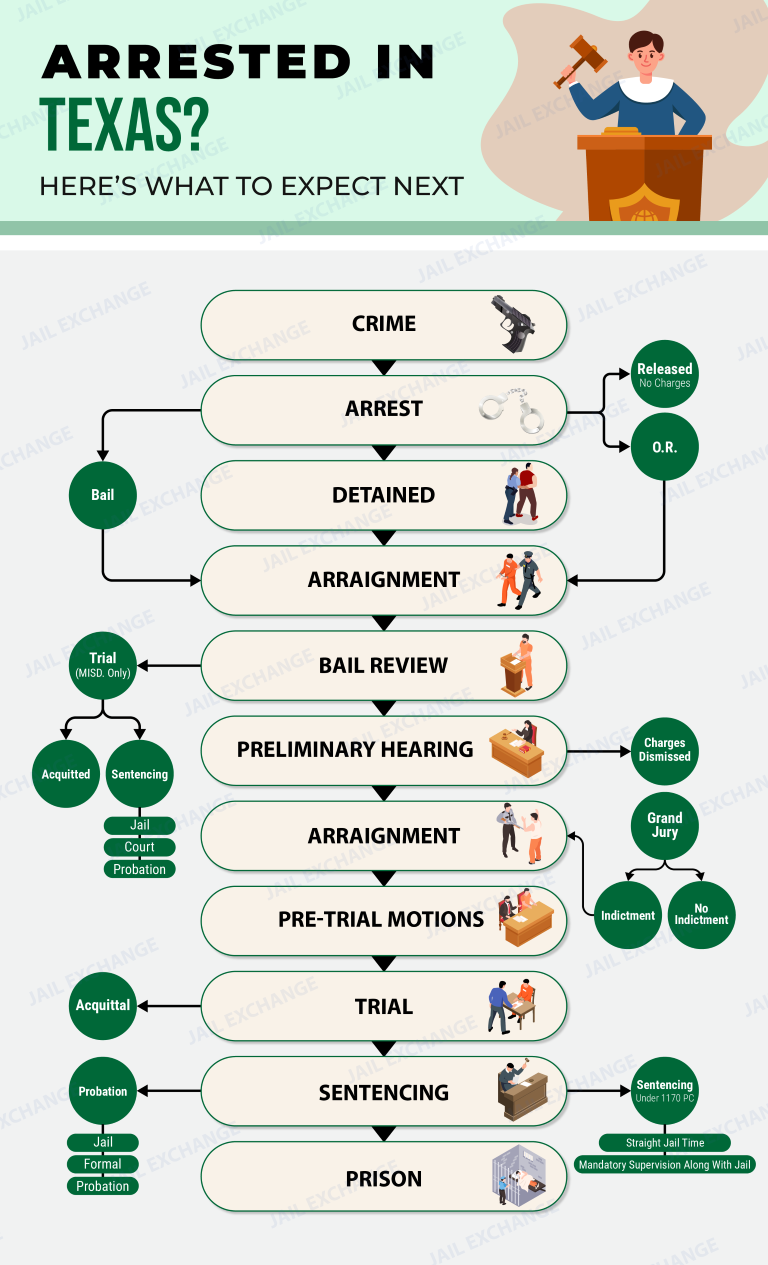
Orange County Correctional Facility Criminal Court Process
Criminal Court Process for Orange County Texas
Orange County Criminal Court Guide
Three District Courts and two County Courts at Law share one courthouse at 801 W. Division Ave., Orange, TX 77630, with four justice of the peace precincts and several city courts taking the ticket-level cases. Anyone jailed while a case moves sits in the Orange County Correctional Facility, 205 S. Border St., Orange, TX 77630. Below you'll find every court, the stages of a case, defense and prosecution, record searches and warrants.
Start by checking custody in the Sheriff's inmate lookup with the person's name. Our Jail Roster page then covers the custody side in depth: who was booked, whether warrants are open, the charges, mugshots, lawyers appointed by the court, and getting back a person's belongings.
Who to call first turns on the charge level. Felony families should try the District Clerk's criminal line, 409-882-7817; Class A and B families, the County Clerk at 409-882-7055. Ask which court has the case, its cause number and when the next hearing falls. To get the person released before then, see our bail and bond page.
1. Felony or misdemeanor: which Orange County court gets the case?
The class printed on the charge tells you the courtroom:
- Felonies, from state jail felonies up through capital murder, open in one of three District Courts: the 128th, 163rd or 260th. Their files go to the District Clerk.
- Misdemeanors that can mean jail (Class A or B) are divided between the two County Courts at Law. Their papers sit with the County Clerk.
- Class C cases carry only fines. A justice of the peace hears most of them. When a city officer wrote the ticket, it goes to that city's municipal judge.
Above all of these, Texas sends final criminal appeals to the Court of Criminal Appeals. The state's court system pamphlet lays out the whole ladder.
↑ Back to the question list2. Where on Division Avenue are the courts and clerks?
Nearly all of it is under one roof at 801 W. Division Ave., Orange, TX 77630:
- 128th District Court: 409-882-7085
- 163rd District Court: 409-882-7090
- 260th District Court: 409-882-7095
- County Court at Law: 409-882-7084
- County Court at Law No. 2: 409-670-4189
- District Clerk (felony records): criminal desk 409-882-7817, main line 409-882-7825. Open Monday, Tuesday, Thursday and Friday 8:00 a.m. to noon and 1:00 to 5:00 p.m.; on Wednesday the morning starts at 8:30.
- County Clerk (misdemeanor records): 409-882-7055, or 409-769-2400 from Vidor. Mail goes to 123 S. 6th St., Orange, TX 77630. Open 8:00 a.m. to 5:00 p.m. without a lunch break, starting at 8:30 a.m. on Wednesdays.
- Court Administrator (appointed lawyers): third floor, 409-882-7075.
Justice courts sit apart: Precinct 1 is in the same courthouse (409-882-7800); Precinct 2 is at 3500 Edgar Brown Dr., Orange, TX 77630 (409-882-7805); Precinct 3 is at 2425 Hwy 87 S, Orange, TX 77630 (409-882-5310); and Precinct 4 is at 190 Camp St., Vidor, TX 77662 (409-769-2284).
↑ Back to the question list3. Do the county's cities keep their own municipal courts?
They do. Under Texas law every incorporated city has a municipal court, sharing the fine-only Class C docket with justice courts. Here that means Rose City, Pine Forest, Pinehurst, Bridge City, Vidor, West Orange and the county seat. City police tickets written inside city limits stay with that city. Tickets from deputies or constables land in a justice court.
The ticket usually names the court that has it. If yours doesn't, or it's lost, the County Clerk at 409-882-7055 or the Sheriff's Office at 409-883-2612 can steer you to the right one.
When someone can't afford a Class C fine, judges can allow installments, community service credited at $150 per eight hours, or a full waiver. Jail over an unpaid fine requires a hearing first, and a finding that the person made no good-faith effort (CCP arts. 45A.252 to 45A.261). A city's Class C warrant is paid at the court that signed it.
↑ Back to the question list4. What does the magistrate do at that first appearance?
Someone booked into the Border Street jail must see a magistrate, in the same room or by video, inside 48 hours (CCP art. 15.17). Local magistrates work under that same limit in the county's lawyer-appointment plan. At the hearing the magistrate:
- names the accusation,
- says the person may stay silent and may hire a lawyer,
- adds that a lawyer can sit in on questioning, that any interview can be stopped, and that an examining trial is available,
- cautions that statements may be used against the person,
- asks whether the person wants a lawyer appointed and helps with the forms, and
- sets bail and any conditions.
On felony warrants, the county says each warrant carries a bond the District and County Attorney suggests. A justice of the peace makes the final call at arraignment. A written request for a lower bond can be filed with the court later.
↑ Back to the question list5. Facing a DWI, theft or assault misdemeanor: how does it play out?
Many everyday arrests here, such as a DWI, a smaller theft or an assault without serious injury, are charged as misdemeanors. The charge papers show the class. After the magistrate hearing, the District and County Attorney files a document called an information, and one of the two misdemeanor courts at law takes the case.
- First setting, arraignment: the accused is told the charge in open court and pleads (CCP art. 26.01).
- Pretrial settings, often several, while both sides trade evidence and discuss a deal.
- A plea. Under CCP art. 26.13, a defendant whose plea bargain the judge turns down gets to withdraw.
- A judge or jury trial if talks fail.
Possible punishment, per Penal Code chapter 12:
- Class A (PC 12.21): a $4,000 fine cap and a one-year jail cap, alone or together.
- Class B (PC 12.22): a $2,000 fine cap and a 180-day jail cap, alone or together.
- Class C (PC 12.23): a $500 fine cap and no jail.
Under CCP arts. 42A.103 and 42A.111, misdemeanor deferred adjudication can run up to two years, and successful completion ends with the case dismissed. Ordinary probation has the same two-year cap on a misdemeanor. Adult Probation is at 104 Border Street, Orange, TX 77630, 409-882-7865.
↑ Back to the question list6. What steps does an Orange County felony take?
A felony here often starts with a warrant that already lists the prosecutor's bond suggestion, as the county's felony page explains. From there:
- Arraignment before a justice of the peace, who fixes the bond.
- Examining trial. CCP art. 16.01 lets the defense ask, before any indictment, for a hearing on probable cause.
- Grand jury. Grand jurors meet behind closed doors, and no indictment issues unless at least nine agree (CCP arts. 20A.202, 20A.301).
- District Court. The case goes to the 128th, 163rd or 260th for arraignment, pretrial hearings and plea talks.
- Plea or trial. If the state still can't try the case 90 days into a jail stay, the court must cut bail or grant a personal bond, apart from listed exceptions (CCP art. 17.151).
Felony sentencing ranges, from Penal Code 12.32 through 12.35 (any of them may add a fine as high as $10,000):
- First degree: a minimum of 5 years, a maximum of 99 years or life.
- Second degree: a minimum of 2 years, a maximum of 20.
- Third degree: a minimum of 2 years, a maximum of 10.
- State jail felony: from six months (180 days) to a two-year top, in a state jail facility. A judge may sometimes punish it like a Class A (PC 12.44).
Under PC 12.42, earlier felony convictions can move a case into a higher range. The ceiling for felony deferred adjudication is ten years.
↑ Back to the question list7. Are violent charges handled more strictly here?
Bail, punishment and protection orders all tighten. Under CCP art. 17.03, nobody facing a charge listed as violent can get a personal bond. In November 2025 voters approved Proposition 3, a constitutional amendment. For aggravated sexual assault, murder, aggravated robbery and certain other violent charges, it requires bail to be refused when the prosecutor convinces the judge, after a hearing, that release brings a risk of flight or harm (Tex. Const. art. I, sec. 11d). S.B. 9 adds a state appeal of a bail amount prosecutors think is too low in such cases.
- Capital murder for an adult means death or life with no parole; a defendant under 18 gets life (PC 12.31).
- Family violence arrests carry a required 4-hour hold after bond when officers expect more violence (CCP art. 17.291). Under CCP art. 17.292, a magistrate's emergency protective order usually lasts 61 to 91 days, stretching to between 91 and 121 days after a serious injury or weapon use.
- Victims may request word of each hearing, and judges must weigh their safety when setting bail (CCP art. 56A.051).
These cases are tried in the District Courts. The Sheriff's Office sends protective order questions to the District and County Attorney at 409-883-6764.
↑ Back to the question list8. Which local office prosecutes, and how do families get appointed counsel?
Prosecution. One office, the District and County Attorney, handles felonies, most misdemeanors and juvenile cases. Some minor offenses stay with city or justice courts. It also enforces bond forfeitures. The office is in the Administration Building, 123 South 6th Street, Orange, TX 77630, 409-883-6764, open weekdays 8:00 a.m. to noon and 1:00 to 5:00 p.m. Ask there whether any diversion program fits the case.
Defense. This county relies on private lawyers picked in turn from a public appointment list, not a public defender office. The steps:
- Speak up for a lawyer when the magistrate asks. The paperwork gets to the Court Administrator within a day.
- Or file the Affidavit of Indigence with the Court Administrator's office on the courthouse's third floor, 801 West Division, Orange, TX 77630, 409-882-7075.
- Expect an appointment no later than three working days after the Court Administrator gets the request. A contact attempt by the lawyer should follow within one more working day (CCP arts. 1.051, 26.04).
People on SSI, Medicaid, food stamps, TANF or public housing, or at or under the federal poverty line, are presumed eligible. The full rules are in the county's indigent defense plan.
↑ Back to the question list9. Where can families find an Orange County case number or hearing date?
Use these, in this order:
- Clerk by phone. Hearing dates come fastest from the clerk. For felonies call the District Clerk at 409-882-7817; for misdemeanors call the County Clerk at 409-882-7055. Have the person's name and birth date nearby when you call.
- County Clerk records. Misdemeanor files are open to the public. The County Clerk has an online records search. At the counter, a name search runs $5, copies are $1 a page and a certified copy is $5 per case.
- re:SearchTX. The District Clerk links the state's court records site. Signing up is free. It shows case numbers, the court and filed charges, plus some judgments, but not hearing dates.
- Court Administrator. Jail staff usually aren't told case details, so the jail's own guidance points families to the Court Administrator at 409-882-7075, or to probation or parole.
A paid statewide search of conviction records is offered by DPS through its conviction name search.
↑ Back to the question list10. Warrant check: who answers, and how is one resolved?
The Sheriff's Warrant Division serves most county warrants; constables and city police serve others. Call it at 409-883-2612, weekdays 8:00 a.m. to 5:00 p.m., with your name and number plus the person's name and birth date. It answers only for its own warrants. Lists: the county warrant page, felony and misdemeanor listings, the prosecutor's most wanted page, Vidor's warrants and Texas DPS Most Wanted. To clear one, have a lawyer set up surrender to the issuing court; bond comes only after booking. District Clerk: 801 W. Division Ave., Orange, TX 77630, 409-882-7817.
↑ Back to the question list11. A federal charge: which court, and who holds the person?
Beaumont. The county falls in the Eastern District of Texas, Beaumont Division.
- Court: Jack Brooks Federal Building, 300 Willow Street, Suite 104, Beaumont, TX 77701, 409-654-7000.
- Prosecutor: U.S. Attorney, 550 Fannin, Suite 1250, Beaumont, TX 77701, 409-839-2538.
- Defense: Federal Public Defender, 510 Park Street, Suite 450, Beaumont, TX 77701, 409-839-2608.
- Custody: the U.S. Marshals Service, which jails federal defendants awaiting trial; Beaumont office: 409-839-2581.
A federal magistrate judge rules on custody at a detention hearing. It usually comes at the first appearance but can be pushed back briefly (18 U.S.C. 3142). No bondsmen work in federal court. Once sentenced, federal prisoners turn up in the BOP's inmate locator.
↑ Back to the question list12. Does an immigration detainer change anything in the state case?
A state case and an immigration case can run side by side. Here is how a detainer plays out:
- When ICE wants the person, a Form I-247A detainer goes to the Border Street jail.
- That hold may last up to 48 hours after they would otherwise be released (8 CFR 287.7(d)).
- Texas jails must honor detainers under CCP art. 2A.060, except for a person who proves citizenship or lawful presence. Local governments also can't restrict enforcement, under a 2017 law (Gov't Code 752.053).
- Under S.B. 8 (2025), the cutoff for jail-running counties to join ICE's 287(g) program is December 1, 2026. The Sheriff's Office, 409-883-2612, can say where things stand here.
- ICE's Houston Field Office, 126 Northpoint Drive, Houston, TX 77060, 281-774-4816, covers Southeast Texas. The ICE Online Detainee Locator finds people it holds.
The court case itself changes too. Judges must tell any defendant who is not a citizen, out loud and on paper, about the deportation risk a plea of guilty or no contest carries (CCP art. 26.13). Some appointed magistrates are barred from releasing anyone with an ICE detainer (CCP art. 17.027). Get immigration advice before any plea.
↑ Back to the question list13. State prison or state jail: how do you follow someone sentenced?
It depends on the level. State jail sentences are served in TDCJ's state jail units. Higher felonies send the person into the Texas prison system run by TDCJ. Until TDCJ picks them up, they stay at the Border Street jail. Intake comes next, with testing and classification, and then a permanent unit.
- Follow the case through TDCJ's inmate search, which is refreshed on working days only, so the newest moves may not show yet.
- Prison units are profiled one by one on our Texas state prisons page.
- Sign up for custody updates through Texas IVSS-Counties, 866-268-8959, a free service open around the clock.
14. What happens when an Orange County teen is charged?
In Texas, juvenile court covers conduct by children from age 10 through age 16, as Family Code 51.02 defines a child, while a 17-year-old answers in adult court. The District and County Attorney prosecutes juvenile cases here. Which court sits as juvenile court is the juvenile board's choice (Family Code 51.04), so ask the probation office which one has the case.
- Juvenile Probation, main office: 213 Market Street, Orange, TX 77630, 409-882-7885.
- Vidor office: 190 Camp Street, Vidor, TX 77662, 409-769-8439.
- Both are open weekdays, 8:00 a.m. to 5:00 p.m. Probation staff tell parents which detention center is holding a child.
Family Code 54.01 sets the clock for a detained child: a first hearing inside two working days, shortened to one for a Friday or Saturday pickup. Counsel is named before that hearing. Transfer to adult court is possible when the charge is a serious felony and the child is 14 or 15. It happens only after the juvenile court holds a hearing and waives its hold on the case (Family Code 54.02).
↑ Back to the question list15. Which services and rights cover victims in this county?
Victims of crime in Texas, plus close relatives when the victim died, hold legal rights under CCP art. 56A.051, including a voice in bail through safety concerns, advance word of court dates when asked, and an impact statement before sentencing.
- The District and County Attorney has a victim assistance coordinator. Call the main office at 409-883-6764 and ask for that person.
- The state's Crime Victims' Compensation program can pay back counseling, hospital bills and lost pay, to a limit of $50,000. The Attorney General's office handles it. Apply online or call 800-983-9933.
- Texas IVSS-Counties sends free, private alerts when an offender is booked, released or moved. Register at its website or call 866-268-8959.