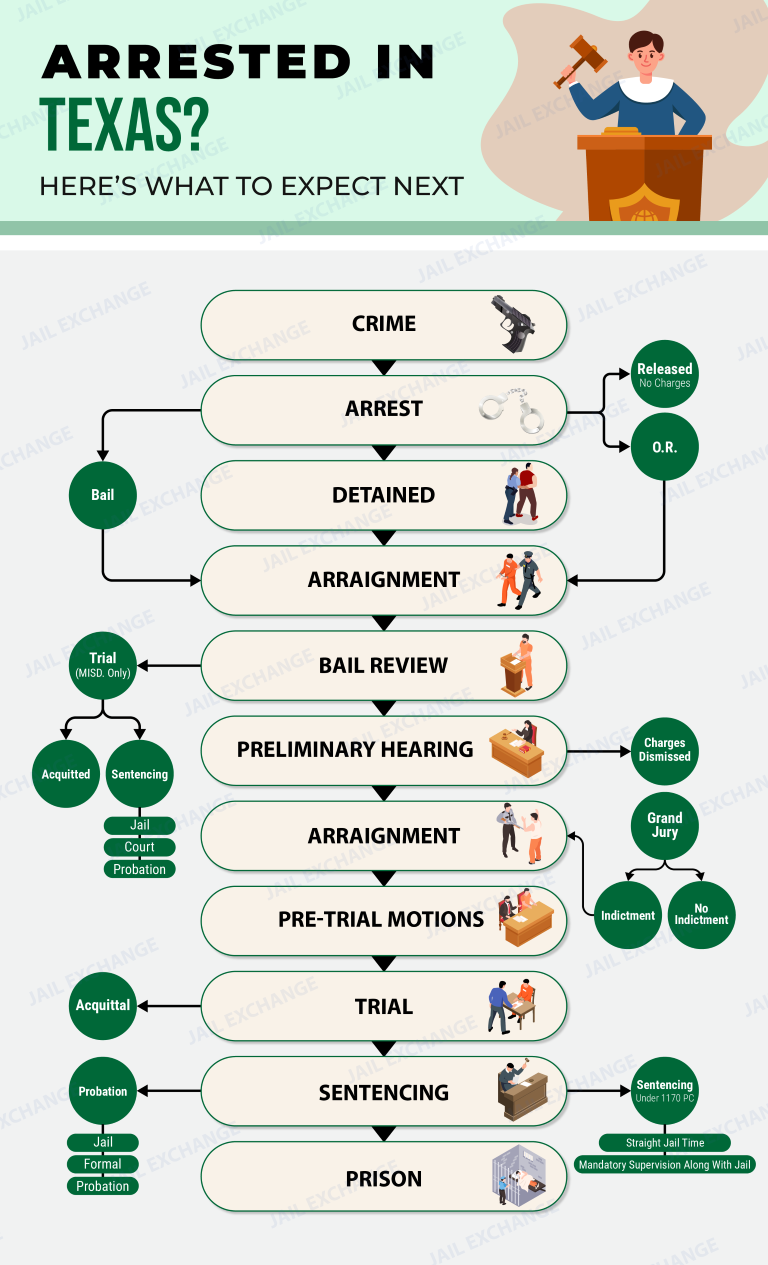
Sherman County Jail Criminal Court Process
Criminal Court Process for Sherman County Texas
Sherman County Criminal Court Guide
A charge from Sherman County lands in one of three local court levels, picked by how serious it is: the 69th District Court for felonies, the County Court for jailable misdemeanors, or a justice or city court for fine-only tickets. Anyone not released before trial is held at the Sherman County Jail in Stratford (Sheriff's Office mail: P.O. Box 526, Stratford, TX 79084). The answers below walk a Panhandle case step by step, from the magistrate to the sentence.
Wondering if the person is still inside? Look them up on the county jail search or type the name into the state's IVSS-Counties lookup. For bookings, open warrants, the charges filed, mugshots, court-appointed defenders and getting belongings back, our Recent Arrests page is the place to go.
Ring the Sheriff's Office at 806-366-5551 to learn the charge and which court holds it. Felony callers can also reach the 69th District Court's office in Dumas at 806-935-2700. If bail is still unsettled, see our bail and bond page.
1. Felony or misdemeanor: which bench gets a Sherman County charge?
Texas sorts criminal cases by the most a person could face:
- District court takes every felony, from a state jail felony all the way to capital murder. For this county that means the 69th District Court. Its papers sit with the District Clerk.
- County Court, which each Texas county has, handles Class A and B misdemeanors, the smaller crimes that still carry possible jail time. Its papers sit with the County Clerk.
- Justice and municipal courts share Class C cases. Those carry a fine only.
Judges at each level may also serve as magistrates for a fresh arrest. If a case is appealed, the last word in Texas criminal law rests with the Court of Criminal Appeals. The state's own court system booklet explains each level.
↑ Back to the question list2. Where are the courts and clerks for Stratford-area cases?
Felony court is shared with three neighbors, so part of the business runs out of Dumas in Moore County:
- 69th District Court, covering Dallam, Hartley, Moore and this county. Court office: 715 S. Dumas Avenue, Room 302, Dumas, TX 79029, 806-935-2700. Ask that office where and when the judge hears a given case.
- County Court, the local misdemeanor court, with its clerk's office handling filings.
- Justice of the peace court for fine-only Class C cases.
- U.S. District Court, Amarillo Division, for federal charges: 205 SE 5th Avenue, Room 133, Amarillo, TX 79101, 806-468-3800.
For the street address, hours and phone of the county courthouse offices and the justice court, call the Sheriff's Office at 806-366-5551. Clerks keep regular business hours, so call on a weekday.
↑ Back to the question list3. What about a ticket from a city officer in Stratford?
State law gives each incorporated city its own municipal court. Fine-only Class C cases can be filed in either that court or a justice court, so a city officer's ticket in Stratford usually goes to the city judge. Municipal judges may sign warrants and serve as magistrates as well.
The top fine on a Class C is $500, with no jail (Penal Code 12.23). Can't pay it in one go? Say so in court. The judge can allow payments over time, swap the fine for community service at $150 per 8 hours, or erase it for a person who is truly broke (see CCP chapter 45A). Jail over an unpaid ticket is a last resort: a hearing must come first, and the judge must find that the person made no honest effort.
For the city court's address and hours, call the Sheriff's Office at 806-366-5551.
↑ Back to the question list4. Right after a Sherman County arrest, what does the magistrate do?
Two days is the outer limit: by then the person must have seen a magistrate, and the jail can handle it by video. The magistrate reads the charge, explains the person's right to say nothing and to have counsel, takes any request for appointed counsel, and sets bail (CCP art. 15.17). On jailable charges, a summary of past cases, known as the public safety report, is read before bail is chosen.
Two newer protections apply. A magistrate who decides there was no probable cause must put the reasons in writing inside a day (CCP art. 15.17(h)). Jailers who think a prisoner may be mentally ill have 12 hours to report it, and the magistrate may then order an expert interview (CCP art. 16.22).
Felony defendants may also request an examining trial, a pre-indictment hearing where the defense can test the state's evidence. Bail may be looked at again there (CCP art. 16.01). For release questions, read our bail guide.
↑ Back to the question list5. DWI, theft, assault: how do Class A and B cases unfold here?
Misdemeanors skip the grand jury. The prosecutor's own charging paper, which Texas calls an "information," opens the case. From there the County Court handles arraignment, pretrial settings and a plea or trial (CCP art. 26.01). Penalty ranges:
- Class A: jail time capped at 12 months, a $4,000 maximum fine, or both together (Penal Code 12.21). Assault that causes bodily injury is a common Class A.
- Class B: jail time capped at 180 days, a $2,000 maximum fine, or both together (Penal Code 12.22). A first DWI is usually a Class B.
Plenty of misdemeanors wrap up without a trial. Deferred adjudication is common: the judge sets aside a guilty finding while the person meets conditions, for as long as two years on a misdemeanor. Finish it, and under CCP art. 42A.101 the judge must dismiss the charge. Ordinary probation on a misdemeanor can't run past two years either. Ask the prosecutor's office if a pretrial diversion program fits the case.
↑ Back to the question list6. From grand jury to verdict: how does a felony move through the 69th District?
- Booking and magistrate. Bail gets set and any lawyer request is sent on.
- Indictment. A grand jury hears the 69th Judicial District Attorney's evidence in secret. Nine jurors or more must vote yes to indict (CCP art. 20A.301).
- Arraignment. The judge confirms who the person is and hears the plea.
- Pretrial. Lawyers trade evidence, argue motions and talk about a deal.
- Deal or trial. Any plea bargain needs the judge's yes or no in open court. Under CCP art. 26.13, a no means the guilty plea can be taken back.
How long a felony sentence can be (Penal Code ch. 12):
- A first degree felony can bring life in prison, or any number of years from 5 up to 99.
- A second degree felony ranges between 2 and 20 years.
- A third degree felony ranges between 2 and 10 years.
- The lowest felony grade, a state jail felony, costs 180 days up to 24 months in a TDCJ state jail unit.
Any felony grade can add a fine as high as $10,000, and a record of earlier felonies may bump the punishment up a level (Penal Code 12.42). For felonies, a deferred adjudication term may run as long as ten years. To see if a drug, veterans or mental health court serves the area, check the state's specialty court registry.
↑ Back to the question list7. Why are violent felony cases treated more strictly?
An adult convicted of capital murder receives either the death penalty or a life term with no parole (Penal Code 12.31). Someone who was 17 or younger receives life. Violent charges often bar release on a personal bond. Appointed magistrates under Government Code chapter 54 also can't free a person facing a murder charge, a capital murder charge, or an aggravated kidnapping or aggravated sexual assault charge (CCP art. 17.027).
Proposition 3, approved in 2025, goes further. It names murder, trafficking, aggravated robbery and several other violent crimes. For those, a judge who hears proof that the person would flee or would endanger others must refuse bail (Texas Constitution, art. I, sec. 11d). Prosecutors gained another tool in 2025 too: on some violent charges they can take a bail they dislike to a higher court, and the defendant stays jailed until it rules.
Most murder cases are shut out of deferred adjudication (CCP art. 42A.102). Expect these cases to take longer, and keep in touch with the defense lawyer.
↑ Back to the question list8. Which office prosecutes, and where does a defendant without money find counsel?
Prosecution. Felonies are handled by the 69th Judicial District Attorney, who serves Dallam, Hartley, Moore and this county: Moore County Courthouse, 715 S. Dumas Avenue, Room 304, Dumas, TX 79029, 806-935-5654. To learn which office files a misdemeanor here, ask that office.
Defense. Texas guarantees a lawyer to a defendant too poor to hire one (CCP art. 1.051). Ask at the magistrate hearing. Appointments for this county go through a managed assigned counsel program:
- Panhandle Area Managed Assigned Counsel, which works from the Santa Fe Building, 900 S. Polk, Suite 206, Amarillo, TX 79101, 806-242-3415
To judge whether someone qualifies, the court weighs what they earn, own and owe and who depends on them, using a money form signed under oath. Once a person qualifies, that finding normally holds for the whole case (CCP art. 26.04). The state agency that oversees county lawyer plans is the Texas Indigent Defense Commission, 209 West 14th Street, Room 202, Austin, TX 78701, 512-936-6994.
↑ Back to the question list9. Where can family find a cause number or hearing date?
The state's online court records system, re:SearchTX, is a good first stop. An account costs nothing. A registered member of the public can see the cause number, which court has the case, the indictment or information, and any judgment or dismissal. Copies run $1 for the first 10 pages. For hearing times, use the phone numbers below.
For court dates:
- Felony: call the 69th District Court's office at 806-935-2700 with the person's name or cause number.
- Misdemeanor or ticket: call the Sheriff's Office at 806-366-5551 for the right clerk's number.
Past convictions and deferred adjudications can be checked, for a fee, with the DPS criminal history name search. Signing up with IVSS-Counties also brings alerts when a hearing is added or moved.
↑ Back to the question list10. Could there be a Sherman County warrant, and how is one resolved?
Deputies from the Sheriff's Office handle most county warrants, though any Texas peace officer, including city police and DPS troopers, may arrest on one. Phone the Sheriff's Office at 806-366-5551 to ask, or call the court that signed it. Statewide fugitives appear on the DPS Ten Most Wanted list.
Call a defense lawyer first. Through the lawyer, the person can turn themselves in to the court whose name is on the warrant, or settle a bond or new court date there. Felony warrants come from the 69th District Court, whose office is at 715 S. Dumas Avenue, Room 302, Dumas, TX 79029, 806-935-2700.
↑ Back to the question list11. What should families expect when Amarillo federal court takes the case?
U.S. prosecutors bring charges from this county in Amarillo, where the Northern District's courthouse sits at 205 SE 5th Avenue, Room 133, Amarillo, TX 79101, 806-468-3800.
- First appearance. A detention hearing in Amarillo weighs pretrial custody against release on conditions (18 U.S.C. 3142).
- Custody. The Marshals Service holds federal defendants before trial, often renting beds in county jails. Amarillo office: 205 SE 5th Street, Unit 214, Amarillo, TX 79101, 806-324-2350.
- Defense. Federal Public Defender, 600 S. Tyler Street, Suite 2300, Amarillo, TX 79101, 806-324-2370.
- After sentence. The Bureau of Prisons inmate finder shows where a sentenced person is. Someone awaiting trial in Marshals custody may be missing from it.
12. Does an immigration hold change anything in a Sherman County courtroom?
The criminal case keeps going. What shifts is the day of release.
- An I-247A detainer from ICE gets filed at the jail.
- When the Texas case alone would mean release, Stratford can keep the person up to 48 hours after they would otherwise be released (8 CFR 287.7(d)).
- A Texas jail has to follow a detainer. Only proof that the prisoner is a citizen, or is in the country legally, gets them out of it (CCP art. 2A.060). Local rules that restrict work with immigration agents are banned (Government Code 752.053).
- Next comes the 2025 deadline rule: jail-running counties in Texas must request 287(g) membership from ICE by December 1, 2026. Call the Sheriff's Office to hear how far along this one is.
- Look for the person on the ICE Online Detainee Locator. ICE's Dallas Field Office, 8101 N. Stemmons Freeway, Dallas, TX 75247, 972-367-2200, serves North Texas and Oklahoma.
Judges must warn non-citizens, both aloud and on paper, before taking their plea. Pleading guilty, or pleading no contest, could lead to removal from the country or keep them from becoming a citizen (CCP art. 26.13). An immigration lawyer's advice before any plea is worth getting.
↑ Back to the question list13. Which prison system takes someone sentenced on a felony?
TDCJ runs both kinds of state lockup. State jail felonies go to state jail units. Third, second and first degree felonies go to prison units. Most people sit in county custody after sentencing until TDCJ comes for them, then go through intake and classification before landing at a unit.
Look someone up by TDCJ number, SID, or a surname with a first initial on the TDCJ offender search. Only people now in a TDCJ unit show up, and the records may be a day old or older. Our Texas prisons page describes the system.
↑ Back to the question list14. How does juvenile court treat a Sherman County teenager?
Texas juvenile court takes cases from a child's 10th birthday until the day they turn 17 (Family Code 51.02), measured at the time of the offense. After that, adult court takes over. The county juvenile board chooses which judge hears juvenile cases.
- Officers must quickly tell a parent. Before the first detention hearing, which must happen inside two working days, the youth gets an attorney.
- A judge may move a youth's case into adult court. The youth must be 14 or older for a capital or first degree felony, or 15 or older for other felonies. That transfer, called certification, needs a complete investigation and a hearing on the record (Family Code 54.02).
- The state's list of youth detention centers shows none here, so detained youth are placed outside the county. For juvenile probation, ring the Sheriff's Office at 806-366-5551.
Statewide, youth detention falls under the Texas Juvenile Justice Department, 1711 San Jacinto Blvd, Austin, TX 78701, 512-490-7130.
↑ Back to the question list15. What help can crime victims count on?
CCP art. 56A.051 gives victims, and the close relatives of someone killed, a list of rights. They can expect protection from threats, a magistrate who thinks about their safety at bail, word of each court setting if they ask for it, and the chance to tell the court how the crime hurt them before sentencing. The 69th Judicial District Attorney's office has a crime victims coordinator. Call 806-935-5654.
- Costs. Through the Texas Attorney General, victim compensation covers up to $50,000 in losses such as hospital bills, therapy and missed pay. Phone 800-983-9933.
- Custody notices. Sign up on Texas IVSS-Counties or by phone at 866-268-8959. Operators answer any hour in Spanish or English, the service costs nothing, and registrations stay private.