Richmond Juvenile Detention Center Criminal Court Process
Criminal Court Process for Richmond city Virginia
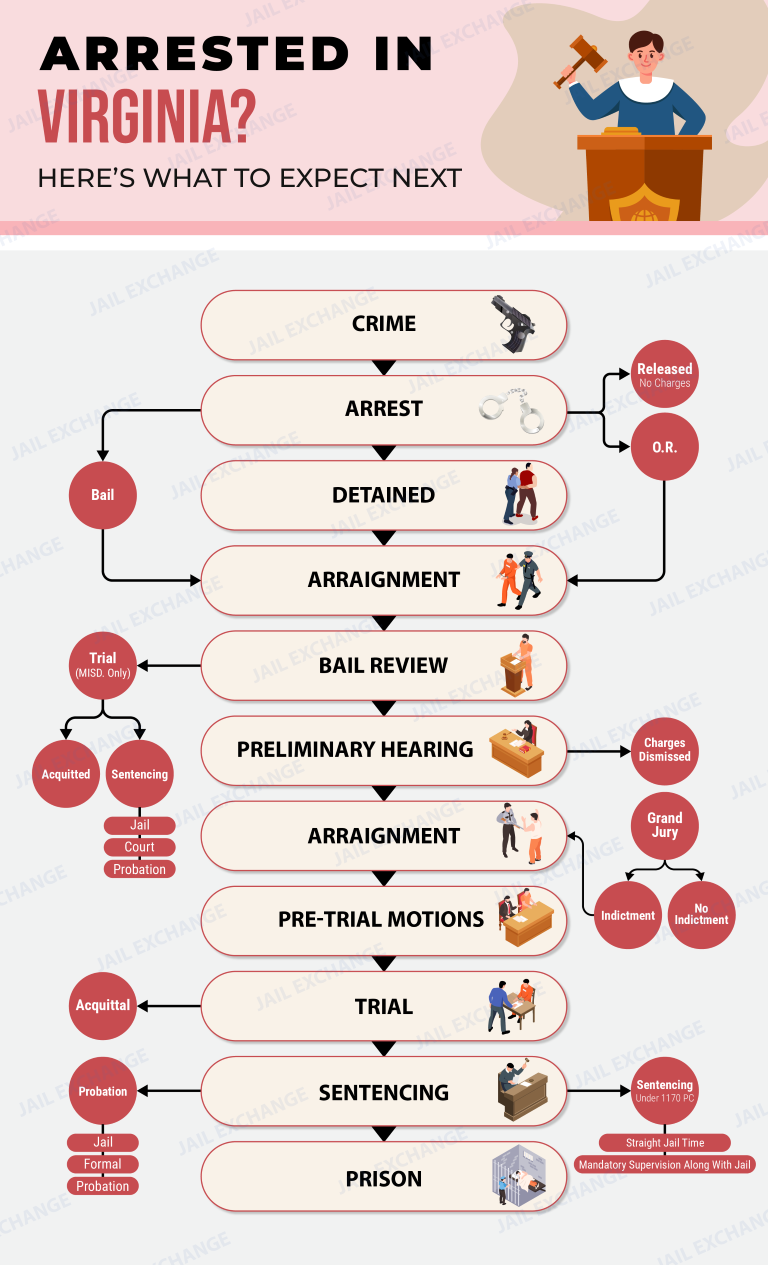
The City of Richmond is an independent city and Virginia's capital, governed separately from Henrico and Chesterfield counties that surround it. Its criminal cases are split among three city courts in the 13th Judicial Circuit: the Richmond General District Court for misdemeanors, traffic charges and felony preliminary hearings, the Richmond Juvenile and Domestic Relations District Court for juveniles and family-violence cases, and the Richmond Circuit Court for felony trials and appeals. The city elects its own Commonwealth's Attorney, who prosecutes only City of Richmond cases. Anyone held after arrest, whether awaiting a bond decision or unable to post one, is jailed at the Richmond City Justice Center, a sheriff-run jail that serves the city alone. Note that Richmond County, a rural Northern Neck county, is a separate place with its own courts.
- Richmond General District Court (criminal and traffic), John Marshall Courts Building, 400 North 9th Street, Room 209, Richmond, VA 23219, (804) 646-6431
- Richmond General District Court (criminal and traffic), Marsh Manchester Courts Building, 920 Hull Street, Richmond, VA 23224, (804) 646-6677
- Richmond Juvenile and Domestic Relations District Court, Oliver Hill Courts Building, 1600 Oliver Hill Way, Suite C181, Richmond, VA 23219, (804) 646-2942
- Richmond Circuit Court Clerk, John Marshall Courts Building, 400 North Ninth Street, Richmond, VA 23219, (804) 646-6505
- Richmond Circuit Court, Manchester, 920 Hull Street, Richmond, VA 23224, (804) 646-8704
- Richmond City Magistrate's Office, 1701 Fairfield Way, Richmond, VA 23223, (804) 646-6689
- Court Service Unit, 13th District, 1600 Oliver Hill Way, Richmond, VA 23219, (804) 646-2900
- Office of the Commonwealth's Attorney, City of Richmond, 400 North 9th Street, Room 100, Richmond, VA 23219, (804) 646-3500
- Public Defender, Richmond office, 701 East Franklin Street, Suite 600, Richmond, VA 23219, (804) 225-4330
- Sheriff of the City of Richmond, 1701 Fairfield Way, Richmond, VA 23223, (804) 646-4464
- Richmond City Justice Center, 1701 Fairfield Way, Richmond, VA 23223, (804) 646-4464
- Richmond Juvenile Detention Center, 1700 Oliver Hill Way, Richmond, VA 23219, (804) 646-2937
- Richmond Police Department, 200 West Grace Street, Richmond, VA 23220, (804) 646-5100 (non-emergency)
Which court hears your case. For a felony, the first stop is a preliminary hearing in the Richmond General District Court, or in the Richmond Juvenile and Domestic Relations District Court if the person allegedly harmed is a family or household member; after a grand jury indicts, the case belongs to the Richmond Circuit Court. Charges of assault on a spouse, partner, parent or other household member, and every case involving a juvenile defendant or an offense against a juvenile, go to the Richmond Juvenile and Domestic Relations District Court. Misdemeanors and traffic violations committed in the City of Richmond are tried in the Richmond General District Court before a judge with no jury. If you lose there, you have 10 days to appeal to the Richmond Circuit Court, which retries the case as if the first trial never happened and allows a jury.
Where pretrial inmates are held. The City of Richmond does not belong to a regional jail. Its Sheriff's Office operates the city's own jail at 1701 Fairfield Way, Richmond, VA 23223, phone (804) 646-4464, and adults arrested anywhere in the city are held there until they are released or their cases end. The jail is used only by the city, not by Henrico, Chesterfield or other neighbors. The magistrate who sets release terms works in the same complex. Youths are never sent there; the juvenile detention center on Oliver Hill Way holds city juveniles a judge or intake officer orders detained.
- Courts in the City of Richmond (circuit, general district, and juvenile and domestic relations courts)
- From arrest to the first court date in the City of Richmond
- Which Richmond courthouse to go to
- Inside the Richmond City Justice Center
- Free lawyers in the City of Richmond: the public defender and appointed counsel
- The City of Richmond Commonwealth's Attorney, plea offers and diversion
- Treatment dockets in the City of Richmond
- Misdemeanor (for example, petit larceny, a first DUI, assault and battery, trespassing)
- Felony (for example, burglary, grand larceny, drug possession or distribution, malicious wounding)
- Violent felony (for example, murder, rape, robbery)
- Juveniles (under 18) arrested in the City of Richmond
- Federal cases (U.S. District Court) from the City of Richmond
1. Courts in the City of Richmond (circuit, general district, and juvenile and domestic relations courts)
The City of Richmond has no towns inside its borders, and Virginia does not use municipal, town or mayor's courts anywhere, so there is no lower "police court" to deal with. A charge from any Richmond neighborhood, from Church Hill to Carytown to the Southside, goes to the city's General District, JDR or Circuit Court, no matter which police agency wrote it.
Trial courts
- Richmond Circuit Court (felonies, jury trials, appeals from the district courts), 400 North Ninth Street, Richmond, VA 23219, (804) 646-6505; second location at 920 Hull Street, Richmond, VA 23224, (804) 646-8704
- Richmond General District Court (misdemeanors, traffic, preliminary hearings): downtown division, 400 North 9th Street, Room 209, (804) 646-6431; Manchester division, 920 Hull Street, (804) 646-6677
- Richmond Juvenile and Domestic Relations District Court (juvenile and family cases), 1600 Oliver Hill Way, Suite C181, Richmond, VA 23219, (804) 646-2942
Law enforcement, prosecution and defense
- Richmond Police Department, 200 West Grace Street, Richmond, VA 23220, (804) 646-5100
- Sheriff of the City of Richmond (jail, courthouse security), 1701 Fairfield Way, Richmond, VA 23223, (804) 646-4464
- City magistrates (warrants and release decisions, around the clock), 1701 Fairfield Way, Richmond, VA 23223, (804) 646-6689
- Commonwealth's Attorney, Room 100, 400 North 9th Street, Richmond, VA 23219, (804) 646-3500
- Public Defender, Richmond office, Suite 600, 701 East Franklin Street, Richmond, VA 23219, (804) 225-4330
- 13th District Court Service Unit (juvenile intake and probation), 1600 Oliver Hill Way, Richmond, VA 23219, (804) 646-2900
If you cannot afford a lawyer, say so at the first hearing; the judge can appoint the Richmond public defender. Questions about a date or the amount of a bond go to the clerk of the court printed on your papers.
2. From arrest to the first court date in the City of Richmond
- Arrest and transport. Officers bring an arrested adult to the city's public safety complex on Fairfield Way in the East End. For many minor offenses, an officer instead writes a summons on the spot and lets the person go with a court date.
- The magistrate. A city magistrate, who is part of the court system rather than the police, hears from the officer, sometimes over video, and decides whether to issue a warrant. The magistrate then sets release terms.
- Release terms. The choices are a personal recognizance release on a signed promise to appear; an unsecured bond that is owed only if the person skips court; or a secured bond that has to be paid in full in cash or covered by a bail bondsman licensed through the Department of Criminal Justice Services, who charges a fee for the service. A 2021 change in Virginia law removed the presumption against release that used to apply to certain charges, so each decision now turns on flight risk and danger. The magistrate can add conditions, for instance no contact with a complaining witness.
- Booking. A person who cannot meet the terms is booked into the Richmond City Justice Center: fingerprints, a photograph, a health screening and an inventory of property.
- Pretrial supervision. Release can come with supervision by the adult pretrial program of the city's Department of Justice Services, which may require phone or office check-ins, drug screens or a curfew.
- Review by a judge. Weekday mornings at 8:30, the General District Court calls in-custody arraignments and motions to change release terms at both the John Marshall and Manchester buildings. A defendant still held, or held on an amount too high to pay, can ask the judge for a new decision there, and an unfavorable ruling can be appealed to the Richmond Circuit Court.
- Arraignment. The first appearance is usually on the court's next working day. You hear the charge, learn your right to counsel and tell the judge whether you have a lawyer, want one appointed, or will represent yourself. People who ask for appointed counsel complete a financial form, and the judge typically assigns the Richmond public defender. Before you leave, the judge gives you the next date: trial if the charge is a misdemeanor, a preliminary hearing if it is a felony.
3. Which Richmond courthouse to go to
The City of Richmond's courts occupy three separate buildings. Read your summons, warrant or release order before leaving home; it names the building and courtroom, and that, rather than the place you were arrested, decides where you appear.
Oliver Hill Courts Building, 1600 Oliver Hill Way. This building, east of downtown, is where you go for a juvenile charge or for a domestic assault, a protective order violation or another offense against a family or household member. The JDR clerk's office (Suite C181) and juvenile intake for the 13th District Court Service Unit are both inside, and the city's juvenile detention center is next door.
Marsh Manchester Courts Building, 920 Hull Street. Across the James River in the Manchester neighborhood, this building has its own General District Court criminal and traffic division and a Circuit Court location. Southside cases are often assigned here. Its General District Court division also holds the city's behavioral health docket on Mondays.
John Marshall Courts Building, 400 North 9th Street. The downtown building holds the Circuit Court clerk's office and most felony proceedings, a General District Court criminal and traffic division in Room 209, and the Commonwealth's Attorney's main office in Room 100.
Both General District Court criminal divisions follow the same weekday schedule: in-custody arraignments and release motions at 8:30 a.m., criminal dockets and walk-in arraignments at 9:00 a.m., and traffic at 11:30 a.m. Circuit Court criminal terms start on the first Monday of each month, when a docket call at 9:00 a.m. sets trial dates. Arrive early to clear security, and dress as you would for a job interview.
4. Inside the Richmond City Justice Center
Run by the elected Sheriff of the City of Richmond, the Richmond City Justice Center stands at 1701 Fairfield Way, Richmond, VA 23223, and its number is (804) 646-4464. The building went into service in 2014, taking the place of the aging city jail that had stood on the site. The sheriff's deputies also guard the city's courtrooms and carry out court orders.
The population mixes several groups: city defendants who are waiting for trial and were not released, people serving jail sentences of a year or less, people held for probation violations or on warrants from other places, and state-sentenced prisoners waiting to be moved to the Virginia Department of Corrections.
If a relative or friend has just been arrested, the sheriff's office can tell you whether the person is in custody and what release terms the magistrate set, including the bail amount. The court date appears on the warrant or summons and can be confirmed with that court's clerk. Visiting schedules, phone accounts, mail and deposit rules are set by the sheriff and do change, so call before you go. The sheriff's office also runs an alternative sentencing program and reentry services.
5. Free lawyers in the City of Richmond: the public defender and appointed counsel
You can ask for a free lawyer at two points: when the magistrate processes you after arrest, and when the judge asks about counsel at your arraignment. Either way, you will sign a statement under oath about your income, property and household, and the judge decides whether you qualify. If you are out of custody and want to start early, contact the clerk of the court hearing your case; for General District Court, that is (804) 646-6431 at the John Marshall building or (804) 646-6677 at Manchester.
Most people who qualify are assigned to the Richmond office of the Virginia Indigent Defense Commission, the state public defender agency. The office is at 701 East Franklin Street, Suite 600, Richmond, VA 23219, (804) 225-4330, and its attorneys appear in all three city courts on misdemeanor, felony and juvenile cases.
A conflict of interest, such as the office already representing a co-defendant, means the judge will instead appoint a private attorney who is certified for court-appointed work. You do not pay up front, but if you are convicted, the appointed lawyer's fee can be assessed against you as part of court costs. You are always free to hire your own lawyer instead.
6. The City of Richmond Commonwealth's Attorney, plea offers and diversion
Voters in the City of Richmond elect a Commonwealth's Attorney whose assistant prosecutors handle cases in the General District, JDR and Circuit Courts. You can reach the office in Room 100 of the John Marshall Courts Building, 400 North 9th Street, at (804) 646-3500. Every felony is prosecuted by an assistant Commonwealth's Attorney; for some minor traffic and misdemeanor charges, the officer who made the arrest presents the evidence to the judge.
Prosecutors control which charges proceed, whether a charge is amended to something less serious, and what plea agreement is offered. Several routes can keep a case from ending in a conviction:
- First-offender deferrals that Virginia law allows for a first drug possession charge and for a first family-assault charge, ending in dismissal after the person meets the court's conditions.
- Deferred dispositions in certain other cases, where the judge holds off on a finding of guilt and later dismisses the charge if the defendant complies.
- Referral to one of the city's treatment dockets, described in the next section.
The office also has a unit called Community Justice Reform. Whether any of these options fits your charge is a question for your defense lawyer, who can raise it with the prosecutor.
Crime victims and witnesses can call the office's Victim/Witness Services program at (804) 646-7665 for court-date notices, updates on bond and plea decisions, help with restitution and someone to accompany them to court, all rights protected by Virginia's Crime Victim and Witness Rights Act.
7. Treatment dockets in the City of Richmond
Two court programs in the City of Richmond pair intensive supervision with treatment.
Behavioral Health Docket (General District Court). Held on Mondays at 1:00 p.m. in the Marsh Manchester Courts Building, this docket takes misdemeanor defendants whose charges are tied to a serious mental illness. The judge, prosecutor, defense lawyer and treatment providers work together, and the defendant returns to court regularly so progress can be checked.
Richmond Adult Drug Court (Circuit Court). This program is for adults charged with felonies who have a substance use disorder that drives their offending. Expect a long commitment, often a year or longer, with treatment sessions, random testing and frequent status hearings before a Circuit Court judge. The Commonwealth's Attorney must agree to admission, and some charges and records make a person ineligible.
Referrals usually come from the defense lawyer, and screening takes time, so raise the question soon after the arrest. For any other specialized docket, such as one for veterans, check with the clerk of the court where your case is pending.
8. Misdemeanor (for example, petit larceny, a first DUI, assault and battery, trespassing)
Most misdemeanor cases in the City of Richmond are over within one to three months. They are tried in the General District Court (or the JDR court for a family-member victim) by a judge sitting alone, and a single trial date often resolves everything. After the arrest, the magistrate usually releases the person on recognizance or a modest bond, and some offenses start with a summons instead of an arrest.
What the classes mean
- Class 4: no jail, a fine up to $250.
- Class 3: no jail, a fine up to $500.
- Class 2: jail up to six months and a fine up to $1,000, either or both.
- Class 1: jail up to twelve months and a fine up to $2,500, either or both. Shoplifting or other theft under $1,000 (petit larceny), trespass, and simple assault and battery are Class 1 charges.
Assault on a family or household member
These cases go to the Richmond JDR court on Oliver Hill Way, not the General District Court. An arrest often brings an emergency protective order and a no-contact condition right away. A person with no prior record may be offered a first-offender deferral that leads to dismissal, while a third conviction for family assault can be prosecuted as a felony.
DUI, first offense
A first DUI in the city is still a Class 1 misdemeanor. Expect an immediate seven-day administrative license suspension at arrest. A conviction brings at least a $250 fine, a one-year license revocation (often with a restricted license that requires an ignition interlock) and enrollment in the Virginia Alcohol Safety Action Program, known as VASAP. Jail becomes mandatory with a high test result: five days for a blood alcohol concentration from 0.15 to 0.20, and ten days above 0.20.
Results and appeals
A case may be dismissed, deferred under a first-offender law, or end in a fine, a suspended sentence with probation, or actual time at the Richmond City Justice Center. Within 10 days of a General District Court conviction, a defendant can appeal to the Richmond Circuit Court and get a brand-new trial, this time with the option of a jury, though the appeal adds months. If jail is on the table and you cannot afford a lawyer, ask for the public defender.
9. Felony (for example, burglary, grand larceny, drug possession or distribution, malicious wounding)
Felony cases in the City of Richmond usually take four to twelve months. They start in the General District Court, where you are arraigned, counsel is appointed or retained, and the judge reviews the magistrate's bail decision if asked; the case then moves up to the Richmond Circuit Court.
Step one: preliminary hearing
A few weeks after arraignment, a district court judge (in the JDR court when the complainant is a family member) holds a preliminary hearing. The only question is whether there is probable cause. If the judge finds it, the charge is certified to the Circuit Court grand jury. Sometimes the prosecutor goes directly to the grand jury, and no preliminary hearing takes place.
Step two: indictment and Circuit Court
After a grand jury indictment, you are arraigned in the Richmond Circuit Court. Criminal cases there are organized by monthly terms beginning on the first Monday, with a docket call to set trial dates, and the court holds a pretrial conference in every case headed for a jury trial.
Step three: plea or trial
Plea agreements resolve most felonies in the City of Richmond. A case that is tried goes before either a judge or a jury of twelve, and a jury must agree unanimously. A judge now sentences in most cases; the jury does so only at the defendant's request, a rule in place since July 2021. Judges consult Virginia's sentencing guidelines but are not bound by them.
Penalties for common felonies
- Grand larceny, when the property taken is worth at least $1,000, can bring one to twenty years in prison or up to twelve months in jail.
- Burglary of a home at night: a Class 3 felony with five to twenty years; carrying a deadly weapon raises it to Class 2. Other statutory burglaries can bring up to twenty years.
- Possession of heroin, cocaine, fentanyl or another Schedule I or II drug: Class 5, one to ten years or up to twelve months in jail.
- Possession with intent to distribute or distribution of a Schedule I or II drug: five to forty years on a first offense, with mandatory minimums for large quantities. Possessing an ounce or less of marijuana is legal for adults 21 and over, but sales remain criminal.
- Malicious wounding: in Richmond Circuit Court this Class 3 felony brings five to twenty years. Unlawful wounding, without malice, is Class 6: one to five years or up to twelve months in jail.
Deadlines and prison time
Virginia's speedy trial law requires trial within five months of the preliminary hearing's probable cause finding for a jailed defendant and within nine months for one who is free, though continuances requested or agreed to by the defense, and other exceptions, can extend those limits. Virginia ended parole for felonies committed from January 1, 1995 onward, and earned sentence credits may reduce the time actually served. Any sentence over twelve months is served in a state prison rather than the city jail.
10. Violent felony (for example, murder, rape, robbery)
Expect a violent felony case in the City of Richmond to last one to two years. These cases take longer because of laboratory analysis, ballistics and DNA work, expert testimony, and the time needed for motions and multi-day jury trials in the Richmond Circuit Court. Experienced prosecutors from the Commonwealth's Attorney's office handle them, and the public defender or a court-appointed lawyer can represent defendants who qualify.
Being held before trial
A magistrate or judge deciding release in a homicide, rape or armed robbery case focuses heavily on public safety and the safety of the victim. Many defendants charged with these crimes stay at the Richmond City Justice Center while the case is pending; others are released on a bond with tight conditions such as GPS monitoring or home confinement.
Possible sentences
- Aggravated murder (Virginia's renamed version of capital murder) is a Class 1 felony and is punished by life imprisonment. Since Virginia ended capital punishment in 2021, death is no longer a possible penalty.
- Murder in the first degree: twenty years up to life.
- Murder in the second degree: five to forty years.
- Robbery, by force, threat or with a weapon: five years up to life.
- Rape: five years up to life.
- Aggravated malicious wounding, causing permanent and significant physical injury: twenty years up to life.
Using a firearm during one of these crimes is charged separately and carries its own mandatory minimum prison term on top of the sentence for the underlying offense.
The path through court
These cases follow the standard felony track: preliminary hearing in district court or a direct indictment, then grand jury, Circuit Court arraignment, and either a plea or a trial before twelve jurors. Defense lawyers commonly file motions to suppress statements or evidence and may request mental health evaluations.
Rights of victims
Under the Crime Victim and Witness Rights Act, victims and surviving family members can ask to be notified of hearings, to be consulted about plea agreements, and to give an impact statement before sentencing. The Victim/Witness Services staff in the prosecutor's office can be reached at (804) 646-7665.
11. Juveniles (under 18) arrested in the City of Richmond
A child under 18 charged with a crime in the City of Richmond goes to the Richmond Juvenile and Domestic Relations District Court at 1600 Oliver Hill Way rather than to an adult court, and police notify a parent or guardian.
Juvenile intake
The first decision is made by an intake officer at the 13th District Court Service Unit, part of the state Department of Juvenile Justice, in the same building, (804) 646-2900. Intake can handle a minor first offense informally through diversion, file a petition that opens a court case, or, when the charge is serious or the youth is considered a danger or likely to run, approve secure detention. When intake is closed, a magistrate may issue the detention order.
Detention
City youths ordered held are taken to the Richmond Juvenile Detention Center, 1700 Oliver Hill Way, (804) 646-2937, a facility of the city's Department of Justice Services beside the courthouse. Within 72 hours, or on the next day the court is in session if that period ends on a weekend or holiday, a judge holds a detention hearing to decide whether the youth stays in or goes home, possibly with electronic monitoring, house arrest or other conditions.
Lawyers in juvenile court
The Commonwealth's Attorney's office assigns prosecutors to the JDR court. Every juvenile is entitled to a lawyer, and when parents cannot pay, the court appoints the public defender or a private attorney. Parents are expected at each hearing.
How juvenile cases end
Outcomes in the Richmond JDR court range from dismissal or diversion, through deferred findings and probation supervised by the Court Service Unit, to community-based programs such as counseling, restitution, community service and short stays in detention. Serious or repeat offenders can be committed to the Department of Juvenile Justice, which may place the youth at Bon Air Juvenile Correctional Center or in a community placement program. In most cases juvenile court records are confidential and are not open to the public.
Adult prosecution of a juvenile
Virginia allows some juvenile cases to move to the Richmond Circuit Court. If a child aged 14 or older is accused of certain serious felonies, the prosecutor can seek a transfer, and the JDR judge holds a transfer hearing that weighs the child's age, maturity, history and the offense. For the most serious offenses, including murder and aggravated malicious wounding, the law lets the Commonwealth's Attorney certify a 16- or 17-year-old to Circuit Court after the JDR judge finds probable cause at a preliminary hearing.
12. Federal cases (U.S. District Court) from the City of Richmond
The City of Richmond falls within the Eastern District of Virginia, and its federal criminal cases belong to the district's Richmond Division. That court sits downtown in the Spottswood W. Robinson III and Robert R. Merhige, Jr., Federal Courthouse, 701 East Broad Street, Richmond, VA 23219; the clerk's office number is (804) 916-2220. A federal appeal from the city does not travel far either: the Fourth Circuit Court of Appeals is headquartered in Richmond's Lewis F. Powell, Jr. courthouse at 1000 East Main Street.
When a case goes federal
Investigations involving Richmond police, the FBI, ATF, DEA or a joint task force can be charged in federal court instead of a city court. Typical federal cases include:
- drug trafficking conspiracies and large-quantity distribution;
- firearm possession by a convicted felon or another prohibited person;
- bank robbery;
- child sexual exploitation and child pornography;
- fraud, including wire, bank and benefits fraud.
Offenses on federal property also belong in federal court. The Richmond Division hears petty-offense cases from sites that include the Hunter Holmes McGuire VA Medical Center on the city's Southside and the Richmond National Battlefield Park, along with federal installations in the region such as Fort Lee in Prince George County and the Defense Supply Center Richmond in Chesterfield County; minor violations there go before a magistrate judge.
Who prosecutes and who defends
- United States Attorney, Eastern District of Virginia (Richmond), Suite 1900, 919 East Main Street, Richmond, VA 23219, (804) 819-5400
- Federal Public Defender for the Eastern District, Richmond branch, located at 701 East Broad Street in downtown Richmond; private Criminal Justice Act panel lawyers are appointed when the federal defender has a conflict
- Federal Probation and Pretrial Services for the Richmond Division, Suite 1150, 701 East Broad Street, Richmond, VA 23219
How a federal case unfolds
A federal arrestee from the City of Richmond is taken before a U.S. magistrate judge for an initial appearance, normally within a day. If prosecutors ask to keep the person locked up, the court generally holds a detention hearing within three days. In federal court, cash bail plays little role: the Bail Reform Act directs the judge to release a defendant on the least restrictive conditions that will work, supervised by Pretrial Services, or to order detention if no conditions are enough. When the case begins with a complaint, an indictment must follow within 30 days of arrest, and the Speedy Trial Act calls for trial within 70 days, though many delays are excluded from that count. The Eastern District's nickname, the "rocket docket," reflects how quickly its judges move cases, so a Richmond federal defendant should expect a fast pace.
Guilty pleas resolve most federal cases. If there is a trial, the defendant faces a federal jury of twelve, all of whom must agree on the verdict. A probation officer's presentence investigation report calculates the advisory federal Sentencing Guidelines, and the judge must also apply any mandatory minimum, common in drug and gun cases. Because there is no federal parole, a prisoner serves about 85 percent of the term with good-conduct credit, in a Federal Bureau of Prisons facility, before starting supervised release.
Locating a federal prisoner
Families trying to find a relative in the federal system can type a name or BOP register number into the Federal Bureau of Prisons inmate locator. People held on federal charges before trial are often lodged in local or regional jails that contract with the Marshals Service, so such a person may also be listed on that facility's roster. Youths are seldom charged federally, and virtually all juvenile cases from the City of Richmond stay in the city's JDR court.
This guide to the City of Richmond's criminal courts is general information, not legal advice, and it does not create a lawyer-client relationship. Offices move, dockets are rescheduled and phone numbers change; confirm anything important with the clerk of the court on your paperwork, such as the Richmond General District Court's Manchester criminal and traffic division at (804) 646-6677. For help with a criminal charge, consult a defense attorney; people who cannot afford one can ask the judge at the first court date or contact the Richmond public defender at (804) 225-4330.