Portage, at the narrow strip of land between the Fox and Wisconsin rivers, is the county seat of Columbia County and the home of its courthouse on DeWitt Street. The Columbia County Circuit Court has three branches there and hears every state criminal case, while ordinance tickets, including most first-offense OWI citations, are handled by the Portage, Wisconsin Dells and Eastern Columbia County municipal courts or, in communities without one, by the circuit court. The elected Columbia County District Attorney prosecutes. Adults who are arrested and not released are held at the Columbia County Jail, part of the Sheriff's Law Enforcement Center in Portage.
- Columbia County Circuit Court, Columbia County Courthouse, 400 DeWitt Street, Portage, WI 53901 (mail: P.O. Box 587); Clerk of Circuit Court (608) 742-2191
- Columbia County District Attorney, 400 DeWitt Street, P.O. Box 638, Portage, WI 53901, (608) 742-9650
- Columbia County Sheriff's Office, Law Enforcement Center, 711 E. Cook Street, P.O. Box 132, Portage, WI 53901, (608) 742-4166
- Columbia County Jail, Law Enforcement Center, 711 E. Cook Street, Portage, WI 53901 (jail entrance also listed at 403 Jackson Street), (608) 742-4166; jail line (608) 742-6476
- Wisconsin State Public Defender, Portage office, 2520 W. Wisconsin Street, Suite 105, Portage, WI 53901, (608) 581-7770
- Columbia County Department of Health and Human Services (juvenile intake and youth justice), 111 E. Mullett Street, P.O. Box 136, Portage, WI 53901, (608) 742-9227
Which court hears your case. Local ordinance violations and a first OWI, which Wisconsin treats as a civil forfeiture instead of a crime unless a child under 16 was in the car, go to the municipal court for the place where the citation was issued: the Portage court, the Wisconsin Dells court, or the joint court in Wyocena that serves Lodi, Columbus and a dozen other communities. Where a town has no municipal court, the citation goes to the circuit court in Portage. Misdemeanors and criminal traffic cases, such as a second OWI, are filed in the Columbia County Circuit Court and spread across Branches I, II and III. A felony case remains in that circuit court from the first appearance through preliminary hearing, arraignment and trial.
Where pretrial inmates are held. Columbia County runs its own jail and a separate work-release unit, the Columbia County Huber Center, at the Law Enforcement Center on East Cook Street. Defendants awaiting trial on Columbia County charges are generally kept in the jail, and relatives who need to post bail or confirm that someone is in custody can call the Sheriff's Office at (608) 742-4166. Wisconsin allows no commercial bail bonds, so cash must be paid in full at the jail or the clerk's office.
- Local courts in Columbia County (circuit court and municipal courts)
- Misdemeanor (for example, theft, battery, disorderly conduct, a second OWI)
- Felony (for example, burglary, felony theft, drug possession with intent to deliver, substantial battery)
- Violent felony (for example, homicide, sexual assault, armed robbery)
- Juveniles (under 17) arrested in Columbia County
- Federal cases (U.S. District Court) from Columbia County
Local courts in Columbia County (circuit court and municipal courts)
Columbia County has one circuit court and three municipal courts. Most of the county's smaller cities and villages have joined a single joint court headquartered in Wyocena, while Portage and Wisconsin Dells keep courts of their own.
Circuit court
- Columbia County Circuit Court, Columbia County Courthouse, 400 DeWitt Street, Portage, WI 53901. Clerk of Circuit Court (608) 742-2191 (alternate clerk line (608) 742-9642). Branch offices: Branch I (608) 742-9619, Branch II (608) 742-9653, Branch III (608) 742-9633. The courthouse is open 8:00 a.m. to 4:30 p.m. on weekdays.
Municipal courts
- Eastern Columbia County Joint Municipal Court, 165 E. Dodge Street, Wyocena, WI 53969 (payments: P.O. Box 108), (608) 429-2323, open Monday through Thursday. Members: the Cities of Lodi and Columbus; the Villages of Arlington, Cambria, Fall River, Friesland, Pardeeville, Poynette, Randolph, Rio and Wyocena; and the Towns of Columbus, Dekorra and Lodi.
- Portage/Endeavor Municipal Court (City of Portage, shared with the Village of Endeavor in Marquette County), 115 W. Pleasant Street, Portage, WI 53901, (608) 742-2258
- Wisconsin Dells Municipal Court (City of Wisconsin Dells, most of which lies in Columbia County), 300 La Crosse Street, Wisconsin Dells, WI 53965, (608) 254-2442
Towns that belong to none of these courts, such as Caledonia, Pacific or West Point, have their ordinance citations heard in the circuit court in Portage. A municipal court handles forfeiture cases only, so it can fine a defendant, suspend a license or order an assessment, but jail comes into play only as a sanction for not paying. In some situations a defendant may be able to move a municipal case to the circuit court or appeal there; the municipal clerk can explain how and when.
Prosecution, defense, police and juvenile intake
- Columbia County District Attorney, 400 DeWitt Street, P.O. Box 638, Portage, WI 53901, (608) 742-9650
- State Public Defender, Portage office, 2520 W. Wisconsin Street, Suite 105, Portage, WI 53901, (608) 581-7770, the trial office serving Columbia County
- Columbia County Sheriff's Office, 711 E. Cook Street, Portage, WI 53901, (608) 742-4166, which runs the Columbia County Jail
- Portage Police Department, 117 W. Pleasant Street, Portage, WI 53901, non-emergency (608) 742-2174; dispatch (608) 742-2171
- Columbus Police Department, 159 S. Ludington Street, Columbus, WI 53925, (920) 623-5919
- Lodi Police Department, 142 S. Main Street, Lodi, WI 53555, (608) 592-5401
- Fall River Police Department, 641 S. Main Street, Fall River, WI 53932, (920) 484-3707
- Wisconsin Dells Police Department, 300 La Crosse Street, Wisconsin Dells, WI 53965, (608) 253-1611
- Columbia County Health and Human Services, 111 E. Mullett Street, Portage, WI 53901, (608) 742-9227, whose Division of Children and Families handles youth justice referrals
A person held at the jail has bail set by a circuit court judge or court commissioner in Portage; the municipal courts have no role in custody decisions.
Misdemeanor (for example, theft, battery, disorderly conduct, a second OWI)
Summer crowds in the Wisconsin Dells area, traffic on Interstates 39 and 90/94, and the bars of Portage and Columbus account for many Columbia County misdemeanor arrests, along with shoplifting and household disputes.
Booking and getting out
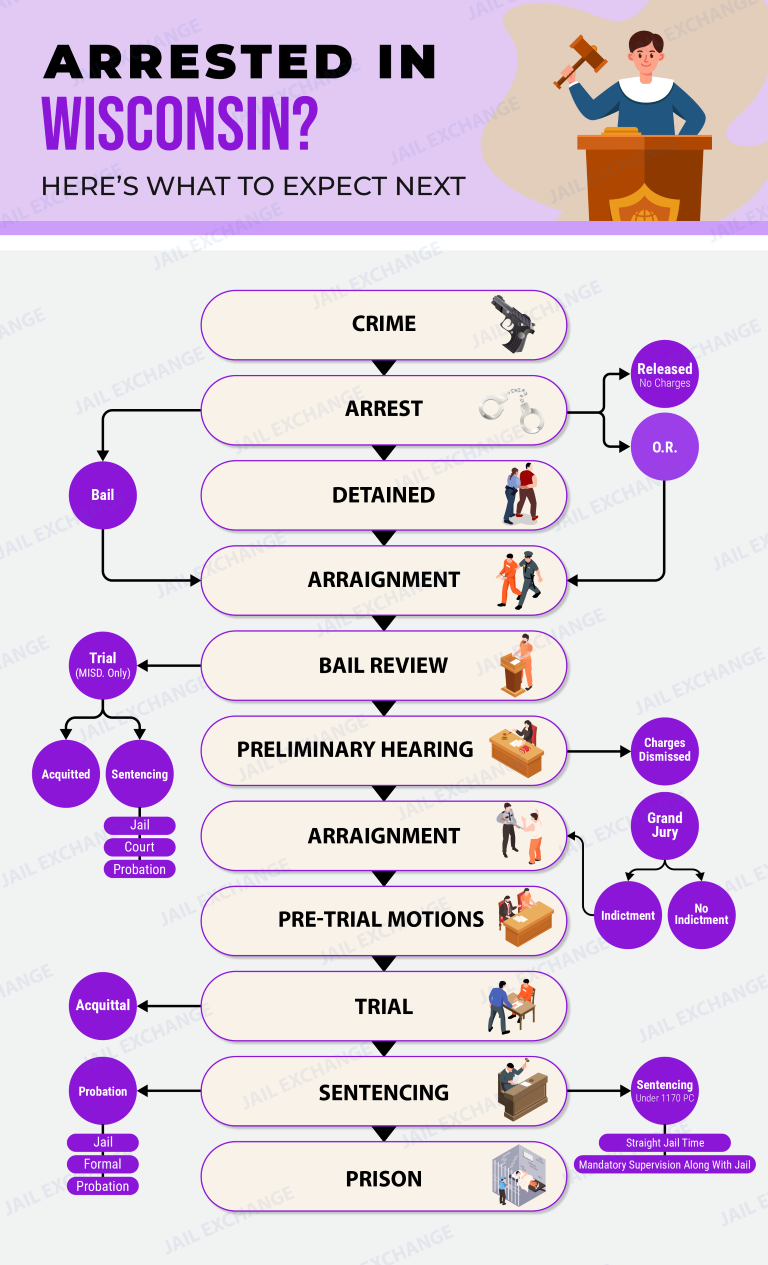
Deputies and city officers bring arrested adults to the Columbia County Jail in Portage for booking. A person facing only a misdemeanor is often released the same day with a citation or on a signature bond, which requires no money up front but may set an amount owed if a court date is missed. Arrests for domestic abuse work differently: officers are often required to make an arrest, and a released defendant may not contact the alleged victim or go to the shared home for 72 hours unless the victim waives that in writing. People who remain in custody appear before a judge or court commissioner, commonly by video and generally within 48 hours, and that official decides whether to release them on a signature bond or set cash bail, with conditions such as no drinking or no contact.
The court process
At the initial appearance in Portage, the defendant gets a copy of the complaint and enters a plea. The State Public Defender's Portage office, (608) 581-7770, screens applicants under a strict income and asset test; if someone fails that test but cannot actually afford a lawyer, the judge may appoint one at county expense. The prosecutor and defense lawyer then meet at pretrial conferences. A misdemeanor that goes to trial in Columbia County is decided by a six-person jury, and a defendant who makes a speedy trial demand generally must be tried within 60 days, subject to exceptions.
Sentencing ranges in the Columbia County Circuit Court
- Class A misdemeanors (battery, criminal trespass to a dwelling, theft of property worth $2,500 or less) can bring 9 months behind bars, a $10,000 fine, or both.
- Class B misdemeanors, including disorderly conduct, which is frequently charged with a domestic abuse modifier, carry up to 90 days and $1,000.
- Class C misdemeanors top out at 30 days in custody and a $500 fine in Portage.
- A second OWI within 10 years requires 5 days to 6 months in jail plus fines, revocation and an ignition interlock. A first OWI remains a forfeiture of $150 to $300 plus costs, with a 6- to 9-month revocation and a required assessment; an interlock is also ordered at a 0.15 test result or after a refusal. A fourth OWI is generally a felony.
Misdemeanor cases may end in dismissal, a deferred prosecution agreement, a fine, probation or jail, and a jail sentence is often served with Huber work-release privileges at the Columbia County Huber Center. Most cases in Portage close within two to six months.
Felony (for example, burglary, felony theft, drug possession with intent to deliver, substantial battery)
Columbia County felony cases often grow out of interstate traffic stops that turn up drugs, break-ins at lake cottages and rural properties, and thefts from tourist businesses near the Dells. Offenses alleged inside Columbia Correctional Institution, the state prison in Portage, may also be charged here.
The felony track
- Arrest and charging. The defendant is held at the Columbia County Jail while the District Attorney reviews reports and files a criminal complaint.
- First appearance. A judge or court commissioner explains the charges and sets bail, either a signature bond or cash with conditions. When the charge is a violent crime, the 2023 amendment to the Wisconsin Constitution permits the court to take the risk of serious harm into account in setting conditions and cash bail.
- Preliminary hearing. For a defendant held because bail has not been posted, this hearing generally must begin within 10 days, and within 20 days for others. The court decides only whether probable cause exists. Waivers are common.
- Information and arraignment. The prosecutor files an information, and the defendant enters a plea to it.
- Plea or jury trial. Negotiated pleas end most cases. A Columbia County felony jury has 12 members, and its verdict must be unanimous. A speedy trial demand generally requires a felony trial within 90 days, with exceptions.
What the example charges carry
- Burglary (Class F): up to 12.5 years and a $25,000 fine.
- Felony theft: Class I for more than $2,500 up to $5,000 (3.5 years, $10,000), Class H up to $10,000 (6 years, $10,000), and Class G above $10,000 (10 years, $25,000).
- Substantial battery (Class I): a Columbia County judge may impose as much as 3.5 years. Aggravated battery is Class H, or Class E (up to 15 years and $50,000) with intent to cause great bodily harm.
- Possession with intent to deliver: the class turns on the drug and its weight, from Class I for small amounts of some substances to Class C for large quantities of others. Class D offenses carry up to 25 years and $100,000.
Wisconsin's truth-in-sentencing law divides a prison term between initial confinement and extended supervision, with no parole for crimes committed after 1999, although a judge may make a person eligible for the Challenge Incarceration Program or Substance Abuse Program. Sentences shorter than a year are served in the county jail; longer ones in the Department of Corrections. Plan on six to twelve months for an ordinary felony case. The Public Defender's Portage office represents qualifying defendants, frequently through appointed private attorneys.
Violent felony (for example, homicide, sexual assault, armed robbery)
Violent felony charges are relatively uncommon in Columbia County, and the Sheriff's Office or a local department may call in the state Division of Criminal Investigation for a homicide. People charged with these crimes face the strictest release terms, and many stay in the Columbia County Jail for the life of the case because they cannot post the cash bail that is set.
Sentences under Wisconsin law
- First-degree intentional homicide: a Class A felony with a required sentence of life; at sentencing in Portage, the judge either sets the earliest date for extended supervision or rules out release altogether.
- Second-degree intentional homicide and first-degree reckless homicide: both Class B, meaning a Columbia County conviction can carry up to 60 years.
- First-degree sexual assault: Class B as well, with up to 60 years possible and mandatory minimum confinement for some offenses against young children.
- Armed robbery: Class C, so a conviction in Portage can mean 40 years and a $100,000 fine. Simple robbery is Class E.
There is no death penalty; Wisconsin abolished it in 1853, earlier than almost any other state.
What families should expect
The steps match the felony track, but expect one to two years before trial, given crime-lab analysis, expert testimony and motion hearings. In a county of Columbia County's size, defense counsel may raise whether an impartial jury can be found locally if a case has drawn heavy coverage. Marsy's Law, approved by Wisconsin voters in 2020, guarantees victims notice, the right to attend proceedings and an opportunity to be heard; the District Attorney's victim/witness program can be reached at (608) 742-9650. Defendants who qualify are represented through the State Public Defender, which typically assigns homicide cases to seasoned counsel.
Juveniles (under 17) arrested in Columbia County
Wisconsin's juvenile court covers children aged 10 through 16; in Columbia County, that means the circuit court in Portage hearing delinquency cases in confidential sessions. Anyone who is 17 at the time of the offense is treated as an adult and, if held, is booked into the Columbia County Jail.
Intake and charging
Police send juvenile referrals to the Columbia County Department of Health and Human Services, 111 E. Mullett Street, Portage, (608) 742-9227, where youth justice intake workers meet with the child and parents. Intake may close the referral, offer a deferred prosecution agreement or recommend that a delinquency petition be filed. The District Attorney makes the final charging decision.
Secure detention and the custody hearing
Columbia County does not run one of Wisconsin's secure juvenile detention centers. A youth who must be locked up is typically taken to a center in another county that accepts Columbia County youth, most often the Dane County Juvenile Detention Center in Madison; the intake worker tells the family where the child has been placed. A custody hearing generally has to be held within 24 hours of the decision to hold the youth, not counting weekends and legal holidays, and the judge or court commissioner then chooses between release home with conditions, a shelter or nonsecure placement, and continued detention. Every child charged with delinquency is entitled to a lawyer, assigned through the State Public Defender.
Possible results
- A closed referral, a deferred prosecution agreement or a consent decree, each of which can avoid a delinquency finding.
- Adjudication with supervision at home, restitution, community service, counseling or school conditions.
- Out-of-home care with relatives, a foster family, a group home or a residential treatment center arranged through Columbia County.
- For serious offenses, a Type 2 placement, a Type 1 commitment to Lincoln Hills School for boys or Copper Lake School for girls in Irma, or placement in the Serious Juvenile Offender program.
Adult prosecution of a youth
On the District Attorney's request, a juvenile judge may waive a youth 14 or older into adult court, and in narrow circumstances a younger one. Adult court has original jurisdiction, with no waiver hearing needed, when a child 10 or older is accused of attempted or first-degree intentional homicide, first-degree reckless homicide or felony murder, and also for some youths with a prior delinquency adjudication who are accused of specified new crimes. Juvenile records in Wisconsin are generally confidential.
Federal cases (U.S. District Court) from Columbia County
Columbia County falls in the Western District of Wisconsin, a federal district without separate divisions, so any federal charge from Portage, Lodi, Columbus or the Dells is filed and tried at the federal courthouse in Madison, about 40 miles south.
- Western District clerk's office, Room 320 of the federal courthouse at 120 North Henry Street, Madison (53703), (608) 264-5156
- U.S. Attorney for the Western District, prosecuting from Suite 700 at 222 West Washington Avenue in Madison, (608) 264-5158
- Federal Defender Services of Wisconsin, Madison staff at Suite 1000, 22 East Mifflin Street, (608) 260-9900; Criminal Justice Act panel lawyers are appointed when the office cannot take a case
- U.S. Pretrial Services and Probation for the Western District, Madison, (608) 264-5165
Which Columbia County cases become federal
Federal charges are the exception. They usually involve drug trafficking organizations using the interstate highways, firearm possession by people with disqualifying convictions, bank robbery, the online sexual exploitation of children, and fraud against banks, investors or federal programs. Columbia Correctional Institution in Portage is a state prison, so crimes there are state matters. Columbia County has no reservation; Ho-Chunk Nation trust lands are scattered across this part of Wisconsin, and because Wisconsin is a Public Law 280 state, crimes on tribal land here generally go to state court, unlike on the Menominee Reservation in the northeast.
Steps in a federal prosecution
A defendant arrested on a federal warrant in Columbia County is brought first to a U.S. magistrate judge in Madison, who reviews the charges and appoints counsel for anyone who cannot afford it. The federal courts do not deal with bail bondsmen. Instead, the magistrate applies the Bail Reform Act, choosing either release with conditions enforced by Pretrial Services or detention until trial, and the government's request for detention is typically argued at a hearing within three court days. A grand jury indictment is generally due within 30 days of an arrest on a complaint. The 70-day trial requirement of the Speedy Trial Act is commonly extended in complex cases. A jury of 12 must reach a unanimous verdict, but pleas resolve most cases.
For sentencing, the court relies on a presentence report prepared by a probation officer and applies the advisory federal Sentencing Guidelines and any mandatory minimum term. Without parole in the federal system, a prisoner from Columbia County serves around 85 percent of the sentence in Bureau of Prisons custody, then a period of supervised release. The Seventh Circuit, based in Chicago, decides appeals from the Western District. Federal charges against a Columbia County juvenile are rare.
Looking up a federal prisoner
Families can check the Federal Bureau of Prisons inmate locator, searching by name or register number, for a Columbia County resident in federal custody. If the person is being held before trial in a local jail that houses federal detainees under a U.S. Marshals agreement, that jail's own inmate roster may list the person too.
The information on this page describes criminal court procedure in Columbia County, Wisconsin, in general terms and is not legal advice; addresses, phone numbers and jail practices may change. For advice about a particular case, consult a Wisconsin-licensed criminal defense attorney. To apply for a public defender, ask jail staff or call the State Public Defender's Portage office at (608) 581-7770; to find out whether someone is being held, call the Columbia County Sheriff's Office at (608) 742-4166.