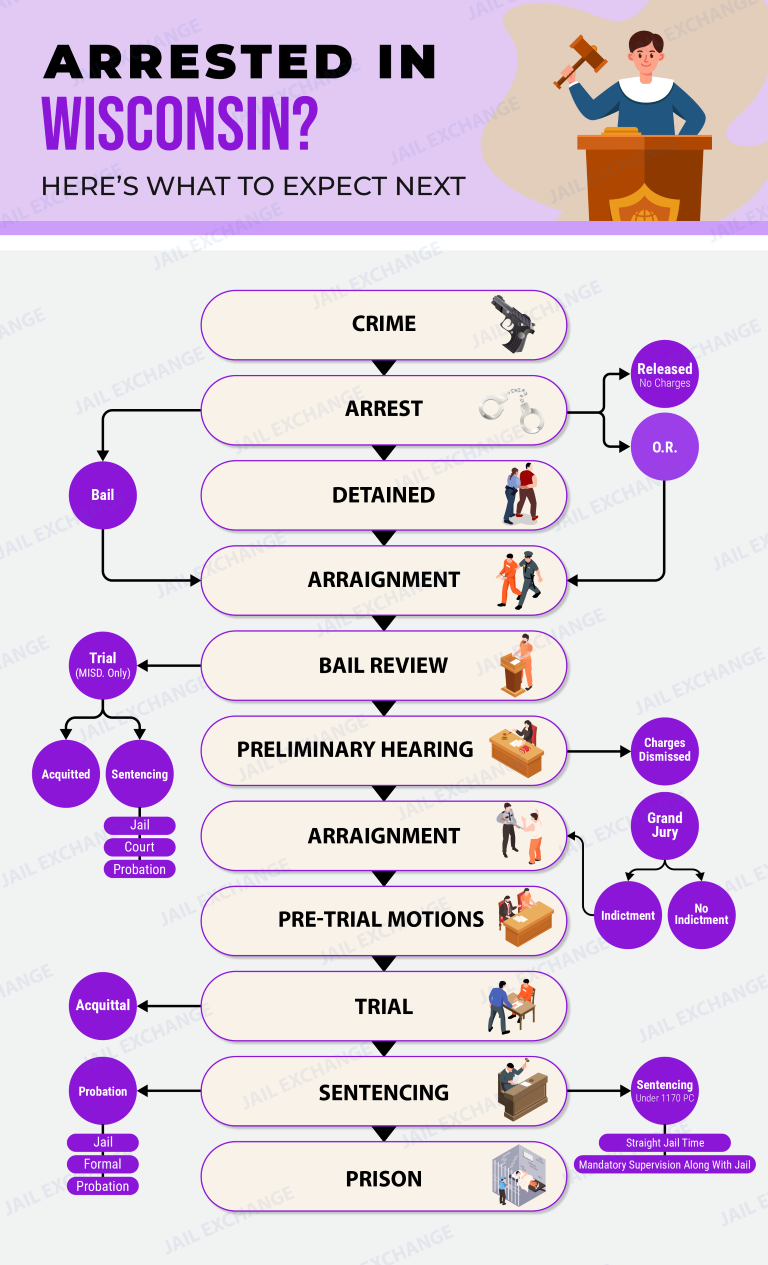
Milwaukee County Jail Criminal Court Process
Criminal Court Process for Milwaukee County Wisconsin
Milwaukee County has a large circuit court with 47 branches, and the courthouse is at 901 N. 9th Street, Milwaukee, WI 53233. Adults are booked at the Milwaukee County Jail, 949 N 9th Street, Milwaukee, WI 53233. Some people waiting for trial are moved to the Community Reintegration Center, 8885 S 68th Street, Franklin, WI 53132.
Look up a person in the Milwaukee County Inmate Search, the Sheriff's list of people held. For arrests, warrants, charges and mugshots, see our Milwaukee County Jail Roster page.
For criminal cases, the Clerk of Circuit Court answers at 414-278-4538. Ask about court dates by full name. If you want to free someone, our Milwaukee County bail page explains the payment window.
- Local courts in Milwaukee County (circuit court and municipal courts)
- The downtown court complex, the Children's Court Center and the 47 branches
- What happens after an arrest in Milwaukee County (booking, charging and intake court)
- The Milwaukee County Jail and the Community Reintegration Center
- The State Public Defender's Milwaukee offices
- The District Attorney, early intervention and diversion in Milwaukee County
- Milwaukee County treatment courts (drug, veterans, mental health)
- Misdemeanor (for example, theft, battery, disorderly conduct, a second OWI)
- Felony (for example, burglary, felony theft, drug possession with intent to deliver, substantial battery)
- Violent felony (for example, homicide, sexual assault, armed robbery)
- Juveniles (under 17) arrested in Milwaukee County
- Federal cases (U.S. District Court) from Milwaukee County
1. Local courts in Milwaukee County (circuit court and municipal courts)
Which court hears your case. A local ordinance ticket, or a first-offense OWI (a civil forfeiture in Wisconsin rather than a crime, unless a child under 16 was riding in the vehicle), is heard by the municipal court of the city or village where the stop happened; every municipality in Milwaukee County is served by one, so a first OWI on a City of Milwaukee street goes to the Milwaukee Municipal Court on North James Lovell Street, while one written by a Sheriff's deputy on a freeway or under a county or state citation is filed in the circuit court's traffic division. Misdemeanors and criminal traffic charges, a second OWI among them, go to the Milwaukee County Circuit Court, where a group of branches in the Misdemeanor/Traffic division (under the August 2025 rotation, Branches 5, 13, 31, 38, 41, 43 and 46) handle the calendar after the first hearing. Felonies stay in the circuit court from start to finish: the initial appearance and most preliminary hearings take place in the Safety Building and Criminal Justice Facility, and the case is then assigned to one of roughly 16 felony branches, some of which take only homicide and sexual assault cases, gun cases or drug cases. Judges rotate among divisions on a regular schedule, so the branch number on the court notice is the surest guide to the right courtroom.
Where pretrial inmates are held. Milwaukee County has two adult lockups. The Milwaukee County Jail, inside the Criminal Justice Facility at 949 N. 9th Street, is run by the Sheriff and is where every adult arrested in the county is booked and where most people charged with crimes wait for court. The Community Reintegration Center in Franklin, a separate county department led by a superintendent, mainly houses people serving county sentences of up to a year, including Huber work-release residents, but at the Sheriff's request it also holds some people awaiting trial; its maximum capacity is about 1,766 beds. Cash bail is posted for the person in custody, because Wisconsin bars commercial bail bondsmen. For booking, custody and release questions call the jail at (414) 226-7070, or the Community Reintegration Center at (414) 427-4700 if the person has been moved there.
- Milwaukee County Circuit Court, Milwaukee County Courthouse, 901 N. 9th Street, Milwaukee, WI 53233; Clerk of Circuit Court main office, Room 104, (414) 278-5362
- Clerk of Circuit Court, Criminal and Traffic Divisions, Safety Building, Room 117, 821 W. State Street, Milwaukee, WI 53233, (414) 278-4538
- Clerk of Circuit Court, Children's Division, Vel R. Phillips Juvenile Justice Center, Room 1530, 10201 W. Watertown Plank Road, Milwaukee, WI 53226, (414) 257-7700
- Milwaukee County District Attorney, Safety Building, Room 405, 821 W. State Street, Milwaukee, WI 53233, (414) 278-4646; Children's Court unit, 10201 W. Watertown Plank Road, (414) 257-7725
- Wisconsin State Public Defender, Milwaukee Trial Office, 819 N. 6th Street, Room 908, Milwaukee, WI 53203, (414) 227-4130
- Wisconsin State Public Defender, Milwaukee Youth/Mental Health Office, 10930 W. Potter Road, Suite D, Wauwatosa, WI 53226, (414) 266-1182
- Milwaukee County Sheriff's Office, Safety Building, Room 107, 821 W. State Street, Milwaukee, WI 53233, (414) 278-4700; non-emergency (414) 278-4788
- Milwaukee County Jail, Criminal Justice Facility, 949 N. 9th Street, Milwaukee, WI 53233, (414) 226-7070
- Community Reintegration Center (formerly the House of Correction), 8885 S. 68th Street, Franklin, WI 53132, (414) 427-4700
- Milwaukee County Department of Health and Human Services, Children, Youth and Family Services (juvenile court intake), at the Vel R. Phillips Juvenile Justice Center, 10201 W. Watertown Plank Road, Milwaukee, WI 53226; questions about a pending juvenile case can go to the Children's Division clerk at (414) 257-7700
- Vel R. Phillips Juvenile Justice Center (Milwaukee County's secure juvenile detention center), 10201 W. Watertown Plank Road, Milwaukee, WI 53226
- Milwaukee Police Department, Police Administration Building, 749 W. State Street, Milwaukee, WI 53233, non-emergency (414) 933-4444
- Suburban police departments: each of the other 18 municipalities has its own department, among them West Allis, Wauwatosa, Greenfield, Oak Creek, Franklin, South Milwaukee, Cudahy, St. Francis, Glendale, Brown Deer, Shorewood, Whitefish Bay, Fox Point, Bayside, River Hills, Greendale, Hales Corners and West Milwaukee; the Sheriff patrols the freeways, county parks and the airport
Cases that begin with a police contact in Milwaukee County land in one of two court systems. The Milwaukee County Circuit Court belongs to the statewide court system and hears all crimes plus many traffic forfeitures. The 17 municipal courts are created by local governments and decide only violations of city and village ordinances, which are civil cases that end in a forfeiture (a money penalty) rather than a criminal conviction. A municipal judge has no power to impose jail as a sentence; a stay in custody, or a driver's license suspension, can follow only when a forfeiture goes unpaid. Milwaukee County's circuit court takes jury trial requests and appeals coming out of these local courts, so in some circumstances a defendant can move an ordinance case to the circuit court, but the time limits are short and anyone considering it should read the citation and ask the municipal court clerk before the first court date.
Milwaukee County Circuit Court
- Milwaukee County Courthouse, 901 N. 9th Street, Milwaukee, WI 53233; Clerk of Circuit Court, Room 104, (414) 278-5362
- Criminal and Traffic Divisions, Safety Building, Room 117, 821 W. State Street, Milwaukee, WI 53233, (414) 278-4538 (also the line for refunds of cash bail)
- Children's Division, 10201 W. Watertown Plank Road, Room 1530, Milwaukee, WI 53226, (414) 257-7700
Municipal courts serving Milwaukee County communities
- Milwaukee Municipal Court (City of Milwaukee; three full-time judges), 951 N. James Lovell Street, Milwaukee, WI 53233, (414) 286-3800
- North Shore Municipal Court (joint court for the City of Glendale and the villages of Brown Deer and Bayside), 5909 N. Milwaukee River Parkway, Glendale, WI 53209, (414) 228-1752; some sessions have been held at Brown Deer Village Hall, 4800 W. Green Brook Drive, so check the location printed on the notice
- Cudahy Municipal Court (City of Cudahy), Cudahy City Hall, 5050 S. Lake Drive, Cudahy, WI 53110, (414) 769-2218
- Fox Point Municipal Court (Village of Fox Point), 7200 N. Santa Monica Boulevard, Fox Point, WI 53217, (414) 247-6637
- Franklin Municipal Court (City of Franklin), 9455 W. Loomis Road, Franklin, WI 53132, (414) 425-4768
- Greendale Municipal Court (Village of Greendale), 5911 W. Grange Avenue, Greendale, WI 53129, (414) 423-2127
- Greenfield Municipal Court (City of Greenfield), 5300 W. Layton Avenue, Greenfield, WI 53220, (414) 761-5366
- Hales Corners Municipal Court (Village of Hales Corners), 5635 S. New Berlin Road, Hales Corners, WI 53130, (414) 529-6145
- Oak Creek Municipal Court (City of Oak Creek), 301 W. Ryan Road, Oak Creek, WI 53154, (414) 766-7621
- River Hills Municipal Court (Village of River Hills), 7650 N. Pheasant Lane, River Hills, WI 53217, (414) 247-2302
- St. Francis Municipal Court (City of St. Francis), 3400 E. Howard Avenue, St. Francis, WI 53235, (414) 316-4315
- Shorewood Municipal Court (Village of Shorewood), 3930 N. Murray Avenue, 2nd floor, Shorewood, WI 53211, (414) 847-2617
- South Milwaukee Municipal Court (City of South Milwaukee), 2424 15th Avenue, South Milwaukee, WI 53172, (414) 762-2222, ext. 170
- Wauwatosa Municipal Court (City of Wauwatosa), 7725 W. North Avenue, Wauwatosa, WI 53213, (414) 471-8488
- West Allis Municipal Court (City of West Allis), 11301 W. Lincoln Avenue, West Allis, WI 53227, (414) 302-8181
- West Milwaukee Municipal Court (Village of West Milwaukee), 1345 S. 47th Street, West Milwaukee, WI 53214, (414) 645-5411
- Whitefish Bay Municipal Court (Village of Whitefish Bay), 5300 N. Marlborough Drive, Whitefish Bay, WI 53217, (414) 967-5125
The citation itself names the court, the date and the amount needed to pay it in full without appearing. A person who ignores a municipal citation can be found guilty by default, and an unpaid judgment can lead to a suspended driver's license or a commitment to jail until it is paid. People held on a state charge in the downtown jail who also have open municipal cases may need to contact the municipal court separately, because the two systems keep different records. Anyone held at the Milwaukee County Jail on a state case who cannot afford a lawyer should ask about the State Public Defender, which handles circuit court criminal cases but does not represent people in municipal ordinance cases.
2. The downtown court complex, the Children's Court Center and the 47 branches
Adult criminal court in Milwaukee County happens in three linked downtown buildings. The Milwaukee County Courthouse at 901 N. 9th Street, the large stone building facing MacArthur Square, holds the Clerk of Circuit Court's main office, the jury room and many misdemeanor and felony courtrooms. The Safety Building at 821 W. State Street holds the clerk's Criminal and Traffic Divisions in Room 117, the District Attorney's office, the Sheriff's administration and several felony courtrooms, including those assigned to homicide, sexual assault, gun and drug calendars. The Criminal Justice Facility at 949 N. 9th Street contains the Milwaukee County Jail and a small number of courtrooms, one of them used for the felony mental health calendar.
Juvenile delinquency cases are heard at the Children's Court Center inside the Vel R. Phillips Juvenile Justice Center, on West Watertown Plank Road near the county grounds in Wauwatosa. Eight branches were assigned to the Children's Division in the August 2025 roster, and the same campus houses the juvenile detention center, the District Attorney's Children's Court unit and county intake staff.
The 47 branches are grouped into divisions: felony, misdemeanor and traffic, children's, family and civil. The felony division has the most judges, about 16 in the 2025 roster, with specialty assignments for homicide and sexual assault cases, gun cases (one branch also takes cases from a regional drug-trafficking task force), drug cases and a mental health calendar. Seven branches handle misdemeanors and traffic crimes. Court commissioners, who are lawyers appointed by the judges, handle intake court, set release conditions, take many preliminary hearings and hear warrant returns. Because judges rotate to new divisions periodically, the branch number printed on the notice, not a judge's name, is what to look for on the courthouse directories.
Visitors pass through security screening at each building. Anyone who misses a court date on a misdemeanor can usually return to court in the afternoon on a weekday to see a court commissioner about the warrant; felony warrants are handled through the Sheriff's office in Room G-1 of the Criminal Justice Facility.
3. What happens after an arrest in Milwaukee County (booking, charging and intake court)
Booking. Milwaukee police officers, suburban officers and Sheriff's deputies bring adults they arrest to the Milwaukee County Jail on North 9th Street. Booking includes fingerprints, photographs, a property inventory, a records check for warrants and a medical and mental health screening. Some people arrested on minor matters are cited and released from the scene or the police district station instead, and receive a date to appear in court.
Charging. In Milwaukee County an arrest is not the same as a charge. Police present the case to an assistant district attorney at a charging conference, and the prosecutor decides whether to issue a criminal complaint, what to charge, whether to send the case to an early intervention program, or whether to decline it. A judge or court commissioner must find probable cause for a warrantless arrest within about 48 hours; if no charge is issued, the person is generally released, although charges can still be filed later.
Intake court and release conditions. Once a complaint is filed, the person in custody appears at the initial appearance, which in Milwaukee is held in an intake courtroom staffed by court commissioners, often with the defendant brought from the jail. The commissioner reviews the complaint, explains the charges and the right to a lawyer, and sets release conditions. Milwaukee uses pretrial screening with a risk assessment for most people in custody, and the results are shared with the court. Release can be on a signature bond, which is a promise to return with an amount owed only if the person fails to appear, or on cash bail, along with conditions such as no contact with an alleged victim, no possession of weapons, absolute sobriety, GPS or alcohol monitoring, or reporting to a pretrial supervision program.
Paying cash bail. Wisconsin law does not allow bail bondsmen, so the full cash amount must come from the defendant, family or friends and is posted at the jail or with the clerk. Money left after the case closes is refunded, usually within a few weeks, unless the judge applies it to fines, costs or restitution; questions about refunds go to the Criminal Division clerk at (414) 278-4538. Under a 2023 amendment to the Wisconsin Constitution, a judge setting cash bail for a person accused of a violent crime may consider the risk of serious bodily harm to the community, in addition to the risk that the person will not come back to court.
Domestic abuse arrests. Officers are generally required to arrest when they have probable cause to believe domestic abuse occurred and certain conditions are met. After release, the arrested person must avoid contact with the alleged victim for 72 hours unless the victim signs a waiver, and the release conditions set at intake usually extend a no-contact order for the life of the case.
4. The Milwaukee County Jail and the Community Reintegration Center
The Milwaukee County Jail, sometimes called the Criminal Justice Facility after the building that houses it, is operated by the Milwaukee County Sheriff's Office at 949 N. 9th Street. It holds people who have just been arrested, people waiting for charging decisions and most adults whose criminal cases are pending in the circuit court. Because it is connected to the Safety Building and courthouse, deputies can move people to their hearings without taking them outdoors. For whether someone is in custody, the charge, the bail amount or how to post it, call (414) 226-7070.
The Community Reintegration Center at 8885 S. 68th Street in Franklin was known for decades as the House of Correction. It is run by its own county department under a superintendent, not by the Sheriff. Most residents are serving sentences of up to one year per conviction from the Milwaukee County courts, often with Huber privileges that let them leave for work, school or treatment, and some are on electronic monitoring or GPS at home. The Sheriff can also ask the center to hold people who are awaiting trial, so a person charged in Milwaukee County may be moved there from the downtown jail. Its main number is (414) 427-4700.
Both facilities post rules for visits, money deposits, phone calls and mail. Confirm where the person is housed before traveling, since transfers between the two buildings are common.
5. The State Public Defender's Milwaukee offices
The Wisconsin State Public Defender has two trial offices for Milwaukee County. Adult criminal cases are handled by the Milwaukee Trial Office at 819 N. 6th Street, Room 908, (414) 227-4130. Cases in the Children's Court and mental health commitment cases go to the Milwaukee Youth/Mental Health Office at 10930 W. Potter Road, Suite D, Wauwatosa, (414) 266-1182.
Public defender staff screen many people at the Milwaukee County Jail before or at intake court, so a person in custody can ask for an interview there. People who are out of custody should contact the Milwaukee Trial Office as soon as they receive a summons or are released on bail, ideally before the next court date. The agency applies a strict financial test set by state law, looking at income, assets and household expenses; anyone whose application is approved receives a staff attorney or a private lawyer the agency appoints and pays. A person who earns too much to qualify under that test but still cannot hire a lawyer can ask the judge to appoint one at county expense, and the court decides those requests case by case. Applicants may later be billed for part of the cost of representation.
6. The District Attorney, early intervention and diversion in Milwaukee County
The Milwaukee County District Attorney's Office, the largest prosecutor's office in Wisconsin, works from Room 405 of the Safety Building at 821 W. State Street, (414) 278-4646, with a Children's Court unit at the Watertown Plank Road campus, (414) 257-7725. Assistant district attorneys are organized into teams by type of case, such as homicide, sexual assault, domestic violence, drugs, firearms and general crimes, and they decide what to charge, what release terms to request and what to offer in plea negotiations.
The office has run an early intervention effort for many years that sends some cases away from a standard prosecution. Two main tracks exist:
- Pre-charge diversion is aimed at people who score low risk on a validated screening tool and are not excluded by the type of offense. The person signs an agreement, with a lawyer, and must stay out of trouble and complete any required steps; on success no charge is filed.
- Deferred prosecution agreements apply after a charge, usually for people who score moderate to high risk and need treatment or supervision. The defendant must have counsel and sign the agreement; the case is put on hold, and if the terms are met the charge is dismissed or reduced. The arrest record remains even when the agreement is completed.
Many of these programs are partly paid for through the state's Treatment Alternatives and Diversion grants. Eligibility depends on the charge, criminal history, risk screening and the position of any victim, and the District Attorney's office makes the final offer. A defense lawyer can ask the prosecutor to consider a case for one of these tracks, and anyone held at the Milwaukee County Jail who is offered one should talk it over with counsel before signing, since a failed agreement can lead to a conviction on the original charge. Release conditions, including any bail, are often adjusted when a person enters one of these programs.
7. Milwaukee County treatment courts (drug, veterans, mental health)
Milwaukee County runs several treatment courts in which a judge, prosecutor, defense lawyer, case manager and treatment providers work together with participants over a period of many months. Participation is voluntary, requires agreement from the District Attorney's office, and usually involves frequent court check-ins, drug and alcohol testing, treatment and rewards or sanctions for progress or setbacks.
- Adult Drug Treatment Court, started in 2009, for people at moderate to high risk whose criminal behavior is tied to substance use. People may enter after a plea but before judgment, or as part of a sentence.
- Veterans Treatment Court, started in 2012, for veterans facing nonviolent charges connected to substance use or mental health needs, with volunteer veteran mentors.
- Mental Health Treatment Court, started in 2014, for people with serious and persistent mental illness, which can also serve as an alternative to revocation of probation.
Milwaukee County's published roster of treatment courts does not list a separate OWI court; repeat drunk-driving defendants are usually handled through the regular misdemeanor and felony branches, where judges commonly order assessments, interlock devices and alcohol monitoring, and some are considered for the drug court. A person in custody at the Milwaukee County Jail who wants to be screened should ask a defense lawyer to make a referral, because the coordinator's review usually takes a few weeks and bail or release terms may be adjusted while it happens.
8. Misdemeanor (for example, theft, battery, disorderly conduct, a second OWI)
Misdemeanors charged in Milwaukee County include retail theft from a Southridge or Bayshore store, battery, disorderly conduct (often with a domestic abuse modifier), criminal damage, resisting an officer and a second OWI. Many people arrested for these offenses are released after booking at the Milwaukee County Jail on a signature bond or with a summons, while others stay in custody until they reach intake court, which is usually within a day or two.
Maximum penalties that apply in Milwaukee County misdemeanor court:
- A Class A misdemeanor, such as theft of property worth $2,500 or less, simple battery or criminal trespass to a dwelling, can bring up to 9 months in jail, a fine as high as $10,000, or both.
- A Class B misdemeanor, such as disorderly conduct, carries as much as 90 days and a fine capped at $1,000.
- A Class C misdemeanor is limited to 30 days and a $500 fine.
- A second OWI within 10 years is a crime with a mandatory jail term that ranges from 5 days to 6 months, plus a fine, license revocation, an alcohol and drug assessment and an ignition interlock order. A first OWI, by contrast, is a civil forfeiture of $150 to $300 plus costs, with a 6- to 9-month revocation, unless a child under 16 was in the car. Third offenses are also misdemeanors with longer mandatory jail, and a fourth offense is generally a felony.
How the case moves. After the initial appearance in intake court, the case is assigned to a misdemeanor branch at the courthouse. The next stage is usually a pretrial conference where the prosecutor and defense lawyer discuss a resolution. The defendant can plead guilty or no contest, ask for a bench trial, or demand a jury of 6. A defendant who formally demands a speedy trial is generally entitled to trial within about 60 days in a misdemeanor case, though delays the defense asks for are not counted.
Outcomes. Results range from dismissal or a deferred prosecution agreement to fines, probation supervised by the state Department of Corrections, or jail. A Milwaukee County jail sentence is often served at the Community Reintegration Center in Franklin, frequently with Huber privileges for work or treatment, and some people serve part of it on electronic monitoring if the sheriff or superintendent allows. Most misdemeanor cases are finished in two to six months. A State Public Defender lawyer from the Milwaukee Trial Office, (414) 227-4130, can represent anyone who qualifies.
9. Felony (for example, burglary, felony theft, drug possession with intent to deliver, substantial battery)
Felony arrests in Milwaukee County often involve stolen cars, burglary, illegal firearm possession, drug dealing, fleeing an officer, substantial battery or theft above $2,500. People arrested for these offenses are usually held at the Milwaukee County Jail until a prosecutor issues a complaint and a court commissioner sets cash bail or other release terms in intake court.
Milwaukee County felony sentence limits by class:
- Class C: up to 40 years in prison and a fine of up to $100,000.
- Class D: no more than 25 years and $100,000.
- Class E: up to 15 years and as much as $50,000 (robbery and some aggravated batteries fall here).
- Class F: as long as 12.5 years and $25,000; burglary of a building or dwelling is a Class F felony.
- Class G: up to 10 years and $25,000, which applies to theft of property worth more than $10,000.
- Class H: up to 6 years and $10,000, covering theft between $5,000 and $10,000 and some aggravated batteries.
- Class I: up to 3.5 years and $10,000, which includes substantial battery and theft over $2,500 up to $5,000.
For possession with intent to deliver, the class depends on the drug and the weight; fentanyl, heroin and cocaine cases climb steeply with the amount involved, and dealing near a school, park or public housing can add penalties.
The steps. The District Attorney files a criminal complaint and the defendant has an initial appearance in intake court. A preliminary hearing must be held within 10 days if the person is in custody and cannot post bail, or within 20 days if not; in Milwaukee it is often held before a court commissioner, and the defense frequently waives it, sometimes as part of a negotiation. If the commissioner finds probable cause, or the hearing is waived, the prosecutor files an information and the defendant is arraigned and enters a plea, after which the case goes to an assigned felony branch for pretrial conferences, motions and plea talks. Most cases end with a plea agreement; those that go to trial are decided by a 12-person jury that must agree unanimously. Grand juries are almost never used, though a judge can conduct a John Doe proceeding in rare investigations. A felony speedy trial demand generally requires trial within about 90 days, subject to delays the defense causes.
Sentencing. Wisconsin's truth-in-sentencing law splits a prison term into initial confinement and extended supervision, with no parole for crimes committed after 1999. A judge can find someone eligible for earned release programs such as the Challenge Incarceration Program or the Substance Abuse Program. Probation is common for first felony convictions, often with conditional jail time served locally; terms longer than a year go to a state prison run by the Department of Corrections. A felony in Milwaukee County typically takes six to twelve months to resolve, longer when the defendant is out of custody.
10. Violent felony (for example, homicide, sexual assault, armed robbery)
Milwaukee County assigns homicide and sexual assault prosecutions to a small group of felony branches in the Safety Building, and the District Attorney's office staffs them with specialized prosecutors and victim-witness advocates. People charged with these crimes nearly always remain at the Milwaukee County Jail throughout the case unless they can post a high cash bail; under the 2023 constitutional change, the court may weigh the danger of serious harm to the public when setting that amount for violent charges.
Penalties a Milwaukee County judge can impose for the most serious charges:
- First-degree intentional homicide (Class A): a mandatory life sentence, with the judge deciding whether the defendant can ever petition for release to extended supervision and, if so, after how many years.
- Second-degree intentional homicide and first-degree reckless homicide (each Class B): up to 60 years. First-degree reckless homicide is frequently charged in fatal drug overdose cases, where the person accused of supplying the drug is prosecuted.
- First-degree sexual assault (Class B): up to 60 years; offenses against young children can carry mandatory minimum prison terms.
- Armed robbery, such as a gas station or phone store holdup with a gun (Class C): a prison term as long as 40 years; a robbery committed without a dangerous weapon drops to Class E.
Wisconsin abolished the death penalty in 1853. Federal charges, which are separate, are covered later on this page.
What to expect. The case follows the felony path described above, but with more evidence, more expert witnesses and more pretrial motions, so the time from charge to trial or plea is usually one to two years. Victims have rights under Marsy's Law, the 2020 amendment to the Wisconsin Constitution, including the right to be notified of hearings, to be heard at release and sentencing decisions and to have their privacy respected. Sentences for these crimes are served in state prison, with extended supervision after release. Public defender lawyers from the Milwaukee Trial Office, (414) 227-4130, often handle homicide and sexual assault cases, and the agency also appoints experienced private lawyers when there is a conflict.
11. Juveniles (under 17) arrested in Milwaukee County
Wisconsin's juvenile courts take delinquency cases for children aged 10 through 16. A 17-year-old arrested anywhere in Milwaukee County is treated as an adult: booked into the Milwaukee County Jail, charged by the District Attorney, and taken through intake court like anyone else, with release terms such as bail set the same way.
Intake. When a younger child is taken into custody, the police contact juvenile intake workers with the Milwaukee County Department of Health and Human Services, Children, Youth and Family Services, whose staff work at the Vel R. Phillips Juvenile Justice Center on West Watertown Plank Road. Intake decides whether the youth goes home to a parent, goes to a non-secure placement or shelter, or is held in secure detention at the same campus. Intake can also close a case, arrange an informal agreement called a deferred prosecution agreement, or refer it to the District Attorney's Children's Court unit, which decides whether to file a delinquency petition.
Custody hearing. If a child is kept in detention, a judge or court commissioner must generally hold a custody hearing within 24 hours after the intake decision, not counting weekends and legal holidays, to decide whether continued custody is necessary. The child has a right to a lawyer; the State Public Defender's Milwaukee Youth/Mental Health Office, (414) 266-1182, represents most juveniles regardless of family income.
Court and outcomes. Delinquency cases are heard by the Children's Division branches at the same complex. After a plea hearing and, if contested, a fact-finding hearing decided by a judge rather than a jury, outcomes can include a consent decree, which suspends the case under conditions; supervision at home; community service, restitution and counseling; placement in a foster home, group home or residential center; Type 2 placement under county supervision; or, for serious cases, commitment to the state's Type 1 secure facilities, Lincoln Hills School for boys and Copper Lake School for girls in Irma. Milwaukee County has worked to reduce its use of the state schools and runs a secure residential program for some committed youth on the Watertown Plank Road campus. The Serious Juvenile Offender Program is available for the gravest offenses and can last up to five years. Juvenile records are generally confidential.
Adult court. The District Attorney can ask a judge to waive a case into adult court for a child 14 or older, and for certain very serious offenses for some younger children; the judge considers the child's history, the seriousness of the offense and the services available in the juvenile system. Adult court also has original jurisdiction, without a waiver, when a child aged 10 or older is accused of attempted or first-degree intentional homicide, first-degree reckless homicide or felony murder, and when a juvenile who has already been adjudicated delinquent is accused of certain additional crimes.
12. Federal cases (U.S. District Court) from Milwaukee County
Milwaukee County lies in the Eastern District of Wisconsin, and federal crimes from the county are prosecuted in the district's Milwaukee Division at the U.S. Courthouse, 517 E. Wisconsin Avenue, about a mile east of the county courthouse; the clerk's office is at (414) 297-3372. Milwaukee is the district's headquarters, and the division also takes cases from 11 other southeastern and central Wisconsin counties.
When a case becomes federal. Federal prosecutors in Milwaukee most often charge drug trafficking (frequently fentanyl and cocaine investigations by multi-agency task forces), firearm possession by people with felony convictions or other prohibited persons, carjacking, bank robbery, child exploitation, wire, bank and health care fraud, and violent crime tied to gangs. Many federal gun cases begin as Milwaukee police arrests that are referred for federal review, and the same conduct can sometimes be charged in either court system. Offenses at federal property, such as the Clement J. Zablocki VA Medical Center on West National Avenue, may also be prosecuted federally. The Forest County Potawatomi Community holds trust land in the Menomonee Valley, where its casino operates, but because Wisconsin has Public Law 280 jurisdiction, state courts generally handle crimes committed there.
Who prosecutes and defends. The U.S. Attorney's Office for the Eastern District of Wisconsin is in the same building, 517 E. Wisconsin Avenue, Suite 530, (414) 297-1700. People who cannot pay a lawyer are represented by Federal Defender Services of Wisconsin, whose Milwaukee office is at 411 E. Wisconsin Avenue, Suite 2310, or by a private lawyer from the court's Criminal Justice Act panel when the defender has a conflict. U.S. Probation and Pretrial Services is in Room 001 of the courthouse, (414) 297-1425.
The process. After a federal arrest the defendant sees a U.S. magistrate judge for an initial appearance. When prosecutors seek to keep the defendant locked up, the detention hearing normally follows within three court days. Federal judges in Milwaukee do not set money bail the way state commissioners do; under the Bail Reform Act they either release the person on conditions monitored by Pretrial Services or order detention until trial. A case started by complaint must be followed by a grand jury indictment within 30 days, and the Speedy Trial Act sets a 70-day trial clock that is regularly extended. Most federal defendants plead guilty, often under a written plea agreement; trials use a 12-person jury that must be unanimous. Before sentencing, a probation officer writes a presentence report, and the judge considers the advisory Sentencing Guidelines along with any mandatory minimum, such as those in many drug and firearm statutes. There is no parole in the federal system, and prisoners serve roughly 85 percent of the sentence in the Bureau of Prisons before supervised release. A Milwaukee federal conviction is appealed to the Seventh Circuit, the federal appeals court in Chicago that also hears cases from Illinois and Indiana.
Finding a federal prisoner. To learn where a person charged in the Milwaukee federal courthouse is held or serving time, search the Federal Bureau of Prisons inmate locator by name or BOP register number. A federal defendant awaiting trial in a Wisconsin county jail that houses detainees for the Marshals may be listed on that county's own roster too. Federal charges against juveniles are rare and are usually referred to the state system.
This Milwaukee County guide is general information, not legal advice, and court assignments, phone numbers and procedures change. For a specific case, speak with a lawyer; to ask about a public defender, call the State Public Defender's Milwaukee Trial Office at (414) 227-4130 (or the Youth/Mental Health Office at (414) 266-1182 for juvenile cases), and for custody questions call the Milwaukee County Jail at (414) 226-7070.